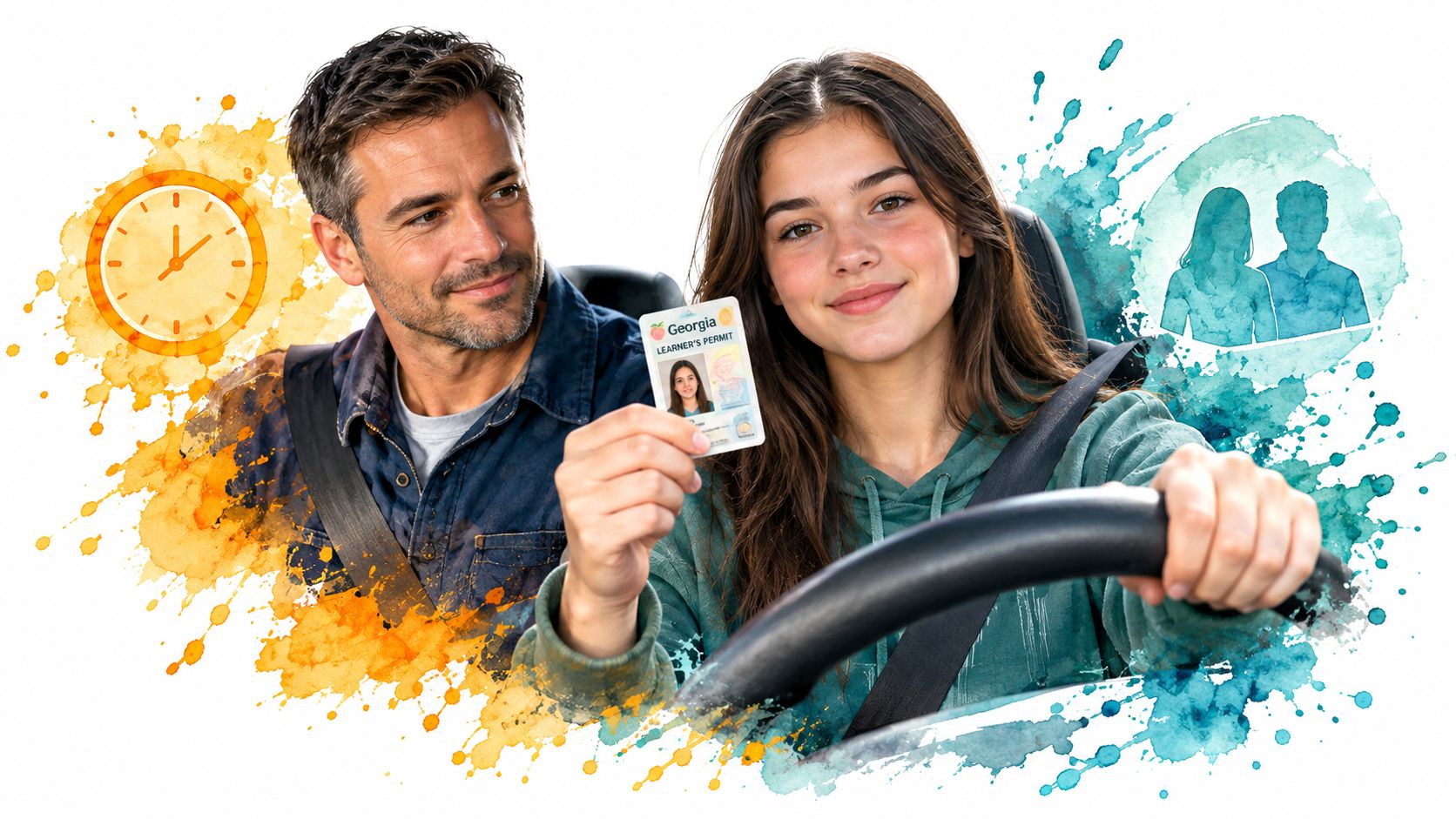
You've just passed the Georgia knowledge test, received your learner's permit, and your family is already discussing the first drive to school. Before anyone starts the engine, make sure everyone understands the rules for driving with a permit in GA. A Georgia Class CP instructional permit is a supervised learning credential, not permission to drive alone. The safest approach is to treat every practice trip as a planned lesson, with the right adult in the front seat and a clear goal for the drive.
Getting Your Georgia Learner's Permit
A teen leaves the DDS with a Class CP instructional permit and feels ready to drive. The next question is usually, “Can I take the car by myself now?” Under Georgia's standard permit rules, the answer is no. The permit allows practice only when a qualified supervising driver is seated beside the teen and can take control if necessary.
Georgia requires permit applicants to be at least 15 years old, pass a vision exam and knowledge exam, and have a parent, guardian, or authorized driver-training instructor sign the application. The state's Georgia learner's permit application guidance also explains that the vehicle and supervising driver must meet specific requirements.
The permit is a learning tool, not a solo-driving license.
Parents and teens should agree on this before the first practice trip. The permit holder may drive only with an accompanying adult who is at least 21 years old, has the appropriate valid license, sits next to the driver, and can physically take control of the vehicle. That means a qualified adult in the back seat doesn't satisfy the standard supervision rule.
Start with a clear practice routine
The first drives should have a simple purpose. A parent might begin with vehicle controls and quiet residential streets, then introduce turns, stopping at intersections, lane positioning, and parking. The adult should give directions early, keep the conversation calm, and avoid treating the permit as permission to run errands independently.
Families can review the documentation, testing steps, and permit restrictions in this Georgia driver's permit requirements guide. The more clearly everyone understands the boundaries, the less likely a teen is to assume that a familiar destination creates an exception.
Plan around the licensing timeline
A Class D provisional license generally requires the teen to be 16 or 17 years old, hold the Class CP permit for at least 1 year and 1 day, pass a road skills test, and surrender the permit at testing. Georgia also requires anyone under 18 to satisfy Joshua's Law driver-training requirements before moving to Class D, as explained by the Georgia Department of Driver Services teen driving laws.
That holding period should shape the family's plan from the beginning. Use the permit phase to complete education, build varied driving experience, record practice hours accurately, and address weak areas before the road test. Passing the written exam is an important first milestone, but it isn't the end of the licensing process.
Supervised Driving Requirements and Edge Cases
The most important day-to-day rule is straightforward: a Georgia permit holder can't drive without a qualified adult beside them. The accompanying driver must be at least 21, hold a valid Class C license, sit in the front passenger seat, and be physically capable of taking control of the vehicle. The DDS learner's permit rules treat this as a supervision requirement, not a suggestion.
That seating position matters. A supervising adult needs to see traffic, monitor mirrors and lane position, respond to hazards, and intervene quickly if the teen brakes late or begins a turn incorrectly. A front-seat adult can provide immediate guidance during merging, busy intersections, lane changes, and unfamiliar roads. Someone following in another car can't provide the same real-time support.
Common destinations don't create a permit exception
Families often ask whether a teen can drive alone to school, a job, a driver education class, sports practice, or a nearby store. Under the standard Georgia instructional permit framework, the teen still needs the qualified supervising adult beside them. Familiarity with the route doesn't change the permit rule.
The practical distinction is important:
- Driving to school: A teen can't make the trip alone just because the school is nearby or the route has been practiced.
- Driving to work: A job schedule doesn't replace the required adult supervision.
- Driving to driver education: The teen needs a qualified accompanying driver unless a different permit category or official authorization specifically applies.
- Practicing in a parking lot: The adult must still meet the supervision requirements, even when traffic is limited.
- Changing seats: The supervising driver should remain beside the teen, not supervise from the rear seat.
Some permit categories can carry purpose-specific restrictions, which is one reason families shouldn't assume that a rule for another category applies to a standard Class CP permit. The Georgia DDS licensing and permit information is especially relevant for families who have recently moved to the state, because new residents must obtain a Georgia permit or license within 30 days.
Make supervision active
A supervising adult should know the route and decide what the teen is practicing before leaving. One drive might focus on smooth stops, while another works on blind-spot checks, left turns, or merging. If the teen becomes overwhelmed, the adult should give a clear instruction and take control when needed, rather than waiting for the situation to become dangerous.
Put the practice goal before the destination. The trip should help the teen learn a skill, not just get somewhere.
Understanding the TADRA Timeline and Restrictions
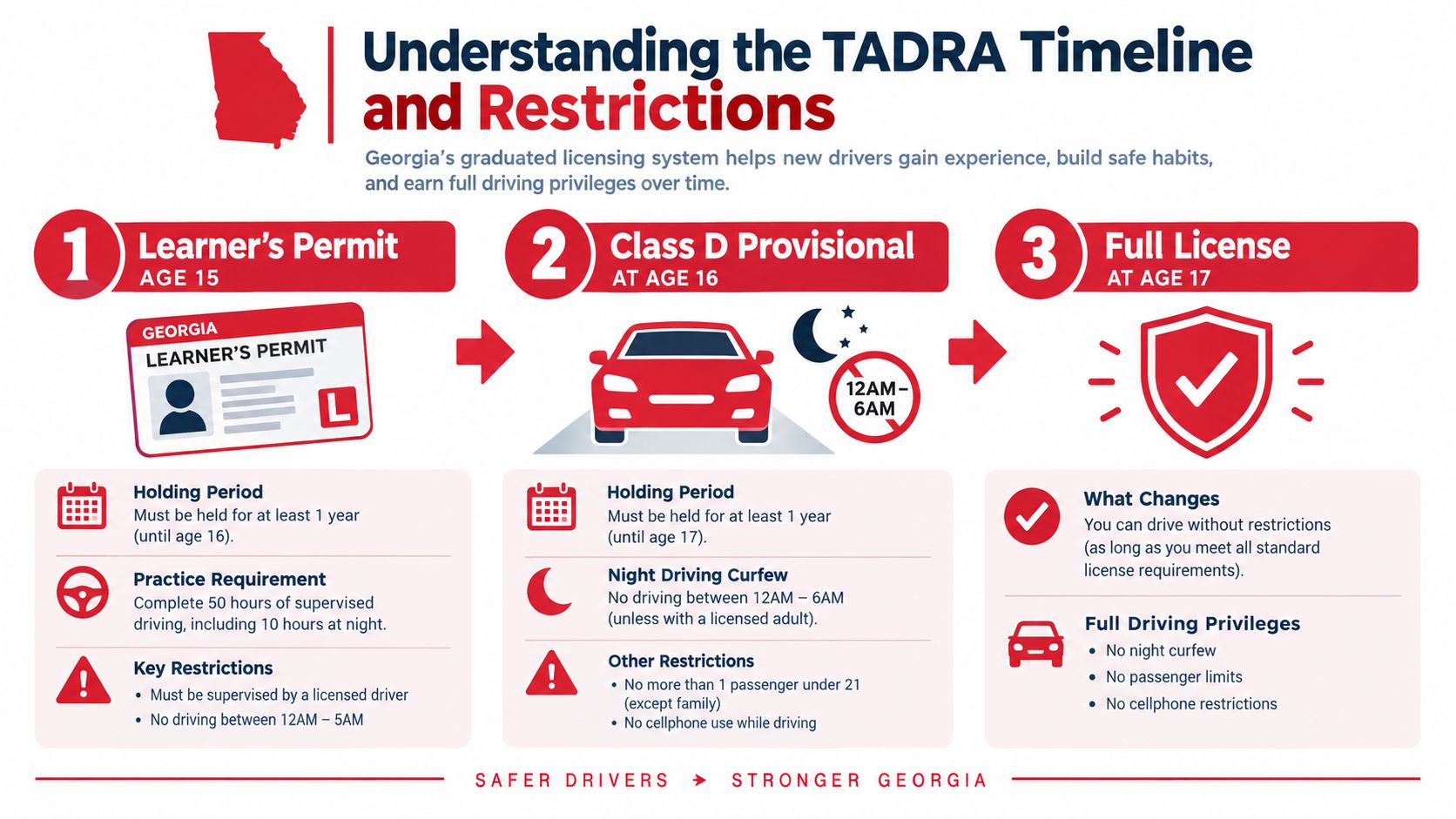
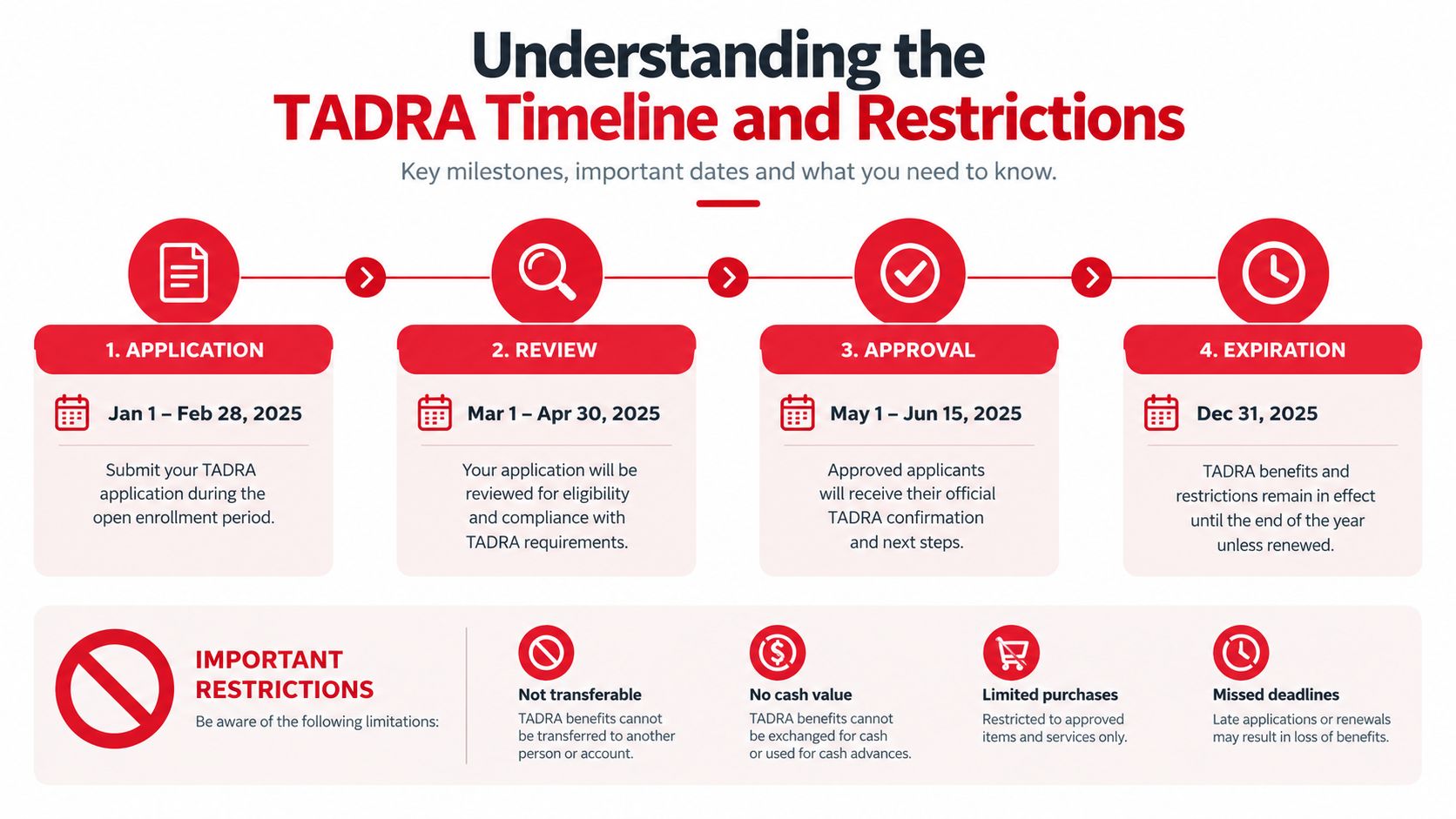
Georgia's teen licensing system has operated as a three-phase graduated driver licensing program since 1997 under the Teenage and Driver Responsibility Act, commonly called TADRA. The structure moves a teen from supervised learning to limited independent driving, then toward fewer restrictions as the teen gains experience and meets the state's requirements.
The permit stage is the foundation. A teen who holds a Class CP permit must continue supervised practice and meet the required education and experience conditions before taking the next step. The permit must be held for 1 year and 1 day before the teen can qualify for the Class D road test, so finishing another requirement early doesn't eliminate the holding period.
Class D restrictions change over time
After a teen earns a Class D provisional license, Georgia applies restrictions that ease in stages. The DDS Class D license rules identify the following limits:
| Class D period | Passenger restriction |
|---|---|
| First 6 months | No non-immediate-family passenger |
| Second 6 months | One non-family passenger under 21 |
| After 1 year | Up to three non-family passengers under 21 |
The state also prohibits Class D driving between 12:00 a.m. and 5:00 a.m. These limits apply after the teen moves beyond the permit stage. They don't give a permit holder permission to drive independently during the day.
The passenger schedule reflects a gradual increase in responsibility. A newly licensed teen has less independent driving experience, so limiting passengers can reduce social distractions. Later, the permitted number expands, but the driver still needs to follow the applicable restrictions and make sound decisions about who rides along.
Use the permit year productively
A long holding period can feel frustrating, especially when a teen has already passed the written test. In practice, it gives families time to turn short practice trips into varied experience. A teen can work from quiet streets toward urban traffic, complex intersections, merging, parking, and safe nighttime practice with a qualified adult.
Review the meaning of TADRA and its role in Georgia licensing before setting a target test date. Mark the permit issue date, calculate the earliest eligible testing date, and schedule education and lessons early enough to avoid a last-minute rush.
Meeting Joshua's Law Education Requirements
For a 16- or 17-year-old seeking a Georgia Class D license, Joshua's Law connects classroom education with supervised and professional driving experience. The education portion includes 30 hours of driver education and 6 hours of behind-the-wheel instruction, with options for the theoretical instruction in a classroom or through a DDS-approved online course. Georgia DDS describes these alternatives in its Joshua's Law driver education information.
That flexibility helps families choose a format that fits school, work, athletics, and transportation needs. An in-person class can provide a fixed schedule and direct classroom interaction. An approved online course can give a student more control over when the theoretical material is completed. Whichever format a family chooses, it should be approved for the relevant Georgia requirement.
Separate education from practice
The 30-hour course teaches rules, decision-making, traffic awareness, and the knowledge needed before independent driving. It doesn't replace the experience gained in the vehicle. Likewise, parent-supervised practice doesn't replace the required professional instruction.
Georgia's licensing information states that the approved education course must include either 30 hours of classroom instruction or an equivalent online course, plus 6 hours of on-the-road experience with a certified instructor or completion of the DDS-approved Parent/Teen Driver Guide. The DDS general licensing information explains how these pieces fit into the Class D process.
A-1 Driving School offers instructor-led and online driver education options, along with behind-the-wheel training and road test preparation. Families should confirm that the selected course and training path satisfy the applicable DDS requirements before enrolling.
Check grant eligibility
Georgia also provides a Driver's Education Grant Scholarship Program for residents ages 15 through 17 who hold a valid Georgia instructional permit or driver's license. The program is intended to cover the Joshua's Law training requirement of 30 hours of classroom instruction and 6 hours of behind-the-wheel instruction, subject to the state program's rules and application process. Details about eligibility and application priorities are available through the Georgia Driver's Education Grant Scholarship Program.
The program gives priority to applicants who are children or dependents of public safety professionals or military members killed in the line of duty. Second priority is based on family-income need. Families should apply early, gather the requested documentation, and ask the participating school how grant-funded enrollment is handled.
Logging Hours and Professional Driving Lessons
A teen needs both supervised practice and professional instruction. Georgia requires 40 hours of supervised driving, including 6 hours at night, for the Class D process. Joshua's Law also requires 6 hours of behind-the-wheel instruction with a certified instructor or the approved parent-taught alternative described by DDS, as set out in the Georgia driver education FAQ.
These categories shouldn't be blended together in the family's records. Parent-supervised hours show that the teen has practiced over time. Professional lessons provide structured coaching, consistent evaluation, and an opportunity to correct habits before they become automatic.
Keep the driving log useful
A driving log should do more than accumulate a total. Record the date, route or practice area, skills covered, conditions, and the adult who supervised the drive. A teen who has practiced only quiet neighborhood turns may still need experience with heavier traffic, lane changes, parking, and complex intersections.
Families can use this Georgia driving practice log to keep the record organized. Include nighttime practice as a distinct goal, because the required nighttime experience must be planned rather than assumed. Practice should remain appropriate to the teen's current ability and the weather and traffic conditions.
Why professional lessons add value
Parents know their teen and can provide regular access to a vehicle. They may also have driving habits that they no longer notice, such as checking mirrors inconsistently, braking late, or positioning the vehicle too close to a lane line. A certified instructor brings an outside evaluation and can break down a maneuver into repeatable steps.
A-1 Driving School provides customized driving lesson packages, flexible scheduling, and training at 18+ metro Atlanta locations, making it possible to arrange instruction around a family's routine. A package may be useful when a student needs several focused sessions rather than a single introductory drive. The instructor can target vehicle control first, then build toward traffic judgment and road test skills.

Parents should continue supervising practice after professional lessons. The instructor can identify what to work on, while the family provides repetition between sessions. That combination helps the teen develop confidence without treating confidence as a substitute for careful observation.
Preparing for and Passing the Georgia Road Test
The road test is the point where the teen must demonstrate control, observation, and safe decision-making in real traffic. Georgia requires a Class D applicant to pass a road skills test, and the applicant must surrender the instructional permit at testing. The test should be scheduled only after the permit holding period, education requirements, supervised practice, and professional instruction are complete.
Begin preparation with the fundamentals. The teen should be able to adjust the vehicle, check mirrors, signal in advance, maintain lane position, control speed, stop smoothly, and manage intersections without constant prompting. Practice should also include backing, turns, parking, lane changes, and blind-spot checks.
Use a final readiness check
A parent or instructor can sit during a mock test and note whether the teen:
- Observes consistently: Checks mirrors and blind spots before changing direction.
- Controls the vehicle smoothly: Accelerates, brakes, steers, and stops without abrupt corrections.
- Communicates clearly: Uses signals correctly and makes intentions predictable to other road users.
- Reads the roadway: Responds to signs, traffic signals, pedestrians, lane markings, and changing traffic.
- Maintains composure: Recovers from a minor mistake without rushing into another one.
Don't wait until test day to discover that the teen has practiced only on familiar roads. Use different intersections and traffic patterns, while keeping the route and conditions appropriate for the student's ability. A calm, repeatable routine usually produces better performance than an intense practice session immediately before testing.
Consider the testing arrangement
Families can take the road test through DDS or ask about authorized testing services offered by a qualified driving school. A-1 Driving School provides Georgia road test preparation and testing assistance, so families can ask which options are available at their chosen location and what the selected package includes.
The vehicle matters as well. The teen should know the car's controls, understand how to use the signals and lights, and confirm that the vehicle is ready for testing. Familiarity reduces avoidable distractions, but it doesn't replace preparation.
The following video can help families review the broader process and discuss what the teen needs to practice before scheduling the test.
On test day, arrive prepared, focused, and with the required documentation. If the teen isn't ready, postponing the test is better than treating the appointment as a practice drive. The objective is to demonstrate safe, independent vehicle operation while meeting Georgia's licensing requirements.
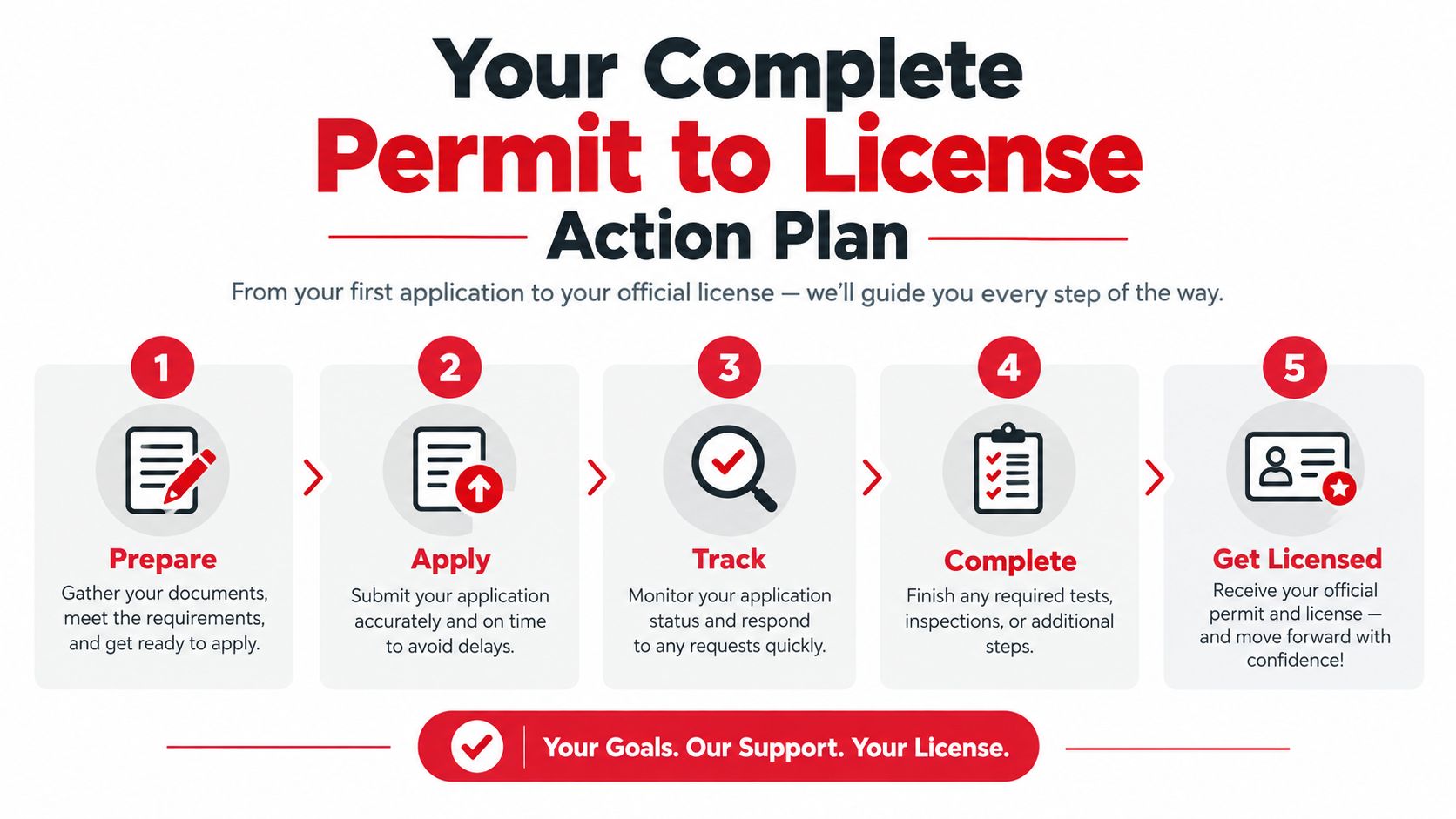
Your Complete Permit to License Action Plan
A successful transition from permit to Class D license depends on sequence and organization. The teen first earns the Class CP permit, then uses the supervised period to complete education, practice consistently, record the required experience, and prepare for the road skills test.
Keep this working checklist where both the teen and parent can review it:
- Earn the permit: Meet the age, vision, knowledge exam, and application-signature requirements.
- Set up legal supervision: Practice only with an eligible adult seated beside the driver.
- Complete Joshua's Law education: Finish the approved 30-hour classroom or online course and the required behind-the-wheel education.
- Build supervised experience: Record 40 hours, including 6 nighttime hours, in an organized practice log.
- Hold the permit long enough: Wait at least 1 year and 1 day before taking the Class D road test.
- Prepare for testing: Practice vehicle control, observation, intersections, lane changes, parking, and decision-making.
- Pass the road test: Bring the required materials and surrender the permit when testing, as required.
The permit year isn't wasted time. It gives a teen repeated opportunities to turn classroom knowledge into safe habits, while parents and instructors can identify problems before the road test. A clear schedule also helps families avoid the common mistake of completing education or practice hours but overlooking the required permit holding period.
A-1 Driving School offers Georgia Joshua's Law courses, online driver education, customized driving lesson packages, permit-to-license guidance, and road test preparation and testing assistance. Visit A-1 Driving School to compare course options, explore driving lessons, and book the training your teen needs to move from supervised practice toward a Class D license.