You've just been in a crash. Your hands are shaking, traffic is moving around you, and your brain is trying to do ten things at once. That's exactly when simple accident response procedures matter most.
For new Georgia drivers, especially teens, the hardest part isn't only staying calm. It's knowing what to do in the right order. Many general accident guides stop at “call 911 and exchange insurance.” They don't explain the evidence-preservation issues that can affect a claim, or the reporting rules that can matter if you're driving under Joshua's Law.
A good response is steady, not rushed. Protect people first. Preserve the scene as carefully as you can. Then handle the reporting, medical follow-up, and insurance steps in a way that keeps small mistakes from turning into bigger problems.
Immediate Actions at the Accident Scene
The first minute after a collision feels chaotic. Keep your next decisions small and practical.
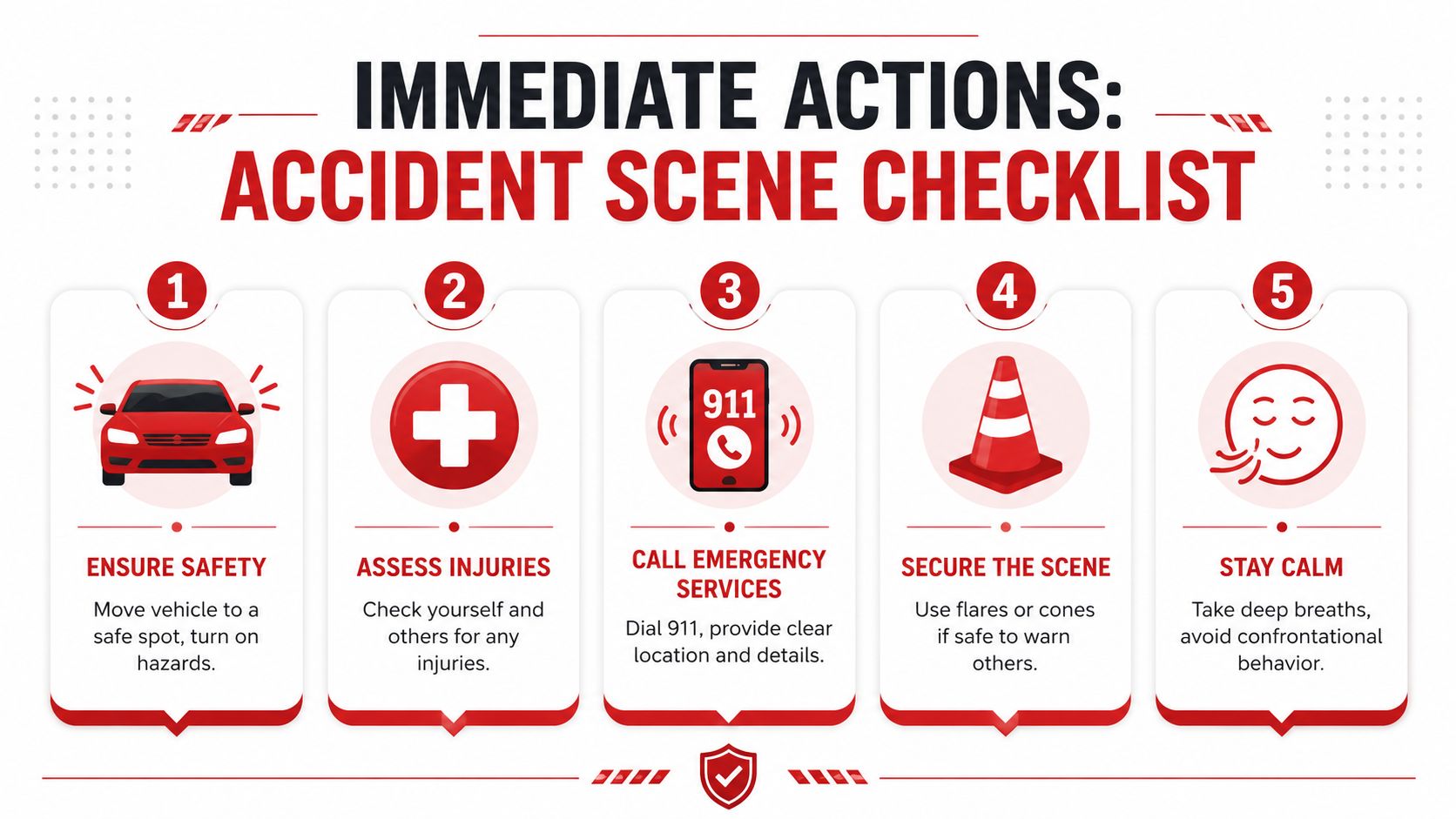
If your car can be moved safely and the situation isn't dangerous to approach, turn on your hazard lights and work on making the scene visible to other drivers. If traffic is still flowing nearby, your job is to reduce the risk of a second crash while checking whether anyone is hurt.
What to do first
- Pause and scan the area. Look for traffic, smoke, leaking fluid, broken glass, or anything that makes getting out unsafe.
- Check yourself before helping others. If you're badly hurt, stay still and call for help.
- Check passengers and the other vehicle if it's safe. Speak clearly. Ask simple questions like “Are you hurt?” and “Can you breathe normally?”
- Call 911 when there's any injury, danger, or uncertainty. Clear, short information helps more than a long explanation.
- Keep the scene calm. Don't argue about fault on the roadside.
Practical rule: Safety comes before paperwork. Evidence matters, but people matter more.
There's one point new drivers often get wrong. Moving an injured person can make things worse. First responders are taught not to move victims unless the situation is life-threatening, because improper extraction causes a 40 to 60% increase in secondary spinal or neck injury complications, and they re-check vital signs every 5 minutes for unstable patients, a frequency linked to a 15% improvement in pre-hospital survival outcomes according to this first aid response guide.
How to help without causing more harm
Use a simple approach:
- Talk first: Ask whether the person can move, where they hurt, and whether they feel dizzy or short of breath.
- Don't pull someone from a seat: Only do that if fire, smoke, or another immediate life threat makes staying put more dangerous.
- Watch, don't over-handle: If someone seems confused or in pain, keep them still and wait for emergency responders.
- Stay observant: Breathing changes, fading alertness, or worsening pain are important details to report.
Some soreness doesn't show up right away. If you want a plain-language explanation of delayed symptoms and preventing pain after a minor crash, that resource is useful after the immediate emergency has passed.
For a Georgia-focused checklist you can review before you ever need it, keep this guide on what to do if you just got in a car wreck bookmarked on your phone.
Documenting the Scene and Exchanging Information
Once everyone is safe, your phone becomes one of your most important tools. Good documentation protects you from bad memories, changing stories, and incomplete insurance files.
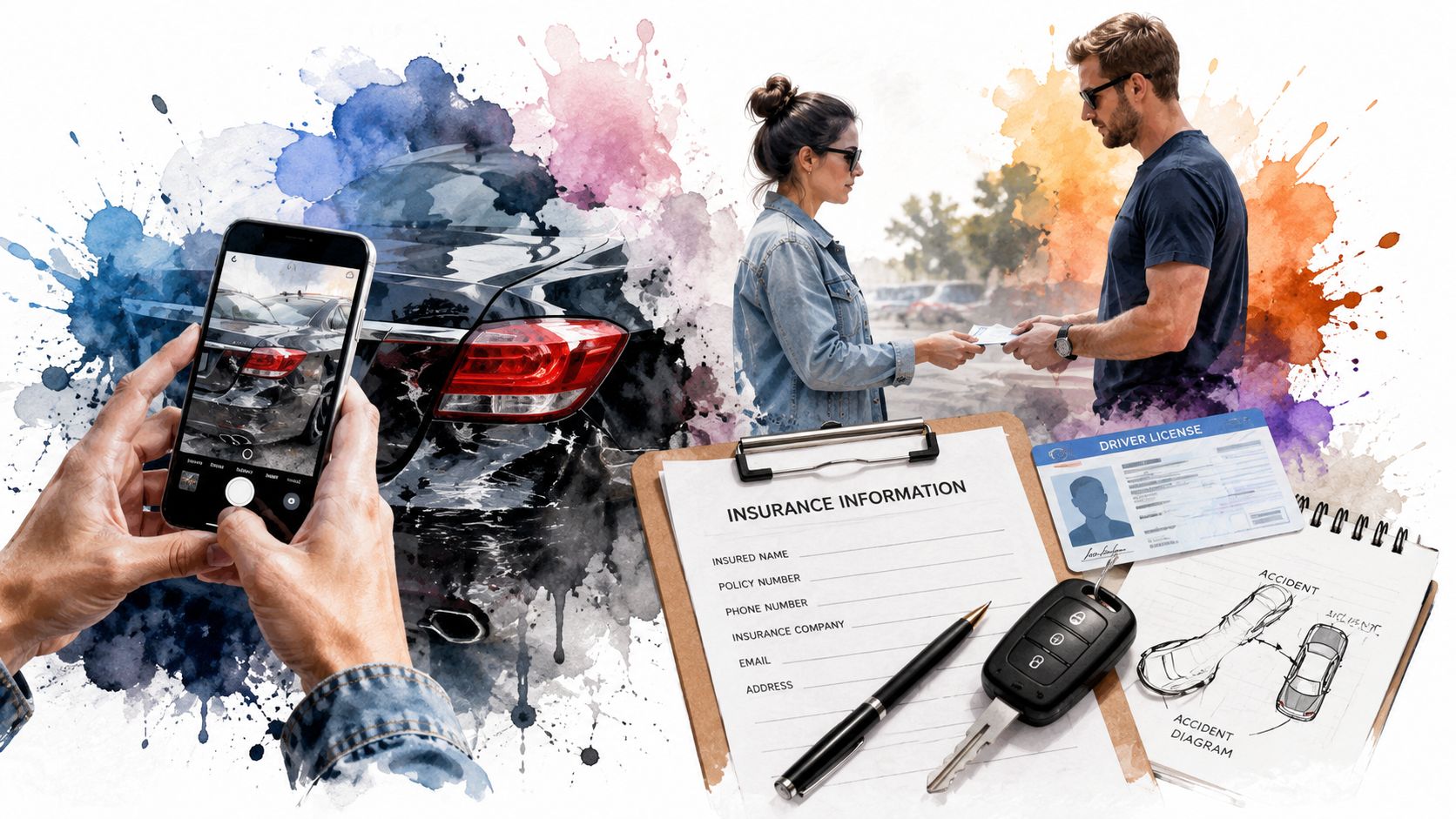
Many new drivers freeze at this stage because they're unsure whether the car should stay where it is. That confusion is common. 78% of new drivers are unsure whether they can legally move their car after a minor collision if it blocks traffic, and that uncertainty often leads them to move vehicles without taking photos first, which can contribute to denied claims or inflated liability findings, as noted in this evidence-preservation reference.
What to photograph before anything changes
Take more photos than you think you need, as long as it's safe.
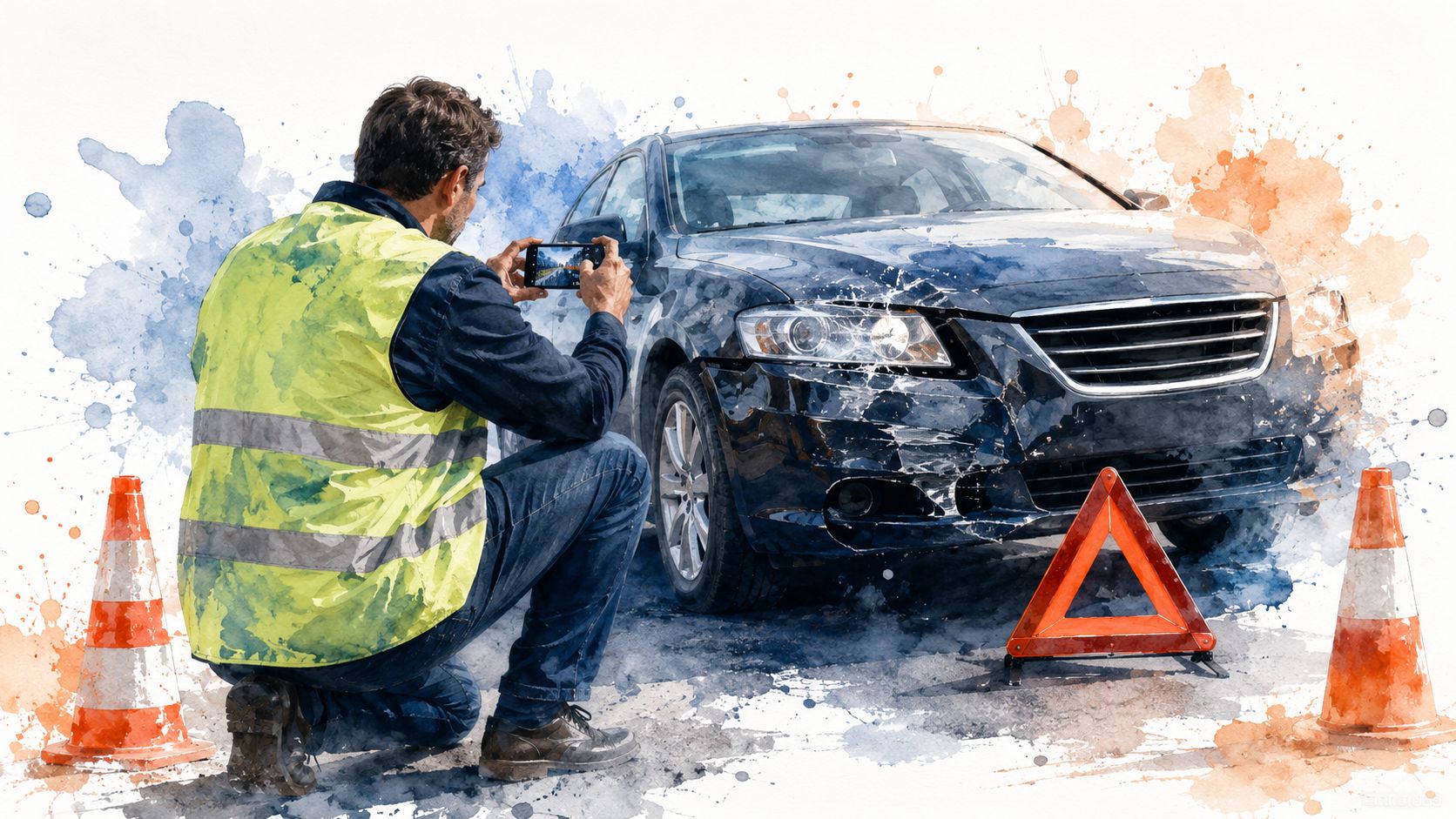
- Wide shots first: Capture the whole scene from several angles.
- Vehicle positions: Show where each car stopped relative to lanes, curbs, intersections, and traffic signs.
- Damage close-ups: Photograph each damaged area on every vehicle.
- Road details: Include skid marks, debris, weather conditions, lane markings, and traffic signals.
- Identifiers: Get license plates and, if visible from a safe place, the make and model of each car.
Don't crop heavily. Don't rely on one dramatic close-up. Insurance companies and investigators often need context more than drama.
If you need to move a vehicle for safety, take the fastest complete photo set you can first. A rushed record is still better than no record.
What information to exchange
Photos are only half the job. You also need clean, accurate contact details.
| What to collect | Why it matters |
|---|---|
| Driver name and phone number | Helps your insurer and police identify parties correctly |
| Driver's license details | Confirms who was operating the vehicle |
| Insurance company and policy information | Starts the claims process |
| Vehicle owner information | Important if the driver isn't the owner |
| Witness names and contact information | Useful if stories conflict later |
Keep your tone neutral. Say, “Let's exchange information,” not “You hit me” or “This was my fault.” Those statements can create problems later.
A quick refresher on the basics can help families prepare in advance. A practical checklist for Georgia driver emergency contact information is worth saving before a stressful day happens.
Video walkthroughs can also help this feel less abstract:
When moving the car becomes the hard question
Many teen drivers encounter a dilemma. You want to clear traffic, but you also don't want to destroy evidence.
Use this rule of thumb. If there's immediate danger from traffic or another hazard, safety comes first. If the situation is stable, document thoroughly before anything changes. That balance matters in Georgia because fault decisions often depend heavily on scene evidence. A few careful photos can preserve what your memory won't.
Understanding Georgia Accident Reporting Laws
Georgia drivers need to think about reporting in two layers. The first is the general crash response. The second, for teen drivers, is the added responsibility that can come with driver education status.
Police reporting and practical judgment
If anyone is injured, if the scene feels unsafe, or if there's serious confusion about what happened, calling law enforcement is the smart move. Even when drivers think the crash is “minor,” a police report often becomes one of the clearest neutral records of the event.
This isn't just about legal protection. It also helps with insurance timing, witness follow-up, and preserving details while memories are fresh.
A calm call to law enforcement often prevents a long argument later.
Families also get tripped up by the gap between what seems optional and what's wise. A teen may think, “We already exchanged insurance, so we're done.” In practice, that can leave out facts that become important once repair estimates or injury symptoms show up later.
The Joshua's Law reporting issue many teens miss
For teens training under Joshua's Law, there may be another obligation beyond the usual accident reporting steps. An important but poorly understood Georgia requirement is that teen drivers under Joshua's Law may need to report crashes to their driving school within 24 hours. Failure can affect course completion and license eligibility, yet a 2025 survey found that 65% of teen drivers are unaware of this procedural rule, according to this reporting guidance reference.
That catches families off guard because most accident advice is written for adults driving independently. A supervised teen driver is in a different situation. A parent, guardian, or instructor may need to help with school communication, documentation, and timing.
A simple reporting checklist for Georgia teens
- Call law enforcement when the situation calls for it: Injuries, danger, major confusion, or significant damage should push you toward reporting.
- Tell your parent or supervising adult immediately: Don't try to handle a teen crash alone.
- Ask whether your driver education program requires notice: If you're enrolled under Joshua's Law, this step matters.
- Save every document: Police incident details, photos, claim numbers, and school communication should stay in one folder.
If you're unsure whether a crash must be reported to your school, don't guess. Contact the program the same day.
Managing Medical Care and Insurance Claims
Leaving the scene doesn't mean the event is over. In many cases, the most important mistakes happen afterward.
Some injuries feel minor at first. Adrenaline can hide pain, stiffness, dizziness, or headaches for hours. Get evaluated if anything feels off, and follow the instructions you're given. If a provider tells you to rest, monitor symptoms, or schedule follow-up care, write that down and keep the paperwork.
What to do when you contact insurance
Your insurer will want the basics quickly. Be organized, not emotional.
- Start with facts: Date, time, location, vehicles involved, and whether police responded.
- Share your documentation: Photos, witness contacts, and the report number if you have one.
- Describe symptoms: Don't exaggerate, but don't minimize either.
- Keep a record of every call: Note the date, time, representative name, and what was discussed.
Avoid guessing about speed, distance, or fault if you aren't sure. “I don't know” is better than a rushed answer that turns out to be wrong.
Keep one file for everything
Use a phone folder, notes app, or paper envelope. What matters is consistency.
| Keep this record | Why it helps |
|---|---|
| Medical visit summaries | Shows when symptoms were reported |
| Repair estimates and invoices | Supports the property damage claim |
| Claim numbers and adjuster names | Keeps communication organized |
| Towing and rental receipts | Helps document out-of-pocket costs |
| Follow-up notes about pain or missed activities | Creates a clear timeline |
If the financial side becomes overwhelming, some families also look for legal and debt-related information after a serious crash. This overview of discharging car accident debt in Georgia may help you understand one part of that bigger picture.
For newer drivers, it also helps to understand what coverage is supposed to do before a claim ever starts. This plain-language guide to liability insurance basics can make insurer conversations much easier to follow.
Keep your statements factual and brief. Insurance claims move more smoothly when your notes, photos, and records all tell the same story.
Building Skills to Prevent Future Accidents
Knowing accident response procedures is important. Building the habits that help you avoid needing them is even better.
New drivers usually don't get into trouble because they never heard the rules. They get into trouble because real traffic moves faster than classroom memory. A left turn tightens, a car brakes unexpectedly, a passenger talks, rain changes stopping feel, and decision-making gets crowded. That's where guided practice matters.
Why structured training matters in Georgia
Georgia sets a clear baseline for teen drivers. Joshua's Law requires exactly 30 hours of classroom instruction and 6 hours of professional behind-the-wheel training with a DDS-certified instructor for teens seeking a Class D license at age 16 or 17, as outlined in this Georgia driver education course guide. Georgia also requires supervised driving practice with an adult before licensing, which is where many families realize they want more support and coaching.
That's why many parents look beyond the minimum course checklist and add more in-car practice through structured lessons. A student who knows how to respond after a crash still needs hazard scanning, lane judgment, parking accuracy, speed control, mirror use, and calm decision-making before the crash ever happens.
Training options that fit real families
Some students learn best in a classroom. Others need flexible online study and more road time. A practical plan often includes a mix of:
- Joshua's Law courses: Useful for meeting the required education standard.
- Online course options in Georgia: Helpful for busy schedules and self-paced review.
- Driving lessons and lesson packages: Strong for students who need repetition in traffic, parking lots, neighborhood roads, and test routes.
- Road test preparation and testing support: Good for students who know the rules but freeze under evaluation.
- Scholarship support: Families should also check the Georgia Driver's Education Scholarship Grant Program to see whether state-supported assistance is available.
One provider families often consider is A-1 Driving School, which offers Georgia driver's education, online course options, road testing support, and driving lessons packages for teens and adults. For many learners, those lesson packages are the difference between “I passed the written portion” and “I can handle traffic calmly.”
What driving lessons actually improve
Professional lessons give students repeated, coached exposure to the situations that create panic when they're alone.
- Intersection decisions: Judging gaps and turn timing
- Lane management: Changing lanes without drifting or rushing
- Parking control: Backing, angle parking, and tight-space awareness
- Defensive observation: Spotting hazards early without overreacting
- Road test readiness: Turning knowledge into a repeatable routine
Consistent training matters outside the car, too. Organizations that follow clear accident response procedures, from securing the scene to documenting details and implementing corrective actions, strengthen liability defenses and can reduce repeat incidents, according to this incident response procedures article. The same idea applies to driver learning. Repetition, review, and correction build safer habits.
Good drivers don't rely on confidence alone. They rely on practiced routines.
If you're choosing where to invest, put the focus on driving lessons and driving lesson packages first. That's where students usually gain practical judgment that online study alone can't provide. Then add the Joshua's Law course, online coursework, and road testing support that fit your timeline.
Navigating Complex Accident Scenarios
Some crashes don't fit the tidy examples in driver manuals. That's where a few decision rules can keep you from getting lost.
What if the other driver has no insurance
Still document everything. Take the same photos, gather the same identity details, and report the crash through the usual channels. Don't let the insurance issue tempt you into skipping paperwork. Uninsured and underinsured situations become harder, not simpler, when records are incomplete.
What if it's a hit-and-run
Write down everything immediately. Vehicle color, direction of travel, part of the plate if you saw it, and any witness contact information all matter. Ask nearby businesses or homeowners whether cameras may have captured the area, but don't argue with anyone or go chasing the other vehicle.
What if you were a passenger
Passengers should document what they can, seek medical care if needed, and keep records just like drivers do. Your role is different, but your documentation still matters.
What if it involves a rental or company vehicle
Check the glove box, rental paperwork, or company instructions for reporting requirements. Then notify the listed contact as soon as you can. These cases often involve extra documentation, and delays can create avoidable complications.
A useful way to think about all of these situations is this: the details change, but the framework doesn't. Organizations that consistently follow accident response procedures, from securing the scene to documenting details and correcting process failures, strengthen liability defenses and reduce repeat problems. Drivers benefit from the same discipline. Calm steps beat improvised reactions.
If you want more than a checklist, A-1 Driving School offers Georgia driver's education, Joshua's Law courses, online options, road testing support, and driving lessons packages that help teens and adults build practical road skills before a stressful moment happens. Parents can also ask about the Georgia Driver's Education Scholarship Grant Program and choose lesson packages that fit a student's schedule and experience level.