
A driving test passing rate that sits below half should change the way families think about test day. In Great Britain, the practical driving test pass rate was 48.2% in the first three quarters of 2023/24, and the theory test pass rate was about 45%, based on 1,384,678 test attempts and 668,038 practical passes, which means fewer than half of candidates cleared either exam on the first reported measure that year (NimbleFins summary of Great Britain driving test pass rates). In the UK's 2024/25 figures, the category B practical pass rate was 48.65% across 1,836,558 tests, with 893,609 passes and 942,949 failures, the highest annual UK pass rate since 2017/18 at 47.4% (UK 2024/25 pass rate guide).
That does not mean most new drivers are unprepared or incapable. It means the test is a narrow measurement, shaped by timing, format, nerves, and local conditions. A parent watching a teen study for the road test should read those numbers as a planning signal, not a verdict on ability.
Why the Driving Test Passing Rate Is Lower Than You Think
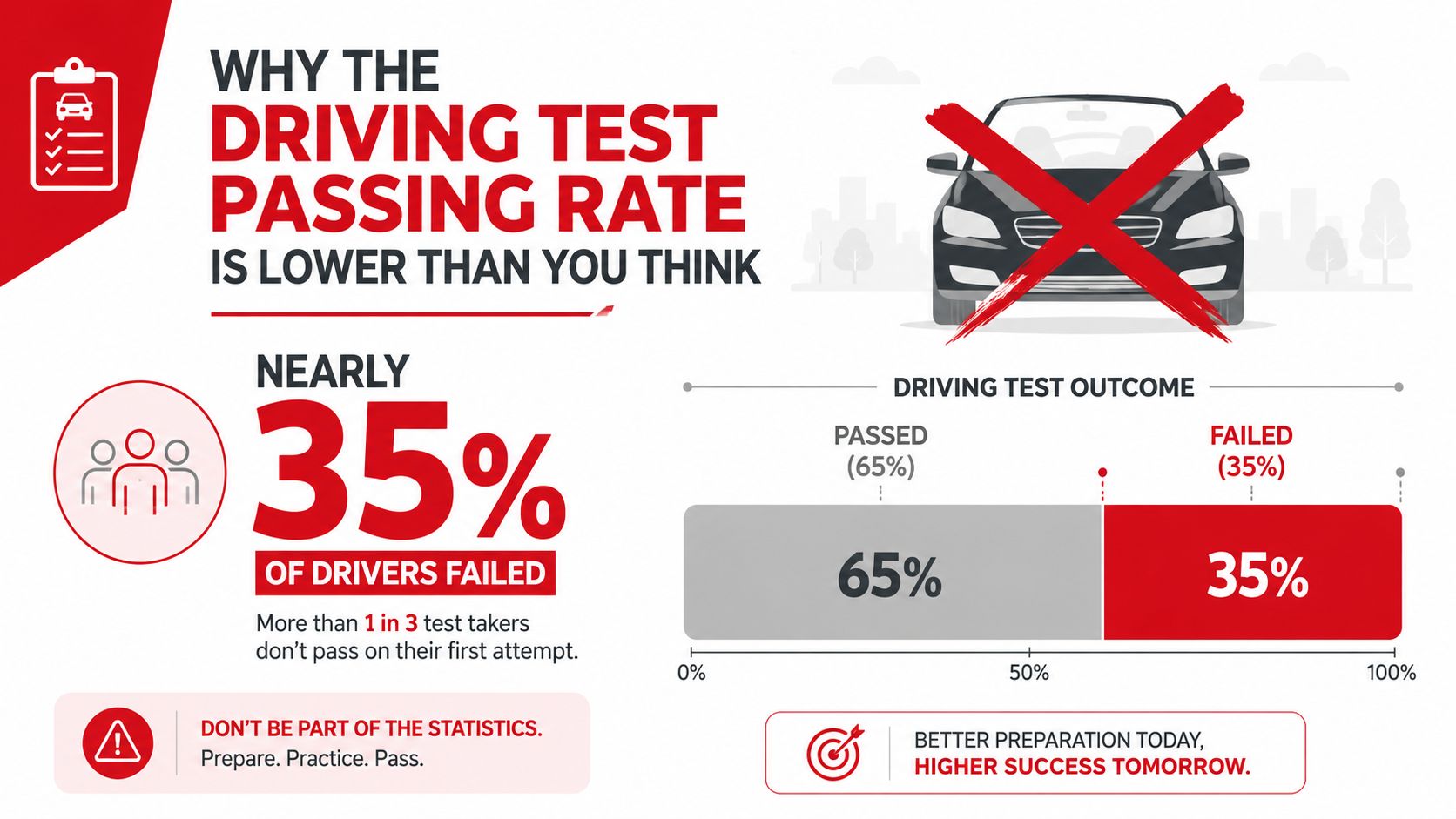
A lot of families assume a failed road test means someone is a bad driver. The numbers point somewhere else. Across 34 U.S. states with comparable results from 2020 to 2023, 65.2% passed written or skills tests and 34.7% failed, with skills tests passing at 78.8% and knowledge tests at 61.7% (U.S. licensing data summary). That spread tells you something important, cognitive knowledge remains a major source of failure, even when the behind-the-wheel part is stronger.
For a Georgia teen, that means the test is not just a show of basic driving instincts. It checks whether the learner can perform specific tasks under pressure, in a fixed format, on a fixed route or route style. If a student knows how to drive with family but freezes at an intersection, misses a mirror check, or loses rhythm after one mistake, the result can look worse than the actual skill level.
Test scores reflect the system as much as the student
The biggest mistake parents make is treating the pass rate like a personal character test. It's better understood as a system outcome. The test format, the amount of practice before test day, and the way the local site runs all influence what happens.
Practical rule: a failed attempt often means the student needs more structured preparation, not that the student lacks driving ability.
The driving examination literature still has gaps in the basic data needed to explain failure cleanly. A Cambridge University review says the field lacks standardized, comparable data on why candidates fail, how examiners score consistently, and whether the test measures real-world safety or test-specific performance (Cambridge review on evidence gaps). That is a strong reminder that a pass rate is useful, but it is not the whole story.
National and International Driving Test Passing Rates Compared
Georgia drivers often ask whether a local pass rate is “good” or “bad.” The honest answer is that the number only makes sense when you compare it with the test type and the jurisdiction. A UK practical pass rate near 48.65% in 2024/25 sits in the same broad neighborhood as the 48.2% Great Britain figure reported for the first three quarters of 2023/24, while the U.S. multi-state data show higher pass rates for skills tests than for knowledge tests (UK 2024/25 pass rate guide, Great Britain pass rate summary, U.S. licensing data summary).
The comparison below helps put those figures side by side without pretending they are identical. Different countries use different scoring systems, routes, and licensing stages, so this is a benchmark, not a ranking.
| Region | Test Type | Pass Rate | Time Period |
|---|---|---|---|
| Great Britain | Practical driving test | 48.2% | First three quarters of 2023/24 |
| Great Britain | Theory test | About 45% | First three quarters of 2023/24 |
| UK | Category B practical test | 48.65% | 2024/25 |
| 34 U.S. states | Written or skills tests, combined | 65.2% | 2020 to 2023 |
| 34 U.S. states | Skills tests | 78.8% | 2020 to 2023 |
| 34 U.S. states | Knowledge tests | 61.7% | 2020 to 2023 |
Why direct comparisons can mislead
A practical test in one place may allow more routine driving, while another site may be more tightly scored or more crowded. That makes raw pass-rate comparisons tricky. A student in metro Atlanta does not need a perfect national benchmark, they need a realistic understanding of how local testing conditions interact with preparation.
The Cambridge review makes that caution explicit by pointing to missing data on examiner consistency and failure reasons (Cambridge review on evidence gaps). In plain language, the question is not just whether someone passed or failed. It is also what the test measured, and how much the testing setup shaped the result.
A single pass-rate number can tell you that a system is hard. It cannot tell you exactly why it is hard.
Hidden Factors That Move the Driving Test Passing Rate Up or Down
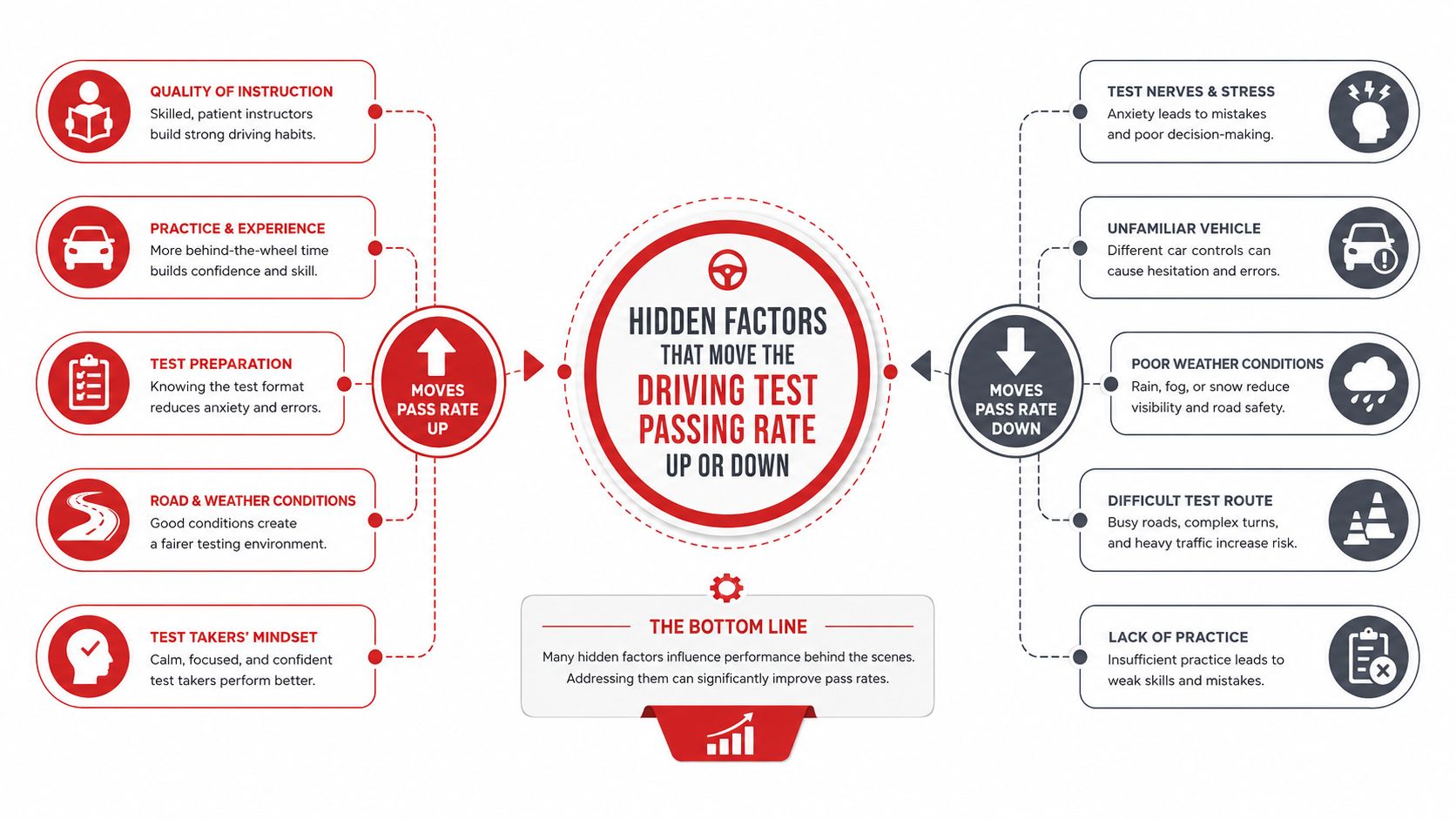
Two learners can drive with the same level of calm on lesson day and get different test outcomes. That's because timing and context matter. In a peer-reviewed study of learner drivers, the strongest predictor of how many practical-test attempts a candidate needed was the time gap between the theory test and the practical test. As that gap grew, candidates tended to need more attempts to pass (peer-reviewed learner-driver study).
For drivers under 25, the same study found that age and the theory-to-practical gap were both positively associated with more attempts, while time spent in step 2 was negatively associated with attempts (peer-reviewed learner-driver study). In practical terms, that suggests early, intensive skill-building can make a difference. Long pauses between preparation stages can work against learners who were nearly ready.
Why location and demographic patterns matter
There is also a fairness question that gets ignored in most pass-rate conversations. UK research shows persistent gender differences in Great Britain, with male practical-test pass rates consistently about 5 percentage points higher than female pass rates over many years. In 2018, 62.7% of men passed versus 53.4% of women (TRL equality in the driving test report). That does not prove why the gap exists, but it does show that pass rates are not evenly distributed.
Location matters too. In 2024, New York City DMV data reported a 48% road-test failure rate in the city, higher than the statewide 43% average (TRL report citing NYC DMV data). Urban traffic, crowded intersections, and unfamiliar road patterns can all make a test feel more difficult.
For Georgia learners, the takeaway is simple. If the local route is busy, if the learner has had a long pause between classroom learning and road testing, or if practice has been informal and inconsistent, the pass rate drops for reasons that have little to do with “being a bad driver.”
How to Prepare for the Georgia Road Test and Beat the Odds
Georgia teens who need a Class D license start with Joshua's Law, which requires a 30-hour driver education course and 6 hours of behind-the-wheel training. That classroom-plus-practice structure matters because it does not leave the learner guessing what comes next. It builds a sequence, and sequence is what lowers stress on test day.
A-1 Driving School offers Joshua's Law Driver's Education, online course options, in-person training, road-test preparation, and testing assistance, along with driving lessons for teens and adults. It also serves Fulton County Schools through the Fulton County Board of Education contract, which means its Driver's Education delivery reaches multiple school settings across the county. For families comparing options, the practical question is not whether the student has “driven enough,” but whether the student has been coached through the exact habits the examiner will watch for.
A simple prep order that works
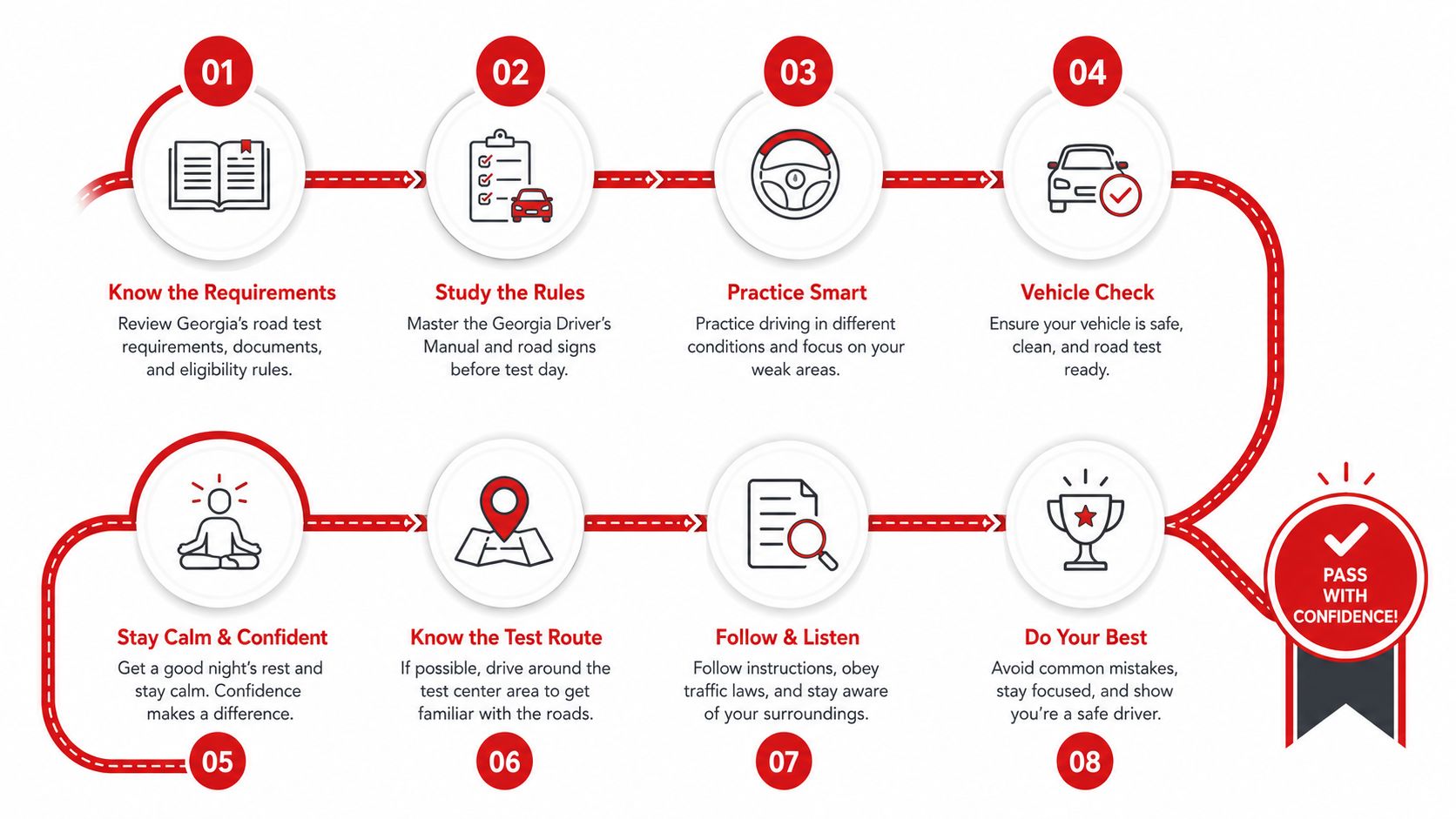
Start with the required education, then move to supervised practice, then to test-specific coaching. The order matters because rushed testing after a long gap tends to produce extra attempts, as the study above showed (peer-reviewed learner-driver study).
- Complete the classroom requirement. Joshua's Law is the legal foundation for teen licensure, and the course gives the student the language of road rules.
- Finish behind-the-wheel training. That's where lane positioning, scanning, parking, and intersection timing become habits rather than guesses.
- Add road-test practice. The student should rehearse the exact maneuvers and decision points that create anxiety.
- Use the test checklist. Documents, vehicle readiness, and calm driving technique matter as much as memorized knowledge.
One useful planning tool is the school's road-test prep guide, which lays out what to review before the appointment. You can find it in A-1's guide to how to prepare for a driving test.
Why coaching beats last-minute cramming
A nervous student usually doesn't fail because they never learned the material. They fail because the skill hasn't become automatic. That's why a lesson plan works better than one long weekend of practice.
A good instructor will correct blind-spot checks, lane changes, right-of-way choices, and parking control before those habits harden. Family practice can still help, but it's usually not enough on its own for the final pass.
Why Structured Driving Lessons Packages Outperform Ad-Hoc Practice
Family driving time is useful, but it often skips the parts that cause real test failure. Parents teach what they know best, and that usually means basic steering, braking, and maybe neighborhood driving. Examiners watch for more specific habits, including disciplined mirror checks, lane changes, intersection judgment, and parking control.
That is where structured driving lessons packages earn their value. A trained instructor breaks the drive into repeatable pieces and corrects the same errors before they become habits. For students who keep making one or two stubborn mistakes, that feedback loop matters more than extra casual mileage.
What professionals usually catch faster
The problems that sink a road test are often small, but they show up at the wrong moment. A student who drifts late on a lane change, rolls too far at a stop, or hesitates through an intersection may drive perfectly well with family and still lose points during the exam. A structured lesson puts those behaviors under a spotlight.
Useful standard: if a habit shows up three times in practice, it probably needs instructor correction before test day.
A-1 Driving School offers customized teen and adult driving lessons, and its lessons packages can be paired with road-test prep so the student practices in the same framework from instruction to testing. If you want a broader view of how instructor-led training compares with casual practice, this overview of the benefits of taking driving lessons from an instructor lays out the difference clearly.
Parents also sometimes search for outside guidance on choosing a school or communicating the value of lessons. A helpful industry perspective is available through find driving school TV advertising, which can help families think about how schools present their programs and services.
Access matters too
Cost is a real concern, and Georgia families should know about the Georgia Driver's Education Scholarship Grant Program. When a student qualifies, that support can make formal training more accessible. For some families, that changes the decision from “can we afford lessons?” to “which lesson schedule fits best?”
Structured training does not guarantee a pass. It does something more practical. It lowers the number of unknowns, and unknowns are what most often make test day feel bigger than it should.
Georgia Resources and Next Steps for Aspiring Drivers
Georgia families usually do best when they turn the process into a checklist instead of a vague goal. The first step is understanding the license requirements, then matching those requirements to the right course, lesson plan, and road-test date. A helpful starting point is this guide to drivers license requirements in Georgia.
A straightforward action list
- Check eligibility early. Confirm the age, course, and documentation requirements before test planning starts.
- Enroll in Joshua's Law training. Use online or in-person options if schedule flexibility matters.
- Book driving lessons. Focus on the maneuvers that create the most hesitation.
- Review grant options. The Georgia Driver's Education Scholarship Grant Program may help qualifying students offset training costs.
- Set the road test date last. Test timing should follow enough practice, not precede it.
A-1 Driving School's local footprint also helps families who need convenience. It has 18+ locations across metro Atlanta and Athens, plus 38+ years of experience and 100,000+ satisfied drivers in its history. Those details matter less as marketing language and more as signs that a school has managed Georgia driver training across different ages, schedules, and testing needs.
For parents balancing school, work, and practice time, the benefit is practical: enrollment can be done online, sessions can be scheduled across multiple time slots, and the student can move from classroom learning to behind-the-wheel training without losing momentum.
Test Day Realities and Frequently Asked Questions
A student can prepare well and still get rattled by one small mistake. I've seen learners roll too far at a stop sign, forget to signal a lane change, then panic because they think one error ruined everything. Most of the time, the bigger problem is the panic, not the mistake itself.
The fix is simple in concept, harder in practice. Slow the breathing, listen carefully, and drive the next minute well instead of replaying the last one. Test examiners want to see control, not perfection.
Frequently asked questions
How long does the road test take?
It varies by location and testing flow, so plan for enough time to stay calm rather than rushing the appointment.
What should I bring?
Bring the documents required by the licensing process, plus any items your local testing site asks for. It's smart to keep everything together before test day.
Can I retake the test if I fail?
Usually, yes, but the practical next step is more practice before rescheduling. A quick repeat without correction usually repeats the same mistake.
Should parents coach right up to test day?
Yes, but keep it short and focused. Last-minute correction works best when it reinforces a few key habits, not a long list of new instructions.
A-1 Driving School helps Georgia teens and adults move from classroom learning to road-test readiness with Joshua's Law courses, driving lessons, and road-test prep. If you want a calmer path to test day, visit A-1 Driving School to explore lesson packages, training options, and enrollment details that fit your schedule.