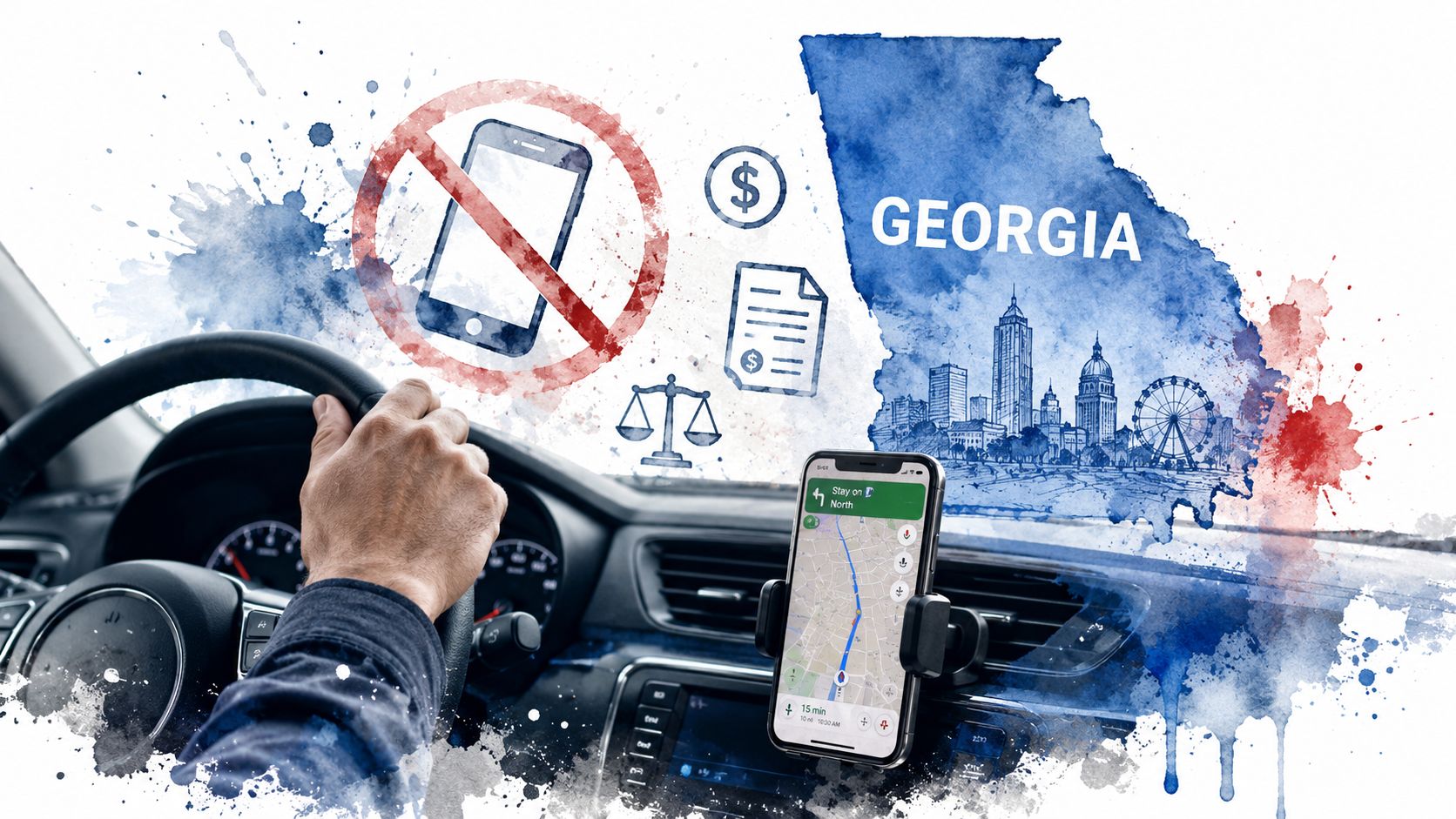
The short answer? Georgia's cell phone law is the Hands‑Free Georgia Act. Since July 1, 2018, it's been illegal to hold or support a wireless device while you're driving. The only exception is using it completely hands‑free — no cradling, no balancing, no fumbling.
Understanding the Hands‑Free Rule and Everyday Impacts
The Hands‑Free Georgia Act changed things pretty dramatically. Before this law, the state only banned texting. Now, holding your phone while driving is a serious offense.
Here's what's off the limits while the car is moving:
- Holding a phone to your ear for a call
- Scrolling through playlists or social media apps
- FaceTiming or video calling while behind the wheel
- Reading or sending texts, emails, or any text‑based messages
- Watching or recording video
The thing is, voice‑activated calling, navigation, and music controls are fine — but only when you're not actually touching the phone. It has to be truly hands‑free.
Think of it like buckling a seatbelt: the device needs to be secured and out of your hands so you can focus on driving.
Quick Reference Table
| Action | Allowed When | Notes |
|---|---|---|
| Holding phone to talk | Never | Use Bluetooth or speakerphone already set up |
| Texting or emailing | Never | Voice‑to‑text only when fully hands‑free |
| Watching/recording video | Never while driving | Passengers can do this |
| Using GPS | Yes if hands‑free | Set your route or use a dash mount before you start moving |
| Taking photos or FaceTime | Never while driving | Pull over somewhere safe first |
How This Affects Teen Drivers and Joshua's Law
For teenagers, this rule connects directly with Georgia's licensing process and what Joshua's Law expects. Joshua's Law requires approved Driver's Education — 30 hours of classroom time plus 6 hours behind the wheel. These days, those lessons put a lot of emphasis on avoiding distractions because the Hands‑Free Act applies to permit holders and newly licensed drivers just as much as anyone else.
- Teens need to show they can stay off their phone during supervised driving hours.
- Road tests look at scanning habits and distraction control, not just basic maneuvers.
- Instructors typically walk through hands‑free setups well before test day.
Why Driving Lessons and Lesson Packages Matter
You don't learn to follow these rules by memorizing them — you learn by doing them over and over until they stick. Behind‑the‑wheel lessons build muscle memory: setting a pre‑drive routine, turning on Do Not Disturb, and getting comfortable with phone mounts or the car's Bluetooth system so your hands stay where they belong.
A‑1 Driving School's driving lessons and multi‑lesson packages give students plenty of real‑world practice in Atlanta traffic. That way, going hands‑free feels automatic way before the road test rolls around.

Georgia has its own specific rules, but knowing how other states handle distracted driving can give you helpful context. If you're curious, find Texas distracted driving law details.
For more on how Georgia's enforcement has changed, check out our piece on Georgia House Votes To Ditch Loophole In Distracted Driving Law.
If you want structured help building these habits, look into a Joshua's Law course or a driving lessons package. It's the best way to make sure teens and families stay safe and feel confident come test day. Explore your options and enroll in a driver's education course today.
Penalties, Points, and Real Enforcement Numbers
The Hands-Free Georgia Act might not sound scary on paper — the fines start small — but the license points tell a different story. Violations stack up quickly, and the consequences reach far beyond what you pay at the courthouse.
A first conviction runs a maximum fine of $50 and adds 1 point to your license. Not much, right? But here's what people overlook: that single point can nudge your insurance premiums upward, and it stays on your record.
A second conviction within 24 months bumps the maximum fine to $100 and adds 2 points. The state isn't messing around with repeat offenders — the numbers climb fast.
A third or subsequent conviction within the same 24-month window? That's $150 and 3 points. At this point, you're looking at serious surcharges and potentially losing driving privileges altogether.
Fine and Point Schedule Under the Georgia Cell Phone Driving Law
Here's the full breakdown of how penalties escalate:
| Conviction Number | Maximum Fine | License Points | Lookback Window |
|---|---|---|---|
| First | $50 | 1 point | 24 months |
| Second | $100 | 2 points | 24 months |
| Third or subsequent | $150 | 3 points | 24 months |
These points aren't just numbers in a database. They can trigger state surcharges, push insurance costs higher, and — especially for teens — combine with other violations to put a license at risk.
"Getting cited isn't just about the ticket. It tells insurers, courts, and even schools that something needs to change behind the wheel."
What This Means for Teens and New Drivers
The real-world impact hits hardest for younger drivers. Picture a newly licensed Class D driver who picks up two phone citations within 24 months. Parents will feel the insurance hike right away. And during road tests, examiners are actively watching for distraction control — they notice when someone fumbles with a phone or can't keep their focus off the screen.
Practical Ways to Avoid These Penalties
The best strategy is building good habits before a citation ever happens. Driver's education plays a huge role here.
- Enroll in Joshua's Law courses to cover the required 30 classroom hours and 6 behind-the-wheel hours, where distraction management gets real practice.
- Book behind-the-wheel lessons and multi-session packages to get comfortable with hands-free setups in actual traffic.
- Use road test preparation sessions to show examiners consistent distraction control — that's what gets rewarded on test day.
Three steps to lower your risk:
- Complete an approved Joshua's Law course so your pre-test behavior is on record.
- Schedule a block of driving lessons to build real muscle memory for hands-free driving.
- Take advantage of A-1's road test preparation and testing assistance to avoid failing on your first attempt.
At A-1 Driving School, the focus is on prevention through solid instruction — not fixing things after a ticket arrives. Want to understand how fines climb and how proper training helps you avoid them? Check out our detailed guide on Higher Fines For Distracted Driving.
For most families, the smartest move is combining a Joshua's Law course with structured driving lessons. That's how you turn the Hands-Free Georgia Act from a legal threat into a habit that keeps everyone safer on the road.
How the Law Affects Teen Drivers and Joshua's Law
Georgia's Hands-Free law doesn't make exceptions for age or license type. If you're behind the wheel—whether you're on a learner's permit or just earned your Class D—the same rules apply.
Getting a license as a teen is a step-by-step process, and each step builds on the last. You start with a permit, work through Joshua's Law requirements, log supervised hours, pass the road test, and finally get that Class D license.
Joshua's Law is a big part of that climb. It requires eligible teens to finish 30 hours of classroom instruction and 6 hours of behind-the-wheel training with a certified instructor.
The Hands-Free Act has shaped how these courses work. Approved programs now weave distraction awareness and hands-free habits into both classroom lessons and in-car training.
Completing Joshua's Law means showing you can drive without reaching for your phone—under supervision—so instructors catch risky habits before they become second nature.
A-1 Driving School offers the Joshua's Law curriculum in person, online, and through virtual classrooms, which gives families real options for fitting it into busy schedules.
A-1 also holds the Fulton County Board of Education contract, teaching Driver's Education across Fulton County Schools and many Atlanta high schools. That means classes stay local and familiar for students.
Short, repeated practice behind the wheel turns rules into reflexes. A-1's driving lessons reinforce the same phone-free habits examiners watch for during the road test.
Road Test Expectations and Distraction Control
Road testers pay attention to how you scan your surroundings, hold your lane, and handle distractions inside the car.
Say a teen fumbles with their phone to adjust navigation—that small moment can cost points and raise concerns for the examiner.
A-1's mock road tests and focused lesson packages walk through those exact scenarios so students show up on test day with steady, confident habits.
- Multi-lesson packages cover highway practice, parking drills, and distraction control coaching.
- Single lessons let students zero in on weak spots, like mirror checks while using hands-free audio.
- Flexible scheduling helps teens fit lessons around school without falling behind.
Practical Access and Scheduling
With 18+ metro Atlanta locations, flexible class times, and 38 years of experience, A-1 makes it realistic for families to complete Joshua's Law without upending school or work schedules.
Here's a straightforward path for families to follow:
- Enroll in an approved Joshua's Law course (classroom plus 6 behind-the-wheel hours).
- Book a block of driving lessons or a package focused on hands-free habits.
- Use road test preparation to show consistent distraction control before the official exam.
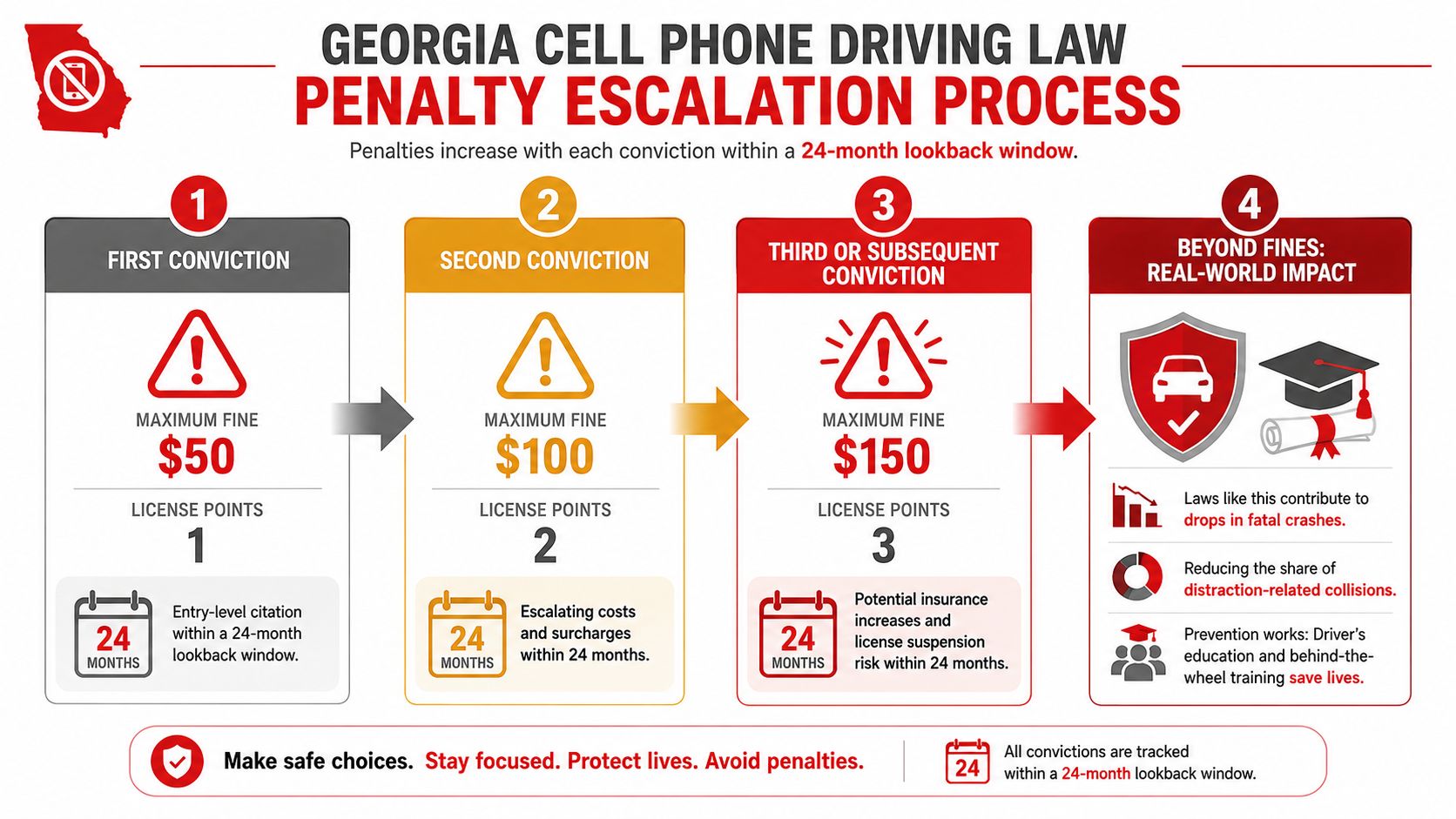
This infographic breaks down how penalties escalate under the Hands-Free law, tying fines and license points to the bigger picture of prevention through driver education.
Looking at the graphic, it's clear: early training helps teens avoid repeat citations down the road. Joshua's Law plus hands-on lessons lower the odds a teen ever starts climbing that penalty ladder.
Read also: Learn more about Georgia teen licensing and Joshua's Law in our guide on A-1 Driving School's site Georgia Teen Driving Laws.
Practical Compliance Tips And Hands-Free Setups
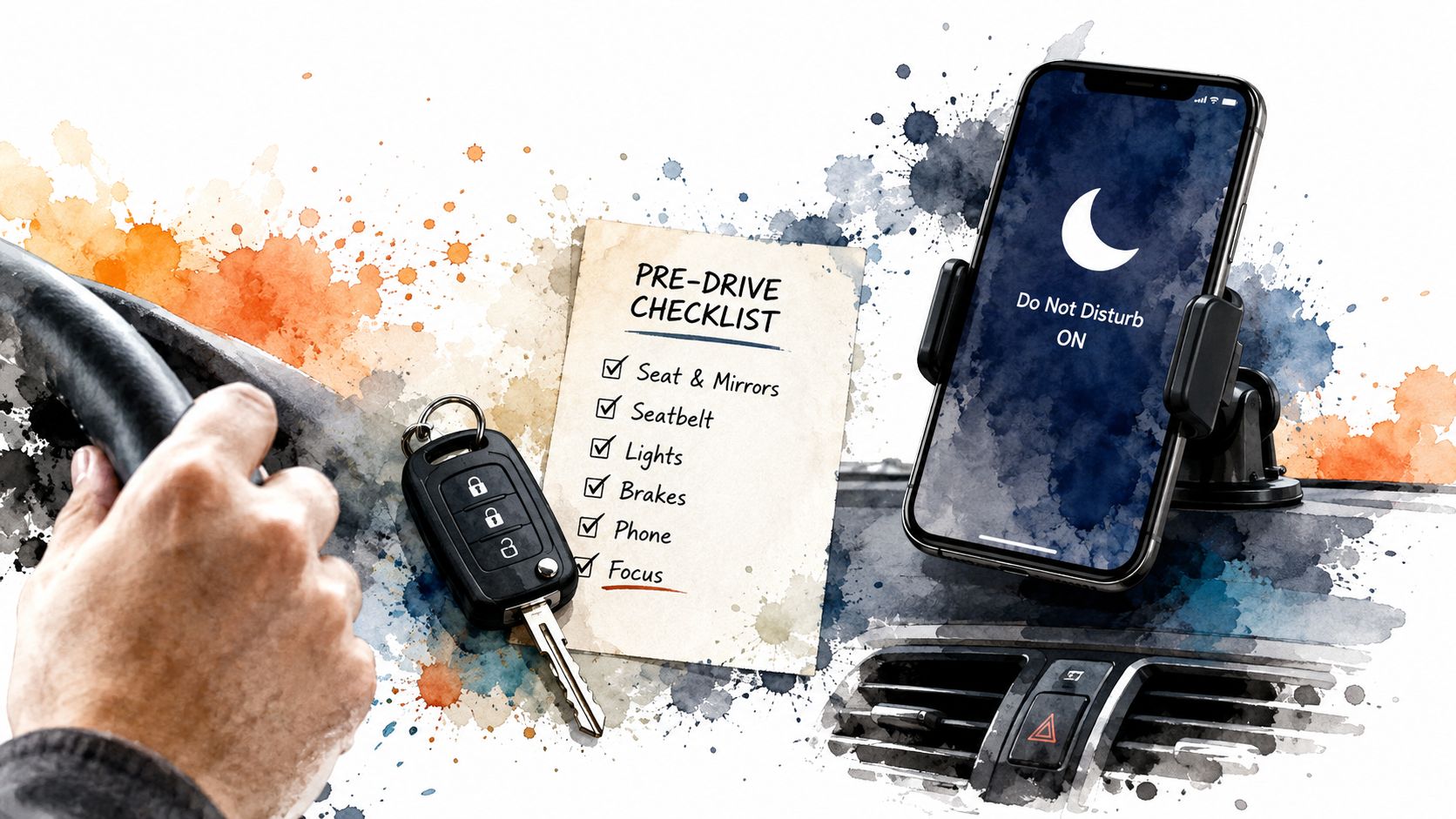
Think of prepping your phone like a pilot running a pre-flight checklist. One short routine eliminates a whole cascade of risks. That shift in mindset turns the Georgia cell phone driving law from an abstract rule into something you actually do every time you drive.
Start with phone placement before you go anywhere. Stash the device in a dash mount, cup holder, or glovebox so it's not in your hands while the car moves. This alone removes temptation and makes compliance almost automatic.
Set your navigation and music before shifting into drive. That single habit prevents last-minute fumbling, and it's the same kind of scanning and mirror-check discipline A-1 builds into its driving lessons packages.
Small routines have outsized benefits — a two-minute check prevents a minute-long distraction that could cost far more.
Voice Assistants And Do Not Disturb Modes
Enable your phone's voice assistant and test voice-to-text while parked. Turn on Do Not Disturb While Driving on iOS or Android so calls and texts stay silent unless paired to the car's Bluetooth. These layers work together: settings, mounts, and habits form a system instead of relying on willpower alone.
Here's a layered setup that works:
- Set Do Not Disturb While Driving with auto-reply to incoming texts so you're not tempted to glance.
- Pair your phone to the car Bluetooth once, then verify audio and call routing.
- Use a sturdy dash mount positioned for minimal eye movement.
Music Queueing And Passenger Handoffs
Queue playlists or podcasts before you depart to avoid adjusting apps mid-trip. If a passenger is around, hand off navigation control and let them manage reroutes or calls. This practical division of labor mirrors the exercises A-1 instructors use during lessons to cut down on in-car distractions.
Try this two-minute pre-drive routine:
- Mount phone and confirm orientation for navigation.
- Turn on Do Not Disturb While Driving and pair Bluetooth.
- Queue music, set route, and verbalize one safety check — mirrors, seatbelt, surroundings.
A-1 Driving School ties each of these clusters directly into its driving lessons packages. Instructors rehearse hands-free habits during real Atlanta traffic so teens and adults build muscle memory. Students can book single lessons focused on tech setup or choose multi-lesson packages that combine mock road tests, highway practice, and persistent habit coaching.
Here's what that looks like behind the wheel:
- A teen practices a simulated emergency reroute while maintaining lane position.
- An adult learner rehearses mirror checks while a passenger handles voice navigation prompts.
Repetition wins. Practicing the two-minute routine before every drive turns legal compliance into a reflex, not a rule you have to remember.
If you want guided practice, A-1 offers customized teen and adult driving lessons, single lessons, and multi-lesson packages that emphasize hands-free behavior during behind-the-wheel time in Atlanta. Enroll in a Joshua's Law course or a driving lessons package to make habit-building structured and consistent — your safest route to following Georgia cell phone driving law every time.
Driver Education, Road Tests, and Scholarship Opportunities
Knowing the rules is one thing. Building the habits that keep you compliant is another. A-1 Driving School bridges that gap by grounding everything in Joshua's Law requirements and plenty of real behind-the-wheel practice, so hands-free driving becomes second nature before a teen ever sits for the road test.
A-1 offers the Joshua's Law curriculum both in person and online. The program covers the mandatory 30 classroom hours plus 6 behind-the-wheel hours, giving families options that work around school schedules and work commitments without cutting corners on what matters — teaching teens how to manage distractions behind the wheel.
During driving lessons, A-1 instructors turn what teens learn in the classroom into habits that stick. They walk students through mounting the phone out of reach, switching on Do Not Disturb, and pairing Bluetooth — then drill those steps in real traffic until they feel automatic. That kind of repetition means a teen is far less likely to fumble with a device when an examiner is watching.
Lesson Packages That Build Real Skills
- Single lessons let students zero in on weak spots like parallel parking or highway merging, with hands-free audio controls practiced throughout.
- Bundled packages combine mock road tests, highway practice, parking drills, and hands-free habit coaching into one program at a discounted rate.
- Mock road tests mirror exactly what state examiners look for, so students walk into the real thing feeling calm and prepared.
"Practice under real conditions beats last-minute cramming — that's how consistent hands-free behavior gets built."
What sets A-1's packages apart is the way they pair technical driving skills with repeated distraction-control scenarios. That combination raises first-attempt pass rates and gives both teens and their parents genuine confidence heading into the test.
Road Test Preparation and Testing Assistance
Examiners are paying close attention to scanning patterns, lane control, and how a driver handles in-car distractions. A-1's road test prep zeroes in on all three:
- A mock evaluation built around the same checklists state examiners use.
- Targeted correction on distraction moments — adjusting the GPS, responding to a notification, that kind of thing.
- A final readiness review that reinforces hands-free routines before test day.
This step-by-step approach cuts the chance of a failed test and helps drivers show they understand what the Georgia cell phone driving law expects of them.
Scholarship Support and Accessibility
The Georgia Driver's Education Scholarship Grant Program can cover the Joshua's Law course and part of behind-the-wheel training for qualifying teens. A-1 helps families navigate the enrollment and paperwork side of things, turning state support into actual seat time — both in the classroom and on the road.
Here's how the scholarship process works:
- Confirm eligibility using the state's criteria.
- Gather the required documents — proof of residency, income verification if it applies.
- Let A-1 staff submit or walk through the application so funding goes toward courses.
Local Reach and Track Record
A-1 holds the Fulton County Board of Education contract, which means it delivers Driver's Education across all Fulton County Schools and many Atlanta high schools. With 18+ metro Atlanta locations, 15,000+ classes taught annually, and 100,000+ satisfied drivers, A-1 pairs large-scale capacity with deep local school partnerships.
What that means for families:
- Flexible scheduling so teens don't miss school time.
- Multiple locations that keep travel time to a minimum.
- Instructors who know exactly what state road test examiners expect.
Next Steps for Parents and Students
- Enroll in an approved Joshua's Law course online or in person to check off the licensing prerequisites.
- Pick a driving lessons package that includes mock tests and hands-free coaching.
- Ask A-1 about scholarship assistance to reduce out-of-pocket costs.
For a clear, structured path to making the Hands-Free Georgia Act part of everyday driving habits, take a look at A-1 Driving School course offerings.
Common Scenarios and Easy Misconceptions to Avoid
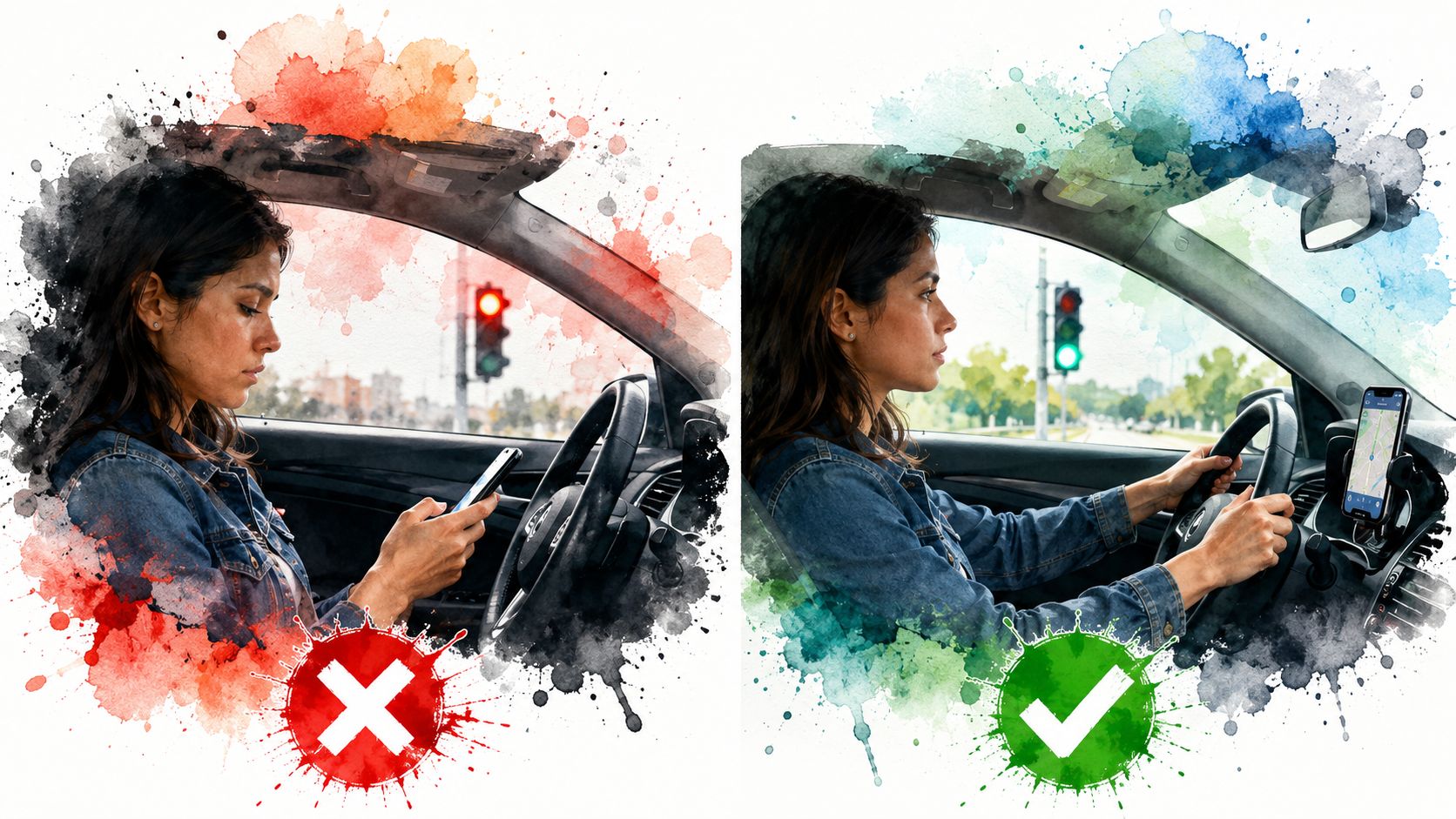
Stopping at a red light and scrolling feels harmless, but Georgia law treats holding a device the same whether you move again or not.
Think of it this way: a quick scroll while waiting for a light is like crossing a busy crosswalk while staring at your phone. You might make it across, but the odds of missing a hazard rise sharply. That's exactly how A-1 instructors teach students to treat every pause — as part of driving, not a break from it.
Sitting in a parked car with the engine running is another gray area drivers misjudge. If your car is in drive or able to move, officers can view device handling as a violation of the Hands-Free Act. A-1 coaches students to fully power down or shift into park before touching a phone, just to avoid any ambiguity.
School pickup lines are a different kind of trap. Parents often grab their phone while stopped, assuming low speed means low risk. But the law applies during those moments too, and reaction time still matters. Our driving lessons packages help drivers rehearse handing navigation and calls to passengers before they ever reach the line.
Then there's the stop sign glance or the quick look during bumper-to-bumper Atlanta traffic — classic misconceptions. A two-second look at 30 mph means you've traveled the length of a football field without watching the road. That's more risk than most people realize. A-1's behind-the-wheel sessions simulate these exact scenarios so students learn that reaction time, not intent, predicts outcomes.
Common myth 1: Hands-free equals risk-free. Hands-free cuts down on manual distraction, but your brain can still be off task. In our lessons, instructors pair hands-free tech practice with scanning drills so students build both skills together.
Common myth 2: Quick glances are harmless. Even a one- or two-second look can mean missing a signal, a pedestrian, or a sudden stop. A-1's mock road tests emphasize continuous scanning to eliminate those micro-moments of distraction.
Common myth 3: The law only applies on highways or to in-state drivers. The Hands-Free Georgia Act covers all public roads and applies to anyone driving in Georgia, regardless of where they're from. That's why our road test preparation uses real-world Atlanta routes — so out-of-state nerves don't lead to risky phone use.
Practicing phone-free habits repeatedly is the only reliable way to make compliance automatic rather than occasional.
Practical takeaways you can use today
- Start a two-minute pre-drive routine: mount your phone, set your route, enable Do Not Disturb.
- Use passenger handoffs for navigation or calls when possible.
- Book targeted driving lessons to rehearse hands-free behaviors under real traffic stress.
Numbered steps to build the habit
- Enroll in a Joshua's Law course to cement classroom rules and hands-free expectations.
- Add single lessons focused on tech setup, then move into multi-lesson packages for real traffic practice.
- Use A-1's road test prep to demonstrate consistent distraction control under examiner review.
If you want guided practice that turns rules into reflexes, consider enrolling in a Joshua's Law course or one of A-1 Driving School's driving lessons packages to build the muscle memory that keeps you safe and compliant with Georgia cell phone driving law.
Frequently Asked Questions About the Georgia Cell Phone Driving Law
Does the law apply to learner permit holders?
Yes. The Hands-Free Georgia Act covers anyone behind the wheel on public roads, and that includes learner permit holders. At A-1 Driving School, we build this into both classroom and behind-the-wheel Joshua's Law lessons so teens pick up the right habits from the start.
Can I ever legally hold my phone while driving?
Generally, no. Holding or supporting a wireless device while driving is off-limits. Our instructors walk students through simple workarounds like dash mounts, Bluetooth pairing, and voice commands so you can still use navigation and music without breaking the law.
How does the law treat GPS and music apps?
Hands-free navigation and audio control are fine as long as you set them up before you start driving or use voice commands. A-1's lessons include step-by-step tech setup practice so students can queue routes and playlists before shifting into drive.
What if I get a citation for using a phone?
The best step is prevention. Finishing Joshua's Law coursework and a block of driving lessons shows you're serious about safer driving and can help reduce the chance of future citations. A-1’s driving lessons and packages are designed to build the habits that prevent tickets in the first place.
Will hands-free tech remove all risk of distraction?
No. Cognitive distraction is still a factor even when your hands are free. That's why A-1 pairs hands-free tech practice with scanning drills and situational training during multi-lesson packages, teaching both device management and attention skills.
How do these rules affect the road test?
Examiners are watching for distraction control, not just how well you handle the car. A-1's road test preparation and mock exams simulate real examiner scenarios so students can prove steady, phone-free behavior on test day.
Can I take Joshua's Law online with A-1?
Yes. A-1 offers Joshua's Law Driver's Education both in person and online, covering the 30 classroom hours and 6 behind-the-wheel requirement. Families can also apply for the Georgia Driver's Education Scholarship Grant Program with A-1's enrollment support.
What training options help make compliance automatic?
Driving lessons packages are the most effective route. You can choose single lessons for focused practice or multi-lesson bundles that combine mock tests, highway time, parking drills, and repeated hands-free habit coaching.
Ready to turn hands-free driving into a habit? Learn more about A-1 Driving School and enroll in a Joshua's Law course or a driving lessons package at A-1 Driving School.