It's a Tuesday night, and your teen has a learner's permit on the kitchen table. Her dad is scrolling through the Georgia Department of Driver Services website while her mom is asking why a 30-hour course costs more than some textbooks. Everyone understands that driving lessons matter, but nobody wants to choose the wrong class, miss a required step, or discover that the schedule doesn't work after enrollment.
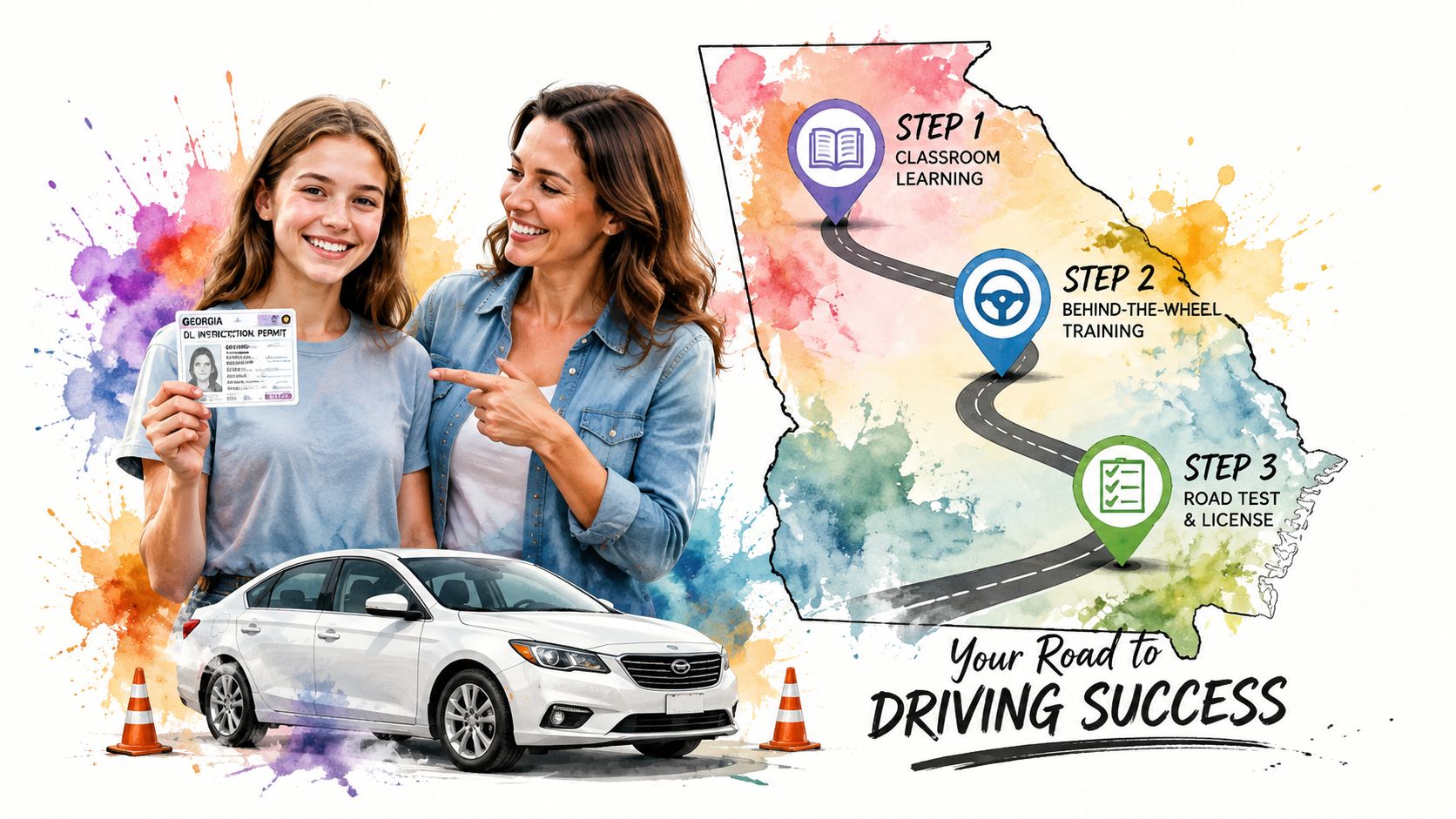
That confusion is normal. Driver ed in GA combines Joshua's Law, supervised practice, classroom instruction, professional lessons, and a road test. The good news is that Georgia doesn't offer just one route. It provides a four-path decision tree, and the state also has a Driver's Education Grant Scholarship Program that may help eligible families manage the cost.
Why Driver Ed in Georgia Feels Overwhelming for First-Timers
Most families run into the same three friction points.
First, people interpret Joshua's Law differently. One parent may say the teen needs a classroom course, while another insists that all driving practice must happen through a school. In reality, Georgia recognizes several completion paths, and the details matter.
Second, provider names create unnecessary fog. Families see terms such as DDS-approved, DDS-certified, licensed driving school, school-based program, and third-party testing center. Those terms can describe different roles, so a course that sounds appropriate may not satisfy every part of the licensing process.
Third, the supervised-practice requirement can collide with ordinary life. School, sports, work, family responsibilities, traffic, weather, and nighttime driving all compete for the same calendar. A teen may understand the rules perfectly and still struggle to organize the required practice with a parent.
The decision is about fit, not just compliance
A family that has a flexible parent available for regular practice may choose a different route from a family with two working parents and a teen who needs evening scheduling. A student who focuses well independently may prefer online instruction, while another learns better in a classroom with an instructor present.
Cost adds another layer. Georgia's Driver's Education Grant Scholarship Program is designed for eligible students, but families often need to understand timing, provider availability, and what training the scholarship supports before they enroll.
Practical rule: Choose the compliance path and lesson schedule together. A classroom certificate alone doesn't create a workable licensing plan.
This roadmap follows the process in the order families experience it, from age and permit decisions through classroom training, supervised practice, driving lessons, scholarship questions, and road-test preparation. The aim is simple: replace guesswork with a clear sequence of choices.
What Joshua's Law Actually Requires at 16 and 17
Joshua's Law is Georgia's framework for moving young drivers from limited driving privileges toward a Class D license. It took effect on January 1, 2007, and created a Graduated Driver's Licensing framework for young drivers ages 15 to 18, according to the Georgia Governor's Office of Highway Safety.
A parent should be able to summarize the rule this way: a teen applying for a Class D license at age 16 or 17 needs approved driver education, professional or parent-guided practice that meets the state's structure, and supervised driving experience. Georgia added 17-year-olds to the driver-training requirement effective July 1, 2021, as stated by the Georgia Department of Driver Services.
Start with the permit and supervised practice
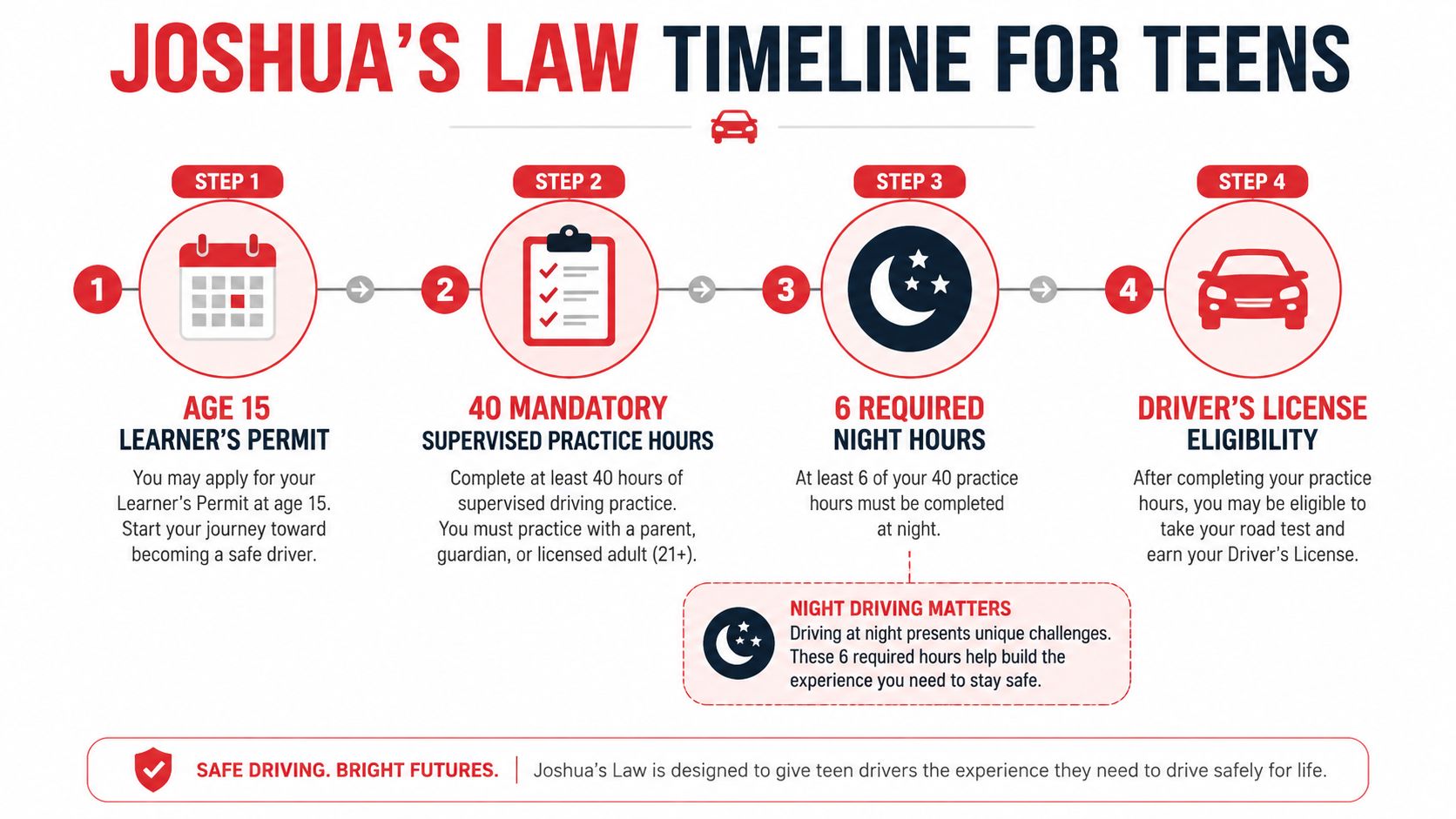
A teen generally begins the licensing journey at age 15 with a Georgia instructional permit. The permit allows supervised driving under the conditions set by Georgia law. The teen must then complete 40 hours of supervised driving, including 6 hours at night, before pursuing the Class D path.
Keep a written or otherwise reliable record of practice. Don't wait until the end to reconstruct where the hours happened. Night driving should be planned deliberately, and parents should introduce more demanding conditions gradually, such as busier roads, lane changes, parking, and highway situations.
Complete the 30-hour and 6-hour education structure
Joshua's Law connects two types of training:
- Theory instruction: A minimum of 30 hours through an approved classroom or online course.
- Professional driving instruction: 6 hours of behind-the-wheel training with a certified instructor at an approved driving school, or completion through the parent-taught option recognized by DDS.
The DDS driver-education FAQs explain that the classroom portion may be completed online through a DDS-approved course. The practical portion must be completed with a DDS-certified instructor or by using the Parent/Teen Driving Guide.
For a 16- or 17-year-old applying for a Class D license, the teen must bring the required identification and licensing documents to a DDS customer service center. Because document requirements can change and depend on the applicant's circumstances, check the current DDS checklist before leaving home. Bring the completion certificate and supervised-driving documentation in the format DDS accepts, along with the teen's permit and required parental or residency documents.
The Four Compliance Paths and Which One Works Best
Georgia DDS lists four approved completion paths. The key difference is who provides the classroom instruction and who handles the six-hour driving component.
| Path | Classroom 30 Hours | Behind-the-Wheel 6 Hours | Best For | Main Trade-Off |
|---|---|---|---|---|
| Path 1 | Classroom instruction through an approved program, with parent-taught practice option | Parent-taught practice may be used under the approved structure | Families with an available parent who can supervise consistently | Requires the most parental time and careful documentation |
| Path 2 | In-person instruction through an approved school | Approved school provides the driving instruction | Teens who learn best face to face | Less control over class timing and travel |
| Path 3 | Online instruction through an approved provider | Approved school provides the driving instruction | Busy students who need flexible classroom access | Requires self-discipline and separate lesson scheduling |
| Path 4 | Approved classroom arrangement, including a provider-based option | Approved school or affiliated provider handles the driving component | Families comparing specialized scheduling options | Verify the provider relationship and acceptance details before paying |
The Georgia DDS Joshua's Law requirements describe the four state-approved combinations as 30 hours of classroom instruction with either 6 hours of behind-the-wheel training or 40 hours of parent-taught practice, and 30 hours of online instruction with the same behind-the-wheel or parent-taught options.
The state evaluation favors a structured school path
Georgia's evaluation compared the approved methods. Method 1, 30 hours of classroom instruction plus 6 hours of behind-the-wheel training at a DDS-approved school and 40 hours of supervised driving, produced the safest outcomes in that evaluation. It had fewer convictions overall than every other method, fewer crashes than Methods 2 and 4, and fewer serious injuries and traffic fatalities than Method 4, according to the Georgia driver-education evaluation executive summary.
That finding doesn't mean every family must choose the same route. It does show why professional instruction deserves serious consideration, especially when a parent feels uncomfortable teaching vehicle control, traffic judgment, or road-test techniques.
For many families, Path 2 or Path 3 offers the clearest balance. Path 2 supplies structure from start to finish. Path 3 keeps the classroom flexible while preserving professional behind-the-wheel instruction. The parent-taught route can work, but only when the supervising adult has the time, patience, and record-keeping discipline to complete it correctly.
In-Person, Online, and Virtual Course Options Compared
The classroom format affects how your teen learns the rules, not whether the behind-the-wheel portion matters. Georgia recognizes a minimum 30-hour theory component, and teens can complete that portion through approved in-person or online instruction, as outlined in the DDS driver-education FAQs.
| Format | Pacing | Where It Happens | Best For | Watch Out For |
|---|---|---|---|---|
| In-person | Scheduled seat time | Driving school or school campus | Students who need accountability and direct interaction | Commute, fixed dates, and attendance requirements |
| Online | Self-paced | At home or another suitable location | Athletes, homeschoolers, and students with changing schedules | Procrastination, distractions, and weak time planning |
| Virtual | Live, instructor-led sessions | Remote classroom | Teens who want structure without traveling | Technology, connection quality, and fixed live-session times |
In-person learning
A classroom gives a nervous student a place to ask questions immediately. The instructor can slow down when students struggle with right-of-way rules, signs, or decision-making, and scheduled attendance creates a firm boundary around the course.
This format works well for a teen who opens a self-paced course and keeps finding reasons to postpone it. It also helps parents who don't want to monitor every login or assignment. The trade-off is transportation and a schedule that may not move around sports or school events.
Online learning
An approved online course can fit around homework, family travel, and late-day activities. The teen controls the pace, but that flexibility only helps if the student creates a realistic study routine and completes the work consistently.
A parent should check whether the provider explains identity verification, progress tracking, completion records, and technical requirements before enrollment. For families comparing online learning resources generally, Soul Shoppe online courses offer useful context on how remote course experiences can be organized, although Georgia families must still select a driver-education provider approved for the state requirement.
Virtual learning
A live virtual class sits between the other two formats. The teen attends at a scheduled time, sees an instructor, and can ask questions, but the family avoids the drive to a physical classroom. It suits students who need a calendar and interaction but have transportation limits.
A practical starting point is to compare Georgia driver's education courses with the teen's actual weekly commitments. Pick the format the student can finish reliably, then reserve the driving lessons before the classroom certificate becomes an isolated accomplishment.
Enrollment, Locations, and Driving Lessons Packages
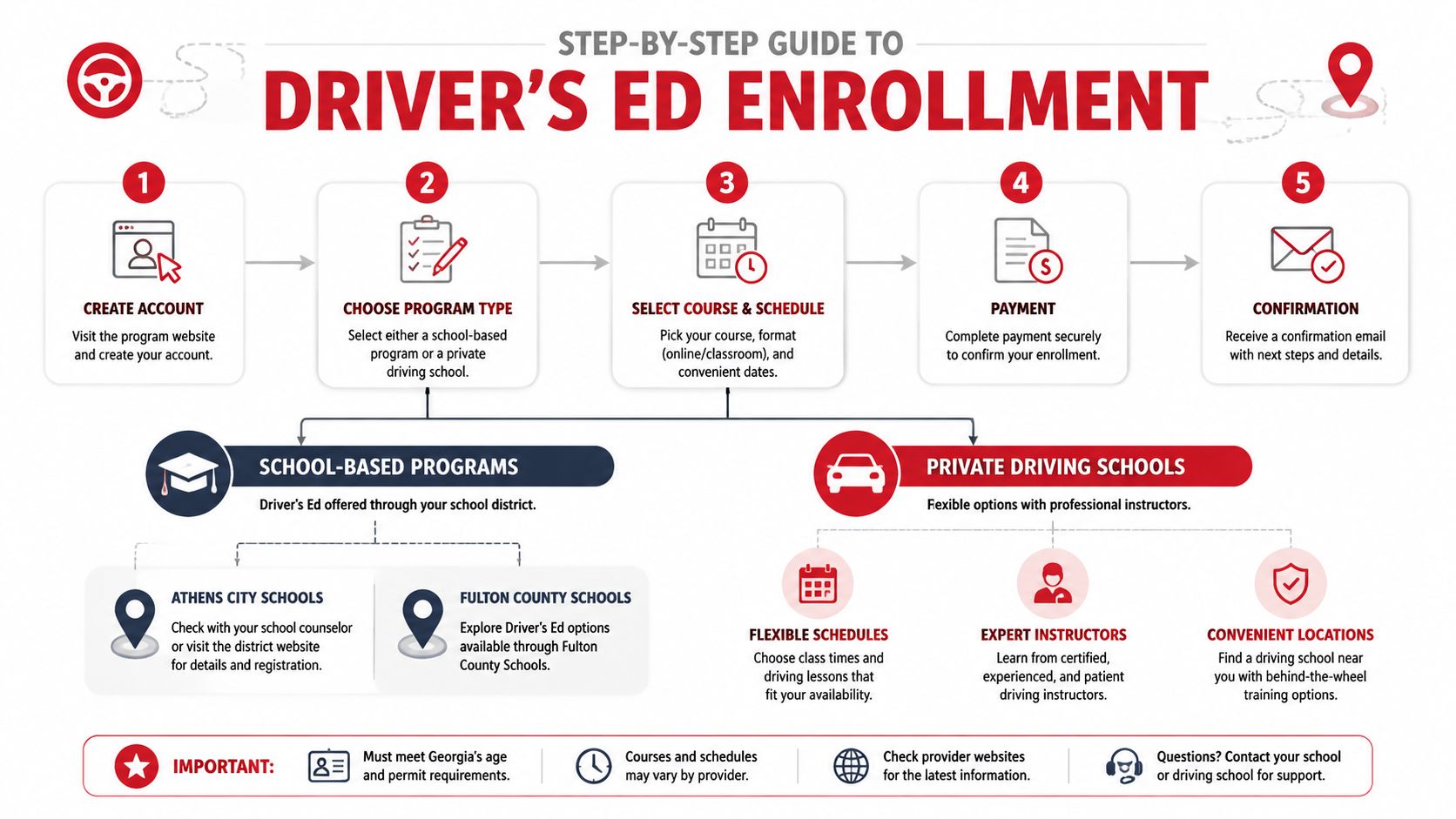
Enrollment should begin with verification, not payment. Ask the school for its current DDS approval or certification information, confirm that the selected course satisfies the relevant Joshua's Law component, and make sure the school explains how it issues completion records.
Gather the basic documents the provider requests, such as the teen's learner's permit when driving lessons require it, a parent or guardian's identification, and proof of Georgia residency when applicable. Before enrolling, read the refund, cancellation, and rescheduling policy. A low-priced course can become expensive if a missed class or lesson has no practical makeup option.
Choose a location that supports the whole plan
Metro Atlanta families may encounter school-based programs, private driving schools, and district partnerships. Athens and Fulton County Schools represent different school-based access points, while private schools in surrounding counties may offer more lesson times or road-test services.
A-1 Driving School is one available provider. Its published materials describe in-person, online, and virtual driver-education options, driving lessons, and Georgia road-test assistance across metro Atlanta locations, including Athens. Families should still confirm current location availability and course dates directly with the provider.
Treat lessons as a package, not an afterthought
The six-hour behind-the-wheel requirement is only one part of becoming ready for independent driving. A useful package may combine the required instructional time with road-test preparation, parking-lot drills, simulator work, or exposure to highway driving, depending on what the school offers.
Ask these questions before booking:
- What is included: Does the package cover the required behind-the-wheel hours, vehicle use, and road-test preparation?
- What can be added: Can the teen schedule extra practice for parking, lane changes, highway entry, or nighttime confidence?
- Who supplies the vehicle: Will the school provide a training vehicle for lessons and testing?
- How are lessons scheduled: Can the family move appointments around school and sports without losing the session?
- What happens after a weak lesson: Does the instructor recommend targeted practice rather than selling more hours?
Use a calendar that connects classroom completion, permit preparation, supervised practice, and lessons. A focused 90-day plan can keep the process visible, but the right timeline depends on permit status, school availability, and the teen's readiness. The Georgia driver's education enrollment guide can help families organize the first administrative steps.
The Georgia Driver's Education Grant Scholarship Program
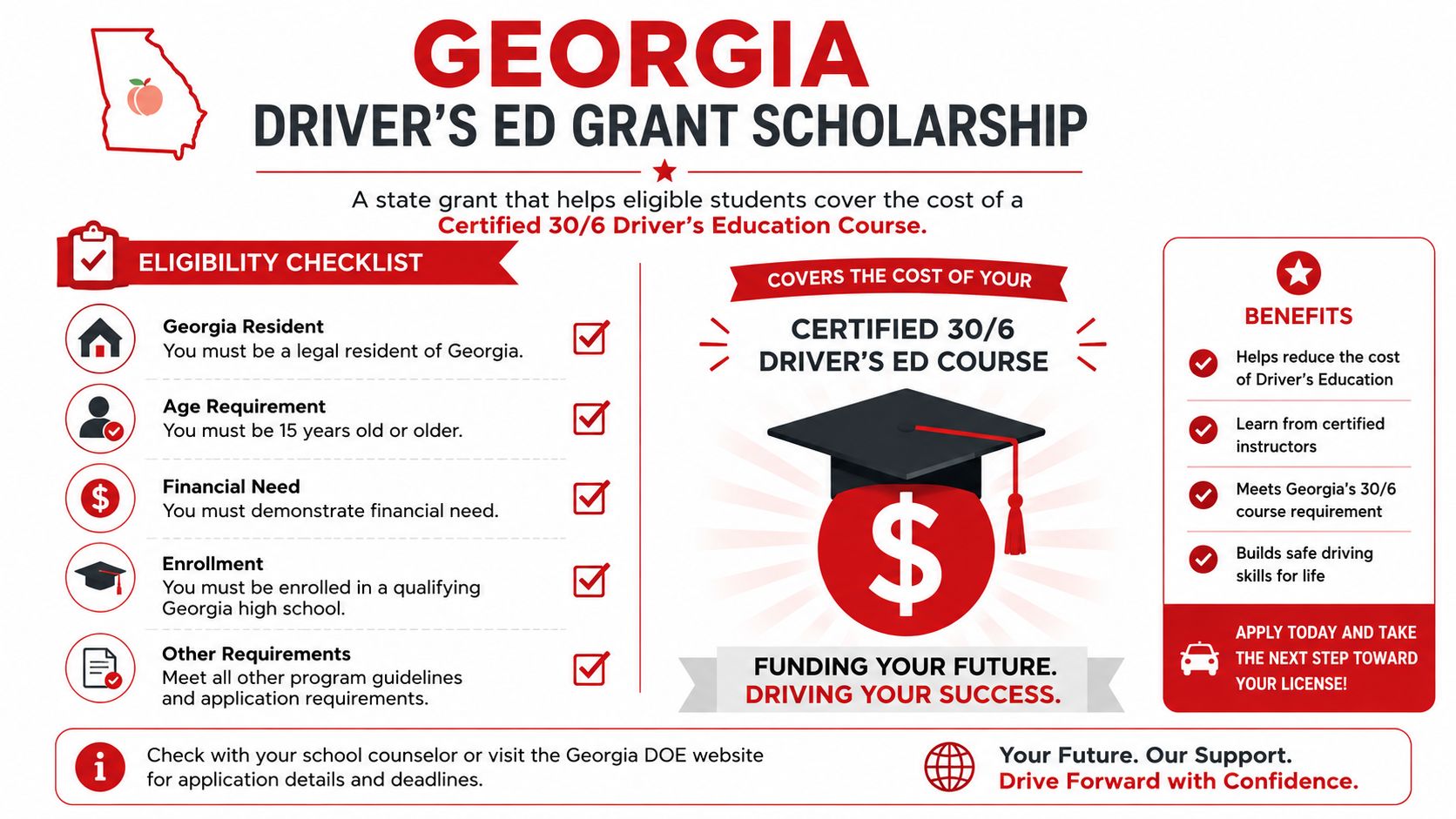
The scholarship is designed to reduce the cost barrier for eligible Georgia students who need the approved driver-education structure. State rules describe a program supporting a 30-hour classroom course plus 6 hours of behind-the-wheel instruction, and school districts may authorize driver-training schools as providers under the state framework described in Georgia rule 163-1-2.
The Georgia Driver's Education Grant Scholarship criteria specify that an eligible student must be a Georgia resident, be actively enrolled in school, be between 15 and 17, and hold a valid Georgia instructional permit or driver's license. The program is intended to help students complete the classroom and driving structure connected to Joshua's Law.
Confirm eligibility before selecting a provider
Public-school access can depend on district arrangements and provider availability. That makes timing important. A family may qualify in principle but still need to confirm which approved schools accept scholarship students, which dates have capacity, and how the school coordinates classroom and driving appointments.
The public information can also be fragmented. Families should verify current application instructions, required documentation, deadlines, and award terms through the state's scholarship portal rather than relying on an old social-media post or a provider's general description.
Before applying: Ask the scholarship administrator and the driving school the same question, what exactly will the award cover for this student and this course?
The scholarship is intended for the qualifying 30-hour classroom and 6-hour driving instruction structure. Families should separately ask about permit or licensing charges, optional additional lessons, missed appointments, and services outside the approved course. If the student needs more practice before testing, a paid lesson package may be considered alongside the covered training, subject to the provider's billing and scholarship rules.
The scholarship program matters because affordability and scheduling usually arrive together. A family needs a provider, a workable calendar, and clarity about coverage, not merely a statement that financial assistance exists.
Road Test Day Through a Certified Driving School
The road test is where classroom knowledge and supervised practice become visible. A certified driving school may offer testing assistance or third-party testing services, but families should confirm the school's current authority, testing schedule, vehicle requirements, and retest policy before booking.
Bring the documents the testing provider and DDS require. Depending on the appointment and licensing situation, that may include the teen's permit or license document, proof of completed driver education and behind-the-wheel training, parent or guardian consent, Social Security information, and proof of insurance. Confirm the exact list in advance because an incomplete document packet can turn a prepared teen away.
Expect practical vehicle control
The examiner evaluates whether the teen can control the vehicle smoothly and make safe decisions. The sequence can include a pre-trip vehicle check, basic control, residential driving, highway or higher-speed driving, turns, lane changes, observation, and compliance with traffic signs and signals.
A student shouldn't memorize a performance script. The better preparation is repeated practice in the skills that create trouble under pressure:
- Vehicle control: Smooth acceleration, braking, steering, and positioning.
- Intersections: Complete stops, deliberate observation, and correct right-of-way decisions.
- Lane changes: Mirror checks, signal use, blind-spot checks, and controlled movement.
- Speed management: Follow the posted limit and adjust appropriately for conditions.
- Parking and backing: Move slowly, look carefully, and maintain control.
Hard braking, rolling stops, speeding, and unsafe lane changes can create serious scoring problems or automatic failure situations. The instructor should explain the school's current rubric and identify the teen's specific weak points before test day.
Connect lessons to eligibility
For a teen pursuing the Class D path, the approved 30-hour education and 6-hour behind-the-wheel structure supports licensing eligibility, while the separate supervised-practice requirement builds broader experience. Extra lessons can help a student who knows the rules but still hesitates at intersections, struggles with parking, or becomes tense around traffic.
The Georgia road test preparation guide can help families review the practical expectations before scheduling. On test morning, check the vehicle, bring the documents, arrive early, silence the phone, and take a moment to breathe before moving. Calm, deliberate driving is more useful than trying to impress the examiner.
Your Next Steps and Common Georgia Driver Ed Questions
A clean plan looks like this:
- Confirm eligibility: Check the teen's age, permit status, school enrollment, and intended license path.
- Choose a compliance route: Compare the four approved combinations, including classroom delivery and who will provide the driving component.
- Verify the provider: Confirm DDS approval or certification and review the completion documentation.
- Plan supervised practice: Record the required hours and deliberately include nighttime driving.
- Schedule professional lessons: Reserve the behind-the-wheel component early, then add targeted practice if needed.
- Prepare for testing: Confirm documents, vehicle arrangements, scheduling, and retest rules.
- Complete the licensing step: Take the road test and bring the accepted records to DDS for the Class D process.
Questions families ask after enrollment
Can an out-of-state certificate be used?
Don't assume it will transfer. Ask DDS and the Georgia provider to verify whether the specific certificate satisfies Georgia's requirement before relying on it.
Can siblings share scholarship funds?
Treat each student's eligibility and award as separate. Confirm the program's current rules rather than assuming one student's approval can be transferred.
What happens if the teen turns 18 before finishing?
The licensing requirements can change with age and license type. Contact DDS and the provider promptly so the family knows which remaining steps still apply.
How long are certificates valid?
Ask the issuing school and DDS about the specific certificate. Keep the original completion record and confirm that the document remains acceptable when the teen schedules licensing.
Does the teen need a learner's permit before driving lessons?
The classroom portion may be completed before the permit, but the teen needs the appropriate legal authorization before driving on public roads. Confirm the school's enrollment and lesson policy.
Can the road test be taken at a private school instead of DDS?
Some certified driving schools may provide testing assistance or third-party testing. Verify the school's current authorization and confirm how the result connects to the DDS licensing process.
Start by checking eligibility and the scholarship option, then reserve the classroom format that fits your teen's actual schedule. Keep the permit, supervised-practice record, completion certificate, lesson appointments, and road-test plan in one place so every checkpoint is easy to verify.
A-1 Driving School offers Joshua's Law driver-education courses, online and instructor-led options, driving lessons packages, and Georgia road-test preparation for families building a complete licensing plan. Visit A-1 Driving School to compare course options, review enrollment details, and take the next step toward confident driving.