You're sitting in an automatic car with your learner's permit, a road-test date in mind, and a practical question: what should you practice first, and how do those lessons fit into Georgia's licensing requirements? The answer isn't to just drive until the controls feel familiar. You need a sequence that builds vehicle control, observation, traffic judgment, supervised practice, and test readiness at the same time.
Automatic car lessons remove clutch coordination and routine gear changes, but they don't remove the work required to become a safe, independent driver. In Georgia, the strongest results come from connecting each behind-the-wheel session to the Class D pathway, including Joshua's Law requirements for eligible teens, supervised driving, documentation, and the road test.
Why Automatic Car Lessons Are Now the Default
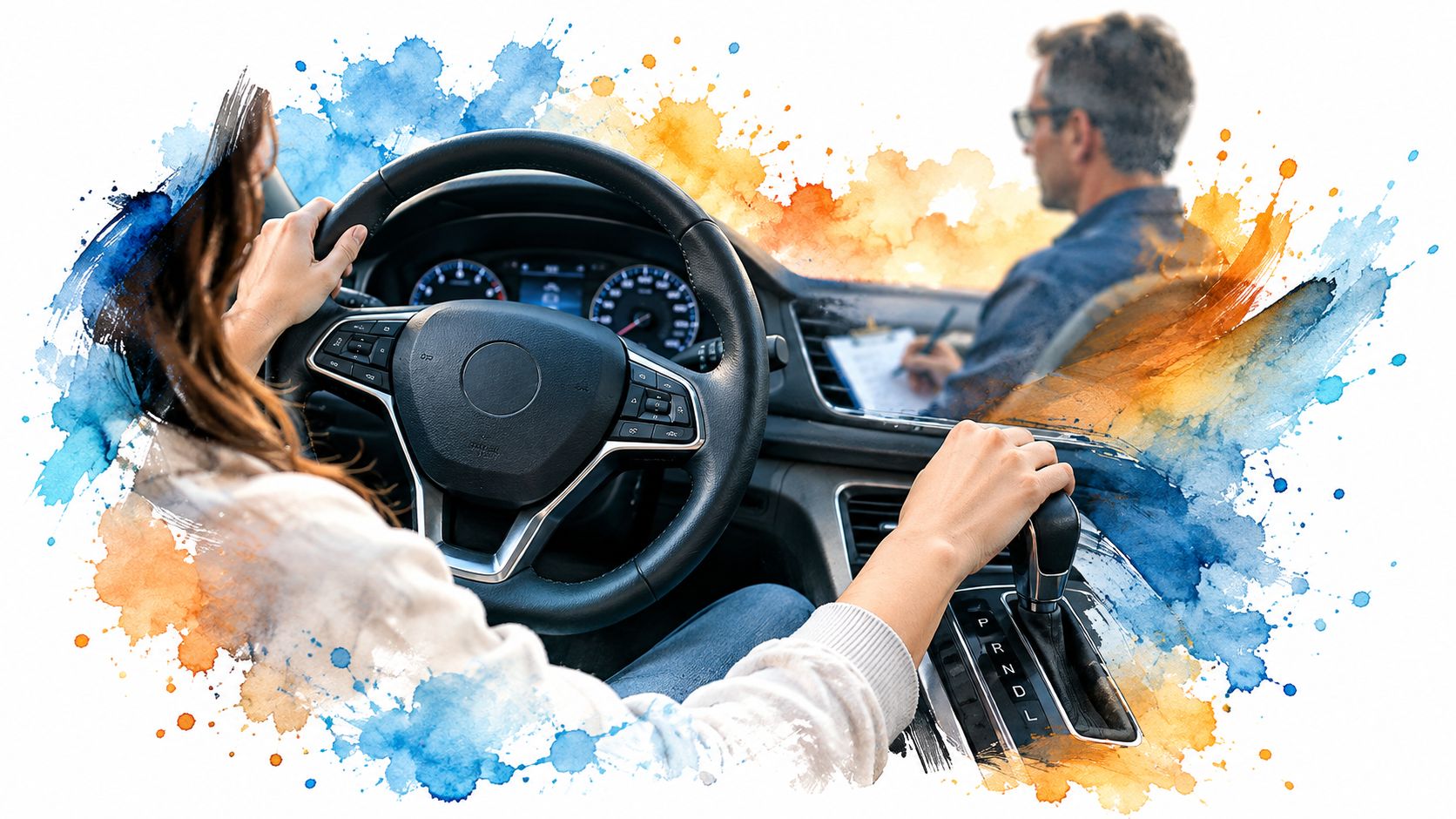
The first automatic lesson often starts calmly. You adjust the seat, check the mirrors, locate the pedals, and look at the gear selector. There's no clutch pedal to find and no manual gear sequence to memorize, but the setup still matters because poor seating position makes steering, braking, and mirror checks less precise.
An automatic transmission takes over clutch engagement and gear selection. It doesn't take over steering accuracy, braking judgment, accelerator control, lane positioning, observation, or hazard response. Those skills remain the foundation of every lesson, whether the vehicle has two pedals or three.
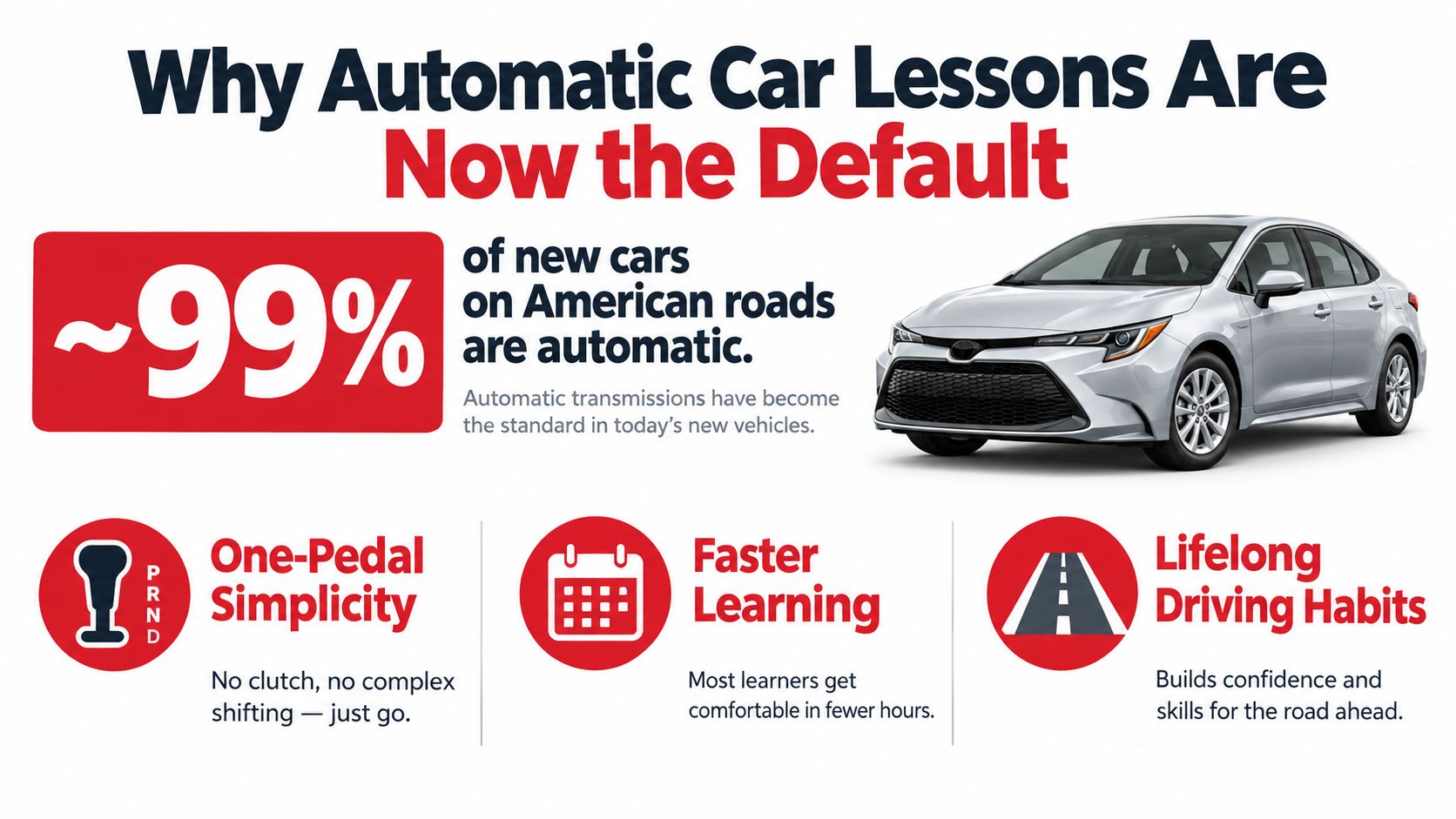
One compiled industry estimate reports that approximately 96% of U.S. passenger vehicles sold in 2023 had automatic transmissions, leaving manual vehicles at about 4%; a separate historical summary places automatic-equipped vehicles at roughly 93% of new U.S. cars by 2016. The exact share varies by vehicle definition and source, but the practical conclusion is clear: most American learners will practice, test, and build long-term driving habits in an automatic vehicle. Automatic transmission market history provides the relevant background.
What the transmission removes
Automatic instruction reduces the mental workload associated with clutch release, gear selection, and timing changes through traffic. That gives a beginner more attention for traffic signals, pedestrians, following distance, and developing a consistent scanning routine.
The technology has been part of mainstream driving for generations. General Motors introduced Hydra-Matic as the first mass-produced automatic transmission in 1939, for the 1940 Oldsmobile model year. It was offered as a $57 option, used four forward speeds plus reverse, and allowed drivers to operate the vehicle without manually engaging a clutch or selecting each gear. Automatic transmission history explains that development.
Automatic lessons aren't a shortcut around driver education. They're the modern route for learners whose daily vehicle, family car, or likely first car uses an automatic transmission.
Inside the Automatic Cockpit on Your First Lesson
Before the engine starts, a good instructor checks the driver's position rather than rushing toward movement. Your seat should let you press the brake firmly without stretching, your back should remain supported, and your hands should reach the steering wheel without locking your elbows. Set the interior and side mirrors after the seat is correct, then recheck them once the car moves.
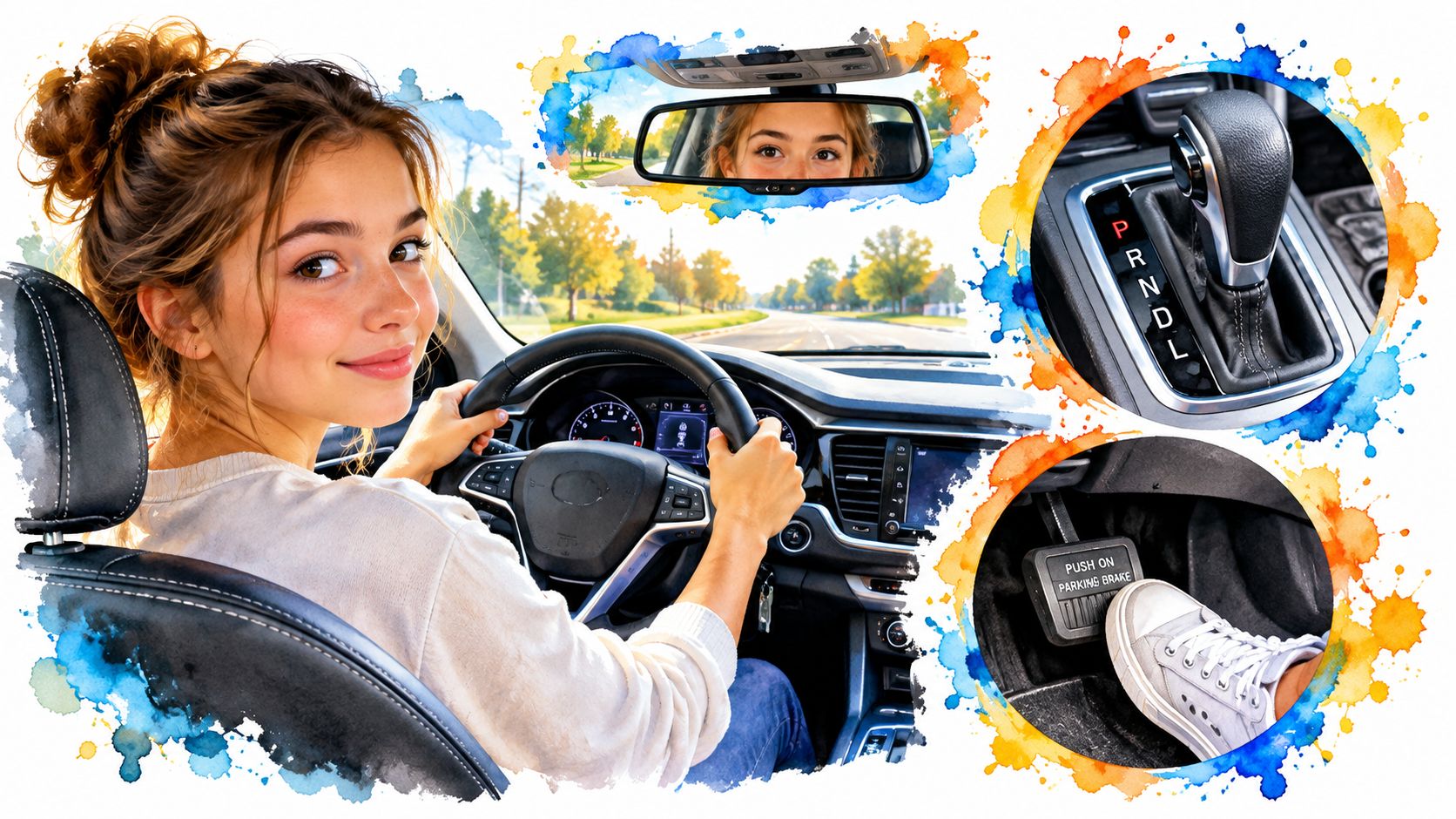
The selector usually shows Park, Reverse, Neutral, and Drive, although some vehicles add lower ranges or manual-selection modes. Park secures the transmission for parking, Reverse moves the vehicle backward, Neutral disconnects normal drive power, and Drive selects forward operation. You still need to understand the parking brake, whether it uses a lever, foot pedal, or electronic switch, because the transmission selector isn't a substitute for correct parking procedure.
The instrument cluster deserves attention too. A learner should recognize the speedometer, warning lights, fuel or charge display, turn-signal indicators, and the selected gear. Looking at the dashboard should be brief and deliberate, never a reason to lose sight of the road.
Building a stationary routine
Before moving, confirm the doors are closed, the seatbelt is fastened, the phone is away, and the mirrors are set. Keep the right foot responsible for both the brake and accelerator. Two-foot driving creates a dangerous habit because the driver can press both pedals or leave the left foot resting near the brake.
The first movement in a quiet lot should feel controlled, not dramatic. With the brake released gradually, the vehicle may creep forward. Learn that low-speed movement before adding gentle accelerator pressure, then practice stopping with progressive brake pressure rather than a late, sharp application.
For additional preparation before a lesson, review how to prepare for driving lessons so the session begins with the right documents, clothing, and expectations.
Core Automatic Skills You Will Practice First
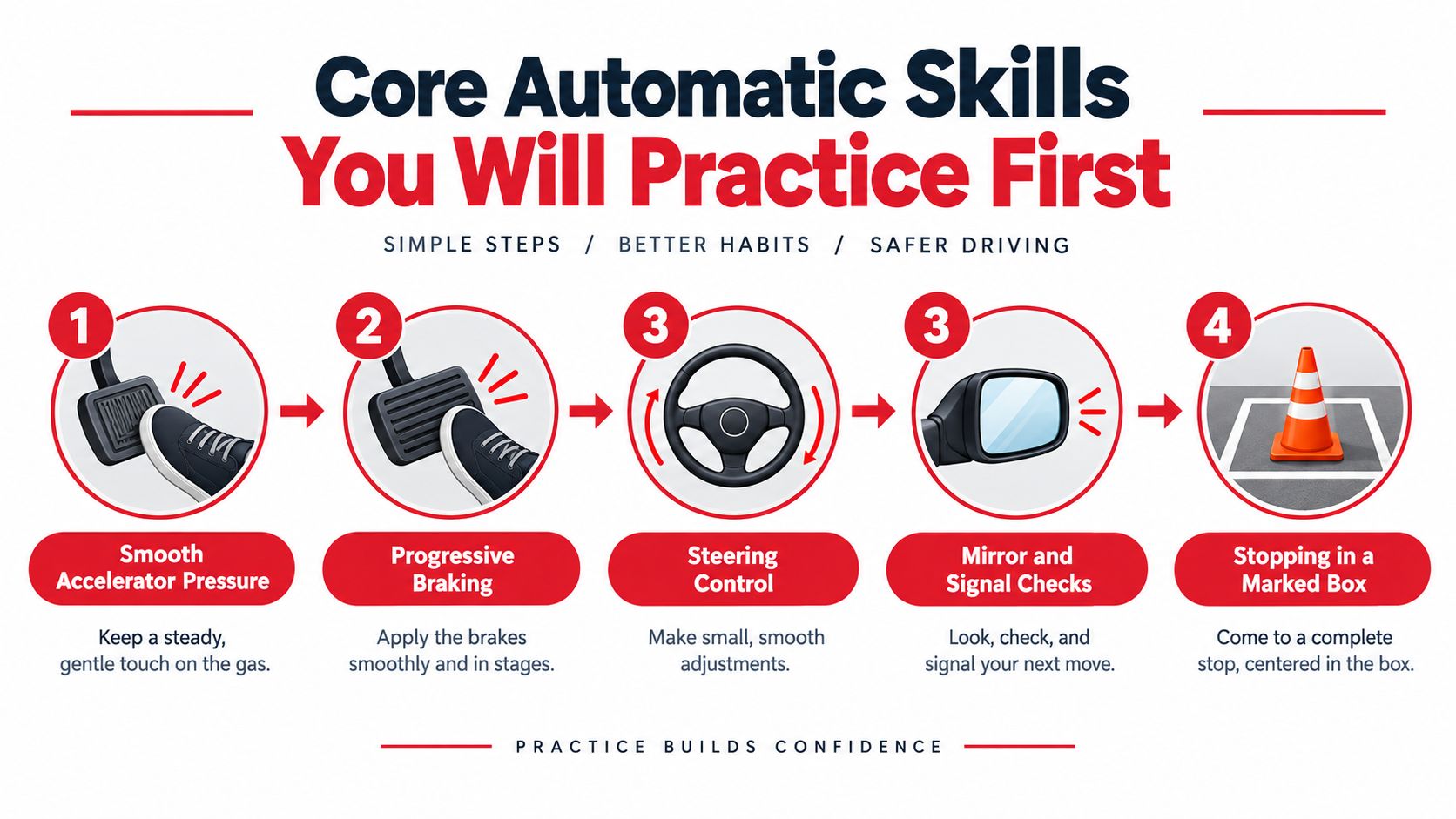
The first parking-lot session should create a repeatable control pattern. Start with light accelerator pressure, then remove pressure early and let the car slow before applying the brake. This teaches your foot to make small adjustments instead of switching between no control and too much control.
Steering comes next. New drivers often grip the wheel tightly and make large corrections, which causes the vehicle to wander. Keep your hands stable, look through the intended path, and make smaller inputs. The car follows your vision more accurately when you're not staring at the curb or the front corner of the hood.
The first control loop
A useful automatic-driving loop combines look, signal, position, speed, and movement. Before changing direction or position, scan mirrors and the surrounding space, signal early enough to communicate, set the correct lane position, manage speed, and then complete the maneuver.
At a stop, keep the brake applied while waiting. On a hill, understand how the car responds when the brake releases. Some vehicles have hill-hold assistance, but a learner must still control the brake and accelerator without assuming technology will prevent rollback.
Reversing deserves its own practice. Georgia DDS materials identify straight-line backing as a tested skill. The applicant reverses approximately 50 feet at no more than 10 miles per hour, looks behind the vehicle, and demonstrates posture and steering control without relying only on mirrors. Georgia road-test requirements describe this expectation.
From the lot to the street
The quiet-area routine extends directly to neighborhood streets. Smooth pedals help at stop signs, accurate steering helps with turns, and mirror checks support lane changes. Parking practice should include pull-in spaces, backing into a space when appropriate, and eventually parallel parking if it's relevant to the test or the driver's normal life.
Observation doesn't change because the transmission is automatic. A pedestrian near a driveway, a vehicle emerging from behind a parked car, or a driver moving across a lane still requires the same scanning and response.
Taking Automatic Skills Into Real Georgia Traffic
A learner can drive around a quiet subdivision for a long time without confronting the decisions that cause difficulty on a road test or during independent driving. Staged, error-based practice works better. The instructor identifies a specific weakness, creates a manageable exercise, and raises the complexity only after the learner can repeat the skill without intervention.
Where control meets judgment
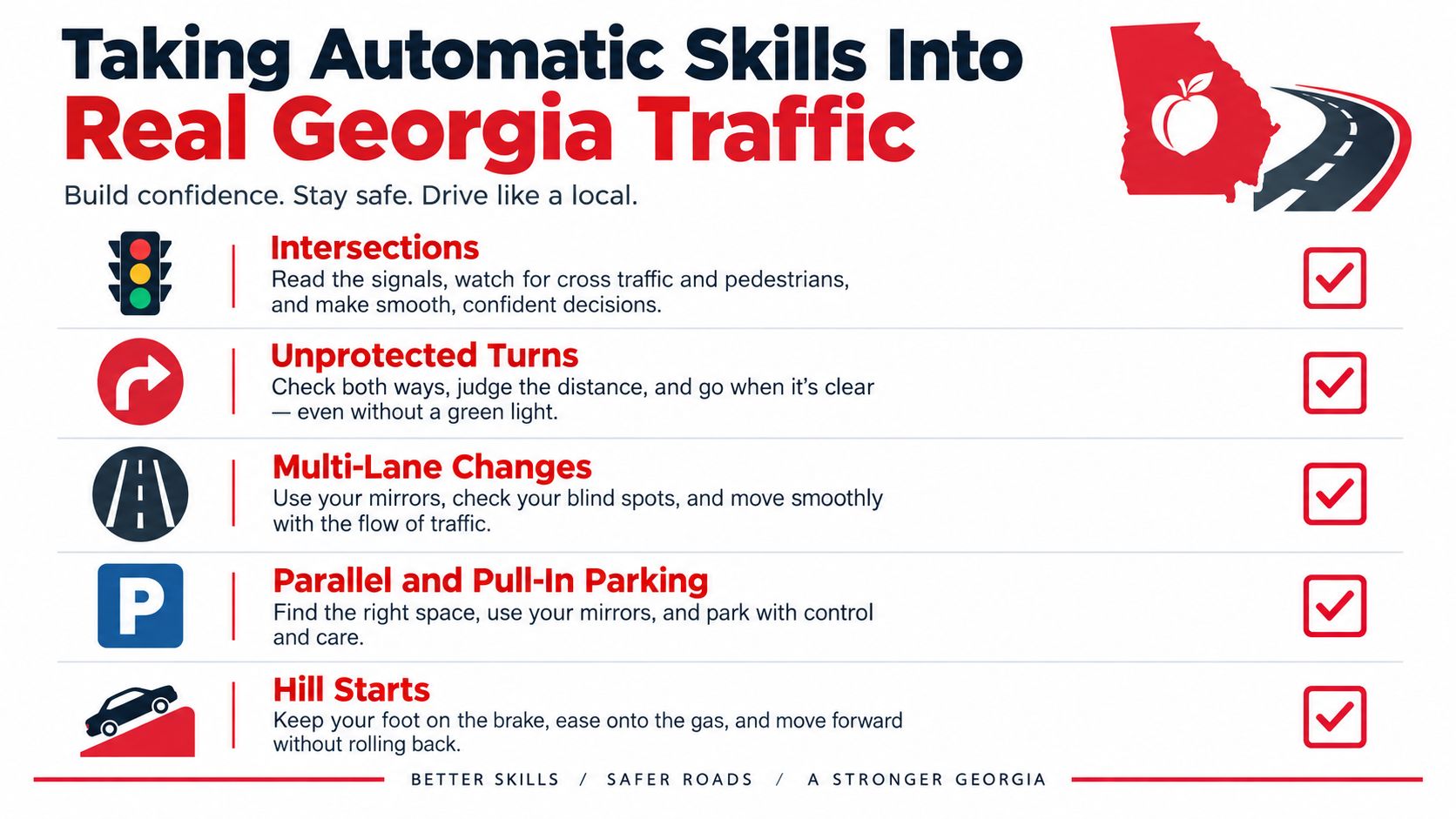
Intersections reveal whether the learner is scanning early or reacting late. Unprotected turns require gap judgment, pedestrian awareness, and a controlled entry speed. Multilane roads add lane-change timing, mirror checks, blind-spot observation, and speed adaptation.
A learner should understand master side mirror blind spots rather than treating a quick mirror glance as a complete safety check. The driver still needs to scan the appropriate area before moving laterally.
Georgia traffic can add pressure through busy merges, school zones, glare, crowded shopping-center entrances, and pedestrians crossing where drivers don't expect them. Automatic creep can help with very slow positioning, but it can also surprise a learner who releases the brake without checking the path.
Why varied routes matter
Practice should move from quiet streets to ordinary traffic, then to more demanding conditions such as multilane roads, unfamiliar routes, darkness, and rain. The learner doesn't need every condition at once. The instructor should introduce one meaningful challenge, observe the errors, and repeat it until the response becomes dependable.
Instructor's rule: If the driver only succeeds on a familiar route, the skill hasn't transferred yet.
A long drive on the same road may feel productive, but it can conceal weak lane changes, late braking, poor gap selection, or incomplete scanning. Shorter drives with different decisions give the instructor better information and give the learner more useful repetition.
Practice Quality Beats Practice Hours Every Time
The most valuable practice is frequent, supervised, and varied. An NICHD-reported study of 82 learner drivers found that participants averaged more than 1,200 supervised miles over 89 days; those who practiced regularly and more frequently had a 39% lower crash risk during the first year after licensure than those who practiced less often. NICHD summary of supervised teen driving research provides the study details.
That finding changes how families should schedule practice. One long weekend session on a familiar route isn't enough if the learner spends the rest of the week away from the wheel. A practical routine is three or more varied drives per week, with each drive focused on a specific combination of control and judgment.
Use an error log
After each drive, record what happened while the details are fresh. The log doesn't need to be complicated.
- Speed control: Did braking begin early enough, especially near intersections and curves?
- Following distance: Did the driver leave enough space when traffic slowed?
- Signaling: Was the signal used before the maneuver, not during it?
- Lane position: Did the vehicle stay centered without repeated corrections?
- Decision timing: Did the driver wait for a safe gap or rush because another vehicle was nearby?
The next session should address the most important recurring error first. If the driver repeatedly brakes late, adding a difficult route won't solve the problem. Return to a manageable environment, improve the visual cue and braking response, then apply it in traffic.
Connect practice to Georgia requirements
For a teen pursuing a Georgia Class D license, supervised driving sits alongside formal education. Joshua's Law requires at least 30 hours of approved driver education, plus 6 hours of behind-the-wheel training with a certified instructor or completion of the approved Parent/Teen Driving Guide. The teen must also complete at least 40 total supervised driving hours, including 6 hours at night. Georgia DDS Driver Education FAQs outlines those requirements.
The permit period also matters. A Class D applicant must hold the instructional permit for at least one year and one day, complete the applicable education and supervised practice, and pass the skills testing sequence. Practice should therefore include night driving, weather when conditions are reasonable, unfamiliar roads, and the exact maneuvers the driver will need to perform independently.
How Automatic Lessons Fit the Georgia Licensing Pathway
Georgia licensing is easier to manage when every requirement has an owner and a completion record. The education course supplies classroom or online instruction, behind-the-wheel lessons develop vehicle control, supervised drives build experience, and the road test confirms independent performance.
For applicants under 18, the required education must be approved by DDS. The course may be completed in a classroom or through an equivalent DDS-approved online option. The separate behind-the-wheel requirement can be completed with a certified instructor or through the approved Parent/Teen Driving Guide pathway.
Georgia Class D licensing sequence at a glance
| Step | Requirement | Who It Applies To | Where Automatic Lessons Help |
|---|---|---|---|
| Education | At least 30 hours of approved driver education | Class D applicants under 18 | Connects road rules to automatic-vehicle decisions |
| Instructor training | 6 hours with a certified instructor, or the approved Parent/Teen Driving Guide pathway | Class D applicants under 18 | Builds controlled braking, steering, parking, and observation |
| Permit period | Hold the instructional permit for at least one year and one day | Class D applicants | Provides time for supervised practice |
| Supervised driving | At least 40 hours, including 6 hours at night | Class D applicants under 18 | Expands practice beyond easy daytime routes |
| Road test | Pass vision and road-skills testing with at least 75% | Road-test applicants | Rehearses tested maneuvers in a compliant vehicle |
An automatic vehicle is suitable for road-test preparation, but the applicant must demonstrate independent control rather than rely on advanced driver-assistance technology. The test vehicle must be a compliant four-wheel vehicle with valid registration, a license plate, and required insurance, and it must pass the applicable safety inspection. During the appointment, the applicant needs a licensed driver who is at least 21 years old accompanying them. Only the applicant and that driver may be in the vehicle, with no additional minors, children, or pets.
Use how to get a driver's permit in Georgia to organize the early paperwork and permit steps. For road-test appointments, remember that the applicant must schedule the test and surrender the instructional permit at testing.
Matching lessons to the sequence
A practical package may begin with vehicle familiarization and control drills, continue through neighborhood traffic and parking, then finish with road-test preparation. An online Driver's Education course can cover the approved classroom component, while private automatic lessons address the skills that a family's practice route may not provide.
The Georgia Driver's Education Scholarship Grant Program can also matter for qualifying applicants. Families should verify current eligibility, documentation, and participating-program details before booking because administrative requirements can change.
Matching Your Situation to the Right Lesson Package
A 16- or 17-year-old starting Joshua's Law needs a coordinated plan, not only a few practice drives. Start with the approved education course, schedule the required instructor training or follow the approved Parent/Teen Driving Guide, and use automatic lessons to target the skills that need professional feedback.
A college student with a permit but little supervised practice may need a fundamentals package first. The priority is to establish pedal control, lane position, turns, parking, and observation before adding busy multilane traffic.
An adult who recently moved to Georgia may already know how to drive but still need local road-test preparation, documentation guidance, or practice in an automatic vehicle. A driver retaking the road test should focus on the exact errors that caused the previous failure rather than repeating every lesson from the beginning.
Before booking, check the following:
- Bring: Your permit or required identification, any course-completion records, and a clear list of skills that cause difficulty.
- Skip: Unsupervised practice in an unfamiliar vehicle, phone use during drives, and endless repetition on one easy route.
- Choose: A package that matches your current level, required Joshua's Law components, supervised-practice needs, or road-test goal.
- Plan: Night, rain, parking, lane changes, unfamiliar roads, and the vehicle requirements before the appointment.
- Book: Review how many driving lessons you may need and select a package based on demonstrated skill, not a guessed number of hours.
A-1 Driving School offers automatic driving lessons for Georgia teens and adults, Joshua's Law Driver's Education through in-person and online options, road-test preparation and testing assistance, lesson packages, and information about the Georgia Driver's Education Scholarship Grant Program. Visit A-1 Driving School to choose the course or automatic lesson path that fits your permit, practice, and Class D road-test needs.