
Your teen is nearly old enough to drive, your work schedule is already packed, and every Georgia driving school seems to advertise a different package. One school leads with a low hourly rate. Another promotes Joshua's Law. A third promises road-test help, but won't explain what that includes. Comparing the price alone is how families end up paying for extra lessons, missed appointments, or a second road test.
A good auto driving school should give you a clear route from classroom instruction to supervised practice, road-test readiness, and licensing. The package should match the student's actual needs, the instructors should be properly licensed, and the school should explain what happens if the learner needs more practice.
| What to compare | Why it matters |
|---|---|
| Joshua's Law coverage | Confirms the teen's required classroom and behind-the-wheel training is accounted for |
| Lesson-package design | Shows whether the school builds skill or simply sells driving hours |
| Instructor credentials | Helps you verify that a qualified professional is teaching your student |
| Road-test support | Reduces the gap between finishing lessons and taking the test |
| Scheduling and pickup options | Determines whether the student can practice consistently |
| Scholarship eligibility | May make an approved course more accessible for qualifying Georgia families |
Choosing an Auto Driving School in Georgia
The right choice depends on where the learner is starting. A teen approaching age 15 needs a structured plan for a learner's permit and the requirements connected to Joshua's Law. An adult who needs a license for a new job may not need a full teen curriculum, but may need focused lessons, test preparation, and a dependable vehicle for the road test. A parent comparing schools has a different problem, balancing cost with instructor quality and scheduling.
Start by asking each school to describe the complete path, not just the advertised lesson rate. You should be able to identify the classroom format, behind-the-wheel hours, supervised practice expectations, road-test preparation, scheduling process, and any charges that sit outside the package.
Practical rule: Compare the cost of reaching a license, not the cost of buying the first lesson.
A cheap driving hour can become expensive if the instructor changes constantly, the student receives little feedback, or the school doesn't help the family prepare for the test. Strong instruction should correct habits early, build decision-making skills, and give parents useful guidance for supervised practice. The National Highway Traffic Safety Administration review of driver education found mixed but measurable safety effects, including 1.9% fewer crashes per driver among driver-education graduates and a 4% lower crash rate per kilometer driven. Those findings don't justify treating classroom completion as a guarantee. They do support taking the quality of the complete training process seriously.
Use a working comparison checklist
Before enrolling, ask two or three local schools the same questions:
- What exactly is included? Confirm classroom hours, behind-the-wheel time, pickup and drop-off, vehicle use, road-test preparation, and retest policies.
- Who will teach the student? Ask about instructor licensing, experience with teens or adults, and how the school handles instructor substitutions.
- How does scheduling work? Look for realistic lesson availability that allows regular practice instead of long gaps.
- What happens after lessons end? Ask whether the school helps coordinate the road test and prevents skill loss during a testing delay.
Your decision should become clear when you compare complete answers side by side. The strongest school isn't necessarily the one with the lowest headline price. It's the one that gives the learner enough quality practice, useful feedback, and a practical route to the license.
What Joshua's Law Requires in Georgia
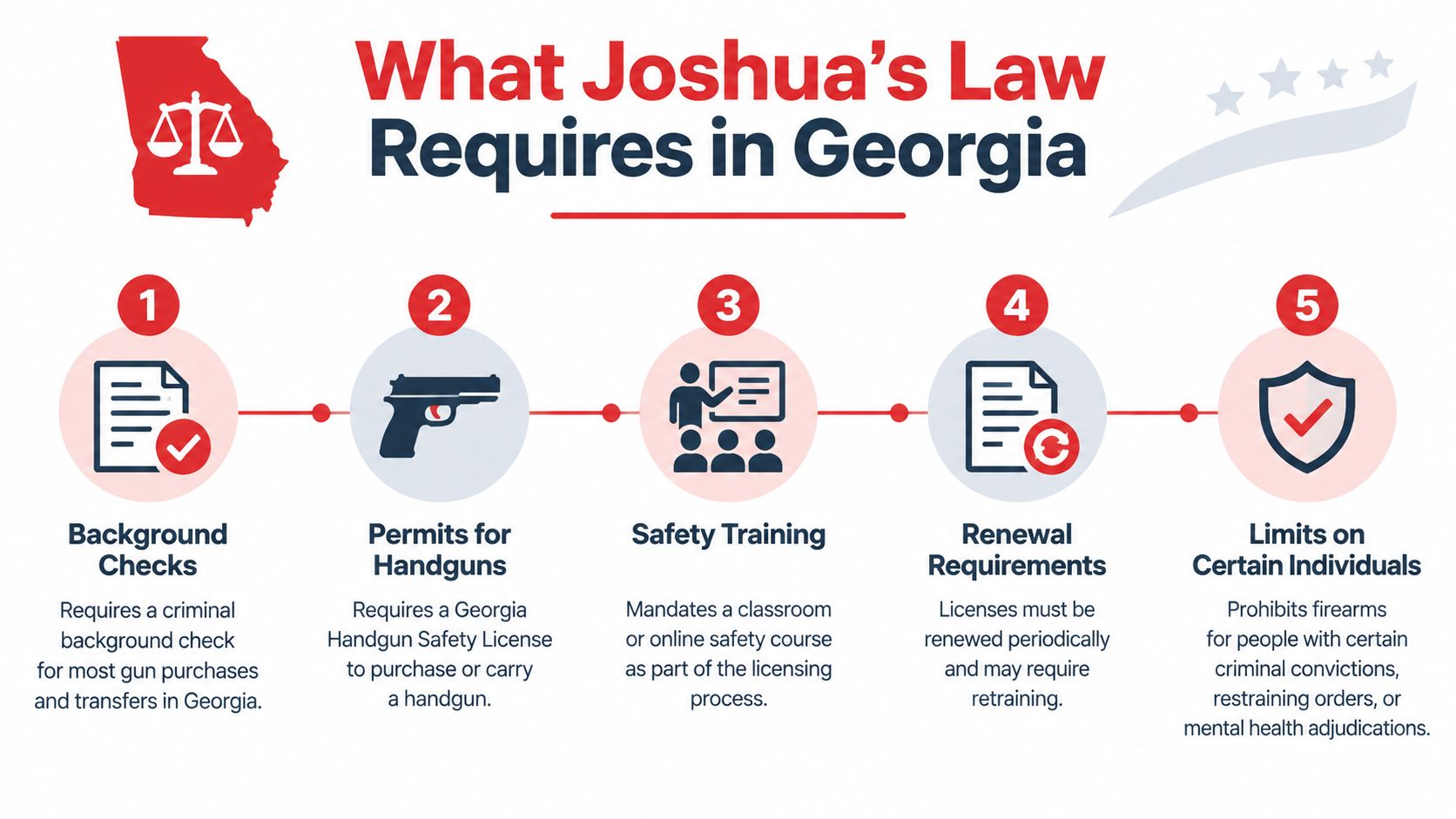
Georgia families should understand Joshua's Law before comparing packages. For teen drivers, the approved paths combine classroom or online instruction, professional behind-the-wheel training in some options, and supervised driving with a parent or guardian.
Georgia lists four approved training paths through the official Joshua's Law requirements:
- Method 1: 30 hours of classroom instruction, 6 hours behind the wheel at a certified school, and 40 hours of supervised driving with a parent or guardian, including 6 hours at night.
- Method 2: 30 hours of classroom instruction and 40 hours of parent-taught behind-the-wheel training.
- Method 3: 30 hours of online instruction, 6 hours behind the wheel at a certified school, and 40 supervised hours with a parent or guardian, including 6 hours at night.
- Method 4: 30 hours of online instruction and 40 hours of parent-taught behind-the-wheel training.
That distinction matters. A parent-taught route can work for families with time, patience, and a vehicle suitable for consistent practice. A certified school route is usually the better fit when the parent wants professional coaching, has limited availability, or isn't comfortable teaching braking, lane positioning, traffic judgment, and maneuver control.
Match the path to the student
The learner's age affects timing. A 15-year-old can work toward a learner's permit after completing the applicable course requirements. A 16-year-old can move toward a Class D license after meeting the required training and supervised-driving conditions. Don't assume that finishing online coursework means the teen is ready to test. The supervised hours still need to be completed and documented.
For the Georgia road test, the applicant must hold a valid Georgia non-commercial learner's permit and sign an affidavit confirming 40 hours of supervised road driving, including 6 hours at night. The Georgia DDS road-test requirements confirm that these hours align with Joshua's Law and must be addressed before testing.
Families should also ask the school what documents DDS expects on test day, including the Certificate of Attendance, known as DS-1, and notarized parent consent where applicable. Requirements can depend on the applicant's circumstances, so verify the current checklist with DDS rather than relying on an old social-media post. A school that helps families organize paperwork is providing real value, because a prepared student can still lose a test appointment over missing documentation.
For Georgia-specific course options, review driver education programs in Georgia and compare the delivery format before paying. Online instruction may solve a scheduling problem, while professional lessons can solve a skill problem. Many teens need both.
Credentials and Instructor Quality That Matter
A polished website doesn't prove that an auto driving school is legitimate. Ask for the school's current DDS license or facility number, verify that instructors hold valid licenses, and confirm that training vehicles have appropriate commercial liability coverage. If a school hesitates to share its DDS license number, disqualify it.
Instructor quality matters just as much as facility approval. Look for experience teaching the specific learner in front of you, whether that's a nervous teen, a confident adult with poor habits, or a student preparing for a first road test. Ask how instructors stay current with Georgia road-test expectations and how they document progress after each lesson.
| Verification Factor | Licensed Georgia School | Unlicensed or Risky Operator |
|---|---|---|
| Facility verification | Shares a current DDS license or facility number | Avoids clear licensing information |
| Instructor vetting | Uses instructors with valid instructor licenses | May rely on unverified or informal teaching |
| Vehicle maintenance | Maintains training vehicles for regular instruction | May provide unclear maintenance or insurance information |
| Complaint history | Can be evaluated through official channels | May have limited accountability |
| Training records | Explains lesson progress and completion documents | May provide vague records or informal receipts |
| Road-test preparation | Describes a defined preparation process | May only sell driving hours |
Ask questions that expose weak instruction
Don't accept “experienced instructors” as a complete answer. Ask how many lessons the instructor typically teaches, whether the instructor works with teens and adults, and what happens when a student isn't ready for the next skill.
A reliable instructor should be able to explain the student's weaknesses in plain language. “Needs more practice” isn't enough. You should hear specific observations about mirror use, speed control, following distance, lane changes, turns, parking, and hazard recognition.
Instructor standard: A lesson should end with a clear next step for the student and, when appropriate, a useful practice assignment for the parent.
Read the warning signs of unlicensed driving schools before making a deposit. Verification isn't busywork. It protects the learner, the family vehicle, and the time you've set aside for training.
Comparing Driving Lesson Packages and Formats
The hourly rate tells you very little by itself. A useful package explains what the student receives before, during, and after each lesson. Compare instructor continuity, pickup and drop-off coverage, scheduling flexibility, vehicle access, progress reports, and road-test support.
A standard Joshua's Law package commonly centers on the required 30 hours of classroom or online instruction and 6 hours of behind-the-wheel training, but the delivery can vary widely. Some schools provide in-person classes, while others offer online coursework. Some schedule one-on-one lessons, while others use shared vehicles or narrow appointment windows.
| Package Feature | Standard Joshua's Law Package | Premium/Add-On Package | Budget Online-Only |
|---|---|---|---|
| Classroom delivery | Classroom instruction or an approved equivalent | Classroom or online option with added support | Online instruction |
| Professional driving | Includes the applicable behind-the-wheel training | Adds private lessons or targeted refreshers | May require parent-taught practice |
| Scheduling | Standard appointment availability | More flexible or priority scheduling may be available | Student and parent manage practice |
| Pickup and drop-off | Depends on the school's service area | May include broader or more convenient coverage | Usually not applicable |
| Road-test support | Ask whether preparation is included | May include dedicated preparation or vehicle support | Often handled separately |
| Best fit | Families completing the standard path | Learners needing extra coaching or convenience | Families able to manage supervised practice |
Look past the promotional price
Suppose one school advertises a $499 special and another lists a $650 standard package. Don't decide until you know whether the difference reflects pickup range, instructor tenure, class format, private lesson time, vehicle availability, or a retest policy. Those details can matter more than the initial gap in advertised price.
Be cautious when a school bundles required hours into a package that makes them appear like optional upgrades. Confirm whether materials, certificates, administrative processing, vehicle use, and road-test preparation are included or billed separately. A clear written quote should identify the total expected cost and the conditions attached to each service.
Choose the format that supports consistency
Online classes are useful when school, work, sports, or family schedules make classroom attendance difficult. In-person instruction can help students who learn better through discussion and direct correction. Neither format replaces quality driving practice.
Weekend lessons may suit a busy family, but weekday availability can make it easier to maintain a steady rhythm. One-on-one instruction usually gives the instructor more time to observe the student's decisions and adjust the lesson. Small-group formats can be practical, but ask how much actual driving time each student receives.
The best package is the one the learner can complete consistently and usefully. More hours won't fix poor coaching. Clear feedback and deliberate practice will.
Road Test Preparation and Scheduling in Georgia
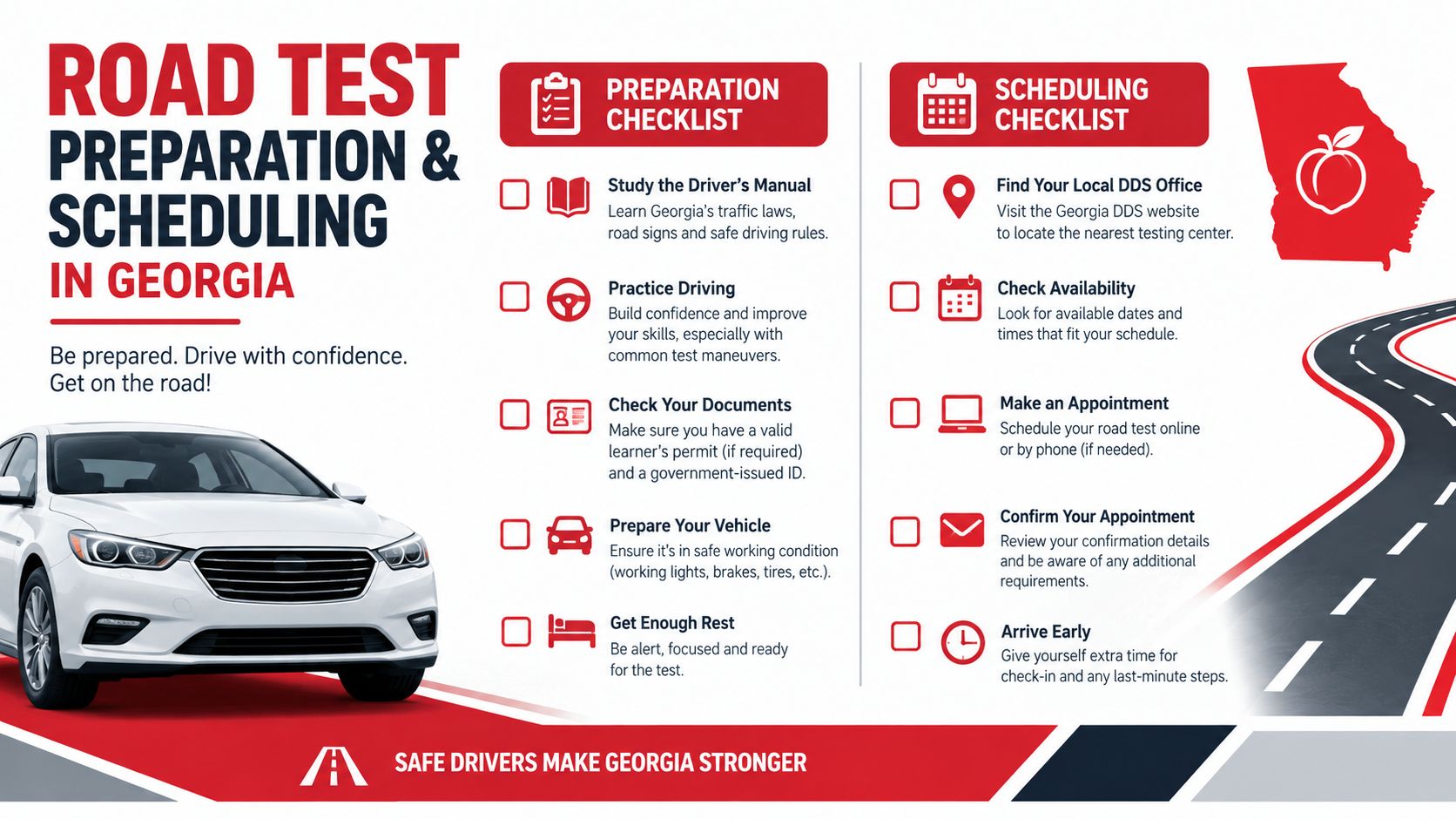
Finishing lessons doesn't automatically mean a student is ready for the Georgia road test. A capable school prepares the learner for the entire testing process, including the vehicle check, basic control skills, and on-road driving.
Students should practice the behaviors testers can observe clearly:
- Vehicle control: Smooth starts, controlled stops, accurate steering, and safe positioning.
- Lane management: Proper mirror checks, signals, lane changes, and spacing from other vehicles.
- Speed judgment: Appropriate speed in ordinary traffic and school zones.
- Turning technique: Entering and leaving turns from the correct lane without drifting.
- Decision-making: Yielding properly, scanning intersections, and responding calmly to changing conditions.
Treat scheduling as part of training
Test timing can determine whether the student retains the skills learned during lessons. In Great Britain, the average driving-test wait reached 20 weeks in February 2025 and 21.9 weeks by May 2025, while 80.8% of test centres were at the maximum 24-week wait, according to The AA's report on driving-test waiting times. The National Audit Office later reported a 22-week average wait in September 2025, compared with just over five weeks in February 2020. Those figures concern Great Britain, not Georgia, but they illustrate the planning problem clearly. A long gap between lessons and testing can create skill decay anywhere.
Ask Georgia schools how they help students book or prepare for a test, whether they provide a test-day vehicle, and whether they offer a dedicated preparation drive rather than logging required hours. Confirm the vehicle requirements as well. The test vehicle should be registered and insured, and a properly licensed adult should be present when required.
Don't assume a school-conducted road test and a DDS-administered test are the same service. Ask who administers the test, what the school charges for vehicle use or assistance, what happens after a failure, and whether the student receives a post-test explanation. A confident learner should know the route, the expected maneuvers, and the paperwork before arriving.
Using the Georgia Driver's Education Scholarship Grant
The Georgia Driver's Education Grant Scholarship Program can help eligible families pay for an approved driver education course. The program supports a course consisting of 30 hours of classroom training and 6 hours of behind-the-wheel training, according to the Georgia Driver's Education Grant Scholarship Program rules.
Eligible applicants are Georgia residents ages 15 to 17 who hold a valid Georgia instructional driving permit or driver's license. Families should review the current application requirements through the state's designated process and confirm which schools participate before enrolling. Don't assume every driving school can accept the award.
Handle the award before paying
Ask the school these questions before making a payment:
- Is the school approved for the program? Request confirmation, not a general statement that the school offers driver education.
- Which course does the award cover? Confirm whether it applies to the classroom and behind-the-wheel components required by the program.
- What remains out of pocket? Ask about extra practice lessons, licensing costs, road-test support, transportation, and any administrative charges.
- How is the award redeemed? Find out whether the school processes the voucher or requires another step from the family.
- What happens if the student needs more training? Scholarship coverage may not include additional lessons beyond the approved course.
The scholarship should be treated as a planning tool, not a last-minute discount. Start checking eligibility and participating providers before the teen reaches the point of needing immediate lessons. The award process, documentation, and timing can affect enrollment, so families should follow the current instructions rather than relying on an old deadline or a school's informal summary.
A qualifying family shouldn't pay for a course out of pocket before confirming the award status and the provider's participation. The Georgia Driver's Education Grant Scholarship information can help families identify the questions to ask and the steps to verify before committing.
Which Driving School Path Fits Your Situation
The best package depends on the learner's starting point, not on the most attractive advertisement. Use the profiles below as a practical filter, then verify every package detail directly with the school.
| Profile | School Type | Package Size | Price Range | Key Question to Ask |
|---|---|---|---|---|
| Teen approaching age 15 in a metro Atlanta suburb | Approved Joshua's Law school with professional instruction | 30 hours classroom or online, 6 hours behind the wheel, plus supervised practice | $400 to $600 | “Are pickup lessons, certified instructors, and road-test scheduling included?” |
| Adult with an out-of-state permit who moved to Georgia last year | Adult refresher and road-test preparation provider | 6-hour adult refresher plus DDS road-test vehicle rental when needed | Not specified | “Can you prepare me for the Georgia test without enrolling me in a full teen curriculum?” |
| Scholarship-eligible Georgia family | DDS-approved provider enrolled in the scholarship program | Approved 30-hour classroom and 6-hour behind-the-wheel course | Award-dependent | “Can you confirm my award and provider eligibility before I pay?” |
The teen who needs a complete path
For the teen approaching age 15, choose an approved 30/6 program with pickup options, certified instructors, and a clear road-test process. A package in the $400 to $600 range may fit the family's budget, but the number only matters after you confirm what it includes. Ask whether instructors have logged substantial teaching experience, including at least 500 hours, and whether the school bundles test scheduling or preparation.
The parent should still plan the supervised practice required under Joshua's Law. Professional lessons establish technique, while parent-guided driving builds repetition in ordinary traffic, neighborhoods, and nighttime conditions.
The adult who needs targeted help
An adult who already has an out-of-state permit and needs Georgia test preparation shouldn't automatically buy a teen package. Look for a school offering a focused 6-hour adult refresher, targeted road-test coaching, and access to a suitable vehicle for the DDS test. The important question is whether the instructor can identify the adult's specific weaknesses quickly.
The family using scholarship support
A scholarship-eligible family should first confirm eligibility, award status, and provider participation. Don't pay out of pocket for an assumed reimbursement. Choose an approved school that can explain what the award covers and what additional practice may cost if the student needs more time.
A-1 Driving School offers Georgia Driver's Education and Joshua's Law courses online, in person, and through virtual learning, along with customized teen and adult driving lessons and road-test preparation. Visit A-1 Driving School to compare course options, lesson packages, locations, and scheduling support for the path that fits your learner.