
The engine is running, the steering wheel feels slick under your hands, and the examiner is walking toward the car with a clipboard. You know how to drive, but the moment suddenly feels different from every lesson. Your mind jumps to parallel parking, your shoulders rise, and a simple mirror check feels harder than it did yesterday.
That reaction doesn't mean you're unprepared or weak. Driving test anxiety is a real performance response, and Georgia learners experience it at every age. It affects the teen working through Joshua's Law requirements, the adult retaking the test after a difficult result, and the parent or caregiver sitting in the passenger seat hoping confidence shows up on schedule.
The way forward isn't to repeat “just relax.” You need to identify the trigger, practise the exact task that creates it, and make the test environment less unfamiliar. The plan below connects practical anxiety tools with Georgia driver's education, focused driving lessons, mock testing, and road-test preparation.
What Driving Test Anxiety Actually Feels Like
A nervous driver may pull into the testing area and feel fine for a few seconds. Then the examiner opens the door, settles into the passenger seat, and says almost nothing. The driver grips the wheel, checks the cone instead of the full space, and suddenly can't remember whether the mirror check happened before the signal or after it.
That rolling wave has recognizable parts. Chest tightness can make normal breathing feel shallow. Tunnel vision narrows attention to the maneuver directly ahead, while nearby traffic, mirrors, and signs fade from awareness. Working-memory blanking can interrupt routines that normally feel automatic, such as checking mirrors before changing position.
The important distinction is that your body is reacting to a formal evaluation, not proving that you can't drive. A foundational British study of driving-test anxiety recorded a practical pass rate of 42.8% in 2003–2004, meaning 57.2% of candidates failed on the first attempt. The research also found that state anxiety increased with the formality of the evaluation, and candidates who failed had significantly larger increases in heart rate and state anxiety than those who passed. (Research on anxiety and performance in the British driving test)
The drivers I see in this situation
The teen counting down supervised-driving hours may worry that every mistake means Joshua's Law preparation has failed. The adult retaker often carries a vivid memory of the last test, especially the maneuver or examiner interaction that went wrong. The caregiver may feel helpless, because encouragement from the passenger seat can't replace a reliable plan.
Each person needs the same starting point: name what the body and mind are doing. Once the trigger has a name, you can choose a targeted response instead of treating the entire road test as one giant threat.
Why Your Nerves Spike Behind the Wheel
Driving test anxiety usually gathers around three pressure points. The first is the examiner-as-judge effect, where a stranger with a scoring sheet feels like a personal critic. The second is the parallel-parking choke point, where one maneuver absorbs so much attention that the driver stops scanning the wider environment. The third is pass-rate pressure, the fear that one result will define ability, intelligence, or readiness.
Survey evidence puts those worries into sharper focus. A 2026 driving survey found that 42.7% of respondents identified failing and having to retake the test as their biggest fear, while 48.0% named parallel parking as the most stressful portion. 28.9% worried about examiner judgment, and 28.6% feared forgetting rules under pressure. A separate UK survey reported that only 13% of learner drivers felt no nerves before the practical test, while 87% felt nervous. (Zutobi driving survey)
| Trigger | Reported Share | Cognitive Distortion Behind It |
|---|---|---|
| Parallel parking | 48.0% | All-or-nothing scoring, one imperfect movement becomes “I failed” |
| Fear of failing and retaking | 42.7% | Catastrophic thinking, the result feels bigger than the event |
| Being judged by the examiner | 28.9% | Social-evaluation fear, observation feels personal |
| Forgetting rules under pressure | 28.6% | Catastrophic thinking, a temporary blank feels permanent |
Match the thought to the trigger
If your thoughts sound like “If I miss this parking maneuver, everything is over,” you're dealing with catastrophic thinking. If you believe a small correction proves you can't pass, that's all-or-nothing scoring. If the examiner's silence makes you assume disapproval, social-evaluation fear is probably driving the reaction.
Those labels aren't diagnoses. They're practical handles. A driver who knows the problem is examiner silence can rehearse a quiet mock test. A driver who fears parallel parking can buy practice focused on entry angle, reference points, observation, and controlled corrections rather than spending every lesson driving familiar straight roads.
Georgia-specific preparation matters because the road skills test has its own vehicle and documentation requirements. DDS requires a vehicle with valid liability insurance, registration, and a current safety inspection, and the test is available only in English. If the vehicle doesn't have turn signals, the applicant must know the required hand signals. (Georgia DDS testing and exam information)
Naming the pressure point is the first way to reduce its size. You can't solve “everything feels scary,” but you can solve a silent examiner, a weak turnabout, or an unprepared vehicle.
The Week Before Your Test
A nervous learner benefits from a plan that produces visible evidence of readiness. Use the seven days before your Georgia road test to remove uncertainty, not to cram every driving skill into one exhausting stretch.
Day 1, turn the marking sheet into a target
Pull the DDS road-skills marking sheet and highlight the three areas where deductions would matter most for your driving. Don't guess based on the maneuver you dislike. Ask your instructor to review the sheet with you and identify the behaviors that need attention, such as observation, lane position, backing control, or a turnabout.
Day 2, book focused instruction
Schedule a private lesson aimed at the weakest maneuver. For many learners, that means parallel parking or a three-point turn, but the correct target is the one that repeatedly breaks down under observation. A focused lesson gives you a deliverable, such as completing the maneuver with a consistent observation routine and calm corrections.
Day 3, remove the audience
Run a silent mock test. No radio, no coaching, and no casual conversation. Use a route that demands the same sequence of decisions as the road test, then write down the first three moments when your attention narrowed or your routine disappeared.
The driving-test preparation guide can help you organize the practical details alongside this rehearsal.
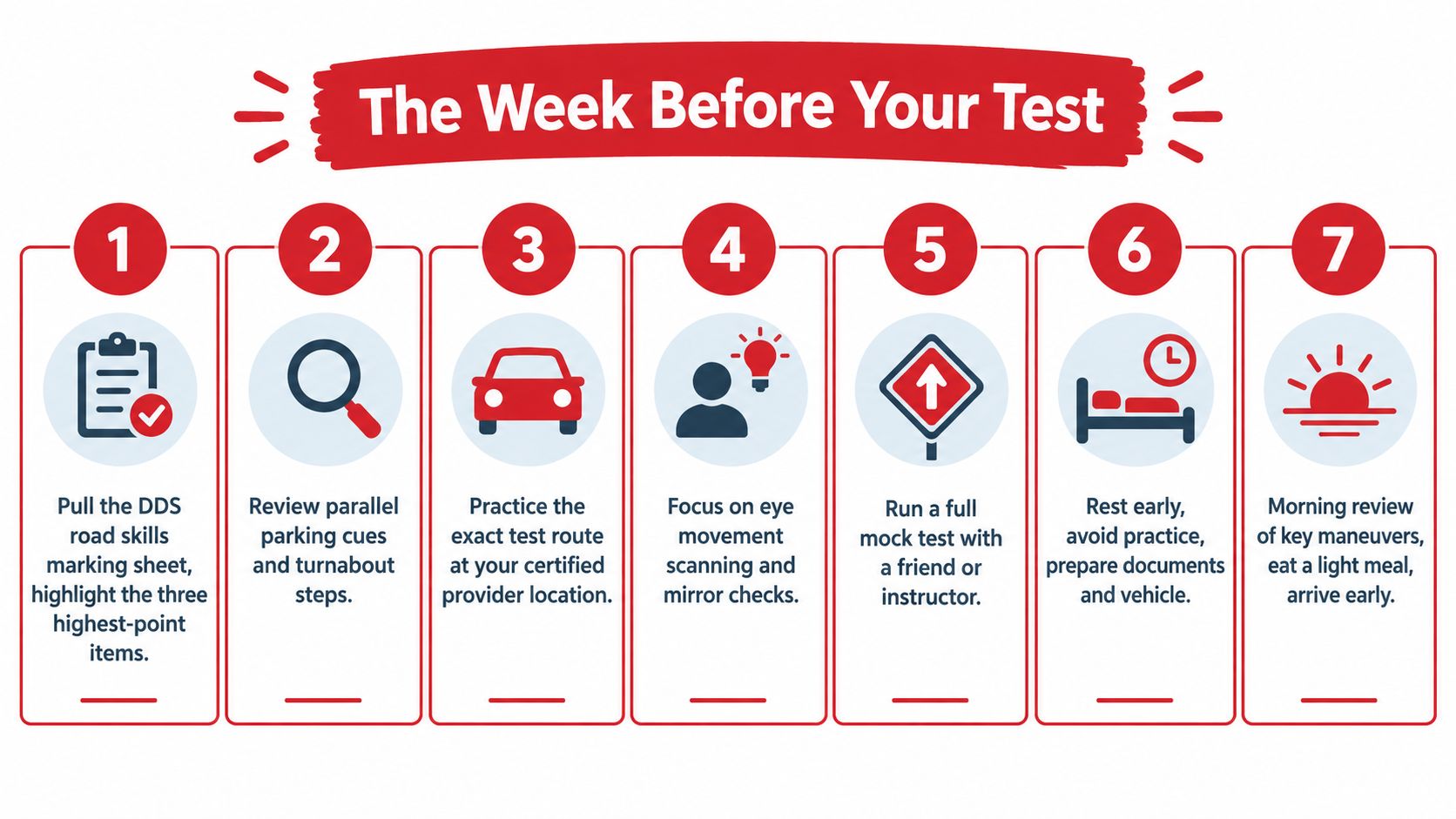
Days 4 and 5, repeat the small routine
Practise your warm-up sequence until it requires little thought: mirror, signal, seat, door. Then attach it to moving away, lane changes, parking, and pulling back into traffic. The purpose isn't robotic driving. It's to preserve your safety routine when your attention is occupied by the examiner.
Use the same vehicle you expect to bring when possible. Georgia DDS says a vehicle with a temporary dealership tag requires a bill of sale proving purchase within the last 30 days, or within 7 days when purchased from a third party. (Georgia DDS vehicle testing information)
Day 6 and Day 7, protect your attention
On Day 6, go to bed early and review only the cues that your instructor has already confirmed. Prepare your permit, insurance, registration, and vehicle the night before. On Day 7, eat a light meal, complete a short mental review, and arrive with enough time to settle instead of rushing from the parking lot into the test.
Independent guidance on driving-test nerves recommends reviewing the marking sheet, targeting the highest-error category, completing a silent mock, and scheduling the retake across the following weeks after a failed attempt. (Practical driving-test nerves guidance)
Breathing and Mental Rehearsal That Actually Work
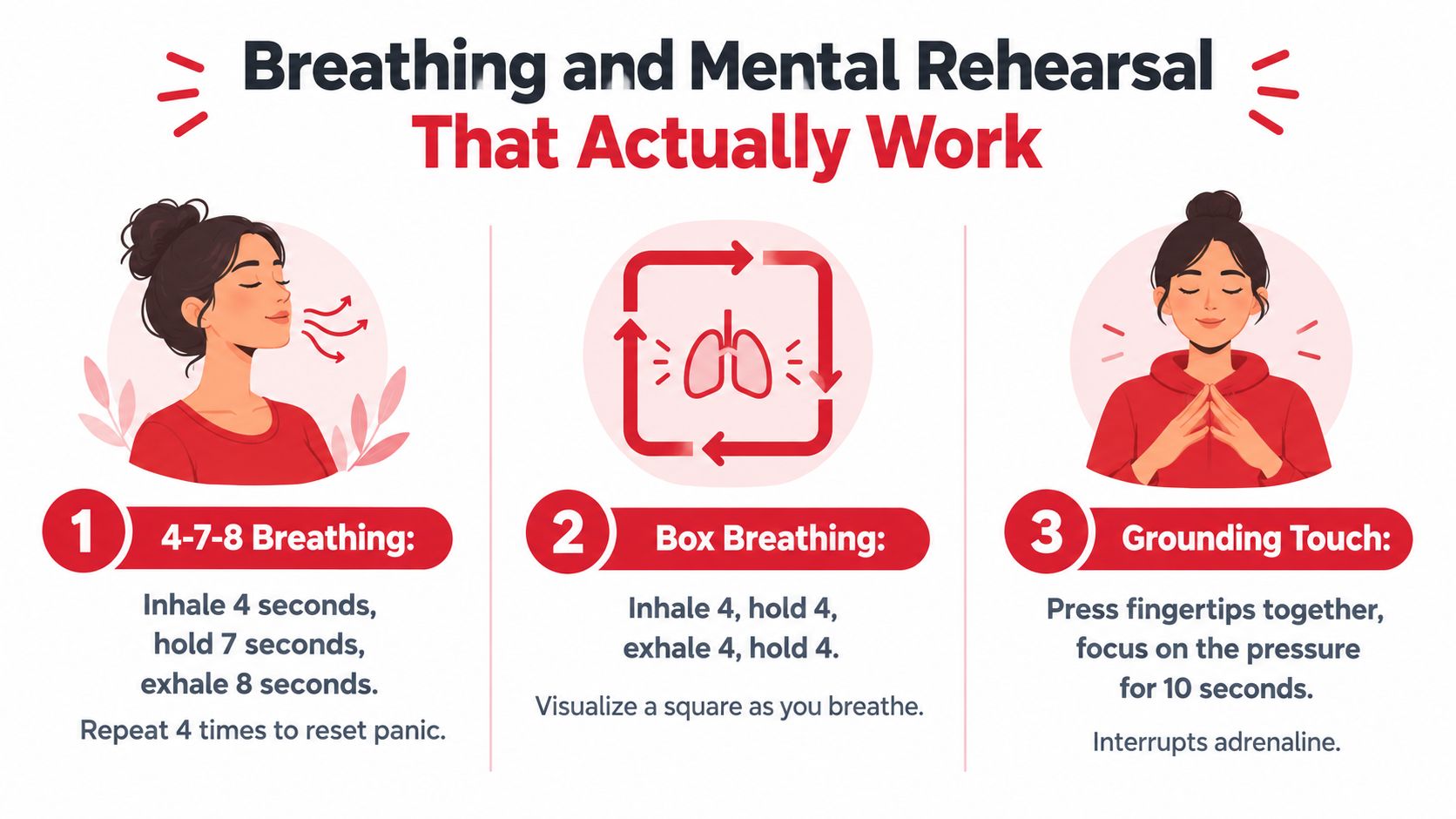
Breathing exercises work best when you practise them before anxiety peaks. You don't want to experiment with a new technique while waiting for the examiner. Use the following routines during lessons, at home, and in the parked car.
Start with 4-7-8 breathing. Inhale gently for four seconds, hold for seven, and exhale for eight. Repeat four cycles if it feels comfortable. The long exhale gives you a deliberate way to slow the adrenaline loop, but don't force a deep breath or become light-headed.
Use box breathing inside the car between maneuvers. Inhale for four, hold for four, exhale for four, and hold for four. At a stop sign, keep your eyes and attention on the driving environment first, then complete one controlled cycle without closing your eyes or losing awareness.
Relax the muscles that announce panic
The night before, try progressive muscle relaxation from feet to face. Tense one muscle group gently, release it, and notice the contrast. Move through calves, thighs, hands, shoulders, jaw, and forehead. Keep the effort mild. The exercise teaches you to recognize that raised shoulders and a clenched jaw are signals you can change, not proof that the test is going badly.
Mental rehearsal adds a driving-specific layer. For five to ten minutes twice daily during the final week, close your eyes and run the test in first person. See the mirror checks, signal timing, lane changes, turn signals, parallel-parking entry angle, and the examiner's neutral voice. Rehearse a safe correction after a small mistake, not a perfect fantasy in which nothing unexpected happens.
Practical rule: Rehearse the next safe action, never the imagined failure.
Common mistakes undermine these tools. Breathing too quickly can increase dizziness. Skipping the hold phase turns 4-7-8 into ordinary shallow breathing. Rehearsing a collision, a failure, or the examiner's disappointment trains the wrong scene. Keep the mental movie specific and controllable.
If panic extends beyond test nerves or interferes with daily life, a qualified mental-health professional can offer more individualized support. Refreshing Psychiatry & Therapy panic help provides additional grounding and panic-management context. You can also review performance-under-pressure driving guidance before practising these routines with an instructor.
Morning-Of Game Plan
Test-day anxiety often rises because small decisions pile up. Remove those decisions before the morning begins.
Build the morning backward
Set your wake-up time far enough ahead of the appointment to eat, prepare, and travel without rushing. Choose a protein-forward breakfast that you already tolerate, drink water, and avoid excess caffeine if caffeine makes your hands shaky or your thoughts race.
Use the first part of the morning for the car, not a last-minute skills marathon. Check that the mirrors and windows are clean, the seat and headrest are adjusted, the tires appear properly inflated, turn signals and brake lights work, washer fluid is available, and the cabin is free of loose clutter.
Keep the documents together
Place the permit, insurance, registration, any required parent or guardian identification for a minor, and the DDS confirmation in one pouch. Confirm the vehicle's registration and license plate before leaving. A temporary dealership tag needs the applicable bill of sale documentation under Georgia DDS rules, so don't leave that check until the testing site. (Georgia DDS road-test vehicle requirements)
Arrive about twenty minutes earlier than the appointment. That buffer lets you park, adjust the seat, use the restroom, and settle your breathing. It also gives you time to discover a missing document or vehicle issue while there's still a chance to address it.
Use a short mental warm-up
In the parked car, complete two rounds of 4-7-8 breathing. Then say three maneuvers aloud, such as “mirror, signal, smooth entry,” “observe before backing,” and “pause, scan, proceed.” Choose one power cue phrase, such as “Slow is smooth, safe is the goal,” and repeat it at the curb before the examiner enters.
If anxiety feels larger than ordinary test nerves, ongoing support may help you build skills beyond this appointment. Therapy for anxiety in Kelowna offers an example of how counselling can address anxiety patterns more broadly.
Don't use the waiting time to search for new tricks. Your job is to demonstrate the routines you've already practised, one decision at a time.
How Georgia Driving Lessons and Mock Tests Cut the Anxiety
The most effective anxiety reducer is often not a motivational phrase. It's rehearsed exposure with feedback. When a certified instructor creates the same pressure you'll meet during the road test, the examiner, route, silence, and scoring format become familiar instead of mysterious.
A targeted Georgia lesson should retarget the maneuvers that trigger your nerves. That may include a three-point turn, controlled backing, lane changes on a multi-lane road, parallel parking, or the transition from a quiet residential street to busier traffic. The instructor watches the exact behavior that breaks down, then gives you a repeatable correction.
A mock road test adds a different kind of value. During an ordinary lesson, your instructor may prompt you before a problem develops. During a mock, prompts are limited, conversation is reduced, and the route is timed and structured to resemble the actual evaluation. That trade-off matters. A mock can feel uncomfortable and may expose weaknesses, but discovering them in practice is safer than discovering them with the examiner.
A focused lesson should answer one question: “What exact behavior will I repeat when pressure rises?”
For teens, driving lessons should fit the broader Joshua's Law path. Georgia requires teens applying for a Class D license to complete an approved driver-education course plus 40 hours of supervised driving, including 6 hours at night. DDS lists four compliance paths, including in-person or online classroom instruction paired with either 6 hours of behind-the-wheel training or parent-taught practice. (Georgia DDS Joshua's Law requirements)
That makes online course options useful for classroom flexibility, while instructor-led lessons address the physical skills that anxiety exposes. A learner might use online driver's education for the required knowledge work, then purchase a focused parallel-parking package, a turnabout session, or a multi-lane-road lesson to close a specific gap. Packages make more sense when they have a defined target, rather than adding practice hours without measuring what changed. The benefits of instructor-led driving lessons include that direct observation and correction.
Georgia also allows road skills testing through certified providers, giving applicants another path to a structured test setting. Before booking, confirm what the provider offers, what vehicle standards apply, and which documents you must bring. Families who need help with training costs can review the Georgia Driver's Education Scholarship Grant Program. Eligibility is limited to Georgia residents actively enrolled in school who are 15 to 17 years old and hold a valid Georgia instructional permit or driver's license. (Georgia scholarship grant eligibility rules)
Your Calm-and-Pass Checklist
Read this the night before, then reduce it to a few notes you can carry into the morning. The purpose isn't to eliminate every nervous sensation. Mild alertness may help attention, while excessive test-specific stress can interfere with performance. Evidence is mixed in other driving contexts, too. A PubMed-indexed study of driving assessment in people with cognitive impairment found that higher pre-test anxiety was associated with fewer errors, and concluded that anxiety wasn't a unique predictor of driving performance. (PubMed-indexed driving assessment study)
Mindset anchors
- Reframe the examiner: Treat the person beside you as an evaluator of driving behavior, not a judge of your character.
- Shrink the assignment: Drive the next safe section of road. Don't drive the entire test in your head at once.
- Expect recovery: If you make a small mistake, return to observation, control, and legal movement. Don't let one moment decide the next one.
- Use a cue phrase: “Calm hands, active eyes” is short enough to remember without distracting you.
Body cues
- Before buckling: Drop your shoulders, loosen your jaw, and place both hands comfortably.
- At a stop sign: Use one controlled box-breathing cycle if the traffic situation allows it.
- When panic rises: Press your fingertips together for ten seconds and focus on the pressure, while remaining visually engaged with the road.
- Before moving off: Take the reset breath, complete your mirror and signal routine, then move only when the situation is safe.
Practice habits
- Complete one silent mock: Let the silence reveal whether you depend on prompts.
- Retarget two maneuvers: Practise the movements that cause actual errors, not the ones that feel easiest.
- Stop adding novelty: In the final 48 hours, don't chase new techniques or radically change your routine. Review established cues instead.
Georgia readiness
- Log Joshua's Law work: Confirm the approved course and supervised-driving requirements that apply to your Class D pathway.
- Confirm the provider: Verify your road test appointment with a certified provider if you're using that option.
- Prepare the vehicle: Check insurance, registration, safety condition, license plate, lights, mirrors, and the required bill of sale if the vehicle carries a temporary dealership tag.
- Pack documents: Keep your permit, confirmation, insurance, registration, and any required identification together.
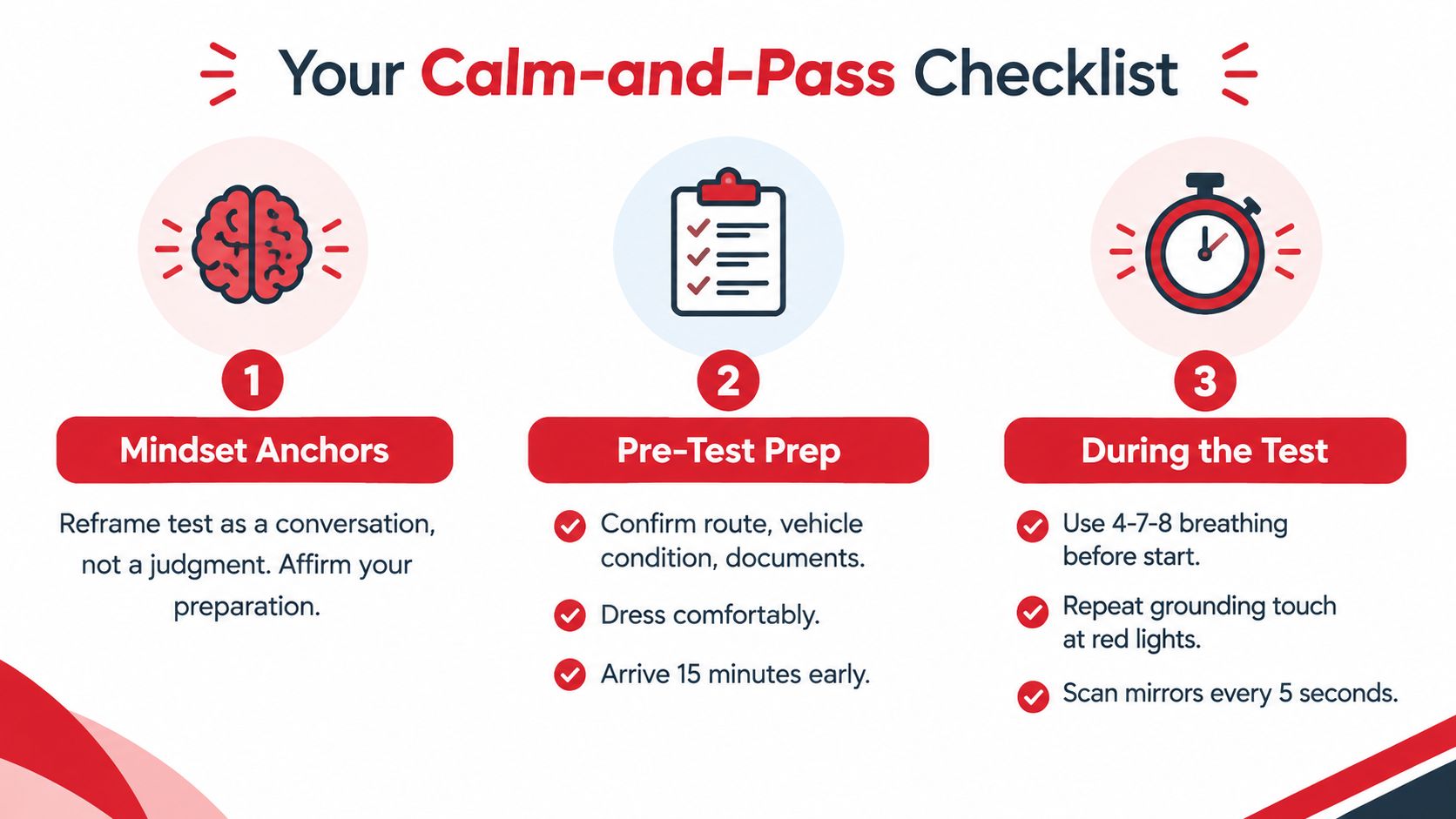
Eat lightly, arrive early, and walk into the testing area slowly. You don't need to feel fearless before you start. You need a prepared vehicle, a practised routine, and enough control to complete the next safe action.
A-1 Driving School offers Georgia driver's education courses, Joshua's Law options, customized teen and adult driving lessons, focused lesson packages, mock-test preparation, and road-testing assistance. Visit A-1 Driving School to choose the course or driving-lesson package that matches your anxiety trigger and schedule your next step toward the Georgia road test.