
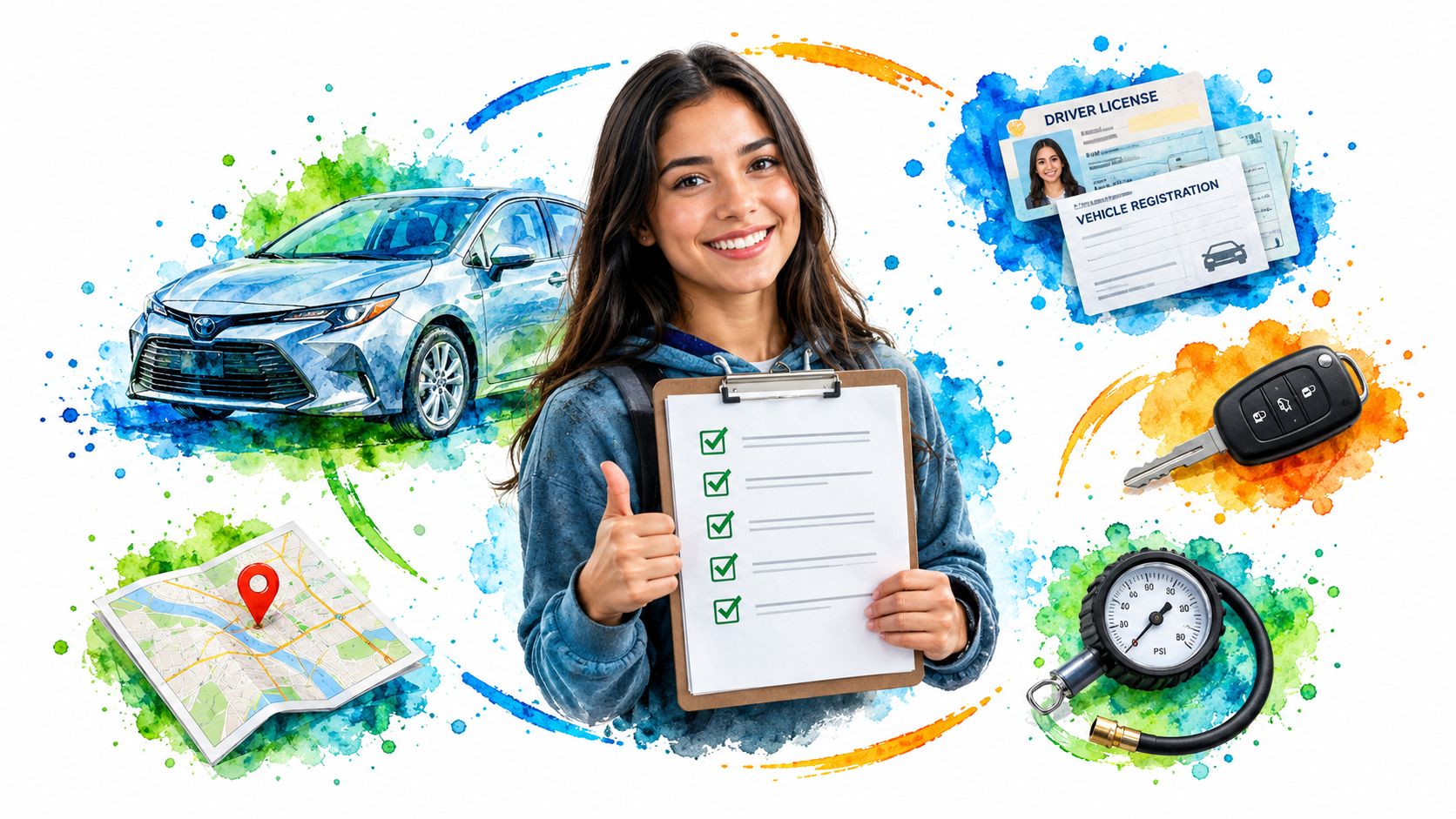
You know the rules, you've completed practice drives, and you can explain who has the right of way. Then test day arrives, and confidence slips because the registration is expired, the vehicle's brake light doesn't work, the testing route feels unfamiliar, or one maneuver hasn't been practiced under pressure. A successful Georgia road test depends on more than remembering traffic signs. It requires a connected plan that covers Driver's Education, Joshua's Law requirements, professional driving lessons, lesson packages, vehicle readiness, documents, route practice, and road-test assistance.
This road test checklist puts preparation in the order that makes sense. You'll know what to complete before scheduling, what to verify before the appointment, how to use coached practice effectively, and what to do when you arrive.
Skill practice and administrative preparation belong on the same checklist.
1. Complete Your Georgia Driver's Education Course
Start with the education requirement, not the appointment. Georgia teens pursuing a Class D license must show the appropriate Driver's Education completion, supervised driving experience, and ADAP documentation. Georgia DDS requires proof of an approved driver education course, at least 40 hours of other driving experience including 6 hours at night, and proof of the Alcohol and Drug Awareness Program for applicants ages 16 or 17 seeking a Class D license. If behind-the-wheel training was completed with a certified instructor, bring the separate required document to the road test. Georgia DDS explains the Class D requirements.
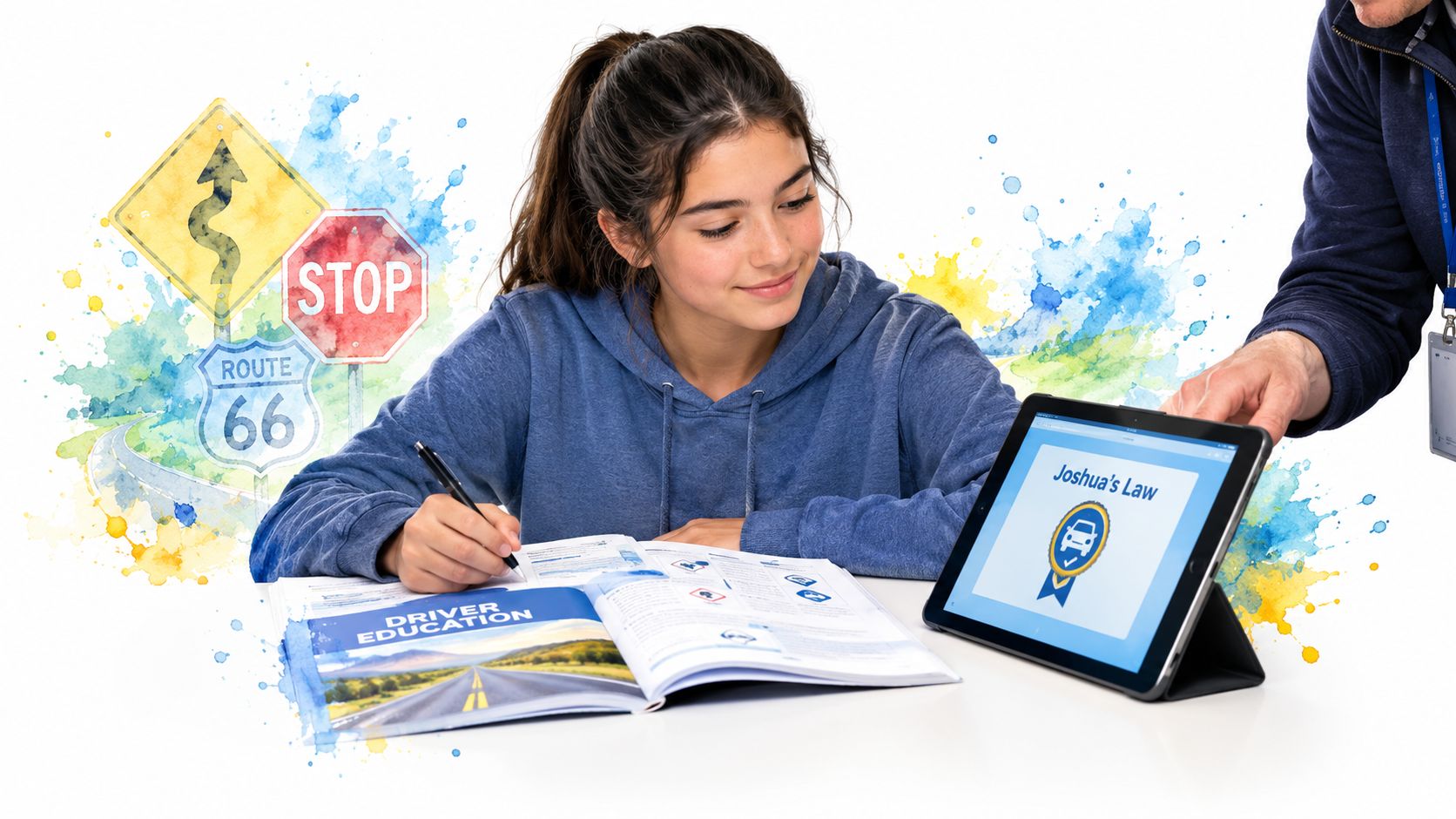
Joshua's Law gives teens several approved ways to complete the education and driving components. Options include classroom instruction with professional behind-the-wheel training and supervised practice, classroom instruction with parent-taught driving, or approved online classroom instruction paired with either instructor training or parent-taught driving. Georgia DDS lists the Joshua's Law pathways.
Choose the course format that fits your schedule
A-1 Driving School offers instructor-led classroom courses and online options, including Driver's Education designed for students across Fulton County Schools. The school also reports serving 100,000+ satisfied drivers, a claim that should be understood as A-1's own published service history rather than a guarantee of an individual result. Review the Georgia Driver's Education course options and enroll early enough to finish the coursework before arranging the road test.
Online learning can be practical when school, work, athletics, or transportation makes classroom attendance difficult. DDS cautions that online providers offer different traffic-safety courses, so confirm that the course explicitly meets Joshua's Law requirements rather than assuming every online course qualifies. Georgia DDS explains how to verify online courses.
Also check whether you qualify for Georgia's Driver's Education Grant Scholarship Program. The program helps eligible Georgia residents ages 15 through 17 with a valid instructional permit or driver's license complete a course consisting of 30 hours of classroom training and 6 hours of behind-the-wheel training. The Georgia rules describe the scholarship program.
2. Schedule Professional Driving Lessons and Practice Sessions
A classroom course explains traffic laws. Lessons teach you to apply them while steering, braking, scanning, changing lanes, and responding to real traffic. That gap matters because a student may know what a safe lane change requires but still check mirrors too late, drift during the maneuver, or accelerate before the target space is clear.
A-1 Driving School provides customized lessons for teens and adults, with packages that can be arranged around experience level and specific weaknesses. A useful progression begins with vehicle control, moves into turns and intersections, then adds lane changes, parking, backing, route practice, and mock-test conditions. Booking several lessons is usually more useful than taking one isolated session immediately before the exam, because an instructor can identify a pattern, assign practice, and check whether the correction holds.
Build the lesson plan around observed gaps
Ask the instructor to watch for:
- Steering and lane position: Keep the vehicle centered and finish turns in the correct lane.
- Braking and acceleration: Make stops controlled and deliberate rather than abrupt.
- Observation habits: Make mirror, signal, and blind-spot checks visible and consistent.
- Decision timing: Choose safe gaps without rushing or waiting so long that you lose awareness.
- Test-specific skills: Rehearse parking, backing, turns, and any maneuvers used at the testing location.
The strongest lesson schedule also matches the likely appointment conditions. If the test is planned for a busy morning, practice in comparable traffic when possible. Request instruction on the local road-test route and ask what mistakes examiners commonly see. A-1's road-test lesson program can connect general driving development with focused test preparation.
Don't judge readiness by whether you completed a maneuver once. You're closer to ready when you can repeat it calmly, correct a small error without panic, and continue observing traffic while performing the task.
3. Verify Vehicle Documentation and Insurance Requirements
A road test can end before the vehicle moves if the paperwork or car fails the appointment requirements. The UK experience shows why administrative preparation belongs on a road test checklist. A government campaign reported that 2,281 driving tests were cancelled in July 2026 because applicants brought an unsuitable car, forgot their driving licence, or arrived late. The figure comes from the UK, not Georgia, but the practical lesson applies: the driver, vehicle, and documents must be ready together. The UK campaign explains what to take to a driving test.
For a Georgia appointment, confirm the testing authority's current requirements. Prepare proof of vehicle ownership, current registration, and valid insurance. Check the car before the lesson plan reaches its final stage. Brakes, lights, turn signals, wipers, horn, mirrors, seat belts, and tires should all be ready for use.
A quick dashboard glance is not enough. Operate each control and walk around the vehicle so a visible defect does not become a test-day problem.
Complete the vehicle check before test day
- Registration and insurance: Confirm both documents are current and store them where you can reach them quickly.
- Exterior lights and signals: Test the headlights, brake lights, and left and right turn signals.
- Driver controls: Check the horn, windshield wipers, parking brake, and other required controls.
- Visibility: Inspect the windshield, windows, and mirrors for damage, obstruction, or poor adjustment.
- Safety equipment: Check the seat belts, tires, doors, and dashboard warning lights.
Use this Georgia road-test document guide to organize the paperwork before the appointment. During a lesson, ask an A-1 instructor to inspect the vehicle you plan to use. A second set of eyes may catch a faulty signal, confusing control, poor mirror setup, or warning light that stress makes easy to miss.
Keep original documents or accepted copies according to the testing authority's rules. Photos can remind you what you packed, but they may not replace the documents the examiner requires.

4. Practice Road Test Routes and Specific Driving Scenarios
A familiar route can still change on test day. Traffic may build, a pedestrian may enter the crossing, or the examiner may give directions from a different position. Practice the area to understand its decisions, not to memorize every turn.
Use an instructor-led session near the testing location. Drive through intersections, lane changes, turn areas, hills, merging points, parking zones, and sections with limited visibility. An A-1 instructor can adjust the lesson to local conditions, whether you are preparing near Decatur, managing Atlanta-area traffic, or learning Georgia expectations after moving from another state.
Build a route map during practice. Mark each location with the action it requires:
- Decision points: Record where you must choose a lane, yield, stop, or merge.
- Visibility limits: Note corners, parked vehicles, hills, and curves that restrict your view.
- Traffic changes: Identify sections that become harder when congestion or turning traffic increases.
- Practice areas: Locate suitable places for parking, backing, turns, and lane changes.
- Direction drills: Ask the instructor for instructions without warning, then respond safely instead of waiting for prompts.
Use several passes through the same area, changing the starting point or direction when practical. On one pass, focus on lane position. On another, listen carefully for directions while checking signs and traffic. This exposes weak habits that route memorization can hide.
Parents supervising extra practice can use a car route tracking tool for parents to confirm where driving occurred and discuss the session afterward. Tracking does not replace coaching, observation, or a written plan.
The goal is flexible judgment. Recognize the road conditions, make the required decision, and continue safely when the actual route differs from rehearsal.
5. Master Essential Maneuvers, Parking, Turns, and Lane Changes
A clean maneuver starts before the vehicle moves. Set the car correctly, identify what you need to observe, and choose a speed that leaves time to adjust. Examiners look for controlled handling, legal positioning, effective observation, and decisions that do not create risk. A slower, deliberate parallel park is usually easier to correct than a rushed attempt.
Use a three-stage practice sequence:
- Learn the setup: In a quiet parking lot, have an instructor demonstrate the maneuver once. Ask which reference points, clearances, and checks matter.
- Perform with limited help: Repeat the maneuver while the instructor gives only necessary prompts. This shows whether you understand the sequence rather than copying instructions in real time.
- Add realistic conditions: Practice near other vehicles and ordinary traffic only after the basic movement is reliable. Change the starting position so you learn the skill, not a single memorized pattern.
Make each movement observable
For parking and backing, position the vehicle before steering, check mirrors and blind spots, use gentle brake control, and keep scanning while the car moves. Finish with the vehicle safely placed and fully controlled.
For a lane change, signal early, check mirrors, inspect the blind spot, confirm a suitable gap, and move smoothly. Cancel the signal when appropriate. For turns, reduce speed before entering, watch cross traffic and pedestrians, hold the correct lane, and accelerate only after the path is clear.
Use feedback to target the weak point. If parallel parking breaks down during setup, ask an instructor to focus on steering timing, clearance, and final position. Repeat the same skill between lessons, then review it during the next coached session. A-1 lesson packages can provide that structured repetition before the Georgia road test.
6. Demonstrate Proper Traffic Law Knowledge and Signal Recognition
A road test rewards decisions, not recitation. Read a sign, understand its instruction, then choose the correct speed, lane position, signal, stop, or yielding action. A warning sign has little value if you recognize it but reach the hazard too quickly.
During a lesson, explain your plan before acting. At an intersection, identify the traffic signal, scan for signs, determine who has priority, and state where you intend to go. After spotting a warning sign, describe what may change ahead and how you will respond. Your instructor can then correct the decision process, not just the final movement.
Use this quick check at each decision point:
- Complete stops: Stop at the required position and stay stopped until proceeding is safe.
- Correct signaling: Signal before a turn or lane change, then confirm the path with observation.
- Right-of-way decisions: Yield when required and avoid forcing another driver to react.
- Speed control: Follow posted limits and slow when visibility, traffic, or road conditions call for it.
- Lane discipline: Select the correct lane early and complete turns without drifting.
- Sign recognition: Read regulatory, warning, and directional signs before action becomes necessary.
Practice these choices in different locations rather than memorizing one route. Ask your instructor to vary the intersection, traffic level, and approach speed. A-1 lesson packages can provide repeated, coached practice before the Georgia road test, with feedback focused on decisions an examiner can observe.
The modern road test checklist developed from early licensing reforms. Driver licensing began in Massachusetts and Missouri in 1903, Rhode Island introduced the first driving test in 1908, and Great Britain made testing compulsory for new drivers in 1935. In that first British year, around 246,000 candidates applied, the pass rate was 63%, and 250 examiners conducted 9 to 16 half-hour tests daily. MIT's history of the driver's license test describes the shift from informal approval to structured checks of control, legal compliance, and safety behavior.
That history clarifies the examiner's task. The test checks whether classroom knowledge becomes consistent action in real traffic, not whether you can drive around the block once without a mistake.
7. Develop Hazard Perception and Defensive Driving Awareness
A parked car's wheels turn toward the street. A pedestrian steps near a crossing. A vehicle approaches a junction with limited visibility. Hazard perception means spotting these developing risks early and adjusting speed, position, or timing while maintaining control.
Use a repeatable scan during coached practice:
- Look well beyond the vehicle ahead for blocked sight lines, cyclists, pedestrians, changing signals, and vehicles entering from side streets.
- Check mirrors before braking, changing lanes, or changing road position.
- Create time and space. A following gap of at least 3 seconds is a practical lesson target, then increase it when rain, congestion, poor visibility, or road conditions make stopping harder.
- Decide what information you need next, such as a clear gap, a visible sign, or confirmation that another driver has seen you.
- Act smoothly. Slow early rather than braking sharply, and keep an escape space when traffic movement is uncertain.
During lessons, vary the setting and ask your instructor to explain the decision an examiner can observe. A-1 lesson packages can provide repeated, coached practice before the Georgia road test, with feedback on scanning, spacing, positioning, and timely responses.
The test examines how classroom knowledge becomes consistent behavior in real traffic. Official examiner guidance separates vehicle safety checks from driving performance, including eyesight, observation, positioning, set exercises, and responses to road situations. UK examiner guidance describes the assessment framework Although that framework applies to a different jurisdiction, its training principle transfers well to Georgia practice: prepare the vehicle, then rehearse behaviors an examiner can see.
Defensive driving should look calm and purposeful, not timid. Your goal is to preserve control, time, and space while making each decision clear to the examiner.
8. Prepare Mentally and Physically for Test Day Success
A capable driver can underperform when fatigue, rushing, or unfamiliar routines take over. Prepare the final day as carefully as you prepare a maneuver. Review instructor feedback the day before, but don't attempt to learn a new skill through late-night cramming. Pack documents, confirm the appointment, inspect the vehicle, and decide how you'll get to the testing location.
A-1's road-test preparation and testing assistance can help students understand the process before they arrive. That support is most useful when it reinforces skills already practiced, rather than creating dependence on last-minute prompts.
Follow a simple arrival routine
- Sleep properly: Aim for 8+ hours the night before the test, as part of a sensible rest plan.
- Eat beforehand: Choose a meal that leaves you comfortable and alert.
- Arrive early: Plan to be there 15 to 20 minutes before the appointment.
- Dress comfortably: Wear clothing and shoes that let you operate the pedals and controls normally.
- Pack documents: Bring the required permit, identification, course records, registration, insurance, and any other appointment-specific paperwork.
- Review lightly: Read your instructor's notes and rehearse the observation sequence, not every possible mistake.
- Manage the start: Adjust the seat and mirrors, fasten the seat belt, listen carefully, and ask for clarification if an instruction is unclear.
The examiner isn't your adversary. Drive the way you practiced, make decisions visible, and correct small errors without abandoning observation.
A calm start matters. Before moving, locate the controls, check mirrors, signal when required, and scan around the vehicle. Once on the route, don't let one imperfect maneuver dictate the rest of the test. Continue making safe, deliberate decisions.
Road Test Prep: 8-Point Comparison
| Item | Implementation complexity | Resource requirements | Expected outcomes | Ideal use cases | Key advantages |
|---|---|---|---|---|---|
| Complete Your Georgia Driver's Education Course | Medium, structured coursework and milestones | Time (course hours), access to online or in-person classes, course fees | State compliance (Joshua's Law), foundational traffic knowledge, eligibility for road test | First-time drivers under 18; anyone needing required certification | Meets DDS standards, flexible formats, scholarship options |
| Schedule Professional Driving Lessons and Practice Sessions | Medium, booking and progressive lessons | Instructor time, lesson packages, vehicle access, fees | Improved driving skills, real-time feedback, higher first-attempt pass rates | Learners needing hands-on practice or skill refinement | One-on-one coaching, tailored instruction, exam-focused practice |
| Verify Vehicle Documentation and Insurance Requirements | Low, gather and confirm paperwork | Time to obtain documents, possible vehicle repairs, insurance validation | Prevents test cancellations, legal compliance, confirmed vehicle safety | Test takers using personal or loaned vehicles | Simple checklist, avoids administrative failures, ensures safe vehicle |
| Practice Road Test Routes and Specific Driving Scenarios | Medium, route-specific repetition and coordination | Instructor time, repeated route sessions, local route knowledge | Reduced anxiety, route familiarity, improved route-specific performance | Candidates testing at known DMV locations or anxious about routes | Targets actual test conditions, prepares for examiner expectations |
| Master Essential Maneuvers: Parking, Turns, and Lane Changes | Medium–High, repeated skill drills required | Practice space/vehicle, instructor guidance, time for repetition | Consistent maneuver execution, muscle memory, fewer test errors | Drivers weak on parking/backing or precise maneuvers | Directly addresses scored skills, repeatable improvement |
| Demonstrate Proper Traffic Law Knowledge and Signal Recognition | Low–Medium, study and applied practice | Driver's manual, classroom or review sessions, instructor reinforcement | Correct sign/signal responses, legal compliance, safer driving behavior | Test takers needing knowledge refresh or new to GA laws | Applies statewide, essential for exam, reduces rule-based errors |
| Develop Hazard Perception and Defensive Driving Awareness | Medium–High, ongoing situational training | Scenario-based lessons, exposure to varied conditions, instructor coaching | Better anticipation of dangers, safer decision-making, examiner approval | Drivers in heavy traffic, teens, or those in variable conditions | Reduces accident risk, demonstrates mature judgment |
| Prepare Mentally and Physically for Test Day Success | Low, planning and final review | Time for rest, review materials, optional final lesson | Lower anxiety, improved concentration, smoother test performance | Any candidate approaching their scheduled road test | Boosts readiness, minimizes avoidable mistakes, enhances confidence |
Move From Checklist to Confident Test Day
A strong Georgia road test plan follows a clear sequence. First, complete the appropriate Driver's Education or Joshua's Law course and confirm that your education pathway meets DDS requirements. Then arrange targeted driving lessons or a lesson package that turns classroom knowledge into repeatable vehicle control. After that, verify the vehicle, registration, insurance, and required documents before practicing the local route and the maneuvers your examiner may evaluate.
The checklist works because each stage supports the next. Education gives you the rules and signs. Professional lessons show you how to apply them. Vehicle checks prevent a mechanical or paperwork problem from ending the appointment early. Route practice reduces unfamiliarity, while maneuver practice builds control. Final-day preparation protects all that work from avoidable fatigue and rushing.
Use this concise final-day review:
- Documents: Confirm your permit, identification, Driver's Education or Joshua's Law records, registration, insurance, and any Georgia DDS forms required for your situation.
- Vehicle controls: Test the brakes, headlights, brake lights, turn signals, horn, windshield wipers, parking brake, and dashboard indicators.
- Mirrors and visibility: Adjust the rearview and side mirrors, clean the glass, and check that seat belts and windows work properly.
- Vehicle condition: Inspect tires, windshield, doors, lights, and other safety equipment.
- Fuel and access: Make sure the vehicle has enough fuel and that you have the keys, documents, and appointment details.
- Arrival plan: Confirm the location, appointment time, route, parking plan, and arrival buffer.
- Calm execution: Listen to directions, scan deliberately, signal consistently, maintain lane position, and avoid rushing.
Commercial inspection programs also show why a checklist may need layers rather than one vague reminder. The AA compares 11 checks in a basic inspection tier with 20 checks in advanced tiers. The AA inspection checklist offers a useful design lesson for training programs: begin with legal and obvious safety items, then add detailed condition checks when the vehicle or driver needs closer review.
A-1 Driving School offers Georgia Driver's Education, Joshua's Law course options, online learning, information about the Georgia Driver's Education Scholarship Grant Program, customized teen and adult driving lessons, lesson packages, road-test preparation, and available road-testing assistance. Its published background includes service since 1987, 18+ locations across metro Atlanta including Athens, and 15,000+ classes annually. Those are publisher-provided business details, so confirm current availability, locations, and eligibility when you enroll.
The best next step is specific. Choose the education pathway, book lessons that address your actual gaps, inspect the vehicle before the appointment, and practice the route with an instructor who can evaluate your decisions under test conditions.
A-1 Driving School offers Georgia Driver's Education and online Joshua's Law course options, scholarship-program guidance, customized driving lessons and packages, road-test preparation, and testing assistance. Use this road test checklist to organize your next steps, then visit A-1 Driving School to review current programs and schedule the support that fits your Georgia licensing plan.