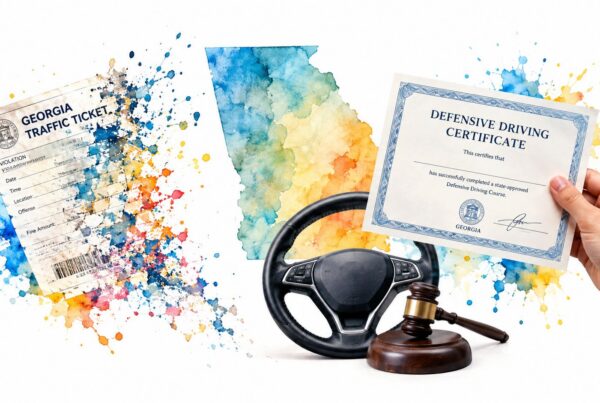
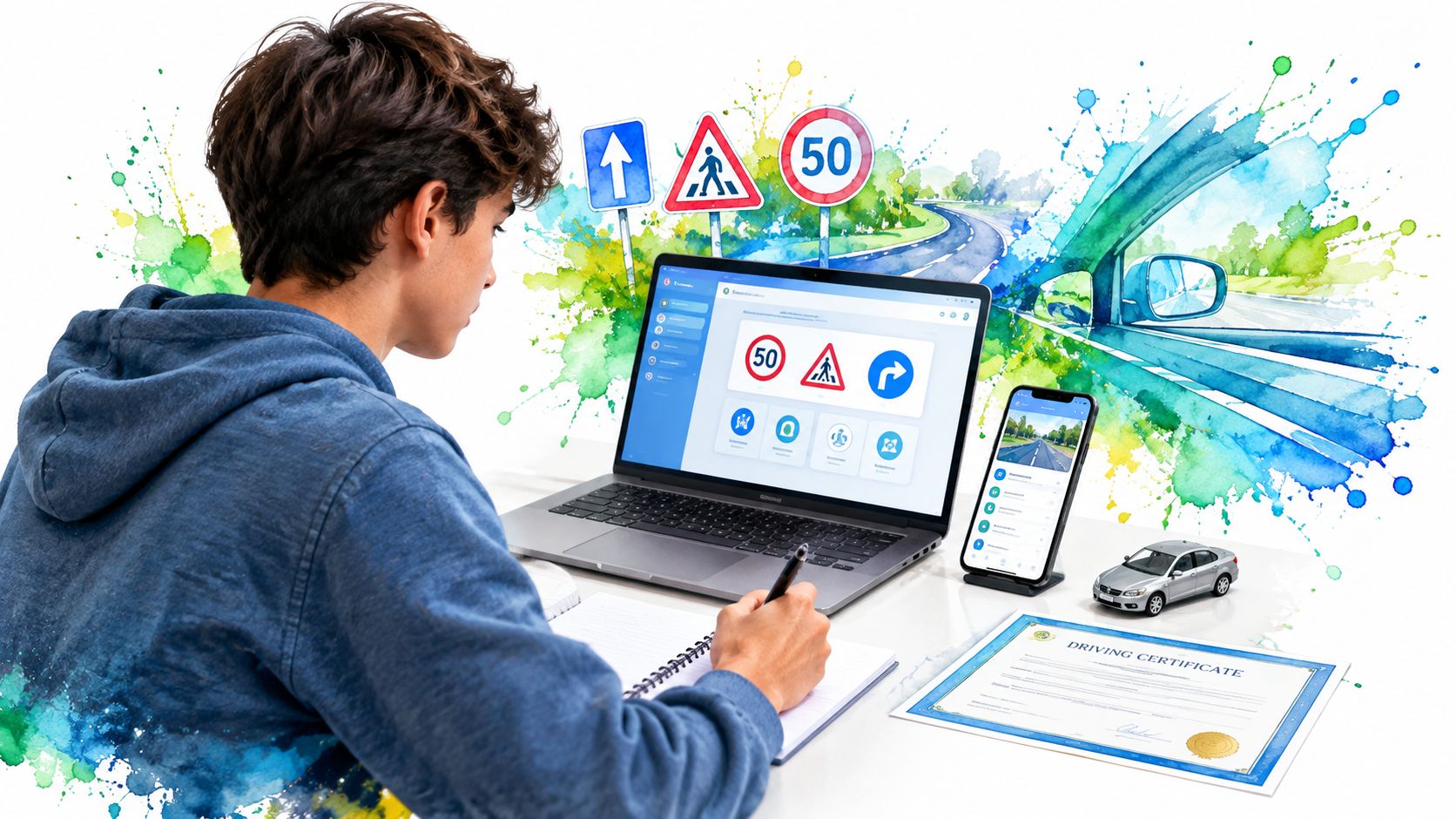
A parent sits down to help a teenager begin driver education and quickly discovers that Georgia's licensing process involves more than registering for an online class. There are classroom hours, supervised practice, professional driving lessons, paperwork, and a road test. The challenge isn't finding an e learning website. It's choosing one that connects virtual instruction to the essential skills required behind the wheel.
A reliable online course can make the theory portion easier to schedule, but it can't replace vehicle control, observation practice, or feedback from a qualified instructor. Georgia families need a complete path from approved online learning to documented driving practice and road-test preparation.
Navigating Georgia Driver Education Online
A typical Georgia family starts with a simple question: can a teenager complete driver's education online and still qualify for a Class D license? The answer is yes for the theoretical portion, provided the course is approved by the Georgia Department of Driver Services and the family completes the required practical training.
Georgia's Joshua's Law applies specific requirements to 16- and 17-year-olds seeking a Class D license. A qualifying path includes 30 hours of classroom or approved online instruction, 6 hours of behind-the-wheel training with a certified school or instructor, and 40 hours of supervised driving with a parent or guardian. The supervised practice must include at least 6 hours at night, as explained in the Georgia DDS Joshua's Law requirements.
The online course handles traffic laws, road signs, safe-driving principles, and other theory topics. It doesn't teach a student how to position a vehicle for a turn, judge a gap in traffic, control speed on a hill, or recover from a poor approach to an intersection. Those abilities develop through structured practice, not through watching lessons alone.
Why families choose online theory
An e learning website gives students more control over when they study. A teenager can complete a lesson after school, while a parent can review progress without driving across town for every classroom session. That flexibility matters for families balancing school, work, sports, and transportation.
The right course should also make the administrative path visible. Parents should be able to see completed modules, quiz results, remaining coursework, and the next step for scheduling driving lessons. A platform that hides completion records creates avoidable stress when a family needs documentation.
Before enrolling, check three details:
- Approval: Confirm that the provider and course satisfy Georgia DDS requirements.
- Course scope: Verify that the online program covers the required theory hours.
- Practical connection: Ask how the website leads into behind-the-wheel lessons, supervised driving, and road testing.
Families comparing formats can also review how online driver's education works before selecting a course. The important distinction is simple. Online education can organize the knowledge component, but a complete Georgia pathway must connect that knowledge to real driving.
Core Features of a Quality Driver's Ed Platform
A student reaches a four-way stop, sees an obstructed view, and must decide who proceeds first. A quality e learning website should prepare the learner for that decision, not merely record that a video played. Students need practice making choices, clear feedback, opportunities to revisit weak topics, and a reliable record of progress.
Georgia DDS approval is required, so treat the approval number on a provider's website as a checklist item rather than a marketing claim. The online course should also connect clearly to the approved practical route that follows, without making families search for driving lessons, supervised practice guidance, or road-test support.
What the student should experience
Short instructional segments usually serve drivers better than one long stream of information. After a lesson on intersections, the student should answer retrieval questions or work through a scenario involving a stop sign, a blocked sightline, or another vehicle approaching from the side.
A virtual classroom works better when it combines instruction with interaction, feedback, assessment, and instructor or peer support. The CIPD evidence review on effective virtual classrooms reports that online learning can produce outcomes comparable to traditional instruction, and sometimes stronger outcomes, when the design supports active learning. Before committing, read independent evaluations such as our online driver's ed reviews to see how real courses handle feedback, assessment, and instructor support.
Look for these practical features:
- Scenario-based quizzes: Questions should require a driving decision, not simple recognition of a definition.
- Immediate explanations: A wrong answer should explain the safety principle and give the learner a reason to try again.
- Progress tracking: Students and parents should see completed lessons, assessment performance, and unfinished work.
- Mobile access: Lessons should remain usable on a phone or tablet, with readable controls and no awkward horizontal scrolling.
- Completion records: The provider should explain how the student receives proof of completion and how that record supports the licensing process.
- Instructor connection: Students need a clear way to get human help when they misunderstand a rule or need to arrange lessons.
Accessibility is part of course quality
Accessibility applies to the full learner journey, including enrollment, quizzes, payment, video playback, and certificate downloads. The University of Georgia recommends logical heading structures, keyboard-operable controls, captions for prerecorded video, audio transcripts, meaningful alternative text, and adequate color contrast. Its University of Georgia e-learning accessibility guidance identifies contrast targets of 4.5:1 for normal text and 3:1 for large text or graphical interface elements.
Test the platform with a keyboard, screen reader, zoom controls, captions, and a mobile device. Automated scans can find technical problems, but they cannot judge whether a road-sign explanation or quiz rationale makes sense to a learner.
A polished interface may still leave a student stuck. Ask whether the learner can complete every required task independently, and find out what support is available when the answer is no.
Evaluating Online Options for Teens and Adults
Two online driver's education programs can both advertise flexibility while offering very different paths to actual driving. One may stop after the final quiz. Another may connect the student with an instructor, driving lessons packages, vehicle practice, and road-test scheduling. For Georgia families, that difference matters more than the appearance of the dashboard.
Start by separating the legal requirement from the preparation need. An approved online course can satisfy the theory portion of Joshua's Law. It doesn't eliminate the need for behind-the-wheel training or supervised practice. A parent-taught route may work for a family with time, patience, and a suitable vehicle, while professional instruction gives the learner an experienced observer who can identify habits a parent may miss.
Compare the complete path
| Option | Main advantage | Limitation to check |
|---|---|---|
| Approved online theory course | Flexible study schedule and browser-based access | Doesn't provide all vehicle practice |
| Classroom instruction | Direct access to an instructor during scheduled lessons | Less flexible for busy families |
| Parent-taught practice | Familiar vehicle and repeated local practice | Parents must teach consistently and document practice |
| Professional driving lessons | Structured feedback and instructor assessment | Requires scheduling and a training fee |
| Combined online and professional route | Separates flexible theory from focused driving practice | Families must coordinate both parts |
A useful provider should answer practical questions before enrollment. Who conducts the behind-the-wheel lessons? Does the instructor understand Georgia's road-skills test? Can the student book lessons at workable times? Are driving lesson packages available for learners who need more practice than the minimum? Can the same provider assist with road-test preparation?
Georgia's Class D process includes conditions beyond driver education. The applicant must be at least 16, must have held an Instructional Permit for 1 year and 1 day, must complete 40 hours of supervised driving, including 6 nighttime hours, and must pass both a vision exam and a road-skills test, according to Georgia DDS guidance for teen drivers.
For adults, the comparison changes slightly. An adult may not need Joshua's Law coursework, but still benefits from lessons focused on observation, lane placement, traffic judgment, parking, and test preparation. The best online option is the one that makes the next practical step obvious instead of leaving the learner alone after course completion.
How A-1 Driving School Leads the Way
A-1 Driving School combines online driver's education with classroom options, customized driving lessons, road-test preparation, and testing assistance. The school also holds a Fulton County Board of Education contract, which connects its driver's education services with Fulton County Schools and Atlanta-area high schools.
That combination addresses a common weakness in online education. A student can complete instructional slides, instructor lecture videos, driving demonstration videos, animated training videos, quizzes, and practice tests, then move into lessons that test whether the information transfers to real traffic. The value isn't the number of features. It's the connection between each feature and a decision the student must make in the vehicle.
What to examine before booking
Parents should evaluate the enrollment experience as carefully as the course content. Forms should work with keyboard navigation, progress information should be easy to understand, and the provider should explain what happens after the final lesson. A student shouldn't have to search through unrelated pages to find driving lesson availability or road-test assistance.
A practical evaluation includes:
- Enrollment clarity: The course page should identify the format, approval status, and next steps.
- Lesson structure: Behind-the-wheel sessions should have a defined purpose, such as lane changes, intersections, parking, or road-test skills.
- Progress evidence: The instructor should communicate recurring weaknesses rather than just reporting that a lesson is complete.
- Scheduling flexibility: Families need options that fit school, work, and transportation demands.
- Testing support: Students should know whether the provider offers preparation, appointment guidance, or testing assistance.
The modern e-learning website grew out of distance education and computer-assisted instruction. Computer-Assisted Instruction was already being developed in the 1960s for subjects such as mathematics, psychology, physics, business administration, and statistics. During the late 1960s and early 1970s, digital learning moved toward computer-supported problem solving, while the World Wide Web around 1998 expanded access through internet-connected browsers worldwide, as described in this history of e-learning development.
That history explains why online learning now includes videos, assessments, progress tools, discussion features, and live instruction. For driver education, however, the website remains only one part of the system.
The most useful platform is the one that reduces friction between learning a rule and applying it safely.
Students should use the online material to prepare for instructor time, not to postpone it. A focused driving lesson can expose a problem with mirror checks, following distance, speed control, or intersection scanning while there's still time to correct the habit before the official road test.
Accessibility and the Scholarship Grant Program
Accessibility has two meanings in driver's education. The website must be usable by people with different abilities, and the overall program must be reachable for families facing financial or logistical barriers. A course isn't fully accessible if a student can open the first lesson but can't complete the quiz, understand the video, schedule a lesson, or afford the practical training that follows.
The pandemic showed why digital access can't be treated as a minor design issue. UNESCO reported that the disruption affected nearly 1.6 billion learners across more than 190 countries. During school closures, 91% of countries used online learning platforms for distance education, but those platforms reached only about one-quarter of students worldwide, according to the UNESCO Global Education Monitoring Report on technology in education.
That lesson applies locally. A Georgia student may have a phone but unreliable internet, may share a device with family members, or may need captions, transcripts, keyboard access, or clearer feedback. A good provider should offer practical help rather than assuming every learner has the same equipment and schedule.
Financial and logistical access
The Georgia Driver's Education Scholarship Grant Program is designed to provide driving training at state expense for qualifying students. Families should review the Georgia Driver's Education Grant Scholarship Program information and confirm current eligibility, application steps, and documentation requirements before enrolling.
A clear process should connect enrollment, coursework, driving lessons, practice records, and road-test preparation. Parents also need to know whom to contact when a student falls behind or cannot complete a required online task.
Practical rule: Test the entire learner journey before committing. Start with enrollment, open a lesson on a phone, complete a quiz with a keyboard, check captions, and locate the support contact.
Hearing access deserves the same attention as visual and motor access. A student who relies on captions or live transcription may benefit from a live transcribe assistive device when communicating during instruction or navigating daily learning needs. Providers should still supply accurate captions and written materials, but assistive technology can add another layer of support.
The strongest accessibility standard is task-based: can the learner complete the work required to move forward? That includes paying or applying for assistance, finishing theory, booking lessons, understanding instructor feedback, and downloading completion records.
Your Path to a Georgia Class D License
Treat the process as a sequence of connected steps rather than a single online purchase. Each stage answers a different question: do you understand the rules, can you control the vehicle, have you practiced enough, and can you demonstrate the required skills during the official test?
Follow the process in order
Choose an approved theory course. Confirm that the online provider is approved by Georgia DDS and that the course covers the required instructional content.
Complete the online coursework. Work through the lessons, quizzes, and practice tests instead of rushing through videos. Revisit topics where the answers show uncertainty.
Finish the permit requirements. Organize the documents and testing steps required for the learner's permit. Keep completion records where the family can find them.
Book professional driving lessons. Use instructor time to work on vehicle control, observation, turns, lane changes, parking, intersections, and the specific weaknesses revealed during practice.
Log supervised driving. Complete the required parent or guardian practice, including nighttime driving. Use each session to practice one or two skills deliberately rather than treating every trip as unstructured experience.
Prepare for the road skills test. The applicant must demonstrate control and safe decision-making in an actual vehicle. Road-test preparation should include the maneuvers and habits that examiners observe, not merely a review of online questions.
Schedule the examination correctly. Georgia DDS requires the applicant to submit the required online license, identification, or permit form before visiting a center, and the road test must be scheduled separately. Confirm the appointment details before arriving.
The minimum training path is not always the right preparation path. Some students need additional lessons to correct inconsistent braking, weak scanning, poor lane positioning, or anxiety during busy traffic. Driving lessons packages can give families a clearer way to plan that practice instead of booking isolated sessions without a goal.
Online theory is valuable because it makes the knowledge portion more flexible. Professional instruction is valuable because an instructor can see what the student does under pressure and correct it immediately. Supervised driving is valuable because the learner needs repeated practice in ordinary traffic, at different times, and across familiar and unfamiliar routes.
A Class D license represents more than finishing a website. It reflects the combination of knowledge, practice, documentation, and demonstrated vehicle skills.
A-1 Driving School offers online and in-person driver's education, Joshua's Law coursework, customized driving lessons packages, road-test preparation, and testing assistance for Georgia teens and adults. Visit A-1 Driving School to connect your e learning website course with the behind-the-wheel training and road-test support needed to move confidently toward a Georgia Class D license.