

You've got your learner's permit, a busy school or work schedule, and a growing list of questions. Should you start with an online course or an in-person class? How much time should you spend behind the wheel? What does Georgia require before you can take the road test?
Those questions are normal. Auto driving lessons work best when they turn a vague, stressful process into a clear sequence of manageable skills. With the right course, instructor, and lesson package, you can build confidence gradually while meeting Georgia's licensing requirements.
Starting Your Journey Behind the Wheel
The first lesson often begins in silence. A new driver sits behind the wheel, adjusts the seat and mirrors, and places both hands on the steering wheel. A parent in the passenger seat may be trying to help, but the advice comes quickly: slow down, check the mirror, watch the curb, turn wider. The student hears every instruction at once and leaves feeling more nervous than when the lesson started.
Professional instruction changes that experience. An instructor can introduce one skill at a time, explain why it matters, and choose a practice area that matches the student's current ability. The first session might focus on vehicle controls, smooth braking, steering position, and simple turns before moving into busier traffic. That structure gives the learner a predictable way to improve.

A family member can provide valuable supervised practice, but professional lessons add a consistent teaching method. The instructor notices habits that relatives may overlook, such as turning the head too late during a lane change, braking abruptly, or focusing on the hood instead of the road ahead. Early correction matters because repeated mistakes can become automatic.
Practical rule: Confidence doesn't come from avoiding mistakes. It comes from practicing each mistake safely, understanding the correction, and trying again.
Before the first appointment, review how to prepare for driving lessons. Bring the required permit or identification, wear comfortable shoes, and arrive ready to communicate. Tell the instructor whether you're anxious about merging, parking, freeway driving, or operating the vehicle in heavier traffic. Specific concerns help the instructor create a more useful lesson.
The larger purpose extends beyond passing the road test. Georgia's licensing system combines education, supervised driving, and graduated privileges because inexperienced drivers need time to develop judgment. A review of driver education found that classroom instruction alone doesn't reliably reduce crashes, and NHTSA similarly cautions that pre-licensure education by itself isn't likely to create dramatic reductions in teen crash rates. The strongest lesson plans connect theory with coached, supervised practice. Read the systematic review on driver education and crash outcomes for the evidence behind that approach.
Here's a short visual introduction to the experience of learning in the car:
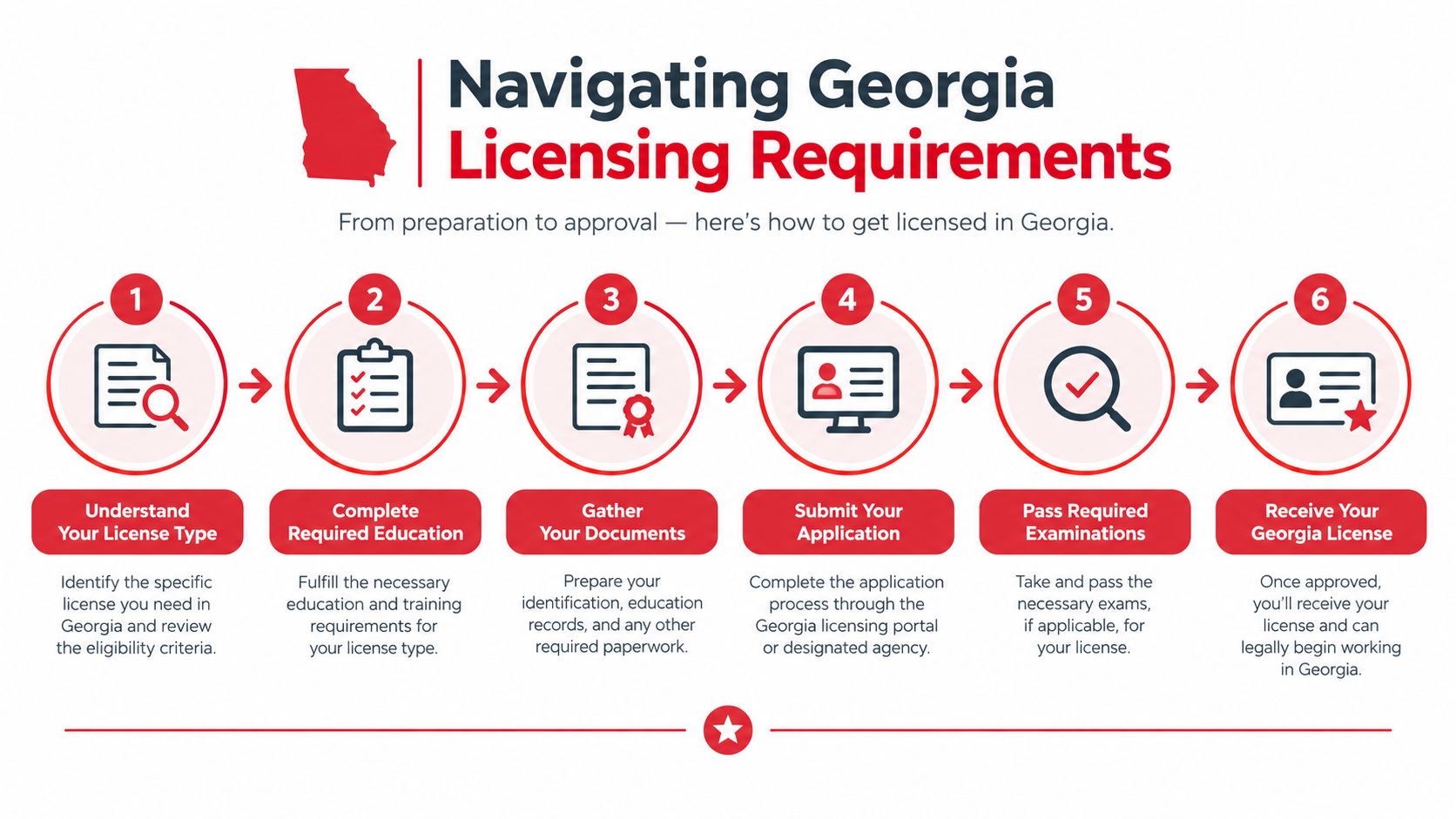
Navigating Georgia Licensing Requirements
Georgia's requirements depend heavily on the learner's age and the type of license being pursued. The first step is to identify your pathway before purchasing a course or scheduling a road test. A teen seeking a Class D license follows a different process from an adult first-time driver, so a course designed for one group may not answer every question for the other.
The teen pathway under Joshua's Law
For 16- and 17-year-olds, Joshua's Law is central. Georgia requires these applicants to complete an approved driver education course. The state lists two education options:
- Classroom option: Complete 30 hours of classroom instruction and 6 hours of behind-the-wheel training.
- Online option: Complete 30 hours of online instruction and 6 hours of behind-the-wheel training.
- Supervised practice: Complete 40 hours of supervised driving, including 6 hours at night.
These requirements are described on the Georgia Department of Driver Services Joshua's Law page. The important distinction is that online theory doesn't replace practical training. Both approved education paths still include professional in-car instruction and supervised driving with a qualified adult.
A useful way to organize the process is to separate the requirements into three categories: education, practice, and testing. Education teaches traffic laws and decision-making. Professional lessons develop vehicle-control skills and help prepare you for common road-test maneuvers. Supervised driving provides additional repetition in varied conditions, including nighttime practice.
The adult first-time pathway
Adults who are learning to drive for the first time shouldn't assume they need to follow the teen process exactly. Georgia's teen-specific Joshua's Law requirements apply to 16- and 17-year-olds, while adult applicants should confirm their own current DDS requirements, permit status, documentation, and testing pathway before enrolling.
That doesn't make professional auto driving lessons less useful for adults. An adult learner may need instruction that fits around work, childcare, college, or a long gap since receiving a permit. A private package can focus on the skills that matter most, such as basic control, traffic-flow decisions, parking, lane changes, merging, and road-test preparation.
A practical order of operations
Start by confirming your permit and age-based requirements with Georgia DDS. Then choose an approved education format if Joshua's Law applies to you, schedule professional behind-the-wheel lessons, complete the required supervised practice, and arrange the road test rather than assuming you can walk in.
Keep records as you go. Save course completion documents, track supervised driving carefully, and ask the instructor which skills still need work. Families lose time when they complete a course but can't document the practice or arrive at testing without the required permit, vehicle, or accompanying driver.
Choosing the Right Lesson Format
A traditional classroom course and an online course can both teach traffic laws, signs, right-of-way rules, and safe decision-making. The better choice depends on how you learn and how reliably you can attend. A student who benefits from live discussion may prefer an instructor-led class, while someone balancing school, work, or family responsibilities may need online access.
Comparing the main options
| Format | Best fit | Main advantage | What it doesn't replace |
|---|---|---|---|
| In-person classroom | Learners who prefer live explanations | Immediate questions and group discussion | Behind-the-wheel practice |
| Online theory | Students with changing schedules | Flexible access and self-paced review | Professional in-car training |
| Hybrid education | Learners who want flexibility plus coaching | Combines digital theory with practical instruction | Required supervised driving |
| Private lesson package | Teens or adults needing targeted practice | Personal feedback and focused skill development | Any state requirement not included in the package |
Online theory can be convenient, but convenience shouldn't be confused with complete preparation. A learner may understand the rule for yielding at an intersection and still hesitate when several vehicles arrive at once. That gap is why the practical portion deserves deliberate scheduling, not a last-minute appointment before the test.
The industry is moving toward online theory, simulation-based instruction, AI-powered scheduling, mobile-first booking, and centralized analytics. One market report says hybrid driver education models are capturing 42% of demand in 2026, a projection that points to changing expectations around access and delivery. Review the report on hybrid driver education trends before treating technology as a substitute for instructor feedback.
Match the format to the learner
A nervous beginner may need shorter, highly focused sessions that start in a quiet area. A driver who already controls the vehicle may benefit more from lane changes, merging, freeway entry, parking, or mock-test routes. An adult who drives occasionally may need a package that concentrates on consistency rather than completing a fixed sequence.
Ask whether the provider offers pickup and drop-off, flexible appointment times, a training vehicle, and a clear plan for moving from theory to the road. Also ask how the school handles rescheduling and whether road-test preparation is built into the package. These details often matter more than choosing between a classroom screen and a classroom seat.
Understanding Pricing and Financial Aid
A low hourly rate can become expensive if parking practice, a road-test vehicle, or extra preparation costs more later. For example, a learner might book one session, discover that another is needed, then pay separately for testing support. A package is easier to compare when it states exactly what the learner receives.
Look beyond the hourly price
Request a written breakdown before enrolling. Check whether it includes:
- Education: Confirm whether the package covers the classroom or online instruction required for the learner's licensing pathway.
- Behind-the-wheel training: Verify the number and length of professional driving sessions.
- Pickup and drop-off: Ask whether transportation is included, limited by location, or billed separately.
- Road-test support: Find out whether the provider offers test preparation, vehicle access, testing assistance, or instruction only.
- Scheduling terms: Review cancellation, rescheduling, expiration, and refund policies before paying.
- Documentation: Confirm how the school supplies course-completion records and other required paperwork.
A coordinated package can also improve instruction. The instructor sees the learner's progress across sessions instead of treating each appointment as a separate purchase. Early lessons can reveal weak areas, while later practice can focus on the maneuvers that need more work. This approach gives families a clearer way to compare modern hybrid programs and private behind-the-wheel packages with classroom-only options that may offer less scheduling flexibility.
Check Georgia scholarship eligibility
The Georgia Driver's Education Grant Scholarship Program is a statewide grant for eligible students who need help paying for driver education. It is open to Georgia residents ages 15 through 17 who hold a valid Georgia instructional permit or driver's license and want to complete Joshua's Law requirements through 30 hours of classroom instruction and 6 hours of behind-the-wheel training. Review the Georgia Driver's Education Grant Scholarship requirements and learn how to get grants and scholarships through A-1 Driving School before assuming the family must pay the full course cost.
Gather eligibility information early and ask whether the driving school participates. The grant applies to qualifying driver education, not automatically to every driving service. If the student needs private lessons beyond the required training, ask for those prices separately.
Adults should compare packages by skill needs rather than by teen-course requirements. A structured set of private lessons may suit an adult who needs practice with specific tasks. The provider should explain what happens at the first appointment, how progress is assessed, and what the learner should practise between sessions.
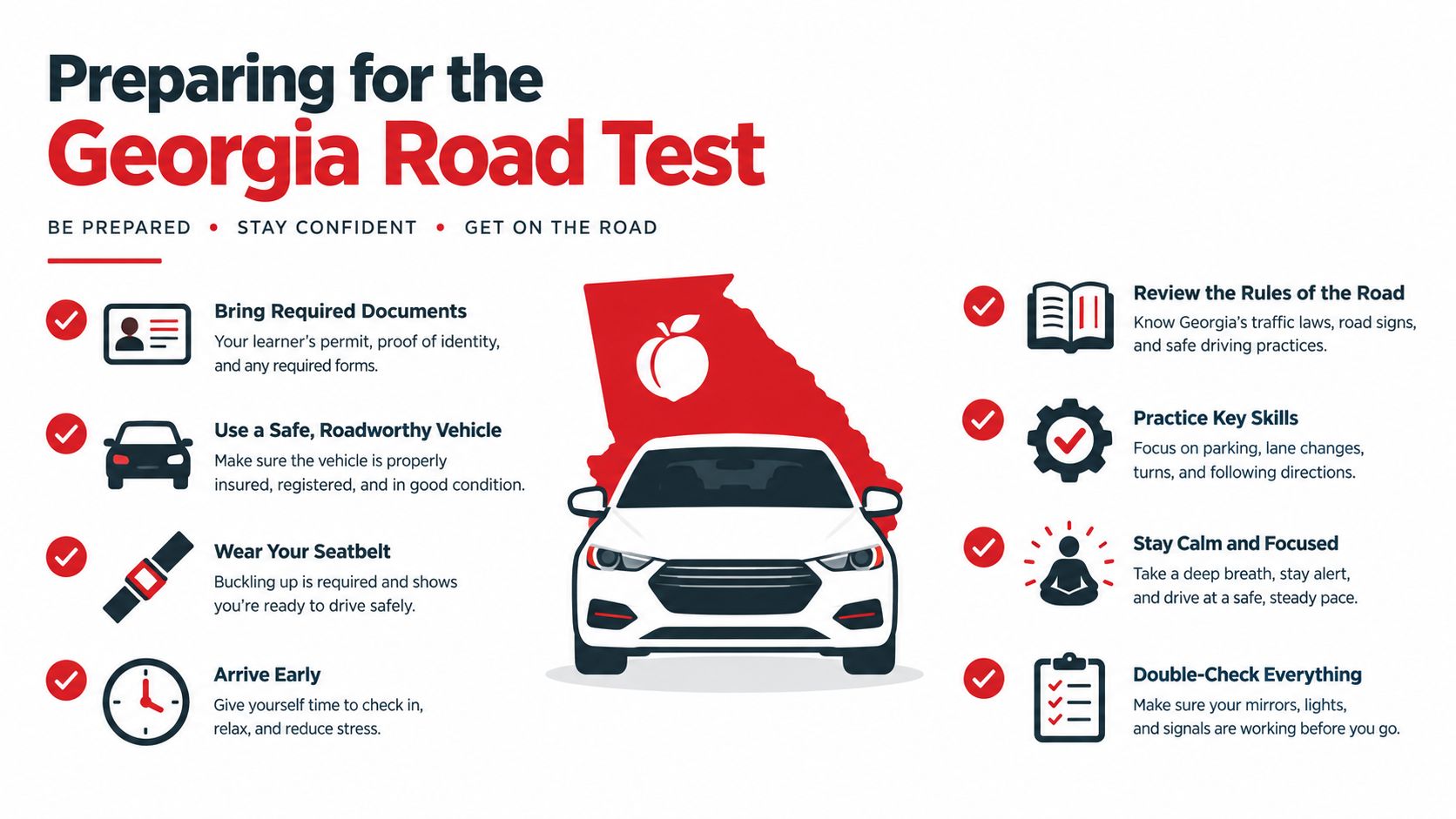
Preparing for the Georgia Road Test
Road-test preparation should begin before the appointment is booked. A student can know the rules and still lose control of the vehicle during a turn, miss a blind-spot check, approach a stop sign too quickly, or become flustered while parking. Instructors use practice sessions to make these tasks routine rather than surprising.
Build the test skills deliberately
A useful lesson sequence might begin with basic vehicle control, then move into neighborhood streets and more complex traffic. As the learner improves, the instructor can add:
- Starting and stopping: Use smooth acceleration, controlled braking, and complete stops.
- Turns and intersections: Choose the correct lane, signal in time, scan for pedestrians and traffic, and maintain a safe speed.
- Lane changes: Check mirrors, signal, check the blind spot, and move only when the gap is safe.
- Merging: Match traffic conditions without forcing another driver to brake.
- Parking: Practice straight parking, backing, and other maneuvers relevant to the test route.
- Vehicle communication: Follow directions calmly and demonstrate control without rushing.
The six hours of professional behind-the-wheel training required for the teen Joshua's Law pathway should be treated as targeted coaching, not a box to check. The instructor can use that time to identify a weak maneuver, explain the visual cues that support it, and repeat the maneuver until the student can perform it without constant prompting.
Confirm the appointment requirements
Georgia DDS road-test appointments aren't walk-in based. Applicants must schedule an appointment, hold a valid Georgia Non-Commercial Learner's Permit, arrive with a licensed driver age 21 or older, and sign an affidavit confirming 40 hours of supervised road driving, including 6 hours at night. These requirements appear on the Georgia DDS road-test guidance.
That checklist affects preparation. A student may be ready to drive but still be unable to test if the appointment hasn't been scheduled or the accompanying driver doesn't meet the requirement. Confirm the vehicle requirements as well, including registration, insurance, working equipment, and any rules that apply to the test location.
Treat test day as a normal lesson
The strongest road-test rehearsal follows the same habits expected during regular driving. The student should adjust the mirrors, fasten the seat belt, scan before moving, signal consistently, and listen carefully to directions. A calm routine reduces the chance that nerves will erase skills already learned.
Ask the instructor to conduct a mock test without frequent coaching. That exercise reveals whether the learner can make safe decisions independently. If the student needs repeated reminders, schedule more focused practice instead of relying on confidence alone.
Selecting a Certified Driving School
A driving school should make the licensing process clearer, not add another layer of uncertainty. Start by checking whether the provider is properly certified and whether its instructors understand Georgia's requirements. A school that teaches local roads and local testing expectations can give more useful guidance than a generic program built around another state's rules.
Use a practical checklist
Look for a provider that can answer these questions directly:
- Which learners do you serve? The school should be able to explain its teen, adult, permit, and road-test services without treating every applicant the same.
- Which education formats are available? Ask about in-person, online, and hybrid options, and confirm which courses satisfy the applicable Georgia requirement.
- What does the lesson package include? Get details on session length, pickup and drop-off, vehicle use, instructor feedback, and rescheduling.
- How do you prepare students for testing? The school should teach practical skills such as parking, lane changes, turns, merging, and freeway driving rather than offering only general encouragement.
- Can you support the full process? Coordinated education, lessons, documentation, and road-test assistance can reduce the need to manage several providers.
Local partnerships can also matter. Schools that work with county boards of education and area high schools may understand school calendars, student transportation needs, and the scheduling pressures families face. That experience doesn't guarantee a perfect fit, but it can make enrollment and appointment planning more practical.
A provider such as A-1 Driving School's auto driving school program offers education and practical training options for Georgia teens and adults, including online and in-person learning, private behind-the-wheel instruction, and road-test preparation. Compare any provider by its actual package terms, instructor availability, certification, and ability to explain your specific licensing pathway.
Ask before enrolling: “What will I complete with this package, and what will I still need to arrange myself?”
That question exposes hidden gaps. A low-cost course may cover theory but not vehicle access. A lesson package may provide instruction but not testing assistance. A school that explains those boundaries clearly helps families make an informed decision.
Building Lifelong Safe Driving Habits
A license proves that a driver met the testing standard on a particular day. It doesn't mean every future decision will be easy. Lifelong skill develops when drivers continue scanning ahead, managing space, adjusting speed, and recognizing hazards before they become emergencies.
Structured licensing supports that gradual development. The CDC cites a meta-analysis of 14 studies associating graduated driver licensing systems with about a 19% reduction in injury crashes and about a 21% reduction in fatal crashes for 16-year-olds. Review the CDC's teen-driver prevention guidance for the evidence behind graduated licensing.
For a Georgia learner, the practical path is straightforward: confirm the correct requirements, complete the appropriate education, schedule professional driving lessons, record supervised practice, prepare deliberately, and book the road test with the required documents and support. Adults can follow the same skill-building principle while confirming the pathway that applies to their age and situation.
A-1 Driving School offers Georgia teens and adults online and in-person driver education, private behind-the-wheel lesson packages, Joshua's Law support, scholarship guidance, and road-test preparation. Visit A-1 Driving School to compare course and driving lesson options, confirm the package that fits your licensing path, and begin scheduling.