
Fun ticket dismissal is a myth in Georgia: a defensive-driving course does not automatically dismiss a ticket, but a court-approved certificate can reduce the assessed fine by 20% and result in zero license points for that violation. The court must accept the course and certificate before those benefits apply.
You're sitting in the driver's seat with a citation in hand, replaying the traffic stop and searching for the fastest way out. Many Georgia drivers type “fun ticket dismissal” into Google expecting a lighthearted online class to erase the problem. That shortcut can create a bigger one if you enroll before checking the court's rules.
A defensive-driving course may still be useful, but its value is more practical than magical. It can support a court-ordered resolution, help with point management, and form part of a broader path toward responsible driving and a full Georgia license. The key is knowing what the course can do, what it can't do, and which decision belongs to the court.
The Truth About Fun Ticket Dismissal

You leave a Georgia traffic stop with a citation in your hand and search for “fun ticket dismissal,” hoping a quick online class will make the problem disappear. That assumption can cost you time and money. Georgia doesn't work that way. A Georgia U.S. Army legal-services guide explains that a ticket is generally dismissed when the driver successfully contests it in court, not because the driver completes Defensive Driving. The guide also identifies a course as a possible tool for point reduction or another court-ordered resolution. Read the Georgia traffic-ticket guidance.
Dismissal and mitigation are different outcomes. Dismissal defeats or removes the citation through the legal process. A zero-point disposition prevents points from being assessed for the qualifying violation, but the matter may still involve a court appearance and a fine. Completing a class does not cancel the citation, extend a deadline, or remove an appearance requirement.
What the course can accomplish
Georgia DDS recognizes a 6-hour Driver Improvement course for uses that may include court orders, point reduction, license reinstatement, insurance-premium reduction, and personal education. The Georgia DDS Driver Improvement program lists the 6-hour course as eligible for court orders and point reduction; the court must accept the original certificate before the 20% fine reduction and zero-point disposition apply.
That makes the course useful for drivers whose courts approve it. It is a way to support a specific resolution, not a promise that every citation will vanish. Ask the issuing court whether it accepts the certificate, whether your violation qualifies, and what paperwork it requires.
Practical rule: A course provider supplies training and documentation. The court decides how your citation is resolved.
Timing, citation type, judicial acceptance, and county procedures can change the result. A website promising guaranteed “fun ticket dismissal” ignores those conditions. Treat that promise as a warning sign. For drivers working toward a full Georgia license, approved education can also matter beyond one citation, including the broader path associated with Joshua's Law.
How to Handle Your Georgia Traffic Citation
Start with the citation, not the course registration page. Read the issuing court, appearance information, violation description, and any instructions printed on the ticket. Then contact that court and ask whether it accepts a DDS-approved 6-hour Driver Improvement certificate for your type of citation and what must be submitted before the appearance or other deadline.
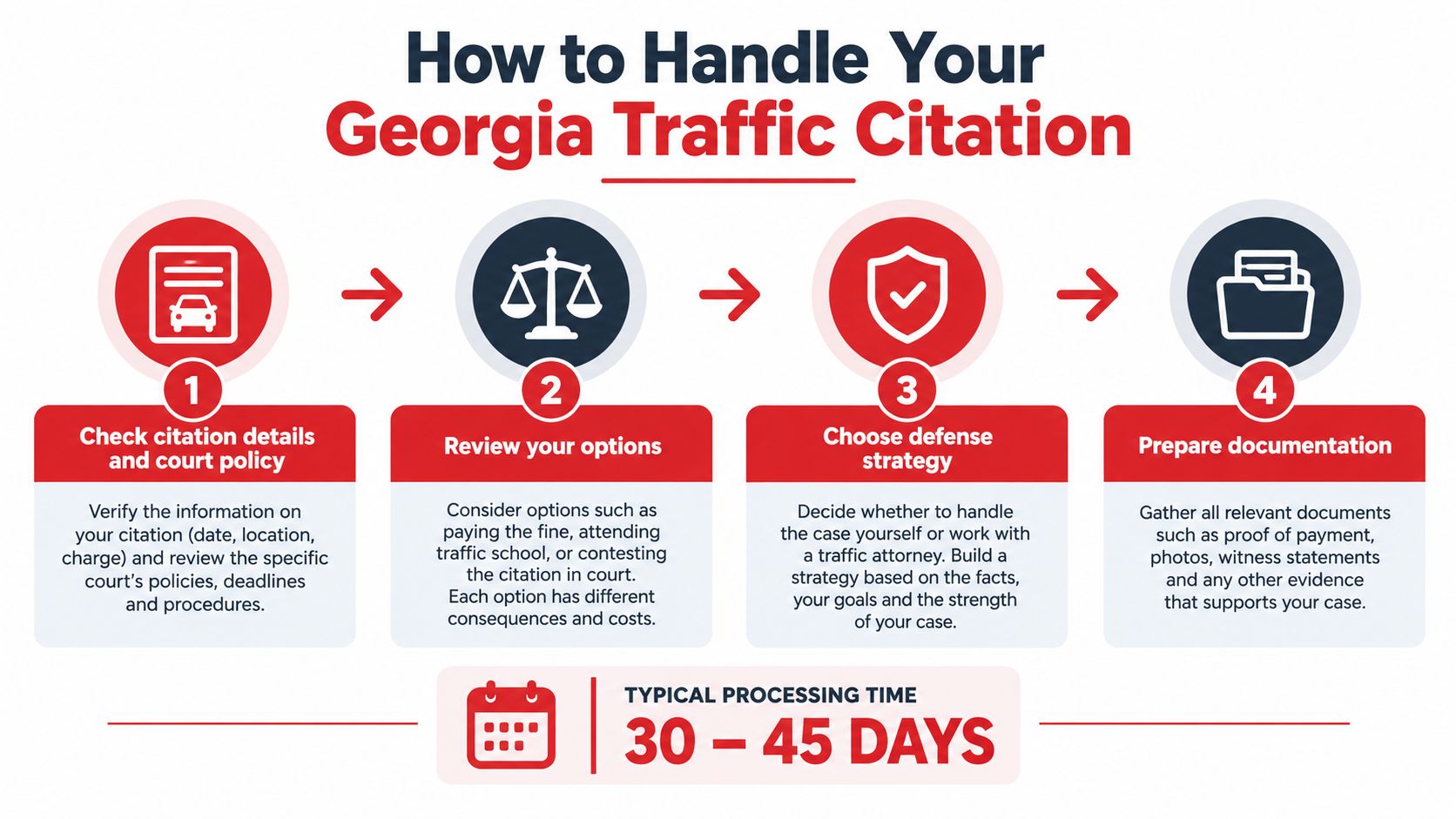
The sequence below keeps drivers from spending money on the wrong solution:
- Check the court policy: Ask the issuing court whether it will accept a DDS-approved certificate and whether you must appear.
- Review the desired outcome: Decide whether you're seeking a court-approved fine and point benefit, contesting the citation, or addressing a separate license issue.
- Choose a certified provider: Enroll only with a provider offering a course recognized by Georgia DDS.
- Protect your paperwork: Complete the course, obtain the original certificate, and deliver it to the court before the appearance or as otherwise ordered.
The Georgia DDS court reference manual states that, when the court accepts the original completion certificate under Georgia law, the assessed fine must be reduced by 20% and no license points imposed for the qualifying moving violation. The court, not the provider, controls whether the citation is dismissed, reduced, or otherwise resolved.
Keep the court in control
Don't assume that registering for a class changes your court date. Don't assume an emailed copy is enough when the court requests the original. Don't assume a provider's marketing language overrides the instructions on your citation.
After submission, keep copies of the certificate, delivery confirmation, and any court response. Written confirmation of the disposition is especially valuable because it tells you what happened to the case rather than what you hoped would happen.
If the ticket affects your insurance situation, you may also need to consider client remediation for tough risks as a separate insurance resource. Insurance treatment and court treatment aren't the same decision, so handle them independently.
For a practical explanation of the broader process, review how to dismiss a traffic ticket, then confirm every step with the issuing court.
The safest workflow is boring and effective: verify first, enroll through a certified provider, finish before the required deadline, submit the original certificate as directed, and obtain the court's final disposition.
Understanding Points Reduction vs. Fine Reduction
A Georgia driver facing a citation may hear “points reduction” and “ticket reduction” used as though they describe the same result. They do not. One concerns the court's handling of the current citation. The other concerns points already recorded by Georgia DDS.
| Benefit | Who handles it | What it affects |
|---|---|---|
| Court benefit | The issuing court | A qualifying moving violation can receive a 20% reduction in the assessed fine and no license points if the court accepts the original certificate. |
| Administrative benefit | Georgia DDS | A licensed Georgia resident may reduce up to 7 accumulated points, subject to the state's eligibility rules. |
The court benefit applies to the ticket before the judge or court clerk. It does not automatically lower your existing license balance. The administrative benefit applies to points already accumulated on your Georgia license. It requires successful completion of a DDS-approved course and submission of the certificate to DDS. Review Georgia DDS points and points-reduction rules.
The seven-point ceiling
DDS limits the reduction to up to 7 points, and a driver can use it only once during any 5-year period. The reduction cannot take the balance below zero. A driver with 9 qualifying points could reach 2 points after approval, while a driver with 5 points would reach zero.
Georgia DDS's Driver Improvement program confirms the 6-hour course requirement and the once-per-5-year reduction limit.
That timing creates a real choice. Using the benefit for a minor issue may leave you without it when a larger point balance threatens your license. Check your license status and confirm your eligibility with DDS before enrolling.
The course you would take for the court benefit is the same DDS-approved 6-hour driver-improvement program, which is why the two benefits are so often confused. The paperwork goes to two different offices. The court decides what happens to the citation, while DDS handles the administrative point record.
The decision point: Identify whether your immediate problem is a court case, an existing point balance, or both. The correct paperwork depends on that answer.
For a practical explanation of the administrative process, review how to reduce points on a license. Use that information as background, then verify your individual status with DDS and the issuing court.
Why Driver Education Matters Beyond the Courtroom
A ticket can be the event that gets a driver's attention, but it shouldn't be the end of the learning process. For a teenager, the more important objective is developing enough knowledge, judgment, and vehicle control to earn a Class D license safely.
Georgia's Joshua's Law applies to applicants ages 16 and 17 seeking a Class D license. The standard school-based pathway includes 30 hours of classroom instruction, 6 hours of behind-the-wheel training with a certified instructor, and at least 40 hours of supervised driving with a parent or guardian, including 6 nighttime hours. Review Georgia DDS Joshua's Law requirements.
Online instruction still needs practical training
Georgia permits equivalent online instruction through a certified virtual program for the classroom portion. Online learning can suit students managing school, activities, work, or family schedules, but it doesn't eliminate the required practical experience. The student must still complete the required behind-the-wheel training or use the approved parent-taught option, along with the supervised-driving requirement where applicable.
That is where families sometimes choose the wrong shortcut. A student may finish online lessons and understand road rules but still struggle with lane positioning, speed control, observation, or decision-making in live traffic. The classroom gives the driver a framework. Supervised and instructor-led practice turns that framework into repeatable behavior.
Education should change driving habits
Good driver education addresses more than memorizing signs. It teaches a new driver how to scan intersections, manage space, respond to changing traffic, and recover from small mistakes before they become dangerous ones. Those habits matter whether a student is preparing for a first license or an experienced driver is responding to a citation.
A course can also help a family identify where additional lessons are needed. One student may need confidence in traffic. Another may need focused practice with turns, parking, or night driving. The best plan connects the classroom requirement to actual weaknesses rather than treating Joshua's Law as a box to check.
For a practical look at how driver improvement fits into safer driving, see why take a defensive-driving course. The useful outcome is more than a certificate. It is a driver who makes better decisions after the class ends.
Preparing for Your Georgia Road Test
Finishing classroom instruction doesn't guarantee a passing road test. Georgia applicants for a Class D provisional license must be at least 16, hold a valid Class CP instructional permit for at least 1 year and 1 day, and complete at least 40 hours of supervised driving, including 6 hours at night. Applicants under 18 must also satisfy Joshua's Law, pass a vision examination, complete ADAP, and pass the road-skills test. Georgia DDS lists the Class D testing and training requirements.
The road test requires a minimum score of 75% to pass. DDS evaluates specific driving tasks, so casual practice around a familiar neighborhood may leave important gaps. A teenager who can drive comfortably in light traffic may still lose control of the situation when asked to turn precisely, change lanes safely, or complete a parking maneuver under observation.

Practice the test, not just the commute
Instructor-led preparation gives the driver a structured way to correct errors. The instructor can watch mirror use, following distance, speed changes, steering control, braking, and communication with other road users. A parent may know that something feels unsafe, but an experienced instructor can identify the precise habit causing the problem and give the student a repeatable correction.
The driver also needs to arrive prepared for the appointment itself. DDS requires the applicant to schedule the road test and complete the applicable online license, ID, or permit form. On test day, the applicant must bring a licensed driver who is at least 21 years old, and only the applicant and accompanying driver may be in the vehicle. The applicant must provide a suitable vehicle and the required documentation. Georgia DDS explains teen-driver road-test rules.
Remove avoidable surprises
Vehicle coordination matters. So does knowing which documents to bring and how the test will be administered. A preparation session can expose a problem with the vehicle, clarify the testing sequence, and help an anxious driver focus on driving rather than logistics.
The strongest preparation combines documented practice with targeted professional lessons. The aim isn't to rehearse one route until it feels familiar. It's to build enough control and awareness that the student can handle the evaluated tasks in a new situation.
Take the Stress Out of Learning to Drive
Georgia drivers can face several separate decisions at once. A ticket may require court communication. A point concern may require DDS paperwork. A teenager may need Joshua's Law coursework, supervised driving, behind-the-wheel instruction, and road-test preparation. Treating all of those needs as one generic “driving course” is how families miss deadlines or pay for training that doesn't solve the actual problem.
A practical plan starts by identifying the driver's current stage:
- Citation stage: Confirm the court's policy before enrolling in a course, then preserve every certificate and filing record.
- Point-management stage: Determine whether the DDS administrative reduction fits the driver's license history and timing.
- Learning stage: Choose classroom instruction, online coursework, or both based on the student's schedule and learning needs.
- Practice stage: Schedule lessons that address real weaknesses, including traffic judgment, parking, lane changes, night driving, or highway confidence.
- Testing stage: Coordinate the road-test appointment, suitable vehicle, required documents, and final preparation.
Georgia's Driver's Education Scholarship Grant Program may also help qualifying students access driver training at the expense of the state. Families should check current eligibility and application details before relying on grant funding, because program administration and availability can change.
The best driving lessons package is the one that matches the student, not the one with the most attractive shortcut. Some students need a calm introduction to vehicle control. Others need concentrated practice before testing. Adults returning to driving may need a different schedule and a different coaching style from a teen completing Joshua's Law.
The same principle applies to citation problems. A course can be useful, but only when the court accepts it and the driver completes the required process. There is no substitute for checking the citation, asking the right authority, and choosing instruction that addresses the actual risk.
A-1 Driving School offers Georgia Driver's Education in person and online, Joshua's Law training, individualized driving lessons and packages, road-test preparation, testing assistance, and support with the Georgia Driver's Education Scholarship Grant Program. Visit A-1 Driving School to choose the course or lesson plan that fits your path from classroom to confident, legal driving.