For most Georgia teens, the required path includes a vision exam, a two-part knowledge exam, and the Class D road-skills test after Joshua's Law training, while adults 18 and older typically test directly for a Class C license. The knowledge sections require at least 15 out of 20, or 75%, on each test, and the road-skills test requires a 75% overall score to pass.
Maybe you're staring at the Georgia Department of Driver Services website with a learner's permit question open in one tab and terms like Class CP, Class D, and Class C in another. You're not alone. The right answer to “what driving test do I need to take” depends mainly on your age and driving history, not just on whether you've completed a course.
A 16- or 17-year-old usually follows the teen pathway, which combines a Class CP learner's permit, Joshua's Law requirements, supervised practice, and a Class D road-skills test. An adult who's applying for a Georgia license typically follows the Class C route instead. You can use this Georgia license requirements guide to identify the path that fits your situation before scheduling training or testing.
Why the Answer Depends on Your Age
The letters on a Georgia license can make a straightforward process feel like a maze. A Class CP is the learner's permit used for supervised practice, a Class D is the provisional license generally associated with teen applicants, and a Class C is the regular license route generally used by adults.
Your age determines which stages apply. Your previous licensing history can also affect what you need to complete, so don't assume that another state's process transfers perfectly to Georgia.
Core takeaway: Teens usually progress from Class CP to Class D. Adults generally work toward Class C.
The teen route
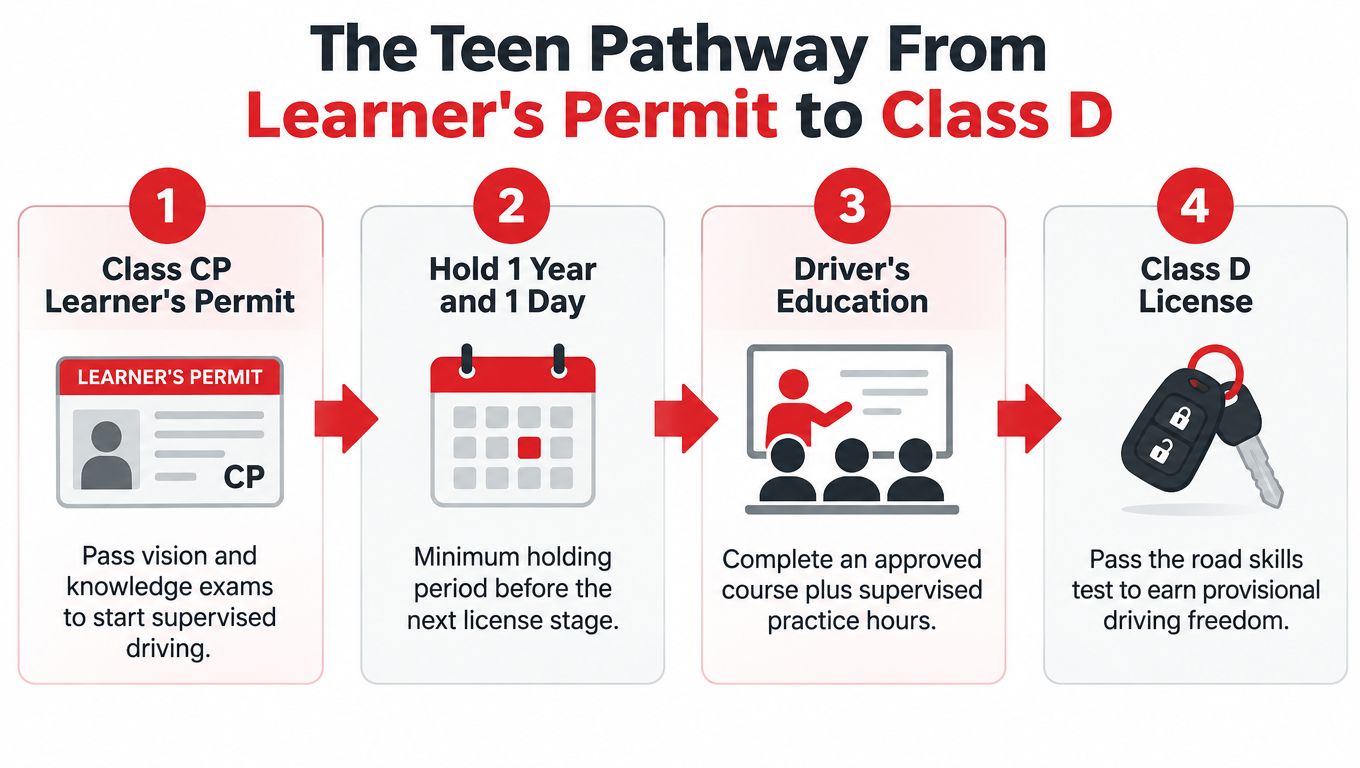
For a Georgia teen seeking a Class D license at age 16 or 17, testing is only one part of the process. The applicant generally must hold a valid Class CP learner's permit for at least 1 year and 1 day, complete Joshua's Law requirements, finish the Alcohol and Drug Awareness Program, and document supervised driving before taking the road-skills test. The state's requirements connect eligibility, education, practice, and testing in a particular order.
That means a certificate from driver education doesn't replace the behind-the-wheel examination. A teen can complete classroom instruction and supervised hours, yet still need to demonstrate safe vehicle control to a DDS examiner.
The adult route
Adults 18 and older generally don't follow the Class D teen sequence. They typically apply for a Class C license and complete the examinations that apply to that route, rather than completing the teen-specific Joshua's Law progression.
This doesn't mean an adult should skip preparation. A new adult driver may need just as much practice with lane positioning, intersections, parking, and speed control as a teen. The difference is that the state pathway is usually not built around the same Class CP holding period and teen training milestones.
The rest of the process becomes easier when you ask three questions first:
- How old are you? This identifies the likely license class.
- Do you already hold a Georgia permit or license? Your history may determine which stage comes next.
- Are you ready for practical testing? A course establishes knowledge, while lessons build the physical skills the road test measures.
The Three Georgia Driving Exams Explained
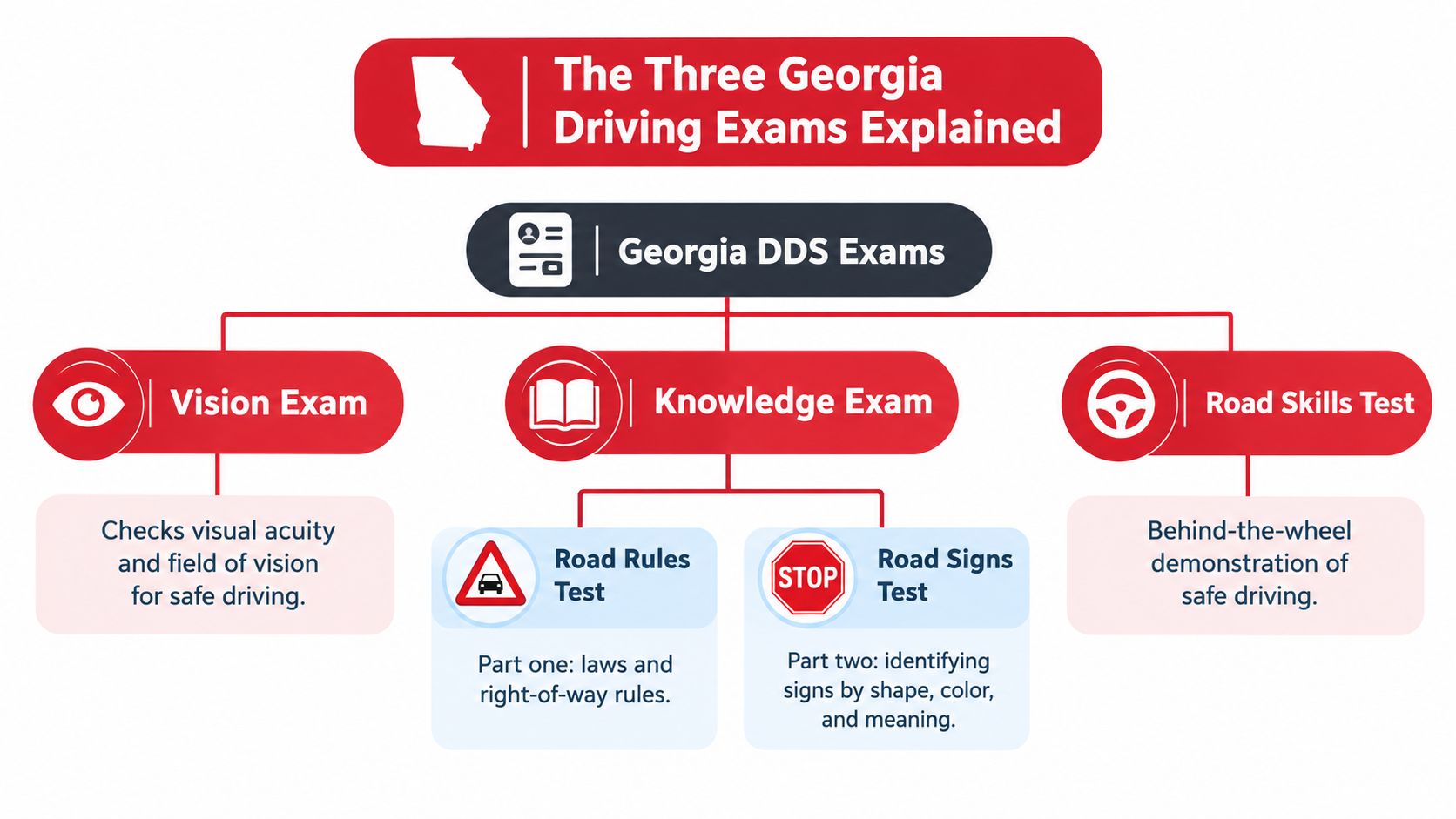
Georgia's standard testing pathway has three main pieces: vision, knowledge, and road skills. They don't all measure the same ability. The first checks whether you can see adequately, the second checks whether you understand traffic rules and signs, and the third asks you to apply that understanding behind the wheel.
Start with the vision examination
The vision examination checks the visual ability needed for safe driving. It belongs at the beginning of the pathway because clear vision affects every later task, from reading a sign to identifying a vehicle at an intersection.
If you use corrective lenses, bring them. Your instructor can help you practice with the same visual correction you'll use while driving, but the official examination is administered by DDS.
Understand the two knowledge tests
Georgia's knowledge exam has two separate parts, the Road Rules Test and the Road Signs Test, as described by the Georgia DDS testing information.
| Knowledge section | What it checks | Minimum score |
|---|---|---|
| Road Rules Test | Traffic laws, right-of-way principles, and safe driving decisions | 15 out of 20, or 75% |
| Road Signs Test | Recognition and meaning of traffic signs | 15 out of 20, or 75% |
You must meet the minimum on each part. A strong result on Road Rules doesn't compensate for falling below the requirement on Road Signs.
Use practice questions to identify whether you're missing rules or misreading signs. If a sign's color, shape, or symbol confuses you, study the meaning rather than memorizing an isolated answer. The Georgia permit test guide can help you understand the format before you arrive.
Prepare for the road-skills test
The road-skills test is the practical examination. It evaluates vehicle control and safe driving behavior, including maneuvers such as parallel parking and straight-line backing. The examiner also observes how you control speed, position the vehicle, respond to traffic, and manage the roadway.
Georgia requires a minimum overall score of 75% to pass the road-skills test. The test is available only in English, so applicants should make sure they understand common driving instructions before test day.
Your vehicle must be a four-wheel vehicle with valid registration or license plates, current liability insurance, and required safety equipment. Applicants generally provide their own vehicle. If the vehicle's turn signals aren't available, the driver must know the appropriate hand signals.
The hierarchy is simple:
- Vision exam, can you see well enough to drive safely?
- Knowledge exam, can you demonstrate the required understanding of rules and signs?
- Road-skills test, can you apply that knowledge through safe vehicle control?
Passing one stage doesn't automatically pass the next. Each exam measures a different part of driving competence.
The Teen Pathway From Learner's Permit to Class D
A teen's licensing process works best as a sequence, not a collection of unrelated appointments. Each milestone supports the next one, and skipping the order can leave an applicant with completed training but no eligibility to test.
Begin with the Class CP permit
The Class CP learner's permit allows supervised driving. The teen first completes the applicable vision and knowledge examinations, then uses the permit to build experience with a qualified supervising adult.
The permit isn't just a document to keep in a wallet. It creates the legal starting point for practice and for behind-the-wheel training connected to Joshua's Law.
Meet the holding period
A 16- or 17-year-old seeking a Class D license must hold a valid Class CP permit for at least 1 year and 1 day, according to the DDS Class D requirements. That means the calendar matters. A teen who reaches the expected birthday or completes a course still can't treat the road test as the next immediate step if the permit period isn't complete.
Parents can use this time to build a steady practice routine rather than postponing all driving until the testing appointment is near.
Complete education and supervised driving
Joshua's Law training can include 30 hours of classroom or approved online instruction, 6 hours of behind-the-wheel training with a certified school, and 40 hours of supervised driving with a parent or guardian. At least 6 of those supervised hours must occur at night.
The applicant must also complete ADAP, the Alcohol and Drug Awareness Program. These milestones establish eligibility, but they don't replace the road-skills test.
Practical rule: A course certificate proves that you completed training. The road test proves that you can drive.
A parent or guardian should maintain the required documentation as practice happens. Waiting until test week to reconstruct driving hours can create avoidable stress.
Bring evidence to the final stage
Before scheduling or attending the road-skills test, organize:
- Training evidence: Bring the applicable Joshua's Law completion documentation.
- Supervised-practice documentation: Prepare the supervised-driving affidavit or other required proof.
- Permit information: Confirm that the Class CP permit has been held for the required period.
- ADAP completion: Keep evidence that the program is complete.
- Test vehicle documents: Confirm registration or plates, liability insurance, and safety equipment.
The exact paperwork can depend on the selected training pathway, so families should verify current DDS requirements before the appointment. For a practical explanation of the sequence, review this guide to getting a Georgia provisional license.
A useful way to remember the process is permit, waiting period, education, supervised practice, ADAP, then road skills. The test comes at the end because Georgia expects the applicant to arrive with both knowledge and experience.
Adults Waivers and Alternative Routes
Adults often ask whether they can use a teen's course pathway or whether a waiver allows them to bypass practical preparation. The clearest answer is to separate license class from training format. Adults generally pursue Class C, while Joshua's Law alternatives primarily address how qualifying teens complete their education and practice.
| Requirement | Teens 16-17, Class D | Adults 18+, Class C |
|---|---|---|
| License pathway | Class CP to provisional Class D | Typically direct Class C pathway |
| Joshua's Law | Generally required for the teen route | Generally not the teen requirement |
| Permit holding period | At least 1 year and 1 day | Teen holding period generally doesn't define the adult route |
| Supervised practice | 40 hours, including 6 nighttime hours | Practice remains important, but the teen-hour structure generally doesn't define the adult route |
| ADAP | Required for the teen route | Teen-specific requirement generally doesn't define the adult route |
| Road-skills test | Required for the Class D pathway | Practical testing may still apply to the Class C application |
Know the Joshua's Law alternatives
Georgia permits the theoretical component through either traditional classroom instruction or a DDS-approved online course. The practical component can include 6 hours with a DDS-certified instructor, or families can use the DDS Parent/Teen Driving Guide parent-supervised alternative, as explained in the DDS driver education FAQs.
For the parent-supervised route, the supervising adult must be at least 21 and hold an unexpired Class C license. The adult must sit beside the learner while the learner drives.
These alternatives don't mean a family can remove practical training altogether. They give families different ways to organize it. An online theory course can fit a busy schedule, while instructor-led lessons can provide feedback that a parent may not know how to give.
Separate real waivers from misunderstandings
Completing an online course doesn't waive the road-skills test. Completing the classroom requirement doesn't erase the supervised-practice documentation. Holding a permit for the required period doesn't demonstrate that the applicant is ready to control a vehicle in traffic.
Adults who start later may not need the teen-specific sequence, but they still benefit from learning the rules, practicing deliberately, and confirming the current Class C requirements with DDS. New residents and applicants with prior licenses should ask DDS how their individual history affects the application rather than relying on a general assumption.
Why Passing the Test Is Not the Same as Being Ready
A passing score answers a narrow question: did the applicant meet the examiner's standard during that examination? It doesn't answer whether the driver can handle an unfamiliar intersection at night, a sudden change in traffic, or a wet Atlanta-area road without a supervising adult beside them.
Federal safety evidence emphasizes that young drivers have higher crash and near-crash rates per mile compared with older, more experienced drivers, particularly during the early months of independent driving, as discussed in this federal safety evidence. Georgia's supervised-practice structure, including nighttime driving for many teen applicants, recognizes that the transition continues after the test.

Connect each maneuver to a real habit
Parallel parking isn't only a test exercise. It teaches low-speed steering, mirror use, spacing, and patience around parked vehicles. Straight-line backing develops controlled movement and awareness of what isn't visible through the windshield.
A stop-sign error may be test-critical because it shows that the driver failed to obey a basic traffic control. Other habits may not cause an immediate failure but still create danger later, such as looking only straight ahead at intersections, carrying too much speed into a turn, drifting within a lane, or failing to adjust for rain.
A successful test should be treated as permission to keep learning, not proof that every driving situation has been mastered.
Adjust practice to the driver
A nervous driver may need short, predictable sessions that repeat one skill until the steps feel familiar. A driver preparing around Atlanta may need practice with heavier traffic, multilane roads, frequent lane changes, and complex intersections. Someone with limited vehicle access can prioritize a structured lesson plan, then use family practice time for the specific skill assigned by the instructor.
After a failed test, don't repeat the entire route without analysis. Identify the exact behavior that caused the problem, such as inadequate observation, poor positioning, or a missed instruction, then practice that behavior in varied settings. A single correction should become a repeatable habit, not a memorized response to one corner.
Prepare for the first solo drive
The first drive alone often feels different from a lesson. No instructor is available to prompt a mirror check or point out a developing conflict. Before driving independently, practice choosing safe speeds, scanning beyond the vehicle ahead, checking blind spots, yielding correctly, and making calm decisions when another driver behaves unpredictably.
Night practice deserves special attention. Darkness changes visibility and distance judgment, while rain can make lane markings and stopping conditions harder to read. These situations belong in preparation because the license begins a longer learning period, rather than ending it.
Choosing Your Training and Preparing the Smart Way
Georgia families can combine different types of education instead of forcing every learner into one format. Traditional classroom instruction supports discussion and questions, a DDS-approved online course provides scheduling flexibility for the theoretical component, and professional lessons provide direct feedback on vehicle control.
The right mix depends on the learner. A teen who understands traffic rules but struggles with steering may need more behind-the-wheel time. An adult who feels comfortable operating a car but doesn't understand Georgia signs may benefit from theory before scheduling lessons.
Match the format to the need
A practical preparation plan may look like this:
- Theory first: Complete classroom instruction or a DDS-approved online Joshua's Law course when the learner needs structured knowledge of rules and signs.
- Professional feedback next: Use instructor-led lessons to work on parking, backing, lane positioning, observation, and speed control.
- Family practice afterward: Reinforce the instructor's technique during supervised driving and document the required hours.
- Road-test preparation last: Schedule a focused session that checks the vehicle, reviews test maneuvers, and addresses the learner's remaining weak points.
Georgia allows the online theoretical component through a DDS-approved virtual program, so families should confirm approval before enrolling. The online format still needs to be paired with an appropriate driving-lessons plan, because screen-based learning can't demonstrate physical vehicle control.
Use lessons as a targeted plan
Driving lessons work best when they have a specific purpose. Instead of asking only for “test practice,” tell the instructor whether the learner needs help with parallel parking, straight-line backing, intersection scanning, night driving, nerves, or traffic exposure.
Customized teen and adult driving lesson packages can make that process easier by giving the learner a planned progression. A package may combine foundational instruction, skill correction, and road-test preparation, but the number of lessons needed should reflect the individual's control, judgment, and consistency rather than an arbitrary promise.
Ask about financial support
The Georgia Driver's Education Scholarship Grant Program may cover driver training costs at the state's expense for people who qualify. Families should check current eligibility and application details before assuming that funding is available or that it covers every service.
A-1 Driving School is a family-owned Atlanta driving school that has served Georgia since 1987 and has 18+ locations, including Athens. It offers in-person, online, and virtual driver education, customized teen and adult driving lessons, Georgia road-test preparation, and testing assistance. Its programs include courses intended to meet Joshua's Law requirements, so applicants should still confirm the specific course's current DDS approval and fit for their pathway.
Your Next Steps From Today to License in Hand
Use this action plan to turn the question into a schedule:
- Identify your route. Decide whether you're following the teen Class CP to Class D pathway or the adult Class C pathway.
- Check your current status. Confirm your age, permit or license history, and any required holding period with DDS.
- Gather your records. Keep course completion evidence, ADAP documentation where applicable, supervised-driving proof, and vehicle documents together.
- Choose the education format. Select classroom instruction or a DDS-approved online theory course when Joshua's Law applies.
- Schedule targeted lessons. Practice the maneuvers and traffic situations that need the most work, then arrange a final road-test preparation session.
- Confirm the appointment. Book the applicable DDS examination or use a certified driving school that offers road testing assistance, and verify the current requirements before arriving.
The teen pathway can feel slow while you're counting toward the permit's 1 year and 1 day milestone, but each stage has a clear purpose. Adults can usually avoid the teen sequence, yet they still need a thoughtful plan for knowledge, vehicle control, and practical testing.
A-1 Driving School offers Georgia driver education, DDS-approved online course options, customized teen and adult driving lessons, road-test preparation, and testing assistance. Visit A-1 Driving School to choose a course or lesson package and get help scheduling the road test that matches your Georgia licensing pathway.