
You can't walk in and test the week you feel ready if you're a Georgia teen. A Class D applicant must be at least 16 and have held a valid Class CP learner's permit for at least 1 year and 1 day, complete Joshua's Law requirements when applicable, and pass the vision and road skills tests, according to the Georgia DDS Class D license page. That timeline reframes the driving road test in Georgia as two gates you have to clear on the same day. First, your car and paperwork must be legal to use. Second, your drive must score high enough. Families who prepare for only one gate lose appointments or lose points they didn't have to lose.
Start by separating, "I can drive," from, "I'm eligible, documented, and bringing a testable car." Those are different jobs, with different checklists, and both need attention before you book.
What Examiners Score on Test Day
Georgia's traditional non-commercial road skills test requires a minimum score of 75% to pass, and a Driver Examiner seated in the passenger seat evaluates specified driving tasks and reviews the score sheet afterward, according to the Georgia DDS test and exams information page. That number decides the day. You're eligible on paper, your car passes inspection, and you still don't pass if the sheet lands under 75.
Think of the examiner as marking habits, not style. They want smooth starts, controlled stops, and speed that builds and drops without a lurch. They want the car centered in its lane through straightaways and curves. They want turns that begin and end in the correct lane, full stops before crosswalks, and proper yields when someone else has the right of way.
The Tasks on the Sheet
Use the table below as your practice list. If a task still needs a reminder from the passenger seat, it isn't automatic yet.
Georgia road-test skills and common misses
| Skill area | What a pass looks like | Common miss |
|---|---|---|
| Start and stop | Smooth launch and controlled stop | Jerky start or hard brake |
| Acceleration and braking | Speed builds and drops without a lurch | Late brake or riding the pedal |
| Lane position | Car stays centered | Drift, wide swing, or hugging the curb |
| Turns and intersections | Correct lane, full stop, proper yield | Rolling stop or turn into the wrong lane |
| Lane changes | Mirrors, blind spot, signal early | Late signal or skipped head check |
| Parking | Parallel park or lines, as that site requires | Too many pulls or a curb strike |
| Speed and space | Speed fits conditions and a safe gap | Too fast, too slow, or tailgating |
| Observation | Signs, signals, people on foot and bikes | Missed sign or person in a crosswalk |
Parking gets the most worry, but it isn't the whole test. Some sites ask for parallel parking, others use parking between lines. Either way, the examiner's watching the same basics during the maneuver. Do you check around the car before backing? Do you move slowly? Do you correct without rushing or striking the curb?
Speed and space work the same way. Driving far under the limit doesn't read as careful if it blocks traffic or shows hesitation at every intersection. Driving at the limit doesn't help if you're following so closely that every brake light ahead forces a hard stop. Pick a speed that fits traffic and weather, and leave a gap that gives you time to respond smoothly.
Who Has to Be There
Applicants under 18 seeking a Class D license need a scheduled appointment rather than a walk-in visit, and they need a licensed driver who is at least 21 years old with them. Plan that adult's schedule when you book, not the morning of the test. A missing adult can cost you the slot before you drive a foot.
The vehicle also needs valid liability insurance and registration, a current license plate, and a passed safety inspection. If the car's turn signals are unavailable, you must know the required hand signals. That's a backup rule, not a plan. Arrive in a car whose signals work.
Practical rule: Practice only the marked tasks until each one is automatic, and practice them as one continuous drive, not as isolated tricks in an empty lot.
Set your seat, mirrors, and belt before you move. Signal early enough that other drivers can react. Check mirrors and blind spots before every lane change and turn. Those small, visible habits are what the sheet rewards from the first block to the last.
Joshua's Law Hours Before You Test
For a 16-year-old, the road test comes after a set of training and permit requirements. The standard pathway includes 30 hours of classroom instruction, 6 hours of behind-the-wheel training at a certified school, and 40 hours of supervised driving with a parent or guardian, including 6 hours at night, according to the Georgia DDS Joshua's Law requirements page. A learner's permit is required before behind-the-wheel training, and it must be held for 1 year and 1 day before a Class D license is issued.
Time on a permit first issued in another state can count after the permit is transferred to Georgia. Families moving mid-year should check the transfer date early, since the holding period must be complete before the license can be issued.
Online, Classroom, and Parent Taught Paths
The academic portion can be completed through approved in-person or online options. An approved online course covers the same 30 hours as classroom instruction. The instructor training and supervised driving requirements still need attention: where the selected Joshua's Law method permits it, parent-taught behind-the-wheel training can replace school training. The 40 supervised hours, including 6 at night, remain part of the pathway.
Choose a format the teen can complete and retain. Online coursework offers scheduling flexibility; classroom instruction gives students a set time and place to learn. A-1 Driving School offers instructor-led and online Georgia DMV-approved Joshua's Law courses, including education and road testing. Review the Joshua's Law course requirements and options before choosing a format.
For drivers under 18, prepare the driver education certificate and proof of supervised driving. ADAP or eADAP completion is also part of the Class D process. Confirm the records well before the appointment so a missing certificate does not delay the test.
Test at 16 or Wait Until 17
A teen who has not completed the driver education requirement at 16 may wait until 17, provided the other Class D requirements are met. Waiting gives more time to complete training and practice, but it does not shorten the remaining checklist or replace supervised driving.
Class D paths before the Georgia road test
| Path | Academic hours | Instructor time | Supervised practice | Earliest test |
|---|---|---|---|---|
| Test at 16 | 30 hours in class or through approved online instruction | 6 hours at a certified school, or parent-taught if the selected method allows | 40 hours, including 6 at night, plus ADAP | After permit held 1 year and 1 day |
| Wait until 17 | Driver education not completed at 16 | Other Class D rules still apply | Continue supervised practice | At age 17, once remaining rules are met |
Ask A-1 Driving School about its Scholarship Grant Program, which may help eligible families cover training costs before you decide the course is out of reach. A lesson package can add structured instructor time alongside practice with a parent or guardian. Spread supervised hours across the permit year, then use the final weeks for complete practice drives.
Make the Test Vehicle Legal to Use
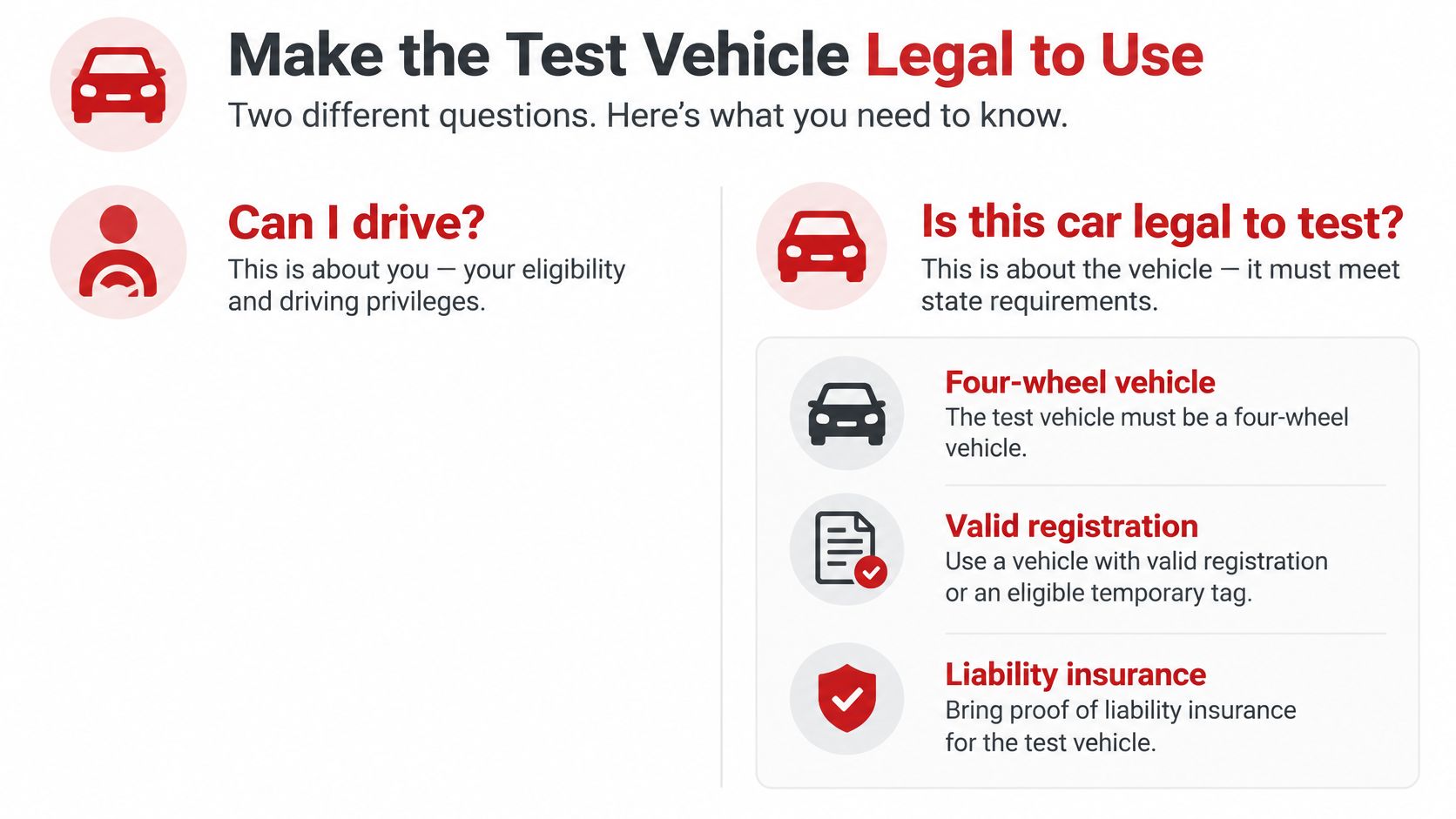
A road test has two gates: the examiner scores the drive, and the vehicle must pass a basic legality and safety check first. A strong score cannot make up for an expired registration, missing insurance, or equipment that fails inspection. Georgia DDS lists the vehicle requirements for road testing.
The car you practiced in may differ from the one you bring. Check the exact vehicle, whether it belongs to your family, is borrowed, leased, or newly purchased. Put its paperwork together and inspect its equipment before test day.
The Night Before Audit
Check the documents first, then the equipment and dashboard. This order makes it easier to catch a paperwork problem before spending time on the walk-around.
- Match the papers to the car: Registration or an eligible temporary tag, insurance card, plate, and VIN should describe the same vehicle.
- Test every light: Check brake lights, turn signals, and headlights. Ask someone to confirm the rear lights work.
- Check the basics: Look at the tires, horn, mirrors, windshield, wipers, and seat belts. Belts should buckle and retract properly.
- Read the dashboard: A warning light tied to a safety system may mean the car will not pass inspection. Fix the fault or choose another vehicle.
Repair a frayed, stuck, or slow-retracting seat belt weeks before the test. That gives the teen time to practice in the same car they will use on test day. For families comparing repair options, mail-in repairs for Georgia vehicle owners are one possible route.
The vehicle inspection checklist lays out the walk-around in printable order. Use it once a week before the appointment and again the night before. A light that worked last week still needs another check.
Test-vehicle readiness audit
| Check | Ready when | Stops the test if |
|---|---|---|
| Registration or temp tag | Current and matches the VIN | The plate is expired or the tag does not match |
| Liability insurance | The card identifies this vehicle | The card is missing or identifies a different car |
| License plate | A current plate is on the car | The plate is missing or expired |
| Lights and signals | Brake lights, turn signals, and headlights work | A required light is out |
| Tires, horn, glass, belts | Tires have legal tread, horn works, glass is clear, and belts function | A tire is bald, glass is cracked, horn is dead, or a belt is faulty |
| Warning lights | No safety fault prevents the vehicle from passing inspection | A dashboard warning indicates a safety fault |
| Hand signals | The driver can signal by hand if needed | The lights are out and the driver cannot signal by hand |
Use the table as a go-or-no-go check. If the documents match and the equipment works, the car may be ready. If a row fails, fix the problem or reschedule rather than risk losing the appointment.
Driver-assistance features do not replace the driver's own skills. Practice backing, parking, and lane control using mirrors, head checks, and steering, so the teen can complete each task without relying on a camera or assistance system.
Plan who will accompany the applicant, too. The examiner rides in front. If the applicant is under 18, a licensed driver age 21 or older must be part of the appointment plan.
How to Book and Take the Road Test
Booking works best as a sequence, and skipping ahead is where appointments fall apart. Work these steps in order and the test day itself gets quieter.
The flow below shows the order at a glance before you walk through each step.
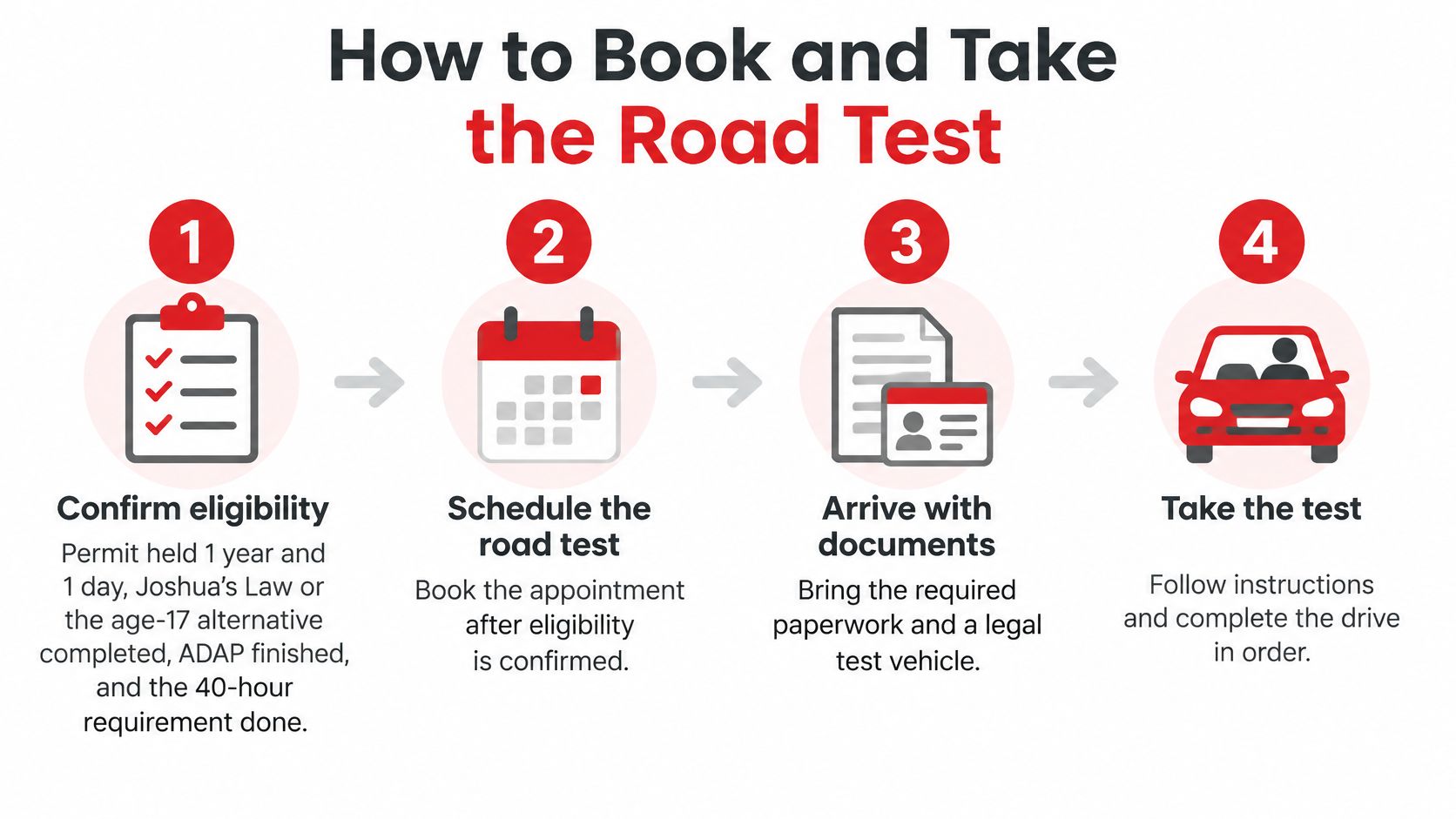
- Confirm eligibility first: permit held 1 year and 1 day, Joshua's Law finished or the age 17 alternative met, ADAP done, and the supervised log complete with its nighttime hours. Don't book a date your paperwork can't support.
- Choose your testing path: a DDS appointment, a virtual road skills test, or a certified third-party examiner. Each path tests the same driver, so pick based on scheduling and where your teen trained.
- Book the slot: if you're under 18, schedule it. Don't plan on walking in.
- Pack the day before: permit, course certificate, supervised driving proof, ADAP proof, insurance, and registration, all in one folder. Confirm your licensed driver age 21 or older if you're under 18.
- Arrive early in the audited car: the safety inspection comes before the drive, so give it time instead of treating it as a formality.
- Drive the route in order: pre-drive setup, residential streets, intersections, lane changes, the site's parking task, and the return. Do each task the way you practiced it.
- Sit for the score review: stay until you know whether you cleared 75% and, if you didn't, exactly which tasks cost points.
Virtual and Third Party Testing
Georgia runs far more than the traditional examiner in the passenger seat model now. In its FY2023 annual report, the Georgia Department of Driver Services reported 263,276 virtual road tests and a 91% pass rate, with virtual testing accounting for 75% of all road tests that year, according to the Georgia DDS FY2023 annual report. The virtual system uses a dash camera so a Driver Examiner can administer the test remotely.
Treat that 91% as a system figure, not your personal odds. It blends ages, preparation levels, vehicles, and testing paths across the whole state. Your result still comes down to your eligibility, your car, and your drive on your day. What the figure does tell you is that virtual testing is a mainstream appointment option, not an experiment.
Third party testing is the other established route. The same FY2023 reporting counted 151 non-commercial third-party examiners who administered 16,557 third-party non-commercial road skills tests in Georgia. A certified driving school that offers the Georgia road test falls in this world, and many families prefer it because the school that handled the instructor hours can line up the test appointment in the same conversation.
Watching a test explained before you sit for one takes some of the mystery out of the passenger seat instructions.
What the Drive Feels Like
Expect ordinary roads, not trick questions. You'll pull away from the site, work through intersections with signs and signals, change lanes where traffic allows, and complete the parking task that site uses. The examiner gives directions one step at a time. If you don't hear an instruction clearly, ask for it again instead of guessing, because a calm question costs nothing and a wrong turn made confidently can cost points.
Keep your setup routine identical to practice. Belt, seat, mirrors, then move. If you trained with an instructor, you'll recognize the rhythm of short directions and quiet observation. That's the point of professional lessons. The test should feel like one more supervised drive, except nobody's coaching you through the hard parts.
When you return, the examiner reviews the score sheet with you. Listen all the way through before you respond. If you passed, you know which habits to keep. If you didn't, you leave with a specific list, and that list is worth more than a vague feeling that the drive went badly.
Mistakes That Drop You Below 75
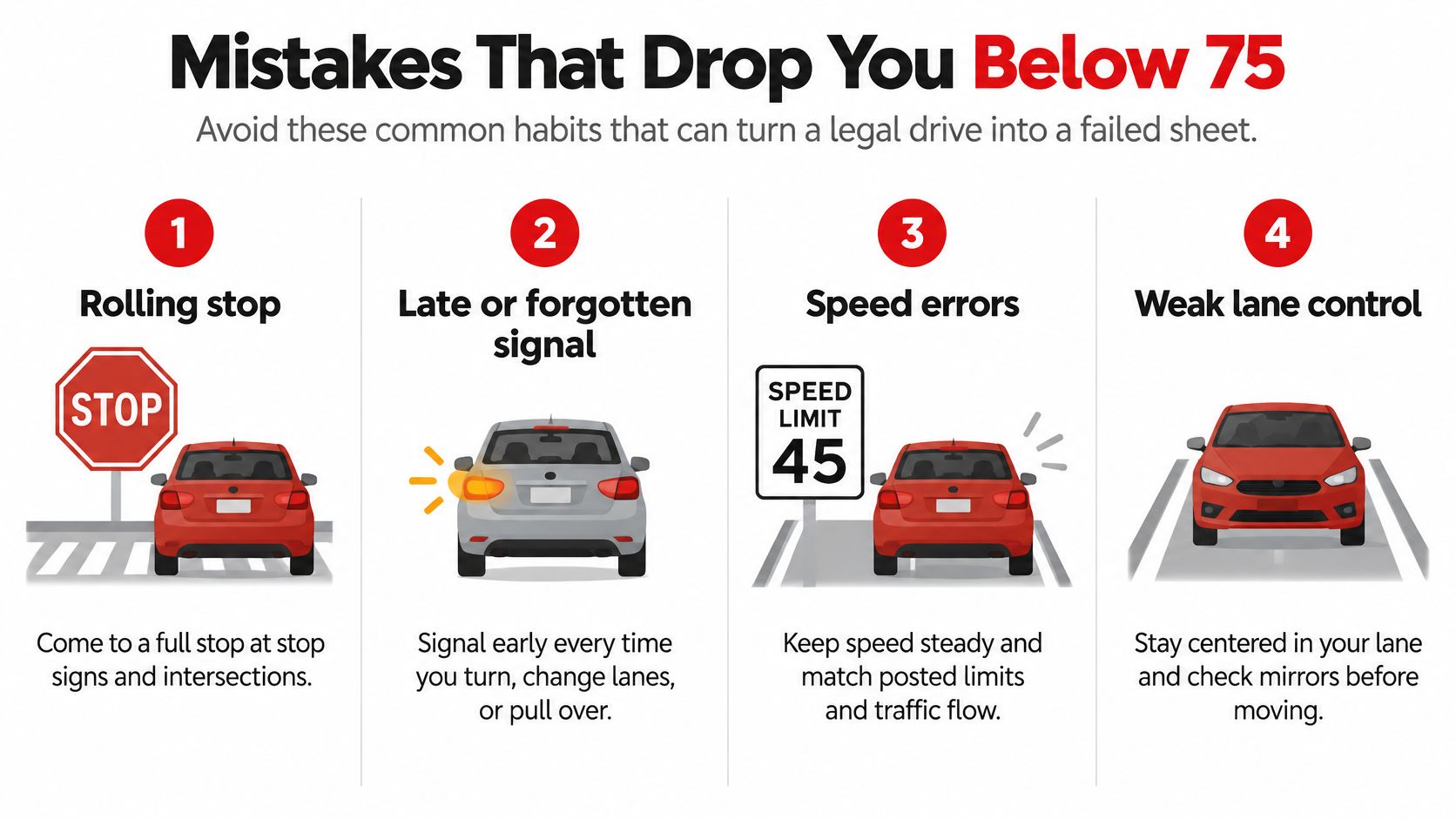
Most failed sheets don't come from one dramatic error. They come from small habits repeated at every intersection until the points add up. The rolling stop leads the list. The car slows, the driver glances, and the wheels never fully stop. Do that at four stop signs and you've built a pattern the examiner can't overlook.
Late or forgotten signals run close behind. A signal flipped on as the wheel turns tells nobody anything. Speed errors cut both ways, since rushing a yellow and crawling well under the flow both read as poor judgment. Lane changes without a blind spot check round out the usual group, along with the panic error, where a small miss rattles the driver into a bigger one at the next corner.
The four habits below are the ones to drill in your final practice drives.
One mistake rarely fails you. Arguing, freezing, or rushing the next intersection does.
Fixes You Can Practice This Week
Each fix is a single action. Add one at a time until it holds under pressure.
- Stop until the bumper is still: come to a complete stop, count a beat, look both ways, then go when it's safe.
- Signal earlier than feels natural: get the signal on before you brake for the turn or start the lane change.
- Make the head check visible: mirrors, then a real turn of the head toward the blind spot, every time.
- Reset after a miss: if you muff a turn or stop a foot long, breathe, and drive the next block cleanly instead of narrating excuses.
Parking anxiety deserves its own honest note. Teens who spend every practice session on parallel parking often lose more points on ordinary intersections than on the maneuver itself. Balance the work. Our parallel parking tips for the road test can steady the maneuver so you can give the rest of the drive its share of repetitions.
Day of basics matter more than families expect. Sleep the night before. Eat something. Arrive with time for the inspection so a paperwork question doesn't eat into your composure. Set your mirrors before you move, and if you're the licensed adult who rode along with a teen, stay quiet during the test unless the examiner asks you something. Coaching from the back serves nobody.
The Clock After a Fail
Plan for the retest rules before you need them. The first failure requires waiting until the next day, while a second or later failure requires a seven-day wait, under the rules summarized on the Georgia DDS license classes page. That gap isn't dead time. Book a short lesson aimed at the exact miss on your score sheet. An hour spent fixing rolling stops or blind spot checks beats a random hour of general driving.
One timing reminder for teens weighing the age 17 route. Waiting doesn't erase a failed test's waiting period, and it doesn't substitute for practice. A thin or rushed practice history is why many first attempts miss 75, whatever the driver's age. The score sheet doesn't care which birthday you tested after. It cares whether the habits held for the whole drive.
If your teen needs repeated reminders about basic decisions during practice, that isn't test readiness yet, and scheduling anyway usually buys a failed sheet and a waiting period. Another few weeks of supervised drives, with the adult saying less each time, is the cheaper investment.
Book Lessons Then Schedule Your Test
If your permit clock is already running, the practical move is to line up three things in one place. A DDS approved Joshua's Law course, online or instructor led. A driving lessons package including the behind-the-wheel instructor hours plus additional road test preparation. And the road test itself, booked once the practice drives say you're ready.
We're A-1 Driving School, family owned in Georgia since 1987, and we offer Road Testing, including the Georgia Road Test, alongside driver's education and lesson packages for teens and adults. That combination matters because the instructor who watches your teen's stops, signals, and parking week after week is the person best placed to say when the sheet will clear 75. A lesson package aimed at the scored tasks turns vague readiness into a scheduled test with a clean car audit behind it.
Where and How to Start
Testing near home removes one more variable from the day. We have 18 locations in Georgia, Athens, Atlanta, Buford, Conyers, Decatur, Douglasville, East Point / College Park, Forest Park, Gainesville, Johns Creek, Jonesboro, Kennesaw, Lawrenceville, Marietta, Riverdale, Roswell, Sandy Springs, and Snellville. A metro Atlanta family can train and test near home instead of guessing at a distant appointment slot and learning a new area on test morning.
If cost is the obstacle, ask us about the Georgia Driver's Education Scholarship Grant Program before you cut anything. Qualifying households can fund approved training through the grant rather than skipping instructor hours and hoping supervised practice fills the gap. Hope isn't a teaching method. A structured package with an instructor who scores practice drives the way an examiner will is.
Call the Driver's Education Hotline at (770) 603-3320 with three facts ready. Your permit issue date, so we can count the 1 year and 1 day with you. Whether the 30 hour course is finished, in progress, or not started. And which car you plan to test in, so the vehicle conversation starts early. With those three answers, we can map the course, the lesson package, and the test date in the right order.
Adults coming to the test later follow the same logic. You may not carry the teen education requirements, but the score sheet, the vehicle audit, and the appointment discipline are identical. A few professional lessons before test day can surface habits, like rolling stops or mirror only lane changes, that years of unobserved driving never corrected.
Don't book the test to create a deadline and then cram. Book the lessons first, let an instructor grade full practice drives, and schedule the driving road test in Georgia when those drives pass consistently. Consistent is the word that matters. One good drive is encouragement. Three clean drives in a row, in the test car, with no coaching, is readiness.
A-1 Driving School brings the whole path under one roof, with Georgia driver's education and Joshua's Law courses online or instructor led, driving lessons and lesson packages for teens and adults, help with the Georgia Driver's Education Scholarship Grant Program, and Georgia road testing at locations across the state. Bring us your permit date and your course status, and we'll build the lesson plan that gets you to a legal test car and a passing score sheet. Visit A-1 Driving School to enroll in a course, book your driving lessons package, and schedule your road test.