

What if your teen finishes every course, passes every practice drive, and still can't take the road test on the day you planned? That's the gap most families miss when they treat driver license requirements in Georgia as a simple checklist. Georgia doesn't work that way. It's a sequence of dates, hours, and signatures, and any one of them can hold up a license even when the others are done.
Think of it in order. First comes time on a permit. Then come classroom hours, supervised practice, and a parent's legal affirmation. Only after those pieces line up does the road test open up. If you build your plan around that sequence, you'll avoid the wasted appointment, the missing certificate, and the last minute scramble for night driving hours.
Georgia License Options by Age and Status
Which license path fits your age and residency status? Start with the credential you can apply for now, then check the conditions that determine when you can move to the next stage.
| Applicant | Starting credential | Key requirement | First step |
|---|---|---|---|
| Teen age 15 | Instructional Permit (Class CP) | Hold the permit for 12 months and one day | Apply for the learner's permit |
| Teen age 16 or 17 | Class D provisional license | Complete Joshua's Law, ADAP and the road-skills test | Schedule the road test once eligible |
| Adult 18 or older | Standard Class C license | Pass the knowledge tests and the road-skills test | Gather documents and visit a DDS office |
| New resident of any age | Georgia license or permit | Apply within 30 days of establishing residency | Bring out-of-state records and transfer the permit |
How the Teen Stages Fit Together
Georgia uses a three-stage graduated licensing framework for drivers ages 15 through 18, established by the Teenage and Driver Responsibility Act in 1997, as described in the Georgia DDS teen driving laws guide. The first stage is an Instructional Permit, also called a Class CP permit. It allows practice with a qualified adult beside the teen, not solo driving.
At 16 or 17, a teen may qualify for the intermediate Class D provisional license after holding the permit for at least 12 months and one day, passing the road-skills test, completing the Alcohol and Drug Awareness Program (ADAP), satisfying Joshua's Law, and avoiding major traffic violations that block issuance. These requirements work like separate gates: finishing a course early does not change the permit date, and completing the waiting period does not replace the course.
What Class D Does and Doesn't Allow
Class D comes with limits on driving and passengers during the early licensing period. Families should check Georgia's rules and account for those limits when planning a teen's schedule.
Adults 18 and older follow a different route to a standard Class C license: they must pass the knowledge and road-skills tests. New residents have a separate deadline. They must apply for a Georgia license or permit within 30 days of establishing residency, so the move's residency date matters when planning the application.
Practical rule: Write down the permit issue date when it is granted. That date determines when the teen can meet the permit-duration requirement.
Joshua's Law Hours You Must Complete
Which requirements depend on course hours, and which depend on time behind the wheel? For teens under 18 seeking a Class D license, Georgia requires both, and finishing one part does not complete the others.
The Georgia DDS teen drivers page sets out the course requirements: at least 30 hours of approved theoretical instruction in a classroom or an approved online virtual course, plus either 6 hours of behind-the-wheel instruction with a certified provider or the approved parent-teen training alternative. Teens must also complete 40 hours of supervised driving, including at least 6 hours at night. A parent, guardian, or authorized certified instructor verifies the supervised hours under oath or affirmation at application.
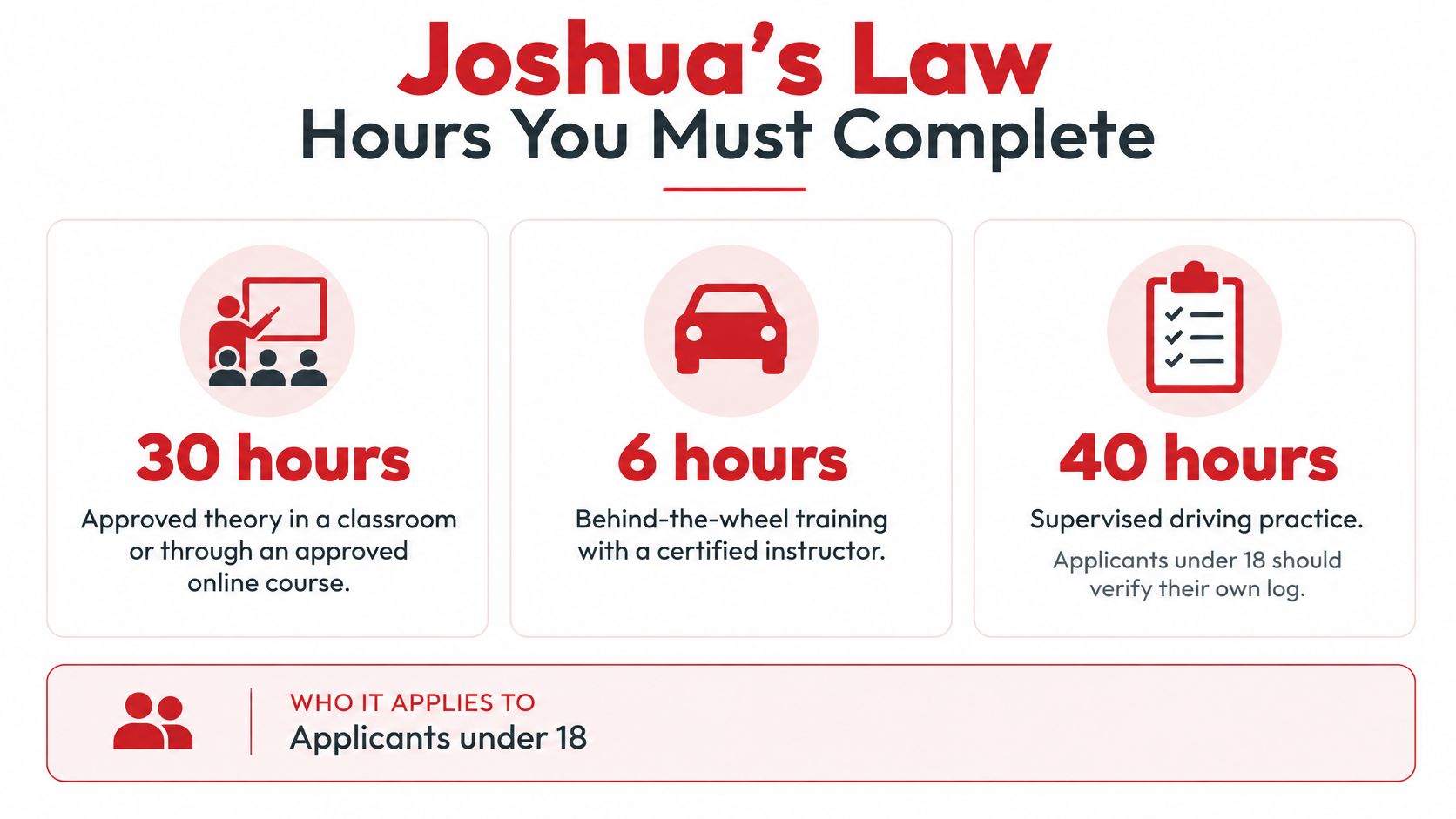
| Requirement | Hours | Accepted source | Who verifies |
|---|---|---|---|
| Driver education theory | 30 hours | Classroom or DDS-approved online course | Course provider certificate |
| Behind-the-wheel training | 6 hours | Certified driving school or instructor, or parent-teen alternative | Instructor or parent record |
| Supervised driving | 40 hours | Practice with parent or guardian beside the learner | Parent, guardian or certified instructor |
| Night supervised driving | 6 hours within the 40 | Supervised practice after dark | Parent, guardian or certified instructor |
The Two Approved Online Routes
The online theory course covers only the classroom portion. Under one route, a student completes 30 hours online plus 6 hours of behind-the-wheel training through a certified school, as well as the separate supervised practice. The Georgia DDS teen drivers page explains the parent-taught alternative. Confirm the approved requirements for that route before relying on it.
Before enrolling in an online course, confirm that the provider is DDS-approved and how the required driving instruction will be completed. A-1 Driving School offers Georgia DMV-approved Joshua's Law and Driver's Education courses, including education and road testing. It also offers driving lessons in Atlanta and Athens.
Keep the requirements on separate lines in your records: theory, behind-the-wheel instruction, supervised practice, and night practice. The hours do not replace the separate permit holding period of one year and one day. A finished course can still leave a teen waiting for the required time to pass.
Supervised Driving Hours and Who Can Certify Them
Most checklists tell you to collect a log. Georgia's rule is different, and that difference creates risk if you don't understand it.
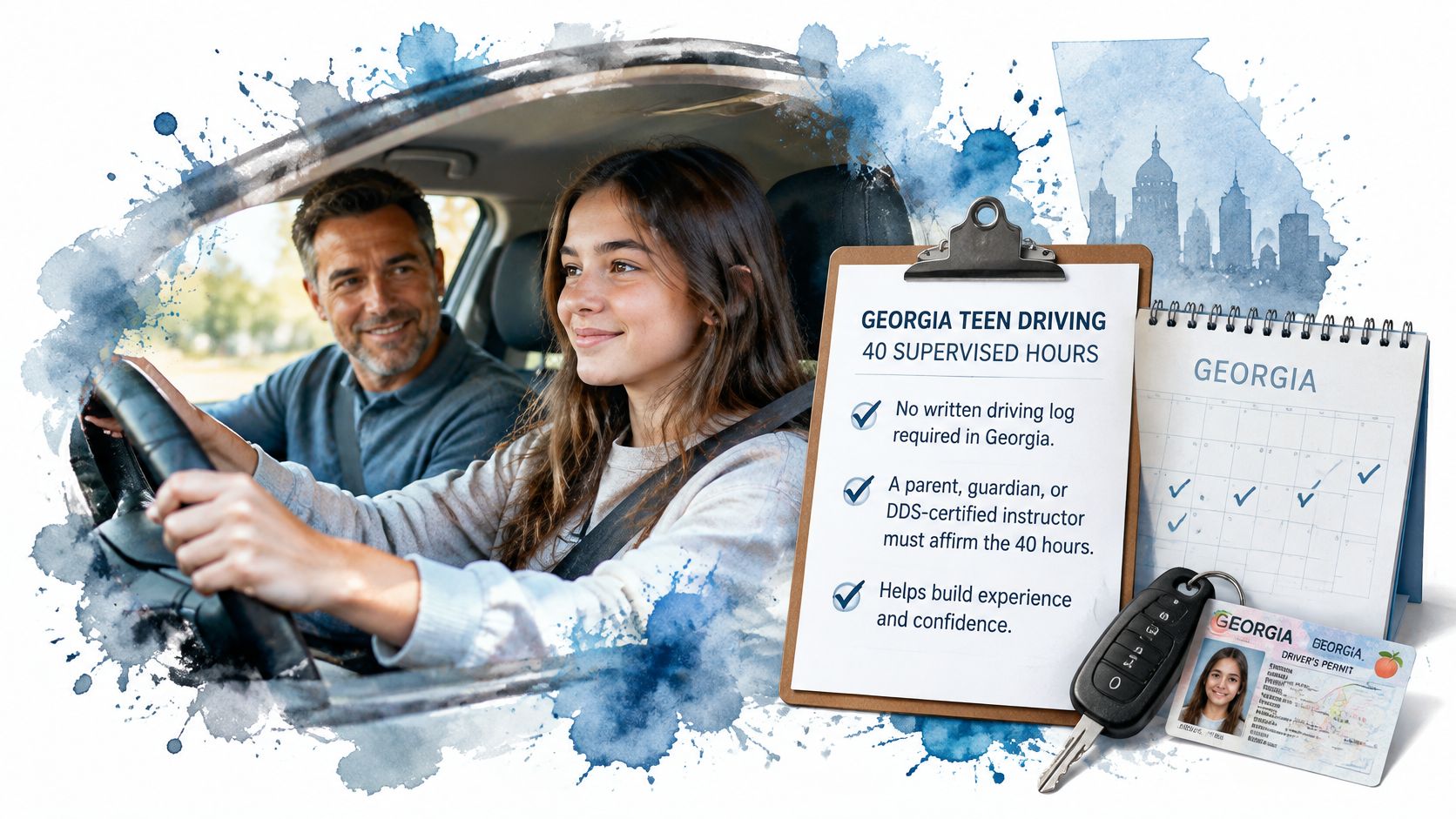
Georgia teens under 18 must complete 40 hours of supervised driving, including six nighttime hours, but the Georgia DDS driver education FAQs say no written driving log is required. Instead, a parent, guardian, or authorized DDS-certified instructor must affirm under penalty of law that the hours were completed. DDS also requires the supervising adult to be at least 21, hold an unexpired Class C license, and sit beside the learner.
What Counts as Supervised Practice
Only driving with a qualified adult beside the learner counts toward the 40 hours. A teen moving a car in a driveway alone, riding as a passenger while observing, or practicing with an older sibling who doesn't meet the age and license rules doesn't count. If you're unsure whether a trip counts, ask whether the right adult was seated beside the learner for the full drive.
Night hours mean supervised practice after dark. Families with late shifts often struggle here, so spread the work out. Try these patterns:
- Split evenings: Do 30 to 45 minutes after dinner on several weeknights instead of waiting for one long weekend drive.
- Use routine trips: Let your teen drive home from practice, work, or a family errand after dark with you beside them.
- Pair planned lessons: Schedule certified behind-the-wheel instruction to build skills, then repeat those same routes at night under your supervision.
This short video walks through how families can structure practice sessions so each drive builds a specific skill.
Keep a Private Record Even Though DDS Doesn't Require One
The absence of a mandatory log reduces paperwork, but it increases reliance on your memory and judgment. Don't sign from memory months later. Keep a simple shared calendar or use our driving practice log to note the date, start and end time, road type, weather, and supervisor initials after each drive.
That private record protects the signing adult. An inaccurate affirmation has legal consequences, and it also sends a teen to the road test with less experience than the form claims. Teens without consistent vehicle access or a parent who can supervise regularly need a plan early, whether that's another qualified guardian, an authorized instructor, or a different weekly schedule. Honest, complete hours are the goal, not just a signature.
Permit Duration, Transfers and Road Test Eligibility
Can a finished course still leave a teen ineligible for the road test? Yes. The permit has its own clock.
Georgia requires a Class D applicant to be at least 16 and to hold a valid Class CP permit for at least one year and one day, according to the Georgia DDS Class D application guide. That same rule set also requires the applicant to avoid major violations and to complete Joshua's Law. An out-of-state learner's permit must be transferred to Georgia, and the total time held must still equal at least one year and one day. The road test itself needs a scheduled appointment. Walk-ins are not accepted. The applicant must arrive with a licensed driver age 21 or older and a compliant vehicle.
Work the calendar before you book. If a Georgia permit is issued on March 3, the earliest eligibility date is March 4 of the following year. That span is one year plus one day. A test on March 2 of that following year is still one day early, so the appointment is lost even when the teen drives well and every course is already finished.
Transfers add time already served. They do not start the year over, and they do not cut it short. Months on a permit in another state can count toward the combined total after that permit is transferred to Georgia. The combined total still has to reach one year and one day. The permit works like a lease term: moving does not erase months already served, and it does not skip the months still left. Military families, relocating households, and recently transferred teens meet this rule most often, because a signature in one state and a test date in another do not line up by themselves.
Before you book training around a test date, answer three questions:
- First permit date: When was the very first learner's permit issued, in Georgia or elsewhere?
- Transfer status: Has an out-of-state permit been transferred to Georgia, and do you have that record?
- Completion status: Are theory, behind-the-wheel training, supervised hours, and ADAP finished and documented?
Calculate the eligibility date first, then book the test. Reversing that order is how an otherwise complete application fails on the calendar, not on skill.
Documents, Vision Standards and Cost Support
A finished course can still leave a teen sitting in the lobby. Vision and paperwork are separate gates, and either one can stop the road test before the car moves.
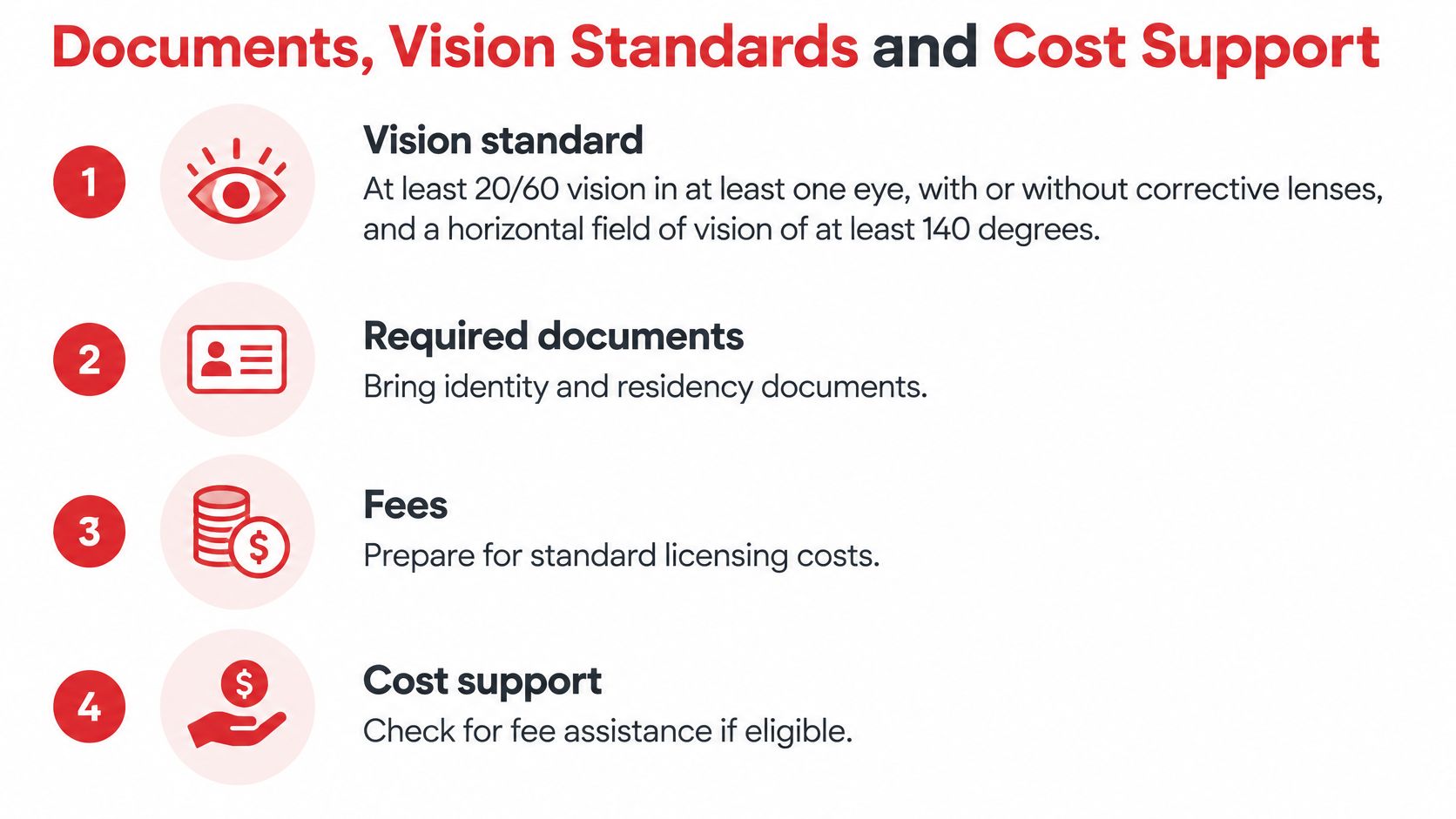
Georgia DDS screens vision for a noncommercial license, with or without corrective lenses. Pass that screening, or the application waits until your vision is corrected. Bring the glasses or contacts you drive with. A recent optometrist visit does not stand in for the screening at the licensing counter, so check your prescription in time to update it if the print is already hard to read at a distance. For a plain account of how the test is run and how to get ready, Style Site Optical's DMV testing guide explains what to expect during a DMV vision test and how to prepare.
Your Document Checklist
Treat the folder as a chain of dates and signatures. One missing line breaks the chain even when every class is finished. Put identity papers in first, then the permit record, then the course certificates and the signatures that certify supervision.
- Proof of identity: Bring the identification DDS accepts for your applicant type.
- Proof of Georgia residency: Bring documents showing your Georgia address.
- Proof of Social Security number: Bring the required Social Security documentation.
- Permit record: Bring your learner's permit or transferred out-of-state permit record.
- Driver education certificates: Applicants under 18 need proof of the approved course and training.
- Supervised-driving affirmation: Bring the signed affirmation from a parent, guardian, or authorized instructor.
- Parental consent: Teens under 18 also need parent or guardian consent.
Hours in the family car stay unofficial until the right adult signs the affirmation. Parental consent is a second signature, not the same line. Parents often sign one and assume the other is included. New residents should gather these papers before the move is complete because the application window after establishing residency comes quickly. Fees change, so confirm the current amount on the Georgia DDS site before you attend rather than relying on an old receipt or a friend's experience.
Help With Driver Education Costs
An unpaid course fee can stall the same sequence. Without the class, there is no certificate, and without the certificate the under-18 file is incomplete. The Georgia Driver's Education Scholarship Grant Program can help qualifying families cover driver education through an approved provider. Review the scholarship eligibility requirements early, because approval and enrollment steps take time. You can also check scholarship and enrolment details to see how grant funding connects to a Joshua's Law course and driving lessons. Apply before your preferred class dates fill, not after.
Road Test Scores, Vehicle Rules and Test-Day Requirements
Road-test preparation has several separate checkpoints: the knowledge-test scores, the road-skills score, a safe vehicle, and the right appointment arrangements. Missing one can delay the test even after the required courses and driving hours are complete.
| Requirement | Standard | What to do |
|---|---|---|
| Road Rules Test | 15 of 20 correct | Study the Georgia rules of the road before testing |
| Road Signs Test | 15 of 20 correct | Learn regulatory, warning and guide signs |
| Road-skills test | 75% minimum score | Practise turns, lane use, stops and mirror checks |
| Vehicle | Valid liability insurance, current registration and safety inspection | Check all three before test day |
| Test appointment | Scheduled only, walk-ins not accepted | Book in advance and confirm the time |
| Accompanying driver | Licensed driver age 21 or older | Arrive with this adult and the vehicle |
The Georgia DDS test and exams information page says the knowledge examination has a Road Rules Test and a Road Signs Test, each requiring 15 correct answers out of 20. The traditional road test requires a minimum score of 75% to pass. The vehicle must have valid liability insurance, current registration and a safety inspection, and the road-skills test is offered only in English.
What the Examiner Is Scoring
The examiner is looking for safe, controlled habits throughout the drive. Practise smooth starts and stops, safe turns, correct lane use, mirror and blind-spot checks before changing lanes, early signalling and full stops at stop signs. Rolling stops, late signals and missed blind-spot checks can cost points.
Use the Georgia road test scoring rubric to organize practice around the tasks being scored. Pair that preparation with driving lessons that rehearse turns, lane changes, parking and stops under test conditions. A-1 Driving School offers road testing and driving lessons; details are available on its road testing and lessons page.
Check the Vehicle the Day Before
Walk around the test vehicle before the appointment. Confirm that proof of insurance and registration are in the car, the lights and signals work, and the tires look sound. If a rear light is damaged, guidance on how to repair a cracked tail light lens may help you understand the repair, but make sure the vehicle is ready before test day.
Bring your completed document packet and arrive with a licensed driver age 21 or older. The road-skills test is offered only in English, so account for that limit when scheduling.
Get Your Class D License in Six Steps
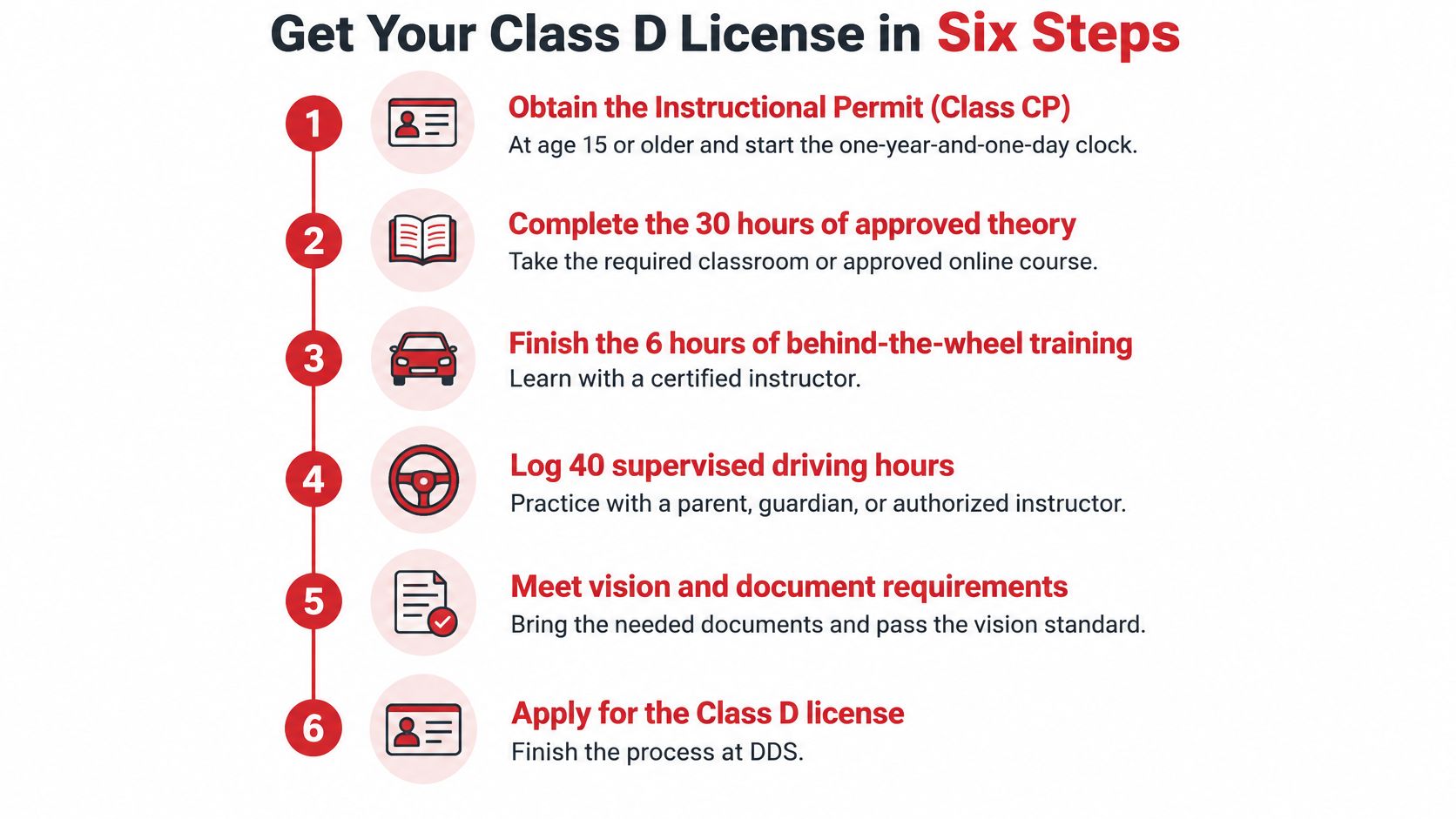
Obtain the Instructional Permit (Class CP) at 15 or older. This starts your one-year-and-one-day clock, so record the issue date immediately. Common slip: families start counting from a birthday or course start date instead of the permit date.
Complete 30 hours of Joshua's Law theory. Take it in a classroom or through a DDS-approved online course, and keep the certificate. Common slip: choosing a course that isn't approved, then having to retake it.
Finish 6 hours of behind-the-wheel training. Learn with a certified instructor or use the approved parent-teen alternative. This step turns theory into coached vehicle control. Common slip: assuming online theory alone covers the driving component.
Log 40 supervised hours, including 6 at night. Practice in varied traffic, weather, and road types, then have a parent, guardian, or authorized instructor affirm the total. Common slip: leaving night hours until the final week.
Complete ADAP, then book once the clock has passed. ADAP must be completed before the Class D license is issued, and major traffic violations can block issuance, so a clean record matters as much as finished hours. Common slip: booking the test before checking both ADAP and the eligibility date.
Pass the tests and receive the Class D license. Bring your documents, a compliant vehicle, and a licensed driver age 21 or older. Pass the knowledge tests and score at least 75% on the road-skills test. Common slip: arriving with expired vehicle paperwork.
Our Driver's Education and Driving Lessons courses include Georgia DMV-approved Joshua's Law / Driver's Education courses, including all education and road testing. We offer driving lessons in Atlanta and Athens, and families can call the Driver's Education Hotline at (770) 603-3320 with course questions. When you're ready to choose a lessons package and course, visit our course and lessons options and pick dates that fit your permit timeline, not just your school calendar.
Ready to turn your permit date into a real plan for lessons, Joshua's Law, and road testing? Visit A-1 Driving School to choose a DDS-approved driver's education course and driving lessons package in Atlanta, Athens, or online, and book the training sequence that gets your teen test-ready without a wasted appointment.