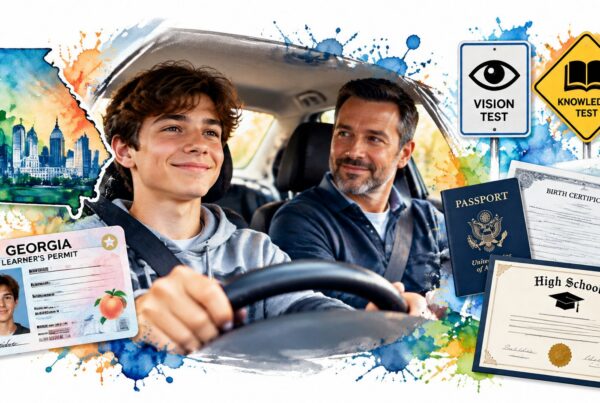

Georgia's learner permit knowledge exam doesn't require an appointment, while automobile, CDL, and motorcycle road tests do. The learner permit fee is $10.
So the familiar advice to book your test before doing anything else can send a Georgia family to the wrong service. Your first job is to prepare for a permit-application visit, not reserve a behind-the-wheel test.
Think of the process as separate milestones: get the permit, learn and practice, then arrange the road test. That distinction helps parents plan transportation, teens choose the right driver-education course, and everyone avoid booking something the student isn't ready to take.
Whether Georgia Requires a Learner Permit Test Appointment
You don't need a learner permit test appointment for the Class CP knowledge exam. The Georgia DDS permit application guide says appointments are required only for behind-the-wheel automobile, commercial driver's license, and motorcycle road tests; Class CP applicants must be at least 15, complete the online License/ID/Permit Form, and finish the in-person vision exam, knowledge exam, photograph, and $10 payment. The submitted application remains on file for 60 days, after which you must complete it again.
The online form isn't an appointment reservation. It supplies information DDS needs to process your application when you arrive.
You'll also need documents establishing identity, residential address, and U.S. citizenship or lawful presence. Completing the form doesn't replace bringing those papers.
Permit visit versus road test appointment
Use this comparison to distinguish the permit counter from the driving-test calendar. The knowledge-exam location and payment details are explained further in the permit checklist below.
| Task | Appointment required | Where | Fee | Who it is for |
|---|---|---|---|---|
| Class CP knowledge exam | No | Nearly all Customer Service Centers except Jackson | $10 permit fee paid before testing | Applicants 15 and older |
| Vision screening, photo, and permit issue | No, same visit as the knowledge exam | Customer Service Center | Included in the permit visit | Applicants who pass vision and both exam sections |
| Non-commercial automobile road test | Yes, no walk-ins and no same-day slots | DDS appointment system after the online form | No DDS reservation fee | Drivers moving from a learner permit toward Class D |
| CDL or motorcycle road test | Yes | DDS scheduling | Follow the DDS fee rules for the vehicle and license class | Applicants testing those vehicle types |
The DDS appointments page confirms that automobile road-test walk-ins aren't accepted, same-day appointments aren't available, and DDS doesn't charge for non-commercial road-test reservations. For applicants 18 and older, it also lists a valid Georgia non-commercial learner permit, a passed knowledge exam, an affidavit showing 40 supervised hours, including 6 at night, and an accompanying licensed driver 21 or older; only the applicant and that driver may be in the vehicle.
What the permit actually starts
A permit gives the student a way to begin supervised learning. It isn't permission to drive alone, and it doesn't mean the student has already qualified for a road test.
Practical rule: If you're preparing for your first written permit exam, prepare your application folder before opening a road-test calendar.
For the first visit, focus on documents, studying, the correct center, and enough time to finish intake and testing. Those are the things that determine whether your family can complete the permit process that day.
Papers and Steps for One Class CP Visit
Put your documents together the night before, not in the parking lot. A prepared student can still lose the opportunity to test if DDS can't complete the application.
Start with a folder for original documents and any supporting paperwork DDS accepts. Match names and addresses carefully, and resolve questions about acceptable documents before leaving home.
The night-before checklist
Use our guide to what you need for a driver's permit to organize the family's preparation. Treat the checklist as a packing tool, not a substitute for DDS's document requirements.
What to have ready for a Class CP visit
| Item | Who needs it | If it is missing |
|---|---|---|
| Online License/ID/Permit Form still inside 60 days | Every applicant | Visit cannot proceed; submit the form again |
| Identity document | Every applicant | Cannot start the permit application |
| Residential address proof | Every applicant | Cannot verify Georgia residency |
| Citizenship or lawful presence proof | Every applicant | Cannot complete the application |
| Social Security documentation | Every applicant | Application stops at intake |
| School enrollment proof | Applicants under 18 | Teen cannot be processed |
| Permit fee of $10 paid before testing | Every applicant | Testing does not start |
| Customer Service Center other than Jackson | Knowledge-exam applicants | Jackson does not give this exam |
| Arrival before the testing cutoff | Every applicant | Turned away even with complete papers |
The DDS license FAQs explain that the knowledge exam is available at nearly all Customer Service Centers except Jackson, applicants under 18 need school-enrollment proof, and the $10 fee is paid before testing and isn't refunded after a failed attempt. They also establish the scoring rule: Road Rules and Road Signs each contain 20 questions, and you need at least 15 correct on each component.
Check the application submission date while you're checking the folder. If it has expired, submit it again before the visit rather than expecting the counter staff to use the old submission.
School paperwork deserves particular attention. Don't assume that a screenshot on a phone will serve as an accepted enrollment document; confirm the acceptable format and bring the required proof.
Follow the visit in order
Confirm the center and testing availability. Choose a location that gives the knowledge exam, then check its operating information and testing cutoff. A center's closing time isn't a promise that you can begin an exam immediately before it closes.
Arrive with time for intake. Staff need to review the application and documents before you can test. Plan for that work rather than timing your arrival around the exam alone.
Present the paperwork together. Keep identity, residency, lawful-presence, Social Security, and school documents organized. Handing over a complete folder is simpler than searching through emails while standing at the counter.
Pay before testing. Leave room in the family budget for another attempt if needed. A failed exam doesn't turn the payment into credit for a future visit.
Complete the vision screening. Bring the glasses or contact lenses you normally rely on. Don't make the permit visit the first occasion on which you discover you can't see clearly enough.
Take both knowledge components. Read each question carefully and treat Road Rules and Road Signs as separate tasks. Strong performance on signs won't cancel out a weak rules result.
After you satisfy the application and testing requirements, complete the photograph and permit-issuance process. Before leaving, check the information on the permit and keep it somewhere you can find it before a lesson.
Study the weak subject, not just familiar questions
A student who passes Road Signs but falls short on Road Rules hasn't passed the overall knowledge requirement. The useful response is to identify the rule categories that caused trouble, rather than repeat the same practice questions from memory.
Use the official DDS manual and free practice test together. When you miss a question, find the relevant manual explanation and say the rule back in your own words.
For example, don't stop at recognizing a yield sign. Explain what you would do when approaching it, what traffic you would watch, and when you could proceed safely.
Don't judge readiness by how familiar the practice questions look. Judge it by whether you can explain why the correct answer is correct.
The cited DDS materials don't publish a statewide knowledge-test pass rate. A private provider's success-rate claim therefore isn't a useful substitute for checking your own understanding.
Keep the final evening manageable. Review unfamiliar signs, revisit misunderstood rules, and finish packing before bedtime rather than rushing through unfamiliar material on the way to DDS.
Who May Supervise Practice on a Class CP
The person beside the learner matters just as much as the permit in the learner's pocket. A willing passenger isn't automatically a lawful supervisor.
Under the DDS teen driving laws FAQs, a Class CP holder may drive only with someone who is at least 21, holds a valid Class C license, occupies the seat beside the driver, and can take control of the vehicle if necessary. Check every part of that rule before the student starts the engine.
Drives that don't meet the supervision rule
A parent sitting in the back seat doesn't satisfy the requirement to sit beside the learner. Neither does a younger relative who knows the route well but doesn't meet the supervisor's age requirement.
Use these examples to check your arrangements:
- The back-seat parent: The parent rides behind the teen while another passenger occupies the front passenger seat. The required supervisor isn't beside the learner.
- The younger sibling: An experienced sibling supervises but is below the required age. Driving experience doesn't replace the age requirement.
- The wrong license: The accompanying person doesn't hold the required valid license. Being an adult doesn't make that supervision lawful.
Don't record those trips as qualifying supervised practice. Writing a drive in a log doesn't fix an unlawful supervision arrangement.
Make each practice drive useful
Before leaving, agree on the route and the skill you'll practice. Start with manageable traffic and familiar roads, then add more demanding situations as the learner becomes consistent.
Keep a log after each drive with the date, driving time, conditions, and skills practiced. Separate nighttime driving clearly so the family doesn't have to reconstruct it later.
Our lesson policy also requires students to have a valid learner's permit or driver's license before taking a driving lesson. Passing the written exam and receiving the permit therefore comes before paid in-car instruction.
Parent coaching reminder: Give directions early and calmly. Discuss a missed turn after the car is safely positioned, not while the student is trying to make a sudden correction.
Use the permit period to build repeatable habits. A student who can stop, observe, signal, and choose a safe gap without constant prompting is making more meaningful progress than a student who has merely accumulated trips.
Joshua's Law Hours Before the Road Test Slot
Families often use the phrase driver's education to mean everything from an online course to a neighborhood practice drive. For planning purposes, separate theory, practical training, and supervised driving.
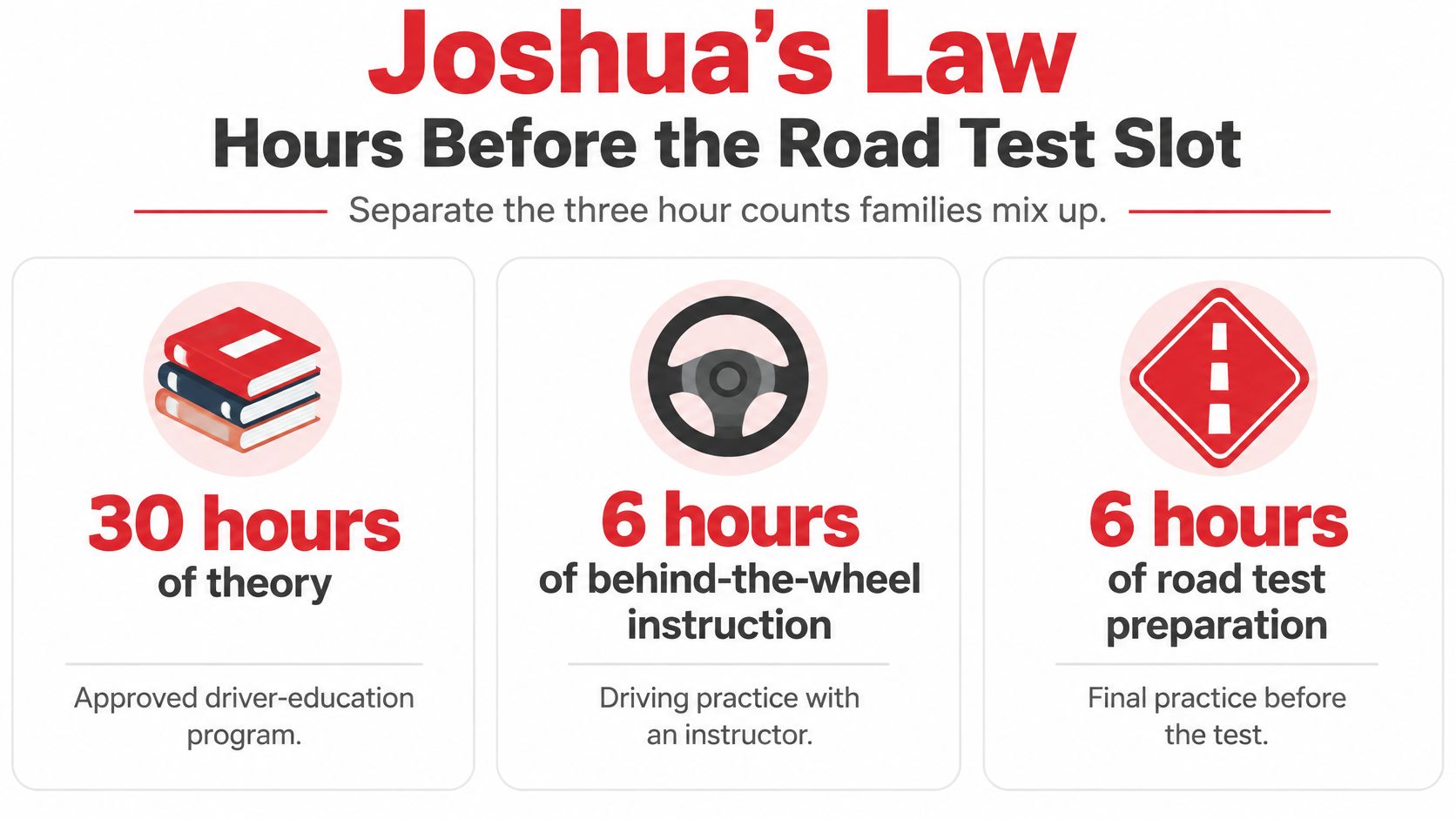
The DDS TADRA chapter says applicants ages 16 and 17 seeking Class D must complete an approved program with at least 30 hours of theory, through classroom, approved online, or virtual instruction, plus 6 hours of practical behind-the-wheel training with an instructor or an approved parent-taught option. It also requires at least 40 hours of supervised driving, including at least 6 hours at night.
Keep the requirements in separate columns
Theory teaches the rules and decisions you'll use in traffic. Practical training gives the student structured opportunities to apply those ideas, while supervised driving develops consistency across everyday trips.
Use this visual as a planning prompt, with one important clarification: road-test preparation is practice, not a separate Joshua's Law hour requirement. The required categories are the theory, practical-training, and supervised-driving components described above.
An approved online course can make theory easier to fit around school and activities. It doesn't turn screen time into behind-the-wheel training or replace the supervised-driving record.
Our Joshua's Law requirements guide can help you compare the course and driving components before choosing a learning plan.
Plan the permit year around skills
A realistic approach is to begin theory early, arrange instruction after the permit is in hand, and spread supervised practice across the learning period. Don't save unfamiliar traffic situations and nighttime driving for the days immediately before testing.
- Early learning: Practice seating position, mirror adjustment, smooth braking, steering, and observation on manageable routes.
- Developing judgment: Add intersections, lane changes, busier roads, and decisions about safe gaps.
- Later preparation: Practice independent decision-making with fewer prompts and address any recurring weaknesses before arranging testing.
Driving lesson packages can provide a structure for the practical-training component while leaving room for additional instruction where the student needs it. Compare what a package includes rather than assuming every lesson bundle covers the same skills or testing services.
If cost is a barrier, explore the Georgia Driver's Education Scholarship Grant Program before paying for training. It can cover training for qualifying students; confirm eligibility, participating options, and award conditions before committing.
Approved schools can also offer road testing, so families aren't limited to a DDS testing location. Education approval, lesson availability, and road-test eligibility are separate questions, however, and each needs to fit the student's plan.
How to Schedule the Class D Road Test Appointment
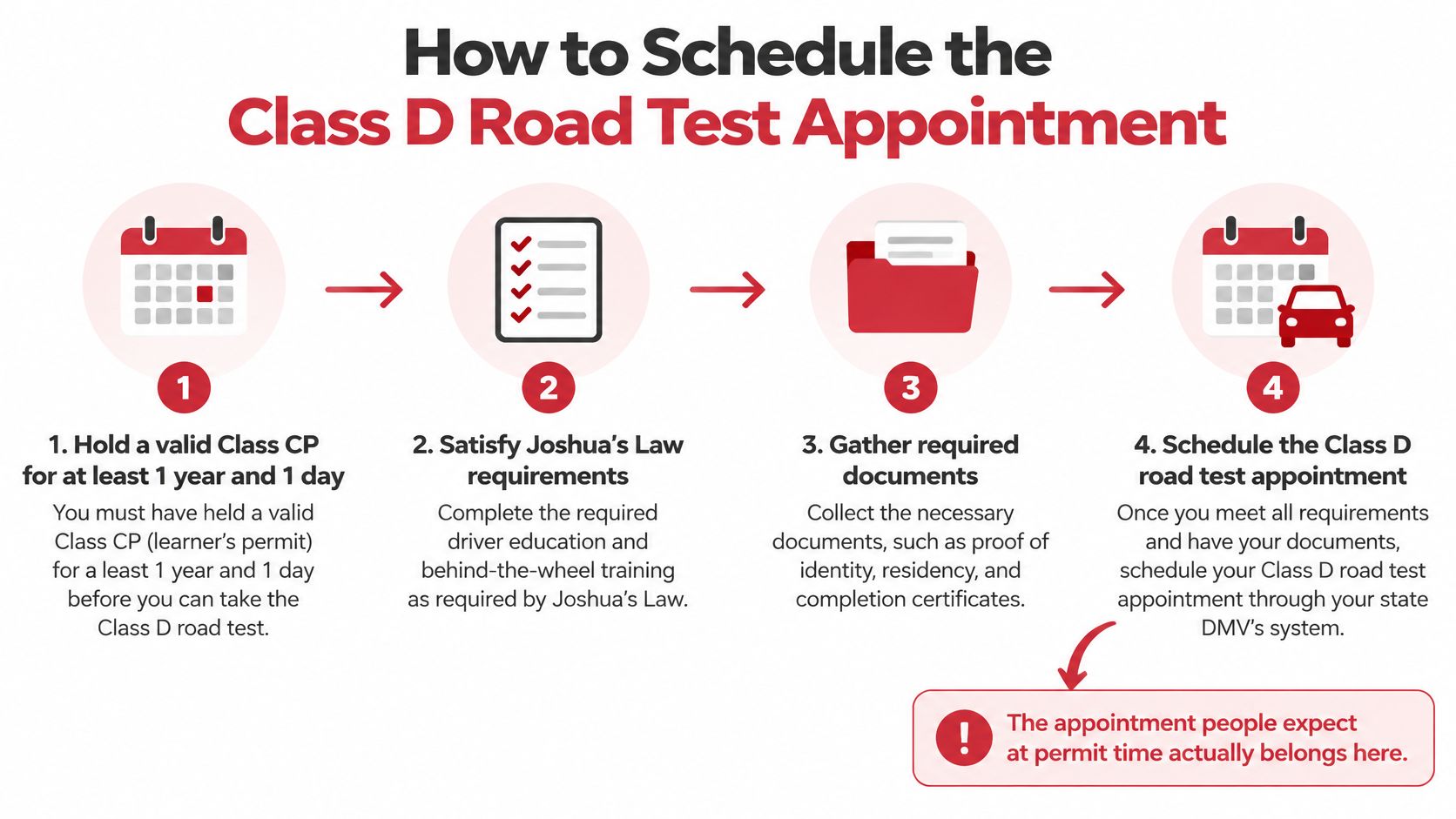
For a teen seeking a Class D provisional license, the DDS Class D application guide requires holding a valid Class CP for at least 1 year and 1 day, satisfying Joshua's Law, completing supervised driving, avoiding major violations that trigger suspension, and passing a road-skills exam administered by appointment only.
That's where the appointment people expect at permit time belongs. Eligibility and driving readiness come before choosing a calendar slot.
Use this timeline to organize the transition from learning to testing.
Verify the record before booking
The DDS road-test appointment instructions require a valid Georgia non-commercial learner permit, a passed knowledge exam, the submitted online application, a compliant vehicle, and a supervised-driving affidavit documenting 40 hours, including 6 at night. DDS doesn't accept road-test walk-ins and may reschedule appointments when requirements aren't met or duplicate bookings are detected.
Follow the booking sequence only after you can verify the prerequisites:
- Check the permit and eligibility. Read the permit's issue information rather than relying on memory. Make sure the student's licensing record and education requirements are ready for the intended test.
- Complete the online License/ID/Permit Form. Treat this as a new application task for the licensing step, not proof that an appointment already exists.
- Prepare the affidavit and vehicle. Reconcile the practice log before signing. Inspect the vehicle before test day, not while waiting to begin.
- Use the DDS appointment system. Choose the automobile road-test service, select the available location and time, and save the confirmation.
- Plan the trip. Arrange the accompanying driver, allow time to arrive, and bring the required documents together.
A school-administered road test has its own scheduling arrangements. Don't assume that selecting a DDS appointment also reserves a school vehicle or an instructor.
Measure readiness by what the student does
Watch for complete stops, deliberate observation, stable lane position, timely signals, and appropriate speed. A student who needs repeated reminders about these behaviors needs more targeted practice, even if the paperwork is finished.
Check the vehicle's lights, signals, tires, mirrors, and other required equipment. A mechanically sound car and organized documents prevent avoidable interruptions, but they don't replace the student's ability to drive safely.
The cited DDS materials don't provide a statewide road-test pass rate. Use a practice assessment to identify specific corrections instead of relying on an unsupported percentage.
This video provides another resource as you prepare for the road-test stage.
Booking checkpoint: Be ready to explain why the student is eligible, show the completed record, and demonstrate the driving skills before reserving the test.
The calendar click is the last step, not the first. A convenient opening isn't a reason to rush an unfinished driver into testing.
Book Lessons and a Road Test After the Permit
Once the Class CP is in hand, make driving lessons and regular supervised practice the center of the plan. A course completion certificate matters, but the student still needs to turn written knowledge into safe decisions behind the wheel.
We offer instructor-led and online Driver's Education Joshua's Law courses, driving lessons for students and adults, and Road Testing, including the Georgia Road Test. You can review our driving lesson options while planning how instruction will fit around family practice.
Choose a package around the student's needs
Ask what you want the student to do more confidently by the end of instruction. For a beginner, that may mean smooth vehicle control and consistent observation; for a student closer to testing, it may mean lane changes, intersections, or making decisions without coaching.
- Match the format: Choose instructor-led or online theory based on how the student learns and the family's schedule.
- Plan the lessons: Consider a lesson package that covers the practical-training requirement, then allow for extra instruction if skills need more work.
- Address affordability: Explore the Georgia Driver's Education Scholarship Grant Program if training costs would otherwise delay learning.
- Arrange testing deliberately: Choose the DDS or school-testing route only after confirming eligibility and readiness.
To get started, select an in-person or online class, choose a Georgia location, and book a time that fits your schedule. Our Driver's Education Hotline is (770) 603-3320 if you need help organizing the process.
Keep the order simple: prepare for the permit visit, build education and lessons into the permit period, and arrange the road test when the student, affidavit, and vehicle are ready. Don't let searching for a learner permit test appointment distract you from the instruction and practice that come next.
A-1 Driving School offers instructor-led and online Joshua's Law courses, teen and adult driving lessons, and Georgia road testing. Visit A-1 Driving School to choose your course and discuss a driving lesson package that fits your permit-to-road-test plan.