
A parent and teen can spend weeks practicing around the neighborhood, then sit at the kitchen table and realize the road test is approaching with no reliable record of the hours. That moment creates unnecessary stress, especially when the family has practiced often but can't prove when, where, and under what conditions the driving happened.
A driving practice log solves more than a paperwork problem. Used correctly, it documents supervised experience, helps families meet Georgia's licensing requirements, and turns every drive into a focused lesson. The most useful log doesn't count time. It shows what the teen practiced, what went well, and what needs attention next.
What Is a Driving Practice Log and Why Georgia Requires It
A teen finishes a supervised drive, parks the car, and says, “That was an hour.” Without a written record, the family may later struggle to confirm the date, duration, night-driving time, or skills covered. A driving practice log turns that uncertain memory into a usable record.
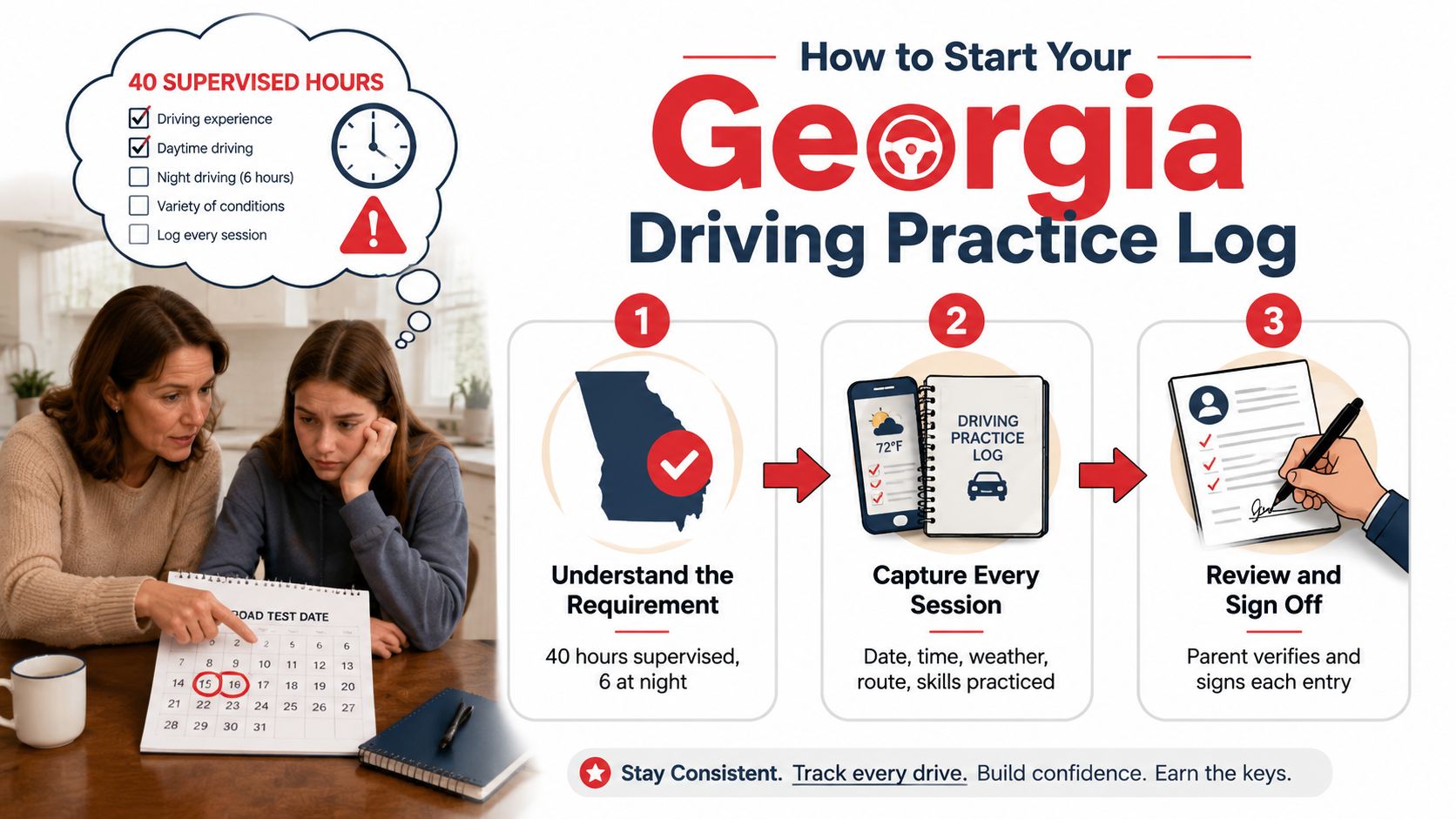
Georgia connects this record to Joshua's Law and the Georgia Department of Driver Services process for teens pursuing a Class D license. The relevant pathway requires 40 hours of supervised driving, including 6 hours at night. Before a Georgia road test appointment, the parent or guardian must also provide an affidavit confirming those hours. The teen needs a valid Georgia Non-Commercial Learner's Permit and must pass the driver's license knowledge exam. The Georgia DDS Joshua's Law requirements and Georgia DDS road test requirements explain the state's current requirements.
A log serves two purposes. It documents supervised experience, and it gives the next practice session a clear starting point. “One hour driving” proves very little about readiness. “Practiced lane changes on a busy arterial, controlled braking at intersections, and highway merging” shows what the teen attempted and what may need another lesson.
Build the record from the first drive
Start the log with the first supervised session, not when the road test is near. Reconstructing weeks of practice from memory can produce missing signatures, inconsistent totals, and unclear night-driving hours. Georgia DDS provides the applicable forms and requirements, so compare the family's record with the current state documentation before submitting it.
Use a simple routine:
- Set the target. Track total supervised time and keep night driving separate from daytime practice.
- Write promptly. Record the date, time, conditions, route, and skills soon after parking.
- Review together. Have the parent or guardian check each entry and maintain the completed record for the appointment.
Families preparing for the permit can also review A-1's Georgia learner's permit information. The log works best as part of each lesson, like a coach's practice notes, rather than paperwork saved for the final week.
Instructor's rule: If the entry does not show what to practice next, it is too vague.
Essential Fields for a Compliant Georgia Driving Log
A useful log captures enough detail for a parent to verify the session and for the teen to learn from it later. Use the official Georgia form when possible, and keep supporting notes consistent with the fields the form requests. Families shouldn't assume that a generic hours-only template will satisfy every state process.
Record the session while details are fresh
At minimum, write the date, start time, end time, and total duration. If a drive begins at 4:10 p.m. and ends at 5:25 p.m., record the session as 1 hour and 15 minutes, not a rough estimate. Keep minutes visible until the final total is calculated, because rounding each entry can create an inaccurate overall count.
Separate day and night practice rather than relying on memory later. For practical tracking, note whether the drive occurred during daylight, dusk, or night, and identify the night portion clearly. Georgia's requirement is 6 hours of night driving, so a separate running total makes it easier to confirm progress before the appointment.
Add context that supports real coaching
Include the supervising adult's full name, license information where the form requests it, and relationship to the teen. Starting and ending odometer readings can provide useful supporting evidence, although the official DDS form should control which fields are mandatory.
The skills column is where the log becomes valuable. Write specific tasks such as parallel parking, lane changes, highway merging, reverse parking, turn selection, speed control, or intersection navigation. Add weather, traffic, road type, and a short note about the teen's performance when space allows.
| Field Name | Description | Example Entry |
|---|---|---|
| Date | Day the supervised drive occurred | March 12 |
| Start and end time | Exact beginning and ending times | 4:10 p.m. to 5:25 p.m. |
| Total duration | Elapsed practice time | 1 hour, 15 minutes |
| Day or night | Identifies whether the session supports night practice | Night |
| Supervising driver | Parent or guardian details requested by the form | Jordan Lee, parent |
| Odometer readings | Starting and ending vehicle readings, if included | 42,180 to 42,204 |
| Skills practiced | Specific maneuvers and driving situations | Lane changes, intersections, merging |
| Conditions and notes | Weather, traffic, confidence, and next target | Light rain, improve mirror checks |
| Signatures | Teen and parent or guardian verification | Signed after review |
The teen and supervising parent or guardian should review the completed log before submission and sign wherever the official form requires. Don't treat signatures as a last-minute formality. A session reviewed the same day is easier to verify and more useful for planning the next drive.
Paper Versus Digital Logging Methods
Paper and digital logs can both work. The better choice is the one your family will use consistently and preserve safely.
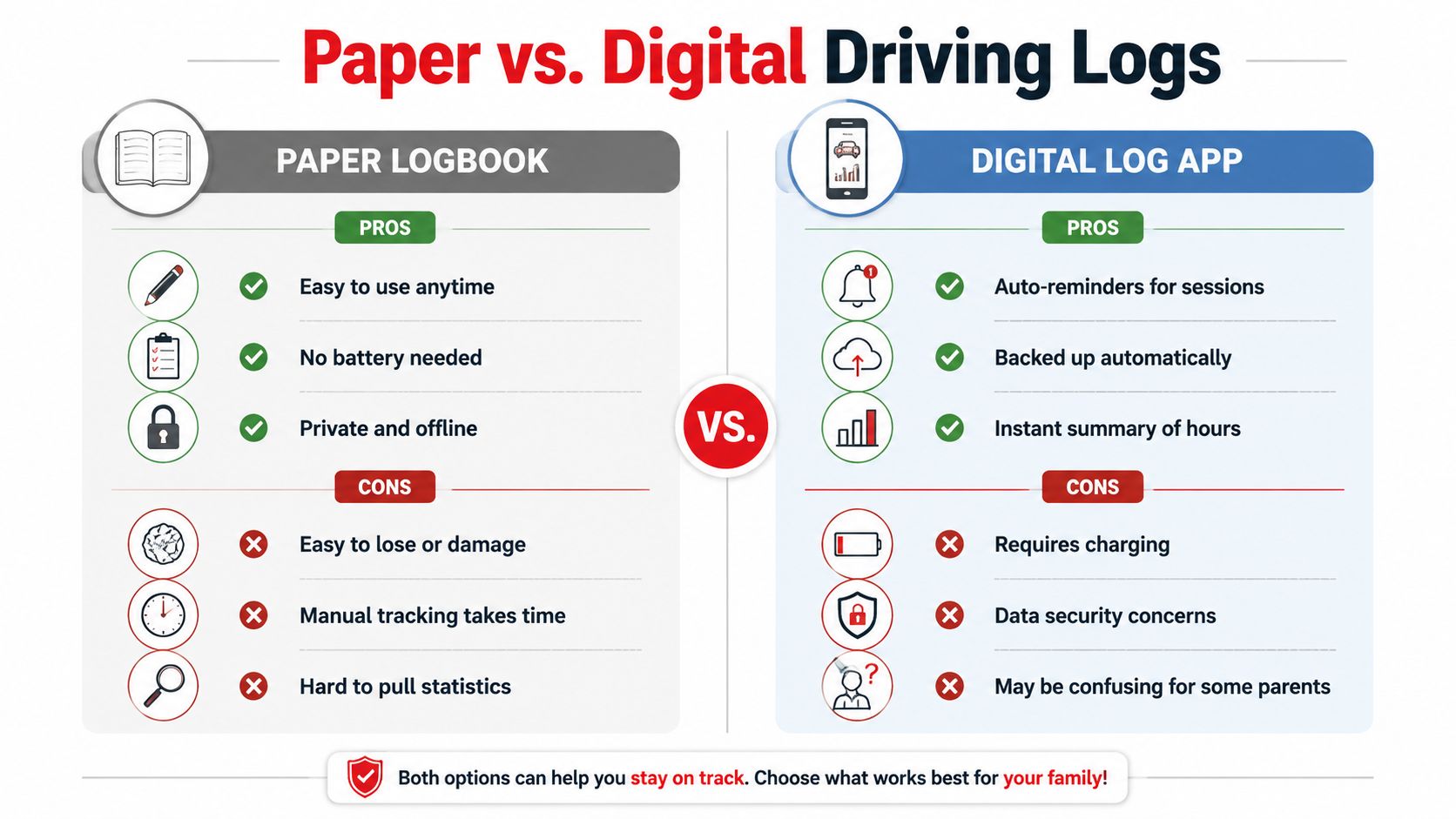
A paper logbook is easy to start, works without a charged phone, and gives parents and teens a physical record during the drive. It also has weaknesses. Pages can be misplaced, ink can fade, and totals must be calculated manually. A paper form is often convenient for a road test appointment because the family can bring the signed original or a completed printout, but families should confirm current DDS submission expectations before relying on any format.
Digital logging can mean a dedicated app, a spreadsheet, or a fillable PDF. Digital tools may calculate totals, remind families to record sessions, and make backups easier. The National Safety Council describes DriveitHOME digital logging options, including the ability to export tracking information for submission. That doesn't mean every app or screenshot will automatically satisfy a DDS examiner, so preserve a clear, printable record and confirm what the appointment requires.
A quick decision guide
- Choose paper if your family prefers handwriting, wants an offline record, and can keep the form in a secure folder.
- Choose digital if automatic totals, reminders, and backups will help you maintain the habit.
- Use a hybrid system if you like app convenience but want a signed paper copy ready for the road test.
For digital signatures, follow the tool's process and print the final record if the state office requests a physical document. If a phone dies during a session, write down the date, times, and key details as soon as possible, then enter them later. A backup spreadsheet or photographed paper page can prevent one device problem from disrupting the whole record.
Families interested in technology-assisted supervision can review guidance about Life360 for teen driving safety, but location tracking shouldn't replace the actual practice entry. Consistency matters more than the medium.
Making Practice Sessions Count Beyond Just Hours
A teen can complete repetitive neighborhood loops and still feel unprepared for a highway, a crowded intersection, or a night drive. The log helps prevent that problem when each session has a clear purpose.
Before leaving, the parent and teen should agree on one primary goal. It might be smooth lane changes, mirror checks, parallel parking, or maintaining a safe following distance in traffic. Keep the goal narrow enough to observe. Trying to correct every driving habit in one session usually overwhelms the learner and creates tension.
Use the notes as a feedback loop
After the drive, record one thing the teen did well, one repeated mistake, and one skill to practice next. A simple confidence rating can also show whether the teen is improving, although the rating should support discussion rather than serve as a formal score.
Parents should give specific, calm feedback. “Check your mirror earlier before changing lanes” teaches more than “You're not paying attention.” Teens should describe what they noticed, including moments that felt uncertain. That conversation turns the log into a shared coaching record.
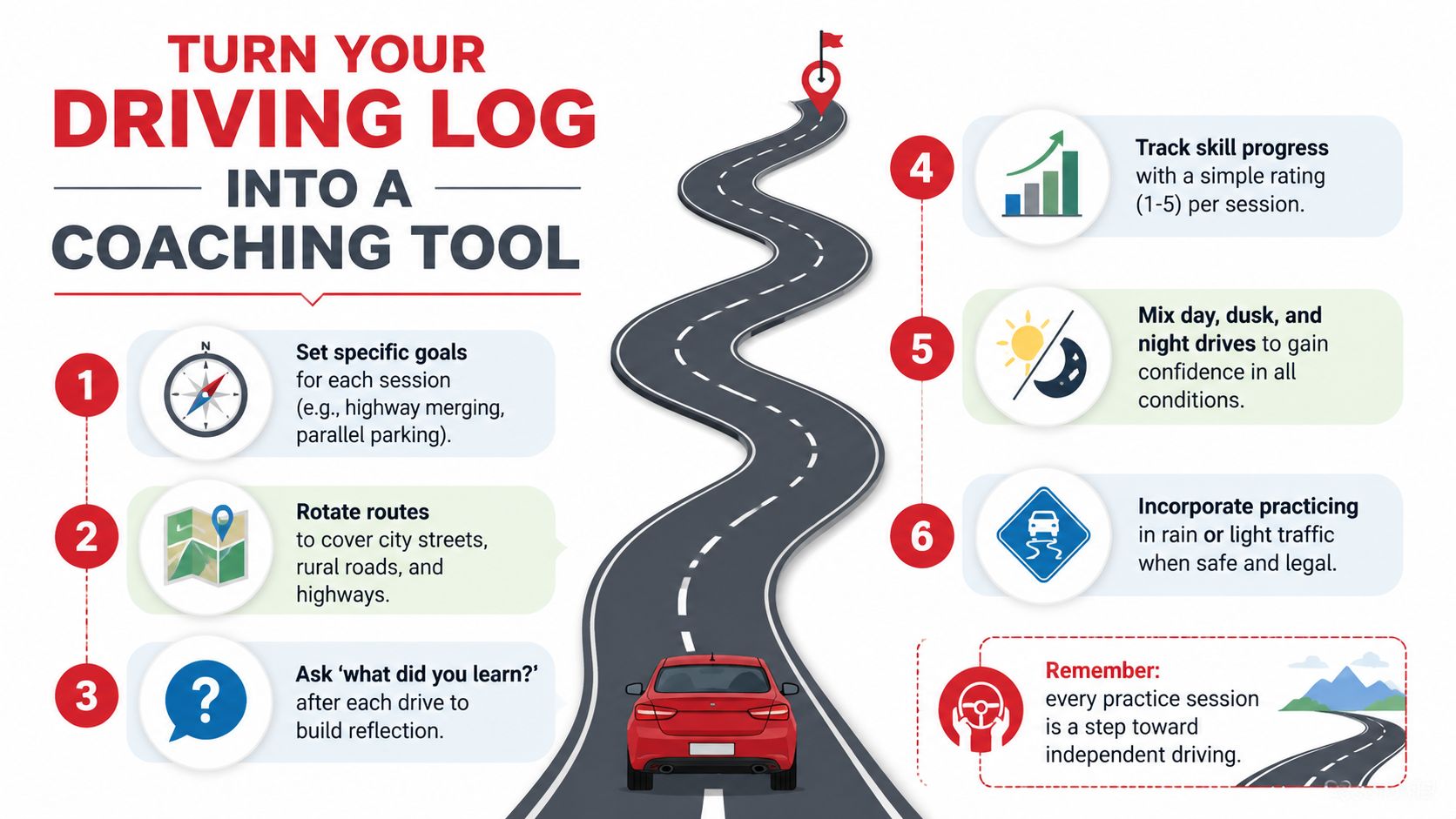
A varied weekly pattern might include a quiet neighborhood session for vehicle control, a city-street drive for signals and intersections, a highway session for merging, and a separate dusk or night drive. Later practice can include rural roads, heavier traffic, parking areas, and light rain when conditions are safe and legal. The point isn't to chase difficult conditions. It's to build experience gradually instead of repeating the same comfortable route.
Families can also use this hour guide for learning to drive as a general planning resource, while remembering that Georgia's licensing requirements control the official log. A professional lesson can add structure when a parent isn't sure how to teach a specific maneuver or evaluate readiness.
Parent coaching prompt: Ask what went well, what needs improvement, and when the next practice session will happen.
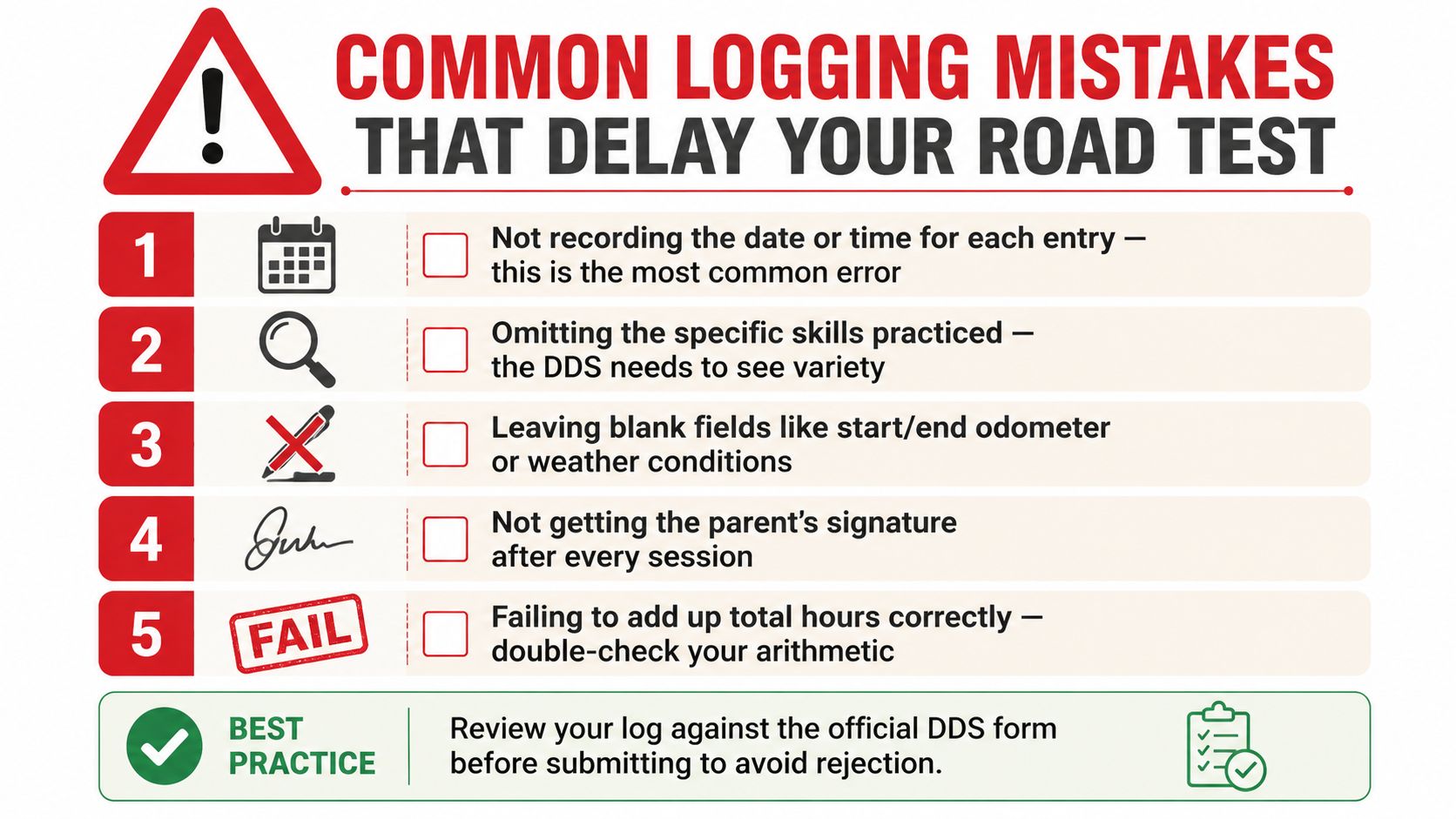
Common Logging Mistakes That Delay Your Road Test
A family may complete several practice drives, then discover that the log cannot show when they happened or what the teen practiced. Reconstructing dates, times, night driving, and signatures from memory can create missing entries, duplicate sessions, incorrect totals, or records that cannot be verified.
Use each entry as both proof and a learning checkpoint. Common errors include:
- Missing dates or times: Record the date and session duration promptly.
- Combining day and night hours: Keep night practice separate so the required total is clear.
- Delaying signatures: Parent or guardian signatures should follow the official form's instructions, rather than wait until the appointment.
- Adding totals incorrectly: Convert hours and minutes carefully before calculating supervised driving time.
- Writing vague skill notes: “Driving around” gives little coaching value. Name the work completed, such as intersections, parking, lane changes, or merging.
Audit the record before booking the appointment
Use the current DDS form as the final reference. Verify 40 total supervised hours, including 6 night hours, and confirm that the parent or guardian can support the entries. Check each date, start and end time, driving condition, skill note, signature, and total. A simple review is like checking mirrors before changing lanes. It catches problems while there is still time to correct them.
DDS requires an affidavit confirming supervised road driving for the road test appointment. Families should also review the vehicle documents and Georgia's current road-test instructions before arriving. For scheduling ideas, this guide to the best time for a driving test may help, but DDS requirements remain the controlling reference.
Do not recreate a month of practice in one sitting. Record each drive promptly, keep paper pages together, and back up a digital copy when using an app or spreadsheet. A-1 Driving School can also help families identify gaps before the log and driving skills are reviewed for test readiness.
How A-1 Driving School Supports Your Practice Journey
A driving practice log works best when classroom instruction, professional lessons, and parent-supervised driving reinforce one another. A-1 Driving School offers Georgia Driver's Education courses in person and online, along with teen and adult driving lessons and road test preparation. Families can use structured lessons to identify skills that need more supervised practice at home.
A professional instructor can demonstrate a maneuver, observe the teen without family dynamics affecting the lesson, and give the parent a specific practice target. That makes the home session more focused. A-1's information about the benefits of taking driving lessons from an instructor also supports the broader idea that professional instruction and family practice serve different roles.
Georgia families should also understand how course completion affects their path. Under Joshua's Law, Georgia has four approved completion paths, including classroom-based and online-based options. Each path includes 30 hours of classroom or online instruction, while behind-the-wheel training can be completed through 6 hours at a certified school or parent-taught training. All paths still require 40 hours of supervised driving with a parent or guardian, including 6 hours at night. Details can change, so confirm the current requirements with DDS and the school before enrolling.
Eligible Georgia residents ages 15 to 17 with a valid Georgia instructional permit or driver's license may apply for the Georgia Driver's Education Grant Scholarship Program. The scholarship supports 30 hours of classroom instruction plus 6 hours of behind-the-wheel training with an approved instructor, and applications are due by the last day of the month before the class begins. Review the Georgia Driver's Education Grant Scholarship Program rules for eligibility and application details.
A-1 Driving School offers Joshua's Law courses, online course options, driving lessons packages, and Georgia road test preparation. Visit A-1 Driving School to choose a course or lesson package, organize supervised practice around instructor feedback, and turn your driving practice log into a clear path toward the road test.