

A teen sits down with the DDS website open and asks, “When can I drive by myself?” The answer depends on the order of Georgia's license stages, the teen's age, and the requirements attached to each step. A permit comes first, followed by a provisional license with restrictions, then a full license.
Those stages are only part of the picture. Joshua's Law pathways differ in total hours, how much work falls to a parent, the records families must keep, and whether professional driving lessons are needed beyond classroom instruction. Passing the road test does not remove every limit: Class D restrictions continue to apply after the test.
This walkthrough explains the license classes, the three stages, Joshua's Law pathways, the restrictions that remain after testing, and the road test. Start by finding the date your teen received a permit. That date helps establish when the next stage may become available, while age, education, supervised practice, and testing determine what else must be completed.
Georgia License Classes at a Glance
Say a 16-year-old walks into the kitchen and asks which license she can get this month. The honest answer depends on two things: her age and what she plans to drive. Georgia runs several classes at once, and only one of them is the provisional license most families are chasing.
Start with the age row, then read across to the restrictions column.
| Class | Who It Applies To | Minimum Age | Key Requirements | Main Restrictions |
|---|---|---|---|---|
| CP | Learner or instructional permit holder | 15 | Passes knowledge and vision tests and meets school-enrollment rules | Supervised driving only |
| D | Provisional license holder | 16 or 17 | Held CP for 12 months and 1 day, approved driver education, 40 supervised hours with 6 at night, road test | No driving from midnight to 5:00 a.m., passenger limits |
| C | Standard noncommercial driver | 18 | Upgrade from Class D if still holding it at 18 and eligible | None beyond standard rules |
| M | Motorcycle operator | Generally 17 | Motorcycle knowledge and skills testing | Motorcycle operation only |
The Georgia Department of Driver Services license classes page confirms the split: Class C is the standard noncommercial license for drivers 18 and older, Class D is the provisional license issued to eligible 16- and 17-year-olds, and Class M covers motorcycles, including motor-driven cycles and certain three-wheeled motorcycles, generally from 17.
Two classes trip families up. Class D is neither a beginner's permit nor a full license. It's the middle step, and it carries conditions tied to the class itself. Class M isn't an add-on to a car license at all, so a teen who wants a motorcycle follows a separate testing path.
Look at the requirements column and notice it holds numbers, not adjectives: a 12 month and 1 day hold period, 40 supervised hours with 6 at night, an approved course, a road test. Those are the items you'll be collecting for months.
How to read this table: find your teen's age row first, then read the restrictions column before anyone plans a Friday night trip.
Treat the list as a compliance checklist rather than a shopping list. The class on the card governs who can ride with your teen and when they can drive, long after the examiner signs the form.
How Teens Move Through Georgia's Three License Stages
A teen who gets a learner's permit at 15 cannot move straight to a full license. Georgia uses three stages, and each one sets the conditions for the next.
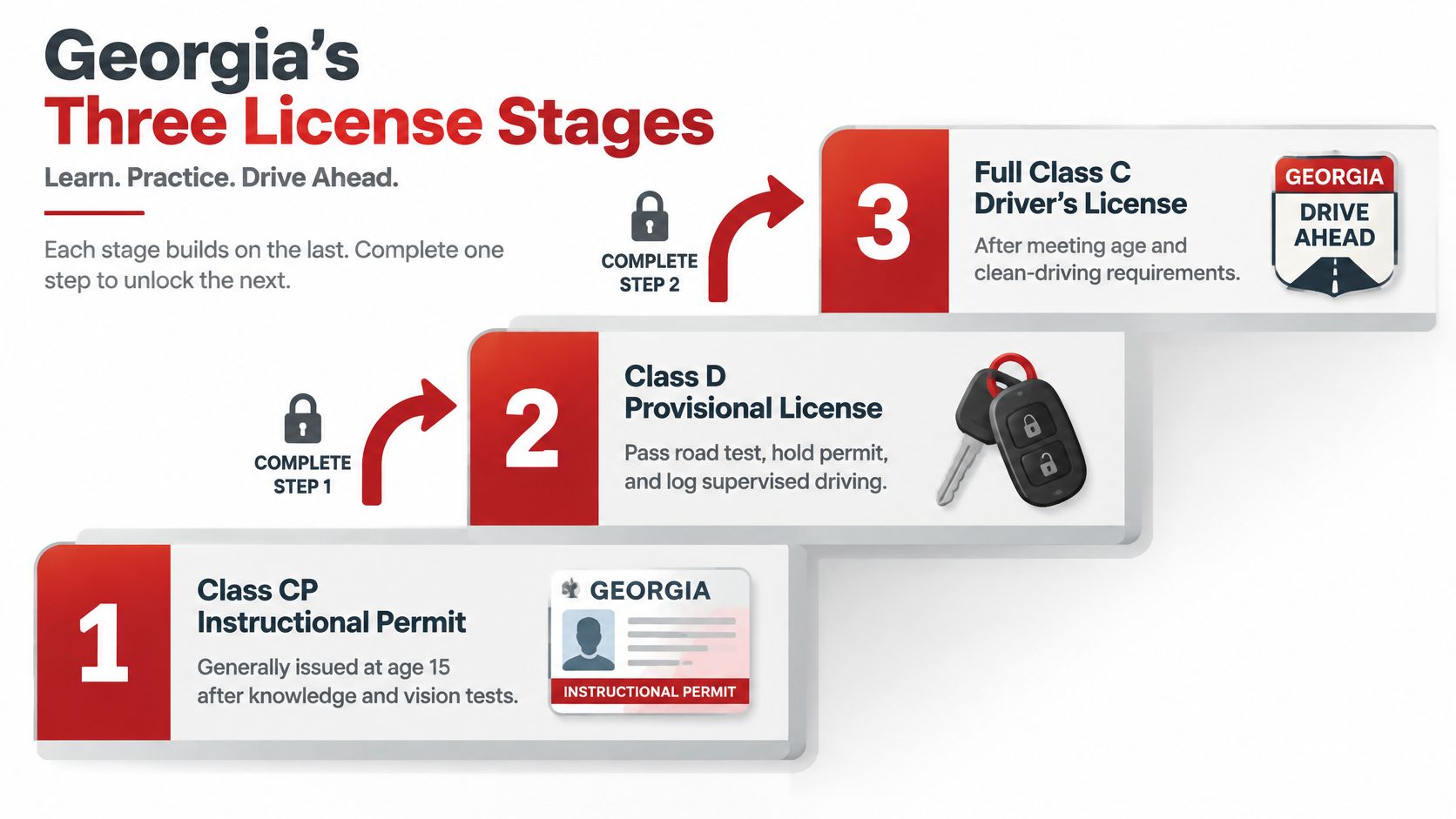
The DDS guide to Georgia's three-stage licensing pathway explains how privileges expand with age, experience and testing. Stage one is the Class CP instructional permit, generally available at 15 after the applicant passes knowledge and vision exams and meets school-enrollment requirements. Stage two is the Class D provisional license, available at 16 or 17 after the teen has held the CP permit for at least 12 months and 1 day, avoided major traffic violations, completed required driver education and supervised driving, and passed a road test. Stage three is the Class C license, generally at 18.
The permit date controls the earliest possible Class D date. For example, a teen who gets a permit at 15 years and 2 months must wait until roughly 16 years and 2 months to qualify for Class D. Completing the 30-hour course early and logging supervised driving hours does not shorten that waiting period.
Practical rule: Write the permit issue date on the fridge. Calculate the earliest Class D date from it.
Keep the stages straight: the permit allows supervised practice, Class D is provisional, and Class C is the later step. The road test and completed training matter, but neither replaces the time the teen must hold the permit. Planning lessons and test appointments around that date helps families avoid scheduling before the teen is eligible.
Joshua's Law Pathways to a Class D License
Joshua's Law is not a single requirement. It's a menu, and Georgia recognizes four ways to satisfy it, depending on whether the classroom hours happen in person or online and whether the behind-the-wheel hours come from a certified school or from a parent. The DDS Joshua's Law requirements page lists all four.
| Method | Course Format | Behind-the-Wheel Training | Supervised Driving |
|---|---|---|---|
| Method 1 | 30 hours classroom | 6 hours with certified driving school | 40 hours with parent or guardian, including 6 at night |
| Method 2 | 30 hours classroom | 40 hours parent-taught | Included in the 40 parent-taught hours, including 6 at night |
| Method 3 | 30 hours online | 6 hours with certified driving school | 40 hours with parent or guardian, including 6 at night |
| Method 4 | 30 hours online | 40 hours parent-taught | Included in the 40 parent-taught hours, including 6 at night |
Every method shares two rules. Each requires 30 hours of classroom or DDS-approved online instruction, and in each one the teen must hold a learner's permit for 1 year and 1 day before receiving a Class D license. That second rule is the one families forget while they're comparing tuition.
What actually changes between the four methods
Only two variables move. The theory format changes: 30 hours in a classroom or 30 hours online. The behind-the-wheel source changes: 6 hours with a certified instructor or 40 hours taught by a parent. Methods 2 and 4 fold the supervised driving into the parent-taught total, which is why that number looks larger than the 6 hours it replaces. In every version, at least six of the supervised hours happen at night.
Online instruction covers theory and nothing else. A virtual classroom doesn't shorten the hours in the passenger seat, and it doesn't replace the nighttime driving. A teen who finishes the online course over a weekend has finished the smallest piece of the job.
Requirements that sit outside the driving hours
- Verified supervision. Supervised hours are confirmed in writing or under oath by a parent or guardian, per the DDS guide to obtaining a license or permit.
- The parent-taught substitution. DDS defines an approved driver-education course as 30 hours of classroom instruction or an equivalent online course, plus either 6 hours of on-road experience with a certified instructor or completion of the DDS Parent Teen Driving Guide.
- The Alcohol and Drug Awareness Program. Applicants ages 16 or 17 must complete ADAP before a Class D license is issued, so schedule it alongside the course rather than after it.
Our approved Joshua's Law courses cover the education side and the road testing side together. If you want the requirements laid out course by course, our Joshua's Law requirements guide walks through each pathway.
Class D Restrictions That Apply After You Pass
A Class D license proves your teen passed the test. It doesn't approve every trip they might want to take with it. That gap between being licensed and being allowed to make a specific drive is where most of the first-year arguments start.
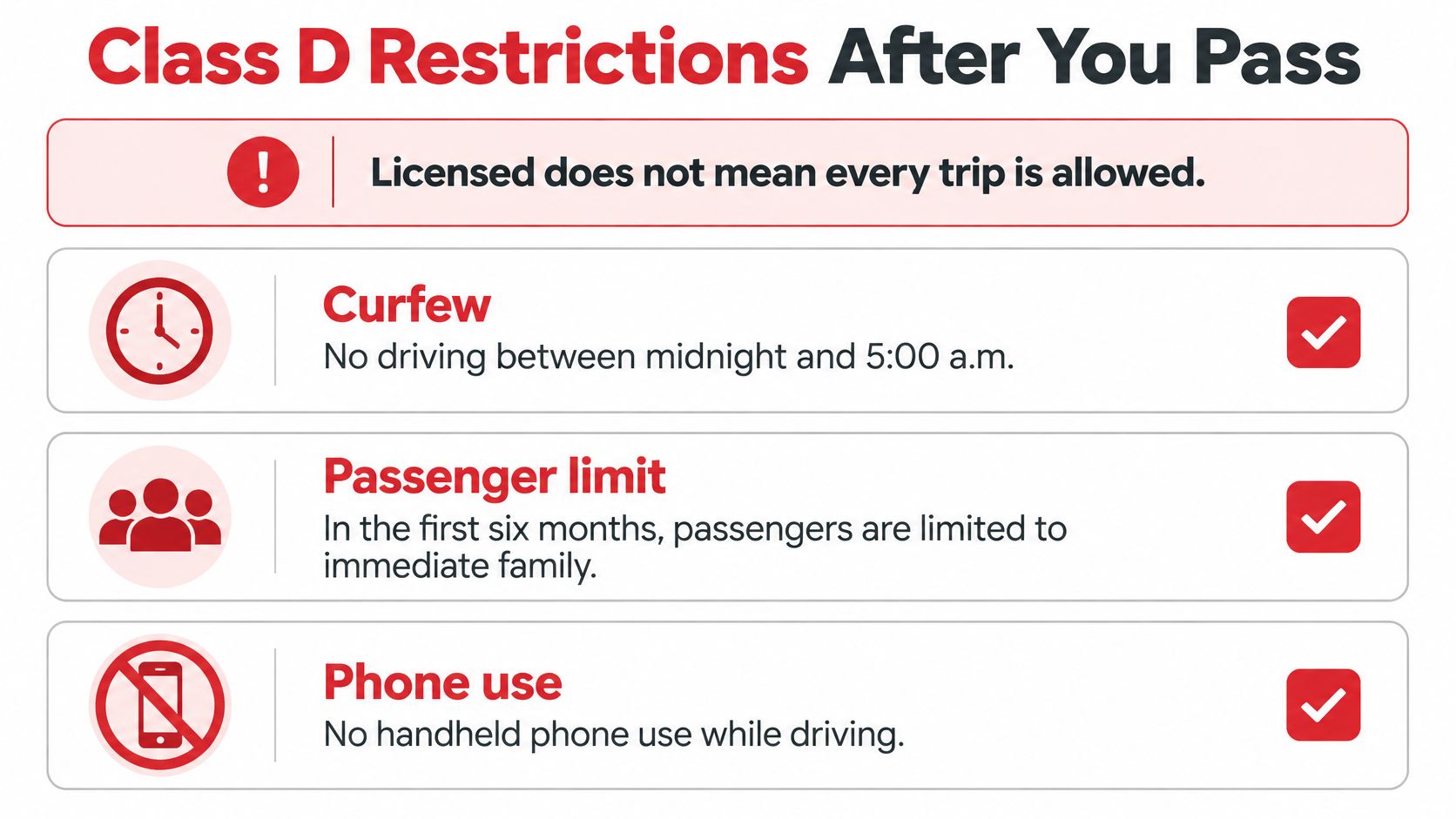
The DDS teen driving laws FAQs describe the shape of it. A Class D holder may not drive between midnight and 5:00 a.m. During the first six months, passengers are limited to immediate family. During the second six months, no more than one non-family passenger under 21 may ride. After that, up to three such passengers are allowed. These are phased risk controls that loosen as months accumulate behind the wheel, not permanent vehicle limits.
Three trips that test the rules
The closing shift. A grocery shift that ends at 12:30 a.m. can't be driven home by a Class D holder, however short the route or well-lit the parking lot.
The carpool. Four friends heading to a game in one car is out during the first six months. It becomes one non-family passenger under 21 in months seven through twelve, and three after the first year.
The younger sibling. A brother or sister counts as immediate family, so that ride works at every stage.
Now the part parents miss. The restriction follows the card, not the birthday. A teen who turns 18 while still holding Class D doesn't wake up with a full license. The driver has to upgrade to Class C to shed the provisional framework, provided the eligibility requirements are met.
Before the keys move: ask two questions out loud. Who's riding, and what time does this drive end?
Write both answers into a family driving plan that also records the current passenger cap and the curfew window. Training should cover the same ground, because a violation doesn't just cost a citation, it can slow the move to a full Class C license. Our breakdown of Georgia provisional license restrictions covers how each phase changes.
Choosing the Pathway That Fits Your Family
Say a family enrolls in the least expensive online course they can find in June. By October the theory hours are finished and the permit clock is running, but nobody has logged a drive after dark because both parents work evenings. Two weeks before the test they book a handful of lessons to settle a nervous new driver, and the total lands above the package they passed over in the spring.
That scenario is the whole decision in miniature, and it's why tuition alone misleads. The DDS Class D page sets out the state's combinations and leaves the choice to the family. Four variables decide how that choice plays out.

Four criteria that decide the pathway
Total hours in the driver's seat. A parent-taught route swaps 6 hours of professional instruction for 40 hours of somebody's evenings and patience. That's the trade, stated plainly.
Parent workload and the dark hours. The supervised time has to happen with a parent or guardian in the car, and evening drives collide with shift work, second jobs and winter sunsets. A family that can't reliably produce those hours hasn't saved money. It has deferred a cost.
Documentation risk. Supervised hours are verified in writing or under oath. A log reconstructed the week before the test is a log that may have to be redone.
Scheduling fit. An online course runs at the teen's pace after school. A classroom course runs on fixed dates, which suits some households and wrecks others.
Driving lessons and lesson packages are the release valve on all four criteria. They suit a teen who freezes at intersections, a driver whose parent practice has plateaued, and families who can't manufacture enough evening hours before the test date. Lessons don't replace the supervised log, so ask how each booking fits the pathway you picked.
Five questions, five minutes, and the pathway usually picks itself:
- Which of us can sit in the passenger seat after dark, and on which weeknights?
- Is there a second vehicle for practice, or does the teen need lessons to get seat time?
- What's the earliest test date the permit allows?
- Who keeps the log, and where does it live?
- Does this teen need instructor-led practice before test day?
Road Test Requirements for Class D
Everything above is paperwork and practice. The road test is where a DDS examiner decides whether the driving is real. Applicants must complete all Class D requirements and pass the applicable Road Skills Test, which evaluates the ability to operate a motor vehicle safely. Appointments run through DDS, and you bring the documents listed for the Class D process, as the DDS road test page explains.
Practice these six skills deliberately, because each one has a predictable way of going wrong:
- Vehicle control at start and stop. Jerky braking or letting the car creep forward at a light is the easiest points to lose.
- Lane use and turns. Cutting a corner or drifting wide costs marks on nearly every attempt that has them.
- Full stops and yielding. A rolling stop at a stop sign is the error examiners notice first.
- Signals, mirrors and blind spots. Skipping the signal or the shoulder check before a lane change is the most frequent lapse.
- Speed matched to traffic. Crawling well under the flow can be marked down as readily as speeding.
- Parking and backing. Rushing the maneuver is what puts a cone under the bumper.
Booking rule: don't schedule the DDS test on the strength of one good drive. Book it once three consecutive practice drives go clean.
A lesson or a lesson package can target any of those six before test day, while the official examination stays a DDS appointment. Our Georgia road test preparation follows the same skill list the examiner scores.
Book Your Class D Pathway and Driving Lessons
Five moves, in order, from here to the test.
- Pin the permit date. The earliest Class D date is 1 year and 1 day after the permit was issued. Put it on a calendar and work backwards from it.
- Choose a pathway from the table, weighing who can supply the nighttime hours, how much professional instruction you want, and the budget.
- Enroll in the 30-hour course, in person or online, and ask whether the Georgia Driver's Education Scholarship Grant Program may help your family qualify.
- Log every supervised hour as it happens, with the verification the state requires.
- Book lessons before the test, not after a failed attempt, then schedule the DDS appointment once practice is consistent.
A-1 Driving School runs in-person and online Joshua's Law courses, offers driving lessons in Atlanta and Athens, and provides road testing including the Georgia Road Test. To get started, you select a class, choose a Georgia location and book a time slot that fits your schedule.
A-1 Driving School has taught Georgia drivers since 1987, with Joshua's Law Driver's Education in person and online, driving lessons in Atlanta and Athens, and road testing at our locations across metro Atlanta. If your teen needs the 30-hour course, a few lessons to steady the nerves before the road test, or a full lesson package built around your permit date, we can map it out with you. Visit A-1 Driving School to pick a class, choose your location and book the time slot that fits your family.