
Senior driver education is targeted instruction that helps older adults refresh traffic knowledge, adapt to changes in vision, reaction time and medication effects, and practice real-world driving skills with feedback. It can include classroom instruction, online learning, behind-the-wheel lessons or a combination of these formats.
The important question isn't whether an experienced driver can pass another written quiz. It's whether that driver can handle the trips that matter, recognize changing limitations and make sensible adjustments without giving up independence unnecessarily.
What Senior Driver Education Is and Why It Matters
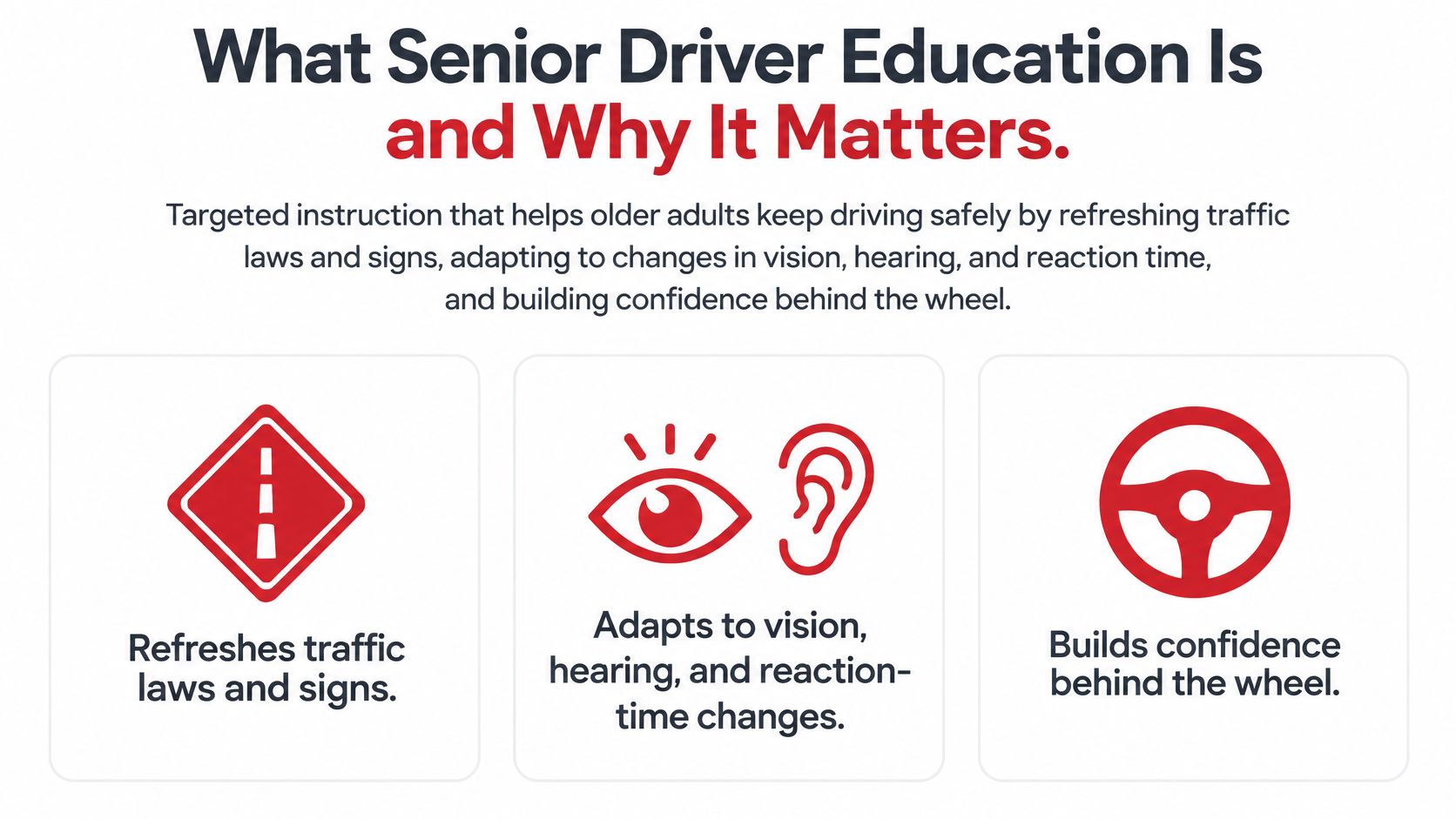
Senior driver education helps older adults connect what they know about driving with what they can comfortably and safely do today. It addresses traffic laws and signs, physical and cognitive changes, and practical decisions about when, where and how to drive.
Say a driver still feels comfortable going to the grocery store but struggles with glare on the return trip from an evening appointment. A useful education plan wouldn't automatically recommend stopping all driving. It would examine the difficult trip, consider a daytime appointment and identify whether vision care, route changes or instruction could help.
This is a mainstream mobility issue. NHTSA's older-driver statistics show that adults 65 and older represented 23% of licensed U.S. drivers in 2024, up from 18% in 2015, with 54.4 million licensed older drivers, a 36% increase over the decade. The Federal Highway Administration also reports that 43% of women and 37% of men aged 80 and older held driver's licenses in 2024.
Adapt the driving, not just the schedule
A personal plan should preserve useful trips while addressing the situations that cause trouble:
- Choose favorable conditions. Schedule essential trips during daylight and postpone nonessential travel in poor weather.
- Simplify routes. Consider a signal-controlled turn instead of an uncomfortable unprotected left turn.
- Prepare for unfamiliar trips. Review entrances, exits and parking before leaving home.
- Keep alternatives available. Arrange a realistic backup for medical appointments, shopping and visits.
The central benefits are practical, not merely academic.
Driving less can be a deliberate adaptation. It isn't, by itself, proof that someone should stop driving.
A short refresher, self-paced theory course and individual driving lesson serve different purposes. Choosing among them starts with identifying the driver's actual difficulty, rather than choosing a program solely because it carries a senior label.
What a Senior Driver Education Course Covers
A useful curriculum connects knowledge, physical abilities, perception and road practice. Knowing the right answer about an intersection isn't the same as noticing a pedestrian while judging a turn.
Start with rules, signs and road layouts. An instructor should clarify right-of-way decisions, pavement markings, signal-controlled turns and unfamiliar intersection designs. Ask the driver to explain a decision in plain language, then practice applying it.
Next, address changing abilities without assuming every older adult has the same limitations. Night glare, difficulty turning to check traffic, slower responses and trouble dividing attention call for different adjustments. Medication questions belong with a pharmacist or prescribing clinician, not a driving instructor.
Turn knowledge into usable habits
Road instruction should cover scanning before entering intersections, complete stops, lane positioning, turning paths and merging. For example, if a driver watches only approaching cars during a left turn, the instructor should coach a deliberate pedestrian check before the vehicle moves.
Vehicle-feature training matters, too. Practice interpreting backup-camera views and driver-assist alerts while maintaining direct observation. A warning system should support a driver's checks, not replace them.
For related preparation, our guide to night vision and driving offers a starting point for discussing low-light difficulties. Orange Neurosciences' guide to supporting independence in older adults provides broader context for considering transportation alongside other daily activities.
Senior driver education formats at a glance
| Format | Typical time | What it includes | Best for |
|---|---|---|---|
| Classroom refresher | Historically 6-10 hours, according to NHTSA's older-driver education review | Rules updates, age-related changes, safe-driving strategies and group discussion | Drivers who want a knowledge refresh first |
| Online course | Confirm the published course duration and whether it is senior instruction or a Georgia licensing course | Theory through video, reading and quiz modules completed from home | Drivers who need flexibility or live far from a classroom |
| Behind-the-wheel lessons | A scheduled session length agreed before booking | Individualized practice and feedback on scanning, lane position and turns | Drivers rebuilding skills or returning after a health change |
| Course plus lessons package | The selected theory course plus scheduled on-road training | Classroom or online theory combined with progressively challenging road practice | Drivers who want documented skill development |
The historical classroom models include programs from AAA, AARP and the National Safety Council, identified in NHTSA's review. Don't assume that every online course follows the same curriculum or that a Georgia licensing course is a senior-specific refresher.
Coverage isn't the same as competence. Ask whether the instructor will observe the driver applying the material, identify a specific mistake and provide an opportunity to practice the correction.
Who Benefits From Senior Driver Education
Consider a daily driver who feels comfortable on familiar streets but has begun hesitating when traffic gets busy. A refresher and an objective driving assessment can help distinguish a knowledge gap from a scanning habit that needs work.
Now consider someone returning after knee surgery. That driver may remember every traffic rule but need to establish whether getting into position, moving between pedals and checking traffic feel manageable again. Medical clearance comes before practice when a health condition could affect safe vehicle control.
Other drivers need help because their circumstances have changed. A spouse who rarely drove on highways may suddenly handle all household trips. A person moving to Georgia may need local-rule instruction and help understanding licensing requirements, without necessarily needing another road test.
Match the starting point to the situation
Your situation and the best first step
| Your situation | Best first step | Why it helps |
|---|---|---|
| Driving daily but noticing slower reactions | Refresher course plus a driving assessment | Updates rule knowledge and identifies habits to adjust early |
| Returning after surgery, illness or new medication | Short series of behind-the-wheel lessons after appropriate medical guidance | Rebuilds skills with a certified instructor in the car |
| Avoiding night driving, highways or left turns | Targeted lessons on suitable routes | Addresses the difficult situation and whether continued avoidance is sensible |
| Family is worried about close calls | Course plus an on-road evaluation | Provides professional observations rather than family opinion alone |
| New to Georgia or returning after years away | Online theory plus road-test preparation when testing is necessary | Rebuilds knowledge and, where applicable, rehearses the state test format |
Confidence can improve, but it shouldn't be mistaken for measured driving ability. In an AARP evaluation of 801 Smart Driver classroom participants surveyed from June 2023 through March 2024, confidence rose from 80% before enrollment to 89% afterward.
Families can use our discussion of risks associated with older drivers to prepare a conversation around specific behaviors, rather than age. Describe a missed signal or difficulty maintaining position instead of making a general accusation about unsafe driving.
For online learners, comfortable screen vision is a separate concern from road vision. Prescript Glasses' discussion of choosing lenses for daily screen use can help frame questions for an eye-care professional, but screen lenses aren't automatically appropriate for driving.
If insurance savings matter, confirm with your carrier whether a mature-driver or defensive-driving course qualifies before enrolling. Choose instruction for its practical fit first, not an assumed discount.
How Well Senior Driver Education Works
Senior driver education works best when it includes behind-the-wheel practice and individualized feedback, rather than lectures alone. The strongest measured improvements concern driving performance, which is different from proving that a course prevents crashes.
The comparison below illustrates that distinction.
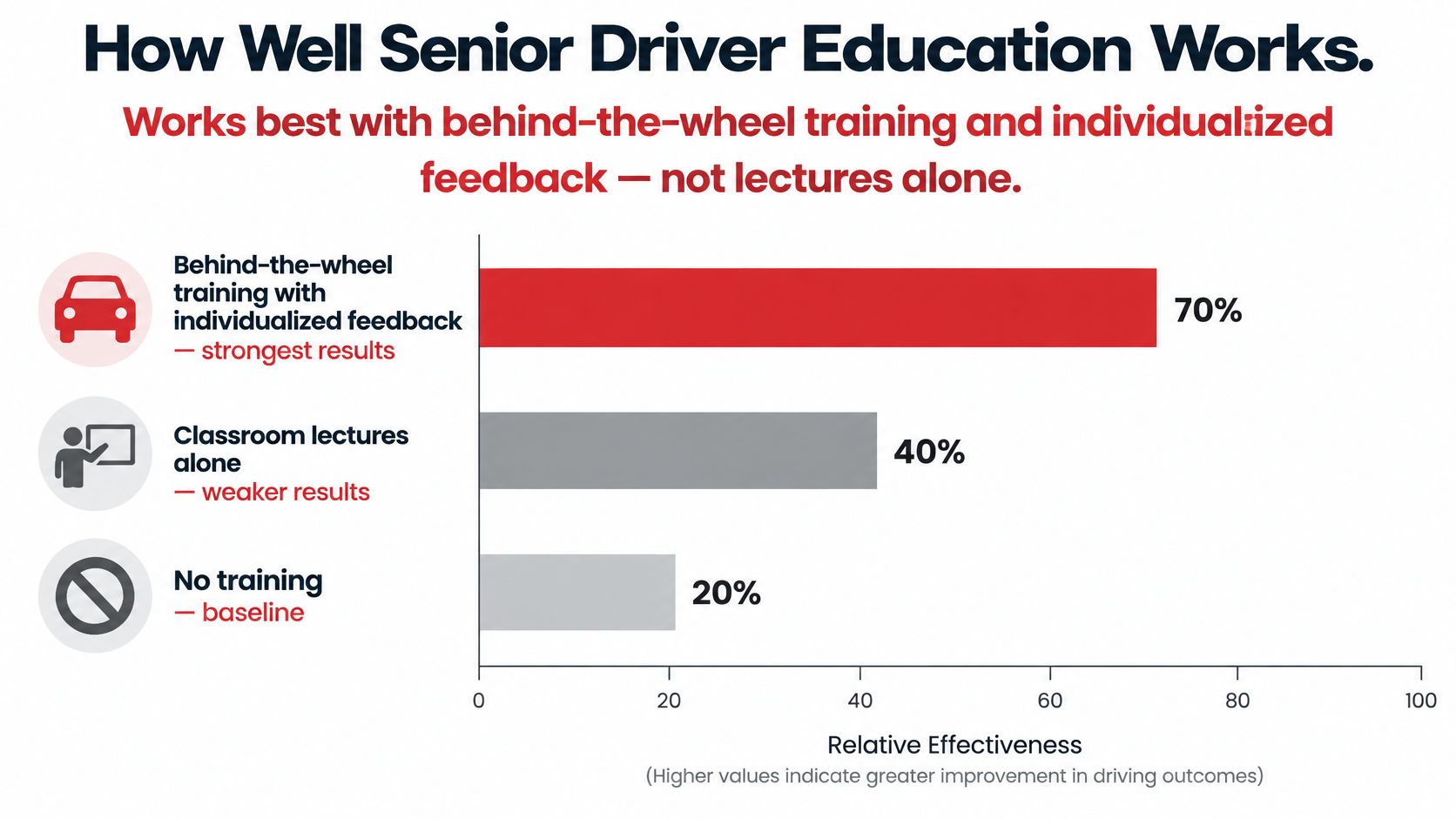
In the randomized trial reviewed by NHTSA, involving 43 older drivers with an average age of 71.7, unsafe driving errors fell 6% after classroom training alone, 23% after classroom plus individualized on-road instruction, and 34% after classroom, on-road and simulator training. Those are changes in observed errors in that trial, not promised results for every participant or equivalent reductions in crashes.
A randomized study of older urban drivers found a 26% reduction in total unsafe driving actions among the on-road training group, with significant improvement compared with education-only participants. Reported improvements included intersection scanning, compliance with stop requirements and lane-position procedures.
Understand what those gains mean
An instructor can explain scanning in a classroom. In the car, the instructor can identify exactly when the driver stopped scanning, what competing task drew attention away and whether the driver corrected the habit on the next attempt.
That feedback creates a useful practice cycle:
- Observe the task. Watch the driver negotiate a real intersection or lane change.
- Name the behavior. Describe the missed check or positioning problem precisely.
- Practice the correction. Repeat an appropriate task under manageable conditions.
- Check consistency. Look for improvement without repeated prompting.
Evidence limit: Better performance during an assessment doesn't establish that a particular course will prevent a future crash.
NHTSA's review supports combining education with road training for performance improvement, while the crash-reduction evidence for classroom-only education remains limited. Simulator training may add value, but the largest improvement in a small trial doesn't establish that every driver needs a simulator package.
This video provides another way to engage with the topic before discussing a training plan.
For most drivers seeking practical improvement, start with an assessment and individualized on-road instruction. Add theory where the assessment reveals uncertainty about rules or decisions, rather than treating lecture attendance as sufficient evidence of road readiness.
Senior Driver Education Options in Georgia
Georgia's Joshua's Law concerns teen licensing, and it sets no age-based requirement for older drivers: the DDS Joshua's Law explanation describes its January 1, 2007 start and the approved driver-education pathway for 16-year-olds seeking a Class D license. A voluntary senior refresher is a different decision from the education a new teen driver must complete.
Adults generally choose among online theory, instructor-led driving lessons and road-test preparation. Online study suits a driver who wants to revisit signs or right-of-way rules at home. Lessons change how the person operates a vehicle, which is where the strongest gains tend to appear. Test preparation matters when a licensing test is on the calendar.
Separate the licensing baseline from senior coaching
The Georgia DDS driver-education FAQs allow the at least 30-hour classroom component to be completed through an approved online course and describe the separate 6-hour instructor-led driving option or DDS Parent/Teen Driving Guide, alongside 40 total supervised hours, including 6 at night.
Georgia DDS baseline requirements for driver education
| Requirement | Georgia rule | Applies to |
|---|---|---|
| Classroom or online theory | At least 30 hours, DDS-approved | Ages 16-17 under the teen driver-education framework |
| Behind-the-wheel practice | 6 hours with a DDS-certified instructor, or the DDS Parent/Teen Driving Guide | Ages 16-17 |
| Supervised driving | 40 total hours, including 6 at night | Ages 16-17 |
| Road-skills test score | Minimum passing score of 75% on the traditional road test | Class D applicants taking the traditional road test |
| Test vehicle | Valid insurance, current registration, safety inspection and unexpired plate | Road-test applicants |
These teen requirements aren't a prescription for how much instruction an experienced older adult needs. Senior coaching should follow the assessment findings, whether the gap is parking accuracy, vehicle controls or a difficult commute.
Our guide to driving tests for elderly drivers can help families separate testing questions from training needs. A refresher lesson doesn't itself change a person's legal licensing status.
Funding deserves the same care as course selection. Some Georgia driver-education programs offer scholarship funding for qualifying students, and A-1 Driving School runs its own Scholarship Grant Program. Grandparents helping a teenage grandchild should confirm eligibility with the provider or the DDS rather than assume any help applies to senior refresher lessons; older adults should budget for their own instruction unless funding is specifically confirmed.
One practical detail saves a wasted trip: a driving lesson requires a valid Learner's Permit or Driver's License, so the senior driver should bring a current license to the first session.
A-1 Driving School's Driver's Education and Driving Lessons courses include Georgia DMV-approved Joshua's Law / Driver's Education courses, including all education and road testing. For a senior driver, the useful question is whether the need is licensing education, practical coaching or preparation for an actual test.
Road Testing and Driving Lessons Packages in Georgia
A road test measures performance under a defined assessment. Driving lessons provide the practice and correction needed before that assessment, or to improve everyday driving when no test is required.
The Georgia DDS Class D application guide requires valid liability insurance, current registration, a safety inspection and an unexpired license plate for the test vehicle, specifies knowledge of hand signals if turn signals are absent, and sets a minimum passing score of 75% for the traditional road test.
Before booking, establish who administers the test, where it takes place, which vehicle will be used and which documents must be brought. Don't assume that booking preparation automatically reserves a test appointment.
What a purposeful driving lesson looks like
A lesson should begin with a clear task, not an aimless drive. The instructor might first check seating, mirror adjustment, pedal access and basic control on quieter streets, then move to an appropriate practice area.
For a driver struggling with left turns, useful instruction could include approaching in the correct position, identifying pedestrians, judging the available gap and completing the turn into the correct lane. For parking, the instructor can establish repeatable reference points and check whether the driver looks beyond the camera display.
The lesson should finish with a practical record:
- What improved. Identify a behavior the driver performed reliably.
- What still needs coaching. Explain the remaining issue without vague labels.
- What comes next. Set the next practice task and appropriate conditions.
- What not to practice alone. Make any safety limitation explicit.
Students must have a valid Learner's Permit or Driver's License to take a driving lesson with us. Bring the document required for your appointment and clarify any licensing concern before scheduling road practice.
Choose a package around goals
An assessment lesson can establish a starting point. A longer package can then provide spaced practice, progressively more demanding routes and opportunities to see whether a correction lasts beyond the session in which it was taught.
A package built around highway merging should have a different progression from one focused on neighborhood trips and parking. Ask how the instructor will decide when to advance, repeat a task or recommend another type of evaluation.
A useful package buys a sequence of learning goals, not just more time in the passenger seat.
For testing-related packages, confirm whether the quoted service includes preparation, vehicle use, test administration or only scheduling assistance. Review the driving-lesson options through the school's website with those distinctions in mind, then select the amount of instruction that matches the driver's needs.
How to Choose a Senior Driver Education Program
Choose the program that can explain what it will assess, how it will teach and how it will report progress. A polished course description doesn't tell you whether an instructor can adapt a lesson to a driver who needs a slower pace or simpler directions.
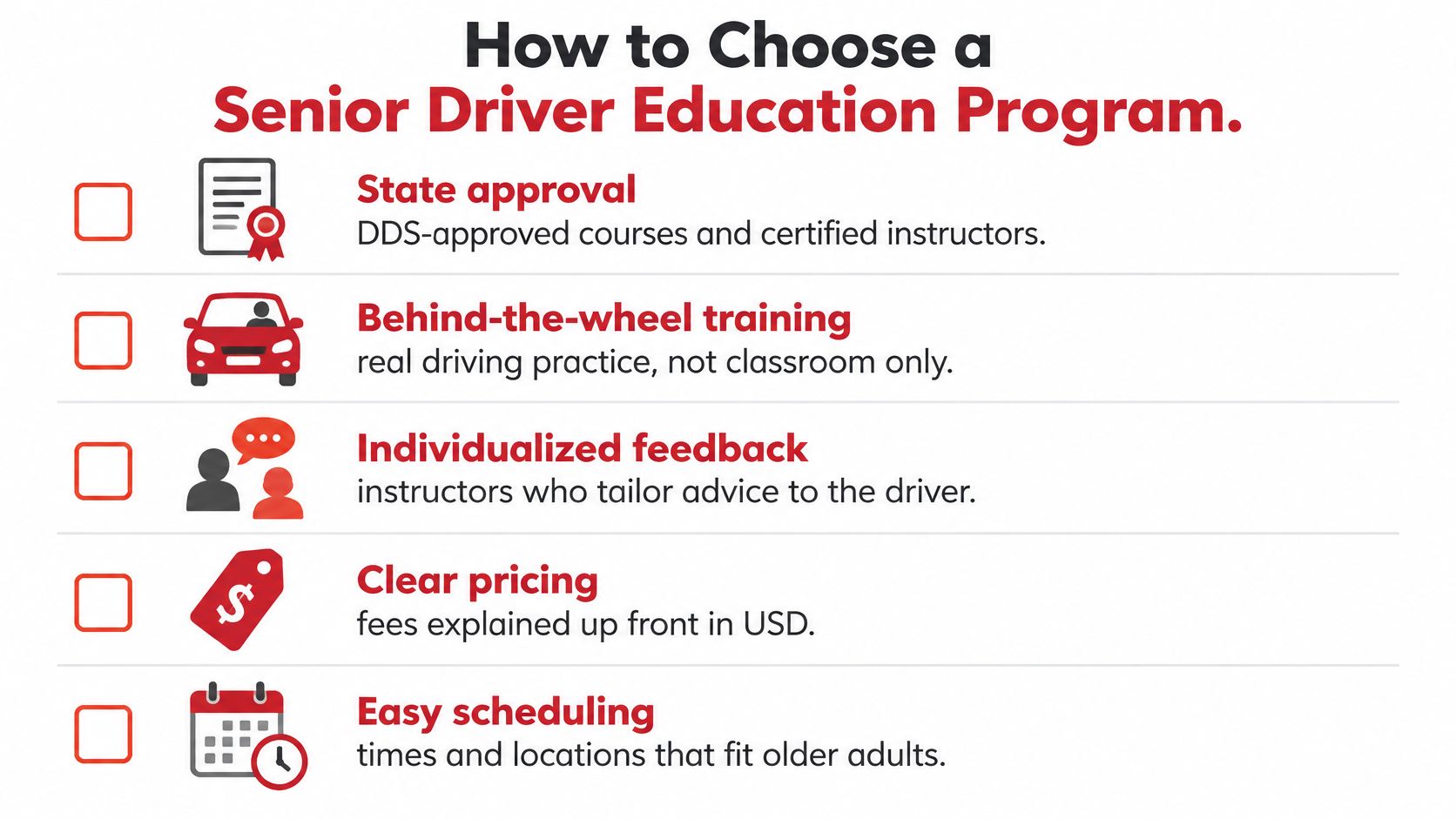
Use this checklist to compare providers:
- State credentials. Verify DDS approval where applicable and the instructor's certification.
- Real driving practice. Look for an on-road option rather than theory alone.
- Assessment before commitment. The school should identify needs before recommending a large package.
- Appropriate pacing. Discuss daytime appointments, breaks and manageable session lengths.
- Vehicle arrangements. Establish whether a training vehicle is supplied and whether test-day use is included.
- Testing arrangements. Confirm the testing location and who is authorized to administer the assessment.
- Clear pricing. Get the included services, additional charges and cancellation terms in writing.
- Progress communication. Agree on what the driver receives and what may be shared with family, with the driver's consent.
- Flexible learning. Consider whether online theory or classroom scheduling fits the person's needs.
The main comparison points are summarized below.
Recognize poor fits early
Be cautious about one-size-fits-all lectures, pressure to buy the largest package before an assessment, or a provider unable to describe its feedback process. Family involvement can help, but instruction should still respect the older adult as the person making decisions.
Before paying, ask: Do you assess before training? Who provides the car for the road test? How do you report progress to family? Clear answers are more useful than a broad promise of confidence.
Start Senior Driver Education With A-1 Driving School
Begin with a brief self-check. Write down any difficulty with night driving, highway speeds, left turns, unfamiliar controls, new medications or recent close calls. Be specific about the situation and what happened, rather than describing yourself or a family member as nervous.
Use those observations to make a practical plan:
- Identify the main need. Separate uncertainty about rules from difficulty performing a driving task.
- Choose the format. Match knowledge gaps to a refresher, skill gaps to driving lessons, or both to a combined approach.
- Establish a starting point. Arrange an assessment or first lesson with clear goals.
- Coordinate testing when necessary. Allow time for preparation before committing to a test date.
- Protect the driver's dignity. Caregivers should frame instruction as support for continued mobility, not a threat to take away the keys.
For medication or health concerns, get appropriate clinical guidance before road practice. A driving instructor can evaluate observed driving habits but can't diagnose a condition or decide whether a medication is medically appropriate.
The school's website is a starting point for planning enrollment.
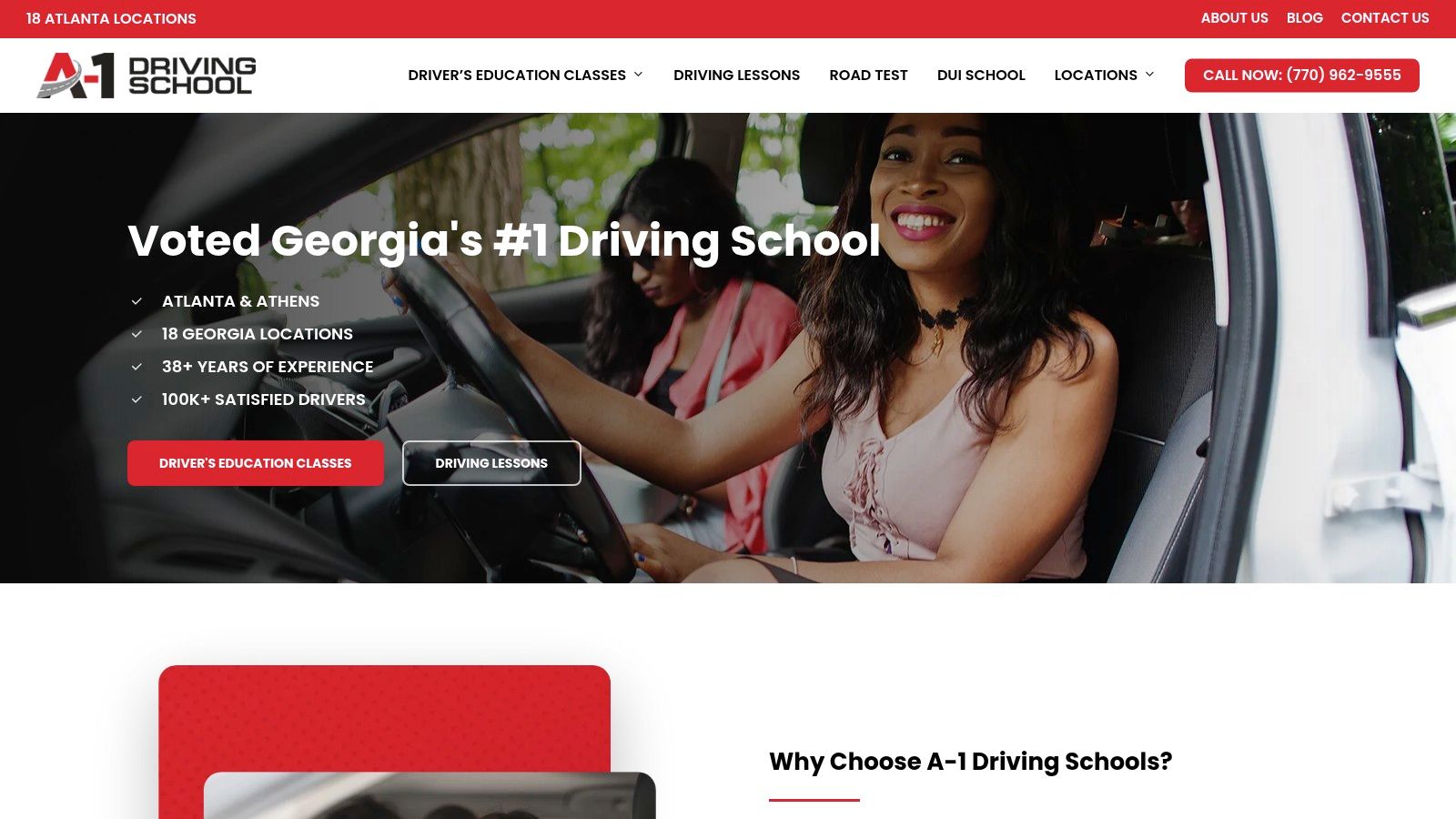
For questions about education and scheduling, call our Driver's Education Hotline at (770) 603-3320. Bring a clear description of the driving task you want help with so the conversation begins with your needs.
Senior driver education supports Georgia's older drivers in keeping their independence safely, with honest feedback and a plan suited to the person.
A-1 Driving School offers driving lessons for students and adults, instructor-led and online Joshua's Law courses, and road-testing services, and participates in the Scholarship Grant Program. Visit A-1 Driving School to explore driver education and driving lessons packages, then arrange a starting point that fits your driving goals.