
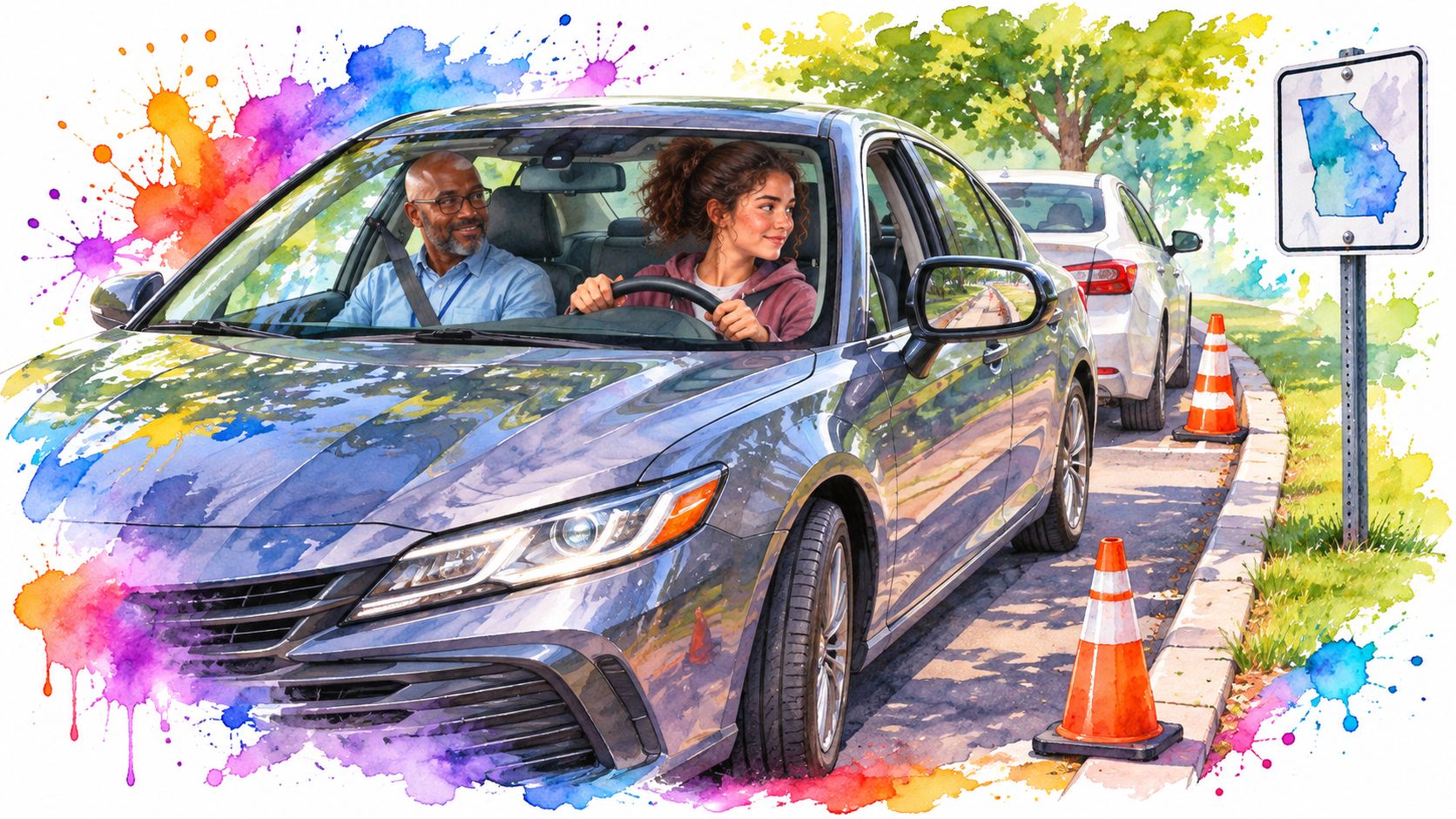
You can drive to school or work with someone supervising, but parallel parking still takes several attempts. Your parent says you're ready, yet you're not sure whether the examiner will agree. Searching for road test practice near me makes sense when you need more than another drive around the neighborhood.
The useful next step is a lesson that identifies which Georgia test tasks still need work, then gives you a drill for each one. Local driving lessons should connect what happens behind the wheel with what the examiner evaluates, not just add miles to your practice log.
Georgia Road Test Skills and Scoring Benchmarks
Georgia's road test requires a minimum score of 75%, according to DDS test and exam information. You also need an appointment, not a walk-in visit. Treat booking and driving readiness as separate jobs: an available appointment doesn't mean your skills are ready.
The examiner evaluates both individual maneuvers and the decisions between them. Finishing a parking attempt isn't enough if you neglect observation, and completing a turn doesn't erase an incorrect approach lane.
Georgia road test scored tasks and benchmarks
Use this table as a practice checklist. The benchmarks reflect the Georgia road-skills tasks, while the final column tells your supervising driver what to watch.
| Scored Task | Benchmark | What to Drill |
|---|---|---|
| Parallel parking | Within 18 inches of the curb | Judging curb distance and stopping position |
| Straight-line backing | About 50 feet at 10 mph or less | Looking rearward and staying centered in the lane |
| Three-point turn | Controlled turn without rolling into traffic | Stopping, reversing and steering timing |
| Turns and lane choice | Approach in the correct lane | Choosing the lane early and signaling before the intersection |
| Stop signs and crosswalks | Full stop, yield where required | Stopping before the line with no rolling |
| Lane position and speed | Centered in lane, speed suited to traffic | Following distance and speed changes |
| Hand position | Both hands on the wheel | Keeping both hands on the wheel through every turn |
| Overall score | At least 75% | Aim for error-free performance in every row |
Error-free practice is a target, not the legal passing standard. Don't build your preparation around guessing how many mistakes you can afford. Repeated small faults across parking, stops, signaling and lane control can undermine an otherwise competent drive.
Make feedback specific enough to use
A useful coach describes the action, not the driver's personality. Replace “you're too nervous” with “you started steering before checking behind you.” Replace “that turn was bad” with “choose your approach lane earlier so you aren't correcting at the intersection.”
Our driving test rubric can help organize that discussion around observable tasks.
Practice standard: Count a maneuver as successful only when the observation, positioning and vehicle control are all correct.
Don't memorize a presumed test route. Practice different intersections and parking approaches so you can apply the same method when the examiner gives an unfamiliar instruction.
Paperwork, Vehicle and Hours You Need Before Booking
Start with the vehicle, because good driving won't fix missing documents. The DDS testing guide says applicants must provide a four-wheel vehicle for a Class C or D test, with valid registration or a license plate, liability insurance and a passing safety inspection.
A temporary dealership tag requires a bill of sale showing purchase within the previous 30 days, or 7 days for a third-party purchase, under that same guide. Put the documents together before committing to test-day transportation.
Road test requirements by case
The DDS road-test requirements distinguish applicants under 18, who must bring a licensed accompanying driver aged at least 21, from adult applicants, who need a valid Georgia non-commercial learner's permit, a passed knowledge exam and an affidavit confirming 40 supervised hours, including 6 at night.
| Requirement | Under 18 | 18 or Older |
|---|---|---|
| Appointment | Required, no walk-ins | Required, no walk-ins |
| Learner's permit | Held under Joshua's Law | Valid Georgia non-commercial learner's permit |
| Knowledge exam | Confirm completion through the permit process | Must pass before testing |
| Supervised driving | 40 hours, including 6 at night | 40 hours, including 6 at night, confirmed by affidavit |
| Accompanying adult | Licensed driver aged 21 or older | Confirm accompaniment arrangements with DDS |
| Test vehicle | Four-wheel, registered, insured, passes safety inspection | Same requirements |
| Temporary dealer tag | Bill of sale within 30 days, or 7 days for a third-party purchase | Same requirements |
| Passing score | 75% | 75% |
Practice in the car you intend to test in whenever possible. Seat height, mirror coverage, brake response and parking reference points change between vehicles.
Before booking, check these practical details:
- Documents: Keep readable registration and insurance documentation together.
- Vehicle condition: Check lights, signals, tires, seat belts and the parking brake before presenting the car for inspection.
- Unresolved requirements: Confirm any unclear permit, accompaniment or eligibility detail directly with DDS rather than guessing.
If you're using a school vehicle, confirm its availability and the testing arrangement separately from your lesson reservation.
Five-Stage Practice Session and Fixes for Common Faults
Run a repeatable session rather than driving until everyone gets tired. The DDS road-skills test overview gives concrete targets: parallel parking within 18 inches of the curb and backing approximately 50 feet at no more than 10 mph while looking rearward.
Keep the session sequence visible so both learner and coach know what comes next.
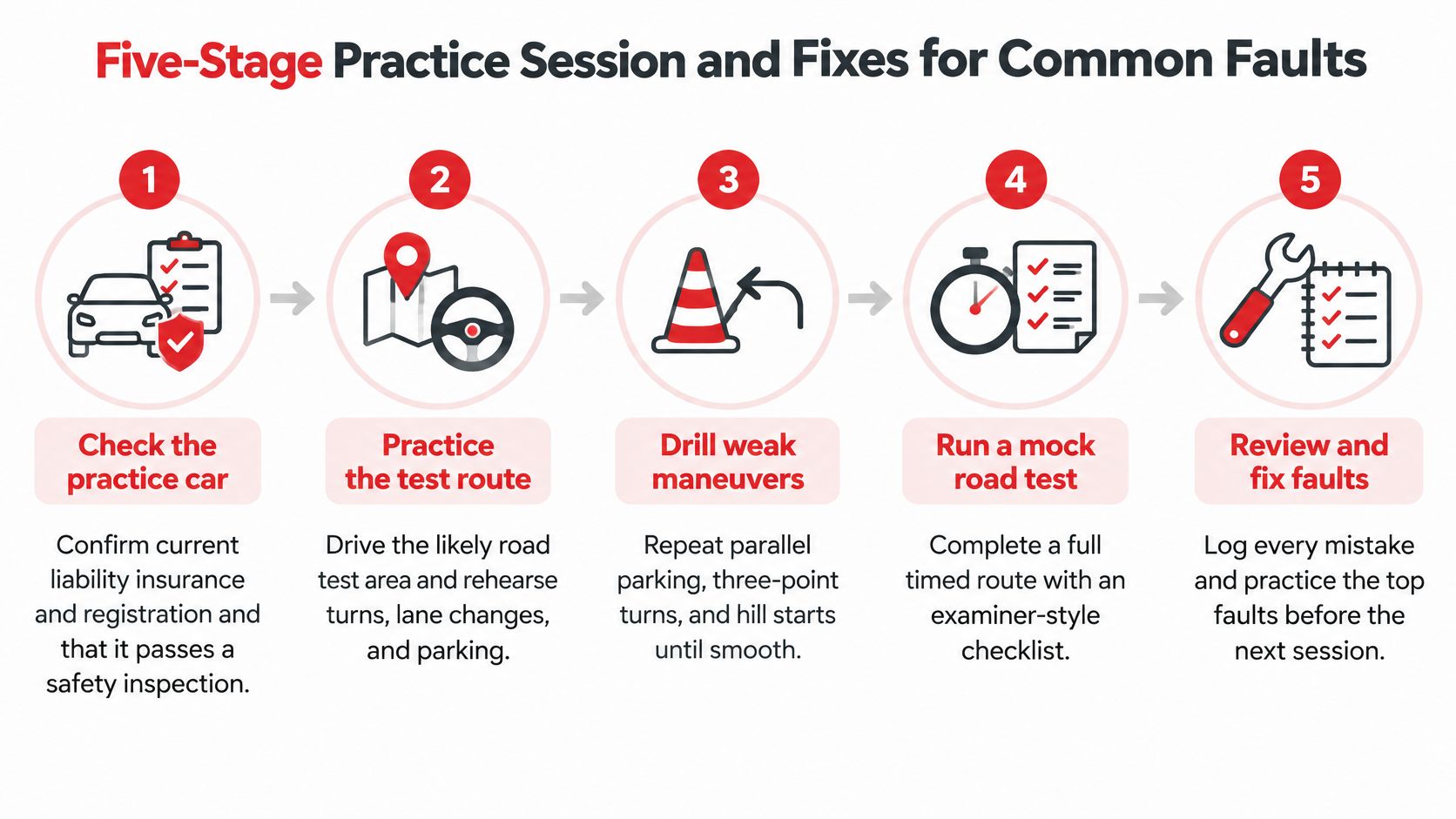
Work from vehicle checks to independent decisions
Check the practice car. Confirm current liability insurance and registration, then check the vehicle's safety condition. Adjust the seat and mirrors before moving. A familiar setup helps the learner judge position without stretching or constantly readjusting.
Run the low-speed circuit. Rehearse parallel parking, straight-line backing, stop-line positioning and a three-point turn in a suitable practice area where you have permission. Check mirrors and the relevant blind spots before moving, then continue observing throughout the maneuver.
If backing drifts, start with short, approximately 10-foot practice segments before extending the run. That's a coaching drill, not a DDS test requirement. Use small steering corrections rather than swinging the wheel after the car has already wandered.
For parking too far from the curb, reset the starting position alongside the vehicle ahead. Correct alignment and small steering adjustments work better than repeating the same rushed entry.
Drive an urban route. Focus on lane selection, intersection scanning, signaling, following distance and speed control. Have the learner narrate decisions during coached practice: identify the intended lane, the signal and the gap before acting.
For rolling stops, have the partner call out whether the wheels stopped. A deliberate pause can help during practice, but a counting ritual doesn't replace observation or yielding. Follow posted limits and reduce speed for conditions, even when surrounding drivers go faster.
Run a mock test without coaching. Give directions, but don't supply reminders about signals, head checks or braking. Intervene whenever safety requires it, then record that the learner wasn't ready to complete that situation independently.
Review and fix the most frequent fault. Use the score sheet to identify the recurring error, then repeat the relevant drill. Don't overwhelm the learner with a running commentary on everything that could improve.
Recover without creating another problem
After a minor mistake, breathe and continue safely. Don't stop unexpectedly to apologize or let frustration distract you from the next intersection.
Use this video alongside supervised practice, pausing to discuss the actions the learner needs to rehearse.
A corrected maneuver during coaching shows understanding. Repeating it successfully without reminders shows readiness.
A useful practice standard is consecutive clean runs of the weak task, followed by a mock drive without coaching. That's a readiness check, not a guarantee of passing.
Scheduling Your Weekly Practice Plan
Build the calendar around skills, not convenient errands. Driving the same comfortable route can fill a log while leaving backing, parking and unfamiliar intersections untouched.
Your supervised-hour requirement sets the minimum commitment. Your performance determines which tasks deserve the remaining practice time.
Give each session a job
Count completed and remaining hours. Separate daytime and nighttime entries before choosing an appointment date. For a teen, coordinate the calendar with school lessons and the Joshua's Law pathway; for an adult, organize it around the required affidavit and current skill gaps.
Assign a scored focus. An example week could start with backing, move to parking and three-point turns, then finish with lane choice and intersection work. Use the weekend for a complete mock drive rather than another coached lap.
Reserve nighttime practice early. Don't leave it until the final stretch. Choose an appropriate route and supervising driver, then work on visibility, judging gaps and reading the road beyond the headlights.
Increase difficulty deliberately. Begin in a quiet, permitted practice area, progress to residential streets and add busier roads when basic control no longer consumes the learner's attention. Don't introduce heavy traffic just because the quiet circuit feels repetitive.
Log the recurring error. Record the task, the fault and the next drill. “Late lane selection before left turn” gives the next session a purpose; “drove around town” doesn't.
Use independent performance to choose the test date. Look for consecutive mock drives completed without reminders. If the same intervention keeps returning, schedule targeted instruction before committing to the test.
Our driving practice log helps keep hours and skill notes together.
Put paid lessons where diagnosis matters
Use supervised family practice for repetition once the technique is sound. Use an instructor when you can't identify why the car keeps finishing crooked, why turns remain wide or why the learner hesitates at intersections.
Scheduling rule: Don't spend another week repeating a maneuver incorrectly when a focused lesson could identify the cause.
That division keeps local practice purposeful without assuming every practice hour needs to be a paid lesson.
Joshua's Law Paths for 16-Year-Old Drivers
For a teen seeking a provisional license, classroom education and driving practice serve different purposes. The course explains rules and decisions; lessons develop physical control and observation; supervised practice makes those skills repeatable.
Choose the classroom format, then plan the driving
One approved pathway in Georgia's Joshua's Law requirements combines 30 hours of classroom instruction, 6 hours of behind-the-wheel training at a certified school, and 40 hours of supervised driving with a parent or guardian, including at least 6 nighttime hours, for a 16-year-old seeking a Class D license. The certified online pathway uses the same classroom-hour requirement and still requires the practical training and supervised driving.
The sequence is straightforward:
- Complete driver's education: Choose instructor-led instruction or a certified online course that fits the student's schedule and learning habits.
- Complete certified behind-the-wheel training: Use lessons to establish the correct technique before repeating it extensively with a parent.
- Maintain supervised practice: Keep accurate records while holding the learner's permit and completing the applicable licensing requirements.
Online driver's education replaces the classroom format, not driving lessons. It's useful when travel or scheduling makes classroom attendance difficult. Instructor-led learning offers scheduled discussion and opportunities to work through questions with the class.
A-1 Driving School offers both an instructor-led Drivers Education Joshua's Law Course and an online Drivers Education Joshua's Law Course. Our Driver's Education and Driving Lessons offerings include Georgia DMV-approved Joshua's Law and driver's education courses, including education and road testing. The Athens location holds its 30-hour Driver's Education/Joshua's Law course every month.
Coordinate the course, lessons and funding
Start the course and initial lessons while building the supervised-driving routine. Don't wait until classroom completion to discover that lesson availability conflicts with school, work or the family's transportation schedule.
For eligible families, the Georgia Driver's Education Grant Scholarship Program is another planning consideration. Check eligibility and funding arrangements before paying for training you hope to cover through the program.
A scholarship can help with access, but it doesn't replace the learner's work. Course completion, practical training, supervised experience, the permit holding period and the road-skills test remain part of the licensing process.
Book Lessons, Packages and the Road Test
A supervising parent can provide valuable repetition. A certified instructor adds something different: a focused assessment of how the learner observes, positions the car and makes decisions without prompting.
Our teen and adult driving lessons can address a specific weak maneuver or support a broader preparation plan. Driving lesson packages make sense when the learner needs several sessions across parking, backing and road driving. Compare the included instruction and scheduling flexibility, not just the package total.
Choose the location and lesson format
Ask which package can accommodate a no-coaching mock assessment and how the lessons will address the learner's weak tasks. We offer Georgia Road Testing and testing assistance; confirm eligibility, vehicle arrangements and availability before treating a lesson booking as a test booking.
Driving lessons by A-1 location
| Location | Teen and Adult Driving Lessons | Pick-up and Schedule |
|---|---|---|
| Roswell | Available | Free pick-up from home or work; day, evening and weekend times |
| Atlanta | Available | Free pick-up from home or work |
| Athens | Available | Free pick-up from home or work; day, evening and weekend times |
Choose a location that works with the places you can realistically practice. Check our road test sites when coordinating instruction and testing.
Book in a practical order
- Check scholarship eligibility. The DDS Class D licensing guide directs families to the Driver's Education Grant Scholarship Program alongside approved education resources. Funding assistance doesn't remove the training or licensing requirements.
- Book the first lesson. Bring your permit, practice history and a short list of difficult tasks so the instructor can assess the right problems.
- Confirm the test vehicle. Resolve registration, insurance and inspection concerns before test day.
- Arrange the road test. Schedule through DDS or discuss our road-testing and testing-assistance options. Confirm exactly who handles the appointment.
- Choose the course or lesson package. Match the option to the assessment, your remaining training requirements and your available practice days.
The first lesson is the useful decision point. It replaces a vague feeling of readiness with specific tasks to improve and a workable plan for doing so.
A-1 Driving School offers instructor-led and online Joshua's Law courses, teen and adult driving lessons, lesson packages and Georgia road testing. Visit A-1 Driving School to choose a nearby location and book a first lesson focused on the skills you need for your road test.