
You need at least 75% to pass the Georgia road test, and the examiner scores two different things on the way to that number: the specific maneuvers you perform and your overall driving behavior across the whole route. Most applicants pour their practice hours into the first and lose their points on the second.
So here's the question worth sitting with. Can a clean parallel park rescue a drive where you drifted over a lane line and turned right without signaling? On the Georgia road test score sheet, no. The sheet doesn't average a strong maneuver against a weak habit. A technically correct park sits in one column, an unsafe lane change sits in another, and the examiner reads both when the drive is done.
That single idea changes how you prepare. Instead of memorizing a parking sequence and hoping the rest holds together, you learn what each row on the sheet measures, which rows you personally fail, and how to drill those rows until the behavior becomes automatic. The sheet is a rubric. Read it that way and the test stops being a mystery.
Georgia Road Test Score Sheet at a Glance
The sheet is the examiner's written record of the traditional Class C and Class D road test, and it holds two kinds of performance on one page. The Georgia Department of Driver Services (DDS) sets the passing mark at 75%, and the Georgia DDS driver's manual explains that the examiner scores both the specific driving maneuvers and the applicant's general driving behavior, then shows the completed score sheet and gives the applicant an opportunity to discuss the results.
The route itself is built from varied traffic situations. Applicants must drive safely, obey traffic signs, signals and laws, and complete the test without an accident or a moving violation. That's why a failure can come from weak maneuver performance or from unsafe conduct on the road, even when several individual tasks were handled correctly.
| Score sheet item | Georgia standard | What it means for you |
|---|---|---|
| Passing score | At least 75% | Applies to the traditional Class C and Class D road test |
| Scored areas | Specific maneuvers and general driving behavior | Both count toward the result |
| Route conduct | Complete the test without an accident or moving violation | One unsafe move can fail the test |
| Results review | Examiner shows the completed sheet and discusses the results | Ask about each category before you leave |
| Vehicle requirements | Valid vehicle, registration, liability insurance and safety inspection | Confirm all four before booking the skills test |
Read the table the way an instructor reads a student's practice log. Go row by row and ask whether you could demonstrate that standard today, in a real car, with someone watching. A row you can't meet isn't a warning about your chances. It's your next practice session, written down for you.
The 75% threshold is the only number you need to remember when you're deciding whether you're ready, and the vehicle requirements are the only ones you can fix in an afternoon. Everything else on the sheet is a skill, and skills respond to repetition.
How Examiners Score Maneuvers and Route Conduct
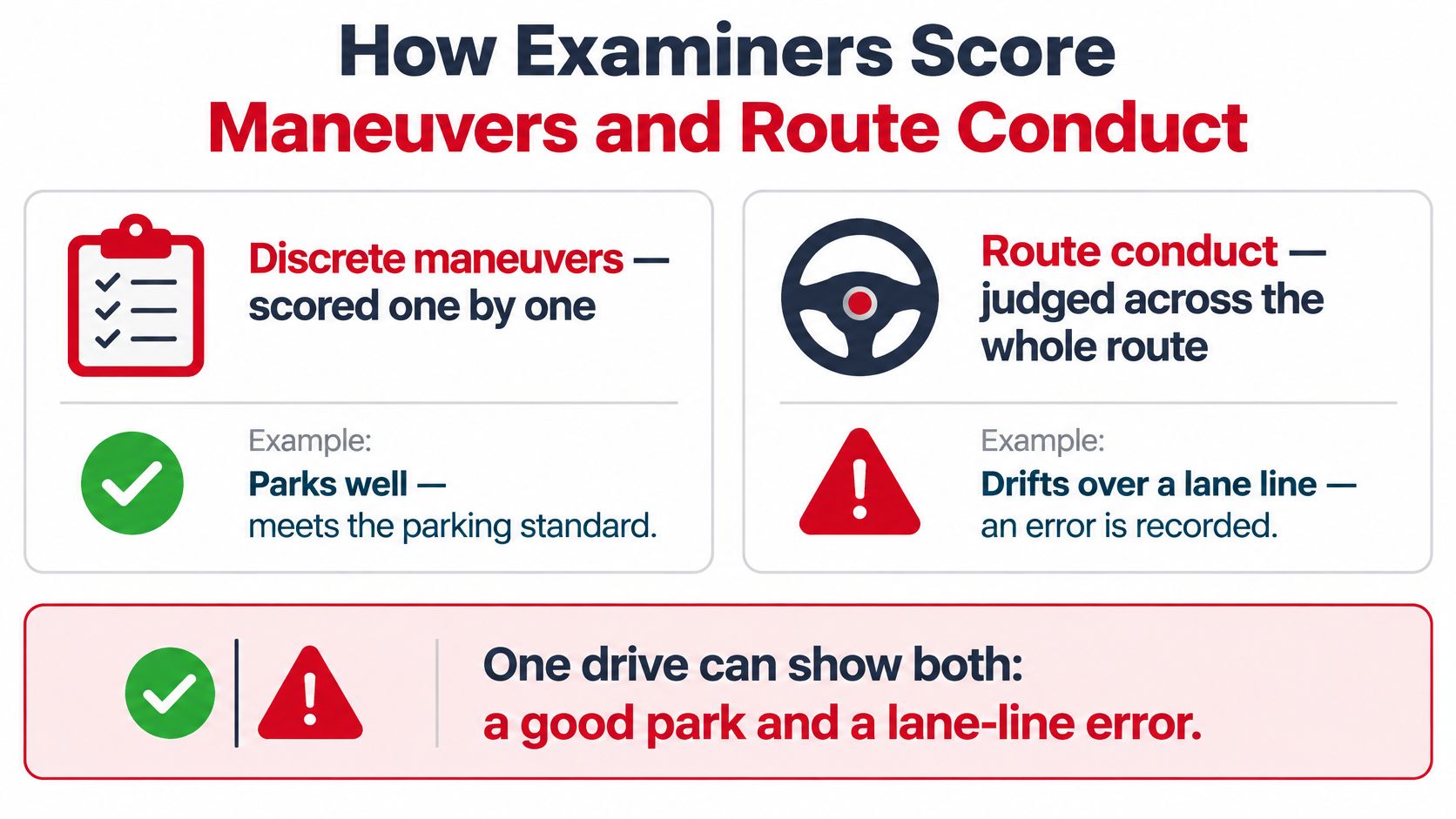
Every applicant moves through the same structure. The examiner scores discrete maneuvers one at a time and judges general driving behavior across the entire drive, and both sets of marks land on the same Georgia road test score sheet. Treat those as two columns that never cancel each other out.
A concrete picture helps. Say an applicant slides into the parallel parking space on the first attempt and finishes with the tires comfortably inside the required distance from the curb. That's one mark in the plus column. Two blocks later the same driver drifts over a lane line while adjusting the mirror, then reaches an intersection and turns without signaling. Those entries go down too, and the final percentage reflects the whole drive rather than the parking job.
What the examiner is watching between maneuvers
The route includes varied traffic, and the examiner expects the applicant to obey signs, signals and laws the whole way through. In practice that means watching for pedestrians and cyclists at crossings, holding a steady lane position, matching speed to traffic and conditions, and making right-of-way decisions early enough that another driver never has to react to you.
None of that is dramatic. It's the ordinary business of driving, and it's exactly where nervous applicants lose points, because their attention narrows to the next instruction and the world outside the windshield goes quiet.
Three moments that end the test
Most route failures trace back to a handful of decisions. These three come up constantly:
- Beating a yellow light. Accelerating to clear an intersection before the signal changes reads as a judgment error, and it's the kind of move that can also produce a violation.
- Drifting across a center line while checking a mirror. A glance should never pull the car out of its lane. If your mirror check moves the wheel, the check is too long or your hands are too tense.
- Failing to yield to a pedestrian in a crosswalk. The crosswalk belongs to the person on foot. Waiting three extra seconds costs nothing on the sheet and protects everything.
A flawless park does not offset any of them. The examiner records the maneuver and the conduct separately, then totals the drive.
The composure rule: after a small mistake, keep driving normally. Don't overcorrect, don't apologize out loud, and don't stop the car unless the situation actually requires it. Examiners score what happens next, and a calm recovery often reads better than a drive with no errors at all.
The review step most applicants skip
When the test ends, the examiner shows you the completed sheet and offers to discuss the results. Take that conversation seriously. Ask which categories were marked down, ask what specifically triggered each mark, and write the answers down before you leave the lot. A marked row you don't understand is a row you'll fail again.
Then use the benchmark to judge your practice. If your own scored practice drives land under the passing mark, the sheet is telling you which category to drill, not that you're a bad driver. Before test day, confirm two habits on your practice route: a steady speed pattern that doesn't surge and sag, and observation checks that happen without anyone reminding you.
Maneuver Standards Examiners Measure
The Georgia road test score sheet evaluates a broad set of measurable driving tasks, not just basic vehicle control. The Georgia DDS test and exam information lists the tested behaviors as parallel parking, backing, stopping at signs or traffic signals, turnabouts, clutch use for manual-transmission vehicles, approaching corners, yielding right-of-way, turning, passing, following distance and posture. Each one has a standard you can practice against.
| Maneuver | Standard | What examiners watch |
|---|---|---|
| Backing | About 50 feet, slow and as straight as possible | Head turned to look back throughout |
| Parallel parking | Midway between two standards | Vehicle less than 18 inches from the curb |
| Stop at sign or signal | Stop before the pedestrian crosswalk | Correct signal, proper lane approach, stays stopped until movement is safe |
| Following distance | Three-second count from a fixed roadside point | Count one-thousand-one through one-thousand-three after the vehicle ahead passes |
| Turnabout | Turn the vehicle around in a limited space using two, three or five points | Controlled movement, mirror and blind-spot checks before each move, no curb contact |
| Manual clutch use | Smooth gear changes without stalling or grinding | Scored only when the test vehicle is a manual transmission |
| Approaching corners | Arrive in the correct lane at a speed that lets you look and react | Early scanning both directions, speed set before the corner, pedestrians and cyclists |
| Yielding right-of-way | Give way to anyone already in the intersection | Timing and judgment, not hesitation or a rolling creep forward |
| Turning | Move into the proper lane and signal before the turn | Signal early, smooth arc, correct entry and exit lane |
| Passing | Pass only where it's legal, with a gap you can complete in | Signal, mirror and blind-spot check, safe return to the lane |
| Posture | Both hands on the wheel, settled and upright | Steady control, no one-handed steering or slouching |
Backing and parking, measured in feet and inches
The backing exercise requires you to reverse roughly 50 feet, slowly, smoothly and as straight as possible, with your head turned to look back the entire way. The parallel park requires you to stop midway between two standards with the vehicle less than 18 inches from the curb. Those are the two most precise numbers on the sheet, and they're the two most worth drilling with cones in an empty lot.
Stops, spacing and the count that keeps you honest
The stopping task asks you to stop before the pedestrian crosswalk, signal correctly, approach in the proper lane, and stay stopped until movement is safe. Following distance uses a fixed roadside reference point: when the vehicle ahead passes it, count one-thousand-one through one-thousand-three and see whether you reach the point after the count. If you arrive early, you're too close.
Manual-transmission applicants are also scored on clutch control, and posture counts for everyone. A student who practices a two-point turnabout slowly, with mirrors checked before each direction change, usually finds the maneuver calmer than the diagram suggests. DDS also requires a valid vehicle, registration, liability insurance and safety inspection before any of this is scored.
Common Errors and How to Fix Them
The errors that sink Georgia road tests are rarely exotic. They're the same handful of habits, repeated, and most of them come from practicing the maneuver instead of practicing the judgment around it. Here's the pattern, the cause, and the drill that fixes it.
| Error on the sheet | Usual cause | Fix before test day |
|---|---|---|
| Late or missing turn signal | Signaling at the turn instead of earlier | Signal before you start braking, every time |
| Parking too far from the curb | Judging distance by eye from the wrong position | Practice with cones; check the gap with the side mirror and aim for under 18 inches |
| Jerky or crooked backing | Looking forward and going too fast | Keep your head turned, move slowly and use fixed reference points |
| Stopping past the crosswalk | Braking late | Start slowing earlier and stop before the crosswalk |
| Following too close | Counting the three seconds too quickly | Use a steady count from a fixed roadside point |
| Missed mirror or blind-spot check | Scanning only ahead | Use a fixed check routine before every lane change |
| Rolling stop | Habit from neighborhood driving | Make each stop complete and hold it for a full count |
Why the same errors keep showing up
Look at the pattern. Almost every row is a timing problem, not a knowledge problem. The student knows to signal. The student signals a beat too late. The student knows to stop. The student starts braking after the sign instead of well before it.
That's why "practice more" doesn't fix these errors. The fix is to change the order of operations inside each maneuver: signal before braking, slow before the corner, head turned before the car moves, observation check before the wheel moves.
Instructor note: drills that pair two actions in the right order stick faster than drills that repeat a single action. Rehearse the sequence, not just the outcome.
Rolling stops deserve their own mention because they're the most common habit imported from everyday driving. In a neighborhood, a slow roll through an empty corner feels reasonable. On the test, it reads as a failure to stop, and it sits in the conduct column where it can drag the whole drive down. Make every stop complete enough that a passenger could count it.
These errors recur across sessions, so a written log beats tackling one problem at a time. When you can see the same row appearing three weeks running, you know exactly where the next lesson should go.
How to Turn the Score Sheet into a Practice Plan
A score sheet is a diagnostic tool the moment you stop treating it as a pass or fail notice. Turn it into a practice plan and every session has a target.
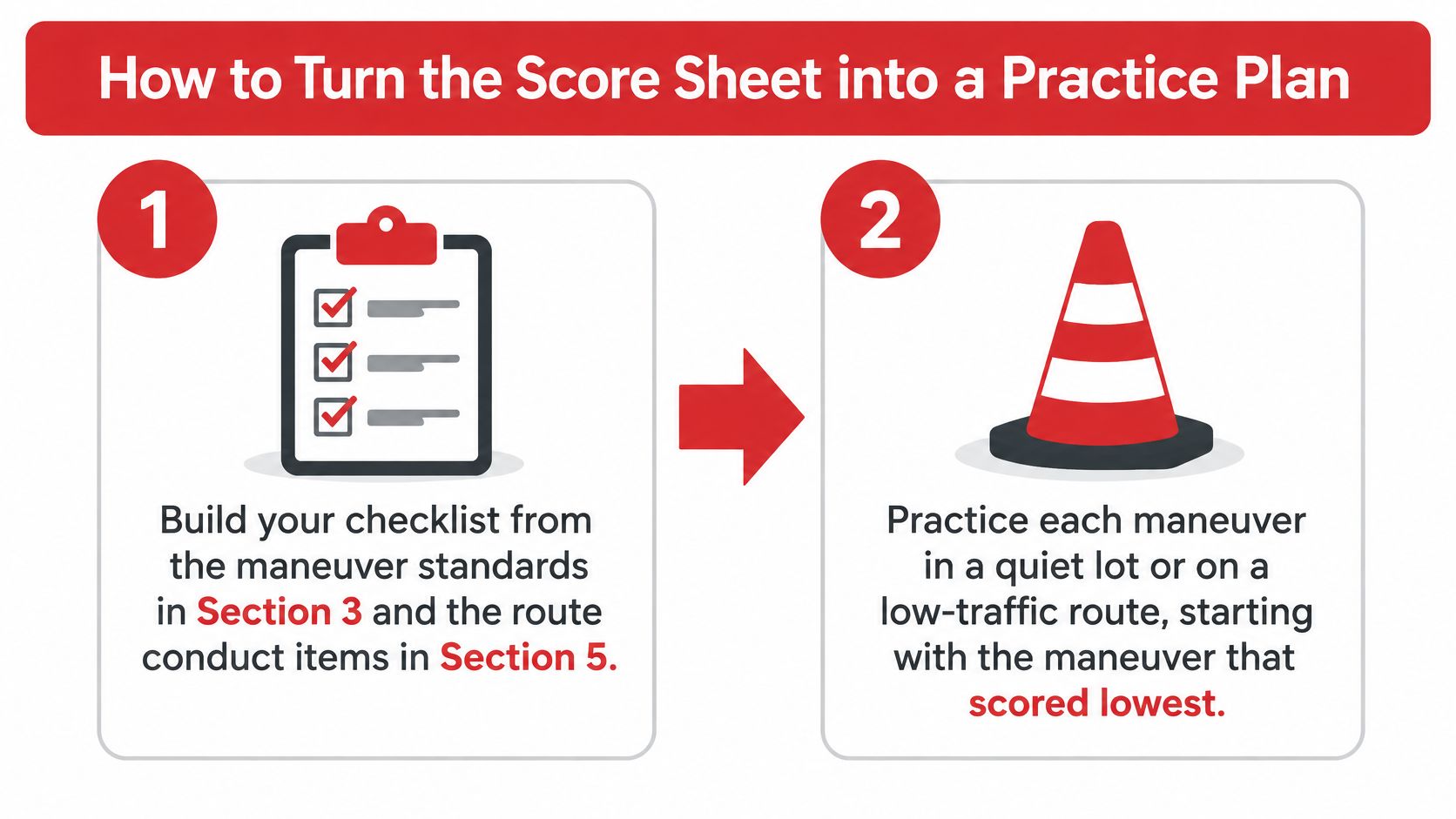
- Build your checklist from the standards. Copy each maneuver and each conduct item into a single list, one row per skill. This is your syllabus.
- Practice in a quiet lot first. Start with the maneuver that scored lowest, not the one that scares you most. A low-speed lot lets you repeat the sequence ten times without traffic pressure.
- Keep an error log after every session. Record the category, the maneuver, and what went wrong. "Parked wide" is useless. "Stopped too far forward, judged the curb from the mirror instead of turning to look" tells you what to change.
- Rank your top three recurring errors. Those three rows will cost you the most on the sheet. Everything else can wait.
- Drill the weakest category at least three times a week. Use the three-second count for following distance and a fixed mirror routine for lane changes so the habit has a shape you can repeat.
- Run a full scored drive. Cover parking, backing, stops and turns in one session, and score it against the sheet end to end. Skills practiced in isolation often fall apart when they're sequenced.
Notice what step six does that steps two through five can't. It tests whether your observation habits survive an unexpected instruction, a pedestrian at a corner, and a light that changes while you're mid-check. That's the condition the test runs under.
Readiness rule: book the skills test only after your practice scores sit consistently above the passing benchmark across three separate sessions. One good run is a good day. Three good runs are a habit.
The last piece is the one you can't do from the driver's seat. A passenger sees whether your mirror glance reaches the mirror, whether your lane position drifts when you talk, and whether the car settles smoothly after a turn. A certified instructor runs structured mock tests and marks the same categories an examiner will, which turns a fuzzy feeling about readiness into a score you can compare week to week.
Joshua's Law Rules for Teen Applicants
The road test is the last step in a long sequence, and for teen applicants the sequence is set by law. A Georgia applicant who doesn't complete an approved driver-education course generally cannot get a Class D license at 16 and has to wait until 17, according to the DDS teen driving requirements document. The same document sets the supervised-driving hours that apply either way.
The two age paths side by side
At 16, the state requires an approved course plus at least 40 hours of supervised driving, including 6 nighttime hours. At 17, driver education isn't mandatory under that guidance, but the applicant still has to complete at least 40 supervised hours with 6 of them after dark. The distinction is practical: approved education allows licensing a year earlier.
The standard course pathway combines 30 hours of classroom instruction, 6 hours of behind-the-wheel training with a certified instructor, and the 40 supervised hours with a parent or guardian. An online or virtual version of the 30-hour course is recognized in Georgia when it's paired with the required practical training and supervised driving. The classroom portion alone doesn't finish the job.
Families who want the full requirement breakdown in one place can review the Joshua's Law requirements before they pick a course format, because the hour combinations are where most planning mistakes happen.
Two supporting rules are worth confirming before you schedule anything. The applicant needs a learner's permit in hand, and an applicant under 18 needs a parent or guardian's consent. Both are paperwork problems, and both are avoidable.
Then tie the timing back to practice. Count the supervised hours in your driving log, note how many nighttime hours you've banked, and hold the road test until the hours are complete and your scored practice drives are where they need to be. A teen who rushes the calendar usually spends the saved weeks retaking the test.
Online Driver's Education and Lesson Options
Georgia allows the theory portion of approved driver education to be completed online. The DDS driver education FAQs describe the classroom requirement as a minimum of 30 hours, and it can be met either in a classroom or through a DDS-approved online course. The practical side can be completed with a DDS-certified instructor or through the approved Parent/Teen Driving Guide, depending on which qualifying method you choose.
The verification step comes before the enrollment step. Courses that aren't approved by DDS cannot be used to obtain a Georgia Class D license, so confirm approval and confirm that the pathway covers the behind-the-wheel or parent-supervised elements before you pay for anything.
| Format | What it covers | Notes |
|---|---|---|
| Classroom theory | Minimum 30 hours | Must be DDS-approved |
| Online theory | Minimum 30 hours through a DDS-approved online course | Practical elements still required |
| DDS-certified instructor | Behind-the-wheel practical training | 6 hours on the Joshua's Law route |
| Parent/Teen Driving Guide | Parent-supervised practical component | Requires 40 supervised hours, including 6 at night |
| Driving lessons packages | Structured practice on score sheet categories | Bundles several sessions |
Comparing the three realistic paths
An online Joshua's Law course fits a student with a packed schedule, but it still leaves the practical hours to be arranged separately. An instructor-led classroom course puts a person in the room to answer questions about right-of-way and turnabouts, which matters if the student learns better by talking things through.
Driving lessons are the third path, and they solve a different problem than either course does. Lessons put a student behind the wheel with someone marking the same categories an examiner will mark, which is how a weak backing exercise or a late signal gets caught before test day rather than on it.
Driving lessons packages make sense when you need several sessions to build consistency rather than one to fix a single maneuver. If three scored practice drives keep flagging the same two rows, a bundle of lessons is a more honest purchase than another round of reading.
A-1 Driving School teaches in communities across Georgia, with locations that include Atlanta and Athens, so families can usually find a lesson site within reach of home or school.
Book Your Georgia Road Test and Driving Lessons
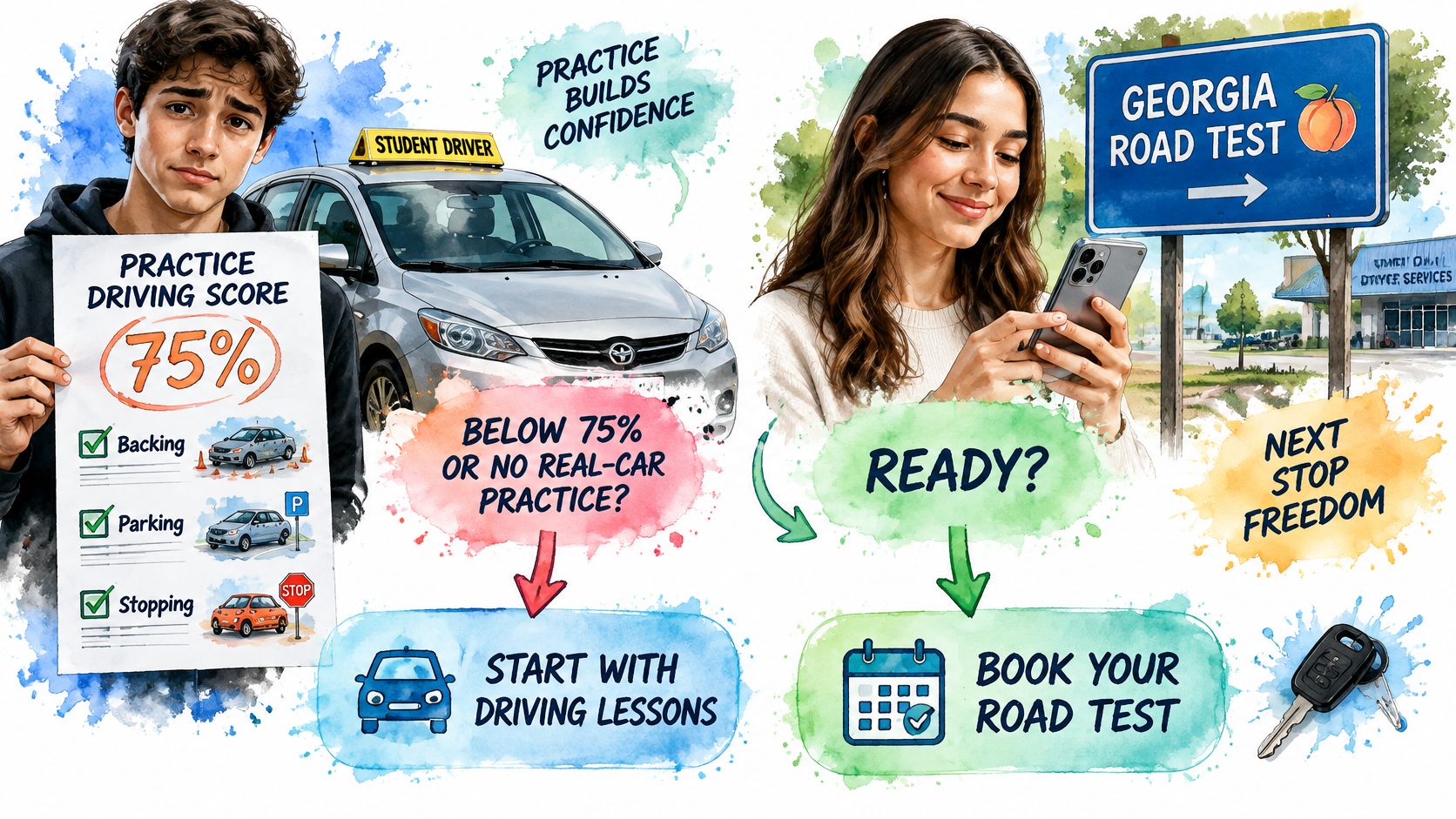
Here's the decision rule. If your practice scores sit below the passing benchmark, or you've never rehearsed the backing, parking and stopping standards in a real car, start with driving lessons aimed at those categories. If your log shows steady scores above the benchmark across three sessions, book the road test.
A-1 Driving School offers Road Testing, including the Georgia Road Test, and our Driver's Education and Driving Lessons courses are Georgia DMV-approved Joshua's Law courses that include all education and road testing, so a family can complete the whole path with one provider. We also run a Georgia Driver's Education Scholarship Grant Program for applicants who qualify.
The steps in order: confirm your Joshua's Law eligibility, choose an approved course format that fits your schedule, then book lessons or the road test. Driving lessons fill the gap between knowing the standards and demonstrating them, which is the gap that fails most first attempts.
Schedules fill quickly around school breaks, so schedule your Georgia driver's test as soon as your practice scores justify it, and call the Driver's Education Hotline at (770) 603-3320 to confirm availability at the location nearest you.
A-1 Driving School has been teaching Georgia drivers since 1987, and our instructors work from the same categories the examiner marks: backing, parallel parking, stops, following distance and the conduct that runs through every one of them. If your practice drives keep flagging the same rows, book driving lessons with us and we'll drill those rows until they hold under pressure, or start with a Joshua's Law course if the education hours still need to be completed. Visit A-1 Driving School to enroll online or find the location closest to you.