
Your teen just turned 15, the permit paperwork is sitting on the kitchen table, and everyone keeps asking the same question, where do we start? Or maybe you're an adult who finally decided the time has come to get licensed, and the maze of courses, certificates, and road-test steps feels bigger than the actual driving. Either way, driving school Texas decisions get easier when you stop looking for a shortcut and start looking for the right path.
Texas doesn't treat driver education as one generic class. It recognizes multiple routes, including a licensed driving school, Parent-Taught Driver Education (PTDE), and instruction through a public school, education service center, college, or university (Texas driver education at a glance). That matters because the right choice changes how you collect forms, when you can apply for a permit, and which certificate you'll need at the end.
Texas also runs driver education like a regulated training and compliance system, not just a weekend course. The state inspects schools, expects proper classroom space and instructors, and ties the training path to real licensing outcomes (TDLR driver education school checklist). If you're trying to get through the process smoothly, the first step is picking the lane that matches the student, not memorizing isolated practice-test answers.
Starting the Texas Driver Education Journey
A lot of families run into the same moment. A teenager turns 15, starts asking about a learner permit, and the question changes from “Should we do driver education?” to “Which path do we choose, and in what order?” Adults have a similar moment when they realize a license will not happen with a handbook alone. The process starts with matching the path to the learner's age, schedule, and how much help a parent will give.
Texas gives you three broad starting points. A student can enroll in a licensed driving school, follow PTDE with a parent, or take instruction through a public school, education service center, or a college or university program (Texas driver education at a glance). That choice matters early because it decides who keeps the records, who signs off on training, and which certificate reaches the DPS office later.
The order matters just as much as the choice. If a family starts on the wrong track, the learner may repeat steps, wait on a certificate, or find out the course does not fit the student's situation. For families comparing online classes with in-person instruction, this overview of what online driver education is gives a helpful starting point.
A practical rule helps here. Choose the path first, then work backward through the forms. In Texas, the sequence of the steps often decides whether the rest of the process feels straightforward or stalled.
Who Is Required to Take Driver Education in Texas
A parent may think the permit step comes first, then the class, then the license. Texas does it the other way around for many first-time applicants. The learner's age and license history decide whether driver education is required, and that decision shapes every form and certificate that comes next.
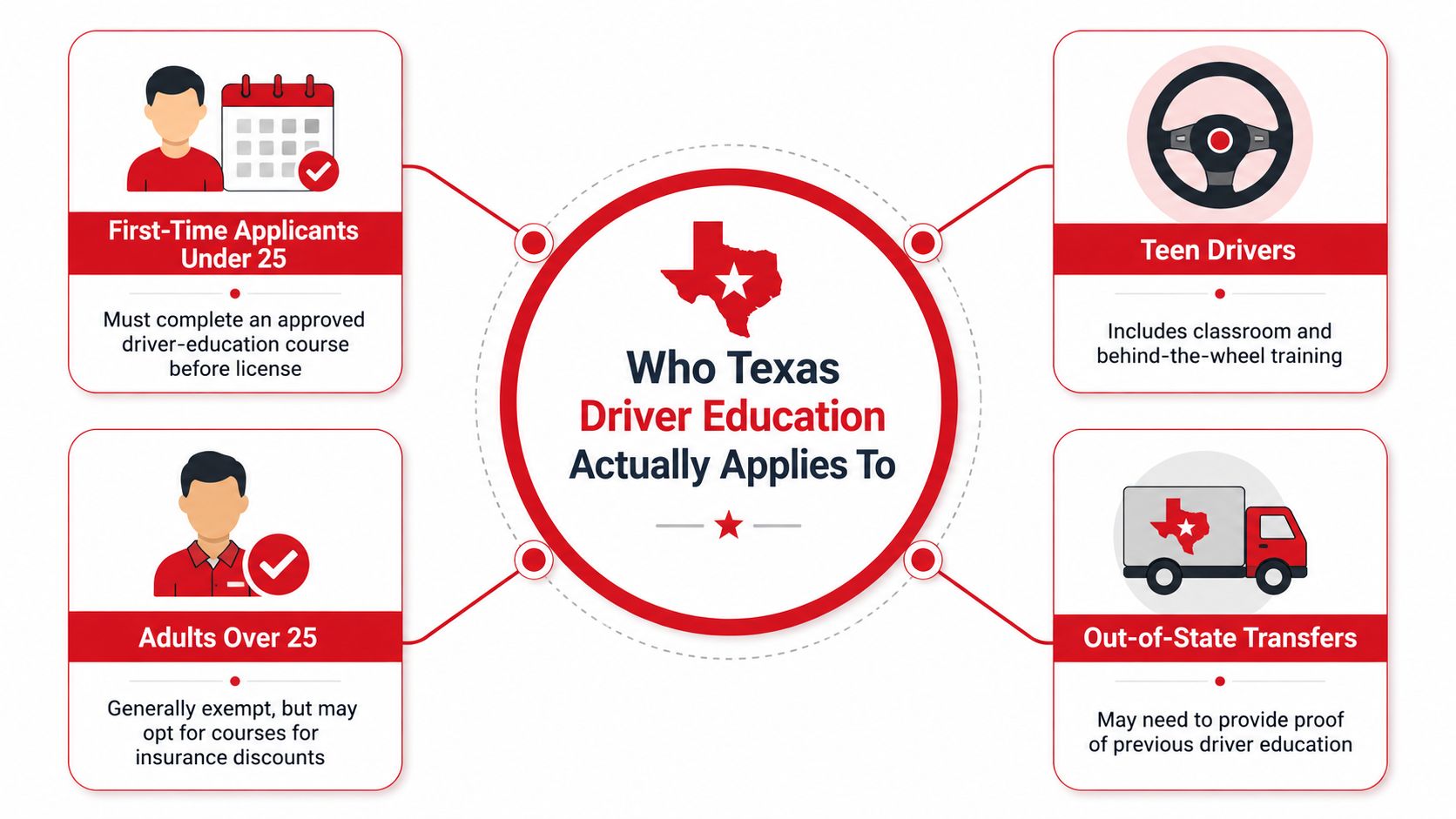
Texas DPS requires first-time driver-license applicants under 25 to complete a driver-education course before getting a license. That group includes teens, college-age newcomers, and adults in their late teens and early 20s who are applying for a Texas license for the first time. If you are comparing course formats, a Texas driver education overview for Houston families can help you see how the path changes based on age and scheduling needs.
Teens and younger first-time applicants
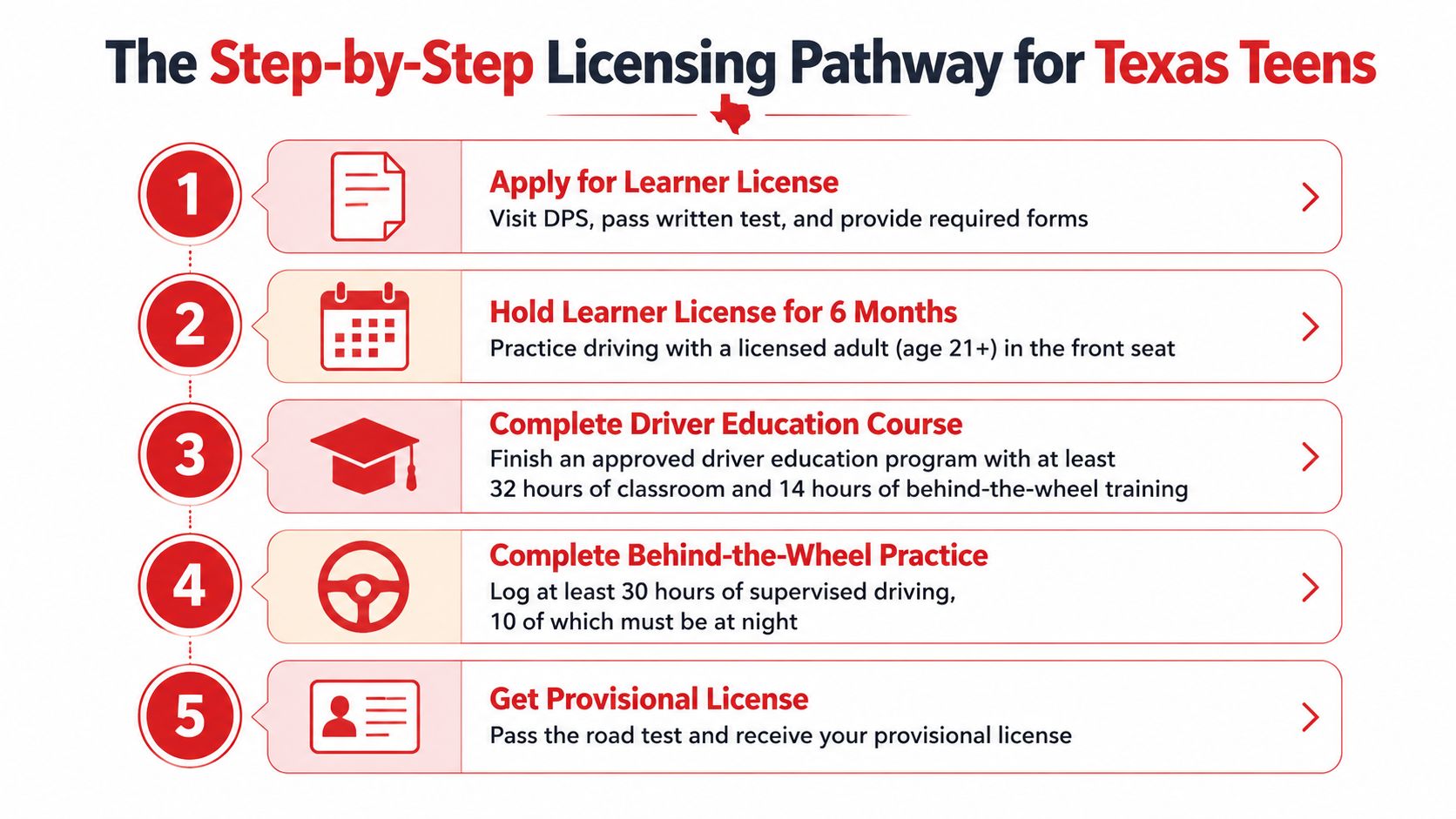
Teen drivers follow the most structured track. Texas materials show 32 classroom hours, 7 hours of in-car observation, and 7 hours of behind-the-wheel instruction, followed by 30 additional hours of supervised driving with a licensed adult, including 10 hours at night (TDLR checklist). That is a lot of moving parts, so the paperwork has to stay in order the same way the driving practice does.
A teen can apply for a learner permit at 15 after completing the first module. That is why families need to match the course schedule with the permit timeline. If the class starts too late, the learner may be ready to drive in theory but still waiting on the right completion record.
Adults and older applicants
Adults ages 18 to 24 have a shorter classroom requirement. Texas guidance says they must complete a 6-hour adult driver-education course before applying for a first Texas license (Texas adult driver education requirements). The class is shorter, but the sequence still matters. Adults need the right certificate before they move to the knowledge test and the rest of the DPS process.
Applicants 25 and older are generally exempt from the formal education requirement, but they still have to pass the knowledge and road tests and complete the licensing steps at DPS. That is why some adults think they can skip the schooling entirely and then get slowed down by the rest of the process. The handbook alone is not enough if the applicant still needs to show test readiness and complete the office requirements.
Out-of-state newcomers and people with an expired license often run into the same confusion. Their path may not match the teen route, and the documents can change depending on the situation. A learner who asks, “Do I need a class?” is usually asking the wrong first question. The better question is, “Which age band and licensing situation am I in, and what certificate does that require?”
Comparing the Main Course Delivery Options
Texas learners usually compare four classroom paths: in-person at a licensed driving school, fully online with a TDLR-approved provider, PTDE, or a public-school or education-service-center program. The right choice depends less on brand names and more on pacing, family structure, and how much help the student needs staying organized.
What each path feels like in real life
| Delivery Path | Classroom Hours | Behind-the-Wheel | Best Fit For | Key Certificate |
|---|---|---|---|---|
| In-person driving school | Required by the approved program | Usually paired with school or separate lessons | Teens who learn well in a structured room | DE-964E |
| Online driver education | Required by the approved program | Often paired with separate driving lessons | Busy families and self-paced learners | DE-964E |
| Parent-Taught Driver Education | Required by the official PTDE curriculum | Parent supervises practice, but a licensed school may still be needed for some driving services | Homeschool families and hands-on parents | DE-964 |
| Public school, education service center, college, or university | Required by the campus or program | Program-specific | Students already in a school-based system | Program certificate or equivalent completion record |
The main difference is not just convenience. It's who controls the process. PTDE gives parents more direct involvement, while school-based options tend to provide clearer structure and outside accountability. Online course formats work well for students who need flexibility, and a school-based path helps families who want someone else to keep the calendar, paperwork, and sequence organized.
If you're comparing formats, look at more than the classroom price. Ask what happens after the lessons, how the behind-the-wheel piece is handled, and which certificate you'll leave with. For a local example of how online classroom instruction is presented, see online driver education in Houston.
Practical rule: the cheapest classroom option is not always the cheapest license path. The hidden cost is usually the driving hours you still have to arrange later.
The Step-by-Step Licensing Pathway for Texas Teens
A Texas teen driver license works like a ladder. Each rung has to be in the right place before the next one makes sense. Families often focus on the permit stage, but the smoother path starts with the paperwork, then the practice hours, then the test dates. If one piece is out of order, the rest of the process can stall.
Step one starts before the permit
A teen can apply for a learner permit at 15 after completing the first module of driver education. That early step matters because it opens the door to supervised driving while the rest of the classwork is still underway. The permit is the start of practice, not the end of the training plan.
Step two is finishing the full instruction stack
The teen still has to complete the rest of the 32 classroom hours, 7 hours of in-car observation, and 7 hours of behind-the-wheel instruction, along with the extra 30 supervised hours, including 10 hours at night. Keeping a paper log and a phone photo backup helps protect those hours if a record gets lost or filled out incorrectly. Families that wait until the last minute to reconstruct the log usually end up chasing signatures and trying to remember when each drive happened.
Step three is timing the road-test paperwork
The Impact Texas Teen Drivers program has to be completed before the road test, and the certificate needs to be current when the teen tests. That timing trips up a lot of families, because the driving practice may be finished while the paperwork clock is already running. A clear calendar matters here more than enthusiasm does.
For help with the next form-and-appointment step, this guide to how to schedule a road test walks through the process in a practical way.
If the hours, permit timing, and certificate dates line up, the road test becomes the last checkpoint instead of a scramble. A teen who feels ready still needs the documents to match the file at DPS or with the testing provider. That is why families do better when they treat the whole sequence as one connected path, not three separate errands.
There's also a helpful video walkthrough for families who learn better by seeing the process in motion.
Costs, Payment Plans, and Scholarship Options
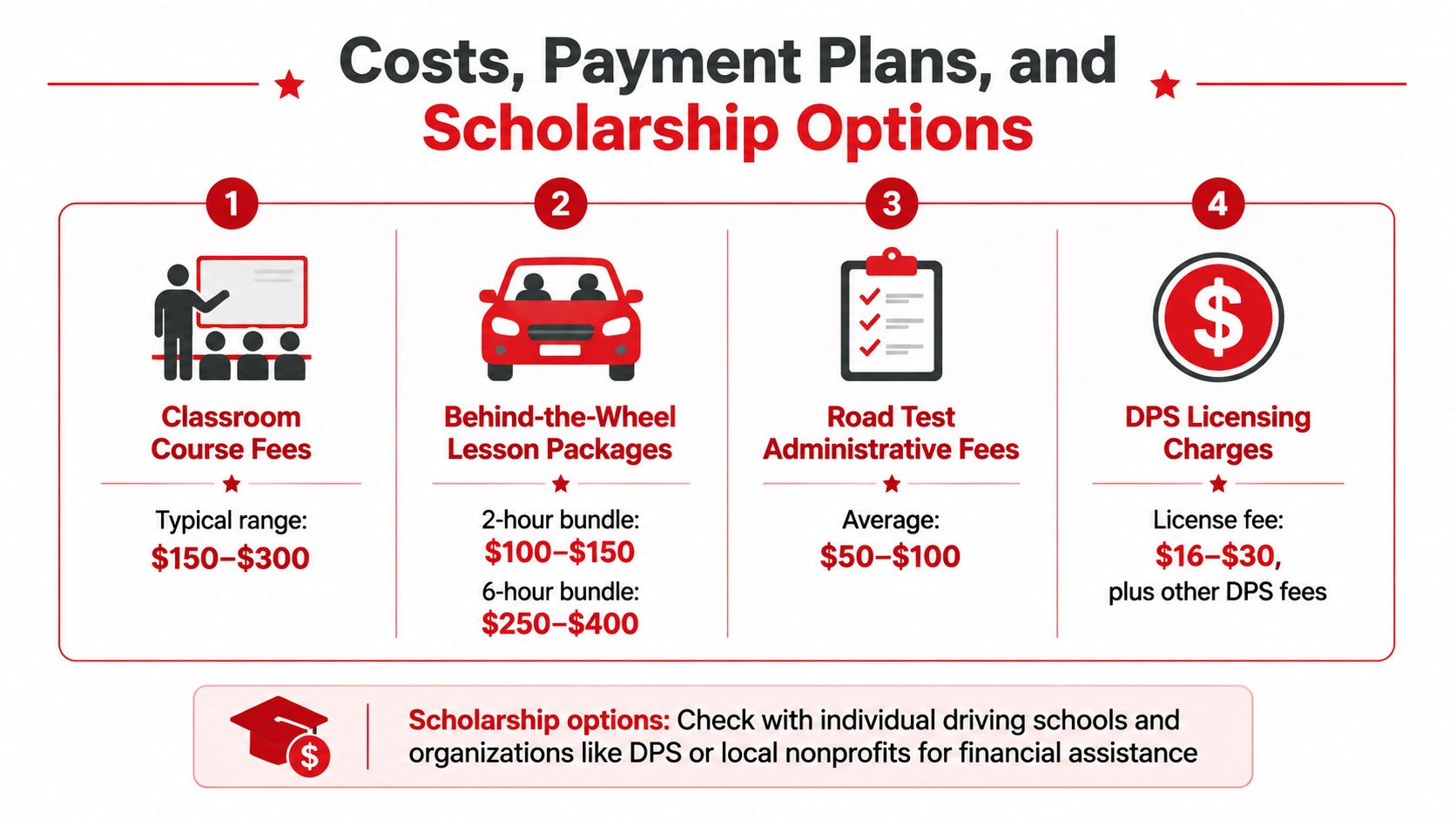
The price of driving school texas usually reaches beyond the first classroom quote. Families often see one number on the sales page, then learn that behind-the-wheel lessons, road-test administration, and DPS charges sit in separate buckets. A clear budget helps you see the full path before the first payment goes out.
What the budget usually includes
A useful budget separates classroom instruction from driving time. Behind-the-wheel lessons are often sold in blocks, and Texas teen training includes both classroom and in-car instruction. Some schools also charge for road-test administration or other test support, while DPS adds its own licensing fees.
The lowest sticker price does not always mean the best value. A low classroom-only package can leave a family paying more later for lessons that were never included. The better question is simple, whether the school covers the parts Texas requires, or whether you will need to piece the missing steps together yourself.
Budget rule: compare the full path, not just the enrollment fee. If a school cannot explain what is included, the final total will probably surprise you.
Payment help can change the decision
Texas families should also ask about the Texas Driver Education Scholarship Grant Program if cost is the main barrier. Some schools offer payment plans, sibling discounts, or seasonal promotions, and those options can make it possible to start on time instead of postponing training. The point is to avoid cutting corners on hours just because the first quote looks too high.
The safety side also matters. The Texas Department of Public Safety's FY23 Collision Rate Summary reports 184,579 student collisions, 9,089 collisions, and an overall 4.92% collision rate, with different outcomes by training path, including 5.27% for commercial driving schools and 4.76% for PTDE (DPS collision summary). Those figures belong in the cost conversation because they show why proper training hours are not optional extras.
Families also learn a lot from reputation signals before they spend a dollar. The online reviews tag is a useful reminder to look for specific comments about scheduling, paperwork, and whether the school delivered the hours it promised.
How to Evaluate and Verify a Texas Driving School
A polished website doesn't prove a school is ready to teach your teen. The test is whether the school can show its licensing, explain its hours clearly, and document what happens if a class is missed or a certificate needs replacing. Texas families should verify those things before enrolling, not after the first problem.
What to check before you pay
Start with the TDLR license number. A legitimate school should be able to provide it, and it should match what you can verify through the Texas Department of Licensing and Regulation. Then ask about instructor credentials, vehicle condition, and whether the training cars are properly equipped and insured.
You should also ask what certificate the student receives and which hours are included in the fee. If the school is vague about class time, driving time, makeup work, or refund terms, that's a warning sign. A written contract should make those points obvious.
For a practical lens on how people judge providers online, the online reviews tag from Digital Skyrocket is a helpful resource for thinking through reputation signals without relying on star counts alone. Reviews matter most when they mention specific experiences, like clear scheduling, organized paperwork, and whether the school delivered the hours it promised.
Red flags worth taking seriously
- License number missing: If a school hesitates to share its TDLR number, move on.
- Personal vehicle pickup: Instructors should not be arriving in unvetted private cars for formal training.
- Undefined hour counts: “We'll figure out the hours later” usually becomes your problem later.
- Pushy upsells: If the school keeps steering a teen toward add-ons that don't match the licensing path, ask why.
Practical rule: if the front office can't answer a simple question about hours, paperwork, and the certificate, don't assume the back end is organized.
Common Roadblocks That Delay Texas Licensure
The hardest delays usually have nothing to do with forgetting a road sign. They come from paperwork gaps, timing mistakes, and records that don't line up when the family shows up for the next step. That's why the safest plan is to manage the process like a checklist, not a memory test.
The problems that cause the most friction
An expired or missing DE-964 certificate can stop the process cold. So can a supervised-hour log that doesn't add up, a permit that hasn't been held long enough, or a current Impact Texas Teen Drivers certificate that was completed too early or too late. The road test can also get delayed if the vehicle isn't ready for inspection or the required paperwork is incomplete.
Families often over-focus on practice-test trivia because it feels familiar and easy to measure. The bottleneck is usually the administrative chain. If the forms are wrong, the most confident driver in the room still can't move forward.
Simple fixes that prevent last-minute panic
- Keep duplicates of everything: Store a paper copy and a digital photo of the permit, completion certificates, and hour logs.
- Use one tracking system: A spreadsheet, notebook, or app is enough if it's updated the same day.
- Time the road test carefully: Schedule it when the permit-holding requirement is satisfied, not when the calendar feels convenient.
- Inspect the car the night before: Check lights, mirrors, registration, and anything else the road-test office expects.
A separate but similar lesson shows up outside driving. Businesses that rely on one phone system can lose customers when the setup is messy, and a resource like best VoIP providers in Dallas is useful for seeing how people compare operational reliability before choosing a service. The same mindset helps with driving school, because reliability is often what gets a learner across the finish line.
Choosing Your Next Step With Confidence
The best decision framework is simple. First, identify the learner, teen, adult beginner, or parent-taught student. Then match that person to the correct course stack, the right certificate, and the right timing for permit and road-test steps. If those pieces line up, the licensing process feels orderly instead of chaotic.
Every path shares a few checkpoints. The student needs an approved course, valid documentation, and the right test-day paperwork. Teens also need supervised practice and current teen-driver completion steps, while adults need to make sure they're following the proper first-license process for their age bracket.
The strongest choice is usually the one that is easiest to verify. A school that explains the full hour stack, gives you a clear contract, and tells you exactly what certificate you'll receive is a better bet than the cheapest option on the page. That's true whether the student is a 15-year-old starting a permit path or an adult trying to finish a license without wasted trips to DPS.
For Georgia readers who need driver education, road testing, or driving lessons, A-1 Driving School offers Joshua's Law driver's education, online course options, road testing, and driving lesson packages through A-1 Driving School. Texas families can use the same decision model here, verify the provider, compare a few schools side by side, and enroll in the path that fits the student's age, schedule, and paperwork needs.
If you want a clear next move, start by comparing two or three Texas schools, verifying each one's TDLR status, and asking exactly what hours and certificates are included. Then choose the path that matches your learner's age and life situation, and keep every document together from day one.