
You're sitting in the passenger seat while your teen adjusts the mirrors for the third time, the appointment code is tucked in a parent's inbox, and everybody in the car is quiet because the road test feels bigger than it should. That's exactly how it feels in Georgia when a license is one drive away and one mistake away at the same time. The good news is that the road test pass rate is not mystery math, it's a practical clue about what examiners are really seeing, and it can help you prepare with a lot more calm and a lot less guesswork.
A lot of families think the test is mostly about nerves. Nerves matter, but the numbers show that outcomes are shaped by location, route difficulty, and preparation quality just as much as raw confidence. Once you understand what the pass rate means, how it looks in major licensing systems, and how Georgia's testing setup works, the next steps get much clearer.
The Night Before the Road Test
The night before a road test, most Georgia parents are doing the same dance. The teen is half excited, half convinced they'll forget how to park, and the parent is checking that the car is clean, insured, and ready to go. That little knot in the stomach is normal, because the test is not just a formality, it's the last gate between practice and a license.
A smart family treats that evening like a final systems check. Mirrors, seat position, permit, paperwork, and the route to the testing site all deserve a look before morning. If you want one quick pre-test reference, the vehicle inspection checklist from A-1 Driving School is a useful starting point because it keeps the focus on the parts of the car that can ruin an otherwise solid attempt.
The anxiety makes sense because the road test pass rate tells you something uncomfortable and useful at the same time. Even when a teen has practiced for months, the actual test is still a scored event with a pass or fail outcome, and that outcome depends on how well they perform under test conditions, not just how well they drive on an ordinary afternoon. Families who understand that difference tend to prepare more deliberately and panic less.
Practical rule: The night before, don't try to learn anything new. Use the evening to remove avoidable mistakes, not to cram for a driving exam.
What the Road Test Pass Rate Really Means
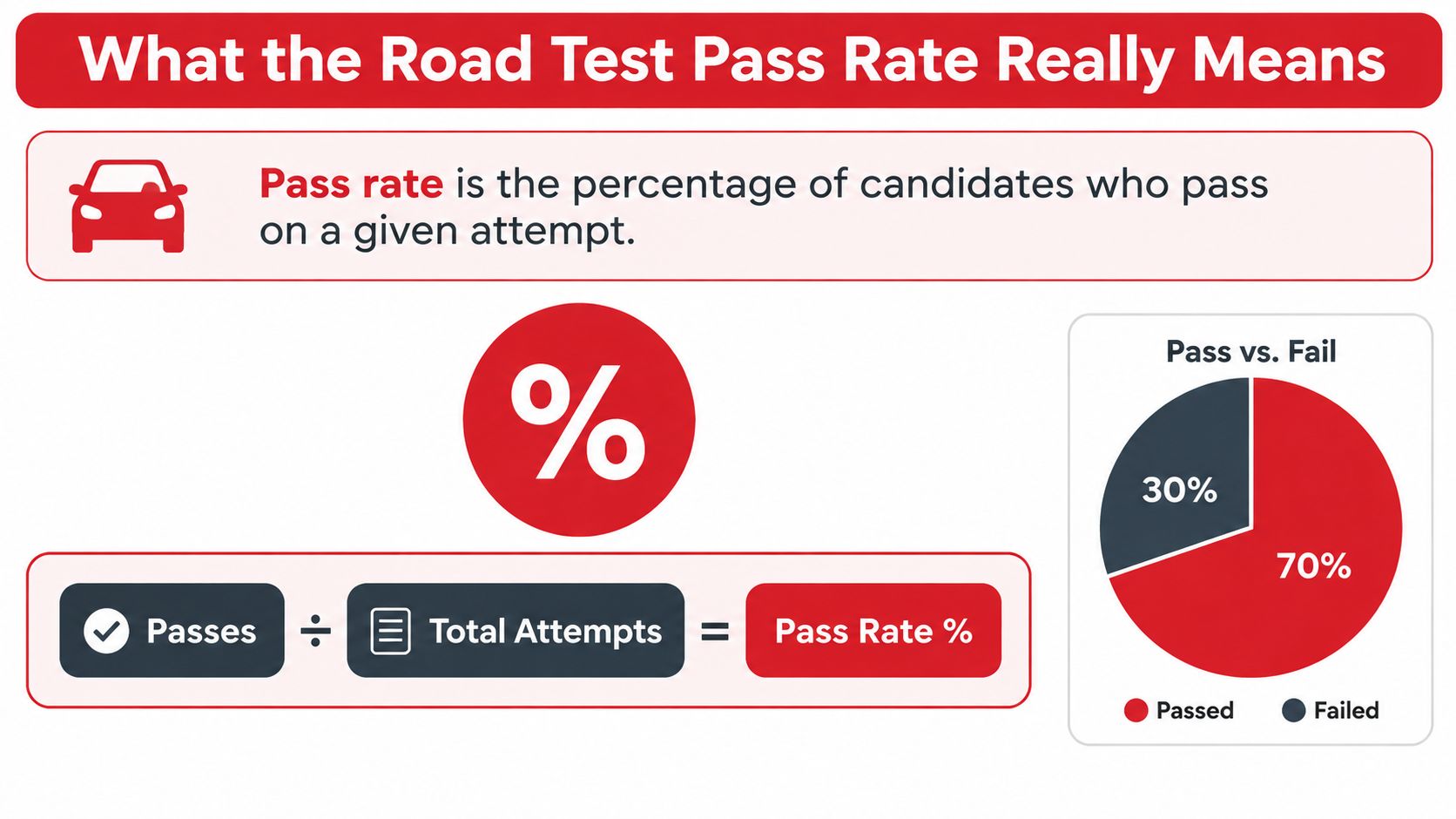
The road test pass rate is the share of candidates who pass a driving test on a given attempt. The calculation is simple, passes divided by total attempts, then multiplied by 100 to turn it into a percentage. If a testing centre runs 1,000 tests and 480 people get licensed, the pass rate for that period is 48%.
Why first attempts and overall outcomes can differ
A first-attempt pass rate only counts people on their first try, while an overall pass rate includes everyone who tested during the period. Those numbers can move differently because some candidates return after extra practice, while others pass right away. That is why a pass rate is best read as a snapshot of testing outcomes, not a fixed measure of who is a “good driver.”
The number also reacts to the way a system operates. Test format, examiner expectations, local congestion, scheduling pressure, and how prepared applicants are can all change the result. In other words, the pass rate measures what happened on test day, not some permanent judgment about a person's driving potential.
A pass rate near 50% usually means the test is demanding enough that preparation really matters, but not so unpredictable that skill stops counting.
What the number can and cannot tell you
A pass rate can help families set expectations, but it can't tell you everything. It does not show how hard the route was, how much practice a candidate had, or whether the test centre handles mostly urban or rural applicants. That's why a single headline number can be misleading if you don't ask where it came from.
The same logic helps explain why one state, one county, or one test centre can feel very different from another. A high pass rate may reflect easier conditions or a more prepared applicant pool. A lower one may reflect route complexity, traffic, or testing standards that force tighter execution.
How Pass Rates Compare Around the World
Road test pass rates often cluster closer to the middle than families expect. Great Britain's practical car test pass rate has moved only from 44.2% in 2007/08 to 50.0% in 2025/26, a gain of 5.8 percentage points over 18 years, and the long-run dataset referenced in the report includes 26,645,572 tests, showing this is a large, steady testing system rather than a small sample. The same history includes a pandemic-era peak of 49.8% in 2020/21 and 48.7% in 2024/25, which tells you the benchmark has stayed close to a one-in-two outcome for years. Great Britain pass-rate history
Benchmark table
| Region | Period | Pass Rate | Notable Spread |
|---|---|---|---|
| Great Britain | 2025/26 | 50.0% | Stable near one in two |
| Great Britain | 2024/25 | 48.65% | Close to even odds at national scale |
| California | 2016–2025 | 67.7% | Still about one in three failing |
| California | 2025 | 66.83% | Higher than many other systems |
| Ireland | 2022 | 53.2% | Just over half passed |
| New York City | 2024 | 48% fail rate | Dense city routes pushed failure higher |
| Ontario, Brampton | 2022 | 57% pass rate | Lower than several suburban centres |
| Ontario, Owen Sound | 2022 | 89% pass rate | Wide centre-to-centre spread |
California sits higher, with a DMV road-test pass rate of 67.7% across 10,164,062 tests from 2016–2025, and a 2025 pass rate of 66.83%, so the system still leaves about one-third of candidates needing a retest. California DMV pass-rate data Ireland's official statistics show an overall average pass rate of 53.2% in 2022, and later analysis places the national average around 53%, with a spread from Kilkenny at 68.4% to Charlestown in North Dublin at 36.8%. Ireland driving test statistics Irish centre comparison
Why location changes the story
Ontario makes the biggest point of all. In 2022, pass rates ranged from 57% in Brampton to 89% in Owen Sound, and urban centres like Toronto Downsview, Etobicoke, Brampton, and Mississauga were lower than rural or suburban centres like Peterborough, Lindsay, and Simcoe. Ontario auditor report
That spread matters for Georgia families because it proves a simple idea, the road test pass rate is not just about the driver. It's also about the testing environment, the type of roads used, and the mix of applicants showing up at each centre. If a system can swing that much between locations, then a local prep strategy matters more than a generic national average.
Georgia and Fulton County Testing Realities
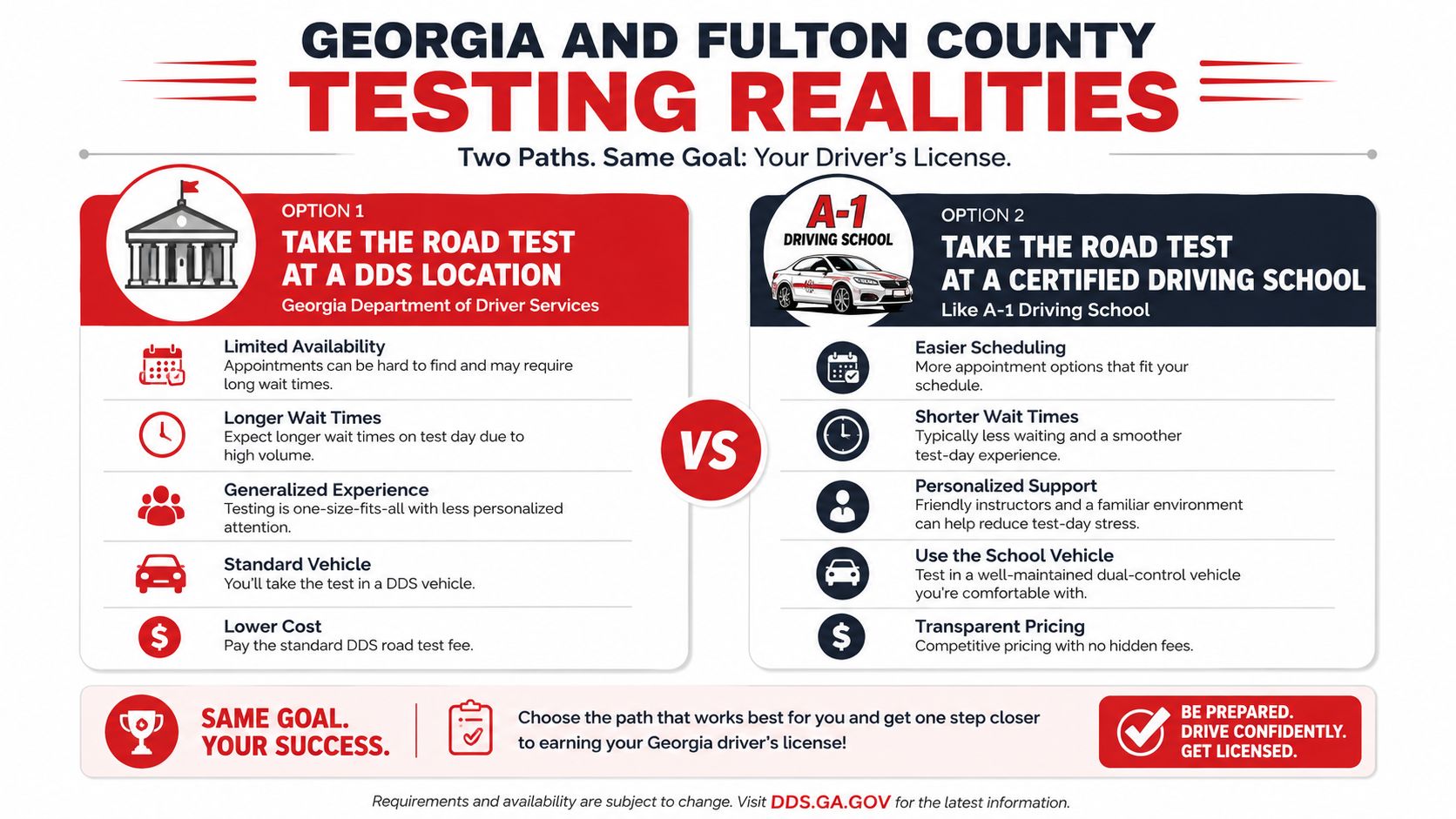
Georgia drivers usually care less about national averages and more about one thing, where they'll take the test. In our state, applicants may test at a DDS location or, where eligible, at a certified driving school, and that second path is why local route familiarity can matter so much. A-1 Driving School is the only provider holding the Fulton County Board of Education contract, and it administers Driver's Education across Fulton County Schools and many Atlanta high schools.
What makes local testing feel harder or easier
Traffic density around the site changes how relaxed a teenager can be while still staying precise. Examiner route choice matters too, because some routes have heavier merging, more lane changes, tighter turns, or more stop-and-go conditions. On top of that, Georgia applicants who have completed Joshua's Law classroom time and behind-the-wheel hours usually arrive with better habits, which helps the examiner see controlled, repeatable driving instead of guesswork.
Georgia does not publish a single statewide road test pass rate the way the UK DVSA does, so it's better to use the national benchmarks as a reference point rather than a prediction. The question is not “What is Georgia's average?” but “How prepared is this teen for the exact route and scoring style they'll face?” That is why local practice beats abstract confidence every time.
DDS versus school-administered tests
The DDS path and the school-administered path can both lead to the same outcome, but the experience can feel different. At a DDS site, the candidate needs to adapt quickly to the centre's route and traffic patterns. At a certified school, students can often train in the same environment where they'll be evaluated, which reduces surprises and gives instructors a better chance to correct recurring errors before test day.
The main lesson for Fulton County families is simple, local familiarity is an advantage, but only if it's built through real practice. A teen who has driven the routes, learned the pace, and already handled the pressure of an instructor in the passenger seat is usually in a much better position than a teen who has only logged casual neighborhood driving.
Why Most Georgia Road Test Candidates Fail
The most common failures are usually not dramatic. They're small errors that add up because the examiner is watching for consistency, not just moments of good driving. A teenager can drive smoothly for ten minutes and still lose points on one or two habits that show they aren't fully in control yet.
The errors examiners notice first
- Rolling stops at stop signs: The car slows down, but it never reaches a clear full stop. Examiners watch for a complete stop before the line, then a pause and a proper scan.
- Weak mirror and blind spot checks: A lane change without a clear glance back is a classic scoring mistake. The examiner wants to see the check happen before the move, not after.
- Jerky turns: A candidate who brakes too late, turns too fast, or corrects the wheel mid-turn looks uncertain. Smooth steering shows planning.
- Speed that doesn't match the road: Some teens drive too slowly because they're nervous, while others rush because they want the test over with. Either one can create a scoring problem if it doesn't fit conditions.
- Parking mistakes: Parallel parking and backing accuracy expose whether the driver can control the car in tight spaces without panicking.
How those mistakes show up in real cities
New York City is a useful reminder that dense routes raise failure risk even in a major U.S. licensing system. Local reporting cited DMV data showing a 48% fail rate in 2024, compared with 43% statewide, and Brooklyn and Queens were around 56% and 57% failing, respectively. New York City road test fail rates
That doesn't mean big-city applicants are worse drivers. It means the route forces more decisions in less time, and the examiner can see hesitation very quickly. In Georgia, the same pattern shows up when a teen is prepared for easy neighborhood streets but not for a more demanding test route.
Small mistakes are trainable. The problem isn't personality, it's repetition under pressure.
Your Road Test Prep Checklist
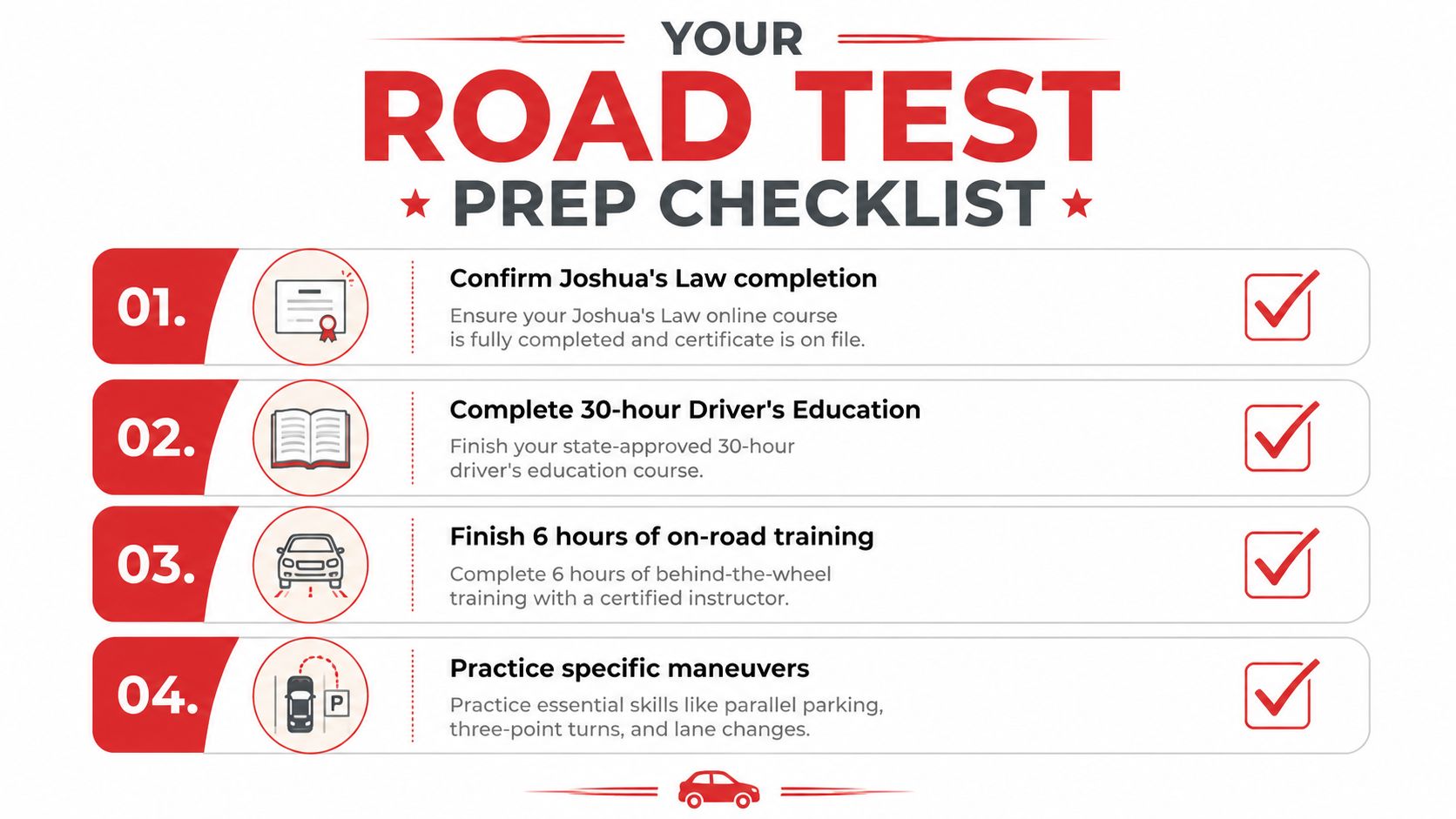
A strong road test result starts weeks before the appointment. The first check is Joshua's Law, which in Georgia means 30-hour Driver's Education plus 6 hours of behind-the-wheel training, followed by the permit holding period and supervised practice. The practical target is to build enough repetition that the test feels like familiar driving with a stranger in the car, not a surprise event.
Use this sequence before you book
- Confirm Joshua's Law completion. Make sure the classroom and behind-the-wheel requirements are finished and documented.
- Hold the learner's permit long enough. Georgia requires the permit for 12 months and 1 day before the road test.
- Log supervised practice. The common benchmark is 40+ supervised hours, including 6 at night, so the teen has seen different road conditions.
- Schedule a mock road test. Practice the actual scoring habits before the appointment.
- Rehearse the scored maneuvers. Parallel parking, backing, lane changes, stopping, and turning should all be second nature.
If you want a structured place to compare prep options, Tutorbase's test prep solution is worth looking at because it frames readiness as a set of repeatable steps rather than a single nervous appointment.
What to bring and how to think on test day
Arrive early, bring a registered and insured vehicle, and know how to get to the site without last-minute stress. If the teen makes a small mistake, don't let it unravel the rest of the drive, because the next clean decision still matters. The best test day mindset is controlled and repair-focused, not perfect.
For a Georgia-specific walkthrough, the driving test preparation guide from A-1 Driving School is a good companion to this checklist because it keeps the practical steps in one place.
How A-1 Driving School Targets Each Failure Point
A lower road test pass rate usually comes from a few repeat problems, and the fix starts with the exact skill that is slipping. A-1 Driving School offers Joshua's Law Driver's Education online and in person across 18+ metro Atlanta locations, plus behind-the-wheel driving lessons that can be booked as single sessions or package bundles. Those lesson packages matter because they let a teen spend more time on one weak area instead of repeating every part of the drive at the same pace.
Match the lesson to the weakness
A student who keeps rolling through stop signs usually needs lane discipline, mirror checks, and full-stop repetition, not just more neighborhood driving. A teen who freezes in reverse benefits from focused parking practice, especially if parallel parking is the trigger. Someone who knows the rules but falls apart under pressure often needs full mock road tests that mirror the DDS scoring style, because the test itself is part of the skill.
A-1 also works within the Georgia Driver's Education Scholarship Grant Program for qualifying students, which matters for families trying to manage cost while still getting real instruction. The school's long-running Fulton County contract also gives it a practical role in local driver training, especially for parents who want an established path from classroom to road test.
Use the right page for the right stage
If your teen is still in the classroom stage, start with Joshua's Law course options. If more time behind the wheel is the issue, look at the driving lessons and package options, because repetition is what starts to change the result. If the problem is one specific maneuver, the parallel parking step-by-step guide can help sharpen that weak point before the test.
A-1's site also gives parents one place to review road test booking flow and course details, which cuts down the back-and-forth that often slows families down. The goal is not to buy more instruction than needed, it is to match the instruction to the exact failure point.
Key Takeaways Before You Book Your Test
The road test pass rate is a real benchmark, and in major systems it often sits near 50%, which means preparation matters more than wishful thinking. For Georgia families, the smartest moves are finishing Joshua's Law, logging supervised practice, and choosing a testing setup that fits the teen's needs. If your student still needs classroom work, go to the Joshua's Law online or in-person course, if they need more seat time, focus on driving lessons and packages, and if they're ready to test, book with a site that matches their training.
If you want a practical next step, use the course that fits your teen's stage and build from there. A clear plan beats a nervous guess every time.
A-1 Driving School helps Georgia families turn road test preparation into a step-by-step plan, from Joshua's Law courses to behind-the-wheel lessons and road test support. If your teen needs more practice, more confidence, or a better grasp of the test route, visit A-1 Driving School and choose the training path that fits where you are right now.