
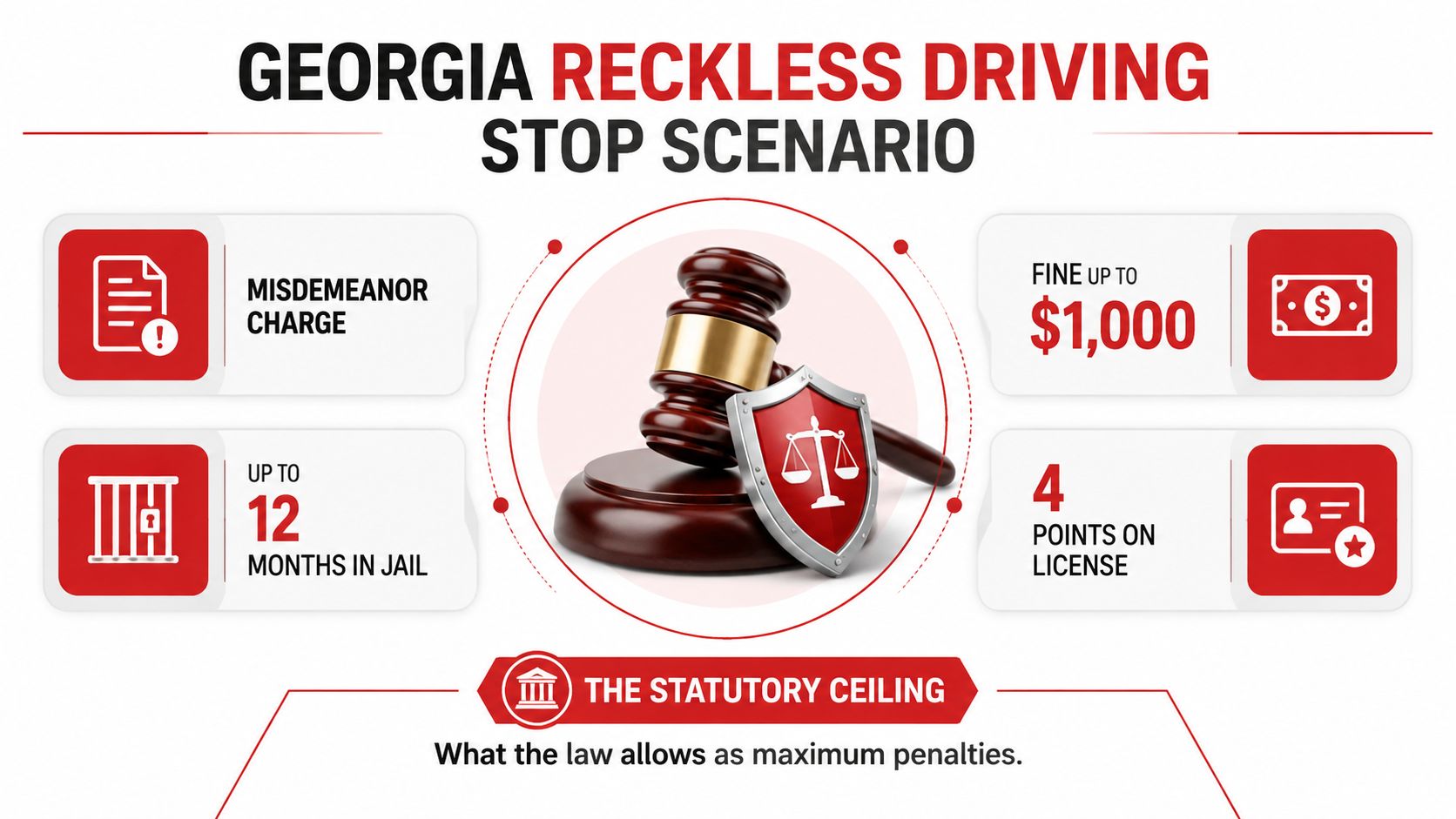
Georgia classifies reckless driving as a misdemeanor with a ceiling of up to 12 months in jail and a fine of up to $1,000. That means the stop you thought was “just a ticket” can turn into a criminal case with real driving and life consequences.
You're on the roadside, the trooper or officer has your license and insurance, and the word reckless driving has already been used. That moment feels sudden, but the legal fallout starts right there, not weeks later in court. If you know what happens next, you can make smarter choices fast, especially in the first few days after the stop.
What a Georgia Driver Faces After a Reckless Driving Stop
A Georgia driver usually does not leave a reckless driving stop thinking it was a routine citation. The charge signals that the state is treating the conduct as a criminal matter, which is why it feels so different from an ordinary speeding ticket. Georgia's reckless driving statute allows the court to treat the case as a misdemeanor with up to 12 months in jail and a fine of up to $1,000. Georgia reckless driving statute
What usually happens at the stop
The officer writes down the facts that led to the charge, speed, lane changes, weather, traffic, braking, and anything else that made the driving look unsafe. That report matters because judges and prosecutors later rely on it when deciding whether the conduct was a mistake, a bad judgment call, or something more serious. It helps to understand the roadside process early, so a parent or teen knows what to do before confusion turns into a bigger problem. The clearest first step is to follow the kind of guidance covered in this what to do when pulled over by a police officer resource.
The hours after the stop can feel more stressful than the stop itself. A driver may get a court date, a bond condition, or notice that a license issue is coming. Save every paper, write down what happened while it is still fresh, and treat the next few days like the start of a legal process, not a pause.
The court consequences can also reach beyond Georgia. A Minnesota reckless driving law overview shows that other states use similar ideas, but Georgia still stands out because the charge is criminal, not merely administrative. That is the part many families miss until the citation is already in hand.
How Georgia Defines Reckless Driving
Georgia's legal definition centers on driving with disregard for the safety of persons or property. In plain English, that means the state isn't punishing a driver for being imperfect, it's punishing conduct that looks unsafe enough that another person or property could be put at risk. The key question is not only “Was the car going fast?” but “Did the whole situation show disregard for safety?”
Behaviors that can trigger the charge
Officers often look at the pattern, not just one move. A car weaving through traffic, making aggressive lane changes, racing another vehicle, or driving too fast for rain or heavy traffic can all push an officer toward a reckless driving charge instead of a simpler speeding citation. A driver doing 90 in a 65 mph zone in the rain may face a very different outcome than the same speed on a clear road with light traffic because the context changes the safety risk.
That's why students and parents sometimes get confused. The line between speeding and reckless driving isn't only about miles per hour, it's about the total behavior. If the driving looks intentional, aggressive, or indifferent to danger, the charge can rise fast.
The legal difference matters because reckless driving is treated as a misdemeanor in Georgia, not a normal traffic ticket. That means the case can carry a criminal record, court appearances, and license consequences that keep going long after the stop itself.
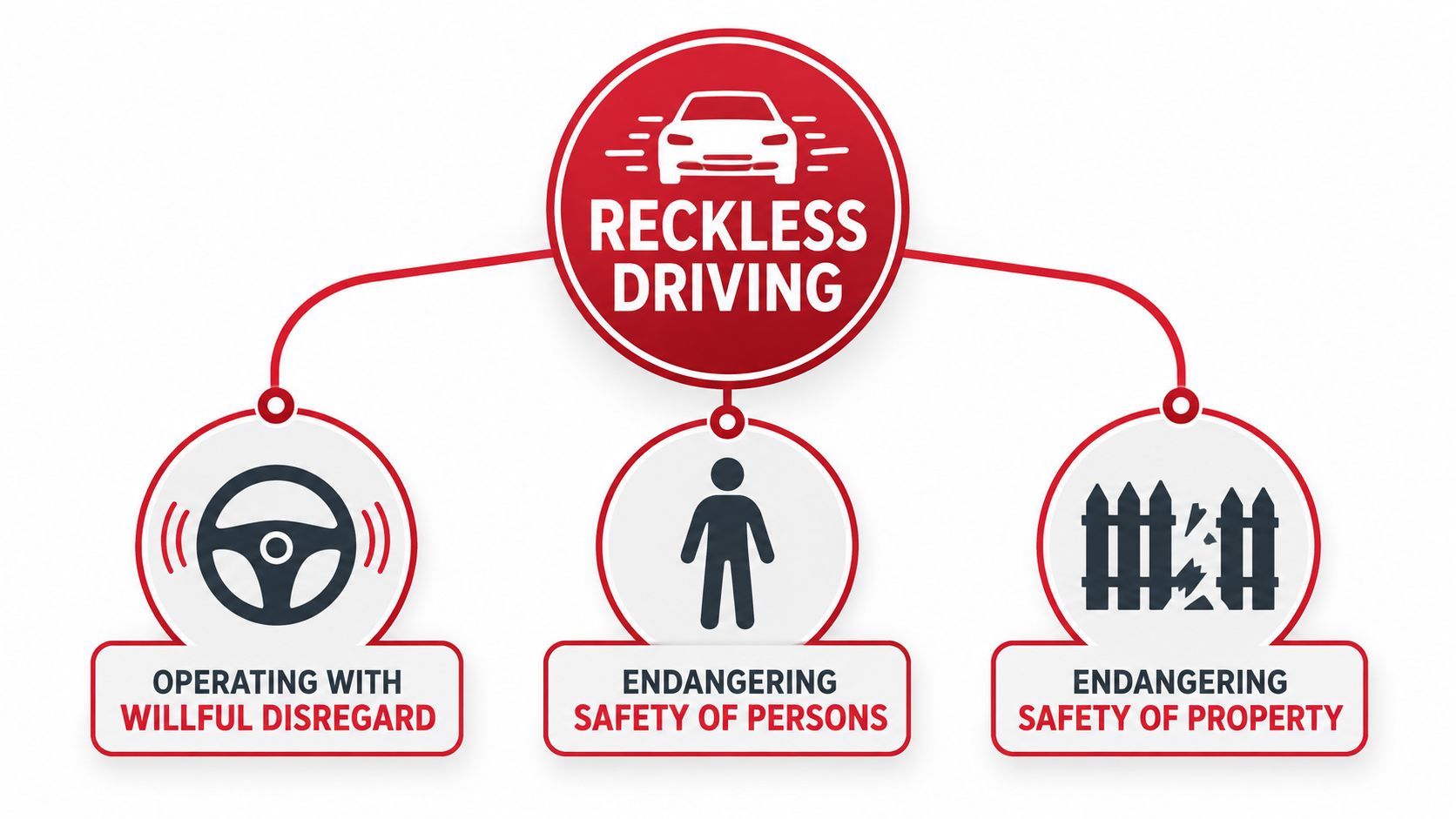
Plain truth: if your driving makes a police report read like a safety story, not just a speed story, you're moving into reckless driving territory.
Fines, Jail Time, and License Penalties in Georgia
A reckless driving stop can turn into more than a court date. In Georgia, the consequences can show up in the criminal case, on the driving record, and in the licensing system that decides whether a teen can keep getting to school or a parent can keep getting to work. The fine gets the attention first, but the license effect is often what changes a family's routine the fastest.
The three layers to keep straight
The first layer is the criminal sentence. Georgia law allows up to 12 months in jail and a fine of up to $1,000 for reckless driving. Judges may still use probation or other non-jail outcomes when the facts support that result, but the legal ceiling is still real and should not be treated like a routine ticket. Georgia reckless driving statute
The second layer is the driving record. Reckless driving can add points and create problems that follow the driver long after the stop. That matters because points work like warning lights on the dashboard, once enough of them collect, the state starts paying closer attention. For a plain-English explanation of how that system works, this drivers license points overview is a helpful reference.
The third layer is administrative action. State licensing authorities may review the case too, so the driver can end up answering to more than one process at the same time. A single conviction can affect money, commuting, school pickup, and the ability to get to a job.
| Georgia Reckless Driving Penalty Layers at a Glance | Maximum or Typical Outcome | Where It Hits You |
|---|---|---|
| Criminal court sentence | Up to 12 months in jail and up to $1,000 fine | Wallet and court record |
| Driving record effect | License points and record damage | Future driving status |
| Administrative fallout | Possible license action depending on the case | Ability to legally drive |
A driver who focuses only on the fine may miss the larger problem. The dollar amount is only one piece. The bigger issue can be losing the freedom to drive at the exact time a teen or parent depends on that privilege most.
When Penalties Get Tougher
Reckless driving penalties get harsher when the facts show more danger, more harm, or more history. The same label can cover very different conduct, so the sentence often depends on what happened before, during, and after the stop. That's why two people with the same charge may walk away with very different outcomes.
What raises the stakes
A prior offense can push the court toward a stricter response. Injury, property damage, work-zone conduct, or driving on a suspended license can also change the seriousness of the case. In Florida, for example, the statute moves from 90 days and $500 on a first conviction to 6 months and $1,000 on a second, and conduct causing property damage or injury can become a first-degree misdemeanor, while serious bodily injury can rise to a third-degree felony with up to 5 years in prison and a $5,000 fine. Florida reckless driving statute
Virginia also shows how a reckless driving case can become much more serious. There, reckless driving is generally a Class 1 misdemeanor, but if a person was driving on a suspended or revoked license for a moving violation and caused another person's death as the sole and proximate result of the reckless driving, the offense can become a Class 6 felony. The statute also imposes a mandatory minimum fine of $250 for a specific work-zone violation. Virginia reckless driving statute
A driver who adds injury, repeat conduct, or a work-zone violation is no longer just arguing about a ticket. They're arguing about how far the case should move up the punishment ladder.
The practical lesson is simple. The more the facts show that other people could have been hurt, the less forgiving the system tends to be. That's why the safest response is not hoping the officer “lets it slide,” it's making sure your driving habits never put you on that ladder in the first place.
Insurance and Long-Term Impacts Beyond the Courtroom
A reckless driving conviction often hurts in places the citation never mentions. The court fine is only one expense, and for many families, it's not even the most expensive one. Insurance companies, employers, schools, and licensing systems can all look at the conviction later and make their own decisions.
Why the record matters after the court date
Insurance carriers often treat a reckless driving conviction as a sign that the driver is higher risk. That can affect pricing and coverage decisions, especially when the conviction appears on the driving record. Even when the car is already insured, the company may react to the new record at renewal time rather than immediately.
The non-driving consequences can be just as frustrating for teens and young adults. A misdemeanor can show up on background checks for jobs, college applications, scholarships, and some housing applications. A high school senior who is counting on a clean record for a scholarship interview can feel that pressure fast, because the issue isn't only traffic anymore, it's reputation.
Travel can also get complicated. Some countries, including Canada, can take U.S. driving records seriously when they assess admissibility or background concerns, so a conviction can create extra questions beyond Georgia.
What families should think about
The hidden cost usually comes from disruption. A parent may have to drive a teen to school, work schedules may change, and a student may lose the kind of flexibility that keeps sports, part-time jobs, and after-school activities on track. Once that happens, the original ticket suddenly looks much bigger than the court fine.
If the driver is young, the lesson is straightforward. A clean record protects more than a license, it protects opportunities. That's why the cheapest ticket is the one never written.
How Juveniles and Adults Are Treated Differently
Age changes the courtroom conversation. A 17-year-old and a 35-year-old can do the same thing behind the wheel, but the system may respond differently because the state looks at maturity, rehabilitation, work obligations, and long-term risk. Teens also have to fit their case into Georgia's graduated licensing structure, which shapes what happens next.
Side-by-side realities
For a 17-year-old, the court often pays attention to rehabilitation, school schedules, parental involvement, and whether driver education can correct the behavior. Juvenile matters are more likely to focus on teaching and supervision, although serious conduct can still lead to adult consequences in the right circumstances. A teen's status as a learner's permit or intermediate license holder also means a citation can affect the path toward a full license.
For a 35-year-old, the case usually lands with less patience for inexperience. The court may assume the driver already knows the rules, especially if the person has been on the road for years. That can make fines, license suspension, and work disruption feel heavier because an adult may depend on driving every day for a job, childcare, or commuting.
| Driver Type | Typical Focus | Real-World Pressure |
|---|---|---|
| 17-year-old | Rehabilitation, family involvement, license progression | School, sports, first job, Class D goals |
| 35-year-old | Accountability, safety history, court compliance | Commute, family transport, employment |
Useful distinction: juveniles often get judged on whether they can be corrected, adults on whether they should have already known better.
That difference is why Joshua's Law training matters so much for teens before they ever face court. Good habits built early are easier to keep than habits fixed after a citation.
Steps to Take After a Citation and Where A-1 Driving School Fits
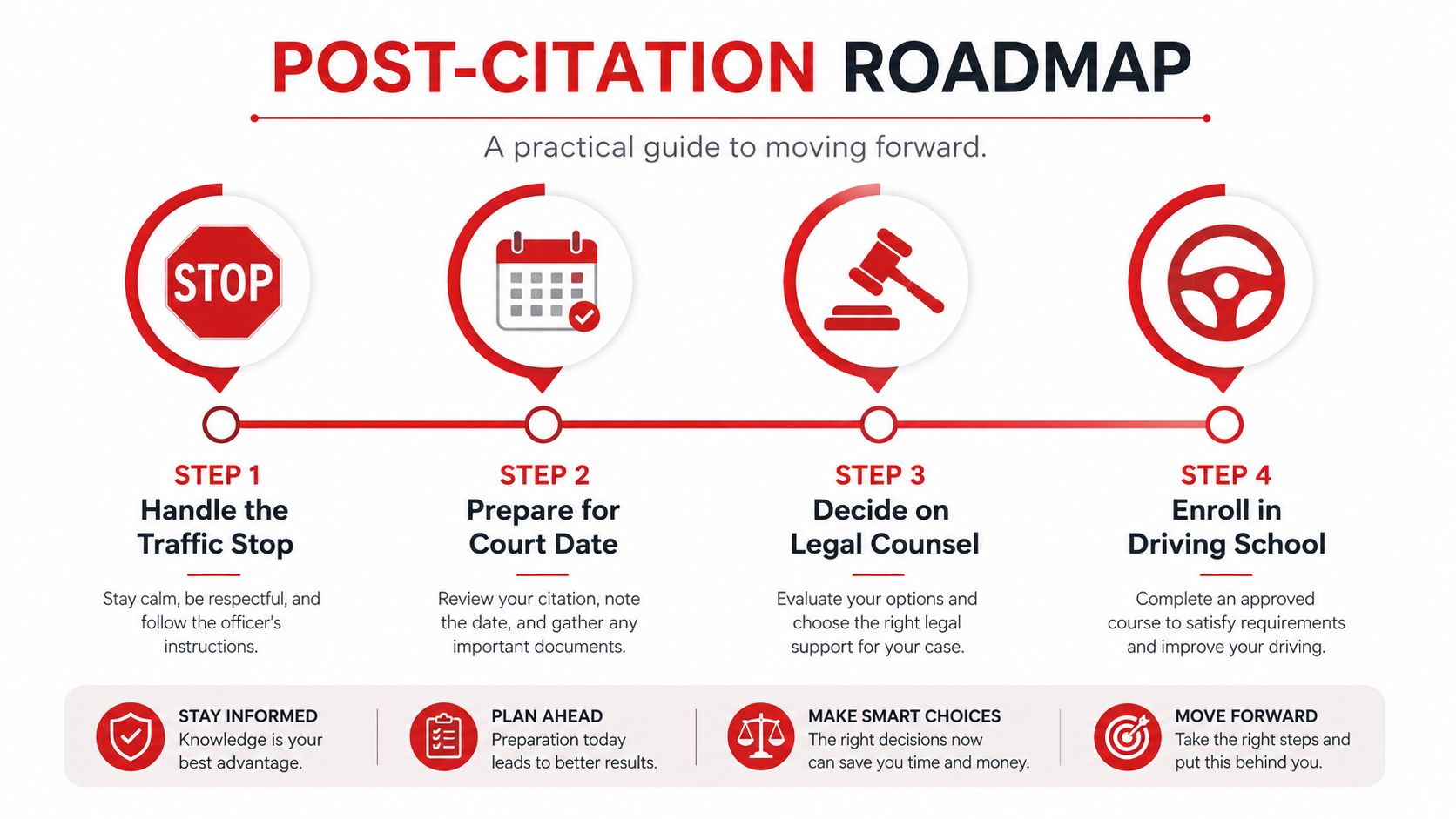
The first move after a reckless driving citation is to stay calm and read every document carefully. Don't ignore the court date, don't toss the ticket in a glove box, and don't assume the matter will resolve itself. Major U.S. markets often treat reckless driving as a criminal matter, and Georgia's ceiling of up to 12 months in jail and a fine of up to $1,000 shows why the case deserves prompt attention. FindLaw reckless driving overview
A practical order of operations
Start by preserving the facts. Write down the road, weather, speed, traffic, and anything the officer said. If there's video, save it now. Then decide whether you need counsel, whether you plan to appear on your own, and whether your court date gives you room to request a reduction or other resolution.
Some drivers also ask whether a defensive driving program might help. In Georgia, that depends on the court, the facts, and the way the case is handled, so it's smart to verify before assuming anything. If you're trying to understand legal help options after an arrest or serious citation, this finding a lawyer after an arrest guide can help you think through that search.
Where training fits
For drivers who need to rebuild skills or prepare for a return to the road, structured education is often the most useful next step. One option is A-1 Driving School, which offers a Joshua's Law 30-hour driver education course, online driver education, road test preparation and testing assistance, and customizable driving lessons and lesson packages. The school also points qualifying teens toward the Georgia Driver's Education Scholarship Grant Program, which can help cover training costs for eligible students.
That matters because the response to a citation shouldn't stop at the court calendar. Better training can make the next stop less likely in the first place.
The Best Defense Is the Training You Do Before the Ticket
The strongest way to avoid reckless driving penalties is to train the habits that keep you out of them. That means understanding Georgia road rules, practicing judgment before speed becomes a problem, and building the kind of behind-the-wheel skill that holds up under pressure. A citation is expensive, but a bad habit repeated for months is what usually creates the citation.
Prevention looks a lot like practice
A-1 Driving School has been family-owned in Atlanta since 1987, serves metro Atlanta and Athens through 18+ locations, and delivers instruction in person, online, and in virtual formats. It also works with the Fulton County Board of Education contract to provide driver education across Fulton County Schools and numerous Atlanta high schools, which gives students a direct path to classroom training that fits school life.
Its most useful pieces for this topic are the ones that build safe behavior before a driver ever faces an officer. That includes the Joshua's Law classroom course, road test preparation, and behind-the-wheel lessons and lesson packages. If you want a shorter read on why the classroom piece matters, this why take a defensive driving course page is worth a look.
A simple prevention checklist
- Enroll in structured driver education. Classroom learning gives teens and adults a chance to slow down and understand risky patterns before they become habits.
- Practice with an instructor. Behind-the-wheel coaching helps drivers correct lane discipline, speed choice, and decision-making in real traffic.
- Use testing support when needed. Road test preparation can reduce anxiety and help a driver approach licensing with more control.
- Check scholarship options. The Georgia Driver's Education Scholarship Grant Program can make training accessible for qualifying families.
The goal is simple. Build the habit pattern now so reckless driving never becomes the story you have to explain later.
If you want help turning safe driving into a real plan, A-1 Driving School offers Joshua's Law driver education, road test preparation, and driving lessons that fit teens and adults who need practical instruction. Visit A-1 Driving School to explore course options, lesson packages, and the next step toward stronger habits on Georgia roads.