A lot of Georgia families hit the same point at the kitchen table. A teen is ready to start driving, a parent opens the manual, and within a few minutes everyone realizes this process involves more than just “study the book and take the test.” There's the permit exam, Joshua's Law, supervised driving hours, lessons, and eventually the road test.
That's where the georgia driver's ed book comes in. It matters because it's the official starting point. It tells you what the state expects you to know before you get behind the wheel.
But the book isn't the whole job. It's the rulebook. A new driver still has to learn how to apply those rules in traffic, in neighborhoods, in parking lots, at busy intersections, and under pressure. Families who understand that early usually move through the licensing process with a lot less confusion.
Your First Step Toward a Georgia Driver's License
Most teens start with the same question: “What do I study first?” Parents usually ask a different one: “What order are we supposed to do all this in?”
The best first move is simple. Start with the official Georgia Driver's Manual, then build the rest of the process around it. That manual is the foundation for the permit test and the basic language of driving in Georgia. If your teen is preparing for a permit, this guide to getting a permit in Georgia helps clarify what comes next after the studying starts.

What trips families up is assuming the manual will also teach driving judgment. It won't. It teaches rules, signs, legal requirements, and test material. That's necessary, but it's different from learning how to merge smoothly, how to manage speed in traffic, or how to recover when a turn starts going wrong.
The families who make the fastest progress usually treat licensing as a sequence, not a single test.
A practical roadmap looks like this:
- Start with the manual so the permit test material is familiar.
- Add a Joshua's Law course so the legal education requirement is covered.
- Schedule driving lessons so the student can connect book knowledge to real traffic situations.
- Prepare for the road test only after the basics feel repeatable, not rushed.
That approach keeps each part of the process in the right lane. The manual teaches what Georgia requires on paper. Training and practice teach what a new driver needs on the road.
Decoding the Official Georgia Driver's Manual
A lot of teens open the Georgia Driver's Manual the night before the permit test, skim a few pages, and assume practice questions will carry them the rest of the way. That usually leads to a retake. The manual is the state's official source for what appears on the exam, and families who use it correctly save time, stress, and extra trips to DDS.
It comes from the Georgia Department of Driver Services, and it covers the rules, signs, and licensing details Georgia expects new drivers to know. Parents usually call it the driver's ed book. For permit prep, that's the right place to start.
What the manual actually does
The manual works as the reference for permit test wording, sign recognition, right-of-way rules, lane use, and legal responsibilities. If a question feels oddly specific, the answer is usually sitting in the manual's exact language.
The learner's permit exam has 40 questions and requires a 75% passing score, with a 20-question road signs section and a 20-question road rules section, and both sections must be passed individually Georgia permit test and driver's manual.
That detail matters. A teen can do fine on rules, miss too many signs, and still fail.
Practical rule: Random practice quizzes help after the student has read the manual. Used too early, they create false confidence and leave gaps in signs, definitions, and Georgia-specific rules.
What to focus on first
Students do better when they study the manual in passes instead of reading straight through once. Start with the sections that show up most often on the permit exam, then review the parts that connect to the full licensing process. Families who want the bigger timeline can pair this step with a guide to getting a Georgia provisional license.
Key topics to mark in the georgia driver's ed book
- Road signs and signals. Similar-looking signs cause a lot of missed questions.
- Road rules. Pay close attention to turns, right-of-way, lane changes, following distance, and intersections.
- Teen driver requirements. These sections help families avoid confusion about permit and Class D steps.
- Testing rules and licensing procedures. Students need to know the material and understand what DDS will ask them to do.
A good study routine is simple. Read one section. Quiz that section. Review the questions that caused hesitation, and write out any rule the student cannot explain clearly in plain language.
Where families get stuck
The common problem is not effort. It is loose study habits.
Teens often recognize a term, a sign, or a rule and mistake recognition for mastery. Then the DDS test changes the wording slightly, and they freeze. I see this a lot with right-of-way questions and signs that look alike at a glance.
Use the manual actively. Highlight the rules that sound similar. Group signs by shape and color. Keep short notes on the mistakes that repeat. The book gives the state's rules. A strong plan uses that book first, then adds structured Joshua's Law coursework and behind-the-wheel coaching so the student is learning for the permit and for real driving.
Meeting Joshua's Law and Class D License Requirements
A lot of families hit the same point. The teen has started reading the Georgia driver's manual, everyone is focused on the permit test, and then the parent realizes the manual is only one part of the licensing process. Joshua's Law sets the training path, and if you do not plan for it early, the Class D timeline gets messy fast.
For a clear overview of the full sequence, use this guide on how to get a Georgia provisional license.
What Joshua's Law actually means for your family
Joshua's Law is built around three parts working together.
A state-approved driver's education course
This gives teens structured instruction on traffic laws, signs, decision-making, and risk factors in a format that goes beyond reading alone.Professional behind-the-wheel instruction Students start applying the rules with coaching in this phase. Bad habits are easier to prevent than to fix later.
Supervised driving with a parent or guardian
Georgia requires 40 hours of supervised driving, including 6 hours at night. Those hours matter because repetition is what turns a rule from something a teen remembers into something they can do under pressure, as outlined in the Georgia Driver's Handbook reference hosted here.
That combination is the part many articles miss. The manual gives the state's rules. Joshua's Law adds the training structure. Professional lessons and parent practice turn both into actual driving skill.
The scheduling choice that saves families time
Parents often ask whether to wait until after the permit to start driver's education. In real life, that usually creates delays.
The smoother plan is to line up the course and driving lessons early, then use the manual, the coursework, and the practice log together. That keeps the student progressing on all fronts instead of treating each requirement like a separate project.
Here is the approach I recommend:
- Study the manual for the knowledge exam
- Start the Joshua's Law course on schedule
- Book professional driving lessons before the calendar gets tight
- Keep the practice log current after each drive
- Spread practice across neighborhoods, main roads, parking lots, rain, night driving, and moderate traffic
Small, regular practice sessions work better than long gaps and last-minute catch-up.
Where teens usually fall behind
The problem is rarely motivation. It is usually poor sequencing.
A teen passes the permit test, then waits too long to drive. Or the family practices often but does not track the hours carefully. Or the student takes a course but gets very little coaching on lane position, speed control, turns, parking, and observation habits.
That is the trade-off. Self-study is cheap and flexible, but it does not correct mistakes in real time. Parent practice is necessary, but parents are often teaching while also managing traffic, schedules, and nerves. A good driving school closes that gap by giving the student focused instruction before weak habits become normal.
At A-1, that is the goal. We help families connect the book, Joshua's Law, and road practice into one plan that gets a teen ready for the Class D test and ready to drive safely after they pass.
The Manual vs A-1 Driving School's Curriculum
Parents usually see the difference after the first few practice drives. Their teen may know the rule for right-of-way, but still hesitate at a four-way stop, drift in the lane, or miss a mirror check during a turn. The Georgia driver's manual gives the right answers. A structured course teaches the student how to use them under pressure.
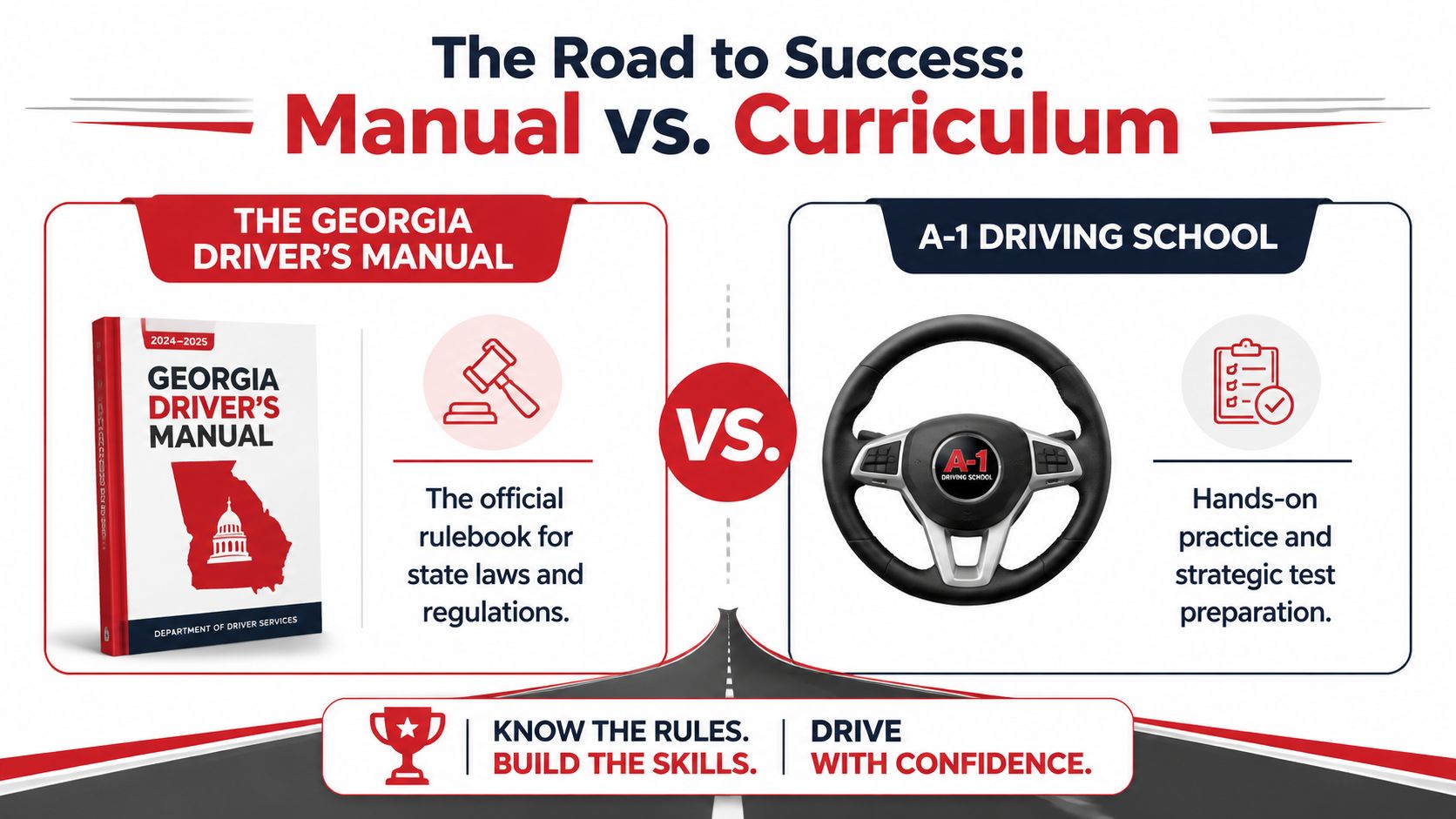
That difference matters because the licensing process has two separate jobs. One is passing the knowledge exam. The other is building habits that hold up in traffic, parking lots, left turns, and lane changes. The book handles the first job well. A school with a clear training plan covers the second.
Families who want both pieces in one place usually do better with a state-approved program such as A-1's Street Smarts driver's education course, which connects the classroom material to coached driving practice.
Side by side comparison
| Focus | Georgia Driver's Manual | Structured driver's education |
|---|---|---|
| Main purpose | Explains Georgia rules, signs, and licensing requirements | Teaches students how to apply those rules in live traffic situations |
| Best use | Permit test prep and quick rule reference | Joshua's Law completion, skill development, and driving habit correction |
| What it does well | Gives the official wording students are tested on | Builds timing, scanning, space management, and decision-making |
| Where it falls short | Cannot correct mistakes or build repetition behind the wheel | Does not replace the official state manual for test study |
What families notice after the permit
The biggest gap is not information. It is execution.
A teen can explain how to change lanes and still rush the signal, skip a shoulder check, or move over without judging traffic speed well. I see that often with new drivers. The mistake is rarely that they never read the rule. The mistake is that nobody coached the sequence in real time and had them repeat it until it became consistent.
That is where a stronger curriculum earns its value. It adds supervised reps, immediate correction, and exposure to the situations that usually make beginners tense up.
What the curriculum adds
A solid driver education program covers parts of learning that a handbook cannot deliver by itself:
Decision-making in motion
Students practice choosing when to slow, wait, merge, or yield while several things are happening at once.Immediate correction
An instructor can stop a bad habit early, whether it is late braking, wide turns, weak scanning, or poor lane position.Defensive driving habits
Certified programs spend time on risk awareness, following distance, escape space, and hazard recognition that many families do not teach in a consistent order.Repeatable routines
Good driving is built on repeatable habits. Mirror check, signal, speed check, head check, move. Students need that pattern until it becomes natural.
The manual still matters. Every Georgia teen should study it carefully. But if the goal is a safe, prepared driver and not just a passed test, the manual should be the foundation, not the whole plan.
Your Plan for Study and Behind-the-Wheel Practice
A lot of families call us after the same rough week. Their teen has the manual open, the permit test is coming up, Joshua's Law hours still are not finished, and nobody is sure when real driving practice should start. The fix is usually simple. Put the book, the course, and the driving lessons in the right order so each step supports the next one.

Step one for the permit
Start with a study schedule, not random reading. Students who formally study the Georgia Driver's Manual have a 75 to 80% first-time pass rate on the permit test, compared to 50% for those who do not study Georgia driver audio handbook summary.
That gap makes sense in practice. Teens who read with a plan usually recognize DDS wording faster, miss fewer sign questions, and walk in less rattled.
A study routine that works well looks like this:
- Read in short sessions so the student keeps focus and remembers more
- Split road signs from rules of the road to spot weak areas faster
- Go over missed practice questions right away before the mistake sticks
- Study several days each week instead of trying to cram the night before
Step two for Joshua's Law training
Once the permit plan is underway, line up Joshua's Law course work early. That keeps families from finishing the permit step and then losing momentum because the class requirement was left for later.
Online courses help many Georgia families because they fit around school, sports, and part-time jobs. They still need structure. I tell parents to set a real class schedule at home, with a start time and an end time, so the student treats it like instruction instead of background activity.
If cost is a concern, check the Georgia Driver's Education Scholarship Grant Program before you assume formal training is out of reach. Families who act early usually have more options and fewer scheduling problems.
Step three for driving lessons and packages
This is the point where the process becomes real. The manual gives students the rules. Driving lessons show whether they can apply those rules calmly, in order, and under pressure.
At A-1, we see the same trade-off again and again. A teen who starts lessons too late often knows the terms but has weak habits. A teen who starts with some guided practice while studying usually connects the book to real traffic much faster.
Look for a lesson package that includes:
- A clear skill sequence from parking lots and neighborhood driving to heavier traffic
- Enough repetition for lane changes, turns, braking, backing, and parking
- Road test prep based on the maneuvers students frequently struggle with
- Feedback parents can reinforce during supervised practice at home
One student may need a short package and a lot of steady family practice. Another may need more instructor time to correct timing, scanning, or control issues before those habits settle in.
This quick video helps families think about timing and preparation before road test season gets crowded.
Step four for the road test
Treat the road test like the final check on a process that is already working. Students usually do better when they have recent practice on stops, turns, parking, backing, speed control, and observation in a quiet, focused setting.
Many families also prefer road testing through a certified school because it cuts down on last-minute stress. Pairing the test with a tune-up lesson is a smart move. It gives the student one more chance to settle nerves, clean up small mistakes, and show the same habits they have been building from the manual through Joshua's Law and behind-the-wheel training.
From the Book to the Road with A-1 Driving School
The Georgia Driver's Manual is where the process begins. It gives teens the rules, signs, and state expectations they need for the permit and for early licensing steps. That part matters, and skipping it usually creates trouble fast.
But a license isn't earned by reading alone. Georgia teens need a full path that includes Joshua's Law coursework, steady supervised driving, and enough behind-the-wheel training to turn knowledge into dependable habits. That's where many families need real support, especially when they're trying to line up online coursework, lesson scheduling, road test prep, and scholarship options without wasting time.
A-1 Driving School stands out because it covers the entire path in one place. The school has served Georgia drivers since 1987, operates 18 locations across metro Atlanta, and is the provider for Fulton County Schools. For families who want more than a basic class, the primary differentiator is access to driver's education, online options, road testing support, and lesson packages that help students build confidence one skill at a time.
If you're ready to move from the georgia driver's ed book to real progress, A-1 Driving School offers Joshua's Law courses, online driver's ed, driving lessons and lesson packages, road test services, and help exploring the Georgia Driver's Education Scholarship Grant Program. Start with the course or lesson option that fits your schedule, and give your teen a clear path from permit prep to road-ready confidence.