
If you're 18 in Georgia, Joshua's Law doesn't apply the same way it does to younger teens, but driver's education still matters. Online drivers ed also makes sense for many new adult drivers because over 30 states allow some form of online driver's ed and these courses are commonly used to complete the classroom portion from home.
A lot of 18-year-olds are in the same spot. You're ready to drive, you're old enough that the rules seem like they should be simpler, and then you start looking things up and get a mix of teen advice, adult advice, permit advice, and school-by-school course pages that don't quite answer your actual question.
The practical question isn't just “Can I take online drivers ed for 18 year olds?” It's “What do I really need in Georgia, what counts, and what will help me pass the test and drive well afterward?”
That's the part worth clearing up. At 18, you may have more flexibility than a 16- or 17-year-old, but flexibility isn't the same as preparation. The smartest path is still a simple one: learn the rules in a structured course, build real skill with driving lessons, then go into the road test with a plan.
Your Path to a Georgia Driver's License at 18
Turning 18 changes the licensing conversation. You're no longer looking at the exact same process younger teens follow, and that's where confusion starts. Many new adult drivers assume that if the rules are lighter, formal training must not matter much.
That's usually the wrong takeaway.

A better way to think about it is this. At 18, you may not be forced into the same teen framework, but you still have to do the same real-world job behind the wheel: read traffic, manage speed, make decisions at intersections, park cleanly, and stay calm under pressure. An online course can help you learn the rules and prepare for the knowledge side, but it won't replace practice.
If you want a Georgia-specific overview of the licensing process, this Georgia driver's license guide is a useful starting point.
What usually works best at 18
Most successful new adult drivers follow a straightforward path:
- Learn the rules first: Use a structured online course or classroom program to cover signs, laws, and driving judgment.
- Add professional lessons early: Get in the car with an instructor before bad habits set in.
- Practice with purpose: Work on turns, lane changes, parking, neighborhood driving, and busier roads in stages.
- Take the road test when your skills are consistent: Don't rush just because the age rules feel simpler.
Practical rule: Online drivers ed is strongest when you use it as the knowledge foundation, not as a substitute for driving time.
That's the mindset that saves people the most frustration. Not more paperwork. Better preparation.
Georgia's Licensing Rules for New Adult Drivers
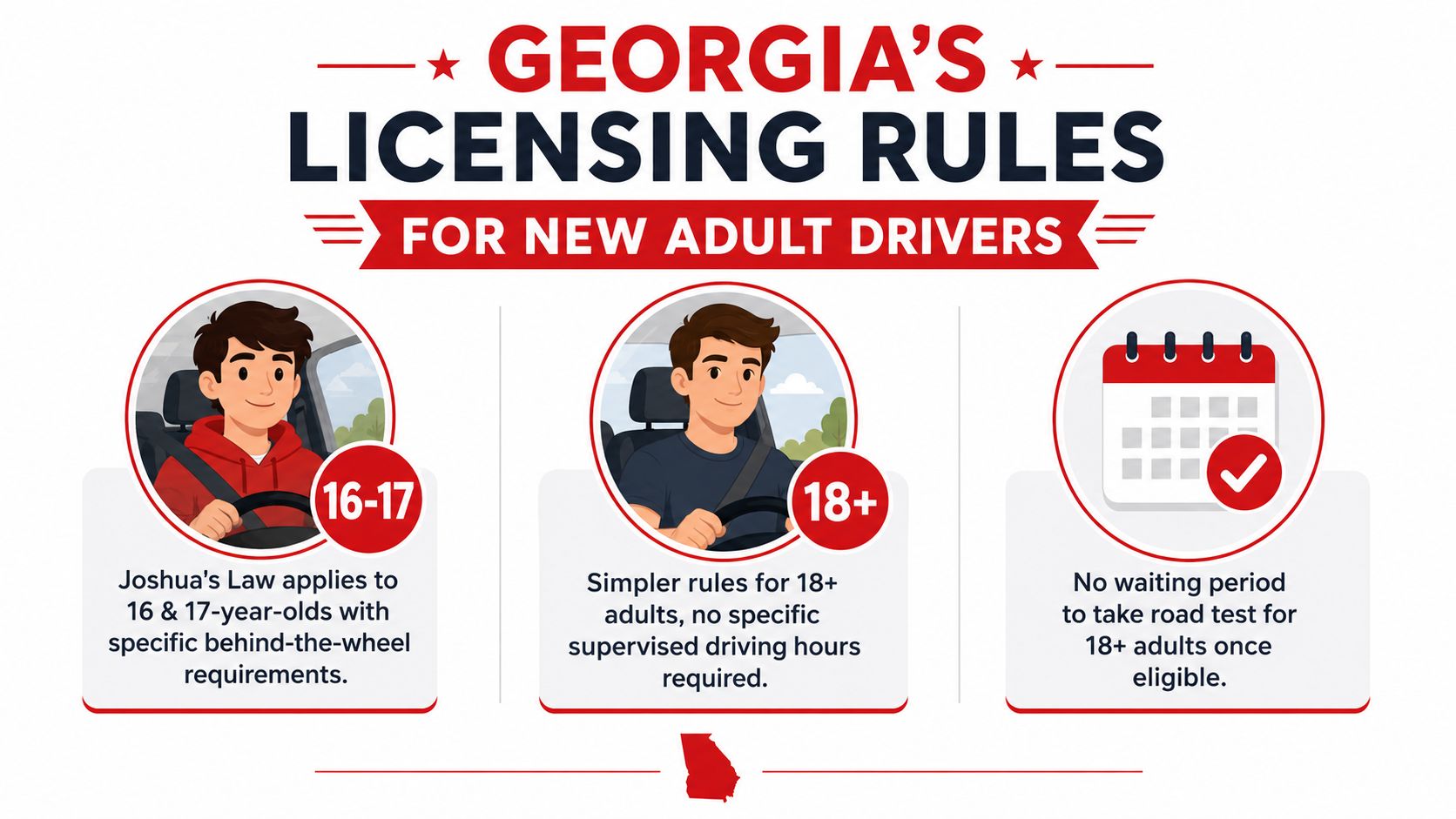
The big distinction in Georgia is age. If you're 16 or 17, Joshua's Law drives much of the conversation around driver education. If you're 18 or older, the process is different, and many people read that as permission to skip training entirely.
You can skip the teen requirement. You shouldn't skip learning how to drive well.
What changes at 18
For a new adult driver, the rules are usually less restrictive than they are for younger teens. That's why so many 18-year-olds search for online drivers ed for 18 year olds and get mixed answers. A lot of content online is written for teens first and adults second.
The practical difference is that being 18 changes the legal requirement, not the difficulty of driving.
The safety reason for training is still strong. The Insurance Institute for Highway Safety says teen drivers have crash rates nearly 4 times those of drivers age 20 and older per mile driven, which shows how risky the early stage of driving can be for inexperienced drivers (IIHS teen driver research).
What that means in real life
If you're 18 and brand new behind the wheel, you still need to build the same abilities younger students need:
- Traffic scanning: noticing hazards before they become urgent
- Speed control: matching road conditions instead of driving by feel
- Space management: leaving room around your car in traffic
- Parking and maneuvering: handling the test basics without panic
- Decision-making: knowing when to go, when to wait, and when to reset
A simpler legal path doesn't create experience. Seat time, coaching, and correction do.
The mistake many new adult drivers make
A common mistake is treating licensing like a one-day event. Study the manual, show up, pass the test, move on. That approach can work for the paperwork side, but it often leaves big gaps in actual driving ability.
For many 18-year-olds, the better question isn't “Do I have to take driver's ed?” It's “What combination of online learning and in-car instruction will help me drive safely and pass without guessing?”
That's where the online option helps most. It removes schedule friction from the theory portion, then leaves room to focus your time and money on what really changes skill: lessons on the road.
Flexible Learning Online Driver's Ed Options
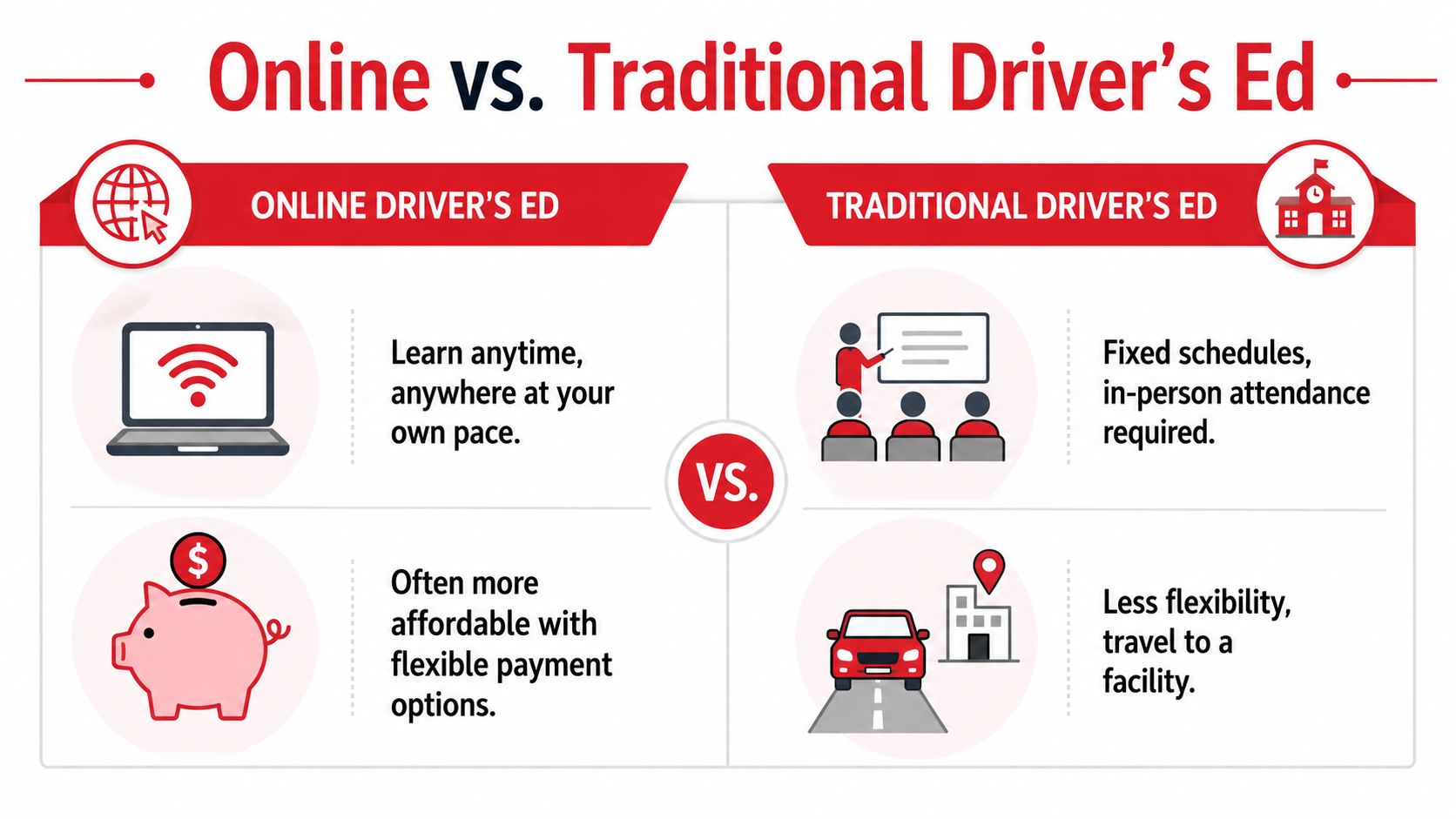
At 18, your schedule usually looks nothing like a 15-year-old student's schedule. You may be balancing college classes, a job, family responsibilities, or a work week that changes every few days. Online driver's ed fits that reality better because you can study the rules when you have time, instead of waiting for a classroom session to open up.
For Georgia adults, that matters for a simple reason. The legal path is different at 18, but you still need to learn the same road signs, right-of-way rules, and safe-driving habits before you walk into a testing center. Online study gives you a practical way to cover that knowledge without putting the rest of your life on hold.
Online versus classroom
The trade-off is straightforward.
| Format | Strongest advantage | Main limitation |
|---|---|---|
| Online driver's ed | Flexible scheduling and self-paced study | Doesn't provide in-car skill coaching |
| Classroom driver's ed | Live structure and instructor-led pacing | Less convenient if your schedule changes |
Online courses work best for the knowledge side of licensing. They help you study signs, signals, lane rules, and test questions at your own pace. A classroom can give you more structure if you know you focus better with a set meeting time and an instructor keeping everyone on track.
Neither format replaces actual driving practice.
That distinction matters more for new adult drivers than many people expect. An online course can help you prepare for the permit or knowledge test, but it will not correct a wide turn, help you judge a gap in traffic, or teach you how to stay calm during a three-point turn. Those are behind-the-wheel skills, and they have to be learned in the car.
When online is a smart choice
Online driver's ed usually makes sense if you:
- Need flexibility: your work or school schedule changes from week to week
- Prefer self-paced study: you want to review difficult topics more than once
- Want a clear first step: you would rather learn the rules before booking lessons
- Use your phone or laptop for everything: you want coursework that fits into short study sessions
If you want a plain-English breakdown of how the format works, A-1's guide to online driver's education explains what you complete online and what still has to happen on the road.
I usually give 18-year-old beginners one piece of advice here. Use the online course to get organized and build confidence with the rules. Then put your money and time into the driving practice that closes the gap between "I studied it" and "I can do it in traffic."
The A-1 Advantage Driving Lessons and Support
At 18, the biggest mistake I see is assuming the online course will carry you all the way to the license. It will not. In Georgia, the part that changes your odds on test day is time in the car with someone who can correct mistakes while they are happening.
That matters even more for adult beginners. An 18-year-old often learns fast on rules and road signs, but still needs guided practice for speed control, right turns, lane position, parking, and busy intersections. Those habits are built through repetition and feedback, not screen time.
Why lessons matter more than students expect
Online study gives you the knowledge base. Driving lessons give you judgment. They are different jobs.
A good instructor catches the small problems new drivers usually miss on their own, like braking too late, turning the wheel while stopped, drifting wide on left turns, or waiting too long to make a decision at a four-way stop. Those are the issues that show up on Georgia road tests and in everyday driving.
That is why many students do better with a plan that combines self-paced coursework with professional instruction. A-1 Driving School offers both, along with road test preparation, so you can build the full skill set instead of checking only the classroom box. If you want a clearer sense of what professional coaching adds, A-1 explains the benefits of taking driving lessons from an instructor.
A practical way to choose a lesson package
Pick the package that matches your actual starting point, not the one that sounds good on paper.
| Package Name | Behind-the-Wheel Hours | Key Features | Ideal For |
|---|---|---|---|
| Starter lessons | 2 to 4 hours | Basic control, turns, parking, and first exposure to local roads | Brand-new drivers |
| Skill-building package | 4 to 6 hours | More repetition in traffic, lane changes, intersections, and test maneuvers | Drivers with some experience but inconsistent skills |
| Road test prep package | 2 to 3 hours | Targeted correction for common test mistakes and test-day readiness | Drivers close to testing |
| Extended lesson package | 6 to 10 hours | Gradual confidence-building, harder routes, and more time to correct habits | Nervous drivers or late starters |
If you have never driven, start smaller only if you know you will book more time soon. A single short lesson helps, but it usually is not enough to make a beginner road-test ready. If you already practice with a parent, roommate, or other licensed adult, a focused package can work well because the instructor can fix technique and give you a clearer practice plan for the days between lessons.
Other support worth asking about
For Georgia students, the details around scheduling and testing can save time and stress:
- Scholarship support: Ask whether you qualify for the Georgia Driver's Education Scholarship Grant Program.
- Road testing services: Some schools can help you prepare for the road test and explain what to bring on test day.
- Scheduling options: Evening, weekend, and multi-location availability matter if you are balancing work, school, or both.
- Adult-focused instruction: New drivers at 18 often need a different teaching pace than teen students.
The cheapest option is not always the low-cost option if it leaves you underprepared and paying for extra lessons later. The better plan is to match your course, your in-car hours, and your test timeline from the start.
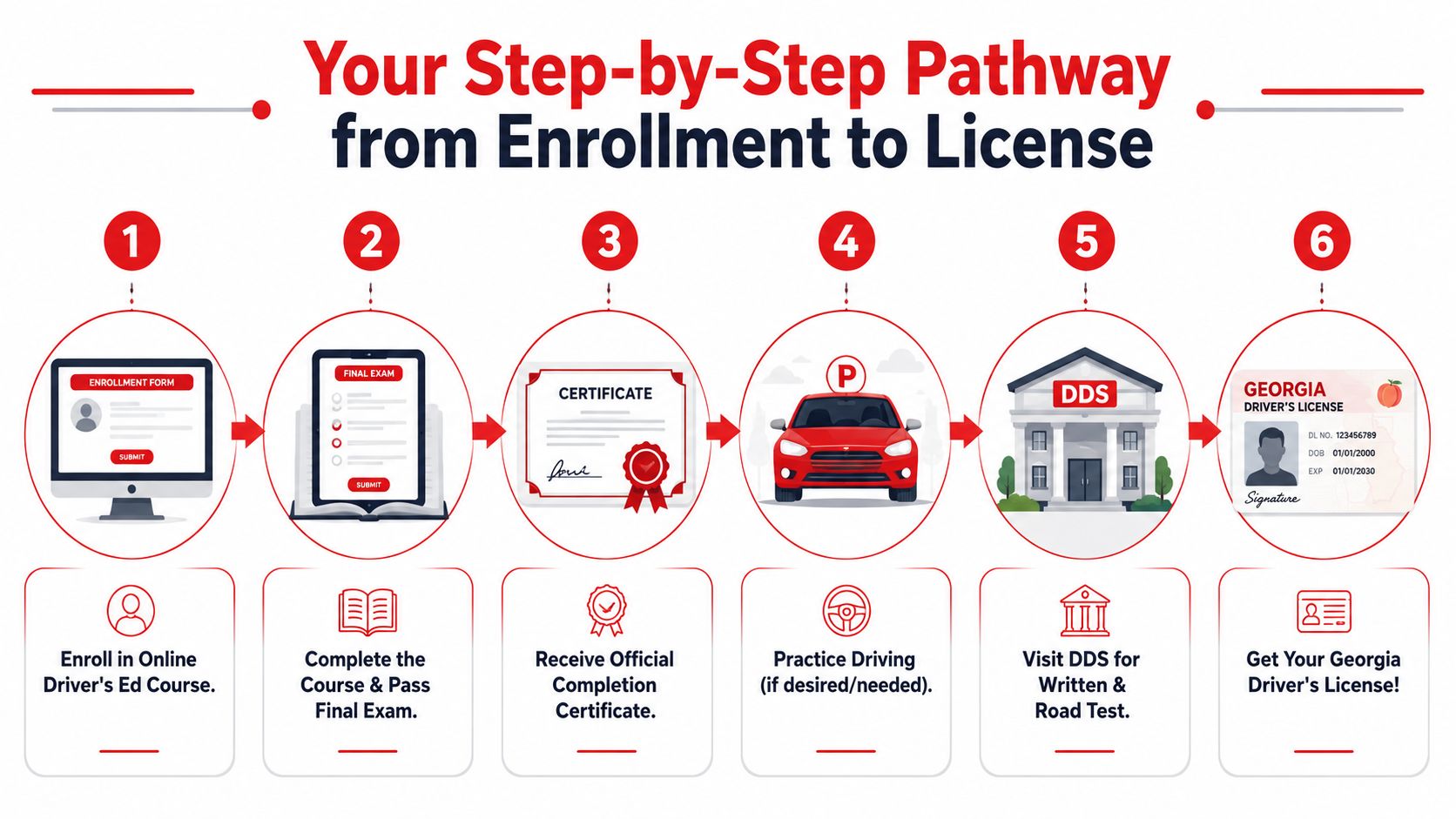
Your Step-by-Step Pathway from Enrollment to License
The cleanest path is to treat licensing as a sequence. Learn the rules. Build the skill. Then test.
Start with the knowledge foundation
Enroll in an online driver's ed course if you want a flexible way to cover road signs, traffic laws, right-of-way rules, and core driving judgment. For many 18-year-olds, this is the easiest part to fit into a busy week.
Finish the coursework carefully. Don't rush through it like background homework. The students who get the most out of online learning usually pause, review, and apply it to prepare for permit and road-test questions.
This short video gives a helpful visual walkthrough before you begin:
Build skill with supervised practice
This is the stage that matters most for safety. A JAMA Network Open analysis summarized by CHOP found that drivers licensed at age 18 had the highest crash rates in the first year of licensure among drivers under 25, and that every additional month in the learner-permit stage was associated with a 2% reduction in crash rates (CHOP summary of the JAMA Network Open study).
That finding lines up with what instructors see every week. Students improve when they spend more time in structured, supervised practice before they start driving on their own.
A strong practice sequence usually looks like this:
- Quiet roads first: starting, stopping, steering, and basic turns
- Neighborhood and local routes: stop signs, lane position, scanning, and speed control
- Busier traffic: multi-lane roads, protected and unprotected turns, gap judgment
- Parking and test maneuvers: repeated reps until they feel ordinary
Finish with road test preparation
Road test prep should be specific, not generic. Work on the exact skills that tend to break down under stress. Smooth stops, mirror checks, lane discipline, parking, and calm decision-making.
If you're close to test-ready, schedule a focused lesson before the exam instead of only practicing with family. A trained instructor usually spots the habits you've stopped noticing.
Common Questions for New Georgia Drivers
Do I still need driver's ed if I'm already 18
You may not be under the same teen requirement, but training is still a smart move. State rules for new drivers can vary a lot. Maryland, for example, requires a state-approved driver education course with 30 hours of classroom instruction plus 6 hours behind the wheel for new drivers, which shows how much the legal path can change by state (Maryland MVA driver education requirements). That's why Georgia-specific guidance matters.
Will an online course count by itself
Usually, the online course handles the theory side. It does not replace actual driving practice. If your goal is to pass the road test and drive confidently after you pass, you'll want behind-the-wheel lessons too.
What if I feel late starting at 18
You're not late. Plenty of people start at 18 or older. What matters is not your age. It's whether you build skill in a structured way instead of trying to force everything into one rushed week.
Should I take lessons even if a parent can teach me
If a parent or another adult can practice with you, that can help. Professional lessons are still useful because an instructor corrects technique, catches weak spots early, and keeps practice focused on the skills that matter for both the test and everyday driving.
How do I know what to sign up for first
Start with the part you're missing. If you know the rules but haven't driven much, book lessons. If you've driven a little but feel shaky on laws and test content, begin with the online course. If money is a concern, ask about the Georgia Driver's Education Scholarship Grant Program and available lesson package options before enrolling.
If you're ready to stop guessing and start moving toward your license, A-1 Driving School is a practical place to begin. You can look at online driver's education, driving lessons, road test support, and scholarship information in one place, then choose the path that fits your experience level and schedule.