
Your teenager has a learner's permit, a busy school calendar, and a parent who isn't sure whether to choose a classroom course, an online program, or private lessons first. Around metro Atlanta, that decision can feel complicated, especially when the primary goal is bigger than passing a road test. Your teen needs a clear path from basic vehicle control to safe, independent driving.
Learning driving classes work best when classroom instruction, professional lessons, and planned parent-supervised practice support one another. Georgia's Joshua's Law provides the formal requirements, while quality practice helps a new driver recognize hazards, manage speed, scan intersections, change lanes, park, and make calm decisions under pressure.
Why Learning Driving Classes Matter for Georgia Teens
A teen in Alpharetta may handle parking-lot practice comfortably, then freeze at a multilane intersection. Another student in South Fulton may understand the rules but rush a lane change while balancing school, sports, and family transportation. Around metro Atlanta, driving skill grows when instruction matches the situations a new driver will face.
That gap between knowing and doing is why driver education should build practice quality, not just target a passing score. In the United States, about 2,800 people ages 13–19 were killed and approximately 227,000 were injured in motor-vehicle crashes in 2020, according to the Centers for Disease Control and Prevention's teen-driver risk information. Teenagers ages 16–19 face a higher crash risk than any other age group, and teen drivers have a fatal-crash rate nearly three times that of drivers ages 20 and older per mile driven, according to the same CDC teen-driver risk information.

The path from permit to Class D license
Georgia's graduated licensing system gives a new driver room to build experience before handling every driving situation independently. All 50 states and the District of Columbia use a three-stage graduated driver-licensing system, with limits that may include nighttime driving or carrying young passengers, according to the CDC's graduated licensing overview.
For a Georgia teen, a clear permit-to-license path combines:
- Theory instruction: Learn traffic laws, signs, risk awareness, and decision-making.
- Professional practical training: Practice vehicle control and traffic skills with an instructor.
- Supervised family practice: Repeat those skills on different roads, at varied times, and in changing traffic or weather.
- Road-test preparation: Rehearse the maneuvers and habits required for the Georgia examination.
- Class D licensing: Meet the state's eligibility requirements and demonstrate readiness.
Each part has a different job. A classroom course explains right-of-way rules, but repeated driving develops judgment. A professional lesson can correct steering, braking, or lane position, while family practice provides more varied exposure. Parents get better results when every drive has a clear objective instead of adding hours without direction.
Practical rule: Treat every practice drive as a lesson. Choose one or two skills, select a suitable route, give calm feedback, and review what improved before ending the drive.
Understanding Joshua's Law and Georgia License Requirements
Joshua's Law is part of Georgia's formal licensing pathway for eligible teens, not merely an optional certificate. Georgia's Teenage and Adult Driver Responsibility Act created the state's graduated licensing framework in 1997, and Joshua's Law took effect on January 1, 2007, adding an approved driver-education requirement for eligible 16-year-olds seeking an initial Class D license. Beginning July 1, 2021, the training requirement also applied to 17-year-olds seeking a Class D license, according to Georgia's licensing information.
For 16- and 17-year-olds, the core requirements are easier to understand as a checklist:
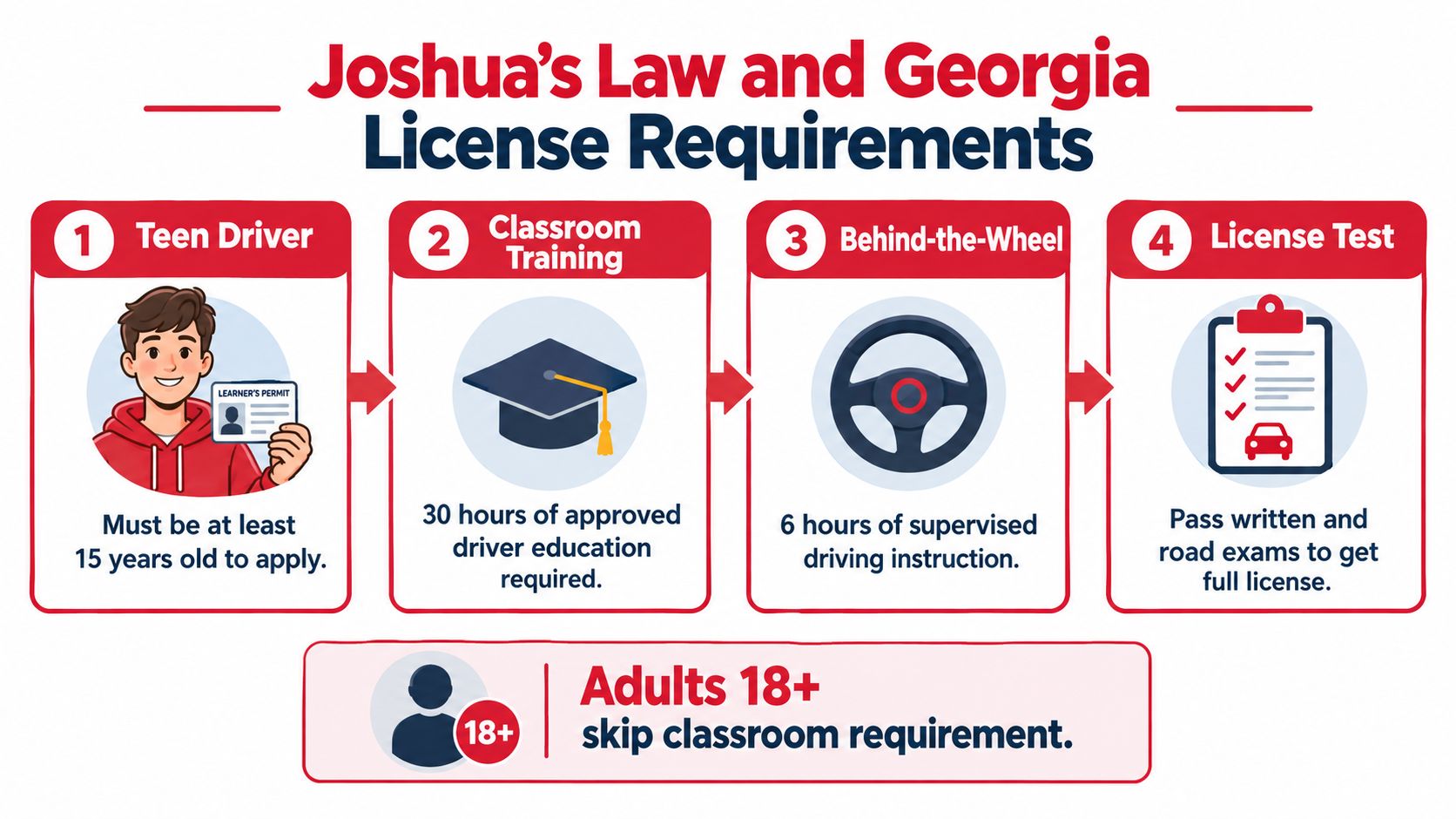
- Complete at least 30 hours of approved theory. The course may be completed in a classroom or through a Georgia Department of Driver Services approved online virtual course.
- Complete practical training. The applicant must complete either 6 hours of behind-the-wheel training with a certified school or the approved parent-taught option.
- Record at least 40 hours of supervised driving. A parent or guardian must supervise the practice, including 6 hours at night.
- Hold the instructional permit for 1 year and 1 day. This waiting period applies before receiving the Class D license.
The Georgia Department of Driver Services teen-driver requirements confirms that applicants must complete an approved driver-education program containing at least 30 hours of theoretical instruction, along with the practical and supervised-driving requirements.
Understanding the 30/6 structure
Families sometimes hear “30/6” and assume those hours cover everything. Traditionally, the phrase refers to 30 hours of classroom instruction plus 6 hours of practical training, as Georgia audit documentation describes. It doesn't eliminate the separate supervised-driving requirement.
That distinction matters when you compare packages. Ask whether the provider documents the theory course, the instructor-led practical component, and the family practice affidavit separately. A course completion record won't replace the supervised hours, and an online theory course won't automatically replace in-car training.
You can review an approved option through A-1 Driving School's Joshua's Law course information. Before enrolling, confirm that the program is approved by DDS and that you understand which practical option your teen will use.
In-Person Classroom Online and Virtual Course Options Compared
Georgia allows the theory portion to fit different family schedules, but the delivery format changes the learning experience. The Georgia DDS driver-education FAQ explains that driver education has two parts, theory and practical training. The theory requirement is a minimum of 30 hours, available through classroom instruction or a DDS-approved online course.
The important point is simple: online theory does not remove the need for behind-the-wheel training or supervised driving. It changes where and how the student completes the academic portion.
Georgia Drivers Ed Formats at a Glance
| Format | Best For | What It Covers |
|---|---|---|
| Instructor-led classroom | Students who learn through discussion, scheduled attendance, and direct questions | Approved theory content, traffic rules, signs, risk awareness, and decision-making |
| DDS-approved online course | Students balancing school, activities, work, or transportation limits | The same required theory component in a flexible online format |
| Virtual learning | Families who want scheduled online interaction without commuting to a classroom | Theory instruction with online participation and instructor access, depending on the program |
An in-person classroom can help a student who needs a fixed routine. A teacher can pause when several students misunderstand an intersection rule, compare examples, and connect a traffic-law concept to a familiar Atlanta route. That social setting also gives some teens a reason to finish the course instead of postponing another self-paced module.
Online learning can be a better fit for a student in Fulton County Schools with changing extracurricular commitments or a family traveling between communities. The student can complete the theory component at home, but parents should still schedule practical training early. Waiting until the final week of the course often creates avoidable scheduling pressure.
Match the format to the learner
Ask three questions before choosing:
- Does the student need structure? Choose scheduled classroom or virtual instruction if reminders and live interaction help.
- Does the household need flexibility? An approved online course may fit better around school and transportation.
- How will practical training happen? Identify the instructor-led or approved parent-taught option before paying for theory.
A good format is the one the student can complete fully and connect to regular in-car practice. Families can review Georgia driver's education course options while checking approval, scheduling, documentation, and practical-training details.
Driving Lessons and Lesson Packages That Build Real Skills
Learning to drive resembles learning a musical instrument. Reading about scales doesn't teach finger control, and watching someone play doesn't create timing. A new driver needs repeated practice, immediate correction, and gradually harder situations.
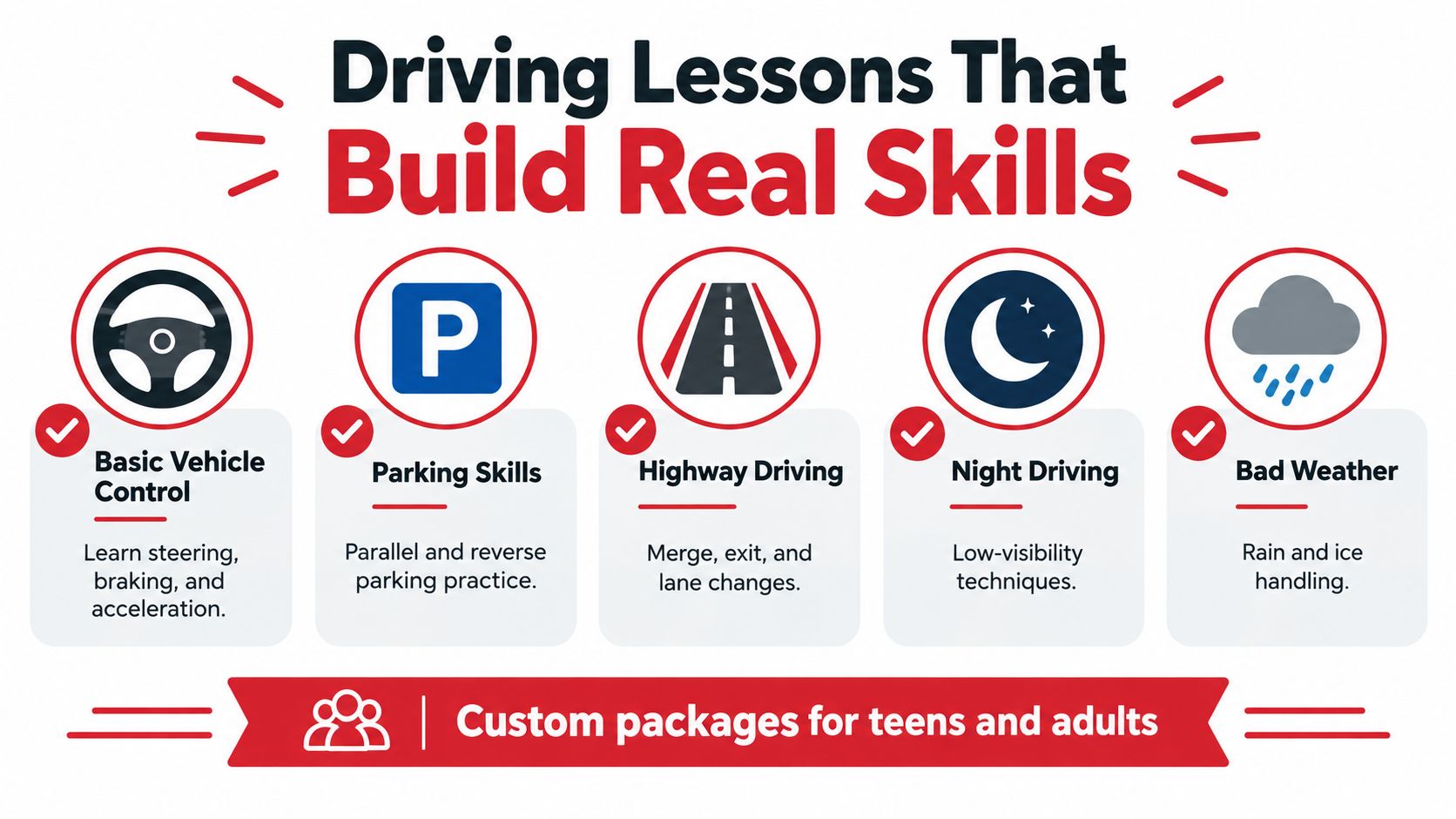
Professional driving lessons give that practice a structure. Early instruction may focus on seating position, steering, smooth braking, acceleration, mirror use, and basic turns. Later lessons can introduce lane changes, intersections, backing, parking, highway merges, night driving, and more demanding traffic.
What a useful lesson progression looks like
A strong package should build complexity instead of repeating the same easy route:
- Basic vehicle control: Practice steering, braking, acceleration, stopping position, and observation.
- Residential roads: Add turns, stop signs, speed management, and visual scanning.
- Parking and backing: Work on parking-lot positioning, reverse movement, and parallel parking.
- Intersections and lane changes: Develop gap judgment, blind-spot checks, signaling, and lane positioning.
- Highway driving: Practice entering, merging, changing lanes, exiting, and managing speed.
- Night and reduced-visibility driving: Add low-light observation and decision-making when conditions are more demanding.
The 6 hours of professional practical training should work alongside, not instead of, the 40 supervised hours. An instructor can teach the method, then a parent can reinforce it on a different route. For example, an instructor might demonstrate a safe multilane merge, while the parent later supervises practice on a suitable section of roadway when traffic is manageable.
Graduated licensing research supports this controlled progression. The CDC's graduated driver-licensing evidence summary reports that these systems are associated with overall crash-rate reductions of approximately 20–40%. NIH-funded research found fatal-crash reductions of 8–14% among 16- and 17-year-olds, with additional benefits linked to nighttime and teen-passenger restrictions when combined with phased licensing.
Make supervised hours varied and deliberate
More practice isn't automatically better practice. A teen who drives the same quiet neighborhood repeatedly may feel comfortable but remain unprepared for a busy intersection, a freeway entrance, nighttime glare, rain, or unfamiliar lane markings.
Use a simple pre-drive routine:
- Name the target skill. For example, “Today we're working on early mirror checks before lane changes.”
- Choose the right environment. Start with manageable roads, then increase complexity.
- Give one correction at a time. Too many instructions can overload a nervous driver.
- Review after parking. Ask what the teen noticed, what felt difficult, and what to repeat next time.
A lesson package becomes valuable when it gives the student a progression and the parent a consistent vocabulary. Instead of saying “be careful,” a parent can say, “Check the mirror, signal, check again, look over your shoulder, then move when the gap is safe.” That specificity turns feedback into a repeatable habit.
Georgia Road Test Prep and What to Expect on Test Day
Road-test preparation should begin before an appointment is booked. Georgia requires the applicant to hold a valid learner's permit, pass the knowledge examination, satisfy the Class D requirements, and sign an affidavit confirming 40 hours of supervised driving, including 6 hours at night, according to the Georgia DDS testing and examinations information.
The test vehicle must also meet state requirements. It needs valid liability insurance, current registration, and a valid safety inspection, and its license plate can't be expired. The applicant must arrive with a licensed driver who is at least 21 years old, and only the applicant and that adult may be in the vehicle.
Complete this test-day checklist
- Confirm eligibility: Check the permit, knowledge exam, Class D requirements, and supervised-driving affidavit.
- Prepare the vehicle: Verify insurance, registration, inspection, plate status, working equipment, and general roadworthiness.
- Schedule ahead: Road-test appointments are required, and walk-ins aren't accepted.
- Practice tested habits: Work on complete stops, smooth starts, turns, lane changes, observation, parking, and speed control.
- Review the passing standard: Georgia states that the traditional road test requires a minimum score of 75%.
A road-test preparation package can help because an instructor watches for details a parent may overlook. Does the student check before moving from a stop? Do they maintain lane position through a turn? Do they observe before changing lanes rather than relying on a signal alone? These small habits often reveal whether the student is ready for independent driving.
Keep the final lesson calm and practical. A nervous student doesn't need a lecture in the parking lot before the exam. They need a clear vehicle check, a short warm-up, and reminders to scan, communicate, and make deliberate decisions.
Scheduling Costs and Georgia Scholarship Grant Options
The least expensive-looking option isn't always the most accessible if the student can't reach the location or the parent can't supervise practice. Distance, household income, transportation, school schedules, and parent availability can combine to create what researchers describe as “driver training deserts.” Research summarized by Children's Hospital of Philadelphia on driver licensing and training access found that financial status and travel time to driving schools significantly affected whether young people completed training and obtained a license before age 18.
A practical budget should consider the whole pathway rather than the theory course alone:
- Theory format: Compare classroom, virtual, and approved online scheduling.
- Practical instruction: Price the required in-car training and decide whether additional lessons are sensible.
- Supervised practice: Plan who will provide the parent or guardian hours and when nighttime practice can happen safely.
- Testing support: Check whether road-test preparation or testing assistance is available.
- Financial help: Investigate the Georgia Driver's Education Scholarship Grant Program if the student may qualify.
A family might choose online theory to reduce travel, then reserve professional driving lessons for skills that are difficult to teach at home. Another household may prefer classroom instruction and use evening or weekend lessons so a parent doesn't have to miss work. The right combination depends on the student's needs and the family's available time.

Before enrolling, ask about locations, pickup and drop-off policies, lesson availability, required documentation, and scholarship eligibility. Families can review Georgia driver-education grants and scholarships and confirm current requirements before making a payment or scheduling training.
How to Choose the Right Program in Metro Atlanta
Start with the license goal. A 16- or 17-year-old seeking a Class D license needs an approved theory course, practical training, supervised hours, the permit timeline, and road-test preparation. An adult learner or an older teen may need a different combination, such as private lessons, refresher instruction, or focused test preparation.
Then match the program to the household:
- Learning preference: Choose classroom, online, or virtual theory based on how the student learns best.
- Practice needs: Select lessons that move from basic control to parking, intersections, lane changes, freeway driving, and night practice.
- Schedule: Look for weekday, evening, and weekend availability that supports consistent practice.
- Location: Reduce missed lessons by choosing a convenient metro Atlanta location or a provider with practical pickup options.
- Financial situation: Check scholarship eligibility before assuming professional training is out of reach.
- Testing timeline: Leave enough time for the permit requirement, supervised practice, vehicle preparation, and appointment scheduling.
A-1 Driving School is a family-owned Atlanta-area provider that has served Georgia drivers since 1987 and offers instructor-led and online Joshua's Law courses, customized teen and adult driving lessons, road-test preparation, testing assistance, and access to locations across metro Atlanta, including Athens. Its Fulton County Board of Education contract also supports Driver's Education delivery across Fulton County Schools and numerous Atlanta high schools.
The most dependable pathway is straightforward: complete approved theory, schedule practical lessons early, organize supervised practice by skill and environment, and prepare the vehicle and paperwork before booking the road test. That approach gives parents a clear role and gives teens repeated opportunities to turn knowledge into controlled decisions.
A-1 Driving School offers Georgia Driver's Education and Joshua's Law courses, online and in-person options, customized driving lessons and packages, and road-test preparation for teens and adults. Visit A-1 Driving School to compare course formats, plan practical training, and start building a clear path from learner's permit to confident driving.