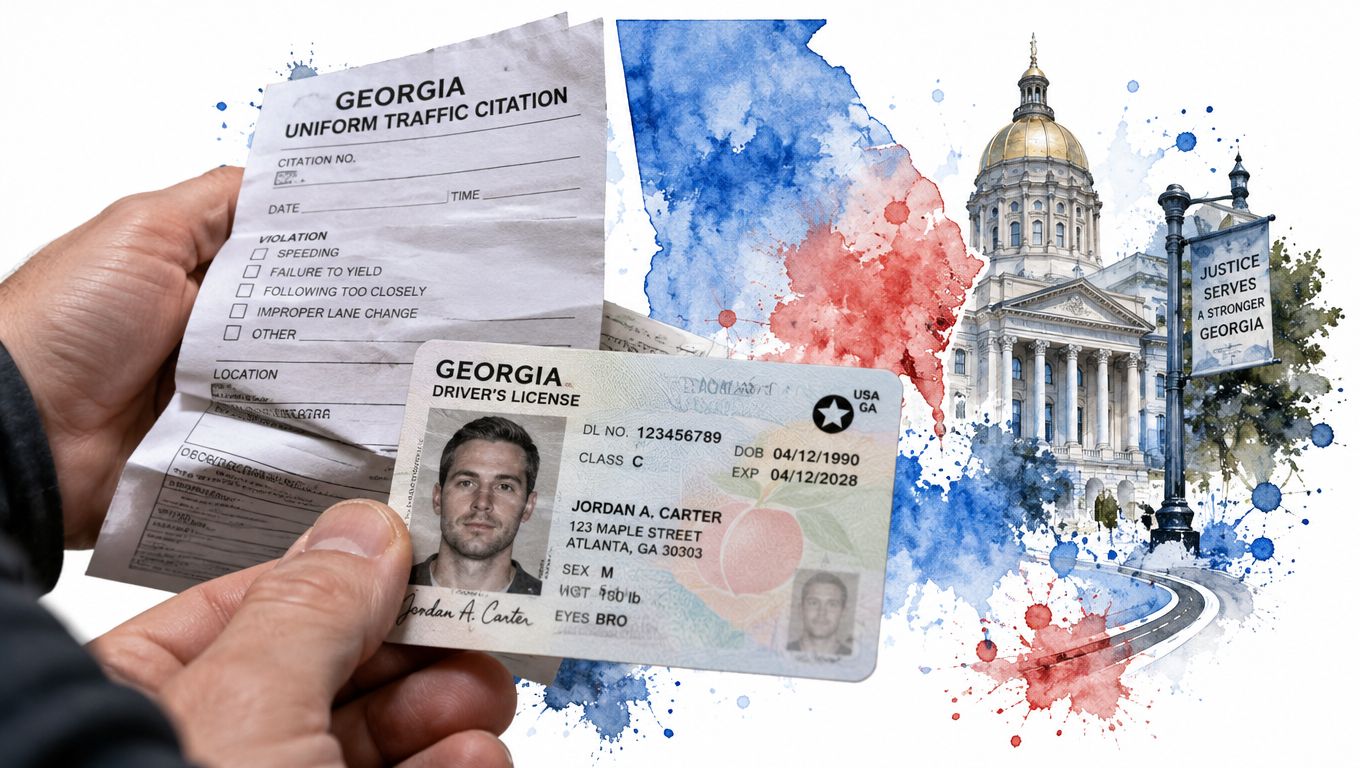
You've just received a Georgia traffic citation. The court date is approaching, your license record may already feel crowded, and every online course seems to promise a quick fix. The important question isn't how to remove driving points on your licence. It's whether you should address the citation through the court first, use a DDS-approved course for points already assessed, or invest in driving instruction that prevents the next mistake.
Georgia separates the license-point system, court conviction records, and insurance decisions. Treating them as one file is how drivers spend money on the wrong course, miss a court opportunity, or assume a “reduced” record is invisible. The steps below show what works, what doesn't, and where A-1's driver education, lessons, road-test services, and scholarship options fit.
When the Points Hit and What the Clock Actually Looks Like
“I've got two weeks before court. Should I take defensive driving now?” That's the question drivers ask after receiving a citation, usually while staring at the court date and trying to guess which decision will do the least damage.
Start by identifying the record involved. Georgia DDS controls license points, courts report convictions, and insurers decide how a driving history affects underwriting. DDS assesses points after receiving a conviction, so a pending citation isn't the same as an assessed point. Paying the ticket or entering a plea can change that status, which is why the days before court matter.
For adult drivers, Georgia suspends a license at 15 or more points within 24 months, according to the Georgia DDS suspension guidance. Drivers under 18 can face suspension at 4 points within 12 months, while drivers under 21 can face suspension for a single 4-point violation. If a points suspension occurs, DDS says the point total is restored to zero, but reinstatement requirements still apply.
The three questions to answer first
- Are points already on your DDS record? Request a current driving record and confirm what has been assessed.
- Is the citation still pending? Contact the specific court before paying or entering a plea.
- Are you worried about a suspended license today? Get legal and practical help promptly. A resource such as suspended license bail bonds may be relevant if an active suspension has created an immediate court or custody issue.
Don't assume a class erases the ticket. A DDS reduction addresses the state point balance, while the conviction and insurance treatment may remain separate issues. The decision you make before court can be more valuable than trying to repair the record afterward.
The DDS-Approved Course and How the Point Reduction Actually Works
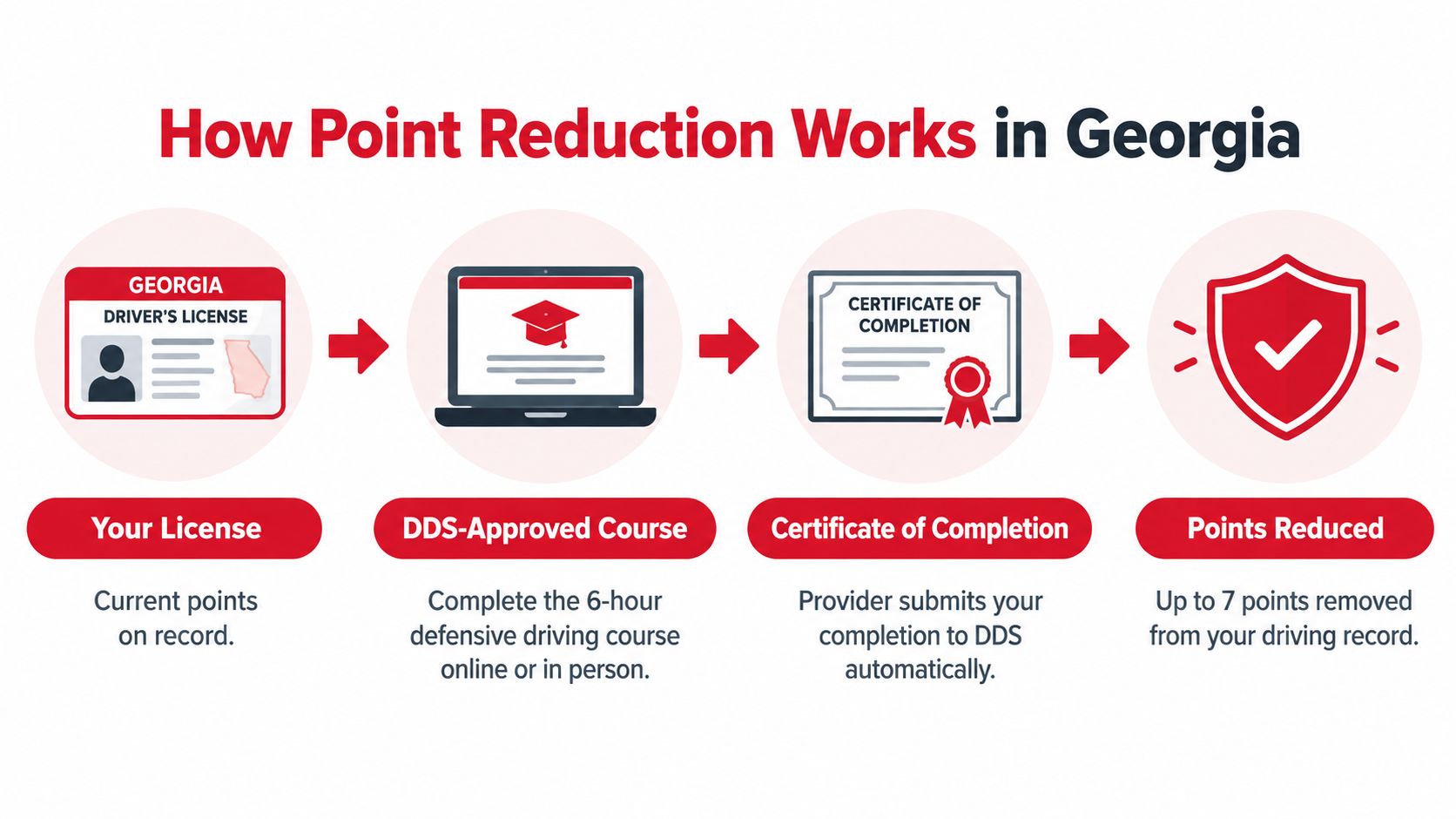
Georgia's principal statutory route for removing existing license points is a DDS-approved Driver Improvement course, commonly called defensive driving. The course is generally 6 hours, and Georgia law permits a reduction of up to 7 points, but the total can't fall below zero. The remedy is available only once during any 5-year period, as explained in Georgia DDS points-reduction guidance.
The process is straightforward, but the paperwork matters:
- Verify the provider. Confirm that the school is DDS-certified before enrolling. A generic traffic-school certificate may not be accepted for licensing or reinstatement purposes.
- Complete the approved course successfully. Attendance alone isn't enough.
- Obtain the original completion certificate. Keep a copy for your records.
- Submit the original to DDS. You can provide it in person at a customer-service center or by mail.
- Confirm the record afterward. The reduction doesn't happen merely because you attended class.
A Georgia provider is usually the sensible choice because the certificate must satisfy Georgia's licensing requirements. An out-of-state online course may teach useful material, but usefulness isn't the same as DDS acceptance. Ask the school directly whether it's DDS-approved for Driver Improvement point reduction, whether it issues the required certificate, and how you'll submit the original.
Practical rule: Never pay for a course based only on the words “defensive driving.” Confirm the exact DDS approval and the certificate procedure first.
A-1's explanation of why drivers take a defensive driving course can help you distinguish personal education, insurance questions, court requirements, and official DDS point reduction. Those purposes overlap, but they aren't interchangeable.
Why Pre-Disposition Court Handling Usually Beats Post-Conviction Reduction
A defensive-driving class isn't always the smartest first move. If your citation is still pending, the court may offer a more powerful outcome than reducing points after conviction.
Under the stated Georgia procedure, a driver may complete a certified 6-hour course before the court appearance, present the original certificate to the court, and receive a 20% fine reduction with no points assessed for that disposition. The court option may be accepted once every 5 years, and the specific court must confirm that it accepts the procedure.

That differs from the post-conviction DDS route. DDS may remove up to 7 already-assessed points, but the underlying conviction remains. If you pay first, plead guilty first, or miss the court's certificate requirements, you may lose the chance to obtain the no-points disposition. Don't enroll blindly and hope the judge accepts the certificate later.
Ask the court before taking action
Call the court listed on the citation and ask:
- Whether the six-hour certified course option is available for your charge.
- Whether the court requires the original certificate.
- When and how you must present it.
- Whether paying online or entering a plea ends that option.
- Whether another court-specific requirement applies.
The Georgia traffic-ticket dismissal guidance is useful for understanding the questions to raise before you pay or plead. It doesn't replace confirmation from the court handling your citation.
The sequence matters more than the certificate itself. Before conviction, the court may prevent points from being assessed. After conviction, DDS can reduce points already on the record, but it doesn't undo the conviction.
Near a suspension threshold, delaying is a poor strategy. Handle the pending citation first, then decide whether additional driver training is needed to prevent another violation.
License Points, Court Records, and Insurance Are Not the Same File
Drivers often say, “My points were reduced, so the ticket is gone.” That's wrong. Georgia's system involves three separate decision-makers, and each one sees a different part of your history.
| Record | Who Controls It | What It Shows | Typical Visibility Window |
|---|---|---|---|
| License-point record | Georgia DDS | Points assessed for reported convictions | Points count toward suspension within the applicable statutory period |
| Court record | The court | Citation disposition, plea, conviction, or other court outcome | May remain part of the driving history after points are reduced |
| Insurance record | Your insurer | Underwriting information and rating decisions | Determined by the insurer's own rules and review practices |
A DDS-approved course can reduce the state point balance, but it doesn't automatically erase the court's conviction. The insurer may still consider the underlying event, and DDS doesn't promise a discount. DDS describes Driver Improvement as potentially useful for insurance-premium reduction, but the insurer decides eligibility and rating treatment.
That's why I tell drivers to get facts in writing before spending money for an insurance reason. Request a current DDS record, keep the citation and court information, and ask your carrier how it will treat a completed course and a reduced point balance. Don't accept a salesperson's promise that your premium will fall.
For broader context on how long a citation may remain visible, review this traffic citation record duration guide from Fiscella Law LLC. Use it as background, but rely on your current DDS record, the court, and your insurer for the decision in front of you.
The word “reduced” describes the point balance. It doesn't necessarily describe the entire driving record.
Rebuilding Habits with Driver's Education, Joshua's Law, and Lesson Packages
Point reduction handles the immediate record problem. Driving lessons address the reason the problem happened, especially when a new driver is struggling with lane control, traffic judgment, parking, merging, or test anxiety.
For applicants ages 16 and 17 seeking a Georgia Class D license, Joshua's Law provides several approved training combinations. The standard instructor-led route includes 30 hours of classroom instruction, 6 hours of behind-the-wheel training at a certified driving school, and 40 hours of supervised driving with a parent or guardian, including at least 6 hours at night, according to the Georgia Joshua's Law requirements.
Online education is a recognized option. A student can complete 30 hours of approved online instruction, then use either 6 hours of instructor-led behind-the-wheel training or the approved parent-taught alternative, while still completing the 40-hour supervised-driving requirement. The learner must hold a permit before behind-the-wheel training and must hold that permit for 1 year and 1 day before receiving a Class D license.
Choose training based on the actual gap
Georgia DDS recognizes four combinations:
- In-person classroom plus instructor driving: Useful when a teen needs structured teaching and professional correction.
- In-person classroom plus parent-taught practice: Suitable when the family can provide consistent, supervised practice.
- Online classroom plus instructor driving: A practical fit for flexible schedules and students who need professional road coaching.
- Online classroom plus parent-taught practice: Works when the family can reliably manage the required supervised driving.
The supervising adult must be at least 21 years old, hold an unexpired Class C license, and sit beside the learner. DDS doesn't require a formal driving log, but a parent, guardian, or qualifying certified instructor must affirm under penalty of law that the teen completed the supervised driving, including nighttime practice. Courses that aren't DDS-approved won't satisfy the Class D requirement.

A-1 Driving School offers instructor-led and online driver education, customized teen and adult driving lessons, road-test preparation, and testing assistance. Its lesson packages make sense for drivers who don't need another broad classroom course but do need focused practice before the Georgia road test or after a confidence-damaging citation. Explore the Joshua's Law Georgia driver education options before choosing a format.
The Georgia Driver's Education Scholarship Grant Program can remove cost as the barrier for qualifying families. Ask about eligibility and apply before assuming professional instruction is out of reach. If the immediate goal is a clean test outcome, combine the required education with targeted lessons rather than relying on unstructured practice.
Your This-Week Checklist Before You Pay for Anything
Start with the record, not the course advertisement. Pull a current DDS driving record and compare it with the citation in your possession. Then write down the court date, court contact information, and whether the citation is still pending.
Use this order:
- Call the court before paying. Ask whether a certified six-hour course can produce the court-level no-points disposition and whether the original certificate is required.
- Check DDS eligibility. If points are already assessed, confirm whether you've used the up-to-7-point reduction during the past 5-year period.
- Verify the provider. Make sure the course is DDS-approved for the purpose you need.
- Ask your insurer directly. Get written confirmation about how a course, reduced points, and the underlying conviction will be treated.
- Choose training that fixes the weakness. Select Joshua's Law education, online coursework, road-test preparation, or driving lessons based on what you need.
- Ask about the scholarship. Qualifying Georgia families may be able to use the Driver's Education Scholarship Grant Program for training costs.
If your citation is pending, protect the court option first. If the conviction is already on your record, follow the DDS certificate process. If driving skill is the underlying issue, book lessons instead of assuming another certificate will change your habits.
A-1 Driving School offers Joshua's Law classroom and online courses, Georgia road-test preparation and testing assistance, and customized driving lesson packages for teens and adults. Visit A-1 Driving School to compare the right course or lesson path, and ask about the Driver's Education Scholarship Grant Program if cost is holding you back.