The first time a brand-new driver pulls out of the driveway alone, the moment feels bigger than a road test. The wheel seems too close, the mirrors feel busy, and every parked car looks like a possible mistake. Parents feel it too, because they know that the true test starts after the license is printed, not before.
That's why new driver challenges are usually not about one hard skill. They're about a dozen small decisions happening at once, then happening again in rain, in traffic, at night, and with a passenger talking in the back seat. RoSPA's guidance is blunt about the risk, one in five new drivers are involved in an accident in their first year of driving, and roughly one in five are involved in a collision in their first six months (RoSPA young driver report).
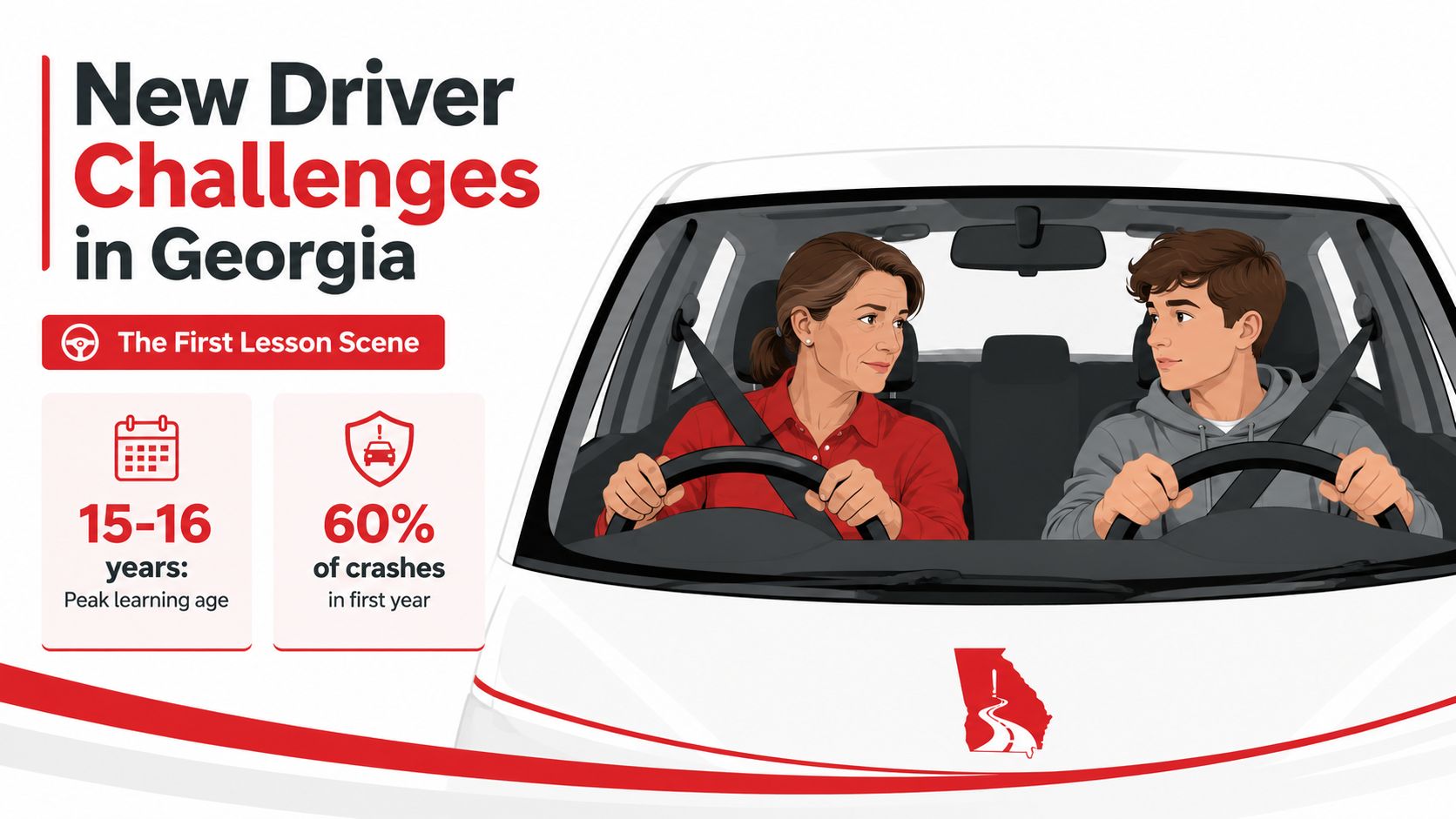
For Georgia families, that early window is where the pressure shows up most clearly. A teen may pass a test and still hesitate at left turns, freeze at busy intersections, or misjudge following distance on a multilane road. Parents often think the problem is confidence, but the deeper issue is that beginners are still learning how to process the road in real time, and that takes repetition, supervision, and the right kind of instruction. The road ahead gets safer when training matches the actual conditions a new driver will face, not just the easiest version of them, and that includes thinking seriously about local risk on roads where pedestrians and cyclists are present too, as discussed in Georgia drivers, pedestrians, and cyclists are facing increasingly dangerous roads.
What New Driver Challenges Really Look Like in Georgia
A new driver often looks ready after the test, then discovers the real work starts alone. The first six months on Georgia roads are when speed control, following distance, mirror checks, and lane choices have to happen without an instructor speaking beside them. A calm neighborhood street can feel manageable, then the same driver can feel overwhelmed on a wet arterial road with a school pickup line, lane changes, and drivers moving faster than expected.
The early learning curve is the hard part
Young drivers usually do not struggle because they ignore safety. They struggle because the road demands that they watch many things at once, and beginners still have to think through each move one by one. RoSPA's young driver report notes that one in five new drivers crash in their first year, with roughly one in five crashing in their first six months (RoSPA young driver report).
That pattern matches what Georgia families often see in ordinary driving. A student may handle a quiet neighborhood route with little trouble, then lose track of gaps, speed, or lane position when merging onto a busier road or approaching a crowded intersection. The challenge is not just whether the student can operate the car. It is whether the student can keep making sound decisions while the pressure rises.
A learner who can only drive well in one easy setting is still building the skill, not yet living it.
The hidden problems are the ones families miss
The problems that catch families off guard usually show up as anxiety, distraction, night driving, bad weather, and road test stress. New drivers also face legal and insurance surprises, because getting licensed does not mean the family can stop paying attention. In Georgia, a teen may finish the paperwork stage and still need months of coached practice before the car feels predictable instead of intimidating, and that concern becomes sharper as traffic around pedestrians and cyclists grows more demanding, as discussed in Georgia roads, pedestrians, and cyclists.
Confidence can swing in both directions. One smooth drive can make a beginner overconfident, while one small mistake can make them timid for days or weeks. The fix is steady practice with clear feedback, because the skill gap is often smaller than it feels, but the risk is real enough that families should treat those first months as training time, not a finished chapter.
Why New Drivers Struggle and How Joshua's Law Helps
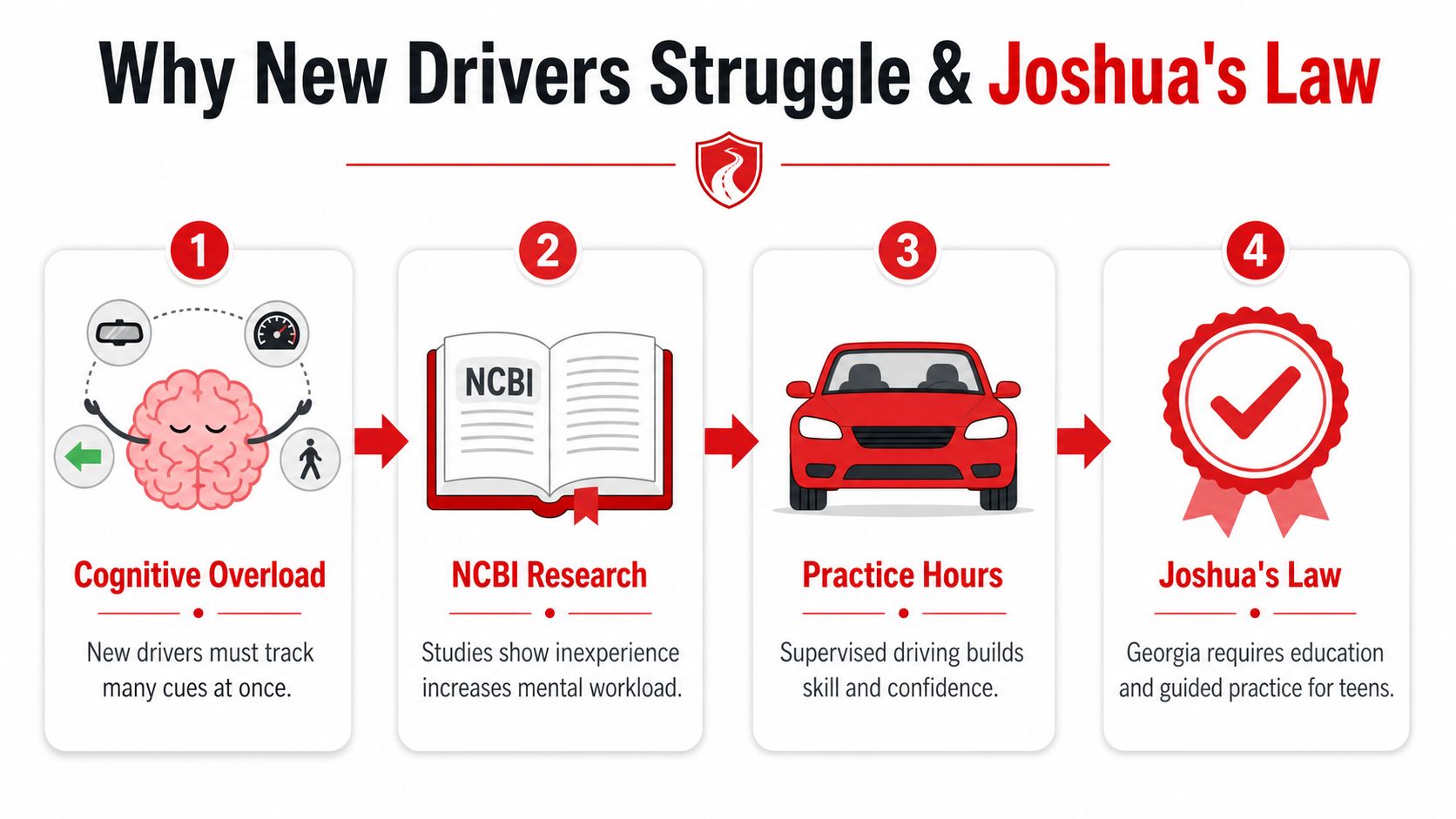
Driving looks simple from the passenger seat. The driver has to keep track of mirrors, speed, signals, pedestrians, lane position, and vehicle control all at the same time, and that workload is exactly why beginners get overloaded. Medical literature on young-driver crashes identifies common novice errors like failing to maintain attention, not keeping proper following distance, missing right-of-way cues, and not responding correctly to emergencies like skids or sudden swerves (NCBI young-driver crash literature).
Joshua's Law breaks the overload into steps
That's where Georgia's Joshua's Law framework makes sense. It does not assume a teen can absorb everything at once. Instead, it pushes learning into layers, with classroom learning, behind-the-wheel instruction, and supervised practice working together as one sequence.
For teens under 18 working toward a Class D license, the structure is meant to build judgment before independence. The 30-hour Driver's Education course teaches the rules and the reasoning behind them, the 6 hours of behind-the-wheel training gives direct coaching in the car, and the 40 hours of supervised driving adds the repetition that turns nervous habits into routine. Of those supervised hours, 6 must be at night, because dark conditions expose weaknesses that daylight hides (NHTSA road to solo driving handbook).
The order matters more than people think
A beginner usually needs explanation before repetition, and repetition before independence. If a student tries to skip straight to solo driving, the missing pieces show up fast, usually in traffic. Joshua's Law works because it turns a fragile first stage into a supervised learning path, which is exactly what new drivers need when they're still building judgment under pressure.
The goal is not to rush a student through the process. The goal is to make the student ready for the road they'll actually face.
For Georgia families comparing course options, the structure becomes easier to understand when the classroom, in-car practice, and supervised hours are treated as one plan instead of separate tasks. A straightforward place to start is the Georgia Driver's Education courses page, where the learning sequence is organized around the state's requirements.
The Five Most Common Skill Gaps New Drivers Face
A beginner can know the rules and still make the same five mistakes over and over. The pattern is familiar, the car drifts in the lane, the mirror checks happen too late, the turn lands in the wrong lane, speed rises on straight roads, and parking turns into a battle of corrections. These are not personality flaws. They're practice gaps.
1. Steering and lane position
Many new drivers overcorrect because they're staring too hard at the center of the lane. The wheel gets small jerks, the car wanders, and the student spends too much energy “fixing” the car instead of guiding it smoothly. Simple lane-holding drills, done at low stress and then repeated on busier roads, help the hands stop chasing every movement.
2. Mirrors and blind spots
Beginners often check mirrors in a panic, not on a rhythm. That's why they miss cars already sitting beside them or forget the blind spot right before a lane change. Repetition is what fixes it, mirror check, signal, shoulder check, move, then do the same sequence until it becomes automatic.
3. Turns and intersections
Intersections expose whether a driver understands right-of-way or just memorized it. A novice may turn too early, swing wide, or hesitate so long that the traffic gap disappears. Targeted practice at intersections teaches timing, lane discipline, and the difference between a safe gap and a risky one.
4. Speed control and braking
Beginners often drive too fast on clear roads and too timidly when traffic gets tight. That inconsistency makes following distance and braking harder to judge. The fix is smooth acceleration, early braking, and coaching that helps the student feel what steady speed looks like.
5. Parking
Parallel parking gets all the attention, but the primary problem is spatial judgment. New drivers often can't tell where the car ends and the curb begins, so every correction feels bigger than it is. Repeated parking practice in the same vehicle builds reference points, and those reference points reduce panic fast.

A structured package of lessons helps here because it lets an instructor fix several problems in sequence instead of chasing one-off mistakes. That continuity matters, because one good lesson on lane position doesn't solve blind spots, and one parking session doesn't teach the student how to handle turns.
Night Driving, Bad Weather, and Heavy Traffic Without Panic
The hardest moments for new drivers usually arrive when the road stops feeling predictable. Night driving hides depth and lane edges, rain changes stopping distance, and heavy traffic asks for faster decisions than a beginner is ready to make. IIHS notes that teen crash rates are nearly four times those of drivers 20 and older per mile driven, and that inexperience means teen drivers often do not recognize or know how to respond to hazards (IIHS teen driving research).
Night driving changes what the eyes can trust.
At night, a beginner cannot depend on the same visual cues used in daylight. Headlights, reflections, and darker edges make distance harder to judge, so scanning matters more than staring at one point. Good coaching focuses on active scanning, low-beam use, and staying alert for pedestrians, cars pulling out, and lane drift. A student who only watches the car ahead often misses the small clues that show where danger is building.
Rain and bad weather punish sloppy habits.
Wet roads reward early braking, steady steering, and slower decisions. A new driver who brakes late or turns sharply on slick pavement will feel the car move in ways that can be startling, like trying to change direction on a smooth floor instead of on dry pavement. If a learner needs a practical refresher before bad-weather practice, the guide on how to prevent hydroplaning on wet roads is a useful supplemental read.
Traffic teaches patience under pressure.
Rush-hour merging is often where beginners lose confidence. Lanes move quickly, other drivers do not leave much space, and a nervous student may either force a gap or freeze until the opening disappears. Staged exposure in lessons helps because an instructor can start on quieter roads, then move into denser traffic once the learner is ready. That step-by-step approach works better than asking a new driver to learn calm under pressure only after the pressure is already on.
A family cannot safely recreate every hard condition on command, but an instructor can build the experience gradually. That is where structured driving lessons packages matter most. They let a student practice night driving, rain judgment, and traffic timing in a controlled sequence, with corrections that happen while the habit is still forming. A calm driver is usually not fearless, just familiar with the situations that used to feel overwhelming.
Here is a short video refresher on staying calm in demanding situations.
Passing the Georgia Road Test on the First Try
The Georgia road test is really a check on whether the basics hold together under supervision. Examiners look for the same core skills teachers drill in lessons, smooth starts and stops, steering control, turns and intersections, lane changes, parking, observation, and speed control. If those habits are still unstable, the test usually exposes the weak spots quickly.
A learner does not need flashy moves. The car just needs to feel predictable, because predictability gives the examiner room to see safe judgment instead of last-second corrections.
What usually goes wrong
Most failures come from ordinary habits that never became automatic. Rolling stops, missed signals, weak blind-spot checks, and panic after one small mistake all point to the same problem, the driver knows the rule but has not built the routine. A student can understand the task and still fail when stress interrupts the sequence.
Test prep should feel like a rehearsal, not a surprise. When a student practices in a setting that matches the route style, the pressure drops because the car, the pacing, and the expectations already feel familiar. Road testing with a school can help with that familiarity, because students are coaching in the same kind of environment where they are later evaluated.
That school setting matters for the first months of solo driving too. The road test is only one checkpoint, and the ultimate goal is to drive calmly after the test is over, especially in the situations that catch new drivers off guard, such as rain, congestion, and quick lane decisions.
Why a school-based road test can help
Taking the road test through a school can feel less intimidating than showing up cold at a state office. Students get to practice in the same place where they have already been coached, and that familiarity often matters as much as the maneuver list. For Georgia teens, the road-test process also fits naturally with the 6 hours of behind-the-wheel training required to earn a license at 16, because test readiness and real competence should grow together.
A-1 Driving School offers road test preparation and testing support, which gives students a place to repeat the exact habits road testers watch for. When a learner has practiced those skills enough times, the test starts to feel like another drive instead of a one-time performance. That same repetition helps after the license is issued, because the first months alone on Georgia roads still demand the same steady habits.
When rain enters the picture, judgment matters more than bravado. A driver who has already learned how to prevent hydroplaning on wet roads is less likely to freeze, overcorrect, or guess at the wrong moment.
Legal and Insurance Hurdles Every New Driver Should Know
Some families think the hardest part is the driving. Then paperwork, timing, and insurance show up and slow everything down. Learner's permit rules, license timing, parental consent, and required documents all affect when a teen can move forward, and families who skip the planning stage often lose time they could have saved.
Driver education does more than teach
A quality driver's ed course is not just about passing a class. It helps satisfy state requirements, and it can also matter when families are trying to show that a teen completed the proper training path. In Georgia, that matters because Joshua's Law is tied to the training sequence that supports licensure, not just the ability to operate the car.
The cost side matters too. New drivers often face higher insurance pressure because they're seen as riskier to insure, so families are smart to look for every legitimate way to make training count. If you're comparing insurance topics alongside training, young driver coverage options can help frame the broader discussion of how new-driver risk is priced and managed.
The scholarship option deserves attention
Georgia families also have a real financial support path through the Georgia Driver's Education Scholarship Grant Program. That program can cover the cost of driver's education for qualifying students, which makes a full Joshua's Law course easier to access when budget is tight. It's a practical answer for families who know training matters but need help making the numbers work.
Online Driver's Ed can also help families fit the requirement into busy schedules without delaying the process. When the classroom piece, supervised practice, and licensing steps are planned together, the family avoids the stop-and-start pattern that leaves new drivers underprepared.
Why Driving Lessons Packages Are the Smartest Investment
A new driver who only books single lessons often ends up fixing one problem at a time. One week it is turns, the next week it is parking, and by the next session the earlier habit has faded. A structured package works better because the instructor can see the pattern, remember the weak spots, and build each lesson on the one before it.
That matters in the first six months of solo driving. A teenager may pass a road test and still struggle with merging, lane changes, parking under pressure, or choosing the right speed on a busy Georgia road. A package gives that driver a sequence, which is the part many families do not realize they are missing until the mistakes start showing up in real traffic.
Continuity matters more than people expect
A package creates a learning sequence. The student does not keep starting from zero, and the instructor does not have to spend half the lesson relearning the driver's habits. When families spread lessons over weeks, the learner has time to practice between sessions and come back with real questions instead of vague frustration.
The same structure also helps parents. Instead of guessing which skill needs attention next, they can see the next step in front of them and support practice at home without turning every ride into a correction session. That is why the benefits of taking driving lessons from an instructor matter so much for new drivers who need more than casual advice.
A school with long-term experience helps. A-1 Driving School has served Georgia drivers since 1987, holds the Fulton County Board of Education contract, and delivers more than 15,000 classes annually to over 100,000 satisfied drivers. That kind of continuity matters when you want a structured path rather than random practice.
What a good package should include
A strong package should do more than add hours. It should connect classroom learning, in-car instruction, and test readiness in a way that matches the learner's stage. Families in metro Atlanta and Athens also benefit from flexible scheduling and multiple locations, because consistency is easier to maintain when the service fits real life.
- Steady progression: Lessons should move from basic control to traffic, then to harder conditions.
- Instructor continuity: The same trainer should be able to correct repeating mistakes.
- Flexible scheduling: Families need options that fit school, work, and commute demands.
A good package also helps with the part most new drivers fear after the test, handling ordinary traffic without freezing up. A student who practices with a plan learns how to read space, stay calm at intersections, and recover from small mistakes before they become dangerous habits. That is the value of paying for a package instead of collecting disconnected lessons.
Your Next Step to Become a Confident Georgia Driver
A nervous new driver usually needs a plan more than a pep talk. The first months alone on Georgia roads can feel like learning to swim in deep water, because the hard part is not just passing a test, it is staying calm once no instructor is beside you. If you are a Georgia teen working toward a Class D license, start with Joshua's Law Driver's Ed and combine it with supervised practice that goes beyond the easiest roads. If you are a parent, a driving lessons package gives the student a clear sequence instead of scattered advice.
The smartest next step depends on where the driver is stuck. Some students need help with the testing step, so road test prep that matches the actual exam format can reduce the surprises that cause nerves to spike. Others run into cost first, and the Georgia Driver's Education Scholarship Grant Program can help families avoid delaying training. If the classroom piece is the main scheduling problem, choose an online or in-person Driver's Ed path that keeps the process moving without adding extra confusion.
| Your Situation | Recommended Service | Why It Helps |
|---|---|---|
| Teen needs Joshua's Law | 30-hour Driver's Education course | Covers the required training foundation |
| Parent wants safer practice | Driving lessons package | Builds skills in a steady sequence |
| Driver needs test support | Road test preparation and testing | Reduces surprises on test day |
| Family needs help with cost | Georgia Driver's Education Scholarship Grant Program | Can cover qualifying driver's ed costs |
A good package matters because new drivers do not fail only from one big mistake. They usually stumble from a chain of small gaps, like braking too late, checking mirrors too slowly, or hesitating at the wrong moment. Structured lessons help close those gaps in order, the same way a coach fixes footwork before asking for speed. As noted earlier, A-1 Driving School's lessons are built to fit real schedules, which is helpful when practice has to happen around school, work, and family time.
The first six months of solo driving are still the hardest stretch for many new drivers, but that stretch does not have to define the whole experience. With the right sequence, the right instructor, and enough practice in the kinds of roads Georgia drivers use, confidence grows and risk drops at the same time.
A-1 Driving School helps Georgia families turn that first stretch into a manageable plan with Driver's Ed, road test preparation, and driving lessons packages that fit real schedules. If you are ready to help a new driver build safer habits from the start, visit A-1 Driving School and choose the path that matches where you are right now.