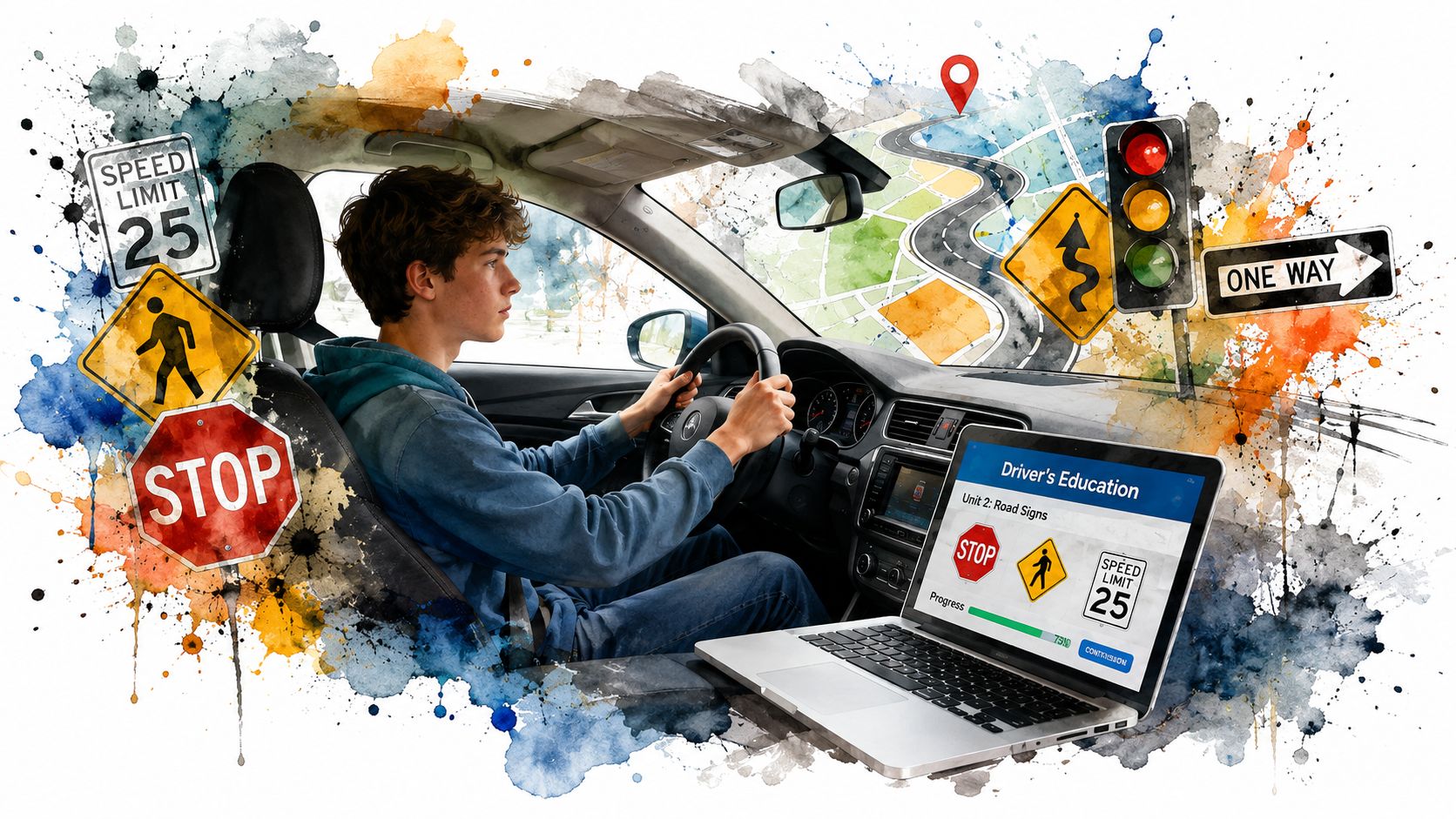
A Fulton County parent is usually not shopping for driver education on a calm afternoon. They're juggling school calendars, sports, homework, and maybe a teen who says they want a license “soon” but can't explain what comes first. That's where online drivers ed and behind the wheel packages make sense, because the right package isn't just a price sheet, it's a sequence that moves a student from classroom learning to supervised road practice to Class D readiness.

A lot of families also run into background-check questions when school volunteering, carpools, or family driving arrangements overlap. If you need a practical reference while you're sorting out teen activities and paperwork, a volunteer background check resource can help you think through the non-driving side of the planning too.
What an Online Drivers Ed and Behind the Wheel Package Covers
A combined package is a two-part pathway. First comes the classroom side, often online, where a student learns traffic laws, road signs, hazard recognition, and the rules that govern safe driving. Then comes the in-car side, where that knowledge gets turned into steering, braking, lane position, parking, and real decision-making with an instructor in the passenger seat.
That split matters because Georgia families are not really buying “lessons” in the abstract. They are trying to move a teen from permit stage to the point where the state recognizes the training as part of the licensing path. In that sense, the package is less like a product bundle and more like a sequence of gates, each one clearing the way for the next.
A parent in Atlanta often thinks in calendar terms. Can the teen finish the course before summer ends, can lessons happen after school, can the road test happen without creating a second round of scheduling chaos? A good package answers those questions by putting theory first, then road practice, then testing support.
Practical rule: if a package does not make the handoff from online coursework to road practice clear, the family usually ends up doing extra admin work later.
For families comparing school programs, district rules, and private options, the decision gets simpler when they treat the package as a pathway instead of a shopping cart. That is especially true when license eligibility, lesson timing, and test readiness all need to line up.
One place that helps with the bigger picture is provisional license guidance, because the package only makes sense when you can see where it sits in the full Georgia progression. For parents who also need a practical reference on the non-driving side of teen activities, a volunteer background check resource can help when school volunteering, carpools, and family driving plans overlap.
Joshua's Law and the Georgia Class D Pathway
Georgia's teen licensing path is built around Joshua's Law, which means the course isn't optional for most under-18 drivers who want a Class D license. In Georgia, teens are typically expected to complete 30 hours of classroom instruction and 6 hours of behind-the-wheel training as part of an approved driver education course that satisfies Joshua's Law and supports Class D eligibility, according to the state guidance summarized in the drivers ed state overview linked in the verified data. The important point for parents is simple, the state wants both the knowledge piece and the road-practice piece before it treats the teen as ready for the next step.
The class hour count is only part of the story. The learner permit, the classroom course, the driving practice, and the road test all fit together like checkpoints, not separate purchases that can be mixed and matched at random. Families in Fulton County Schools, Atlanta high schools, and homeschool programs all run into the same reality, the student needs the right sequence, not just the right paperwork.
The internal course logic usually follows this pattern. The teen finishes the approved classroom work, completes the in-car training, and then moves toward the licensing steps that lead to a road test and, eventually, a Class D application. That is why Georgia parents should gather documents and consent forms early, especially if the teen is close to permit age and the family wants to avoid a last-minute scramble.
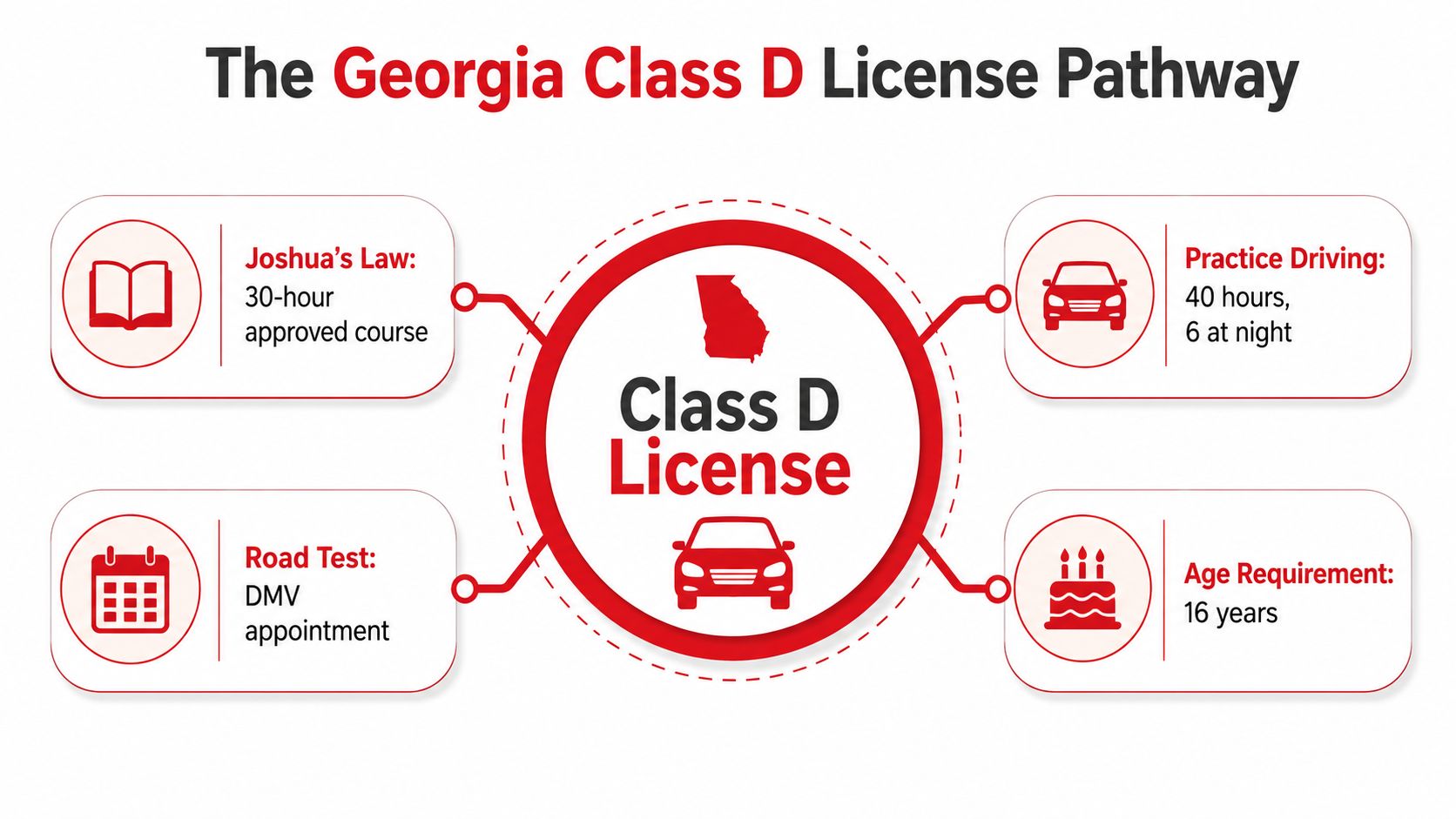
The cleanest way to think about it is this, Joshua's Law sets the educational floor, and the rest of the pathway proves the student can use that knowledge on the road. A family that understands that distinction usually makes better decisions about package size, timing, and whether they need extra lessons.
If you want a plain-language walk-through of the permit-to-license transition, the Georgia provisional license guide is a useful companion to this part of the process.
How Online Drivers Ed Works in Georgia
A parent in Atlanta may see online drivers ed as just a screen-based class, but the job is bigger than convenience. The course gives a teen the rules of the road, the meaning of signs, space management, and hazard recognition in a format that fits around school, sports, family time, and commuting. It builds the student's mental model of driving before they ever sit in the car with an instructor.
According to state-structured programs, online driver-ed packages usually divide asynchronous theory from supervised road practice, and several programs pair a 30-hour online classroom component with 6 hours of behind-the-wheel instruction NS Driving Academy course structure. That split matters because the knowledge work can happen at night or on weekends, while the in-car lessons stay focused on skills that have to be coached in real time.
What the student usually studies
The online portion usually covers the information every new driver needs before stepping into traffic. Parents should expect modules on road signs, right-of-way, safe following distance, lane use, and the kinds of mistakes that show up in real driving. The goal is not just to pass a quiz, it is to give the teen enough vocabulary and judgment to make the in-car lessons more useful.
When a student knows the rules before the car starts moving, the instructor can spend more time on judgment and control, not on memorizing signs.
Pacing matters as well. One state-accredited model requires the online course to be finished within 120 days of purchase, limits students to one unit per 24-hour period, and notes that each unit averages about 2.5 hours DriverEdSafety pacing rules. Other programs require completion within 6 months. Those limits matter because they discourage cramming and spread learning out in a way that usually works better for a first-time driver.
A family in Cobb County or DeKalb County may want a teen to finish the course quickly, but the pacing rules still shape the experience. A student who pauses between units has time to absorb right-of-way decisions, check questions with a parent, and come back to the material with less pressure. That is the practical difference between finishing a course and learning from it.
The biggest misunderstanding is thinking an online certificate replaces road lessons. It does not. The certificate shows the classroom content was completed, but the driving skill has to be built in a real car. If you want a plain-language explanation of the format, what online driver education is gives a straightforward overview of how the classroom piece is delivered.
Online vs In-Person Components and How They Fit Together
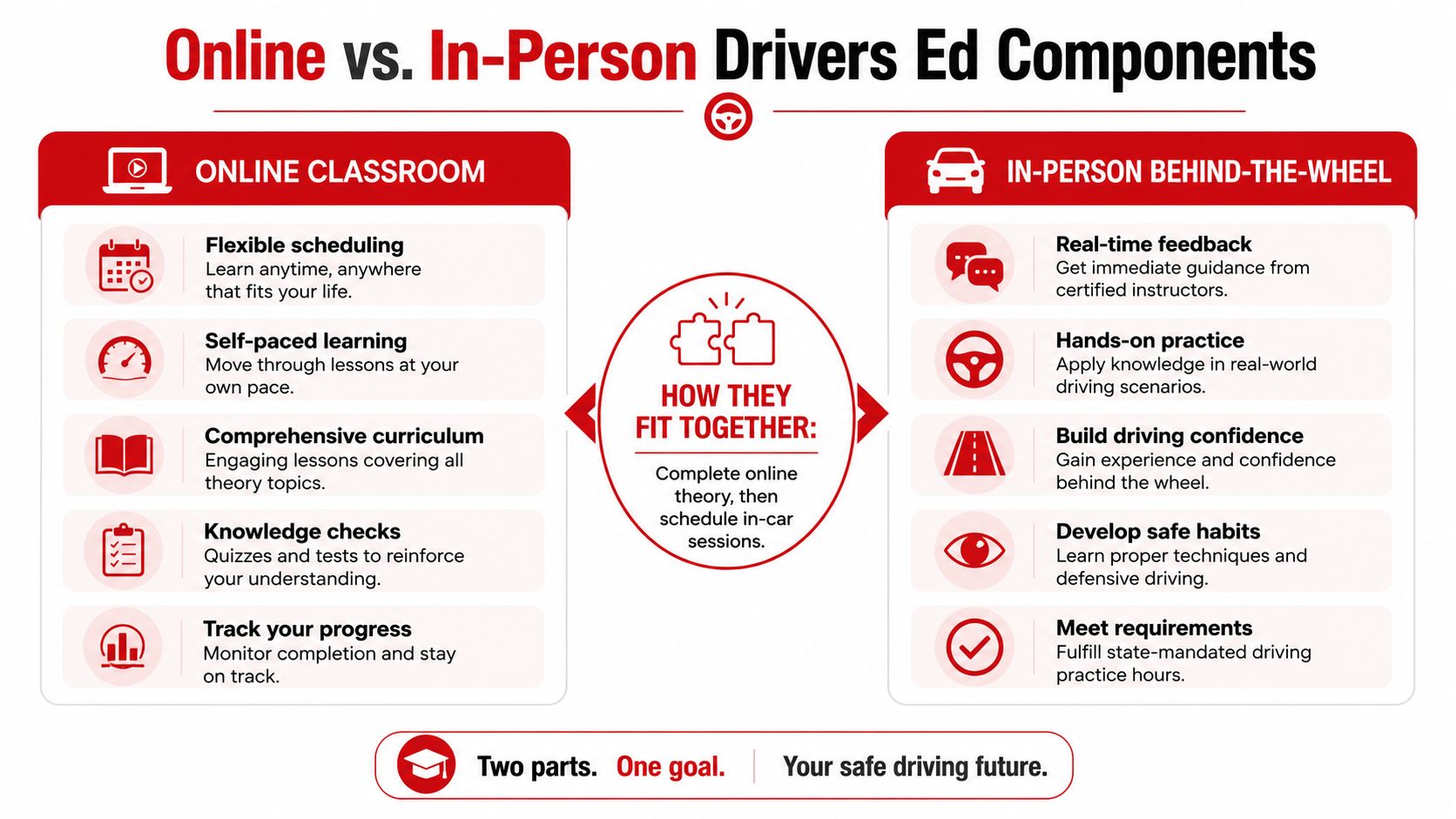
Families often treat online learning like a shortcut, but it's really a scheduling choice. Online classroom work gives a teen flexibility, especially if they're balancing school, sports, a job, or commuting across the Atlanta area. In-person classroom work gives more structure, more immediate questions, and a built-in routine, which some students need to stay focused.
The right choice usually comes down to the student's learning style. A self-directed teen who can work steadily at home may do fine online, especially if the family wants to avoid another commute. A nervous first-time driver may do better with a room full of peers and an instructor who can slow down and rephrase the material when needed.
The road part is where the comparison ends. Behind-the-wheel training has to happen in a real car with a certified instructor, no matter how the classroom portion was completed. California's DMV gives a useful benchmark here, stating that behind-the-wheel training must include at least six hours with a professional instructor, cannot exceed two hours per day, and that observation time does not count toward the six-hour requirement California DMV driver training rules. That's not Georgia law, but it shows how seriously regulated the road-practice side tends to be.
What the hybrid model does well
Online theory and in-car practice solve different problems. The classroom part teaches rules and recognition, while the car part teaches timing, control, and judgment under supervision. Put together, they keep the student from using lesson time to ask basic rule questions that could have been handled online first.
For Georgia parents who want a second opinion on the value of in-car coaching, the case for instructor-led driving lessons lays out why direct feedback matters once the teen is moving.
A hybrid model usually makes the most sense when the family needs both convenience and accountability. Online gets the theory done efficiently, and in-person lessons make sure the student can apply it without guessing.
Choosing the Right Driving Lessons Package for Your Situation
A package should match where the student is right now, not where the family hopes they will be after a few more weekends of practice. A teen who already has permit time, practice at home, and a clear grasp of the basics may only need a smaller bundle to tighten lane changes, parking, and test routes. A more nervous new driver often needs more repetition before the skills feel automatic, so a larger package can be the practical choice instead of an oversized one.
That is why package sizing works like a path, not a shopping cart. One student may only need a few focused hours to close the gap between “can drive around the neighborhood” and “ready for the road test,” while another student needs enough supervised time to stop hesitating at intersections and build steady control. Atlanta-area parents usually see this difference quickly. A teen who has logged calm practice with a parent in subdivision streets may need less instructor time than a student who has only sat behind the wheel a few times and still grips every turn like it might fight back.
The market reflects that range. Public listings show bundle sizes from small add-ons to 6-, 10-, 12-, 20-, and even 30-hour packages, which tells you families are choosing from very different starting points Access Driving School pricing examples. The lesson count matters because it signals how much supervised time the student is likely to need before test day, not just what sounds convenient on a sales page.
A simple way to sort the options
Start with the student's current confidence, not the package name. If the teen can already handle neighborhood turns, lane position, and low-stress traffic, the smaller end of the range may be enough to prepare for the test. If they are still freezing up at intersections or fighting the steering wheel, more hours make more sense.
The other factor is whether the student has been driving outside lessons. A teen who has had guided permit practice with a parent often needs less time in the instructor car than a student who is starting from zero. Adults returning after a lapse may also need extra practice, but their needs are usually shaped by old habits that have to be corrected, not just basic unfamiliarity.
Rule of thumb: buy the smallest package that closes the gap between current skill and test readiness, not the package that looks impressive on a webpage.
Cost comparisons matter too, but they need context. Verified pricing examples show the U.S. market ranging from an online course alone at about $45 to bundles around $249, $519, $750, $839, $989, $1100, $1495, $1800, and $2700, depending on hours and test services Access Driving School pricing examples. That spread tells you package design changes a lot with add-ons, road-test support, and lesson volume, so the lowest upfront price is not always the best fit.
If you are trying to keep your car organized while a teen learns, a find our driving close sticker is a practical little reminder that driving habits are still a work in progress.
A-1 Driving School Programs, Locations, and Scholarship Eligibility
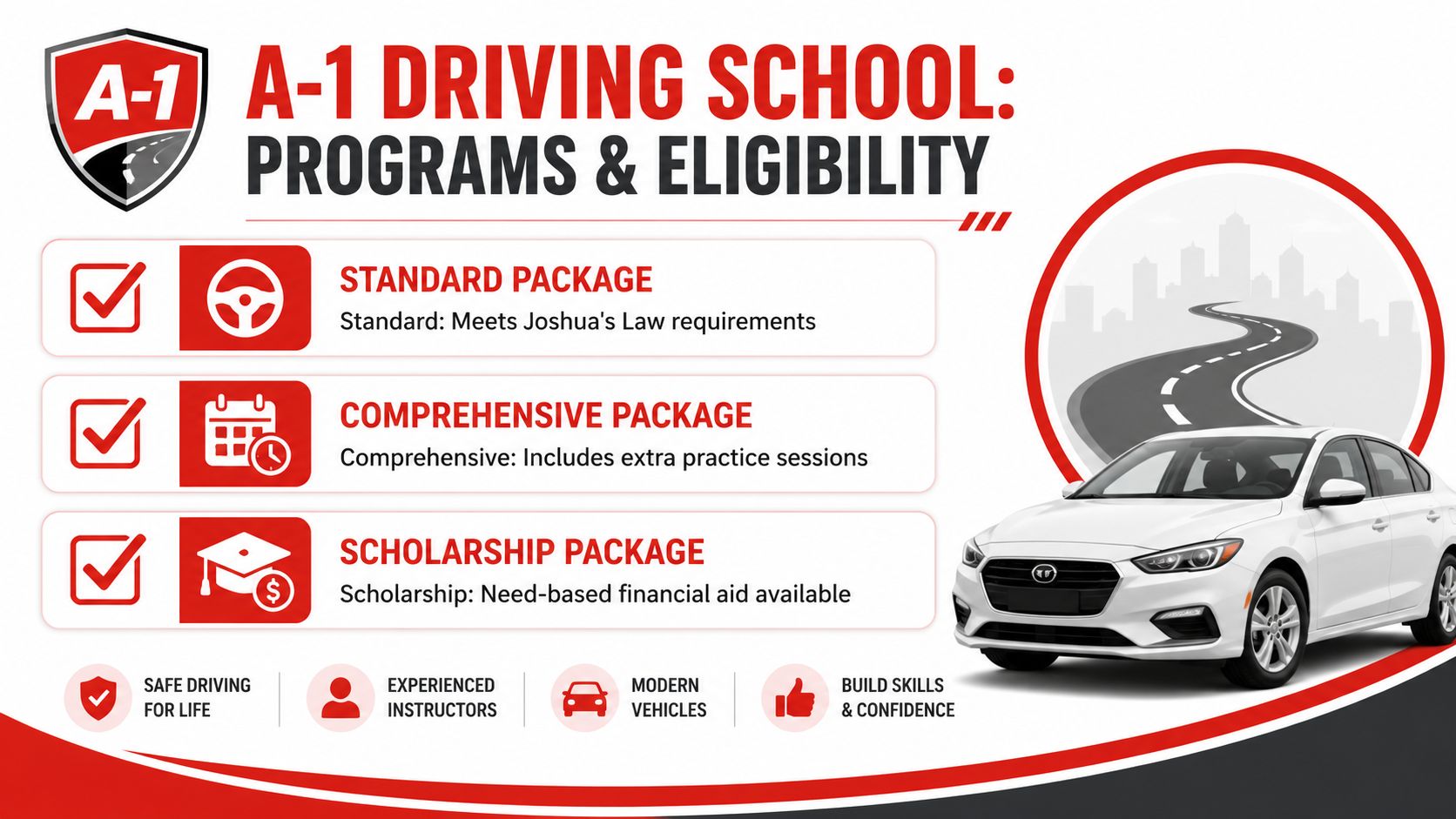
A-1 Driving School fits naturally into this conversation because it already serves Georgia families with instructor-led and online Driver's Education courses, teen and adult lessons, and road test preparation and assistance. The school is family-owned, has served Georgia since 1987, and works across 18+ locations in the metro area, including Athens, which matters for parents trying to avoid a long cross-town drive for every appointment. It's also described as the only provider holding the Fulton County Board of Education contract, so families in that system have a direct path to district-connected driver education.
The scale signals help parents judge whether a provider can keep up with volume during busy seasons. A-1 says it has 38+ years of experience, teaches 15,000+ classes annually, and has trained 100,000+ drivers. Those aren't teaching guarantees, but they do tell families the school isn't a one-off operation, and that matters when you're trying to schedule around high school calendars and permit timelines.
Where scholarship help fits in
The Georgia Driver's Education Scholarship Grant Program is the piece families should look at when the cost of training is the main barrier. A-1 notes that it offers scholarship grant access, and that means qualifying families may be able to reduce or eliminate out-of-pocket expense for approved training. The practical move is to verify eligibility early, because scholarship paperwork can affect timing just as much as money does.
Families should also compare how the provider structures online classes, road test help, and lesson packages. Some programs are more classroom-heavy, some are more practice-heavy, and some bundle testing support into the package so parents don't have to coordinate everything separately. A-1's mix of services makes it a relevant option for Georgia families who want one place to handle the course, lessons, and road-test prep.
For parents comparing schools across districts, the main question is whether the provider can align with Joshua's Law, the family's location, and the scholarship path. If all three line up, the rest of the decision becomes much easier.
Enrollment Steps From Online Course to Road Test
The cleanest enrollment process starts with one question, is the student ready for the online course, the lesson package, or both? If the answer is both, families should enroll in the approved classroom format first, because the online work often opens the door to the behind-the-wheel scheduling that comes later. That sequence saves time and prevents the common mistake of trying to book driving lessons before the course is complete.
From there, the family should map out the deadlines. Some programs require the online course to be finished in a shorter window, while others allow a longer span, so parents need to know the provider's completion rules before they buy. A student who works slowly and steadily often does better than one who tries to finish everything in a rushed weekend.
The order that keeps families from stalling
- Choose the course format early. Decide whether the student will take the approved classroom work online, in person, or through a hybrid arrangement.
- Finish the online portion on the provider's timeline. Don't wait until the last minute, because the pacing rules are there for a reason.
- Schedule behind-the-wheel lessons next. The classroom knowledge gets converted into actual skill with a certified instructor.
- Confirm test readiness. If the provider offers road test preparation or an on-site test, make sure the student has completed every required step before booking.
Parents also get tripped up by small omissions. A vision screening, missing paperwork, or a lesson booked too early can delay the whole process. If the school offers on-site road testing, that can remove an extra DDS trip, which is a real advantage for Atlanta-area families trying to limit missed work and missed classes.
If a provider can keep the sequence tight, the student spends less time waiting and more time driving.
The best enrollment plan is the one that respects the sequence. Learn the rules, drive with an instructor, then test with confidence, instead of trying to force those steps out of order.
Frequently Asked Questions From Georgia Parents
Does the online drivers ed certificate alone qualify a teen for a Class D license? No. The certificate covers the classroom requirement, but the teen still needs the behind-the-wheel training and the rest of the licensing steps.
How many behind-the-wheel hours does a teen usually need? The state minimum is 6 hours in the approved curriculum, but many families choose more practice if the teen still needs confidence or test readiness.
Can adults use the same online and driving lesson packages? Yes. Adults often use the same structure, although their reasons are usually different, like rebuilding confidence or correcting habits after time away from driving.
Who may qualify for the Georgia Driver's Education Scholarship Grant Program? Qualifying families should check the program's eligibility rules early, because scholarship access can affect both cost and enrollment timing.
A-1 Driving School offers Georgia families a clear path from approved online coursework to behind-the-wheel lessons, road test preparation, and scholarship-aware enrollment. If you're comparing online drivers ed and behind the wheel packages for a teen working toward Joshua's Law and a Class D license, visit A-1 Driving School and look at the course, lesson, and test options that fit your family's schedule.