

Your teen is turning 15, asking about permits, and already talking about driving to school, practice, or a part-time job. Most Georgia families hit the same moment. Excitement shows up first, then the questions start.
What does TADRA stand for? How does it affect a learner’s permit? Is Joshua’s Law the same thing? When can a teen drive friends? What has to happen before the road test?
Georgia’s teen licensing system makes more sense when you treat it like a sequence instead of a pile of rules. That is the goal here. You will get a plain-English roadmap from first permit to full license, with the confusing parts translated into steps a teen and parent can follow.
Decoding Georgia’s Driving Rules for Teens
In Georgia, teen drivers do not move straight from “I’m 15” to “I can drive anywhere.” The state uses a staged system so new drivers build skill a little at a time. That system is the rulebook families need to understand before the first trip to the DDS.

A lot of parents get tripped up because licensing rules, school requirements, insurance questions, and vehicle rules all start colliding at once. For example, once a teen starts driving, families often also ask practical questions about the car itself, including Georgia's legal limit for tint, because visibility and vehicle compliance matter too.
Why families get confused
Some rules apply to age. Some apply to license type. Some apply only during the first months after a teen gets a provisional license. That is why many parents feel like they are reading three different systems at once.
A simpler way to think about it is this:
- Step one: Get the permit and begin supervised practice.
- Step two: Complete the education and driving requirements for a provisional license.
- Step three: Stay violation-free and move toward full driving privileges.
If your family is just getting started, this quick guide on https://a1drivingschools.com/what-to-know-as-a-teen-driver/ can help answer the early questions before you schedule classes or driving time.
Tip: The easiest way to manage TADRA is to track progress in order. Permit first, training next, supervised practice after that, then road test prep.
What TADRA Stands For and Why It Was Created
TADRA stands for the Teenage and Adult Driver Responsibility Act. Georgia enacted it in 1997 to create a three-step graduated driver licensing system for drivers ages 15 through 18 and to reduce fatal crashes among young drivers.
Before TADRA, Georgia saw teenage drivers involved in fatal crashes at disproportionately high rates compared to other age groups. The law responded by limiting high-risk situations while teens gained experience, instead of giving brand-new drivers full freedom immediately.
Why Georgia built a staged system
New drivers usually need time to handle traffic, judgment calls, night driving, passengers, and distractions. TADRA addresses that by requiring teens to move through licensing in sequence.
That sequence matters because each stage adds experience before the next one begins. A teen starts with supervised driving, then moves to a restricted license, and only later qualifies for full privileges.
Did TADRA make a difference
The strongest reason families should take TADRA seriously is that Georgia’s results were measurable. A 2006 Emory University study analyzing 5.5 years after enactment found a 36.8% reduction in fatal crashes involving 16-year-old drivers and a nearly 50% decline in speed-related fatal crashes for that same group, according to Atlanta Insurance’s summary of the study and law.
That is the practical answer to “what does tadra stand for” beyond the acronym. It is a safety law designed to slow the process down so teens can gain experience under lower-risk conditions.
Key takeaway: TADRA is not paperwork for the sake of paperwork. It is Georgia’s way of helping teens earn driving freedom in stages.
The Three Steps of Georgia’s Graduated Driver Licensing
Georgia’s teen licensing path has three levels. Each one has its own age rules, restrictions, and requirements.
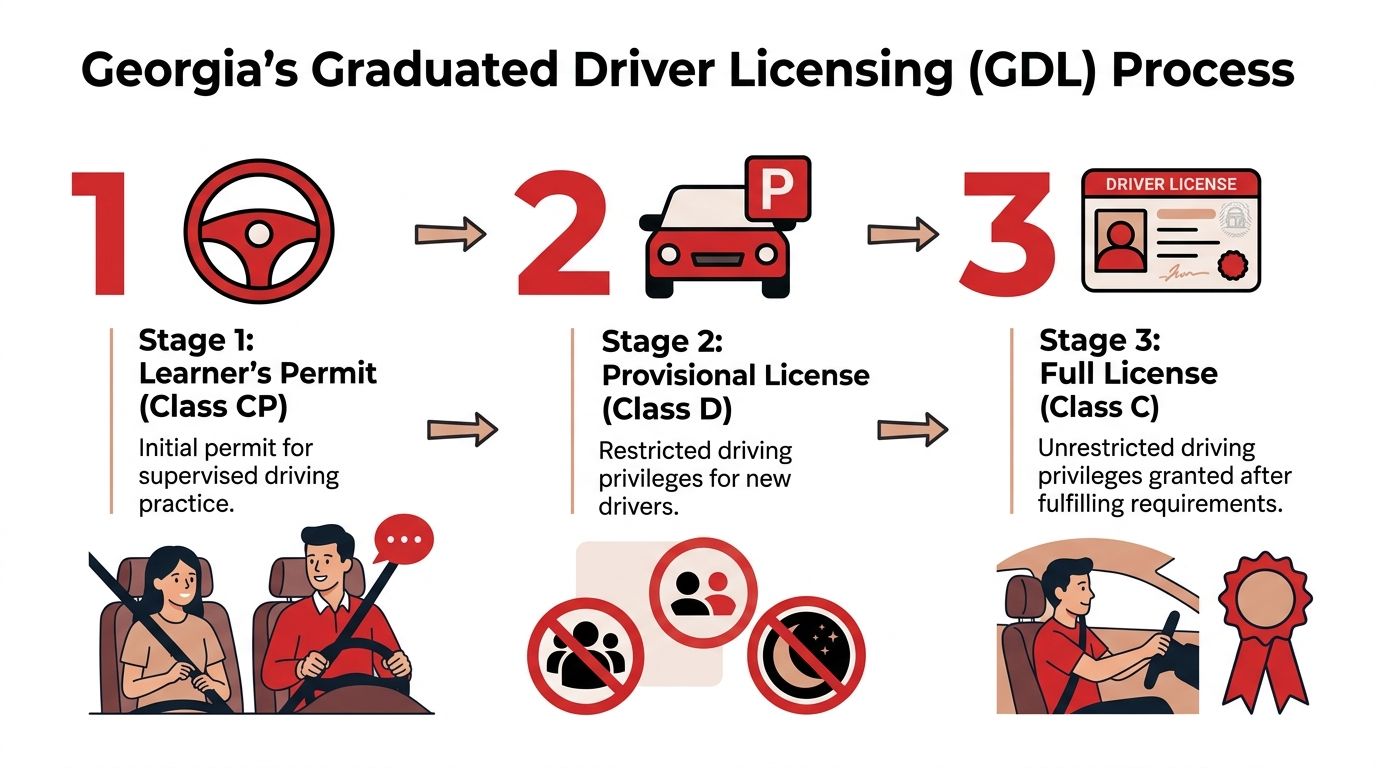
Step 1 with the Instructional Permit Class CP
A teen can begin at age 15 by applying for an instructional permit.
With a Class CP permit:
- Adult supervision is required: The teen may drive only with a licensed adult age 21 or older who has a valid Class C license.
- A knowledge test comes first: The permit stage begins after passing the required written test.
- Practice is the point: This stage is where teens learn basic control, scanning, turning, parking, and traffic judgment with an adult beside them.
This is also the stage where many families realize that “riding along with a parent” and “building real driving skill” are not always the same thing. Structured practice can make those hours more productive.
Step 2 with the Provisional License Class D
After holding the permit for one year, a teen can move to a Class D provisional license if the required steps are complete. Georgia also requires supervised practice time. To move from the permit to the provisional stage, a teen must complete and log 40 hours of supervised driving, including at least 6 hours at night, under TADRA rules listed by the Georgia DDS at https://dds.georgia.gov/chapter-1-tadra.
The provisional license gives more freedom, but it also comes with clear limits:
- Night driving restriction: No driving from 12 a.m. to 6 a.m.
- First six months: Only immediate family passengers are allowed.
- Second six months: One non-family passenger under 21 is allowed.
- After that: Up to three passengers under 21 are allowed.
Those passenger rules are where many teens get caught off guard. The license is not “open” just because it is no longer a permit.
If you want a more detailed breakdown of the eligibility process, https://a1drivingschools.com/how-to-get-provisional-license/ is a useful starting point.
Step 3 with the Full License Class C
The final stage is the full Class C license.
At this point, the teen has completed the earlier stages, met the supervised driving requirement, and stayed clear of major violations during the required period. Full licensure means the graduated restrictions end and the driver moves into standard driving privileges.
For most families, this stage feels simple because the hard part happened earlier. The important work involves building habits during the permit and provisional periods.
Georgia’s Graduated License At a Glance
| License Stage | Minimum Age | Key Requirements | Key Restrictions |
|---|---|---|---|
| Learner’s Permit Class CP | 15 | Pass the written test | Must drive only with a licensed adult age 21 or older with a valid Class C license |
| Provisional License Class D | 16 after holding permit for one year | Complete supervised driving log with required day and night hours | No driving from 12 a.m. to 6 a.m.; passenger limits apply |
| Full License Class C | After completing prior steps and meeting TADRA conditions | Complete licensing sequence and maintain a clean recent record for major violations | Graduated teen restrictions no longer apply |
Practical advice: Families do better when they treat the Class CP stage like training, not waiting. The more variety a teen gets in supervised practice, the smoother the Class D stage usually feels.
How Joshua’s Law Fits Into the TADRA Framework
Joshua’s Law is one of the biggest sources of confusion for Georgia families. Many people talk about it as if it were a separate route. It is not. It fits inside the same teen licensing path.
TADRA creates the overall graduated system. Joshua’s Law handles the driver education piece that many teens need before getting a Class D license at 16.
The simple way to think about it
TADRA is the framework. Joshua’s Law is part of the training requirement within that framework.
For families, that means the questions are usually practical:
- Does my teen need a driver education course
- Can the course be taken online
- When do behind-the-wheel lessons happen
- How does this line up with permit holding time and road test prep
What families usually need to arrange
Joshua’s Law commonly sends families looking for three things:
- A state-approved course option, either online or in person.
- Behind-the-wheel instruction for teens who need guided on-road training.
- A schedule that works with school, sports, and parent availability.
That is why course format matters. Some teens do well in a classroom setting. Others need online flexibility so they can complete the educational portion around a busy week.
If you have ever wondered where the name came from and why Georgia treats this part of training seriously, https://a1drivingschools.com/who-is-joshua-from-joshuas-law/ gives the background.
Tip: Parents often focus on checking the course box. The better approach is to pair the required education with actual driving lessons so the teen builds judgment, not just paperwork completion.
Penalties for Violating TADRA Rules
TADRA works because Georgia attaches real consequences to teen driving violations. For a parent, that means the restrictions are not suggestions. For a teen, it means one bad decision can delay the entire licensing path.
What can trigger a suspension
Under TADRA, a driver under 18 can face a license suspension of 6 to 12 months for a first DUI conviction with a blood alcohol concentration of 0.02 g/dL or higher, or for accumulating 4 or more points from traffic violations in any 12-month period, as stated by the Georgia DDS in the earlier licensing guidance.
That is why families should pay close attention to daily habits, not just major mistakes. Curfew rules, passenger rules, speeding, and general decision-making all matter because they can affect whether a teen keeps moving forward.
Why this matters so much for new drivers
A suspension does not just create inconvenience. It can interrupt practice, delay advancement, and force a teen to rebuild momentum after losing driving privileges.
This short video gives a helpful look at teen driving safety and rule awareness.
The most useful mindset is simple. Do not drive right up to the line. Stay well inside it.
Your Next Steps to Becoming a Safe Georgia Driver
Once you understand what does tadra stand for, the path gets much easier. The next move is not more research. It is building a plan your family can follow.
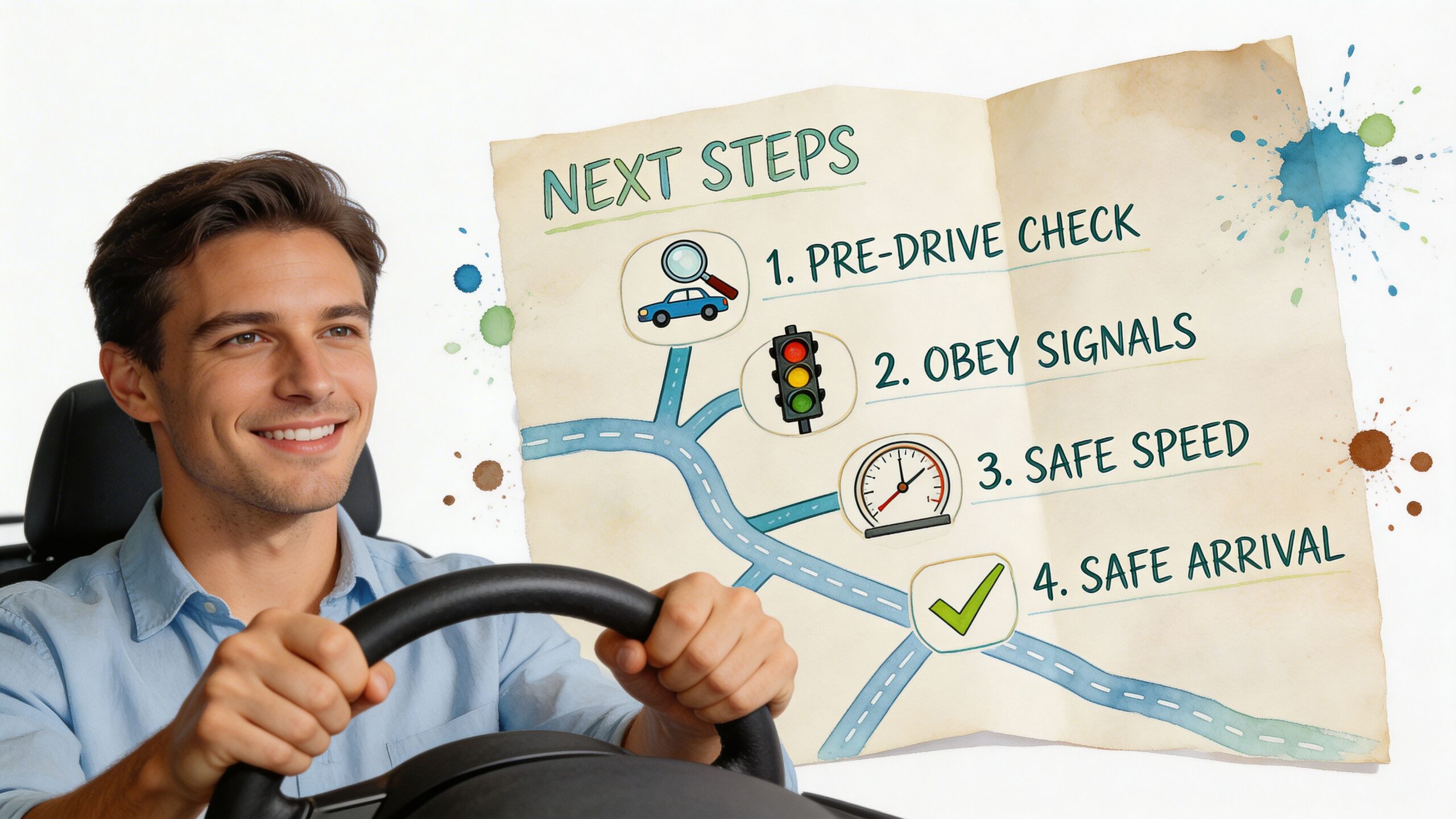
A practical checklist for teens and parents
- Start with the permit timeline: Make sure the teen understands that the permit stage is for supervised skill-building, not just waiting until a birthday.
- Choose the right education format: Some families need online coursework because schedules are tight. Others prefer in-person instruction.
- Add driving lessons early: Professional lessons can help teens practice turns, lane changes, parking, neighborhood driving, and busier roads with clear coaching.
- Track supervised hours carefully: Keep the required log organized and current.
- Prepare for the road test on purpose: Do not leave test prep to the final week.
- Ask about scholarship options: The Georgia Driver’s Education Scholarship Grant Program may help qualifying families access driver training.
- Review insurance before full driving begins: Parents who are adding a teen driver often also read up on Car Insurance In Georgia so they understand common coverage questions and policy basics.
Where training services fit into the process
One practical option is A-1 Driving School, which offers Joshua’s Law courses, online course options in Georgia, driving lessons, lesson packages, road test preparation, and Georgia road testing support through https://a1drivingschools.com/courses/.
For many families, the primary value is not a single class. It is matching the service to the stage:
- At the beginning: Driver education helps teens understand rules and responsibilities.
- During practice: Lesson packages give parents a structured way to build real road skills.
- Near licensing time: Road test prep helps teens clean up common mistakes before test day.
- If cost is a concern: Scholarship information can open the door to training a family may have delayed.
Keep the focus on skill, not speed
Parents often want the process to feel efficient. Teens want it to feel quick. The better goal is confidence with judgment.
A teen who has practiced left turns in traffic, safe following distance, mirror checks, lane position, parking, and night driving is usually in a much stronger position than a teen who only rushed to meet the minimum requirements.
Final takeaway: TADRA works best when families treat every stage as preparation for the next one, not as a hurdle to get past.
If your family is ready to move from questions to action, A-1 Driving School can help you line up the next step, whether that means a Joshua’s Law course, driving lessons, lesson packages, or road test preparation. Explore options and enroll at A-1 Driving School.