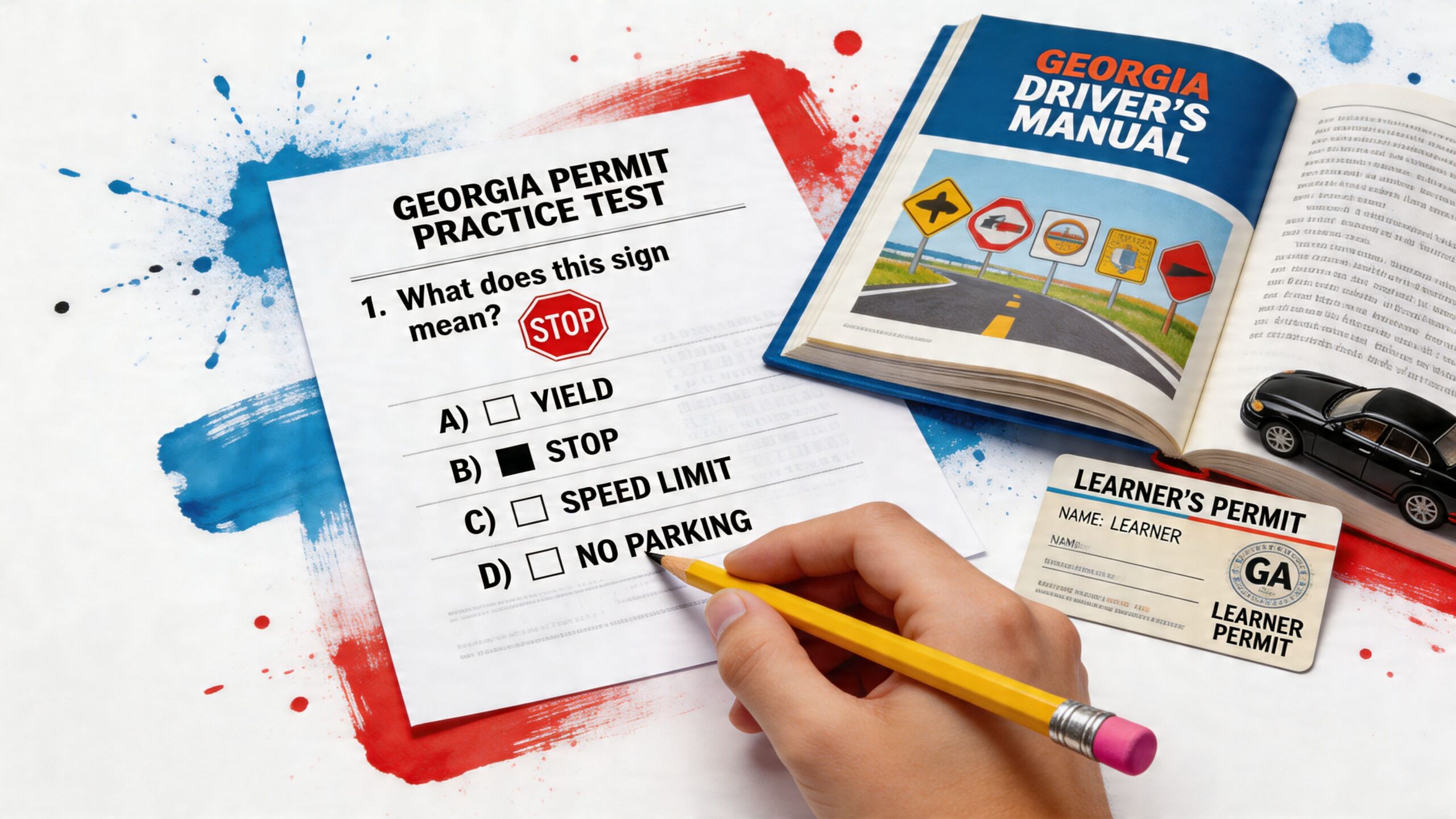
The Georgia Driver’s Manual is open, your phone has five tabs of practice questions, and every answer starts to blur together after a while. That’s a normal place to be.
Most students don’t struggle because they’re not smart enough to pass. They struggle because the ga permit practice test feels bigger and more confusing than it really is. Once you understand the test format, study the right material, and practice with a purpose, the whole process gets much more manageable.
Ready to Get Your Georgia Learner's Permit Let's Begin
A Georgia learner’s permit is usually your first real checkpoint on the road to driving on your own. For a lot of teens, it also comes with pressure from school, parents, schedules, and nerves. You might be wondering if you need to memorize the entire manual word for word. You don’t.
What matters is learning the rules well enough to recognize them in real situations. That means understanding signs by sight, knowing how Georgia expects drivers to handle intersections, and being able to spot the answer that is safest, not just the one that sounds familiar.
If you’re still figuring out the basics, this guide to getting your permit in Georgia helps put the process in order. That matters because students often mix up three separate things: studying for the knowledge exam, earning the permit, and completing the steps that come after the permit.
Practical rule: Study for understanding first, then use practice questions to test recall. If you reverse that order, you can memorize answers without learning the rule behind them.
A good study approach is simple:
- Start with the manual: Read in short sections instead of cramming.
- Separate signs from rules: They’re tested separately, so they should be studied separately.
- Use mistakes as clues: Every missed question points to a topic that needs one more review.
- Keep the goal narrow: You are not trying to become a perfect driver overnight. You’re trying to become a prepared beginner.
Students usually calm down once they realize the permit test isn’t random. Georgia asks about core driving knowledge. If you build that foundation one piece at a time, the test starts to feel less like a mystery and more like a checklist you can complete.
What to Expect on Your Georgia Permit Test
Before you study harder, it helps to know exactly what the DDS is asking you to do.
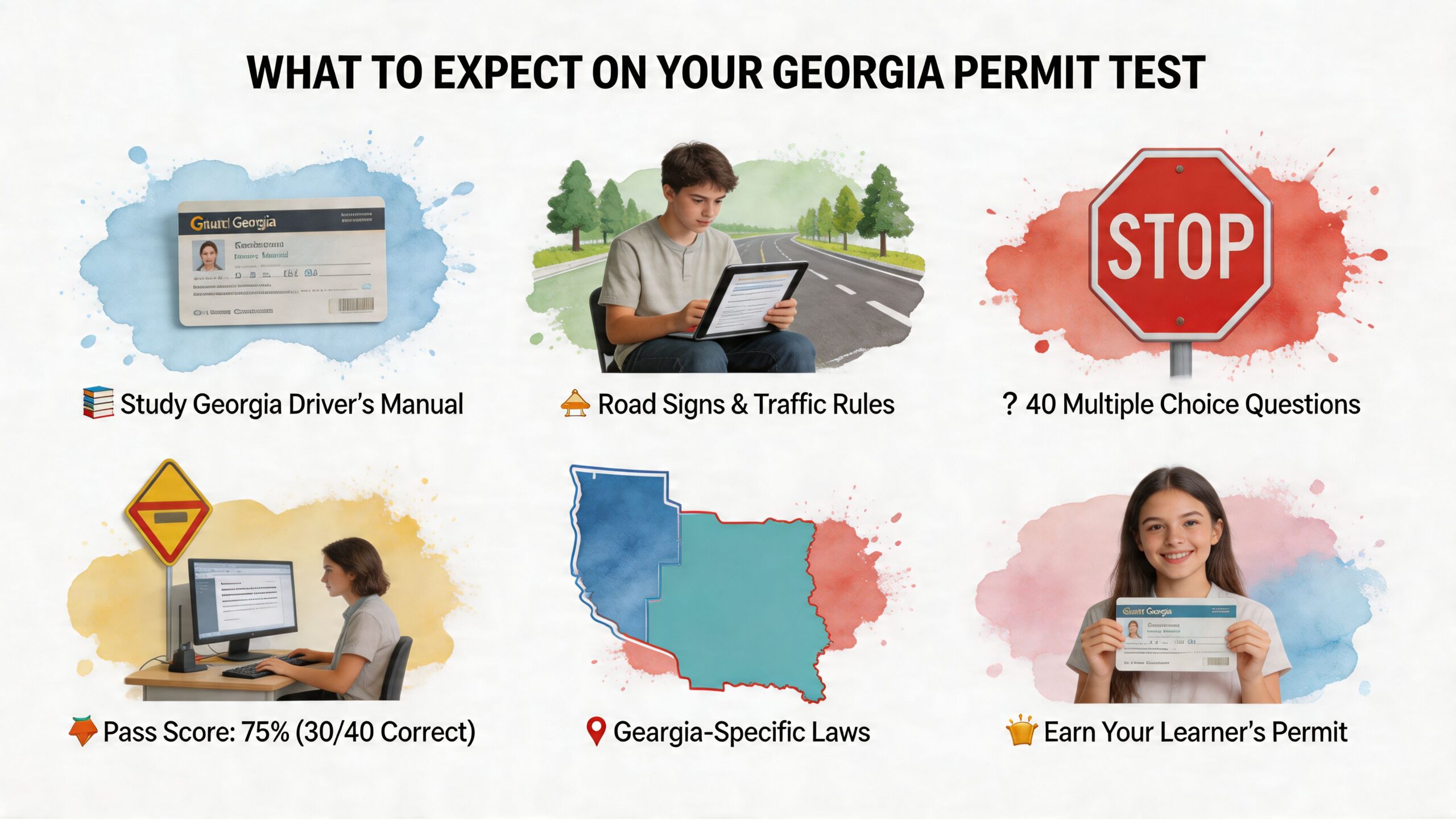
The Georgia knowledge exam has 40 multiple-choice questions, split into 20 road rules questions and 20 road signs questions. To pass, you must get at least 15 correct in each section, which is 75% per section. The average first-try pass rate is 57%, and one reason many students fail is that they do well overall but fall short in one section. The test costs $10 and is offered in multiple languages, according to Georgia permit test details from Driving-Tests.org.
The two-section rule matters
A lot of students assume, “If I do great on rules, that will make up for signs.” It won’t.
Georgia treats road rules and road signs as two separate hurdles. If you miss too many sign questions, a strong rules score won’t rescue you. That’s why students who only read the manual straight through often get surprised. They studied “driving” in general, but they didn’t prepare for the test structure.
If you want to see the format in a visual way before test day, this page on what a permit test looks like is useful.
What the questions usually feel like
The exam is based on the Georgia Driver’s Manual. Expect questions on topics such as:
- Road rules: Right-of-way, lane use, school zones, safe driving practices, and other basic traffic laws.
- Road signs: Warning signs, regulatory signs, guide signs, and sign shapes and colors.
- Situational judgment: What you should do at an intersection, near a school bus, or when sharing the road.
The questions aren’t there to trick you, but they do test whether you can apply what you read. That’s where students get caught. It’s one thing to recognize a sentence in the manual. It’s another thing to answer a question that changes the wording and asks you to choose the safest action.
The students who pass most comfortably are usually the ones who stop asking, “What’s the answer?” and start asking, “What rule is this testing?”
Why students stumble
Most first-time misses fall into a few predictable patterns:
- They underprepare for signs. Signs look easy until two similar choices appear next to each other.
- They rush simple questions. A missed word like “not” can flip the whole meaning.
- They study passively. Reading without self-testing creates false confidence.
- They ignore section balance. Spending all your time on rules can leave the signs section exposed.
Here’s the good news. Once you know the test blueprint, you can study in a much smarter way. Instead of trying to remember everything at once, you can build skill in the exact categories Georgia uses.
Your Week-by-Week Plan to Pass the Permit Test
Students usually ask me one version of the same question: “How do I study without wasting time?” The answer is to divide your prep into short, repeatable blocks and treat road rules and road signs as different subjects.
The signs section must be passed independently at 15 out of 20, and color and shape matter. Practice resources also note that tricky topics such as Georgia’s Slowpoke Law and right-of-way at uncontrolled intersections cause many failures, and the test is available in English, Spanish, Chinese, Vietnamese, and Russian, according to Joshua’s Law practice test guidance.
First build recognition, then speed
For road signs, start with visual recognition. Don’t begin by trying to memorize long definitions. Learn the sign’s color, shape, and purpose together.
A simple example:
- A red sign usually signals prohibition, stopping, or a strict command.
- A yellow sign is usually a warning.
- Shape also matters. An octagon means stop, even before you read the word.
That skill helps when nerves kick in. If your brain freezes on the wording, the shape and color can still guide you.
For rules, act out the scenario in your head
Road rules are easier when you turn the question into a real scene. If a problem asks about an uncontrolled intersection, don’t stare at the answer choices. Pause and picture two cars arriving. Ask yourself who got there first, who is to the right, and what the safest move is.
That same approach helps with Georgia-specific trouble spots. The Slowpoke Law can confuse students because they focus on speed limits in only one direction. On the test, Georgia may ask whether driving too slowly can also create a problem. The key is to think about traffic flow, not just the posted maximum.
Study shortcut: If a rule feels abstract, imagine it happening on a road you know. Your neighborhood, your school entrance, or a familiar four-way stop works fine.
A one-week study schedule that actually works
You don’t need marathon sessions. You need steady repetition. Here’s a simple schedule you can follow.
| Day | Road Rules Focus (30 mins) | Road Signs Focus (30 mins) |
|---|---|---|
| Monday | Read one manual section on basic traffic laws and take notes in your own words | Review common warning and regulatory signs by color and shape |
| Tuesday | Practice right-of-way questions, especially intersections and yielding | Study stop, yield, school, and railroad-related signs |
| Wednesday | Review school zones, lane use, and safe passing rules | Mix sign flashcards and identify signs without reading labels first |
| Thursday | Focus on Georgia-specific rules that are easy to confuse, including slower traffic rules | Practice similar-looking signs and explain the difference out loud |
| Friday | Take a short road rules quiz and review every missed answer | Take a short road signs quiz and group misses by pattern |
| Saturday | Do a mixed practice set and mark weak areas | Do a mixed sign set under mild time pressure |
| Sunday | Re-read only the topics you missed during the week | Final sign review using shape, color, and meaning together |
How to review missed questions
Most students waste the best part of practice. They check whether they were right, then move on too fast.
Use this method instead:
- Write the topic, not just the answer: “Right-of-way at uncontrolled intersection” is more useful than “I missed number 8.”
- Explain why the wrong choices were wrong: That trains your judgment.
- Retest the weak topic the next day: Don’t wait until the end of the week.
- Say the rule aloud: Speaking it clearly often reveals whether you understand it.
What to do if English is not your strongest language
Some students know the rule but freeze on wording. If that sounds like you, practice in the language you’ll use on test day whenever possible. Keep your study materials consistent. Switching back and forth too often can make common terms harder to recall under pressure.
It also helps to create a tiny vocabulary list of words that show up often in driving questions, like yield, merge, shoulder, intersection, and right-of-way. Once those words feel familiar, the question becomes easier to decode.
How to know you’re ready
You’re close when three things happen:
- You can identify most common signs quickly without guessing.
- You can explain intersection questions without reading the choices first.
- Your mistakes come from carelessness, not confusion.
If you’re still guessing between two answers over and over, that’s not failure. That’s useful information. It means your next study session already has a job.
Take Our Full-Length GA Permit Practice Test
Practice is where the information starts to stick. Reading the manual gives you the material. Answering questions forces your brain to retrieve it.
That matters because unassisted, first-time test takers fail about 40% of the time, while structured practice can raise first-try success from 51% to over 92% for users who regularly practice and review answers, according to DMV practice test analytics for Georgia.
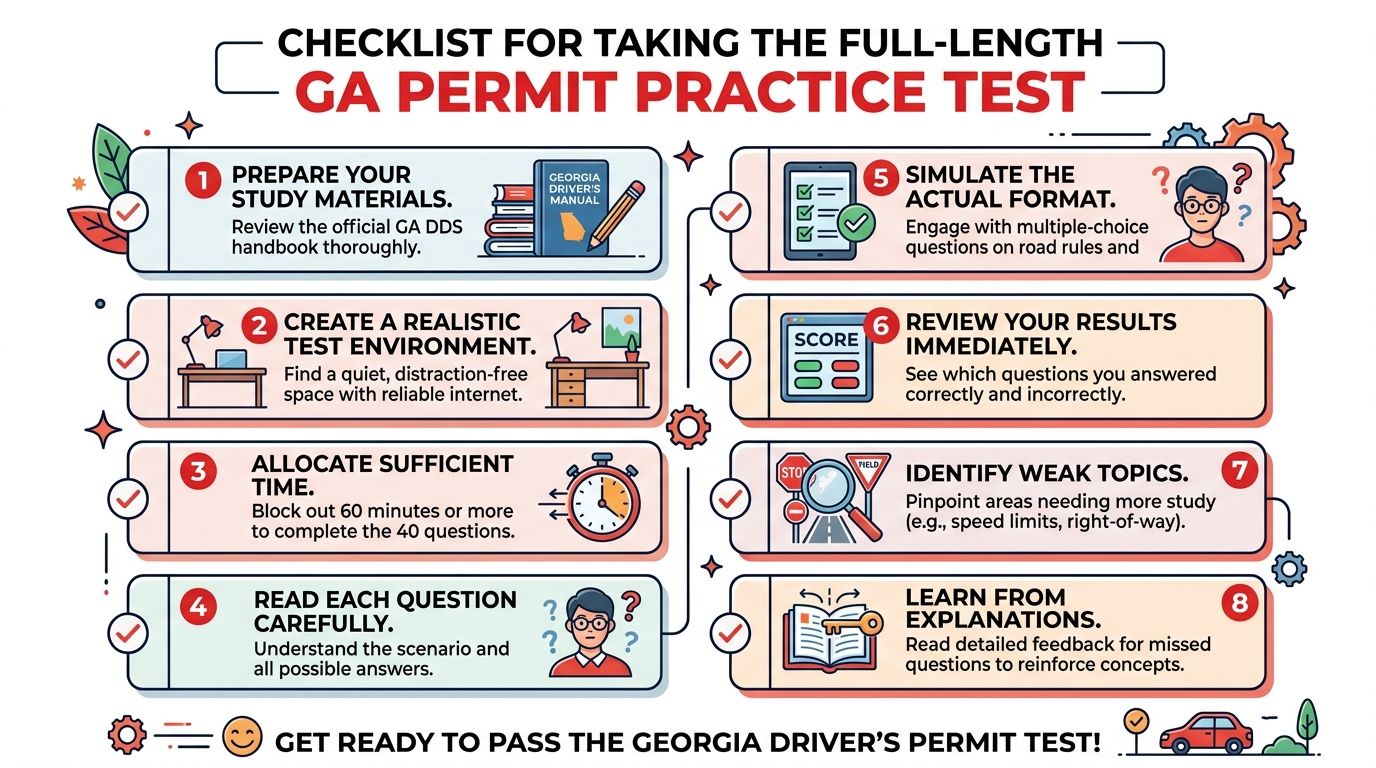
Use the questions below like a real ga permit practice test. Try answering on your own first. Then check the explanation. The explanation is where the learning happens.
Road rules practice questions
1. You arrive first at a four-way stop. What should you generally do?
A. Wave everyone else through
B. Go first when it is safe
C. Let the driver on the right go first no matter what
D. Back up and wait
Correct answer: B
Why: At a four-way stop, the driver who arrives first generally goes first when it is safe. Students get tripped up because they memorize only “yield to the right.” That rule matters when vehicles arrive at about the same time. Arrival order still matters.
2. When approaching a school zone, what should you do first?
A. Speed up before entering
B. Ignore signs if no children are visible
C. Watch for posted instructions and reduce speed as required
D. Change lanes quickly
Correct answer: C
Why: School zones are about caution, awareness, and following the posted rules. A common mistake is assuming the zone only matters when students are easy to see. On a test, the safest legal response is usually the right one.
3. What does right-of-way mean?
A. The right side of the road
B. A guarantee that you can go first
C. A legal priority that still requires you to drive carefully
D. A rule that applies only at traffic lights
Correct answer: C
Why: Right-of-way is not permission to force your way through. It means one road user has legal priority, but everyone must still avoid a crash if possible. That distinction appears in many permit questions.
4. If two vehicles reach an uncontrolled intersection at about the same time, what principle should guide you?
A. The larger vehicle always goes first
B. The vehicle on the left generally yields to the vehicle on the right
C. The faster vehicle goes first
D. Whoever honks first goes first
Correct answer: B
Why: This is one of the classic Georgia trouble areas. If arrival is close, the driver on the left generally yields to the driver on the right. Picture the intersection. Don’t answer from instinct.
5. Why can driving too slowly sometimes be a problem?
A. It never is
B. It can interfere with normal traffic flow
C. It automatically saves fuel
D. It cancels speed limits
Correct answer: B
Why: Students often focus only on not speeding. Georgia also expects drivers to avoid unnecessarily impeding traffic. The test may present this as a safety and traffic-flow issue.
6. When should you choose the safest answer instead of the most aggressive one?
A. Only during road tests
B. Only at night
C. On every permit test question involving judgment
D. Only when police are present
Correct answer: C
Why: Permit questions often reward the safest legal action. If two choices seem possible, the safer one is often the better choice.
7. A driver should read permit questions carefully because
A. the shortest answer is usually correct
B. one keyword can change the meaning of the question
C. all wrong answers look the same
D. the test is based on trick wording only
Correct answer: B
Why: Words like “first,” “best,” “must,” and “not” matter. Many missed questions come from reading too fast.
8. If you do well on road rules but fall short on road signs, what happens?
A. You still pass based on your total score
B. You pass if your rules score is strong enough
C. You do not pass because each section matters on its own
D. You can skip the signs section next time
Correct answer: C
Why: This is one of the most important test-day facts. The exam is not just about your combined total. Section performance matters.
9. Which study habit helps most after a missed practice question?
A. Memorizing the answer choice letter
B. Reviewing why the rule works
C. Skipping that topic because it is confusing
D. Changing to random topics
Correct answer: B
Why: You want to learn the rule, not just the answer key. If the wording changes on the official test, understanding will still carry you.
10. What is the best response if a question describes a confusing traffic situation?
A. Guess immediately
B. Think about a real road situation and apply the rule
C. Pick the longest answer
D. Skip all intersection questions
Correct answer: B
Why: Visualization helps. Turning a question into a real scene slows you down in a good way.
Road signs practice questions
11. Why does sign shape matter on the permit test?
A. It doesn’t matter if you can read fast
B. Shape helps identify a sign even before reading the words
C. Only color matters
D. Shape is used only on maps
Correct answer: B
Why: Shape is one of the fastest clues on the test. If you recognize the form immediately, you cut down on guessing.
12. A yellow sign generally signals
A. a stop requirement
B. a warning
C. a parking permit
D. a hospital entrance only
Correct answer: B
Why: Yellow signs usually warn you about upcoming conditions. This is why color recognition is such a powerful study tool.
13. A red sign often indicates
A. information only
B. recreation areas
C. prohibition, stopping, or a strict command
D. lane decoration
Correct answer: C
Why: Red is used where attention and compliance are critical. Students sometimes mix up warning signs and command signs. Color helps separate them.
14. If you cannot remember the wording on a sign question, what should you use first?
A. Guess based on the longest answer
B. Sign color and shape
C. Whatever your friend told you
D. The answer in the same position as the last question
Correct answer: B
Why: This is exactly why signs should be studied visually, not only verbally.
15. What is the smartest way to study two similar-looking signs?
A. Ignore both until the night before the test
B. Compare them side by side and state the difference out loud
C. Memorize only one
D. Skip signs and focus on rules
Correct answer: B
Why: Saying the difference aloud forces precision. “This one warns. This one commands.” That simple habit reduces confusion.
16. A sign question becomes easier when you
A. separate color, shape, and purpose
B. look only at the answer choices
C. assume all triangle-shaped signs mean speed up
D. treat every sign as a word puzzle
Correct answer: A
Why: Breaking sign recognition into three parts gives your brain more than one way to retrieve the answer.
17. Why do many students miss road signs?
A. Signs are never on the official test
B. They study signs as random pictures instead of categories
C. The signs section does not count
D. There are no patterns to learn
Correct answer: B
Why: Grouping signs by function and appearance creates a system. Random memorization fades fast.
18. A warning sign should make you think
A. “This does not matter until I see danger”
B. “I should expect a condition ahead and prepare”
C. “I can ignore this if traffic is light”
D. “This sign is optional”
Correct answer: B
Why: Warning signs prepare you for what is coming next. Good drivers adjust early.
19. If a road sign question gives you two plausible answers, what should you check?
A. Whether the sign’s color and shape fit one option better
B. Which answer sounds more dramatic
C. Which answer you chose last time
D. Whether the shortest answer is available
Correct answer: A
Why: Sign features often break the tie between close answer choices.
20. What is a strong last-step review for signs before test day?
A. Read all sign names once and stop
B. Cover the labels and identify the sign by appearance and meaning
C. Study only after midnight
D. Avoid sign practice to stay calm
Correct answer: B
Why: That method mirrors the actual challenge. You won’t get the sign with its label attached on the test.
How to use this practice test well
Don’t just score yourself and move on. Break your misses into categories.
| Weak Area | What It Usually Means | Best Next Step |
|---|---|---|
| Intersections | You know the words but not the order of actions | Recreate the scenario on paper and talk through who yields |
| School zone questions | You’re reading too generally | Re-read the specific rule and look for posted-instruction language |
| Slowpoke Law questions | You remember only maximum speed ideas | Review traffic-flow concepts and safety purpose |
| Sign confusion | You’re relying on wording too much | Drill by color, shape, and purpose without labels |
“If you miss a question twice, it’s no longer a memory problem. It’s a concept problem.”
A better way to repeat practice
Try this three-pass method:
- First pass: Answer normally without notes.
- Second pass: Review only the questions you missed and write the rule in plain language.
- Third pass: Return a day later and retake just that weak category.
That approach turns practice from simple checking into actual training. Students who do this usually feel calmer because they can see improvement topic by topic.
Beyond the Permit Your Path to a Georgia Driver's License
Passing the permit test feels huge, and it should. But many Georgia teens hit the same wall right after that moment. They ask, “Now what?”
That confusion is common. Online forums show that 70% of Georgia teens ask what comes after the permit, and many practice test sites don’t connect the permit to Joshua’s Law or the Class D license path. The same source notes that A-1 Driving School is a DDS-approved provider that has served over 100,000 drivers since 1987, according to Georgia DDS practice test context on next steps.
What comes after you pass
For teens, the permit is not the finish line. It opens the door to the rest of driver education.
That next stage usually includes learning the Joshua’s Law requirements, scheduling formal driver’s education, getting real behind-the-wheel practice, and preparing for the road test. Many families often get lost during this process because practice test websites stop at the written exam.
A clear next-step guide like how to get your driver’s license in Georgia helps connect the permit to the full licensing path.
Why hands-on instruction matters
A permit proves you know basic rules. It does not mean you’re ready for lane changes in traffic, left turns at busy intersections, parking, or making good choices under pressure.
That’s why driving lessons matter so much. A structured lesson gives you a coach in the car, immediate correction, and practice in situations that usually scare new drivers the most. Lesson packages can also help families create consistency. Instead of hoping practice happens, it gets scheduled and taught.
Some students need confidence first. Others need technique first. Good instruction adjusts to both.
Online courses, Joshua’s Law, and road testing
A lot of families need flexibility. Online driver’s education can make the classroom side easier to fit around school, sports, and work. For many teens, that’s the difference between delaying training and completing it.
Once a student moves beyond permit study, they may also need road test preparation and a clear timeline for the final exam. That full journey matters more than a single written score because safe driving is built in stages.
If you want a plain-language legal overview of why license rules matter in Georgia, Brian Hansford Law explains Georgia driving laws in a way that can help parents and teens understand the bigger picture.
Don’t overlook scholarship options
Cost is a real concern for many families. The Georgia Driver’s Education Scholarship Grant Program can make quality training more accessible for qualified students.
If that applies to your family, it’s worth asking about it early. Scholarship spots, paperwork, and scheduling usually go more smoothly when you plan ahead instead of waiting until you’re ready to road test.
Common Questions About the Georgia Permit Test
What should I bring to the DDS for my permit test
Bring every required document in original or approved form, and check them before you leave home. The biggest preventable problem on permit day is not the test itself. It’s showing up with missing paperwork, outdated paperwork, or the wrong supporting form.
A good habit is to lay everything out the night before in one folder. Then have a parent or guardian double-check it with you.
Is the permit test timed
The Georgia permit knowledge exam does not have a time limit, based on the verified test details discussed earlier. That sounds comforting, but students still rush. Give yourself permission to slow down, especially on sign questions and intersection questions.
Read the full question. Then read all four answers before picking one.
Final check before you tap an answer: Ask yourself, “What rule is this testing?”
What if I fail one section but do well on the other
You need balanced preparation because the test is divided into separate parts. If one section falls short, that weak section can keep you from passing even if you felt strong overall.
The best response is not to panic or restart from zero. Go back to the category that caused trouble. If signs were the issue, return to color, shape, and purpose. If rules were the issue, focus on scenarios such as yielding, school zones, and intersection order.
Should I keep taking practice tests over and over
Yes, but only if you review them properly. Repeating questions without thinking can make you memorize patterns instead of learning rules.
A smarter approach is to rotate between three things:
- Manual review: Short reading sessions on weak topics
- Focused practice sets: One category at a time
- Mixed review: A realistic blend of signs and rules
That combination builds both recall and judgment. That’s what you need on test day.
If you’re ready to move from permit prep to the full licensing path, A-1 Driving School offers Joshua’s Law courses, online driver’s education options, road test preparation, scholarship guidance, and driving lessons packages that help teens and adults build real confidence behind the wheel.