
Your hands are on the wheel, but your body is acting like you're in danger. Your shoulders creep up. Your breathing gets shallow. A lane change that looked easy yesterday suddenly feels impossible today.
If that sounds familiar, you're not weak, and you're not the only one. I’ve worked with nervous drivers long enough to know this fear can show up in a lot of ways. Sometimes it starts after a crash. Sometimes it starts with one bad merge, one honk, one failed road test, or months of not driving at all. For many Georgia drivers, the hardest part isn’t learning the rules. It’s getting your nervous system to believe you can handle the road.
The good news is that this can improve. Not with pressure, and not by forcing yourself into traffic you’re not ready for. It gets better with a calm plan, repeated practice, and the right kind of support.
Understanding Driving Anxiety and Its Impact
A student once told me, “I’m fine until I need to speed up.” That’s how driving anxiety often works. You may feel okay in a parking lot, then tense up at a left turn, a highway entrance, or a busy school-zone pickup line. The fear can seem random until you slow down and notice the pattern.

What it can feel like
Driving anxiety can be physical, mental, and behavioral at the same time. Your body gets loud before your thoughts do.
Common signs include:
- Physical tension: tight grip on the wheel, sweating, shaky legs, jaw clenching, or a pounding heart
- Racing thoughts: “I’m going to mess this up,” “I’ll miss the sign,” “I can’t merge,” or “I’m holding everyone up”
- Avoidance: skipping highways, refusing left turns, only driving with someone else in the car, or putting off practice for weeks
Some people also realize they relate to amaxophobia (fear of driving), which can help put a name to what they’ve been experiencing.
Why this fear is so common
Driving asks you to process a lot at once. Speed, distance, mirrors, other drivers, signals, signs, and timing all compete for attention. If you’ve had a stressful event on the road, your brain may start treating normal driving situations as threats.
That reaction is more common than often realized. In the U.S., 66% of Americans experience driving anxiety, and 55% feel nervous during everyday maneuvers according to The Zebra’s driving anxiety overview. The same source notes that up to a third of people involved in a non-fatal car accident develop PTSD symptoms, which can show up as fear of driving.
Driving anxiety often looks like a skill problem from the outside, but for many people it’s a fear cycle. A hard moment leads to avoidance, avoidance lowers confidence, and lower confidence makes the next drive feel even harder.
What usually confuses drivers
Many anxious drivers think, “If I were really capable, I wouldn’t feel this way.” That’s not how anxiety works. You can know the rule and still freeze while trying to apply it in real traffic.
You can also be a licensed driver and still feel panicked. Adults often assume they should be “past this already,” while teens worry they’re behind everyone else. Both groups make the same mistake. They judge themselves for the fear instead of learning how to work with it.
If you want to know how to overcome driving anxiety, start with this truth. Fear doesn’t automatically mean you’re unsafe. It means your brain is overpredicting danger. That can be retrained.
Immediate Techniques to Calm Your Nerves
You don’t need to wait until you feel fully confident to get some relief. A few practical techniques can lower the intensity enough to help you think clearly and make better decisions.

Start before the key turns
The best time to calm your body is before you start moving. Once panic builds, everything feels urgent. Give yourself a short reset in the parked car first.
Research on in-vehicle coping strategies points to controlled breathing, sensory grounding, and positive self-talk as useful tools, and notes that using them before and during a drive helps calm the fight-or-flight response. You can read more in this discussion of somatic approaches for driving anxiety.
Try this short pre-drive routine:
- Settle your posture: place both feet flat, drop your shoulders, and loosen your jaw
- Name the drive: say out loud where you’re going and what the first step is
- Lower the pressure: tell yourself, “I only need to do the next safe step”
That last line matters. Anxiety wants you to think about the whole trip at once. Calm comes from shrinking the task.
Use box breathing when your body speeds up
If your chest feels tight or your breathing gets shallow, slow the rhythm on purpose. A simple version is Box Breathing, which many drivers find easier than trying to “just relax.”
Use it like this while parked:
- Inhale slowly
- Hold briefly
- Exhale slowly
- Pause before the next breath
Repeat for a few rounds. Don’t force a giant breath. Gentle, steady breathing works better than trying to gulp in air.
Practical rule: If your body feels urgent, slow the exhale first. Most anxious drivers focus on “breathing more.” What helps most is often breathing slower.
If panic tends to hit before lessons or practice sessions, this guide on what to do when you start to panic while driving can help you think through safe next steps.
Ground yourself with your senses
When your thoughts start spiraling, bring your attention back to what is physically present. One easy version is the 5-4-3-2-1 grounding method.
Notice:
- 5 things you can see
- 4 things you can feel
- 3 things you can hear
- 2 things you can smell
- 1 thing you can taste
You can do a driving-friendly version too. While stopped safely, name the steering wheel in your hands, the seat under your back, the sound of the air, and the shape of the lane ahead. This interrupts the mental movie of “what if.”
Here’s a short video that can support that reset and help you settle before practice:
Release tension where drivers hold it most
Anxious drivers often don’t realize how much they’re bracing. The usual spots are the neck, shoulders, hands, and stomach. If those muscles stay tight, your brain reads that tension as proof that something is wrong.
Before driving, try this:
- Shrug your shoulders up, hold briefly, then release
- Press your hands together, then let them soften
- Unclench your jaw and rest your tongue
- Loosen your grip on the wheel to a controlled, not crushing, hold
Use a script, not a pep talk
Big motivational speeches usually don’t work in anxious moments. Short, believable phrases do.
Useful examples:
- “I can be nervous and still drive safely.”
- “I only need to handle this one part.”
- “Slow is fine. Safe is the goal.”
That’s the difference between trying to overpower fear and learning how to drive with steadiness.
Building Confidence with a Graduated Practice Plan
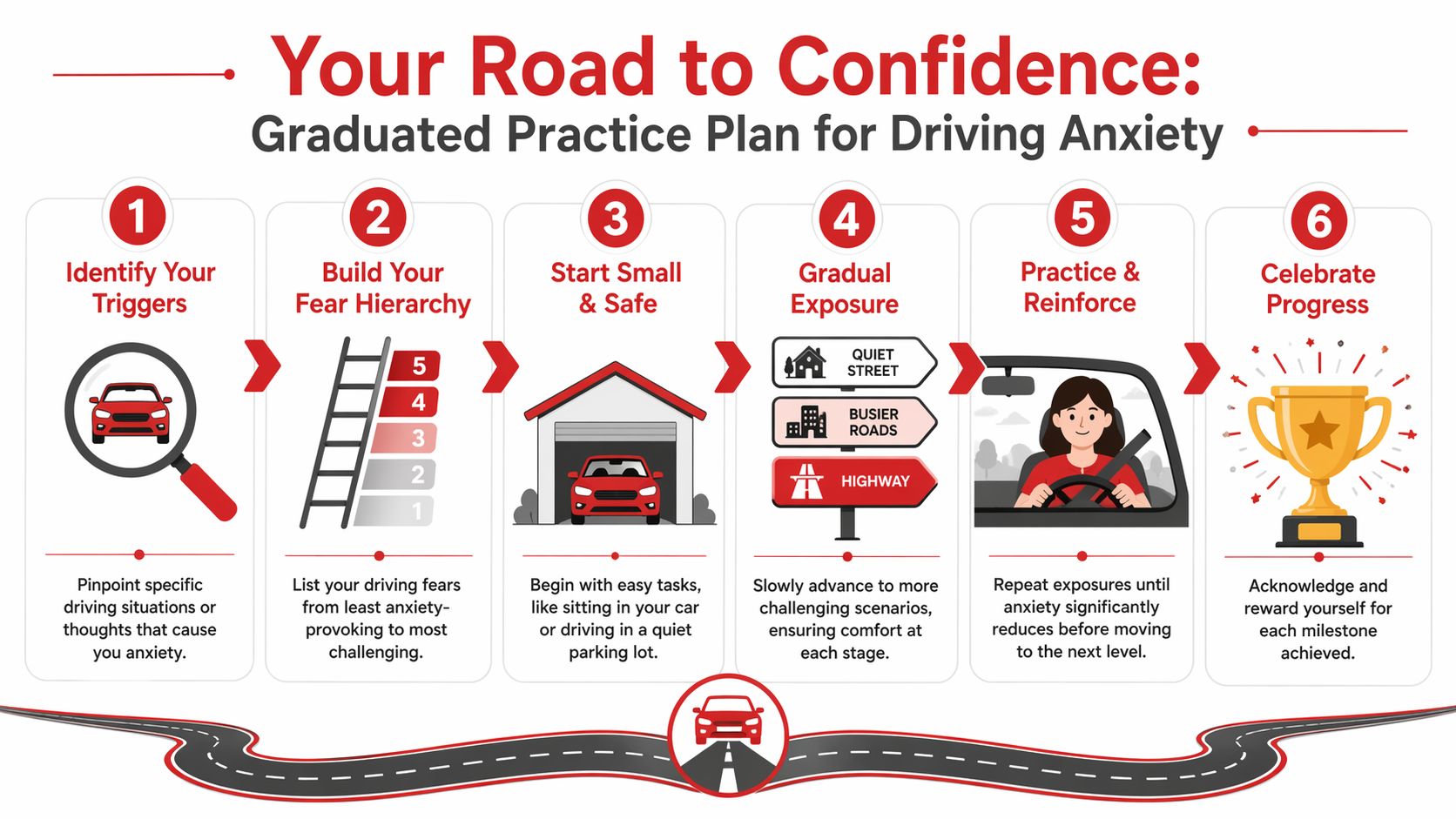
Confidence usually doesn’t appear first. Practice does. The safest way to build confidence is through graduated exposure, which means you face driving in small, manageable steps instead of jumping into your hardest situation right away.
Clinical guidance on exposure therapy for fear of driving describes it as the most effective treatment for specific phobias like driving fear. The basic idea is simple. You create new, safe experiences that teach your brain, “I can do this without disaster.”
Why jumping ahead backfires
Many people try to cure fear by forcing themselves onto the most stressful road they can think of. That often leads to white-knuckle driving, near panic, and another bad memory.
A better approach is to choose practice that stretches you without flooding you. You want enough challenge to grow, but not so much that your body goes into full shutdown.
If a practice session leaves you overwhelmed every time, the step is too big. Cut it down until you can repeat it successfully.
Build your fear ladder
Write down the situations that make you nervous, starting with the easiest and ending with the hardest. Be specific. “Driving” is too broad. “Turning right at a quiet stop sign” is useful.
A simple fear ladder might look like this:
- Sit in the parked car
- Start the engine and stay parked
- Drive in an empty lot
- Make slow turns in a quiet neighborhood
- Drive on a local road with light traffic
- Handle lane changes on a busier road
- Practice entering and exiting a highway
Each step should feel doable, not pleasant. You’re not waiting until it feels easy. You’re choosing a level where you can stay engaged and learn.
A step-by-step practice sequence
Step one with no pressure
Sit in the car without going anywhere. Adjust the mirrors. Put your hands on the wheel. Practice calm breathing. If even this raises your heart rate, stay here until your body settles faster.
Step two in a low-stakes space
Move the car in an empty parking lot or a very open area. Practice stopping smoothly, turning, backing up, and parking. Keep the session short.
Step three on familiar streets
Choose a neighborhood route with low speed and low traffic. Drive the same route several times on different days. Familiarity lowers the mental load.
Step four with one new challenge
Add only one harder skill at a time. That might be a busier intersection, a left turn with a light, or a slightly faster road. Don’t add highway speed and unfamiliar navigation on the same day.
Step five with repetition
Stay on a step until the anxiety drops enough that you can think, scan, and respond. You don’t need zero fear. You need enough calm to drive with control.
Step six toward real-life driving
Once smaller tasks feel steadier, practice the routes that matter to your life. School. Work. Practice locations. The DDS area. Grocery store. Home at dusk.
For road test nerves, it helps to know what examiners are looking for before test day. Reviewing a practical guide on how to prepare for a driving test can make your practice sessions more focused.
Graduated Exposure Plan comparison
| Factor | Self-Guided DIY Approach | A-1 Instructor-Led Lessons |
|---|---|---|
| Pacing | You choose the pace, which can help, but many drivers either rush ahead or stay too comfortable for too long | Lessons can progress in a steady order with outside judgment about when to level up |
| Safety margin | Practice depends on the supervising driver, the car, and how calm everyone stays | A professional setting can create more structure and reduce emotional pressure |
| Feedback | Family feedback may be inconsistent, vague, or overly emotional | Instruction is usually clearer, more skill-specific, and easier to act on |
| Trigger planning | You may know what scares you but not how to break it into steps | A trained instructor can turn broad fear into targeted drills |
| Test preparation | Practice may stay general and miss test habits | Lessons can focus on the exact skills that tend to break down under pressure |
| Consistency | Sessions often get delayed because of schedules, weather, or nerves | Scheduled lessons make it easier to keep momentum |
Mistakes that slow progress
Some drivers work hard but use a plan that keeps them stuck. Watch for these patterns:
Practicing only when you “feel ready”
Fear rarely disappears first. Readiness usually grows after repetition.Changing too many variables at once
New road, new time of day, new passenger, and bad weather is too much for one session.Using avoidance as relief
Turning around can feel better in the moment, but it teaches your brain the road was something to escape.Measuring success by comfort alone
A good session is one where you stayed, practiced, and completed the task safely.
What progress actually looks like
Progress is often quiet. Your hands loosen sooner. You stop replaying the drive all night. You recover faster after a mistake. You still get nervous, but you don’t cancel.
That’s how to overcome driving anxiety in real life. Not in one perfect breakthrough, but in repeated, boring, successful drives that teach your brain a new story.
Why Professional Driving Lessons Are Your Best Tool
Family support can help. Practice with a trusted adult can help. But anxious drivers often improve faster when a professional takes over the teaching role.
The reason is simple. Anxiety doesn’t just need encouragement. It needs structure, clear feedback, and a calm person in the car who isn’t emotionally tangled up in your mistakes.

What an instructor changes
A nervous driver usually has two problems at once. There’s fear, and there are skill gaps. The hard part is telling them apart.
A professional instructor can spot whether the underlying issue is scanning too late, braking too abruptly, poor lane positioning, uncertainty at four-way stops, or just panic that flares before the skill has a chance to work. That matters because the fix depends on the cause.
Here’s what professional lessons typically do well:
- They lower emotional noise: instruction is direct, neutral, and less personal than family coaching
- They break big fears into smaller tasks: instead of “you need highway practice,” it becomes “today we’ll work on ramp entry and speed matching”
- They give immediate corrections: you don’t leave the car wondering what went wrong
- They make practice consistent: scheduled sessions keep anxiety from winning by delay
A calm instructor doesn’t just teach car control. They help you recover after small mistakes so one imperfect turn doesn’t ruin the whole lesson.
Why parents and partners aren’t always the best coaches
Loved ones mean well, but they often teach from their own stress. One person talks too much. Another waits too long to say anything. Some grab the dashboard, gasp, or correct every detail at once.
That makes anxious drivers more self-conscious. Instead of learning the road, they start monitoring the passenger.
A trained instructor brings a different energy. The feedback is usually shorter, better timed, and tied to one habit at a time. That makes it easier to improve without spiraling.
For a closer look at the value of that setup, this page on the benefits of taking driving lessons from an instructor highlights why professional guidance can be especially useful for new and nervous drivers.
What a first lesson often looks like
Many people expect the first lesson to be intense. It usually shouldn’t be.
A good first session for an anxious driver often includes:
- a short conversation about triggers
- a simple route choice
- basic vehicle setup
- a few foundational skills
- pauses to reset if tension rises
The lesson should feel organized, not chaotic. You should know what you’re practicing and why. If a driver is especially nervous, even a low-speed session can be productive when the focus is mirror checks, smooth braking, turning, and staying regulated.
Lesson packages help because anxiety needs continuity
One-off practice can help, but anxiety tends to respond better to repeated, connected sessions. That’s because confidence isn’t built from information alone. It’s built from a sequence of successful experiences.
A package of lessons gives you room to do three things:
- Stabilize the basics
- Practice harder situations gradually
- Prepare for independent driving or the road test
That sequence matters. Drivers often get frustrated because they try to master the final stage before the middle stage is steady.
Adults benefit too
Driving anxiety isn’t just a teen issue. Adults come back to lessons after accidents, long gaps in driving, moves to busier areas, or years of avoiding highways. What helps them isn’t being told to “just be confident.” It’s getting a clean restart with practical coaching.
Sometimes the most powerful part of professional instruction is that it removes shame. You don’t have to explain why merging scares you. You just work on merging until it gets easier.
Special Guidance for Georgia Teens and Parents
For Georgia teens, driving anxiety often gets tangled up with deadlines, rules, and pressure from everyone around them. They’re not only learning to drive. They’re trying to satisfy Joshua’s Law, log supervised hours, prepare for the road test, and avoid feeling behind their friends.
That’s a lot for one nervous beginner.
Why teen anxiety needs a local plan
General advice like “start with short drives” doesn’t always help a Georgia teen who has to think about Atlanta traffic patterns, school-zone congestion, multilane turns, and roads that feel much faster in real life than they looked from the passenger seat.
The guidance in the earlier section on understanding the problem applies here too, but the teen version needs more structure. As noted in the earlier source, for teens in Georgia, driving anxiety often intersects with the pressure of Joshua’s Law, and an individualized, instructor-led approach matters because avoidance tends to make the fear worse.
What parents can do during supervised practice
Parents often want to help, but the car can turn into a stressful classroom fast. A better approach is to act like a calm supervisor, not a second steering wheel.
Try these rules:
- Give directions early: say “turn right at the next light,” not “right here, right here”
- Correct one thing at a time: if your teen is anxious, a flood of feedback won’t stick
- Practice at lower-demand times: start when roads are quieter and visibility is good
- Repeat familiar routes: consistency helps teens focus on skill instead of novelty
- Debrief after the drive, not during every second of it: let the teen finish the task first
The best parent coaches sound steady, specific, and boring. That calm tone gives a nervous teen something solid to lean on.
Why classroom learning still matters
A teen who understands right-of-way, following distance, scanning, and common road-test expectations usually feels less overwhelmed once the car starts moving. Knowledge doesn’t erase anxiety, but it cuts down uncertainty.
That’s one reason Georgia families often do well with a combination of driver’s education and in-car lessons. The class builds the map. The practice builds the muscle memory.
Online courses can also help some anxious students because they can learn at a controlled pace. Others do better in person because they can ask questions in the moment. The right format is the one the teen will complete and absorb.
Road test stress is real
Many teens aren’t most afraid of driving itself. They’re afraid of being judged while driving. The road test combines nerves, performance pressure, and the fear of making one obvious mistake.
That’s why familiar routines matter so much before test day. If the student has practiced the test-style skills repeatedly and understands the expectations, the road test becomes a driving task, not a mystery.
Parents can help by avoiding speeches like “this is a big day” or “don’t mess this up.” Better language is simple. Eat something. Arrive early. Drive the basics. One decision at a time.
Your Path to Confident Driving Starts Here
If you’ve been waiting to feel fearless before you take action, that wait may be the thing holding you back. Overcoming driving anxiety often involves taking steady steps while some fear is still present.
The path gets clearer when you stop asking, “How do I get rid of this feeling forever?” and start asking, “What’s the next safe, repeatable step?”
A simple way to move forward
Choose the right starting point
If your anxiety is high, start with low-pressure driving lessons or beginner-friendly driver’s education instead of forcing solo practice.Pick the format you’ll complete
Some students do best with online coursework first. Others need in-person instruction and immediate feedback. Don’t choose what sounds ideal. Choose what keeps you consistent.Use road test prep as skill-building
Test preparation works better when it’s framed as confidence practice, not just exam practice.Ask about financial help if cost is a barrier
Georgia families should look into the Georgia Driver’s Education Scholarship Grant Program if paying for training feels out of reach.
Quick answers to common concerns
Is one lesson enough if I’m very anxious
Usually, one lesson is a starting point, not a complete solution. Anxious drivers tend to improve more with a series of connected lessons because repetition is what makes the road feel familiar again.
What if I’m nervous about taking an online course
That’s common. Online learning can still be useful if you set a routine, take notes, and pair it with real driving practice. If self-paced learning makes you procrastinate, in-person instruction may be a better fit.
What if my fear started after a crash
That can take more patience. Some drivers benefit from both driving instruction and counseling support. If you need mental health help in addition to practice behind the wheel, local or regional therapy directories such as Penticton counselling options can be a reminder of the kind of support to look for in your own area.
What if I’m most scared of the road test
That’s one of the most workable fears because the skills are concrete. The more familiar the process becomes, the less power the test tends to have.
The most important thing to remember
You do not need perfect calm to become a capable driver. You need a plan that is calm enough to repeat. Small wins count. Controlled parking lot practice counts. A short local drive counts. Asking for lessons counts.
Driving confidence is usually built in layers. First the body settles. Then the skills sharpen. Then the independence starts to come back.
If you're ready for real support, A-1 Driving School offers Georgia-focused help that matches the situations this article covered, including driving lessons and lesson packages, Joshua’s Law courses, online driver’s education options, road test services, and information about the Georgia Driver’s Education Scholarship Grant Program. If anxiety has been slowing you down, start with the option that feels most manageable and take the first step.