Walking into the DDS for your permit test can feel simple until you realize the road signs section stands on its own. A lot of teens study road rules, skim the signs, and assume they’ll be fine. That’s where many first attempts go off track.
The ga road sign test rewards recognition, not guesswork. You need to identify signs quickly by shape, color, and meaning, and that matters long after test day. When students learn signs the right way, they don’t just pass a test. They drive with better awareness at intersections, school zones, railroad crossings, and merges.
Conquering the GA Road Sign Test Starts Here
You’re sitting at the DDS computer, the sign on the screen looks familiar, and then two answer choices seem right. I’ve seen that moment with hundreds of students. The ones who pass are usually not smarter or better test takers. They prepared in a way that matches how the road signs section works.
A lot of first-time applicants underestimate signs because they look basic in the manual. Then the test puts similar warnings, regulations, and right-of-way signs side by side, and hesitation starts to cost points. If you’ve been giving most of your time to road rules and only skimming signs, fix that now.
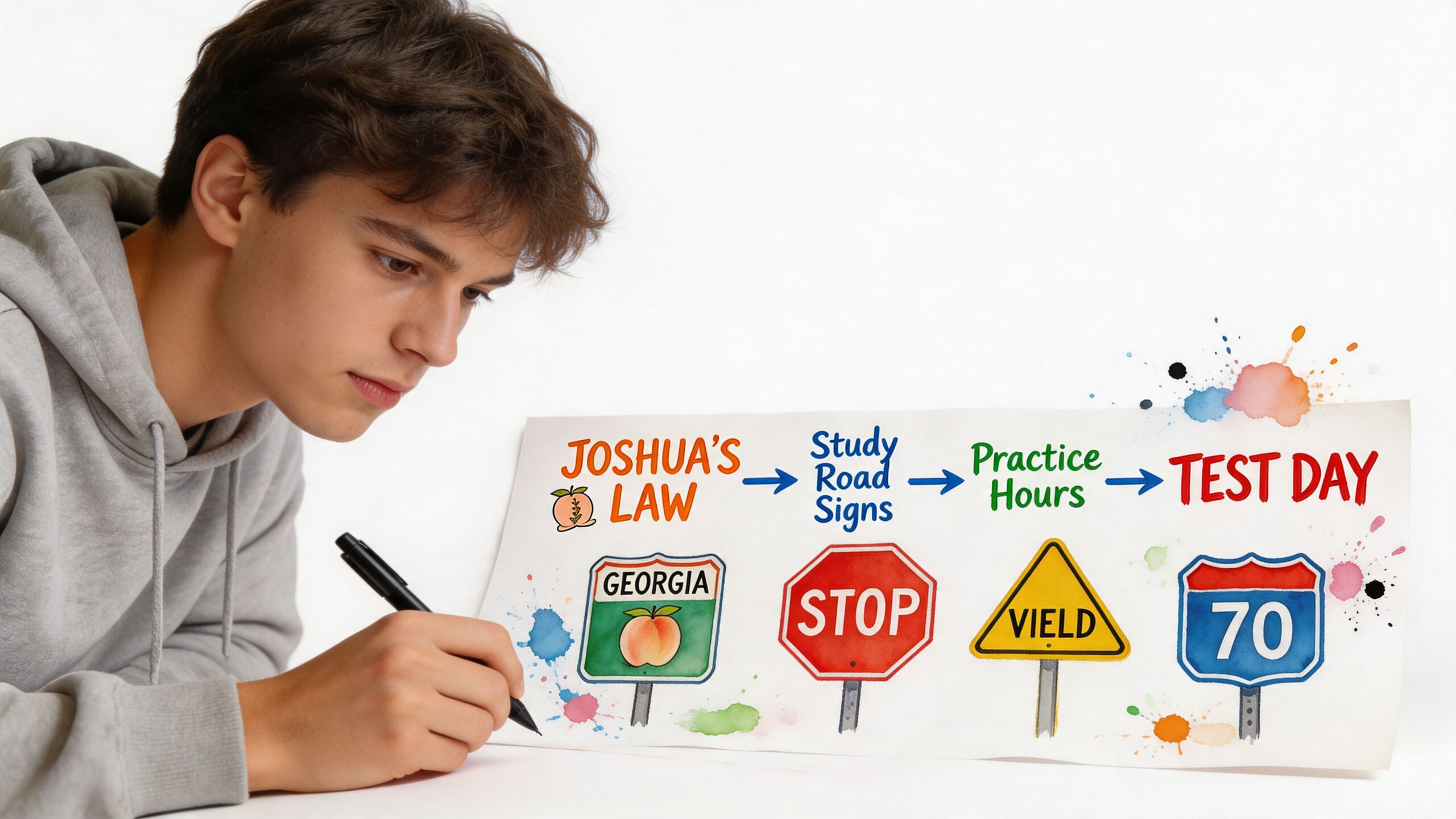
The fastest improvement usually comes from three steps. Study the Georgia Driver’s Manual. Practice with sign images until you can identify them on sight. Then connect each sign to a real driving situation so it sticks under pressure.
That last step is where students make real progress.
At A-1 Driving School, we build that progression into the full path to a license. Students in our Joshua’s Law courses get the foundation they need early. Driving lesson packages help turn sign recognition into real-world judgment at intersections, merges, school zones, and railroad crossings. For many families, on-site road testing also makes the final step simpler because training and testing stay in one place instead of being spread across different providers.
What students usually get wrong
The mistakes are predictable, which is good news because predictable mistakes can be fixed.
- They memorize definitions instead of visuals: On test day, you need to recognize the sign before the answer choices help you.
- They wait too long to study: Sign recognition improves with short, repeated practice, not one late cram session.
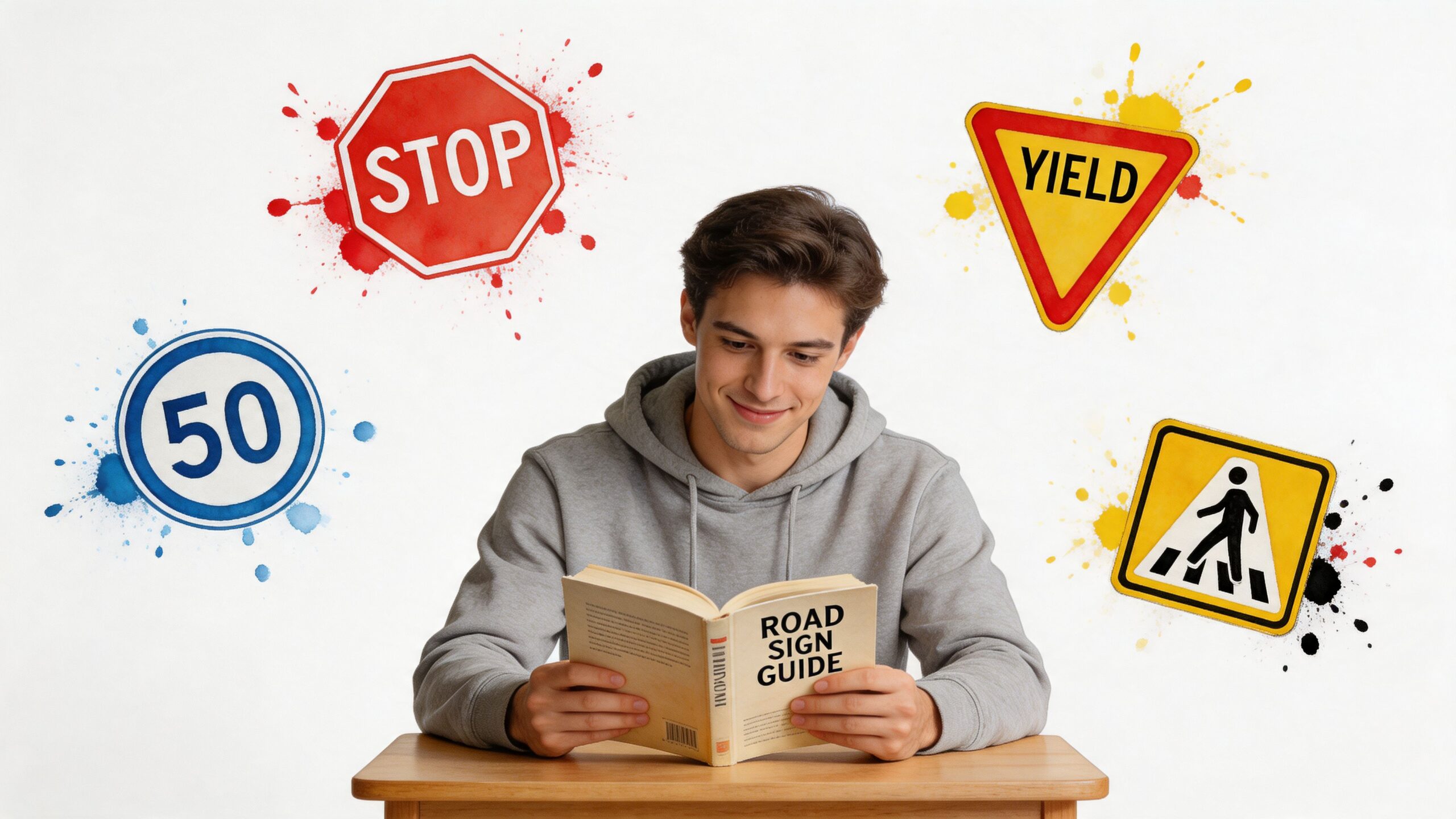
- They stay with the obvious signs: Stop, yield, and speed limit signs are only the starting point. Trouble usually comes from less familiar warning and regulatory signs.
- They assume a class by itself will cover it: Driver education gives structure, but signs still need direct review and repetition.
Practical rule: If you need the answer choices to figure out the sign, keep studying.
Strong students read signs in a consistent order. Shape gives the first clue. Color narrows the category. Meaning becomes clearer once those two pieces are in place. That is the same pattern experienced drivers use on the road, and it gives you a much better shot at passing the ga road sign test on the first try.
Decoding the Road Signs Test Format
A student can know plenty of signs and still miss the road signs section because they misunderstand how the questions are presented. I see that happen with permit applicants who study definitions but have not practiced identifying signs the way the exam shows them.
The road signs portion is one part of the Georgia knowledge exam for new permit and Class D applicants. You need a passing score on this section by itself, so it deserves focused prep instead of a quick review the night before.
What the test is really measuring
The exam checks fast visual recognition. Students often see the sign first, then choose the meaning. That puts pressure on shape, color, symbol, and category recognition long before the answer choices feel helpful. If you want the bigger picture of the written exam, this guide on what a permit test looks like in Georgia gives useful context.
That trade-off matters. Memorizing a glossary feels productive, but recognition practice produces better test results.
At A-1, this is one reason our Joshua's Law students tend to prepare more efficiently. They already have a structured path for the permit phase, and students who add driving lessons get repeated exposure to the same signs in real traffic instead of only seeing them on flashcards.
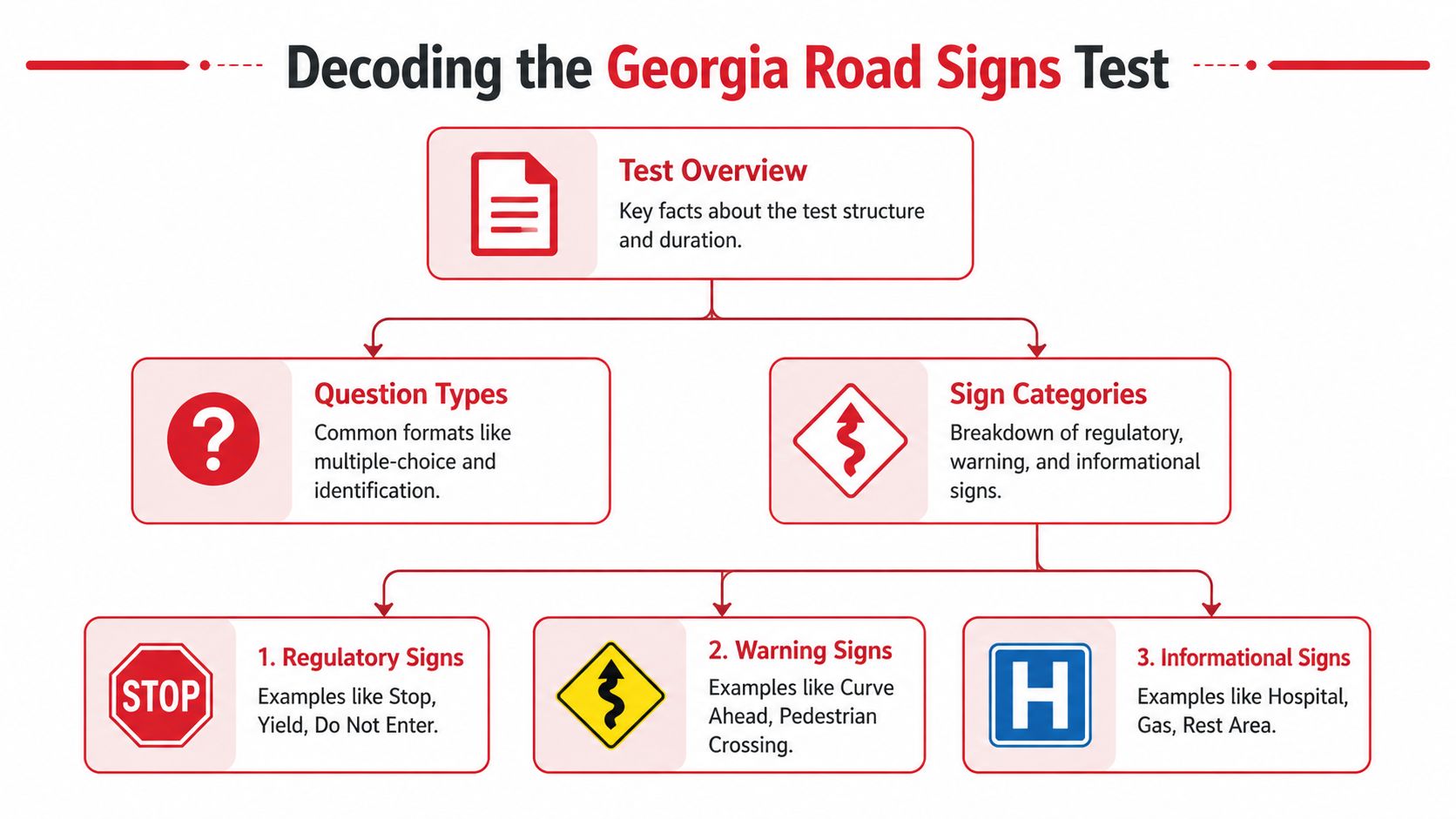
The three categories that organize your studying
Regulatory signs
These signs tell you the rule. Stop, yield, speed limit, do not enter, and no passing all fall into this group.
Students usually miss regulatory questions for one of two reasons. They rush past the shape, or they confuse signs that seem similar under pressure. On the road, a mistake here affects right-of-way, speed, or lane use immediately. On the test, it usually shows up as a preventable miss.
Warning signs
Warning signs tell you to prepare for a condition ahead, such as a curve, crossing, merge, or surface change. Many students understand the general idea but lose points on the exact hazard being shown.
This category causes trouble because the signs often look related. A railroad warning, a side road warning, and an intersection warning all ask you to notice different details. Strong test takers slow down just enough to read the visual pattern correctly.
Guide signs
Guide signs help drivers with routes, destinations, services, and direction. Students often treat these as the easy category, then get surprised by questions that ask for the sign's purpose rather than its wording.
That is why category-based study works so well. Once you identify whether a sign regulates behavior, warns about a condition, or guides travel, bad answer choices become easier to eliminate.
In our classes, I teach students to sort the sign before they name it. That habit carries over nicely into later training. By the time many A-1 students move from Joshua's Law into lesson packages and then on-site road testing, they are using the same quick recognition process in the classroom, on the road, and at test time.
The Must-Know Georgia Road Signs by Category
If you’re studying for the ga road sign test, don’t try to memorize every sign in one pass. Learn them by category and by visual pattern. That gives your brain a quicker way to sort what you see.
The Georgia Driver’s Manual is the main source for the signs you’ll need to know. The most effective approach is to group them into regulatory, warning, and guide signs, then attach each sign to its shape and color before you focus on the exact meaning. For more sign-specific review, this Georgia driving test signs guide is a useful companion.
Regulatory signs you should know cold
These signs give instructions. On the test, they tend to punish hesitation because they’re supposed to trigger immediate recognition.
- Stop sign: Red octagon. Come to a complete stop.
- Yield sign: Triangle shape. Slow down and give the right-of-way when needed.
- Speed limit sign: Rectangular regulatory sign. Obey the posted maximum speed.
- Do not enter sign: Signals that traffic may not proceed into that area.
- No passing zone sign: Tells drivers passing is not allowed in that section.
Students usually know the names of these signs. The problem comes when a question shows only the shape or uses a similar-looking option to distract you.
Warning signs that require sharper attention
Warning signs tell you to prepare for a condition ahead. They aren’t usually telling you what to do right now. They’re telling you what’s coming next.
Common examples include:
- Curve ahead
- Pedestrian crossing
- Slippery when wet
- Railroad crossing
- Intersection ahead
These signs often feel more difficult because several of them share similar colors and general caution styling. That’s why shape matters so much.
Instructor habit: Learn the shape first, then the category, then the meaning. Students who reverse that order tend to second-guess themselves.
Guide signs that support navigation
Guide signs help direct drivers to routes, destinations, and services. They matter less for immediate hazard response, but they still appear because Georgia expects drivers to understand the road system they’re entering.
Examples include route markers, exit guidance, and service information such as hospitals, gas, or rest areas. Many students overlook these because they seem familiar. Familiarity isn’t the same as accuracy.
Common Georgia Road Signs Cheat Sheet
| Sign Category | Shape & Color | Example Sign Name | What It Means |
|---|---|---|---|
| Regulatory | Red octagon | Stop | Come to a complete stop |
| Regulatory | Triangle | Yield | Slow and give the right-of-way when required |
| Regulatory | Rectangle | Speed Limit | Follow the posted legal speed |
| Regulatory | Standard prohibition format | Do Not Enter | Do not drive into that roadway or lane |
| Regulatory | Pennant | No Passing Zone | Passing is prohibited |
| Warning | Diamond | Curve Ahead | Road curves ahead |
| Warning | Diamond | Pedestrian Crossing | Watch for pedestrians ahead |
| Warning | Diamond | Slippery When Wet | Road surface may be slick |
| Warning | Circle | Railroad Crossing | Railroad crossing ahead |
| Warning | Diamond | Intersection Ahead | Be ready for cross traffic |
| Guide | Rectangle | Hospital | Indicates hospital services nearby |
| Guide | Rectangle | Gas | Indicates fuel services nearby |
| Guide | Rectangle | Rest Area | Indicates rest stop ahead |
| Guide | Route marker format | Interstate or Route Marker | Identifies roadway number and route |
What helps signs stick
A plain list won’t carry you all the way. Use a study method that forces active recall:
- Cover the name: Look at the sign image and say the meaning out loud.
- Sort by category: Make three piles or digital groups for regulatory, warning, and guide.
- Mix similar signs together: Put yield next to stop. Put railroad crossing near other warning signs. Train your eye to separate them.
- Review from images only: Don’t rely on text labels during the final stage of practice.
You don’t need a complicated system. You need repeated, accurate recognition until the sign meaning feels immediate.
Your Smart Study Plan From Joshua's Law to Test Day
The biggest misunderstanding I see from families is this: they think finishing a Joshua’s Law course means the signs test is handled automatically. It doesn’t work that way.
A common point of confusion for teens and parents is whether completing a Joshua’s Law course is enough to pass the signs test. While these courses cover the material, dedicated sign practice is essential, as the DDS test requires passing the 20-question sign portion independently, as explained in this Georgia road signs practice overview.
Where Joshua's Law helps and where it doesn't
Joshua’s Law courses build the foundation. That matters. Students need that structure because it introduces road rules, sign categories, and the decision-making habits they’ll use later behind the wheel.
But there’s a trade-off. General driver education covers a lot of ground. The ga road sign test is narrow and visual. If you stop at course completion, you may understand the material without being fast enough at sign recognition.
That’s why the best plan layers your preparation instead of treating everything as one study block.
A practical weekly study rhythm
A simple plan works better than an ambitious one you won’t follow. If you need a model for organizing short study sessions, these learning plan samples are useful for turning a vague goal into a repeatable routine.
Try this approach:
- Early phase: Read the manual sections on signs and mark any sign that feels unfamiliar.
- Middle phase: Use image-based quizzes and flashcards. Focus on recognition, not just recall from text.
- Late phase: Take mixed practice sets that force fast switching between signs and road rules.
- Final review: Study mistakes only. Don’t keep re-reading signs you already know well.
Students who do this consistently usually feel calmer because the test stops looking random.
Turn study knowledge into driving knowledge
Driving lessons prove more critical than commonly realized. When a student sees a sign on a screen, they’re memorizing. When they see the same sign during a lesson and have to respond correctly, they’re learning how to drive.
That difference is huge.
An instructor can point out a yield sign as you approach a merge, explain the reason for the sign, and connect it to lane position, speed choice, and right-of-way judgment. The same thing happens with school zone signs, railroad warnings, no passing zones, and regulatory signs near major intersections. That practical repetition locks in recognition far better than passive reading.
A lot of families also don’t realize they can start building this pathway early. The permit preparation stage, Joshua’s Law course, and driving lesson scheduling work best when they’re planned together instead of one at a time. This overview of the Georgia permit test process is a helpful reference when mapping out the next step.
Here’s a useful visual refresher before your final review session:
A realistic path to test readiness
What tends to work best is a layered path:
- Complete the classroom requirement: Online or in-person driver education gives you the base knowledge.
- Add sign-specific review: Spend focused time on shapes, colors, and image-only questions.
- Schedule driving lessons after the permit stage opens up: Use real traffic situations to reinforce what you studied.
- Keep one running mistake list: If a sign confuses you once, revisit it until it stops slowing you down.
Students remember signs better when they connect each one to a real driving decision instead of a flashcard alone.
That’s the bridge from knowing the answer to using it correctly.
Use A-1 Driving School Resources for Guaranteed Success
Students do better when their permit prep, sign review, driving practice, and road test plan all work together. After teaching hundreds of Georgia drivers, I’ve seen the same problem again and again. Families study hard, but they split the process across too many providers and lose momentum between steps.
A-1 Driving School gives students one place to complete Joshua’s Law in an online or in-person format, build skill through driving lesson packages, prepare for the road test, and use on-site road testing assistance when eligible. That setup saves time, reduces scheduling problems, and keeps the focus on passing the signs test and getting licensed.

Why lesson packages matter for sign recognition
Road signs are not just flashcard material. They are decisions made in real time.
A student may score well in practice and still miss signs in traffic because recognition under pressure is different from recognition on a screen. In lessons, instructors catch the mistakes that usually stay hidden until test day or a close call on the road. I’m talking about late braking at warning signs, drifting into the wrong lane after missing a regulatory sign, or hesitating at intersections because the student saw the sign a second too late.
That is why driving lesson packages help so much. They give students repetition in live traffic, with immediate correction, until sign recognition becomes quicker and more reliable.
For many families, the progression is straightforward:
- Start with driver education: Learn the rules, responsibilities, and test material.
- Add behind-the-wheel lessons: Practice using signs in real traffic situations.
- Prepare for the road test: Clean up weak spots before the exam.
- Keep the process with one school when possible: It is easier to schedule, track progress, and stay consistent.
Good options for different students
Students do not all need the same kind of help. A teen may need Joshua’s Law first and a clear step-by-step path after the permit. A permitted student may only need driving time and sign-based correction in traffic. Adult drivers often need a shorter refresher focused on confidence, lane control, intersections, and test readiness.
A-1’s mix of online classes, in-person instruction, lesson packages, and on-site testing support fits those different starting points well. That matters because the right format affects follow-through. Some students do better with flexible online coursework. Others stay on track only when they have set class times and instructor accountability.
Key takeaway: If a student recognizes signs in a study app but freezes in traffic, more road time with an instructor is usually the fix.
Scholarship and testing convenience can keep students on track
Cost and scheduling problems delay a lot of students who are otherwise ready to move forward. A-1 also provides guidance for families looking into the Georgia Driver’s Education Scholarship Grant Program, which can make training more accessible for qualifying students.
Testing logistics matter too. When students can prepare with the same school that helps them through the final stage, the process is simpler and easier to manage. The strongest results usually come from combining formal coursework, focused sign study, enough driving practice to make signs feel familiar at speed, and a clear road test plan with A-1 from start to finish.
Test Day Tips and Common Mistakes to Avoid
By test day, your job isn’t to learn new signs. Your job is to stay calm enough to recognize what you already know.
One of the most useful things you can do is slow your eyes down for a second when a sign appears. Students miss easy questions when they rush the shape. Based on practice test data, the most common errors include misidentifying the pennant-shaped No Passing Zone sign, which shows a 25% error rate, confusing similarly colored signs like yellow circles and yellow diamonds, and missing image-only questions, according to this Georgia road sign test breakdown.
What to do before you start
Use a short mental checklist:
- Review shapes first: Octagon, triangle, diamond, circle, rectangle, and pennant should feel automatic.
- Read each answer choice fully: Two options may sound close, but only one matches the sign’s actual function.
- Expect image-only questions: Don’t wait for text clues that may not be there.
- Keep your pace steady: Fast is helpful only if it stays accurate.
The mistakes that show up most often
Confusing pennant and diamond
This is a classic miss. The no passing zone sign has a different shape from the standard warning sign, but students often react to the color before the shape and choose the wrong answer.
Guessing based on color alone
Yellow doesn’t always mean the same exact condition. It points you toward a category, not the full answer. Shape and symbol finish the job.
Panicking after one hard question
A difficult item early in the test can shake a student who was otherwise ready. Don’t let one uncertain answer affect the next five. The test rewards consistency more than perfection.
If a sign looks unfamiliar, identify the shape first, then eliminate answers that don’t fit that category.
Bring the documents you need, arrive with enough time, and don’t cram in the parking lot. A brief review is fine. Last-minute overload usually hurts more than it helps.
If you want a smoother path from permit prep to driving lessons and road testing, A-1 Driving School is a practical place to start. Families can explore Joshua’s Law courses, online class options, lesson packages, road test support, and scholarship information in one place so the ga road sign test is only one step in a clear licensing plan.