
You're probably here because a search for “defensive driving course reddit” led you into a maze of opinions.
One post says, “Just pick the cheapest online class.” Another says, “Any course works.” A third insists Georgia is different, but doesn't explain how. If you're a teen trying to get licensed, or a parent trying to help without wasting time and money, that advice gets confusing fast.
As a driving educator, I can tell you the biggest mistake people make is assuming every driving course does the same job. It doesn't. In Georgia, the course you need depends on your goal. Fixing a ticket is one thing. Getting a teen legally prepared for a Class D license under Joshua's Law is something else. Building confidence with real driving lessons is something else again.
That's where most Reddit threads fall short. They start with a narrow problem and miss the bigger one. How do you choose a legitimate Georgia path that helps you drive better, pass your road test, and move forward with confidence?
Why Everyone Is Searching Reddit for Defensive Driving Courses
People search Reddit when they need answers quickly and don't trust marketing language. That makes sense. A driving course can affect your court outcome, your license points, or your insurance situation, so drivers want real-world feedback from other people who've already done it.
That's especially true because the rules change from place to place. Some jurisdictions allow point removal once every 12 months, while others limit it to every 36 months. Insurance discounts also vary, often in the range of 5% to 10% for approved courses. That's why so many drivers look for peer guidance before enrolling, as discussed in this overview of what defensive driving means in practice.
What people are really asking
When you read enough “defensive driving course reddit” threads, the same questions keep showing up:
- Will this course count for my situation? People want to know if a class works for ticket dismissal, point reduction, or an insurance discount.
- Can I do it online? Convenience matters, especially when there's a deadline.
- How long will it take? Approved courses typically run about 4 to 8 hours depending on the jurisdiction and course type.
- Will the court or insurer accept it? This is usually the biggest worry, even when people don't phrase it that way.
Those are reasonable questions. The problem is that Reddit answers often mix together advice from different states, different courts, and different reasons for taking the class.
Practical rule: A course that worked for someone in another state might be useless for your Georgia requirement.
Why the search intent matters
There's also a broader reason this topic gets so much attention. Defensive driving isn't some minor side issue in traffic policy. It's part of a larger safety system. The CDC reported that motor vehicle crashes were a leading cause of death for people ages 1–54 in the United States, and globally road traffic injuries cause about 1.19 million deaths each year. That's why these courses exist in the first place. They aren't only about paperwork.
For Georgia families, though, the Reddit rabbit hole often starts in the wrong place. Parents of teens may begin by searching for “defensive driving course reddit” when what they need is driver's education, Joshua's Law training, driving lessons, or a road test plan.
That's the key shift. The right question usually isn't “What's the easiest class?” It's “What Georgia-approved training solves my actual problem?”
What Reddit Gets Wrong About Georgia Driving Courses
The biggest mistake in Reddit advice is simple. People treat all driving courses as interchangeable.
They're not. A course taken for a traffic citation is not the same thing as a Joshua's Law driver's education program for a teen who wants a license. One may deal with a legal or insurance issue. The other is part of a first-time licensing path and real skill development.
Many Reddit threads focus on whether a course is “easy” or “worth it,” but they miss the harder question. Will it satisfy the exact legal purpose you need? In Georgia, that matters because courts only allow defensive driving for certain offenses and under specific conditions. The course that counts is the one accepted by the relevant authority, not the one strangers online say was quick.
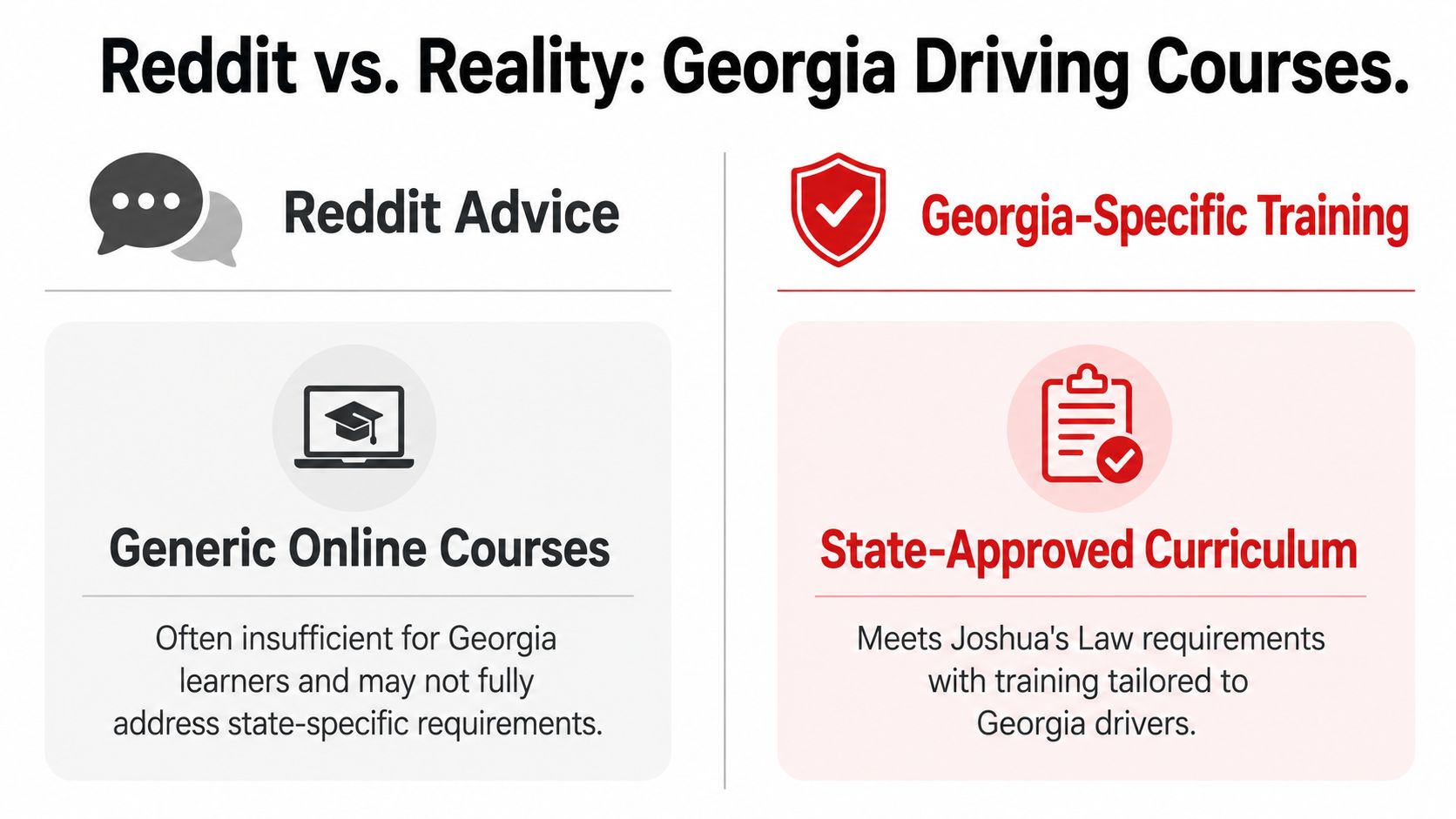
Reddit advice vs Georgia reality
Here's where people get tripped up most often:
| Question | Common Reddit assumption | Georgia reality |
|---|---|---|
| Will any online course work? | If it has good reviews, probably | Acceptance depends on the specific purpose, provider approval, and sometimes the court or insurer |
| Is defensive driving the same as driver's ed? | Close enough | No. They serve different legal and educational purposes |
| Is the fastest course the best choice? | Usually | Only if it's explicitly accepted for your situation |
| Can I rely on someone else's experience? | Yes, if they're in the U.S. | Only if their situation matches your county, court, age, and licensing goal |
The term “driving course” causes confusion
A parent might say, “My teen needs a driving course.” That could mean several very different things:
- A remedial or defensive driving class tied to a citation or insurance matter
- A Joshua's Law course for a teen working toward a Class D license
- Professional behind-the-wheel lessons
- Road test preparation
- A road skills test appointment
Those are related, but they are not the same product.
If the course doesn't match the requirement, it doesn't matter how cheap, short, or popular it is.
That's why Georgia-specific guidance matters so much. A random thread can't tell you whether a provider's program fits your teen's licensing timeline, whether a court will accept a certificate, or whether an insurer recognizes a course for a discount.
For most new drivers, the smarter move is to stop chasing generic “defensive driving course reddit” advice and start with the requirement that applies. In Georgia, for teens, that usually means Joshua's Law and professional lessons.
The Real Goal For Most New Drivers Joshua's Law
For many Georgia families, the primary issue isn't a ticket at all. It's getting a teen licensed the right way.
That's where Joshua's Law comes in. If your teen wants a Class D license at age 16, this is the requirement parents need to understand first. It's not just a box to check. It's part of a broader traffic-safety system designed to prepare young drivers before they're fully on their own.

What Joshua's Law includes
The path is more structured than many families expect. In practical terms, it usually involves two parts:
- A 30-hour driver education course
- 6 hours of professional behind-the-wheel instruction
That combination matters because classroom learning and actual driving practice do different jobs. The course teaches rules, signs, judgment, and decision-making. The in-car instruction helps a teen apply those rules when traffic is moving, visibility changes, or another driver does something unexpected.
Why this matters beyond compliance
Programs like Joshua's Law are part of a larger safety effort. With motor vehicle crashes being a leading cause of death for people ages 1–54 in the U.S., structured driver education is a prevention-focused tool, not just an administrative requirement.
That's why families shouldn't think of Joshua's Law as “just the thing you do before the license test.” The true purpose is to build habits early.
A teen driver needs to learn more than the textbook answers. They need to understand:
- How to scan intersections
- How to judge following distance
- How to manage speed when visibility changes
- How to stay calm when traffic gets crowded
- How to recognize trouble before it becomes an emergency
Good driver education gives teens a margin for error. That margin is what keeps routine mistakes from turning into crashes.
Where parents often get stuck
Parents usually don't get confused about whether training is important. They get confused about logistics.
Common questions sound like this:
- Does my teen need online class or in-person class?
- When should we book the driving lessons?
- Can we do the road test in a familiar setting?
- Is there financial help available?
Those are the right questions. And they're much more useful than scrolling another thread about whether a generic defensive driving class is “easy.”
If your teen is working toward a first license in Georgia, Joshua's Law is the main lane you need to be in. Once that's clear, choosing the right format and getting enough professional lesson time becomes much easier.
Choosing Your Path Online vs In-Person Driver's Ed
Once families understand the Joshua's Law requirement, the next question is usually about format. Should your teen take driver's ed online or in a classroom?
There isn't one perfect answer for every student. The right choice depends on schedule, learning style, and how much structure a teen needs to stay engaged.
When online works well
Online driver's ed fits families with packed calendars. A self-paced course can help when a student is balancing school, sports, work, or transportation challenges. It also gives parents more flexibility because they don't have to coordinate around one classroom schedule.
That convenience has become a major part of modern driver education. Online and virtual delivery has expanded access in many markets, but it has also created a new problem. People sometimes assume “online” automatically means “accepted.” It doesn't.
If you're comparing options, review a Georgia online driving course format carefully and make sure it matches the exact requirement you're trying to satisfy.
When in-person instruction helps more
Some teens do better with live structure. A classroom gives them a set meeting time, direct access to an instructor, and fewer chances to rush through material without absorbing it.
In-person sessions can also help students who learn best by asking questions in the moment, especially when the topic is judgment rather than memorization. Rules are one thing. Understanding why a left turn is risky at a certain intersection is another.
Here's a simple comparison:
| Format | Strong fit for | Watch for |
|---|---|---|
| Online | Busy schedules, independent learners, flexible pacing | Make sure the course is state-approved for your purpose |
| In-person | Students who benefit from structure and live discussion | Fixed schedules may require more planning |
A practical way to decide
If your teen usually stays on top of schoolwork without reminders, online learning may be a smooth fit. If your teen tends to procrastinate or tune out on screens, a classroom can be the better choice.
Parents sometimes overthink this step. The format matters, but not as much as legitimacy and follow-through. The primary goal is choosing a Georgia-approved path that your teen will complete and understand.
The strongest setup is often a simple one. Pick a valid course format, then put most of your energy into the behind-the-wheel side. That's where confidence usually gets built or lost.
Why Professional Driving Lessons Are Your Best Investment
A teen can finish an online module, pass a quiz, and still freeze the first time traffic stacks up at a busy Georgia intersection. That gap surprises a lot of families. Knowing the rule is one skill. Using it at the right moment, with other cars moving around you, is a different skill.
That is why professional driving lessons matter.

What a good lesson builds
A strong lesson helps a student notice problems sooner, make decisions earlier, and stay calmer while doing it. It works like sports coaching. Reading the playbook helps, but real improvement happens when someone watches your timing, points out what you missed, and has you try it again the right way.
In the car, that often means correcting habits that sound small but matter a lot:
- A student checks mirrors too late before changing lanes
- A new driver watches only the bumper ahead instead of scanning farther up the road
- A teen brakes hard because they noticed slowing traffic too late
- A learner steers through a turn well but misjudges speed while merging into traffic
Those are road habits, not quiz questions. They improve fastest with live feedback.
Why parent practice helps, but has limits
Parent practice still has real value. It gives teens hours behind the wheel, repetition, and time to get comfortable with the vehicle. For Joshua's Law students, it is also part of the process.
But parents usually teach from experience, not from a step-by-step method. That is not a criticism. It is just how experienced drivers operate. After years on the road, many adults make safe choices automatically and may find it hard to explain exactly when to scan, when to ease off the gas, or how to set up a lane change early.
A trained instructor makes those invisible decisions visible. The student hears clear cues, practices them in real time, and repeats them until the habit starts to stick.
Instructor insight: Students improve faster when feedback comes before the mistake grows into a panic response.
That matters for nervous teens, late-start adult drivers, and families who want more than the minimum required hours. Extra lessons can target the parts new drivers often avoid, such as lane changes, parking, highway entry, heavier traffic, and test-day nerves.
A-1 Driving School offers Georgia driver education, behind-the-wheel lesson packages for teens and adults, road test prep, and road testing services. For many families, the value is not just seat time. It is having a clear path from Joshua's Law requirements to real driving skill and then to the license.
What to look for in a lesson package
Before you book, look past the course title and ask what the student will practice.
- Does the lesson include normal traffic, not just empty lots? Students need experience making decisions with real cars around them.
- Will the instructor teach scanning and hazard recognition? Safe driving starts with seeing trouble early.
- Does the practice match Georgia licensing goals? A new driver usually needs more than a ticket-focused defensive driving course.
- Can the instructor work with anxious students? Confidence grows faster when the lesson pace matches the student.
- Will the student practice road test skills on purpose? Families should not have to guess whether that is included.
For teens and parents, professional lessons are usually a smarter investment than spending hours in Reddit threads about defensive driving classes that do not match the true goal. If the goal is a safe new driver in Georgia, the better route is structured instruction, guided practice, and a school that can help from first lesson to license.
From Lessons to License Acing the Georgia Road Test
The road test is where many teens get tense. Parents do too. By that point, everyone wants the process to feel clear, familiar, and manageable.
That anxiety usually drops when students know what the examiner is looking for and have already practiced those exact skills under instruction.
What the road test is really measuring
The Georgia road test doesn't just check whether a student can move a car. It looks at whether the student can drive with control, awareness, and consistency.
That includes skills such as:
- Smooth starts and stops
- Proper turns
- Lane position
- Backing
- Stopping at the right place
- Using mirrors and checking surroundings
- General awareness and safe judgment
A lot of students know these items in theory, but the test feels harder because they're doing them under pressure.
A better way to prepare
Cramming rarely works for road skills. Short, focused practice is usually better.
Try this approach:
- Practice the test basics until they feel routine.
- Spend extra time on the skills the student avoids.
- Do at least some practice in an unfamiliar area so the driver learns to adapt.
- Review the pre-drive habits too, like seat position, mirrors, and calm setup.
Here's a helpful walkthrough families can watch before test day:
Why familiarity helps
One reason students struggle at the DDS is the environment. New setting, long waits, unfamiliar route, extra nerves. A more guided process can make a big difference.
Some driving schools in Georgia help students prepare for the road test and may also offer testing support in a more familiar environment. That can reduce confusion because the student already knows the car setup, the practice routine, and the expectations.
Students usually perform closer to their real skill level when the testing process feels familiar and organized.
If your teen is close to test day, don't focus only on “passing.” Focus on smooth, repeatable driving. A student who can consistently scan, signal, position the car, and manage turns is usually much better prepared than a student who has only memorized what they think the examiner wants.
Making Driver's Ed Affordable With the Grant Program
Cost stops some families before they even begin. That's understandable. Driver's education often comes at the same time families are paying for school activities, sports, transportation, and everything else that comes with raising a teenager.
Georgia offers help through the Driver's Education Scholarship Grant Program, and many families don't realize they may qualify.
What the grant is for
The program is designed to help eligible students access driver training. In practical terms, families often look to it for support with the two parts that matter most:
- The 30-hour driver education course
- The 6 hours of behind-the-wheel instruction
That combination is important because it supports both the knowledge side and the practical driving side.
Why parents should check early
Grant-related opportunities can affect scheduling. If your teen plans to start driver's ed during a school break or before a birthday tied to licensing goals, it helps to look into eligibility and provider participation sooner rather than later.
A clear place to start is the Georgia driver's education grant scholarship program page, which explains how the program works and what families should review before enrolling.
What to ask before applying
Families often save themselves frustration by asking a few direct questions:
- Is my teen eligible under the current program rules?
- Does the provider participate in the grant program?
- What parts of training are covered?
- What documents or timing requirements should we expect?
This is one of those areas where a little preparation helps a lot. Parents who wait until the last minute often feel rushed. Parents who check early usually have more flexibility to pick class dates, lesson times, and a training path that fits their teen.
The main point is simple. If cost is the reason you've delayed driver's ed, don't assume the process is out of reach. Georgia families should look at the grant option before giving up on formal instruction.
Your A-1 Driving School Questions Answered
Families usually reach this stage with very practical questions. Not “What is driver's ed?” but “What do we sign up for first?” and “How do we avoid picking the wrong course?”
That's the right mindset. The recent growth in online delivery has made driver education more accessible, but it has also increased the risk of noncompliance when families assume an online option is automatically accepted. A well-established, state-approved provider with both online and in-person options can help reduce that confusion.
Which service should a Georgia teen start with
If the goal is a first license, start with the Georgia requirement that matches that path. For most teens, that means Joshua's Law driver's education, then professional driving lessons, then road test preparation.
If the student already completed the classroom part but still feels shaky behind the wheel, lessons are usually the next priority.
Are driving lesson packages only for teens
No. Adults use lesson packages too.
Some adults are first-time drivers. Others have a license but haven't driven in years. Some need help with parking, traffic, highway merging, or preparing for a Georgia road test after moving from another state. A structured lesson plan can help in all of those cases.
Is online always the easier option
Not always. It's often more flexible, but flexibility only helps if the course fits the legal requirement and the student completes it.
That's why families should confirm acceptance first and convenience second.
Can students prepare for reviews and local reputation checks
Yes, and that's smart. Parents often want a simple way to gather and compare local feedback before booking. If you're checking community reputation for schools or service businesses, a tool like this Google review link generator can make it easier to organize direct review links and see what recent customers are saying.
What should parents ask before enrolling
A short checklist helps:
- Is the program state-approved for my teen's exact need?
- Can we choose online or in-person instruction?
- Are driving lessons offered separately or in packages?
- Can the student get road test preparation?
- Is there guidance for the grant program if we may qualify?
What's the simplest way to avoid the Reddit rabbit hole
Match the service to the goal.
If the goal is a first Georgia license, don't start with generic defensive-driving chatter. Start with driver's education, then lessons, then road test planning. If the goal is a court or insurance issue, verify acceptance with the relevant authority before you register anywhere.
That one habit saves families the most time.
If you want a clear Georgia path for driver's education, Joshua's Law, driving lessons, lesson packages, road testing, or scholarship-grant guidance, visit A-1 Driving School and choose the service that matches your next step.