
A lot of Houston families start in the same place. A teen is ready to drive, a parent opens three browser tabs, and within ten minutes everybody is asking the same questions. Which course is approved? What has to be done online? When can the student get a permit? And who handles the driving lessons?
That confusion is normal. Texas gives you more than one way to complete driver education, and online options make the process easier, but only if you know what each step is for.
This guide is written the way I'd explain it at a school front desk. Plain language. Clear order. No guessing. If you're searching for online drivers ed Houston, the main job is to separate what's required by Texas from what makes the process smoother and safer.
Navigating Your Path to a Texas Driver's License in Houston
A Houston parent gets off work, a teen asks when they can start driving, and suddenly the kitchen table turns into a planning meeting. One tab shows online courses. Another mentions permits. A third talks about driving practice. The process feels confusing because several steps are happening at once.
The easiest way to handle it is to put the steps in order, the same way you would follow a recipe. First, choose the right type of driver education. Next, make sure the student is ready for the permit stage. After that, build driving skill with real practice. Then prepare for the road test.
What Houston families usually need first
The first question is usually simple. Can the student complete driver education online?
For many Houston students, yes. Texas allows approved online options, which is why this path works well for busy families managing school schedules, activities, work hours, and traffic across the city.
That convenience helps, but convenience alone is not enough.
A good provider should make the full process easier to manage, not just give you a username and password. That is where Houston families can learn from a school outside Texas too. A-1 Driving in Georgia is a useful benchmark because it shows what strong schools often provide beyond basic course access, such as clearly structured lesson packages, support for different student needs, and even scholarship opportunities. If you are comparing Houston options, look for that same level of organization and student support.
What to look for before you enroll
Choosing a course works better when you ask practical questions early. The goal is to avoid getting stuck halfway through because no one explained the next step.
Check for these points:
- Clear course type: Make sure the program matches the student's age and license goal.
- Driving lesson plan: Find out who handles the behind-the-wheel portion and how it is scheduled.
- Parent guidance: For teen students, confirm what the parent or guardian needs to track, supervise, or sign.
- Road test preparation: Ask how the school helps students practice the skills they will be graded on.
- Document support: Make sure you know what paperwork to gather before permit or license appointments.
I also suggest reviewing this checklist of documents needed to legally drive early. It saves time and cuts down on last-minute problems when the student is ready to move from coursework to permit or license steps.
One situation families should not overlook
Some Houston drivers are dealing with a different issue. They are not starting fresh. They are trying to get limited legal driving privileges back for work, school, or daily responsibilities.
In that case, the normal driver education path may not be the only issue to solve. A clear overview of the Texas occupational license application can help you understand what to do before making plans.
The main idea is simple. Pick a school based on the whole licensing process, not just the online class screen. That approach saves time, reduces confusion, and gives Houston students a better start.
Understanding Texas Driver's Education Requirements
A Houston family often hits the same question right after comparing schools. Which course do we need?
That question matters because Texas does not use one driver education track for everyone. The rules change based on the student's age and license stage, so the first job is matching the course to the learner.
What teen students need to know
For teens, Texas uses a step-by-step process. A good way to view it is like school prerequisites. One milestone lets you start the next part, but it does not mean the whole class is finished.
Under the concurrent method, a teen can reach the permit stage after the first 6 hours of classroom instruction, then complete the rest of the required 24 classroom hours afterward. The Texas Department of Public Safety explains both the concurrent and block methods in its driver education course guidance.
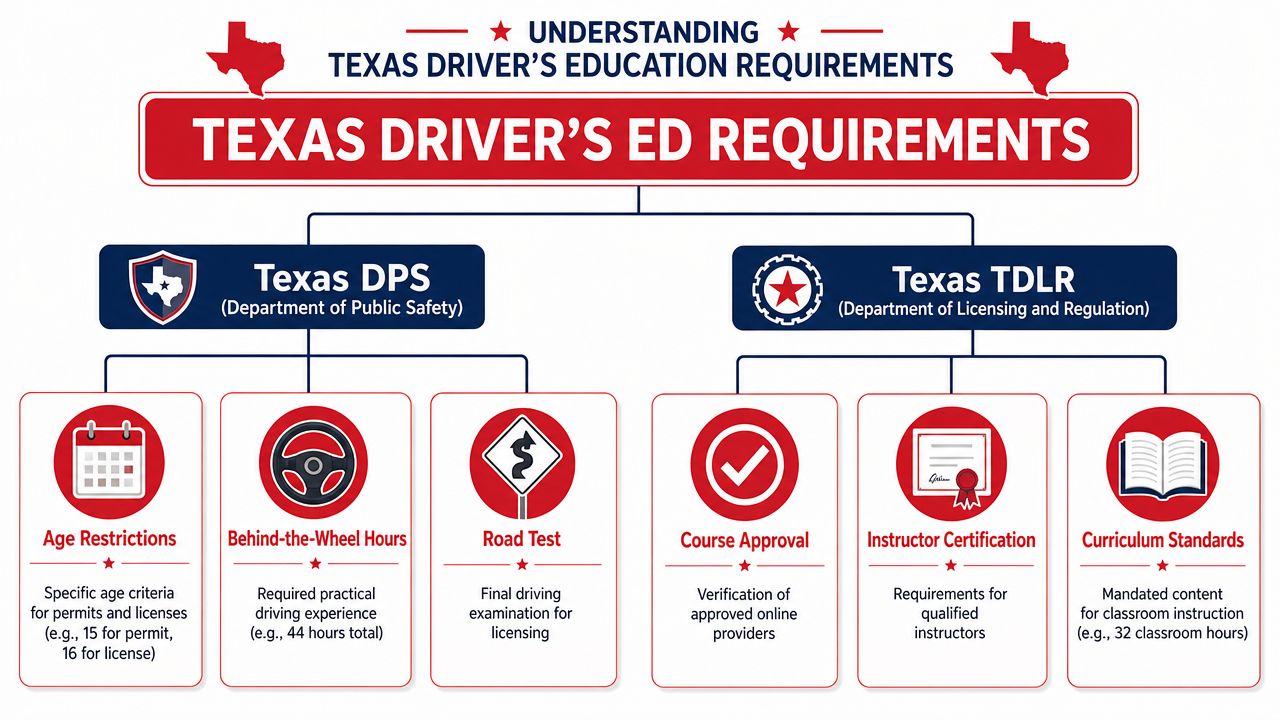
Here is the part that trips up parents. Getting to the permit point is an early milestone, not the finish line.
Use this simple breakdown:
- First milestone: After 6 hours, a teen in a concurrent course may qualify to take the knowledge exam and apply for a learner license.
- Remaining classroom work: The student still has to finish the rest of the required classroom hours.
- Next driving stage: Permit eligibility allows supervised practice to begin when the other course and state steps are in place.
That last point is where families lose time. They assume permit eligibility means all education requirements are done, then find out there is still coursework, supervised practice, or paperwork left.
Why approval matters before you pay
Texas families need to check more than the course topic. They also need to confirm the provider is approved for the type of course being sold.
If you are new to this format, a plain-language explanation of what online driver's education includes can help you compare programs without guessing what "online" covers.
This is also where Houston shoppers can use a stronger benchmark. A well-run school should explain the full path clearly, including class hours, driving requirements, parent responsibilities, records, and what happens after the online portion ends. That is one reason some families look at how established schools in other states structure student support. For example, A-1 Driving is a useful comparison point because it reflects the kind of organized guidance, lesson packaging, and student-focused extras, including scholarship-related support, that help families judge whether a Houston provider is merely selling a login or genuinely helping a student finish the process.
Adult learners have a different path
Adult students should slow down for one minute before enrolling. The main risk is choosing a teen course by mistake.
A clear provider makes the difference obvious at the start. If the website blurs teen and adult options together, treat that as a warning sign.
Use this quick check:
| Learner type | Main question to ask |
|---|---|
| Teen student | Is this an approved teen driver education course with a clear permit path? |
| Adult student | Is this the correct adult course for my age, not a teen package with extra steps? |
| Parent | Does the school clearly explain the full process after enrollment, including records and next licensing steps? |
How Online Driver's Ed Courses Work in Houston
A Houston student signs up on Sunday night, logs in after school on Monday, finishes one lesson, takes a short quiz, and picks up again later in the week. That is how online driver's ed usually works in practice. It breaks the classroom portion into smaller pieces so students can make steady progress without sitting in one physical class for hours.
The key point is simple. Online driver's ed covers the knowledge side of learning to drive. It teaches the rules, signs, decision-making, and safety habits you need before or while you complete the driving part of the process.
What you actually do in the course
Most approved online courses in Houston follow the same basic pattern:
- Create your account and start the first unit.
- Read or watch a lesson on topics like right-of-way, lane changes, road signs, speed management, and sharing the road.
- Answer review questions to show you understood that section.
- Pass short quizzes or unit tests before the next lesson opens.
- Track your progress in your student dashboard so you know what is finished and what is left.
It works like a well-organized workbook with built-in checks after each chapter. You study a skill, prove you understand it, then move to the next one.
That structure helps students who need repetition. It also helps parents who want proof that the course is being completed, not just opened in a browser tab.
What the online part does, and what it does not do
Students often get confused at this point.
The online course handles the classroom instruction. It does not turn into a full license by itself. You still need to follow the rest of the Texas process that applies to your age and course type.
For example, a student may finish an online lesson about scanning intersections safely. That lesson teaches the decision process. The driving portion is where the student practices that habit in a real vehicle with the required supervision.
A good provider explains that difference clearly from the start.
Why the format works well in Houston
Houston is spread out. Travel time alone can turn a one-hour class into a much bigger commitment.
Online study removes that problem for the classroom portion. Students can complete a lesson before dinner, after practice, or on a weekend morning. They can also pause and review a topic that did not click the first time, which is helpful for rules that are easy to mix up, like right-of-way or following distance.
That flexibility should not be confused with lower standards. The better way to think about it is this: the schedule is flexible, but the course still has required material, checkpoints, and completion steps.
How to tell whether an online course is organized well
Two online schools can both be approved and still feel very different to use.
A strong provider gives clear instructions, shows progress plainly, and explains what happens after each milestone. That is one reason Houston families sometimes compare local options against schools that set a higher service standard in other states. A-1 Driving is a useful benchmark because it shows what good student support looks like, including clear program structure, lesson options beyond the online classroom, and added student-focused programs such as scholarship support. If you want a practical comparison point, these online driver's ed reviews and program examples can help you see what a well-run course experience looks like.
When a school explains the steps plainly, students spend less time guessing and more time finishing.
Choosing the Right Online Provider in Houston
A provider can be legally approved and still be a poor fit for your family. Approval is the floor, not the finish line.
When I talk with parents, I suggest evaluating schools in two layers. First, confirm basic Texas compliance. Then look for signs that the school helps students become capable drivers, not just course completers.
Start with the non-negotiables
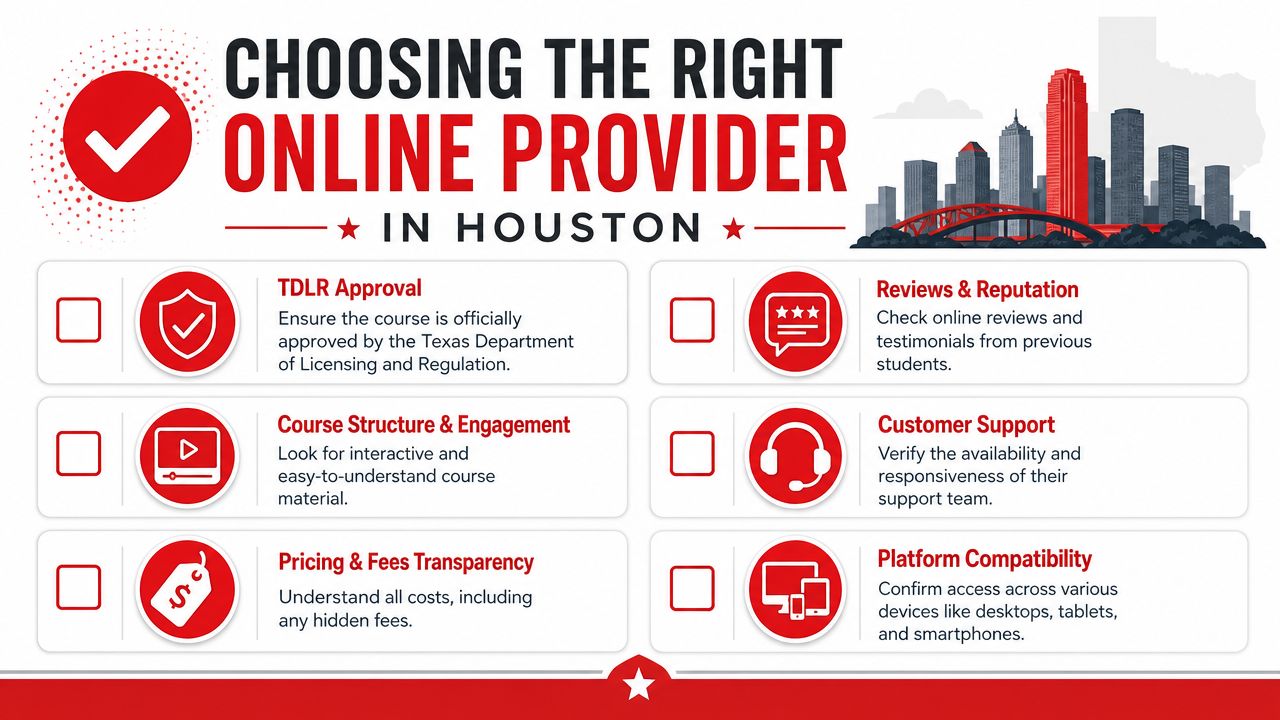
Use this checklist before you enroll:
- State approval: Confirm the provider is approved for the course you need.
- Clear course type: Make sure the listing clearly separates teen and adult options.
- Visible support: Check whether a real person can answer questions about permits, records, or scheduling.
- Plain pricing: The site should explain what is included and what is separate.
- Driving lesson options: See whether the school also offers in-car instruction or only the online classroom portion.
A school that hides basic details usually creates problems later.
Use a quality benchmark, not just a price comparison
One useful way to judge Houston options is to compare them against what a strong full-service school offers elsewhere. For example, A-1 Driving School in Georgia offers driver education, driving lessons, road test support, and scholarship-related guidance in its home market. Even though Houston students need Texas-specific compliance, that kind of bundled model is still a helpful benchmark when you're deciding what to look for locally.
The lesson for Houston families is straightforward. A good provider should do more than sell login access. It should help the student move from online coursework into actual driving skill.
If you want to see how students talk about the experience of an online course provider, reading online drivers ed reviews can help you build a better comparison standard.
What strong providers do differently
Not every family needs the same setup. Some parents want a standalone online course because they're comfortable supervising most of the practice. Others want a more integrated package because they'd rather have a professional instructor teach foundational skills early.
Here's how to think about that decision:
| Provider style | Best for | Watch for |
|---|---|---|
| Online course only | Families who already have a clear practice plan | Weak follow-up support |
| Course plus lessons | Students who need skill-building in traffic, turns, parking, and test prep | Scheduling availability |
| Full-service school | Families who want one point of contact from enrollment to test day | Whether all services are clearly explained |
Don't choose a school only because the course looks quick. Choose one that helps the student become calm, consistent, and safe behind the wheel.
From Enrollment to Road Test Your Step-by-Step Guide
Once you've chosen a provider, the path gets easier because you can focus on one action at a time.
The practical sequence
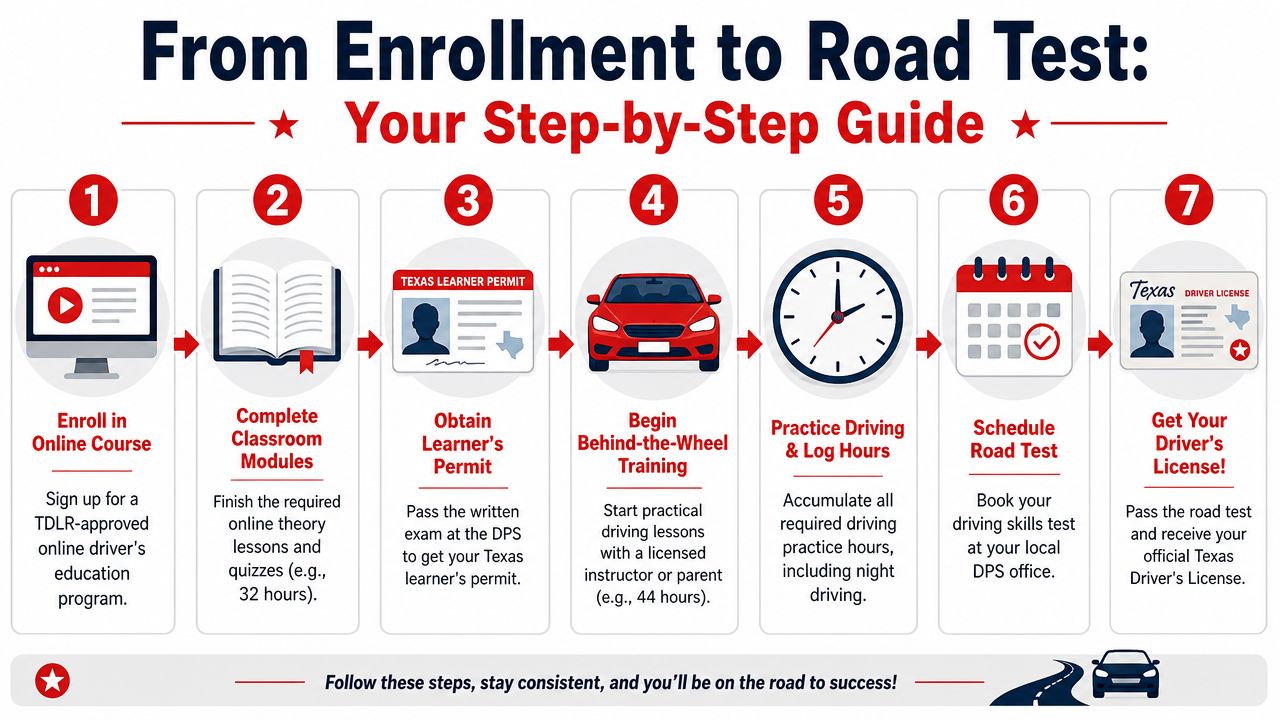
Follow the process in this order:
Enroll in the right course
Choose the approved online program that matches the student's age and license path.Complete the early coursework
Work steadily through the opening lessons. Don't rush just to “finish screens.” The point is to understand signs, rules, lane use, and decision-making.Handle the permit step when eligible
Once the student reaches the required course milestone, move on to the permit process.Begin supervised driving
During supervised driving, many students discover that knowing a rule and applying it in traffic are very different things.Add professional lessons if needed
A certified instructor can correct habits early, especially with lane changes, turns, braking judgment, parking, and scanning intersections.Prepare for the road test
Practice the skills that tend to create anxiety, including smooth stops, speed control, observation, and following directions.
One of the most useful things a school can offer at this stage is road test support. Some schools in other states, including those with integrated training models, can administer or closely support testing. In Houston, it's worth asking a provider exactly what kind of road test preparation or scheduling help they offer rather than assuming it's included.
To see common testing situations in action, this short video gives helpful visual context.
Where students usually struggle
Most students don't get stuck on the idea of driving. They get stuck on specific transitions.
- From course to permit: They aren't sure when they're eligible.
- From permit to practice: They don't know how to structure meaningful driving time.
- From practice to test: They've driven a lot, but not with test standards in mind.
Build practice sessions around one or two skills at a time. A short drive focused on left turns and lane position is often more productive than a longer drive with no plan.
If your Houston provider offers lesson packages, ask how those lessons are sequenced. The best setup usually starts with core vehicle control, moves into neighborhood driving, then busier roads, and finally test-oriented review.
Teen vs Adult Driver's Ed Key Differences and Costs
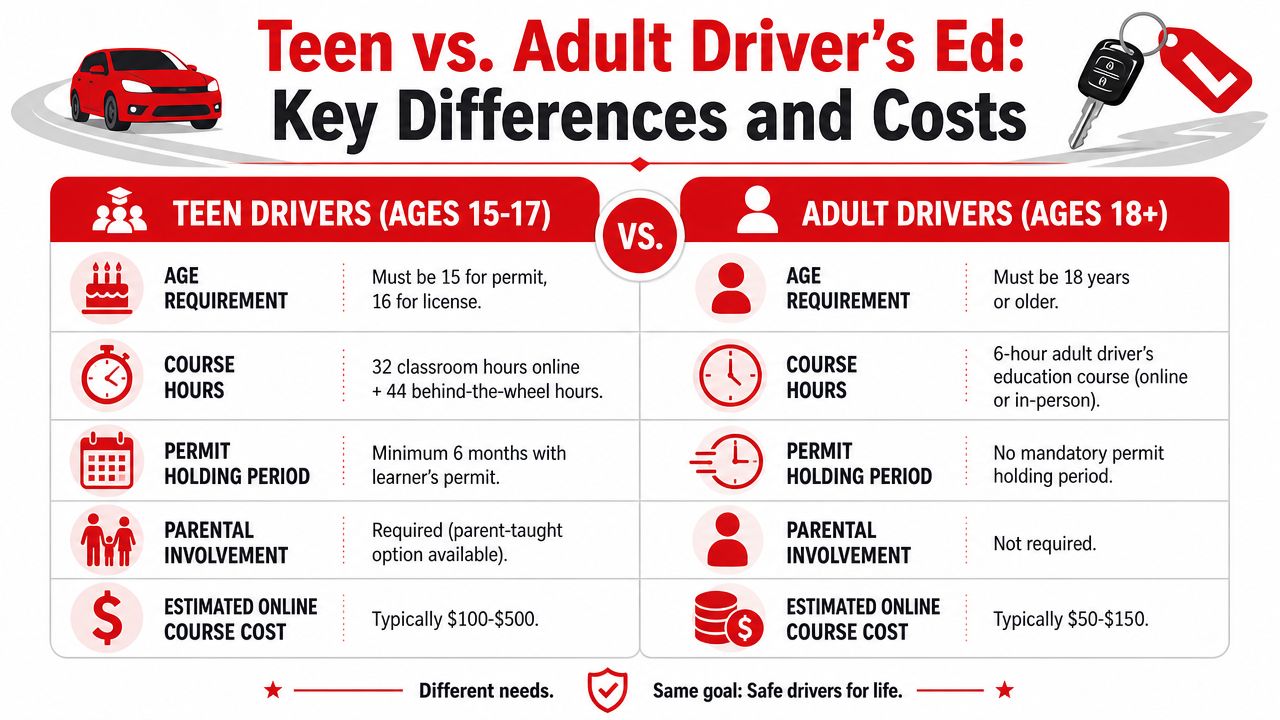
A Houston parent may be comparing options for a 16 year old while an adult learner is trying to get licensed around a full-time job. Both need driver education, but the process, support, and total cost are usually different.
For teens, Texas treats driver training as a longer sequence with supervision built in. Adults usually have a shorter classroom requirement, but many still need in-car lessons to build judgment, confidence, and test readiness. The difference is a lot like the difference between a full semester course and a targeted refresher class. Both can work. The right choice depends on the student.
What changes for teens
Teen licensing in Texas usually involves more steps, more supervision, and more scheduling. If you are a parent, this is the part to read carefully.
The Houston Area Driving Schools page on the Texas Workforce Commission Youth Driver Education Funding Program explains that eligible students may receive help with the teen classroom course, behind-the-wheel training, observation hours, and related driving support. That matters because it shows what teen training often includes beyond the online portion.
In practical terms, a teen course is rarely just a login and a final exam. It often includes:
- Online or classroom instruction
- Supervised driving requirements
- In-car teaching with an instructor
- Parent involvement in scheduling and practice
- Extra planning around permit and license timing
How the adult path is different
Adult students usually deal with fewer formal steps, but they should not assume the cheaper option is the smarter one.
An adult who reads quickly may finish the classroom portion without trouble, then realize the key challenge is lane changes in traffic, left turns at busy intersections, or test-day nerves. That is why many adults do better with shorter, focused practice sessions instead of long study blocks. If that sounds familiar, this overview of understanding adult learning is a useful reference.
Side-by-side comparison
| Topic | Teen learner | Adult learner |
|---|---|---|
| State process | More structured, with supervised stages | Usually simpler |
| Parent role | Often active in practice and scheduling | Usually independent |
| In-car lesson needs | Common and often built into the process | Often added based on skill level or anxiety |
| Budget planning | Course, lessons, practice time, and possible vehicle use | Course plus targeted lessons, if needed |
How to budget without surprises
Break the price into parts. That makes comparisons much easier.
- Course fee: The online instruction itself.
- In-car lessons: Professional driving time with an instructor.
- Vehicle use: Whether a school car is included for lessons or testing support.
- Testing expenses: Fees tied to licensing steps, road test prep, or scheduling help.
A quality benchmark proves helpful. Earlier, we noted a Georgia school, A-1 Driving, as an example of a provider that bundles multiple services and even highlights scholarship information. Houston providers may not package services the same way, but the comparison is useful. Ask whether the price covers only the online course or also includes lessons, vehicle access, and any guidance beyond the classroom.
A low sticker price can still lead to a higher total cost if the student later needs extra instruction. For both teens and adults, the better question is simple: what do you need to do, and what parts of that process are included in the price?