
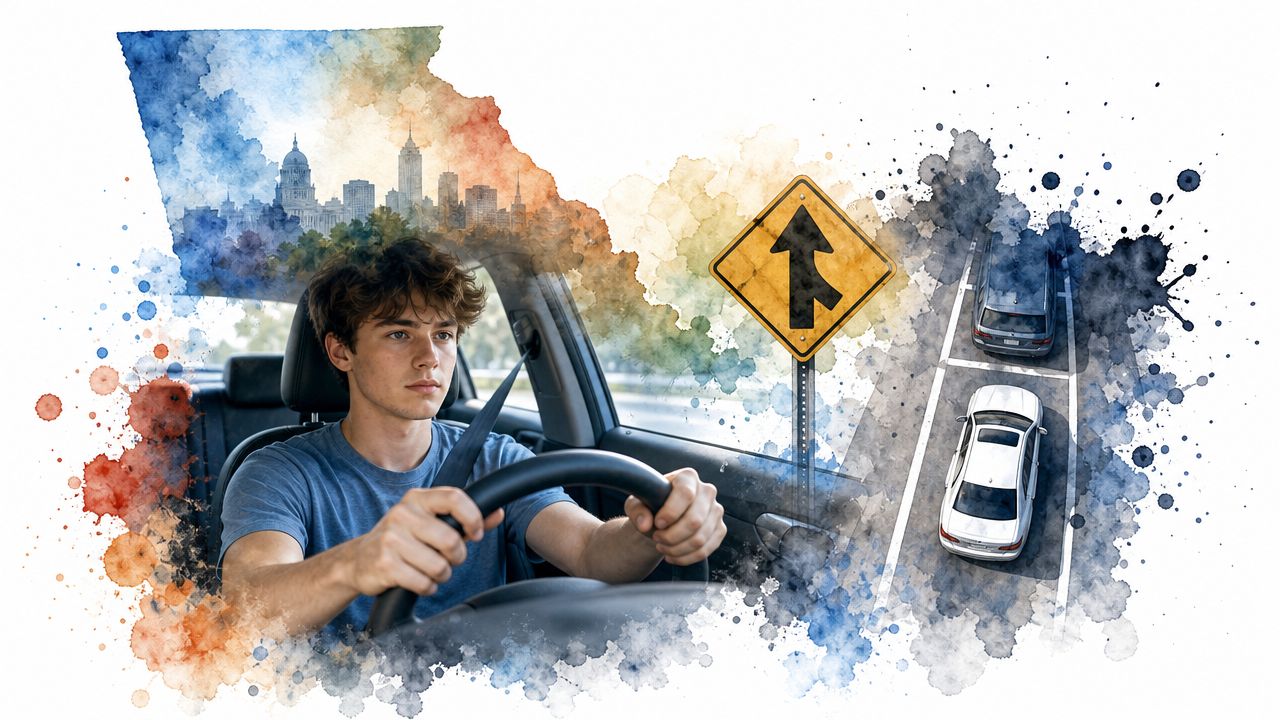
You've got your permit. You've driven around the neighborhood. You can start, stop, and turn without much trouble. Then someone says, “Let's go practice on a busy road,” and your stomach drops.
That's normal.
A lot of new drivers in Georgia reach the same point. Basic control starts to feel manageable, but lane changes, parking, highway ramps, and crowded intersections still feel fast and unpredictable. That doesn't mean you're a bad driver. It usually means you need a better practice plan.
Knowing how to improve driving skills isn't about getting braver by force. It's about building habits that make the car feel more predictable, traffic feel less chaotic, and decisions feel less rushed. Good drivers don't just react well. They prepare early, scan well, leave space, and repeat the same safe actions until those actions become automatic.
From Learner's Permit to Confident Driver
A nervous learner often looks like this. Hands at ten and two, eyes locked on the bumper ahead, breathing a little too fast, and hoping nobody asks for a lane change.
Then the road gets busy. A car slows in front. Another drifts near the lane line. A light turns yellow. That's when many learners realize driving skill isn't one single skill. It's several small skills working together at once.
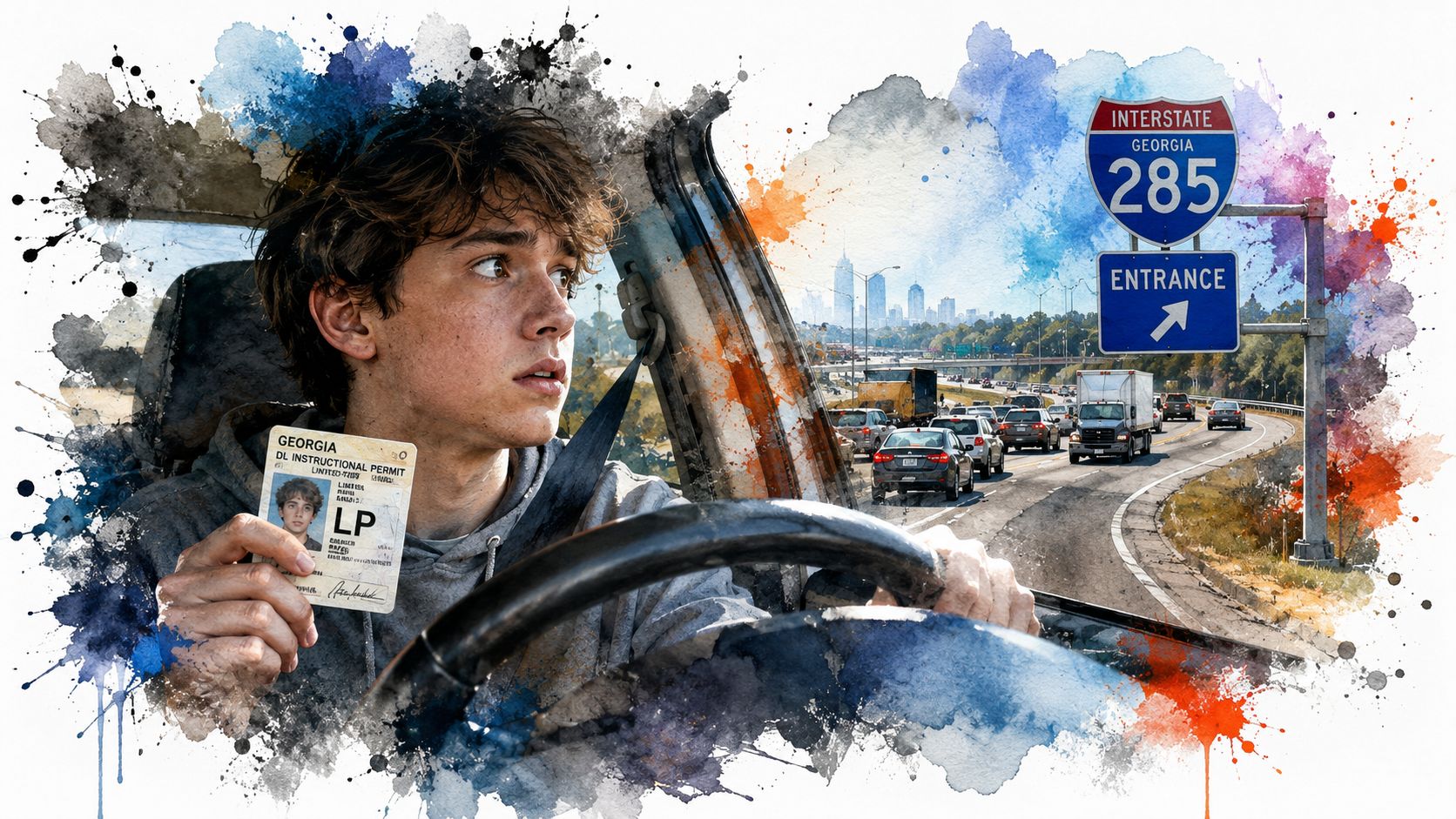
Confidence comes after repetition
The biggest misunderstanding new drivers have is thinking confidence should come first. It usually doesn't. Confidence comes after you've repeated the right habits enough times that your brain stops treating every situation like a surprise.
A learner in Georgia might be comfortable on a quiet street in the morning but freeze when asked to merge near heavier traffic later that day. That's not inconsistency. That's a sign that the driver needs more structured exposure, starting simple and getting gradually harder.
Practical rule: Don't judge your driving by your calmest route. Judge it by how well you handle change.
Skill means more than passing the road test
Passing the Georgia road test matters, but real improvement goes beyond test day. A capable driver can keep the car centered, brake smoothly, check mirrors without drifting, notice a problem early, and make a simple decision without panic.
That's especially important for new drivers. A 2022 study on young drivers found that driving experience was strongly related to driving style and self-rated safety skills, and that higher safety-skill scores were negatively correlated with errors, lapses, violations, and aggressive violations. The authors also suggested training should emphasize realistic self-assessment and safe driving practices because overconfidence can rise with experience while concern for safety declines.
That finding lines up with what instructors see every week. The goal isn't to feel fearless. The goal is to become accurate about what you can do well, what still needs work, and how to improve safely.
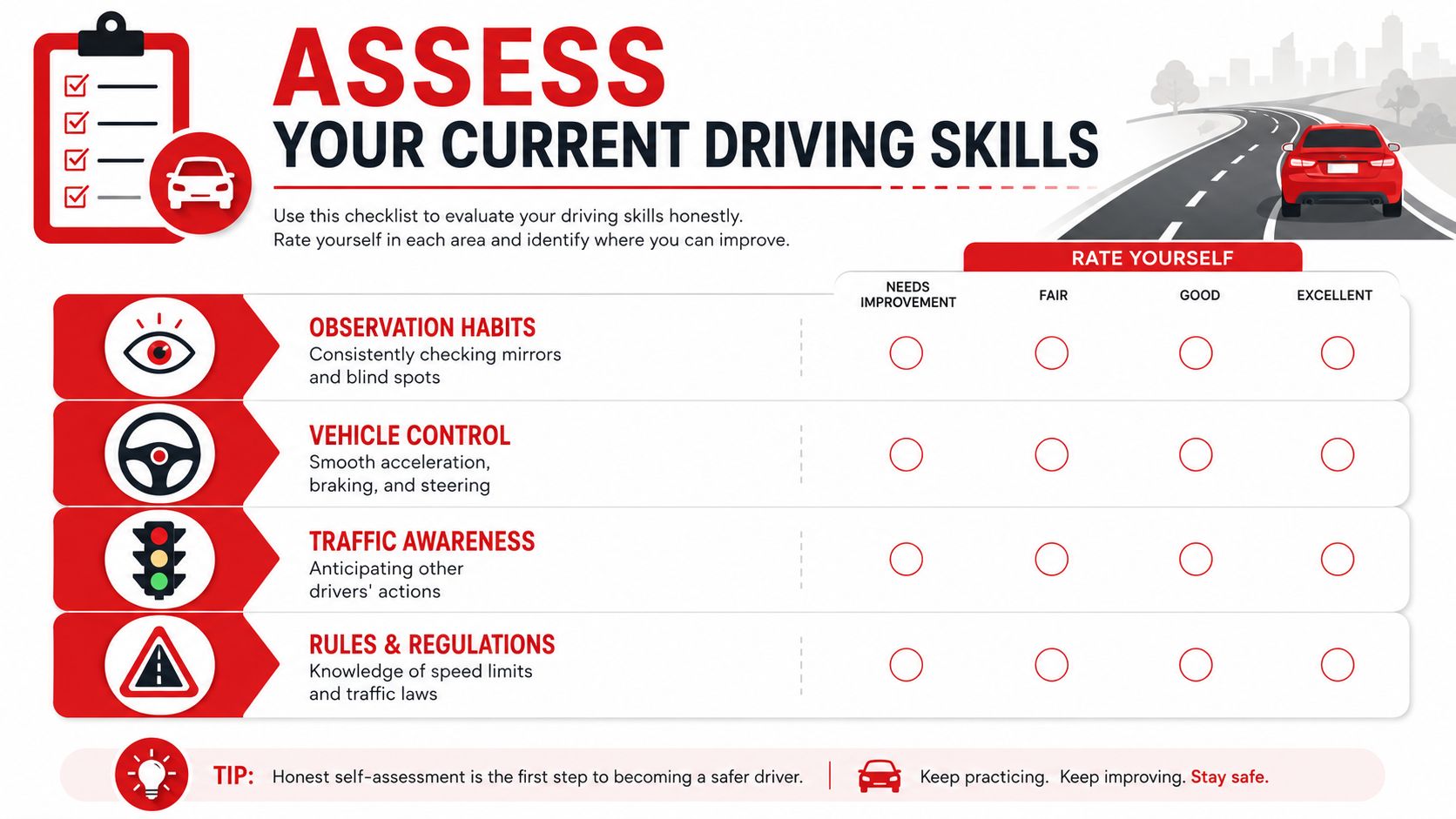
Assess Your Current Driving Skills
A Georgia learner leaves the subdivision feeling fine, then misses a mirror check on a lane change near a busier road and grabs the wheel too hard. That does not mean the driver is “bad at driving.” It usually means the driver has a few specific habits that need to be identified, practiced, and corrected.
A useful self-check is concrete. “I need more practice” does not tell you what to work on. “I brake late at yellow lights,” “I drift while checking mirrors,” or “I skip blind-spot checks before moving right” gives you a starting point. Those are the kinds of details that help an A-1 instructor match you to the right lesson focus and help you prepare for the habits Georgia examiners watch on the road test.
Four things to watch during practice
After each drive, review the same four areas. You are looking for patterns, not trying to grade yourself like a final exam.
Observation habits
Did you check mirrors often enough to stay ahead of traffic, or only after you felt pressure? Did you turn your head before moving sideways? A lane change should begin with information, not steering. If this step feels rushed, practice how to check blind spots while driving until the sequence becomes consistent.Vehicle control
Notice what the car is telling you. Abrupt braking, wide turns, and lane drift usually point to the same root problem: your eyes and hands are working late. When you look farther ahead, the car usually becomes smoother.Traffic awareness
Could you spot a slowing line of cars early? Did you notice the driver beside you creeping toward your lane? Strong awareness works like reading the road one step ahead, the same way a good reader looks beyond a single word to understand the sentence.Rules and road decisions
Were lane arrows, speed changes, stop order, or right-of-way situations clear to you in time to act calmly? Confusion often shows up as hesitation. On a Georgia road test, hesitation at the wrong moment can look like uncertainty about the rule, even if you knew it a second too late.
What confuses many learners
“Nerves” is often the label. The actual issue is usually more specific.
| Area | What it looks like | What it usually means |
|---|---|---|
| Looking too close | Sudden braking, late turns, drifting | Your eyes are not scanning far enough ahead |
| Rushed decisions | Sharp lane changes, missed checks | You're deciding too late |
| Inconsistent control | Jerky steering, uneven stops | Your hands and feet need repeat practice |
Once you can name the exact mistake, you can assign the right drill to it. That is how practice stops feeling random.
Make your assessment honest
Skill shows up in repeatable behaviors. You can see it in mirror timing, lane position, stopping distance, turn setup, and how early you recognize a problem. That is why honest assessment works better than general confidence. A driver who says, “I handled left turns well, but I hesitated at a four-way stop,” is already improving faster than a driver who just says, “I think I did okay.”
Keep a short practice log after every session. Three lines are enough.
One thing I did well
Example: “I kept steady lane position through two curves.”One mistake that repeated
Example: “I checked my left mirror too late before changing lanes.”One skill for the next drive
Example: “I'll start scanning intersections earlier and decide sooner.”
This kind of review helps you connect practice to Georgia's licensing path. Joshua's Law requires structured training for many teen drivers, and the Georgia road test rewards calm observation, steady control, and correct decisions under normal traffic conditions. If you assess yourself clearly, you can walk into lessons at A-1 Driving School knowing what needs work and why.
Build Foundational Skills with Targeted Drills
Most drivers don't need more random driving. They need targeted repetition. A parking lot, a quiet neighborhood street, and a low-pressure route can teach more than an hour of unfocused driving.
Parking and low-speed control
Start where speed is low and feedback is immediate.
Straight-line parking drill
Pick an empty row. Pull into a space, back out, and repeat. Focus on entering slowly, centering the vehicle, and straightening the wheel at the right moment.Reverse control drill
Back through a parking lane at walking speed. Use mirrors, turn your head, and make small steering corrections. If the wheel is moving too much, your hands are trying to fix problems too late.Parallel parking setup practice
Don't begin with the full maneuver. First practice stopping next to a parked car at a proper distance, then reversing in a smooth arc. Break the skill into parts instead of trying to force the whole sequence at once.
Lane control and spacing
Once basic control feels steady, move to quiet roads and work on consistency.
A good benchmark is to maintain a 3-to-4-second following distance and scan 10 to 15 seconds ahead to anticipate hazards, based on safe-driving guidance and defensive-driving benchmarks. Those numbers matter because they give you something you can practice.
Try these drills:
The count-it-out drill
Pick a roadside object after the car ahead passes it. Count until you reach the same spot. If you arrive too soon, you're following too closely.The far-ahead eyes drill
On a familiar road, say out loud what you notice ahead: “light turning red,” “car waiting to turn,” “pedestrian near curb.” This teaches your eyes to lead your hands and feet.The smooth-stop drill
Approach stop signs and lights by lifting off the accelerator earlier than usual. Aim for one continuous brake pressure instead of a late, hard press.
For lane changes, many learners focus on the wheel too soon and forget the information-gathering part. A clear blind-spot routine matters, and this step-by-step guide on how to check blind spots while driving is useful for building a repeatable habit.
Smooth driving starts with early information, not fast reactions.
Handling harder situations
Busy intersections, merge lanes, and multilane roads create a different problem. The challenge isn't just control. It's deciding what deserves your attention first.
Use this simple order:
- Look where your path could be blocked
- Check which nearby vehicle is changing speed or direction
- Protect space around your car before you move
That helps when traffic gets messy. If a car ahead is steady but a vehicle beside you is drifting toward your lane, the side-lane threat may matter more. If rain reduces visibility, your first move isn't sharper steering. It's slower speed, more spacing, and simpler choices.
A coached lesson is often the fastest way to sharpen these basics because an instructor can watch your mirror timing, braking, lane position, and decision-making in real time. Driving lesson packages are built around these same core drills, then expanded into city traffic, highway merging, parking, and road test preparation.
Meeting Georgia's Licensing Requirements
A learner can do well in quiet neighborhood practice, then feel lost when the conversation turns to Joshua's Law, supervised hours, and the road test. That confusion is common in Georgia because the legal steps and the driving skills often get treated as separate jobs. They work better as one plan.
What Georgia learners need to keep straight
For teens pursuing a Class D license, the goal is bigger than checking off forms. You are building skill in the same order Georgia expects you to use it. First, learn the rules. Then practice them with supervision. Then show you can repeat them calmly under test conditions.
That order matters. A permit lets a student begin supervised practice, but practice without structure can turn into random seat time. Joshua's Law adds structure by pairing study with guided driving, which helps families build habits instead of guessing what to practice next.
If you want the steps laid out in plain language, review this guide to driver's license requirements in Georgia.
How Joshua's Law fits into real improvement
Joshua's Law works like a training framework. The classroom portion builds knowledge of signs, right-of-way, risk, and decision-making. The driving portion turns that knowledge into routines you can repeat under pressure, such as scanning before a turn, choosing a safe gap, and stopping without rushing the brake.
Many families also overlook useful support. The Georgia Driver's Education Scholarship Grant Program can help eligible students pay for driver education through participating providers. If cost has slowed down training, checking eligibility early can keep practice on schedule instead of compressing everything right before the test.
Road test skills are everyday skills
The Georgia road test rewards consistency. An examiner is looking for the same habits that keep you safe on normal trips to school, work, or practice. Smooth control, good observation, correct lane use, and steady judgment matter more than trying to look impressive.
A simple way to prepare is to group road test tasks into four repeatable drills:
Starting and stopping smoothly
Practice pulling away with light, steady pressure and stopping without a last-second jab at the brake.Turning with control
Enter the turn at the right speed, stay in the correct lane, and finish without drifting wide.Backing and parking
Move slowly, keep your eyes active, and make small corrections instead of sharp ones.Observation at the right time
Check mirrors early, look in the direction of travel, and avoid waiting until the car is already moving into the next space.
A 2023 systematic review on driver-skill evaluation found that instructors and evaluators often look at observable habits such as mirror use, lane position, and braking control when identifying repeat weaknesses. That is useful for Georgia learners because it turns “I made a mistake” into a clearer question: Was the problem observation, timing, speed control, or vehicle position?
For families who want one place to handle the process, A-1 Driving School provides Georgia-certified driver education, online course options, behind-the-wheel lessons, and road testing support. That helps students connect permit study, Joshua's Law completion, skill practice, and test preparation in one training path.
Why Professional Driving Lessons Accelerate Your Skills
A parent or friend can help you get seat time. That's valuable. But seat time alone doesn't always fix the problem that's holding you back.
Sometimes the core problem is that the person teaching you can feel your mistakes, but can't explain them clearly. They may say “slow down,” “pay attention,” or “turn more,” but they don't break the skill into a drill you can repeat.
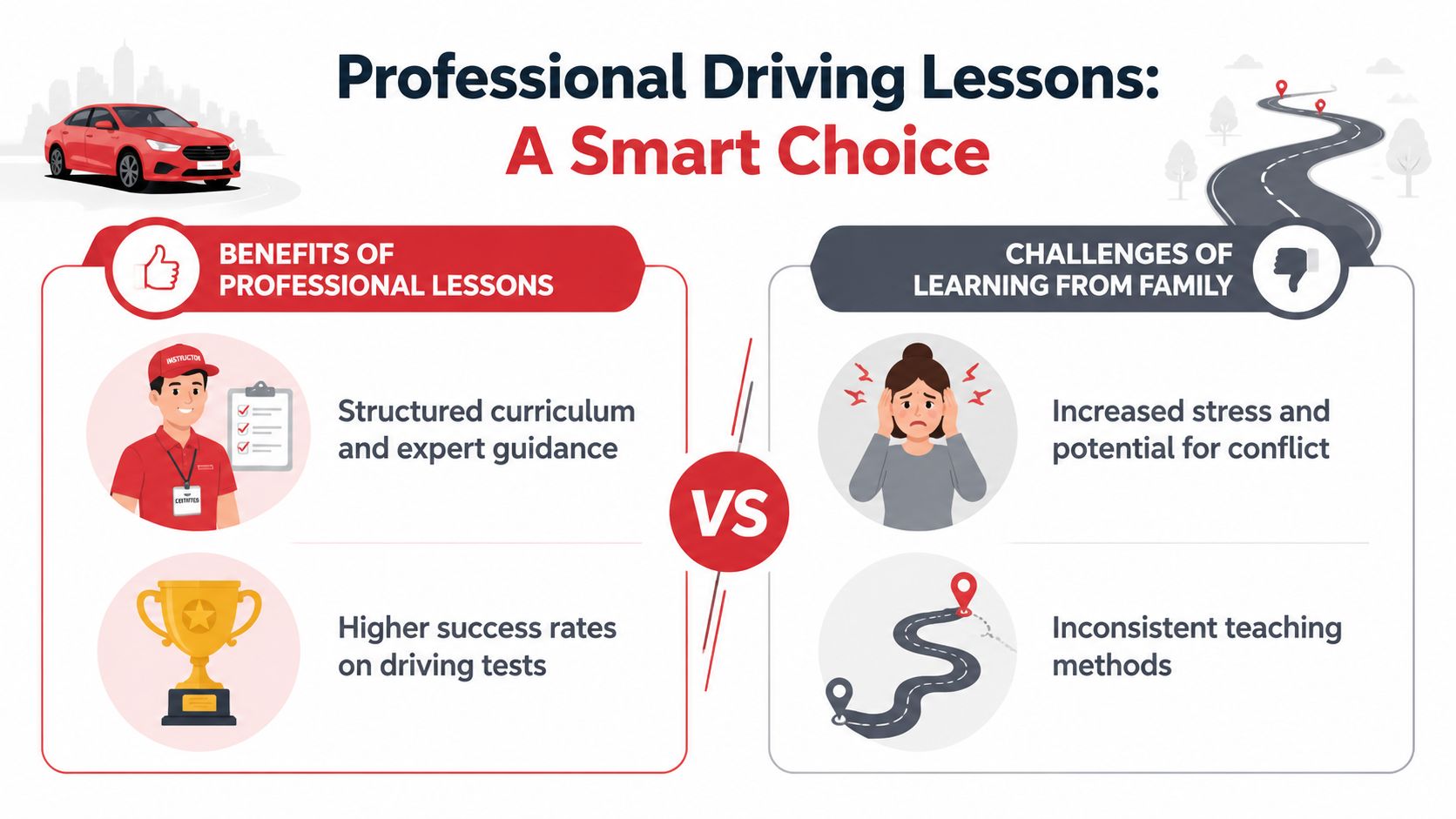
Family practice versus structured instruction
Here's where professional lessons tend to help most:
| Learning with family | Learning with an instructor |
|---|---|
| Feedback may be emotional or inconsistent | Feedback is usually specific and skill-based |
| Routes may stay too easy for too long | Lessons can progress from simple to complex |
| Bad habits can be passed down | Habits are corrected against road-test and safety standards |
That difference matters when the learner is stuck on one recurring issue, such as late braking, weak observation, or hesitation in traffic.
A professional lesson also creates a safer learning environment. The student can focus on timing, scanning, lane placement, and decision-making while the instructor coaches in real time. That makes it easier to practice the same move correctly several times in a row.
Why coaching helps in real traffic
Some skills are hard to learn from casual advice because the challenge isn't visible from the passenger seat unless the teacher knows what to watch for. Following distance in bad weather is a good example.
Guidance on superior driving techniques recommends using the time-gap method and increasing the normal gap to about 5 to 6 seconds in bad weather because visibility and traction worsen, as explained in this overview of safer following distance and weather adjustments. An instructor can coach that judgment live by helping you recognize when rain, spray, low light, or stop-and-go traffic are shrinking your safety margin.
A lot of learners also improve faster when lessons are packaged with a purpose. One student may only need the required behind-the-wheel hours for Joshua's Law. Another may need a broader package that includes parking, lane changes, city driving, highway practice, and road test rehearsal.
For a fuller comparison of what students gain from structured instruction, this article on the benefits of taking driving lessons from an instructor breaks down the practical advantages.
A short video can also help you visualize what coached training looks like in action.
Good lessons don't just tell you what went wrong. They show you exactly when it started going wrong.
Your Next Steps to Becoming a Safer Georgia Driver
You are at a busy Georgia intersection, the light turns green, a car to your left starts creeping forward, and a pedestrian steps off the curb a second later than you expected. Moments like this are where safe driving becomes more than steering and braking. It becomes judgment.
A clear next step is to turn practice into a plan. Start by identifying the situations that still make you hesitate, then match each one to a drill, a Georgia requirement, or a lesson goal. Driving safety experts often point out that one of the biggest gaps for learners is hazard anticipation in heavy traffic, merge areas, and poor weather. Many new drivers know they should look ahead, but they still need help deciding which risk needs attention first and how early to respond.
A simple plan you can follow
Keep your next steps focused and specific:
Name your current weak spots
Choose one or two habits to work on first, such as late braking, wide turns, parking, or checking mirrors too late.Practice one skill in the right setting
Parking lot work helps with steering control and backing. Quiet neighborhood roads help with turns, stops, and scanning. Busier roads help you practice timing, space judgment, and lane changes.Tie practice to Georgia's licensing path
If you are a teen completing Joshua's Law, use each session to strengthen the same skills that show up in supervised driving and the road test. If you are an adult preparing for the Georgia Road Test, rehearse the exact maneuvers and decision-making steps an examiner will watch.Get coached when a mistake keeps repeating
A good instructor does more than point out an error. A good instructor helps you catch it earlier, understand why it happens, and replace it with a repeatable habit.
This works like building control in layers. First you make the car go where you want. Then you make good decisions with enough time to stay calm. That is how a learner becomes a confident Georgia driver.
If you are also dealing with the effects of citations or older violations, your improvement plan may include reviewing your record along with your driving habits. This Georgia driving record cleanup guide offers a useful overview of what to check.
Driving skill grows through steady repetition, clear feedback, and practice that matches real Georgia roads. If you want a structured path from permit work to road test readiness, A-1 Driving School offers Georgia driver education, Joshua's Law training, road test support, and lesson packages for teens and adults.