You're probably here because you need a license, a permit, a road test, or a clear answer before you take time off work or pull your teen out of school for a DDS visit. This is a common point of confusion. Individuals search for a Georgia driving license office, find a list of addresses, and still don't know whether they need to go in person, what to bring, or whether they're about to waste a trip.
I've seen the same pattern for years. A parent arrives with a nervous teen, only to learn one document is missing. A new resident assumes any office can handle any transaction. An adult driver thinks a renewal requires a full office visit when it might not. The stress usually isn't the driving part. It's the process.
A better approach is to treat licensing like a route plan. First, match your goal to the right channel. Then prepare your paperwork. Then practice the skills that matter most for the road test and daily driving. When you do that, the DDS system starts to feel manageable.
Your Roadmap to a Georgia Driver's License
Individuals don't need more office addresses. They need a decision guide.
If you say “I need to go to the Georgia driving license office,” that could mean several very different things. A first-time teen license, an out-of-state transfer, a renewal, a replacement card, or a road test all follow different paths. Some require an in-person visit. Some don't. Some are better handled after you've finished driver education and practice lessons, not before.
Start with your actual goal
A simple way to avoid confusion is to ask one question first: What are you trying to complete today?
That answer changes everything.
- A first license usually means more preparation, identity documents, and testing.
- A permit-to-license step for a teen depends on timing rules and training progress.
- A transfer from another state has its own deadline and document checklist.
- A renewal or fee payment may be routed through online tools or another channel instead of a full office visit.
- A road test should be planned only after the driver is consistently handling turns, lane changes, speed control, and parking with confidence.
A common real-life example
A parent might tell me, “We're going to DDS Saturday and hoping to get everything done.” My first response is usually, “What exactly are you going for?” If the student still needs road practice, hasn't finished the required education steps, or hasn't checked documents, Saturday turns into a frustrating errand instead of a milestone.
Practical rule: Don't schedule the office visit first and figure out the rest later. Build the training and paperwork first, then book the transaction.
That's especially important for teens. Parents often focus on the final card in the wallet. The smoother path is to think in stages: permit, education, supervised practice, professional lessons, road test readiness, then licensing.
Confidence comes from preparation
The good news is that Georgia's system gives you more than one path for many tasks. You're not limited to standing in line and hoping for the best. If you understand where DDS fits, what can be handled online, and when a driving school or third-party testing option makes more sense, the whole process gets easier.
By the time you walk into the right office for the right service, you should already know three things:
- Why you're there
- What documents you need
- What driving skills or course requirements you've already completed
That's how you turn a stressful government errand into a planned step toward getting licensed.
Understanding the Georgia DDS System
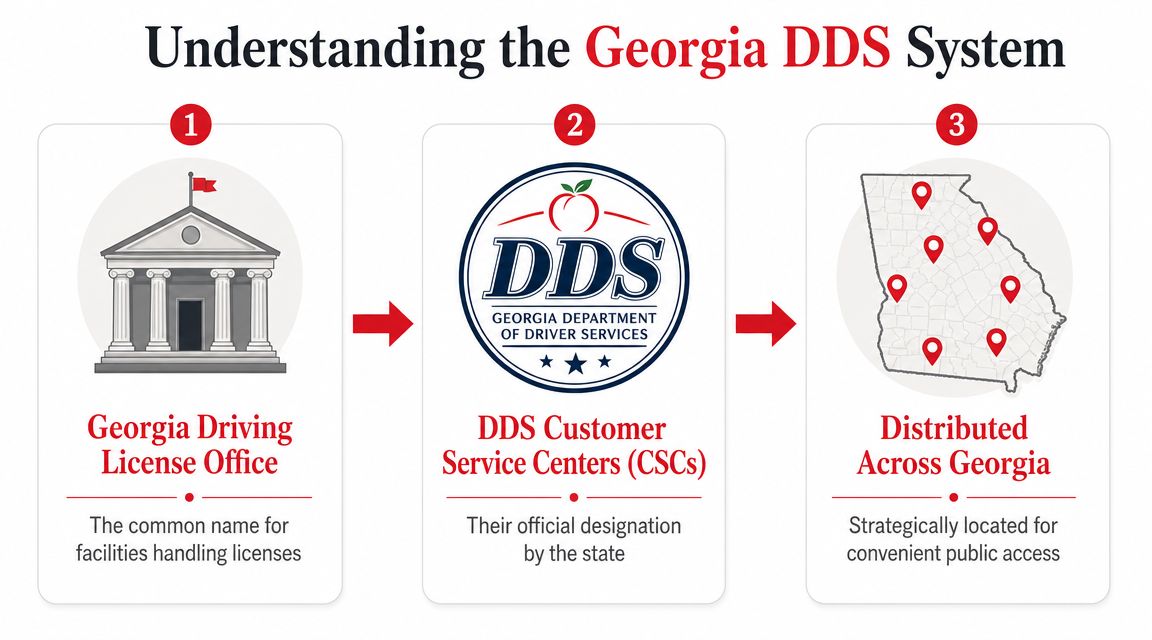
A lot of families use the word “DMV,” then get tripped up because Georgia does not organize everything the way they expect. In Georgia, the agency you deal with is the Department of Driver Services, or DDS, and the offices are called Customer Service Centers, or CSCs.
That sounds like a small detail. It matters because the system works more like a set of service lanes than one single front desk.
The first lane is online. The second is an in-person CSC. The third is a limited renewal option in certain grocery store locations. If you choose the wrong lane for your goal, you can lose a morning and still leave without getting the step you came for.
The Atlanta CSC at 400 Whitehall Street SW, for example, lists services such as first issuance, renewals, replacements, out-of-state transfers, reinstatements, driving history reports, knowledge exams, and CDL written exams on the DDS Customer Service Center page.
Start with your goal, then choose the channel
Students often ask me, “Which DDS office should I go to?” My answer is usually, “What are you trying to get done?”
That is the better question.
A renewal may be handled without a traditional office visit. A first license, a knowledge exam, or an out-of-state transfer often requires an in-person stop where DDS staff can review documents or administer a test. DDS also notes that some locations are set up only for renewals, including self-service options listed through the state's DDS location and service guidance.
Here is the practical way to sort it out:
| Goal | Best first step |
|---|---|
| Renew a license | Check whether online or renewal-only service fits your case |
| Book an appointment or check service availability | Use DDS online tools before driving anywhere |
| Get a first license or take a knowledge exam | Confirm a CSC offers that service |
| Transfer an out-of-state license | Verify the in-person process and document rules first |
This is the part many guides skip. They give you an address, but not a plan.
A better approach is to match the task to the channel before you ever leave home. That is why many new drivers use a plain-language checklist like this Georgia driver's license requirements guide before booking anything. It helps you see whether you are at the permit stage, the testing stage, or the final licensing stage.
Professional help can save time here too. A driving school such as A-1 can help you figure out whether you need more training, a road test plan, or just the right paperwork sequence before DDS enters the picture.
If your long-term goal is commercial driving, the regular license process is only your starting point. After that, a different training path applies, and this guide on how to become a truck driver in Georgia is a useful next read.
The smartest trip to DDS is the one you only make after you know the exact service, location type, and requirements for your specific goal.
How to Prepare for Your DDS Visit
A successful DDS visit usually happens before you leave the house. If you wait until the parking lot to figure things out, you're already behind.
Georgia's licensing process gets much easier when you prepare in three parts: timing, paperwork, and personal readiness.
Check your eligibility before your appointment
For teens, timing matters as much as documents. One county guide notes that teens must hold a Georgia instructional permit for 12 months and one day before a driver's license can be issued, and new residents need to transfer an out-of-state license within 30 days of becoming a Georgia resident on the Stephens County driver's license page.
That rule catches a lot of families by surprise. A teen may feel ready to test, but DDS won't move forward if the permit-holding period hasn't been met. A new resident may still be unpacking boxes and not realize the transfer clock starts quickly.
Build a document pack, not a loose pile
Most failed DDS trips happen because someone brought “something that should work” instead of what DDS will accept.
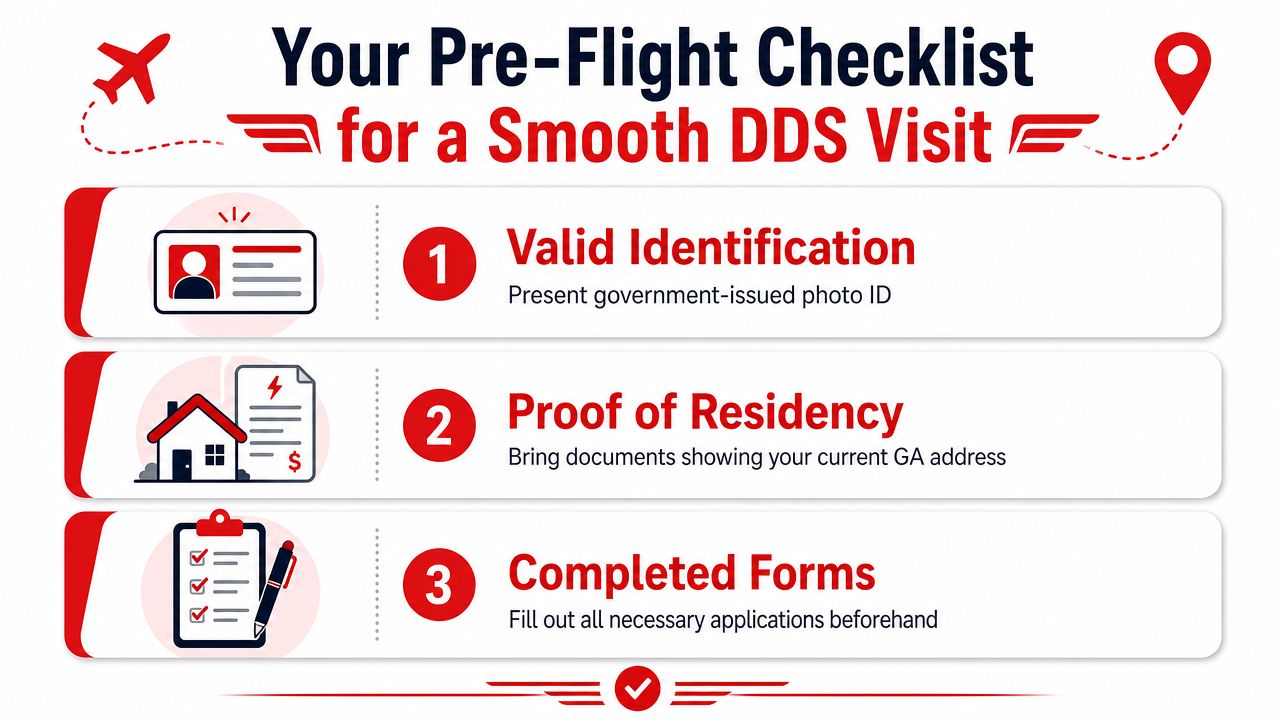
Use a folder and separate your items into categories:
- Identity documents you know are current and legible
- Social Security documentation that matches your legal identity
- Georgia residency documents that show your current address
- Name change documents if the name on one document doesn't match another
- Immigration or legal presence documents if they apply to your case
The Georgia ID requirements guide is helpful for reviewing the types of documents families commonly need before a DDS trip.
If vision is a concern, handle that before test day instead of hoping for the best at the counter. This overview of driver vision and eye test basics can help you think through what to check in advance.
Bring more organization than you think you need. DDS staff can only work with the documents in front of them.
Prepare like you're going to finish the transaction
Don't arrive with half the plan done.
Before your visit, make sure you've done the practical pieces too:
- Confirm the location handles your exact service.
- Schedule if possible through DDS tools rather than walking in blindly.
- Review every document name and address for consistency.
- Bring payment readiness for any fees tied to your transaction.
- If a teen is testing soon, make sure the student is driving at test level, not just permit level.
That last point matters. A student can know the rules and still not be road-test ready. DDS paperwork gets you to the counter. Driving practice gets you through the final step.
Passing the Georgia Road Test
The road test is where nerves show up fast. Even students who drive well in practice can tighten up when an examiner is watching every move.
That's why preparation should focus on repeatable habits, not last-minute confidence talks.

What examiners usually want to see
A road test isn't designed to trick you. It's designed to confirm that you can operate a vehicle safely, follow directions, and handle ordinary driving situations without constant correction.
That usually means the examiner is paying attention to skills like:
- Smooth turns without drifting wide or cutting corners
- Lane changes with mirror checks, signaling, and steady control
- Speed management that matches the road and instructions
- Stops and starts that are controlled, not rushed
- Parking and backing with awareness and accuracy
Students often obsess over one maneuver and ignore the basics. In reality, many test problems come from simple issues like rolling stops, late signals, poor scanning, or forgetting to check surroundings before moving.
DDS testing compared with a school-based option
Some drivers assume the only place to take the road test is a DDS center. In practice, many families also look at school-based testing options when available because the setting can feel more familiar and the scheduling can be simpler.
Here's the difference in plain terms:
| Testing setting | What it may feel like |
|---|---|
| DDS Customer Service Center | More official, busier, and unfamiliar for many first-time drivers |
| School-based testing option | Often more familiar to students who trained there and practiced in a similar environment |
For students who want to know what skills and expectations to review ahead of time, this Georgia road test guide is a useful prep resource.
A short video overview can also help some students settle their nerves before test day.
The best final practice session
The strongest pre-test practice isn't random driving around the neighborhood. It's a focused session where the student drives as if the test has already started.
Have the student do this in order:
- Vehicle setup with mirrors, seat, seat belt, and calm breathing
- Ordinary neighborhood driving with stops, right turns, and left turns
- Lane changes on a busier road
- Parking and backing
- A full mock test with minimal coaching
Drive the test the way you want to drive after you're licensed. Calm, observant, and predictable beats flashy every time.
Fulfilling Joshua's Law with A-1 Driving School
For many Georgia teens, the licensing journey gets real when Joshua's Law enters the conversation. Parents hear the name, students hear “required course,” and both immediately want to know the same thing: what do we need to complete, and what format works best for our schedule?
The answer is usually less about the nearest office and more about choosing a learning format the student will finish and absorb.
Why course format matters
DDS has noted that Tuesday is the busiest day statewide because offices are closed on Monday, and that lines are typically longer before 10 a.m., with afternoons recommended for shorter waits on the Georgia DDS website. That matters because many families still organize the whole process around office availability when the bigger win is handling education and preparation ahead of time.
For Joshua's Law, students often choose between an online format and a classroom format based on how they learn best. Some do well with a self-paced setup at home. Others stay more engaged when an instructor leads the class and keeps them on track.
A simple comparison of course options
| Feature | Online Course | In-Person Classroom |
|---|---|---|
| Schedule style | Self-paced from home | Set meeting times |
| Learning environment | Independent | Instructor-led |
| Good fit for | Students with flexible routines | Students who prefer structure |
| Main consideration | Requires self-discipline | Requires calendar coordination |
A-1 Driving School offers both Joshua's Law course formats, including online and instructor-led options, along with related training pathways for teens working toward a Georgia license.
What families often get wrong
The course isn't just a checkbox. It lays the foundation for what happens in the car later. Students who treat it seriously usually ask better questions during lessons, make fewer repeat mistakes, and understand why traffic rules matter when the instructor corrects them.
That's also why parents shouldn't wait until the permit period is nearly over to start looking for a class. If the student completes education early, the rest of the timeline tends to move more smoothly.
A student who understands the rules before the first serious driving lesson usually progresses faster than one who's trying to learn everything at once.
Build Real-World Skills with Driving Lessons
A new driver changes from “someone preparing for a test” into “someone who can handle the road.”
A lot of teens can pass a written exam after studying. Far fewer can merge smoothly, judge gaps, recover from a bad setup in a parking lot, or stay calm when traffic gets messy. That kind of growth happens in the car, with repetition and correction.
What good driving lessons actually do
Professional lessons should build layered skills. The first layer is vehicle control. The next is traffic awareness. Then comes decision-making under normal pressure.
That progression matters because students don't all struggle with the same things. One may steer well but rush turns. Another may know the rules but freeze at four-way stops. A third may be comfortable on neighborhood roads and uneasy anywhere with heavier traffic.
Strong lesson plans usually focus on areas like:
- Starting and stopping smoothly
- Turn control and lane position
- Mirror use and scanning habits
- Parking, backing, and tight-space maneuvering
- Busier roads, lane changes, and route planning
Why lesson packages help more than one-off practice
Single lessons can help with a specific weakness, but packages are often where real improvement shows up because the student gets continuity. The instructor can identify patterns, assign the right next challenge, and build from one session to the next instead of restarting every time.
That's especially useful for:
- Brand-new teen drivers who need a full foundation
- Students close to the road test who need polish, not basics
- Adults returning to driving after a long break
- Nervous drivers who need steady, calm repetition
A parent's supervision is still important, but it's different from professional coaching. Parents know their child. Instructors know which habits lead to trouble on tests and on public roads. Both roles matter, and they work best together.
The confidence piece families underestimate
Students rarely say, “I need more hazard recognition” or “I need better visual scanning.” They say, “I'm nervous.” That nervousness usually comes from not yet having enough successful repetitions.
Driving lessons fix that by giving the student controlled exposure. The instructor picks the road, the traffic level, and the skill focus. The student gains experience without being thrown into situations they can't yet manage.
By the time a learner has practiced turns, lane changes, parking, and common traffic situations repeatedly with feedback, the road test stops feeling like an unknown. What's more, everyday driving after the test feels less intimidating.
Funding Your Education and Getting Your License
A lot of families reach the same point at the same time. The student is finally ready to drive, school and activities are packed into every week, and the first question is not about the road test. It is, "How are we going to pay for all of this?"
That question matters because driver education works best when you can start planning early instead of waiting until the last minute. If training gets pushed back, the whole licensing timeline can start to feel rushed. Paperwork gets handled late. Practice hours get squeezed into weekends. The DDS appointment becomes the focus, even though the office visit is only one part of the process.
The Georgia Driver's Education Scholarship Grant Program can help some eligible families cover driver training, including classroom and behind-the-wheel instruction. If your student may qualify, check that first. It is often easier to build a realistic plan once you know whether scholarship help is available.
Why planning matters more than office-hopping
Georgia has a large licensing system. The Federal Highway Administration's licensed driver data shows that Georgia had 7,360,699 licensed drivers in 2022. In a system serving that many drivers, preparation saves time.
That is the essential key. Many articles treat the georgia driving license office like the center of the whole experience. For most families, it is closer to the checkout counter at the end of a long trip. You do the learning, practice, documents, and scheduling first. Then you go in for the specific transaction you are ready to complete.
A clearer path families can follow
Use this order:
- Decide the exact goal. Permit, first license, road test, transfer, or renewal each follow a different path.
- Check the age-based requirements. A teen working through Joshua's Law has different steps than an adult first-time driver.
- Figure out how training will be paid for. That may include family budgeting, scholarship support, or spacing lessons out over time.
- Choose the right channel for the last step. Some needs go through DDS, while some road test and training support may be easier to handle through an approved school or testing option.
- Handle insurance right after licensing. Once the student is licensed, families often compare Georgia auto insurance so the new driver is covered before regular driving begins.
That sequence keeps families from doing what causes the most frustration. They book the final step before the student is prepared, then have to reschedule, repeat paperwork, or scramble to fill in missing requirements.
A calm plan usually costs less in time, stress, and missed appointments.
If you want a clearer path from permit to license, A-1 Driving School offers information on driver's education, Joshua's Law courses, driving lessons, lesson packages, road test preparation, and scholarship-related options so you can plan each step with less guesswork.