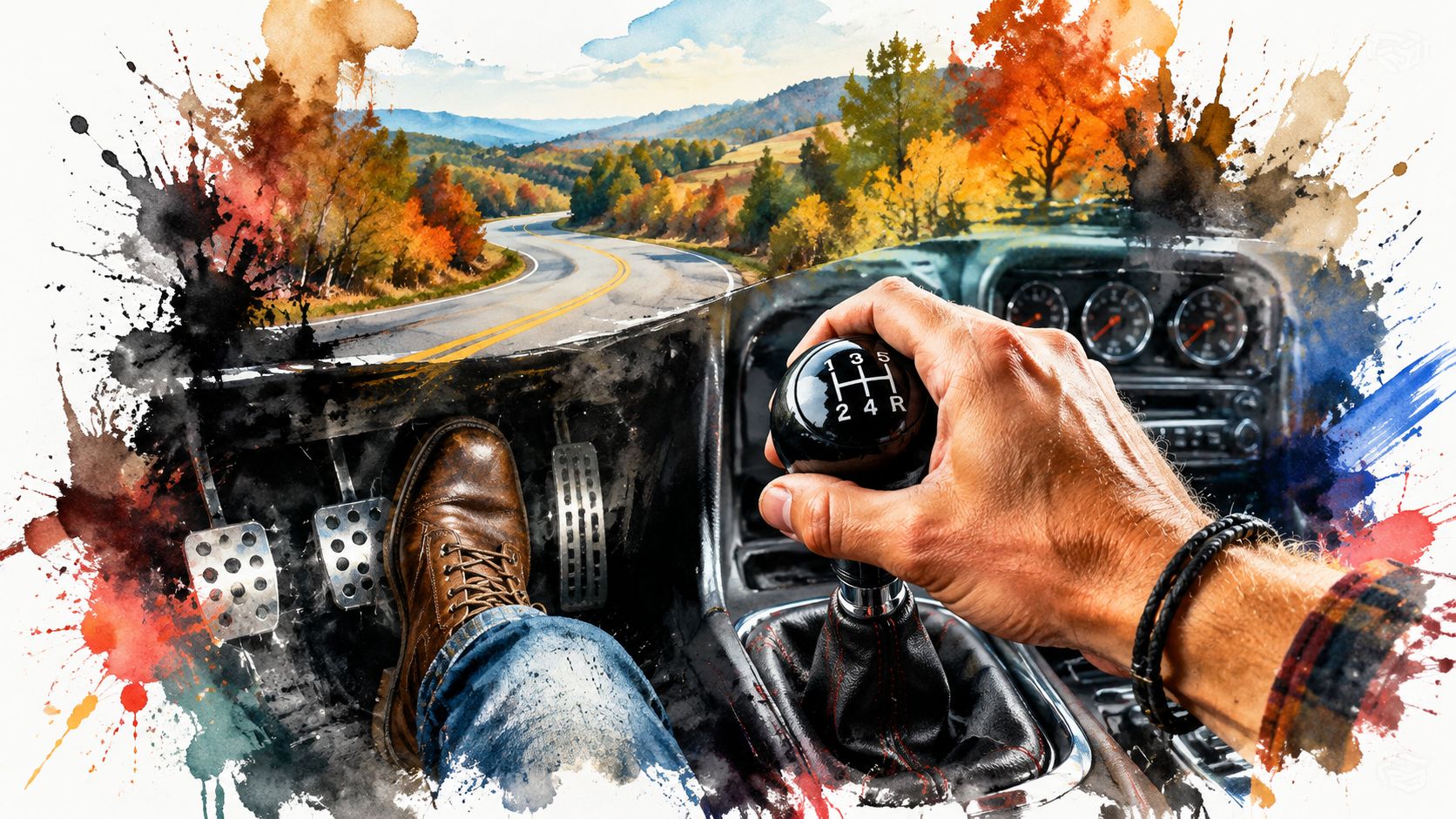
You're probably here for one of two reasons. Either you've always wanted to learn stick shift and kept putting it off, or you've found yourself staring at three pedals and wondering how anyone makes that look smooth.
Manual transmission driving can feel intimidating for the first hour and immensely satisfying after that. The difference is usually not talent. It's having a simple practice sequence, the right expectations, and enough time behind the wheel to stop overthinking every movement. For Georgia drivers, that matters even more. Atlanta traffic, rolling hills, busy intersections, and quick light changes all punish hesitation. A calm routine fixes that.
Why Learn to Drive Stick Shift in 2026
A manual isn't the default anymore, but that doesn't make it irrelevant. It makes it specialized. That's a big difference.
In the U.S., manual transmissions accounted for 6.5% of new purchases in Q1 2012, after 3.9% in 2010 and 3.8% in 2011, while 66% of American drivers know how to drive a manual and 55% have owned or leased one at some point according to this market snapshot on manual transmission use. That gap tells you something useful. Fewer people buy them new, but many drivers still value the skill.
The skill is bigger than the car
Learning manual transmission driving gives you something more durable than a preference for one type of vehicle. It builds driving literacy. You start noticing how engine sound, road speed, slope, and traction all work together.
That's why many people who learn stick shift become calmer drivers in general. They don't just press pedals. They read what the car is doing.
Three practical reasons still hold up:
- More control: You choose the gear instead of waiting for the car to decide.
- More access: You can handle older vehicles, enthusiast cars, and some rentals or borrowed cars.
- More confidence: Once you can launch smoothly on a hill and recover from a stall without panic, regular driving feels easier.
Manual transmission driving isn't only about convenience. It's about being capable in more situations.
It still makes sense for new drivers
For a teen or adult learner in Georgia, this skill can fit into a broader learning path. That path often starts with the basics, including getting a permit and understanding the rules of the road through resources like A-1's guide to a Georgia instruction permit.
The bigger point is simple. If you want the easiest commute in heavy traffic every day, an automatic is hard to beat. If you want stronger coordination, a better feel for how a car behaves, and the ability to drive more than one type of vehicle, learning stick still pays off.
What manual does well, and what it doesn't
Manual driving rewards attention. It also asks for attention.
That trade-off matters in real life. In open traffic, on back roads, or when you want more involvement, a manual can feel natural and satisfying. In stop-and-go congestion, it can feel like work. Both things are true. Good drivers don't need marketing language here. They need honesty.
Understanding the Three Pedals and a Shifter
A manual car looks complicated until you give each control one job.
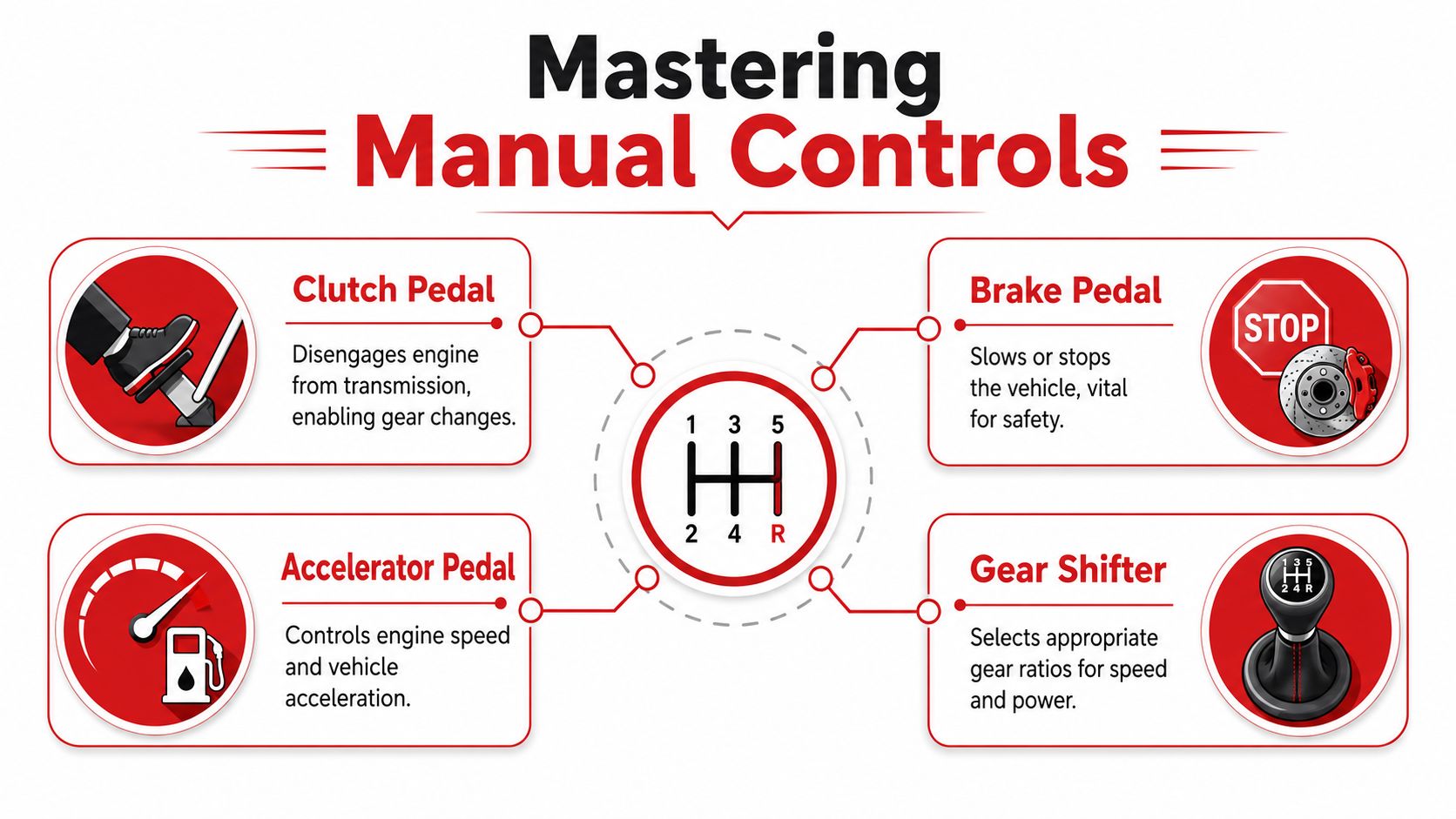
What each control does
Think of the controls this way:
- Clutch pedal: This temporarily disconnects the engine's power from the transmission so you can change gears or start moving from a stop.
- Brake pedal: This slows or stops the car.
- Accelerator pedal: This raises engine speed.
- Gear shifter: This selects the gear the car will use.
The clutch is the part that unnerves beginners. That's normal. It doesn't work like an on-off switch in practice, even if the idea sounds simple. It has a narrow zone where the engine and transmission begin to reconnect. That's the place you learn to feel.
The clutch is about feel, not force
Most beginners try to control a manual by moving too fast. They release the clutch quickly, then react after the car bucks or stalls. Smooth drivers do the opposite. They slow down around the engagement zone and let the car tell them what's happening.
The easiest mental model is this:
| Control | What you should feel for |
|---|---|
| Clutch | The point where the car begins to tug forward |
| Gas | A gentle rise in engine sound, not a surge |
| Shifter | A clean path into gear, never forced |
| Brake | Stability and control before all else |
If the shifter resists, don't muscle it. If the clutch feels vague, slow your foot movement. If the engine sounds strained, your timing is off and you need a little more coordination between clutch release and throttle.
Practical rule: Your ears and feet work together in a manual. Listen to the engine, then adjust your timing.
Why this still matters today
A lot of beginner content explains only the mechanics. It tells you where first gear is and what the clutch does, but it skips the ultimate benefit. As one recent discussion of manual driving points out, many guides miss the practical question of whether manual is still worth learning. Its strongest value is often the access, confidence, and driving literacy it gives you, especially if you may encounter older cars, rentals, or enthusiast vehicles in different places, as noted in this discussion of manual driving practicality.
That's why I teach the controls as a conversation between driver and car, not a memorization drill. You're not trying to perform steps like a robot. You're learning what the car feels like when it's happy.
Your First Drive Getting Started and Stopping Smoothly
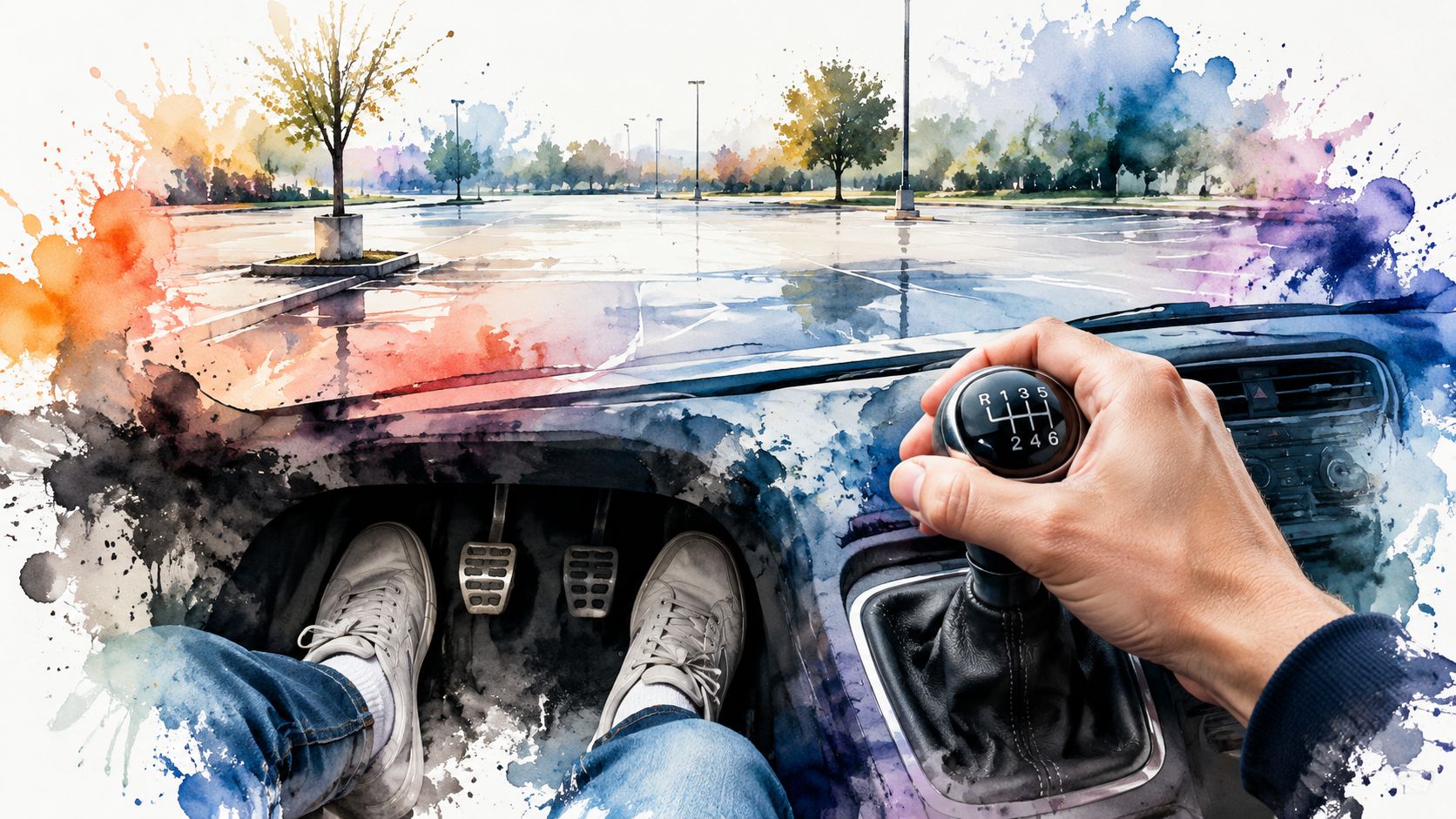
Your first session should happen in a flat, empty parking lot. Not a crowded street. Not a steep hill. Not in rush hour.
That first session has one job. Start moving a few feet, then stop smoothly, over and over.
The launch drill that works
Use this sequence every time:
- Press the clutch fully down.
- Select first gear.
- Release the brake.
- Slowly lift the clutch until you feel the bite point.
- Add light throttle.
- Keep releasing the clutch smoothly until the car moves away.
That bite point matters. RAC guidance describes it as the moment the clutch plates begin to engage, often felt as a slight vibration or change in the car's behavior. Their beginner method is to hold the clutch down, select first, then lift slowly to that point, add light throttle, and continue releasing for a smooth start, as explained in RAC's guide to driving a manual.
What the bite point feels like
Beginners often ask whether the bite point is a sound, a vibration, or motion. It can be all three, depending on the car.
You may notice:
- A slight dip or change in engine tone
- A faint vibration through the pedal
- The nose of the car wanting to creep forward
The mistake is rushing past that point. Pause there briefly. Don't hold it forever, but don't fly through it either. That small moment is where the car begins to trust your inputs.
If the car stalls, nothing has gone wrong. You just released the clutch faster than the engine could support.
How to stop without drama
Stopping is simpler than starting, but many new drivers still get jerky at the end. The rhythm is steady:
- Ease off the accelerator
- Apply the brake
- Press the clutch before the engine begins to struggle
- Come to a smooth stop
If you're stopping fully, neutral is usually the resting place before setting up again for first gear. Don't sit tense with the clutch pushed in while waiting and wondering what to do next.
Here's a visual walkthrough if seeing the hand and foot timing helps:
The reset after a stall
Every beginner stalls. Some stall several times in a row. That's still normal.
Use the same reset each time:
- Stay calm: Hold the brake so the car is secure.
- Clutch down: Fully depress the clutch.
- Shift to neutral if needed: Restart cleanly.
- Start the engine: Then repeat your launch routine.
A clean reset keeps frustration from snowballing. In Georgia traffic, the driver who recovers calmly is safer than the driver who panics and rushes the next move.
Mastering the Art of Shifting Gears
Once you can start and stop without tension, the next step is flow. That means shifting while the car is moving without making every gear change feel like a separate event.
Upshifting without jerking the car
A smooth upshift follows a simple rhythm. Ease off the gas, press the clutch, move the shifter into the next gear, release the clutch smoothly, then return to the accelerator.
The common beginner mistake is overlapping everything too aggressively. They keep pressing the gas while dipping the clutch, or they dump the clutch after the shift. Both create that head-bob feeling everyone in the car notices.
Use the engine sound as your guide. If the engine sounds busy and strained, it's usually time to shift up. If it goes quiet and the car pulls smoothly, your timing was probably close.
Downshifting for hills and turns
Downshifting is where manual transmission driving starts to feel useful instead of just novel.
You downshift when the car needs more pulling power at a lower speed. That often happens:
- Before a hill: So the car doesn't bog down halfway up.
- Before a turn: So you're in the right gear as you exit.
- When slowing in traffic: So the car stays settled and responsive.
Don't wait until the engine is struggling badly. Shift before that point. In hilly parts of Georgia or when merging into faster traffic, early downshifts make the car feel composed instead of reluctant.
What smooth shifting sounds like
A good shift is usually quiet. Not silent, but unremarkable.
Here's a quick reference:
| Situation | What you hear | What to do |
|---|---|---|
| Engine sounds high and busy | Car wants the next gear | Upshift |
| Engine sounds low and reluctant | Car needs more leverage | Downshift |
| Shift causes a lurch | Timing mismatch | Slow your clutch release |
| Shifter resists | Gear engagement isn't clean | Re-center calmly, don't force it |
Drivers who want to build smoother habits beyond basic technique usually improve fastest by sharpening observation, not by moving quicker. These ways to improve driving skills apply especially well to manual drivers because the car gives immediate feedback.
Smooth shifting isn't fast hands. It's good timing.
Tackling Common Manual Driving Challenges
The hardest moments in a manual are rarely the ones you practice first. They show up later, when traffic tightens, the hill gets steeper, or the shift doesn't go where you expected.
Stalling in stop and go traffic
Atlanta-style traffic is where many new manual drivers lose confidence. The car inches forward, stops, creeps again, and suddenly your left leg feels like it's taking a quiz every five seconds.
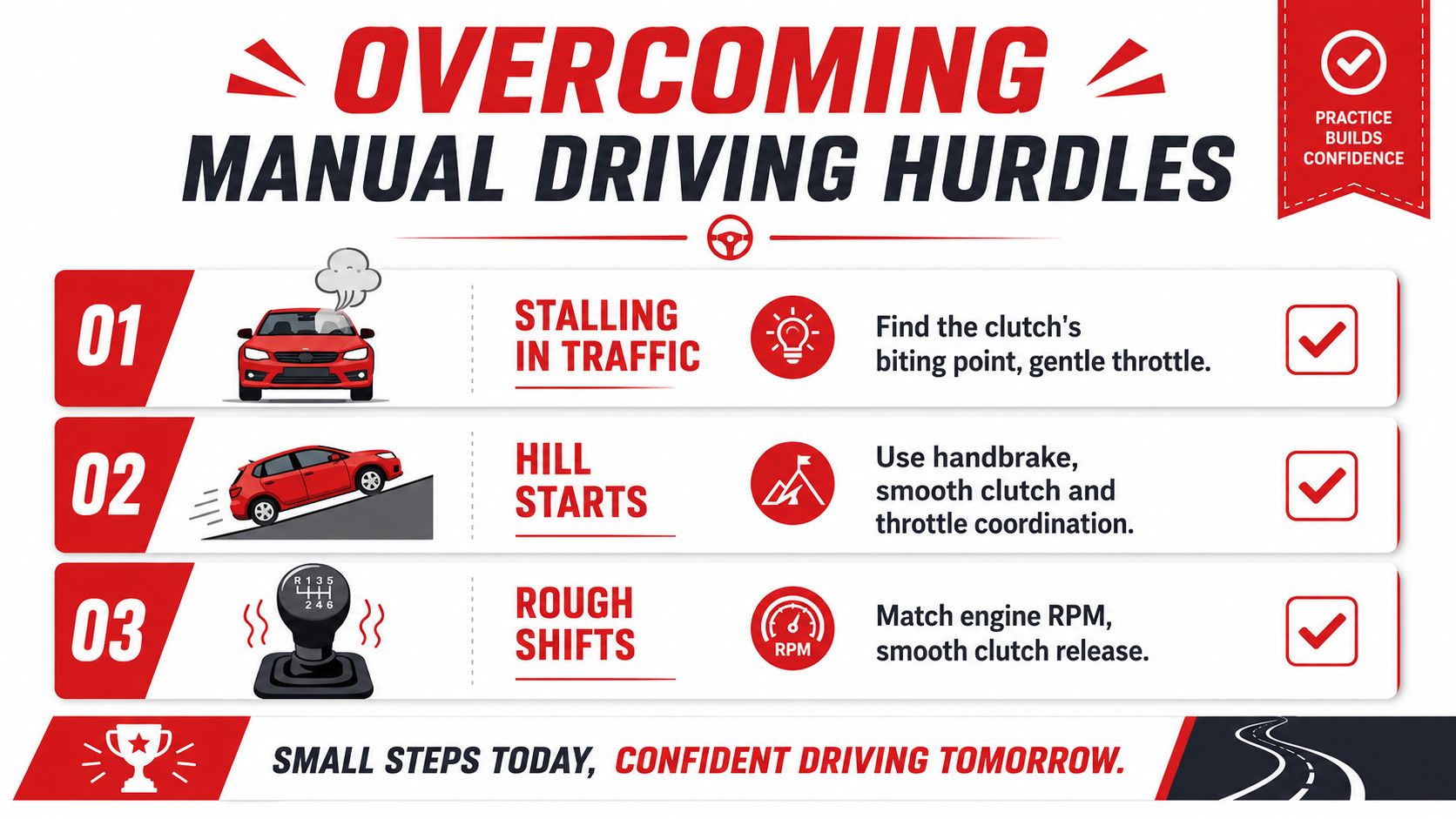
The fix is restraint. Don't treat each tiny gap like a full launch. Let traffic open enough to justify moving, then use a calm first-gear start. A detailed tutorial on stop-and-go manual technique advises adding about 1,000 RPM during launch to reduce stalling or shaking, and shifting to neutral for longer stops to reduce clutch wear, as shown in this manual driving lesson on smoother starts.
A few habits help immediately:
- Leave space ahead: More room gives you time to move once instead of creeping constantly.
- Use neutral for waits: If you'll be stopped more than a few seconds, don't hover at the friction point.
- Stay gentle with throttle: Enough to support the launch, not enough to jump forward.
If you want another plain-English reference on this specific problem, these tips for driving manual smoothly are worth reading because they focus on reducing stalls without overcomplicating the process.
Hill starts without panic
A hill start scares people because rollback feels public. Someone is often behind you. The pressure rises fast.
The handbrake method is the cleanest for beginners:
- Stop with the brake and clutch fully controlled.
- Set the handbrake.
- Select first gear.
- Bring the clutch to the bite point.
- Add gentle throttle.
- Release the handbrake as the car begins to pull.
That sequence buys you time. It prevents the rushed foot shuffle that causes rollback.
On a hill, setup matters more than speed. A rushed launch is what creates the problem.
Grinding gears and rough shifts
Grinding usually happens when the clutch isn't fully engaged during the shift, or the shifter is being rushed into gear before the transmission is ready. It can also happen when a driver guesses the wrong gate and pushes instead of guiding.
If that happens, don't force it. Clutch fully in, return the shifter to neutral, then try again with a calmer hand. A rough shift is feedback, not failure.
Watch for these causes:
- Partial clutch press: The transmission isn't fully disengaged.
- Too much hand force: The shifter should move with intention, not muscle.
- Poor timing on downshifts: The engine speed and road speed don't match well.
Accelerate Your Learning with A-1 Driving School
Self-teaching can get you started, but manual transmission driving gets easier much faster when someone experienced is in the car correcting small mistakes before they become habits.
That matters because learning any new driving skill carries risk. Research on crash outcomes comparing transmission types found different injury patterns across more than 4,000 crashes, with 2,272 manual-transmission crashes and 1,856 automatic-transmission crashes examined in one observational study. The same paper notes mixed findings in earlier work and does not prove one transmission is universally safer. The practical takeaway is that driver skill and vehicle control matter most, especially while learning, as discussed in this crash-injury analysis of transmission type.
Why instruction speeds up progress
A good instructor shortens the learning curve by catching the things you can't diagnose alone. Most learners can tell when the car stalls. Fewer can tell whether the cause was clutch speed, not enough throttle, poor posture, or a late downshift.
That outside feedback is especially useful for:
- Hill starts in traffic
- Smooth launches from lights
- Recovering after mistakes without panic
- Building consistency in real Georgia road conditions
There's also a safety advantage when difficult skills are practiced in a controlled learning environment. That's one reason many drivers benefit from reading about the benefits of taking driving lessons from an instructor, especially when they're learning a more hands-on skill.
Georgia learners need more than one path
Not every learner starts in the same place. Some are teens working through driver's education and Joshua's Law requirements. Some are adults who never learned stick shift the first time around. Others are licensed drivers who want road test preparation, better fundamentals, or a structured way to practice.
A strong school should make those paths easy to combine. That includes:
| Need | Useful training option |
|---|---|
| Teen starting out | Driver's education and Joshua's Law course options |
| Busy family schedule | Online course options in Georgia |
| New or returning driver | Driving lessons and lesson packages |
| Test readiness | Road test preparation and testing support |
| Cost concerns | Georgia Driver's Education Scholarship Grant Program information |
Where A-1 stands out
A-1 Driving School has been serving Georgia drivers since 1987, with metro Atlanta locations, online options, road testing support, teen and adult lessons, and access to the Georgia Driver's Education Scholarship Grant Program for eligible students. For families trying to connect classroom learning to real road confidence, the biggest differentiator is still the practical side: driving lessons and lesson packages.
That matters because confidence behind the wheel doesn't come from reading about clutch control. It comes from repeating the right moves with coaching, then carrying those habits into traffic, turns, intersections, and test-day conditions across Georgia.
If you want the fastest route from “I think I get it” to “I can drive this car smoothly,” professional instruction usually beats trial and error.
If you're ready to build real confidence behind the wheel, A-1 Driving School offers Georgia driver's education, Joshua's Law courses, online learning options, road testing support, and hands-on driving lessons and lesson packages that help teens and adults turn basic knowledge into dependable skill.