You've probably done some version of this already. You open the Georgia Driver's Manual, flip a few pages, see sign charts, right-of-way rules, penalties, lane markings, and school zone details, then close it again because it feels bigger than you expected. Most teens aren't confused because the material is impossible. They're confused because nobody shows them the right order to learn it.
That's where a good Drivers Permit Test Study Guide helps. Not as a giant pile of facts, but as a simple plan. If you study the Georgia permit test the same way you'd prepare for a hard school exam, it becomes manageable. If you study randomly, it starts to feel stressful fast.
Your First Step Toward a Georgia Driver's Permit
A student walks into our office all the time with the same look. Excited. Nervous. Ready to drive, but not sure where to start.
Usually, they've heard mixed advice from friends. One person says the test is easy. Another says the signs section got them. A parent tells them to “just read the book,” but they don't know what that means in practice. That's a normal place to begin.
The Georgia permit process gets much easier when you stop treating it like one big mystery. It's really a series of smaller tasks. Learn the test format. Study the highest-risk topics first. Practice in a way that matches how the DDS asks questions. Then show up prepared.
If you're still sorting out the basics of eligibility and what the permit process looks like, start with this overview of a permit in Georgia. Once you know the path, studying feels less intimidating.
Practical rule: Don't begin by memorizing everything. Begin by understanding what you'll be tested on and how the test is scored.
A lot of students make the same mistake. They read a few manual pages one night, take a random online quiz a week later, then assume they're “kind of ready.” That approach leaves gaps. On permit day, those gaps show up in road signs, right-of-way questions, and wording that feels familiar but not fully clear.
A better approach is simple. Break the work into weeks. Give road signs their own focused study time. Use examples for rules instead of memorizing lines. Review missed questions until you understand why the right answer is right.
That's how confident students prepare. Not with last-minute cramming, but with a plan they can follow.
Deconstructing the Georgia Permit Test Format
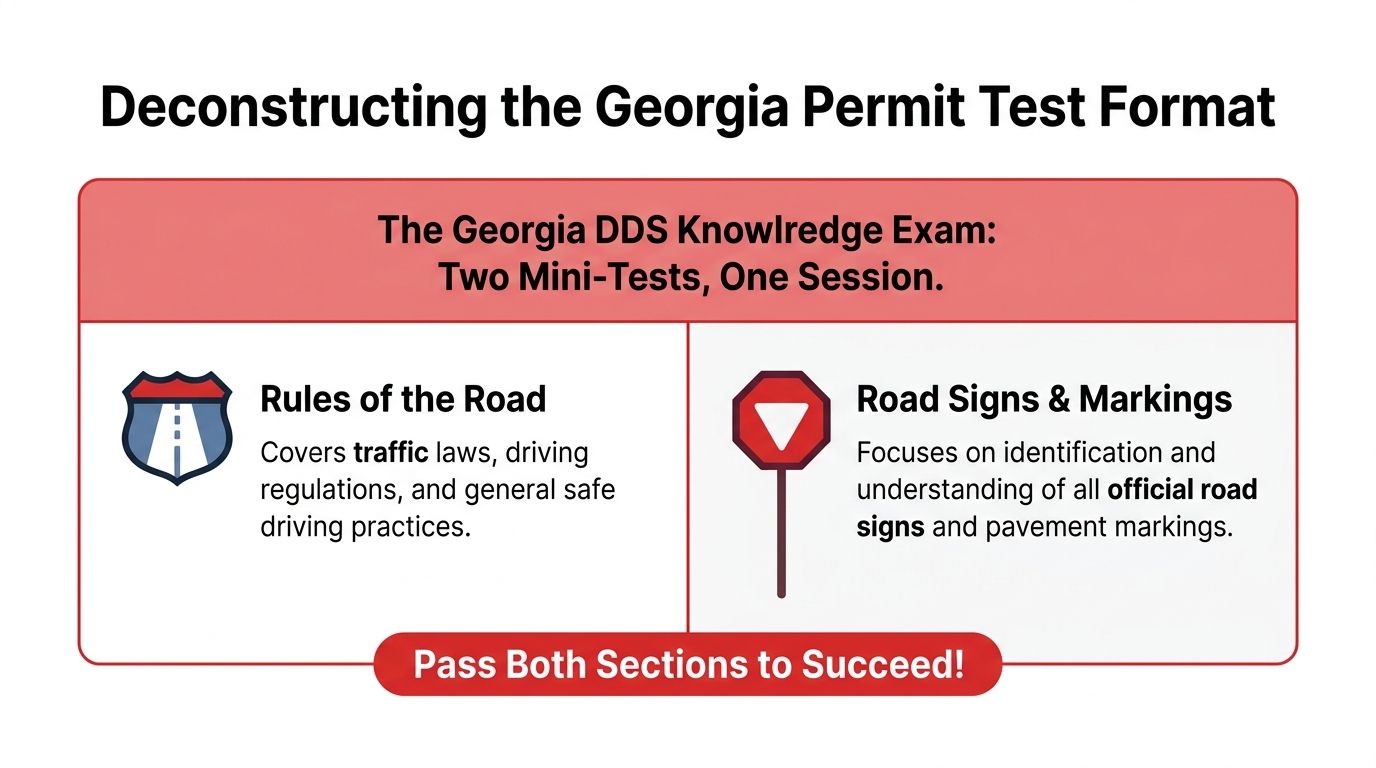
A student can walk into the DDS feeling prepared, answer plenty of questions correctly, and still leave without a permit. The reason is simple. Georgia does not treat the knowledge exam like one big pool of 40 questions. It treats it like two separate tests taken at the same time.
The Georgia Learner's Permit knowledge exam has two sections. One covers Road Rules. The other covers Road Signs.
Each section has 20 questions, and you must answer at least 15 correctly in each section to pass. A strong Road Rules score cannot cover for a weak Road Signs score. If one section falls short, the exam is marked as a failure.
What the two sections mean
The Road Rules Test measures whether you understand how to behave legally and safely in traffic. Expect questions on right-of-way, turning, lane position, signals, speed laws, and common driving situations. These questions often reward scenario-based thinking. In other words, you need to know what you would do, not just what a sentence in the manual says.
The Road Signs Test checks recognition and meaning. You need to identify signs by shape, color, symbol, and purpose. That includes warning signs, regulatory signs, guide signs, and pavement markings. This section works more like visual recall. Students who study signs only by reading definitions often miss questions they could have answered if they had practiced seeing the sign and naming its meaning quickly.
If you want a cleaner visual of the layout before test day, this breakdown of what a permit test looks like gives students a simple preview of the format.
Why the scoring rule changes how you study
Many students underestimate this part.
They hear "40 questions" and assume they only need a decent total score. Georgia's scoring does not work that way. You need two passing scores, one in each section.
Here is the structure in plain language:
- Road Rules: 20 questions
- Road Signs: 20 questions
- Passing score: 15 correct in Road Rules and 15 correct in Road Signs
- Key takeaway: one strong section does not rescue one weak section
That is why a smart study plan separates the material. Road Rules should be practiced with short scenarios. Road Signs should be practiced with repeated visual review. As an instructor at A-1 Driving School, I have seen this pattern for years. Teens who study both sections the same way usually leave points on the table.
A student can understand driving laws well and still fail by missing too many sign questions.
What happens if you fail
Retesting rules matter because they can slow down your permit timeline. If you fail a section, you must wait before taking that section again. A second failure of the same section brings a longer wait. That is one reason students do better with a study system than with random practice.
One helpful option is creating your own review sets with Cramberry for students, especially for signs, definitions, and missed questions that need extra repetition.
The format becomes much less stressful once you see it clearly. You are preparing for two different kinds of thinking. One asks, "What is the safe and legal choice here?" The other asks, "What do I need to recognize immediately?" Once you understand that split, your study time starts working much harder for you.
Prioritizing Your Study for First-Time Success
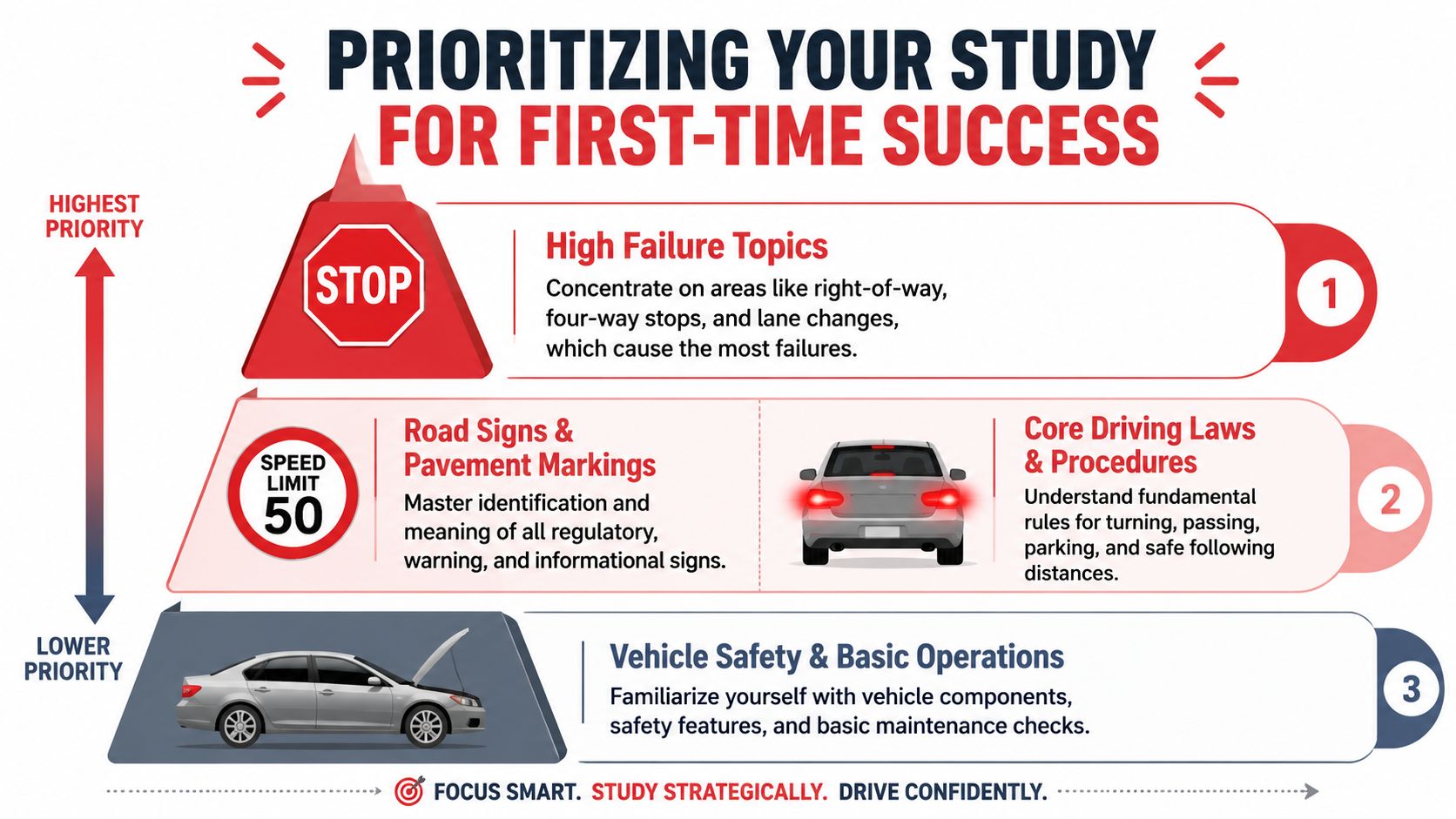
Most students think they should study the manual from page one to the end in order. That sounds organized, but it usually isn't the fastest way to pass. A better Drivers Permit Test Study Guide puts your energy where students most often lose points.
The first priority should be road signs. Expert guidance in this Georgia-focused DDS test study guide notes that the Road Signs section is a frequent failure point, especially when students overlook geometric shapes and color codes. In other words, students often know more rules than their score shows, but signs pull them below the passing mark.
Start with signs because they reward repetition
Signs are visual. That makes them perfect for short, repeated study sessions. You don't need to write long notes about every sign. You need to recognize it fast and connect shape, color, and meaning.
Study signs in groups:
- Warning signs: focus on what the sign is alerting you to
- Regulatory signs: learn what you must or must not do
- Guide signs: understand what information they give
- Pavement markings: connect lines and markings to lane behavior
If you make your own flashcards, keep them visual. Put the sign image on one side and the meaning on the other. If you want a faster way to turn your notes into review materials, tools like Cramberry for students can help organize study prompts into something easier to revisit.
Move next to rules that create confusion under pressure
After signs, shift to the rules that tend to trip students up when they're rushed. These usually include:
- Right-of-way situations: four-way stops, uncontrolled intersections, pedestrians
- Turning rules: proper lanes, signaling, and yielding
- Lane changes and passing: when it's legal and when it isn't
- School zones and special driving environments: where details matter
Don't memorize these as isolated sentences. Tie them to scenes. Ask yourself, “If two cars arrive at the same time, who goes first?” or “If I'm turning left, who am I waiting on?”
That's why students do better when they work through a focused Georgia permit practice test instead of only rereading paragraphs. A good practice test forces you to retrieve the rule, not just recognize it.
A helpful video explanation can also break up your studying and make the material stick better:
Leave broad review for last
General safe driving content still matters. You need it. But it should come after signs and the most mistake-prone rule questions.
Use this order:
- Signs and markings first
- High-confusion road rules second
- General safe driving review last
That order gives you the strongest return on your study time. It also matches what we see in real students. The ones who pass calmly usually don't study more. They study in a smarter sequence.
Your Four-Week Permit Test Study Schedule
A study plan works better when it's realistic. You don't need marathon sessions. You need consistent sessions that build on each other. Research summarized by Drive Smart Georgia notes that students who use official or well-structured practice tests tend to do better on a first attempt, and that 75% of test content is directly derived from the manual's safety and regulatory chapters in this guide on how to prepare for the Georgia permit test.
That tells you two things. First, the manual matters. Second, practice tests help lock that material in.
Four-Week Permit Study Plan
| Week | Primary Focus | Key Activities |
|---|---|---|
| Week 1 | Road signs and pavement markings | Review sign groups, build flashcards, do short visual quizzes, repeat missed signs daily |
| Week 2 | Core road rules part one | Study right-of-way, intersections, signaling, and turns. Write out examples in plain language |
| Week 3 | Core road rules part two | Review parking, speed control, lane use, passing, sharing the road, and safety rules |
| Week 4 | Full review and practice testing | Take repeated practice tests, review missed questions, revisit weak areas, simulate test conditions |
Week 1 on signs only
This week should feel simple and repetitive. That's a good thing.
Read the signs section of the Georgia manual. Then stop reading and start recalling. Quiz yourself on shapes first, then colors, then full meanings. Students often try to learn every sign in one sitting. Don't do that. Split them into smaller groups and revisit them every day.
If shorter sessions work better for your attention span, it helps to explore microlearning. The idea is simple. Learn in small bursts that are easy to repeat, instead of forcing one long study block that you won't remember well.
Study habit: Short review done consistently beats one heavy cram session every time.
Week 2 on road rules that show up most often
This is the week for right-of-way, intersections, and signaling. These topics cause confusion because the wording can feel similar from one question to the next.
A strong method is to create mini scenarios in your head. For example:
- You reach a four-way stop at the same time as another car
- You're turning left while oncoming traffic continues straight
- A pedestrian is crossing while you want to turn right
Write the answer in your own words before checking the manual. That step matters. If you can explain a rule clearly, you probably understand it.
Week 3 on the rest of the rules
Now fill in the remaining knowledge areas. Focus on parking, speed management, lane changes, passing restrictions, and sharing the road safely.
This week is where many students start mixing everything together, so keep your notes organized by topic. Don't just reread. Test yourself after every short study block.
Try this format:
- Read one topic
- Close the manual
- Say the rule out loud
- Answer a few practice questions
- Review only the ones you missed
Week 4 on test rehearsal
This week is about performance, not first-time learning. Take multiple practice tests. Sit without distractions. Treat the session like the actual exam.
After each round, don't just mark right or wrong. Study the explanation for every miss. A missed question is useful because it shows you exactly where your understanding is thin.
A good final-week routine looks like this:
- Take a full practice set.
- Mark every missed sign or rule.
- Return to the manual for those topics only.
- Retest the next day.
- Stop heavy studying the night before the exam.
By test week, your job isn't to learn everything. Your job is to recognize patterns quickly and stay calm.
From Theory to Practice The A-1 Advantage
You passed the knowledge test. Then you pull up to a busy Georgia intersection for your first real left turn, and suddenly the rule you memorized feels different when cars are moving, a light is changing, and someone is waiting behind you. That gap between knowing and doing is normal. It is also where good instruction matters.
For Georgia teens, the training path continues after the permit. Joshua's Law requires 16 and 17-year-olds to complete a DDS-approved 30-hour Driver's Education course before they can apply for a Class D driver's license, as explained in this overview of Joshua's Law in Georgia. Families often aim all their energy at the written exam first. That makes sense. The permit is the doorway, not the finish line.

A permit test checks recall. Driving lessons build judgment, timing, and control.
Students usually feel this difference in a few predictable places. A teen may know the right-of-way rule, but still freeze while turning left across traffic. Another may answer every sign question correctly, yet drift in the lane because steering control is still new. Parking is another common example. On paper, it sounds simple. In motion, it takes foot control, mirror use, and patience.
That is why practice should match the skill you are trying to build. Road signs are learned best with visual repetition. Rules are learned best by talking through real traffic situations. Car control is learned by doing it again and again with feedback right away, while the mistake is still fresh.
If you are comparing programs, look for training that supports the full progression from permit holder to confident new driver. Useful options often include:
- Joshua's Law courses: online or in person, based on your schedule
- Multiple driving lessons: so skills can improve one layer at a time
- Road test preparation: focused work on the habits and maneuvers evaluators watch for
- Road testing options: for families who prefer a familiar practice setting
- Scholarship information: for students who may qualify for state-supported help
A-1 Driving School is one example of that full-path approach. The school offers Joshua's Law courses, online class options in Georgia, driving lessons, lesson packages, and road test services. For many families, the primary value is structure. Instead of treating the permit as one task and driving skill as a separate problem, they follow one plan from study to supervised practice to licensing.
Here is the simplest way to view it. The written test asks, “Do you know the rule?” Behind-the-wheel training asks, “Can you use the rule calmly, at the right moment, with other cars around you?” Students who work on both are usually far better prepared for real roads, not just the exam room.
Your Permit Test Day Success Checklist
The final 24 hours before your permit test should feel like the night before a game you already practiced for. You are not trying to cram new material into your head. You are protecting your focus, your energy, and your routine so your preparation shows up when it counts.
That last part matters. In 2025, 19,012 Georgians failed their driving test, a rate of more than 50 failures per day, according to Zutobi's Georgia driving test report. A good share of test-day mistakes come from preventable problems like rushing, second-guessing, or showing up unprepared.
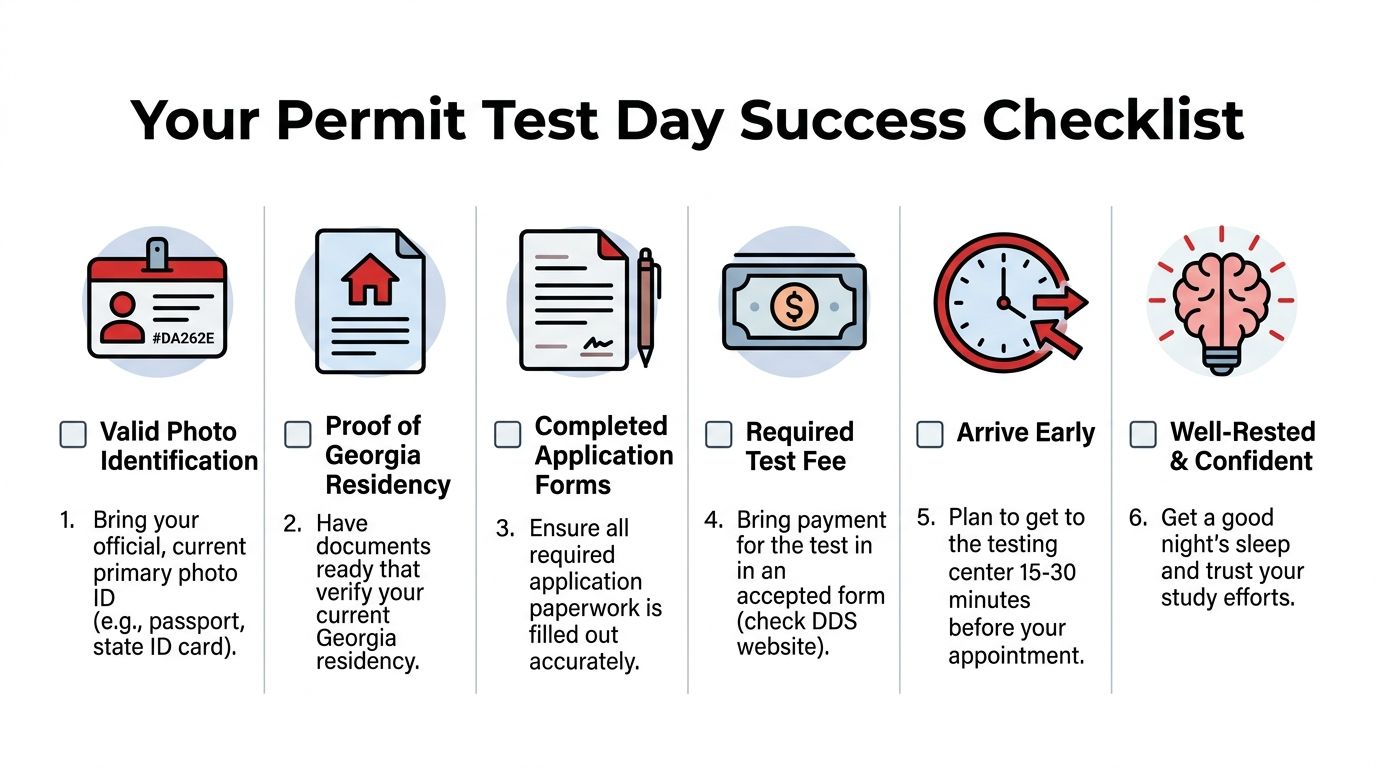
The night before
Keep your routine simple and predictable.
- End heavy studying early: do a short review, then stop
- Set out your documents: treat this like packing your backpack before school
- Get enough sleep: tired students often miss words like except, always, or yield
- Eat and drink water: your brain works better when your body is not running on empty
One mistake I see often is students studying late because they feel nervous. Usually, that backfires. Permit questions reward a clear head far more than one extra hour of anxious rereading.
What to do at the testing center
Start each question the same way. Read the full question first. Then read every answer choice. If two options seem similar, remove the one that clearly breaks a Georgia rule. That process works like narrowing a lane before a turn. Once the extra space disappears, the correct path is easier to see.
Keep these reminders in mind:
- Read every word carefully: one small word can change the whole meaning
- Answer by the Georgia DDS rule: do not rely on what a friend, sibling, or parent says they do
- Use sign clues: shape, color, and symbol patterns often point you to the right answer
- Stay steady after a hard question: one difficult item does not predict your final result
Trust the study plan you followed. Calm students recall more.
If you get stuck, pause for a breath and work the question in order. What is it asking? Which answer clearly fits the rule? Which answer sounds familiar but is too broad or too risky? That kind of step-by-step thinking is how prepared students avoid common Georgia permit test misses.
Walk in organized. Sit down focused. Handle one question at a time. That is the test-day habit that gives your study work its full value.
If you're ready for the next step after studying, A-1 Driving School offers Georgia driver's education, Joshua's Law courses, online course options, road test support, and driving lesson packages that help students move from permit prep to real-world driving practice.