
You're probably here because a judge, clerk, parent, or school official told you that you need an Alive at 25 class, and now you're trying to figure out what that entails. A lot of young drivers in Georgia end up in this spot. One ticket, one court notice, one deadline, and suddenly the process feels much bigger than it did a day earlier.
Parents often feel the same pressure. They want to help their teen fix the immediate problem, but they also want to know what comes next. Is this just a one-time class? Does it replace driver's education? Will it help with safer habits, or is it only about satisfying the court?
Those are fair questions. The short answer is that Alive at 25 classes can be useful, but they're only one part of youth driver safety in Georgia. A single class can address a court or traffic issue. It usually doesn't replace the kind of structured learning that helps a new driver build real skill, confidence, and better judgment over time.
Your Guide to Youth Driver Safety in Georgia
A teen gets a traffic ticket. A parent opens the paperwork and sees a class requirement. The family starts searching online and runs into a confusing mix of terms like driver's ed, Joshua's Law, defensive driving, road testing, and Alive at 25. That confusion is common because those programs sound similar, but they don't do the same job.
Alive at 25 is usually tied to a specific issue, often after a traffic violation or court involvement. It addresses choices behind the wheel. That matters, especially for young drivers who are still learning how quickly a simple decision can turn into a dangerous one.
But safe driving doesn't start with a court order. It starts earlier, with a basic understanding of Georgia's licensing path, quality instruction, and time behind the wheel with feedback from a trained instructor. A teen who learns lane positioning, scanning habits, parking, turns, merging, and speed control from the beginning is in a much stronger position than a teen who only takes a reactive class after a mistake.
Practical rule: If a class helps you satisfy a requirement, that solves today's problem. If lessons help you avoid the next ticket or close call, that changes your driving for the long term.
For many Georgia families, a significant challenge is choosing the right mix of training. A teen may need a Joshua's Law course to move toward a Class D license. Another driver may need private lessons because they're nervous in traffic. Someone else may already know the rules but still needs help preparing for the Georgia road test in a calm, structured setting.
That's why it helps to think of youth driver safety as a full path, not a single checkbox. The court-ordered class handles one piece. Professional driver education, online course options, road test preparation, and lesson packages handle the bigger picture.
What Exactly Are Alive at 25 Classes
Alive at 25 classes are designed for young drivers and focus on behavior, judgment, and road decisions. The program was developed by the National Safety Council and is aimed at drivers in the young adult age range. In plain language, it's less about teaching the mechanics of driving and more about teaching what happens in the seconds before a bad decision.
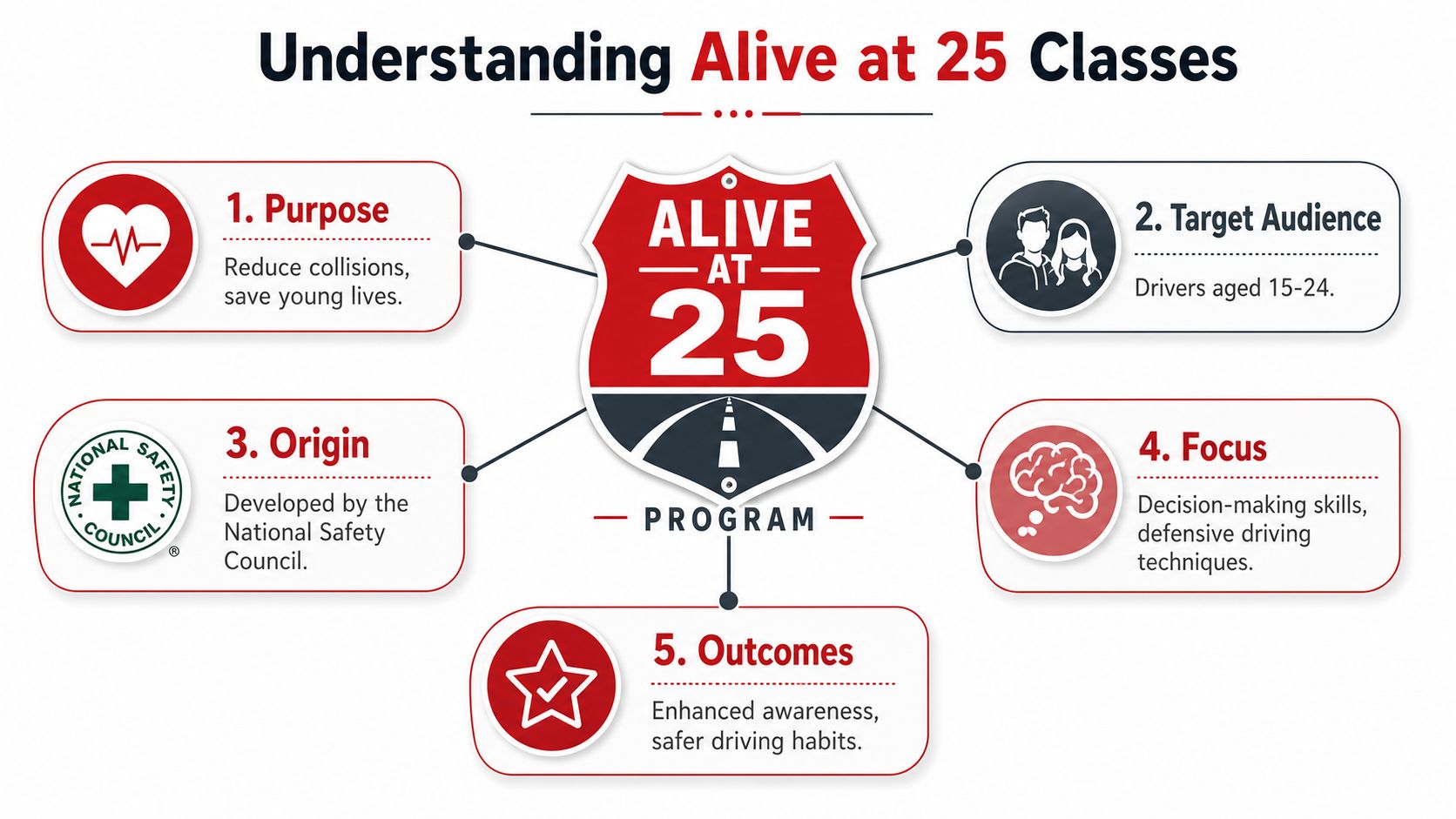
A mental toolkit for split-second choices
A good way to understand this course is to think of it as a mental toolkit for the road.
A basic driver's ed class teaches rules, signs, and core driving knowledge. Behind-the-wheel lessons teach physical skills like braking smoothly, changing lanes, and backing into a space. Alive at 25 works on a different layer. It pushes drivers to slow down their thinking, notice risks earlier, and understand consequences before they act.
That includes topics such as:
- Hazard recognition when traffic conditions start changing around you
- Risk assessment when you feel pressure to speed, show off, or keep up with other drivers
- Passenger influence and how friends can distract a young driver
- Choice and consequence in moments that seem small but carry real weight
A teen might know that speeding is against the law. That doesn't always mean they've built the judgment to resist speeding when running late to school or when another car is pushing from behind. Alive at 25 speaks to that gap.
What it is not
At this point, many readers get mixed up.
Alive at 25 is not the same as DUI school. It also isn't the same as a standard driver's education course required for many teen drivers working through Georgia's licensing process. It's closer to a focused safety and decision-making class for younger drivers, often taken because a court, traffic case, or legal situation brought it into the picture.
If you're trying to sort out the difference between this type of course and broader safety training, this overview of defensive driving basics in Georgia can help clarify the bigger concept without blending it into the wrong requirement.
Young drivers often know more rules than adults assume. What they usually lack is practice applying those rules under stress, distraction, or peer pressure.
That's why the class can be valuable. It encourages self-awareness. But it also has limits. If a driver struggles with turns, parking, lane changes, or confidence in traffic, this class won't replace real instruction and coached driving time.
Who Takes Alive at 25 and Why in Georgia
In Georgia, people usually end up in Alive at 25 classes for a practical reason, not because they woke up wanting extra instruction. The most common situation is a young driver who has had contact with the court system after a traffic violation and needs to complete the class to meet a requirement.

Common reasons a young driver may be assigned the class
Some drivers take it because a court orders it directly. Others take it because an attorney, clerk, or judge indicates that completing the course may help resolve a ticket in a better way than doing nothing. The exact outcome depends on the local court and the specific case, so drivers should always read their paperwork carefully and confirm the requirement before enrolling.
Here are the situations families most often ask about:
- Court-ordered attendance after a traffic offense involving a younger driver
- Ticket resolution support when the court allows the class as part of a case outcome
- Point-related concerns when a driver wants to reduce the long-term impact of a citation, if the court or applicable process allows it
- Voluntary enrollment by families who want a wake-up call before a pattern gets worse
Why Georgia families shouldn't guess
The confusion usually starts when someone assumes every traffic class works the same way. It doesn't. One court may name the exact class required. Another may accept a specific course provider or a specific type of youth traffic safety program. A parent may hear “defensive driving” and assume that any course with safety content will count. That can lead to wasted time.
A better approach is simple:
- Read the court notice carefully
- Check whether the order names Alive at 25 specifically
- Confirm whether online or in-person attendance is allowed
- Ask what proof of completion must be submitted
- Keep a copy of the completion record
If the court names a course by name, don't substitute a different class just because the topics sound close.
Some families also use the class as a turning point. The court issue may be what gets their attention, but the bigger need is often skill-building. If a teen has already shown poor speed control, weak scanning habits, or trouble handling pressure in traffic, a one-time class may help with awareness, while follow-up instruction does the work of changing habits on the road.
Course Logistics Format Cost and Locations
Once you know you need the class, the next questions are practical. How is it delivered? How long will it take? Where can you find it? Those details matter because most young drivers are balancing school, work, family schedules, and court deadlines.
What the format usually looks like
Alive at 25 is commonly offered in a classroom format, and some providers may offer online availability depending on the rules that apply to the course and the local requirement. Before registering, it's smart to confirm that the format you choose will satisfy the court or agency that asked for it.
Expect the class to be structured rather than casual. This isn't the kind of course where you click around a few screens and move on. The material usually asks students to pay attention, think through scenarios, and engage with the consequences of driving choices.
A few practical points to check before enrolling:
- Approved format so you don't take an online option that isn't accepted
- Schedule fit if you need evenings, weekends, or a faster completion window
- Completion proof because some courts want specific documentation
- Location convenience especially if a parent has to drive the student there
Cost and convenience matter
Course prices can vary by provider and location. Because pricing and acceptance can change, the safest move is to check the current listing directly before you register instead of relying on old forum posts or secondhand advice.
Georgia families also care about convenience. A provider with multiple metro-area options can make a big difference when you're trying to fit a required class into a crowded week. If you're comparing local choices and want to see available class options in one place, you can review Georgia defensive driving course locations and schedules.
What to bring and what to confirm
Bring your ID, any court paperwork that explains the requirement, and a way to save or print your completion record. If the student is under a deadline, don't wait until the last minute to check the accepted format.
A missed detail causes more problems than is often anticipated. The wrong class, the wrong delivery method, or incomplete paperwork can turn a simple step into another round of calls and delays.
The Proactive Path to Confident Driving with A-1
A court-required class can correct a problem after it happens. It can't fully build the habits that help a driver avoid that problem in the first place. That's where structured training matters most.
Why skill-based lessons change more than a classroom can
A young driver may leave an Alive at 25 class with a better attitude. That's useful. But attitude alone doesn't teach smooth lane changes, proper following distance in heavy traffic, mirror checks before a turn, or how to recover calmly after a mistake.
That's why private driving lessons and driving lesson packages are often the missing piece. In a lesson, an instructor can watch the driver in real time and correct what's happening. If the student brakes late, the instructor sees it. If they drift too wide on right turns, the instructor addresses it. If they panic at a four-way stop, the instructor helps them repeat the situation until it feels normal instead of overwhelming.
This matters for both teens and adults. Some teens need a full learning path from the beginning. Some older students already have a permit or prior experience but need targeted help with city driving, parking, highway merging, or test preparation. A lesson package lets the training match the person, not just the requirement.
Joshua's Law and the basic path for teen drivers
For many Georgia teens, the smarter move is to start with a proper Joshua's Law course rather than wait until a mistake puts them into a reactive class. That course is tied to the state's teen licensing path and is part of how many young drivers build their foundation before moving toward a Class D license.
Families often like having options. Some students focus better in a classroom. Others do better with an online driver's education course they can complete on a flexible schedule. What matters is choosing an approved path and pairing the academic portion with meaningful behind-the-wheel instruction, not just checking off the minimum and hoping experience fills in the gaps later.
A student who knows the rule but hasn't practiced it under supervision is still guessing when traffic gets busy.
Road testing without extra stress
Another place where good schools make a real difference is the Georgia road test. New drivers often feel far more anxious about the test environment than the actual skills. They worry about making one mistake, forgetting a step, or dealing with the pressure of an unfamiliar setting.
Using a school that offers road testing and preparation can make the process feel more manageable. The student gets a clearer picture of what examiners expect, what vehicle basics matter, and where weak spots still need work before test day. That's much better than waiting for the test to reveal problems the student never had a chance to fix.
For drivers who want a broader outside perspective on reducing road risk, this article on Preventing car crashes in Texas gives a useful example of how passing, spacing, and judgment errors can turn ordinary driving moments into dangerous ones. The road laws differ by state, but the habit of making calm, disciplined decisions carries over everywhere.
A quick look at training options can also help families see how the pieces fit together.
| Need | Best fit |
|---|---|
| Teen starting from scratch | Joshua's Law course plus driving lessons |
| Nervous student with permit | Private lesson package |
| Driver preparing for test day | Road test prep and testing support |
| Young driver after a citation | Required class plus follow-up lessons |
Here's a short look at what that kind of instruction can involve:
The main point is simple. A mandatory class can interrupt a bad pattern. Driving lessons are what rebuild the pattern into something safer.
Fund Your Training with the Georgia Drivers Ed Scholarship
Cost stops some families from getting the training they know their teen needs. That's one reason the Georgia Driver's Education Scholarship Grant Program matters so much. It gives eligible students a path toward approved driver training without forcing families to put the full burden on their own budget.
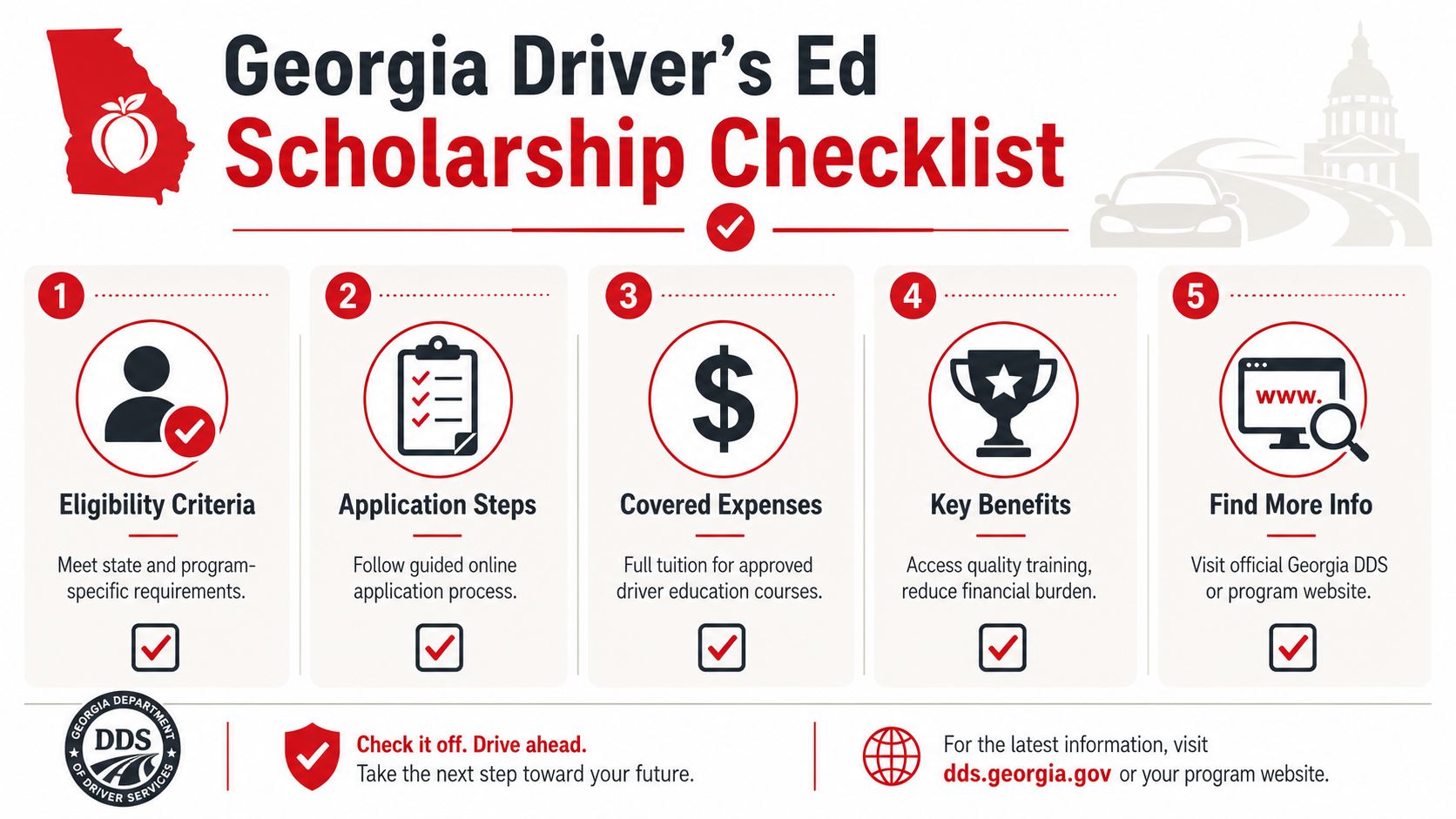
What the scholarship is meant to do
The scholarship exists to help qualifying Georgia students access driver education. In practical terms, that means support for the kind of training many families already want, especially a state-aligned course and the behind-the-wheel instruction that turns lessons from theory into real skill.
If you've been putting off driver training because the family budget is tight, this program is worth serious attention. It can make the difference between delaying important instruction and getting started now.
How families should approach the application
The application process feels easier when you treat it like a checklist instead of a mystery. Start with the eligibility rules. Then gather any documents the program asks for. After that, submit carefully and keep copies of what you send.
A smart approach looks like this:
- Confirm eligibility first so you don't waste time on the wrong application path
- Use an approved school because the program applies to qualifying training
- Watch deadlines closely since missing one can delay everything
- Keep records organized including confirmation emails and submission details
For families who want a clearer path, this page on the Georgia Driver's Education Grant Scholarship Program can help you understand the process and what to do next.
Getting financial help for driver training isn't just about saving money. It helps families choose better instruction sooner, when it can do the most good.
Why this matters beyond the application
Scholarship support does more than reduce cost pressure. It gives families room to choose training based on quality and fit instead of choosing only the cheapest available option. For a brand-new driver, that can mean a better learning experience, more confidence, and fewer bad habits baked in from the start.
That's especially important for teens who need more than a classroom. A student may understand signs and rules quickly but still need patient, repeated coaching in traffic. Scholarship support can help make that coaching realistic.
Frequently Asked Questions About Georgia Driver Training
Is Alive at 25 the same thing as Joshua's Law
No. Alive at 25 is typically a youth-focused safety class tied to behavior and judgment, often connected to a traffic or court issue. Joshua's Law is part of Georgia's teen licensing path and focuses on driver education for younger new drivers working toward legal driving privileges.
If I take driver's ed, do I still need driving lessons
Often, yes. Driver's ed teaches knowledge. Driving lessons teach execution. A student may pass the classroom portion and still need help with left turns, merging, parking, lane control, speed management, or confidence in real traffic. That's why lesson packages are so useful. They let instructors work on the exact skills the student still lacks.
Are online driver education courses a good option in Georgia
They can be, especially for students who learn well on a flexible schedule. Online options are often helpful for busy families or teens balancing school and activities. The key is making sure the course is approved for the purpose you need and pairing it with proper behind-the-wheel instruction if the student still needs road skill development.
Can I use my own car for road testing
That depends on the testing provider's rules and whether the vehicle meets the required condition and documentation standards. Some students prefer using a familiar car because it reduces anxiety. Others do better using a school vehicle because it has already been used in instruction and feels predictable. Always confirm the testing rules in advance.
What if I'm an adult who never learned to drive well
You're not alone, and you're not too late. Adult students often need targeted help rather than a full teen-style program. A few focused private lessons can work on exactly what's holding you back, whether that's parking, traffic flow, highway entry, or fear after a bad experience.
How do I enroll in a course, lesson package, or road test service
Start by choosing your actual need, not just the most familiar course name. If you need to satisfy a legal requirement, verify that first. If you need licensing progress, look at driver's education. If your main problem is skill or confidence, choose private lessons. If test day is close, book road test prep or testing support. Then register early enough to get the schedule you want and keep your confirmation details in one place.
If you want one place to handle driver's education, Joshua's Law training, online course options, private driving lessons, lesson packages, and Georgia road testing support, A-1 Driving School is a strong place to start. It helps Georgia teens, adults, and families move from confusion to a clear training plan with flexible options that fit real schedules.