
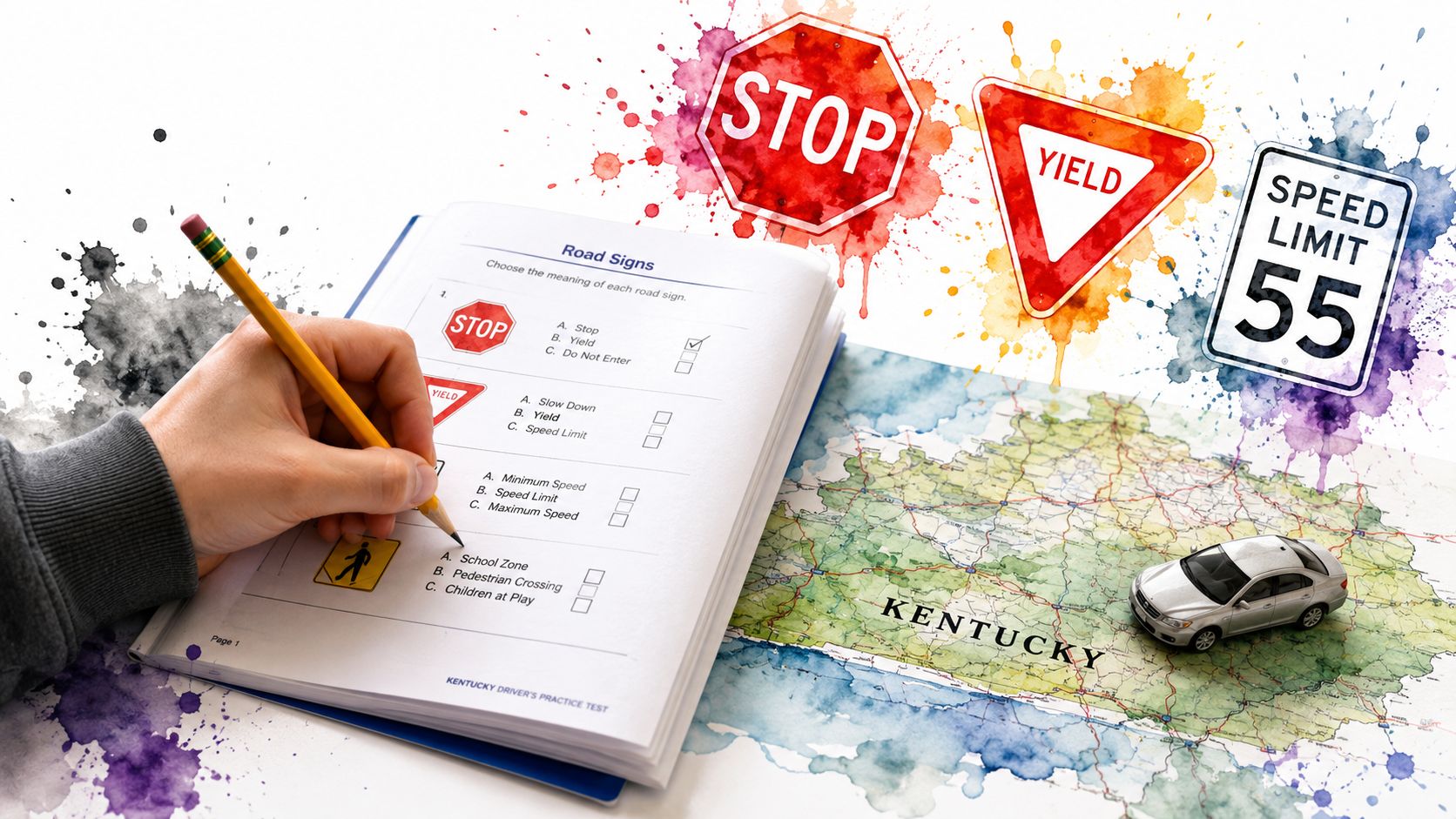
You're probably in one of two spots right now. Either you've opened a Kentucky driver's permit practice test and want to know what the official exam looks like, or you're a parent trying to make sure your teen prepares the right way the first time.
That's a smart place to start. A permit test feels like a single event, but good preparation works better when you treat it as the first step in learning how to drive well. The test matters. Confidence matters more. Both are easier to build when you know exactly what Kentucky expects and when you study with a clear plan instead of guessing.
Decoding the Kentucky Permit Test Format
You sit down at the testing station, and your first thought is, “How is this thing laid out?” That question matters more than students realize. Once the format is familiar, the test feels less like a surprise quiz and more like a checklist.
Kentucky's permit exam is built around two jobs every new driver must handle. You need to understand the rules of the road, and you need to recognize signs quickly and correctly. That split matters because safe driving works the same way. A driver who knows the law but misses signs is still unsafe. A driver who spots signs but forgets right of way rules has the same problem.

What those categories mean for your study plan
Treat the test like a basketball game with two quarters that both count. If you only practice one half well, your final result can still fall short.
Here is the breakdown:
| Test area | Questions | Need correct |
|---|---|---|
| Road rules | 30 | 24 |
| Road signs | 10 | 8 |
That table gives you a clearer target than “just get 80%.” Students often hear the passing score and assume strong performance in one area will cover weakness in the other. In practice, that is a risky way to prepare. If signs are your weak spot, you need to know that early, not the night before the exam.
This is also why random quiz-taking has limits. A few practice rounds can show where you stand, but they do not replace a structured plan. Georgia's Joshua's Law approach gets this part right. It treats preparation as a sequence: learn the rules, test your understanding, then connect that knowledge to real driving habits. That model works well whether you test in Georgia, Kentucky, or anywhere else.
How to use the format to your advantage
Study in short, specific rounds. One session can focus on road signs only. Another can focus on right of way, speed control, or lane use. That kind of separation helps you find weak areas faster than mixed guessing.
If you want a quick way to check whether a rule really makes sense to you, effective true or false questions can help expose small misunderstandings before they show up as missed answers.
It also helps to see a realistic test layout before exam day. This guide on what a permit test looks like gives you a better sense of how questions are typically presented, which can lower stress and help you focus on the content instead of the screen.
One more practical point. Do not study only to finish a written test. At A-1, we teach students to prepare in a way that carries over to the driver's seat, because the ultimate goal is not checking boxes on permit day. The ultimate aim is becoming the kind of driver who reads a sign, understands the rule behind it, and makes a calm decision without hesitation.
Mastering Kentucky's Core Rules and Road Signs
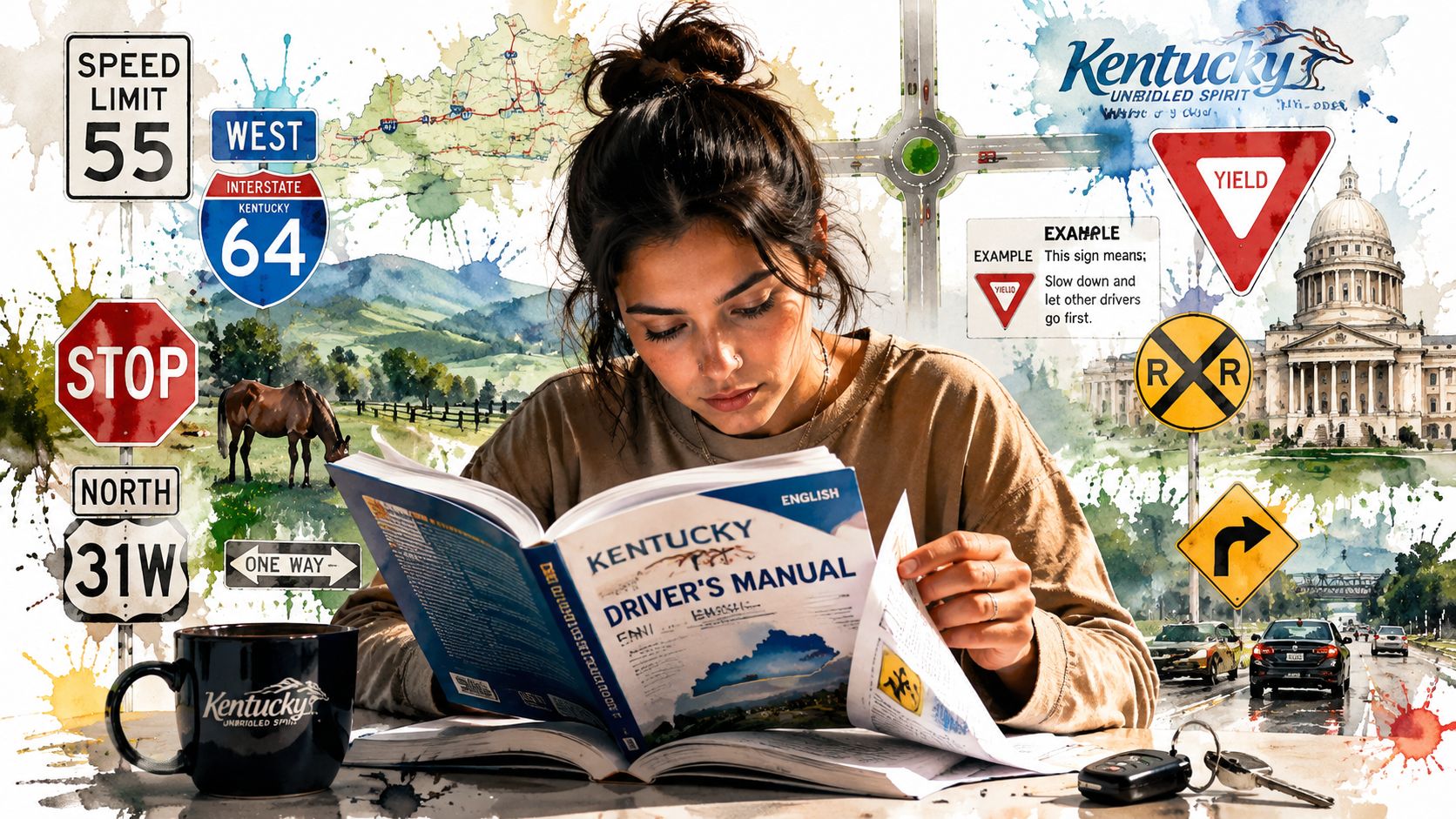
Once you know the format, the next step is learning the material in a way that sticks. Memorizing isolated facts won't carry you very far. The students who do best usually understand why a rule exists and what a sign is asking them to do.
Focus on situations, not just definitions
Think in driving scenes.
At intersections, ask yourself who goes first, who must wait, and what makes a turn safe. When studying lane changes, think about mirrors, blind spots, and spacing. For parking questions, picture the curb, the hill, and the direction the wheels should go. This kind of mental rehearsal makes written questions easier because the rule connects to a real situation.
A few high-value study categories:
- Right-of-way decisions help you answer questions about intersections, turns, pedestrians, and merging.
- Speed control includes more than posted limits. It also means adjusting to traffic, road conditions, and visibility.
- Stopping and parking often trips students up because small details matter.
- Lane position and signaling shows up in both test questions and real driving judgment.
Don't ask, “What answer do they want?” Ask, “What would keep everyone safest here?” That question usually points you to the right answer.
Learn signs by pattern recognition
Road signs get easier when you stop treating them like flash cards and start noticing patterns. Shape and color give you clues before you even read the sign.
For example, warning signs signal caution. Regulatory signs tell you what you must or must not do. Guide signs help you find your way. When students understand those categories, uncommon signs stop feeling random.
Try this approach when you study:
- Cover the words first and identify the sign by shape and color.
- Say the meaning out loud in plain language.
- Add the driving response you'd make if you saw it on the road.
If you want extra practice, this page on traffic sign recognition is a helpful companion to your manual study.
What students usually mix up
Students often confuse similar-looking signs or read too fast and miss one key word. Others memorize a sentence from the manual but can't apply it when the question changes the setting.
That's why it helps to rotate your practice. One day, work by topic. Another day, mix rules and signs together. Then explain your answers to someone else. If you can teach it clearly, you probably know it well.
Why Practice Tests Are Not Enough A Proven Study Plan
A Kentucky driver's permit practice test is useful. It's just not the whole job.
Many teens treat the written exam like the finish line. It isn't. In Kentucky, passing the written exam is only Step 1 of a 180-day+ process, and teens need a 60-hour supervised driving log that includes 10 night hours before applying for the intermediate license, as noted in this Kentucky permit progression overview.
Where practice tests help and where they fall short
Practice tests are great for spotting weak areas. They help you recognize repeated question styles, sharpen recall, and reduce surprise. That matters.
What they don't do well is teach judgment. A multiple-choice screen can ask about right-of-way. It can't fully teach the feel of checking mirrors before braking, judging a gap in traffic, or staying calm when a driver behind you gets impatient.
That gap explains why some students pass the written part and still feel uneasy in a real car.
A better study plan
Use a layered approach instead of relying on one tool.
- Start with the manual so you learn the actual rules, terms, and sign meanings.
- Use practice tests after reading to check whether you understood the material.
- Review mistakes in writing so you can see patterns in what you miss.
- Talk through scenarios with a parent, instructor, or study partner.
- Connect study to driving behavior by noticing signs, lanes, and right-of-way rules whenever you're a passenger.
If you want to sharpen your routine, these effective learning techniques can help you build study sessions that are more deliberate and less repetitive.
A useful next step is working on habits that transfer from the written exam to real driving. This guide on how to improve driving skills is strong because it keeps the focus on decision-making, not just memorization.
The strongest prep plan answers two questions at the same time. “Can I pass the test?” and “Would I trust myself making this decision in traffic?”
That's the standard worth aiming for.
What a Gold-Standard Driver's Ed Program Includes
Good driver education doesn't just prepare someone to pass a test. It organizes the learning process so a new driver builds knowledge, habits, and confidence in the right order.
Georgia offers a strong model for that kind of preparation. Under Joshua's Law, teens complete a state-approved Driver's Education course with 30 hours of classroom instruction, along with professionally supervised driving hours, according to this Georgia Driver's Education course overview. Even if you're focused on Kentucky, that structure is a useful benchmark for what quality preparation should look like.

Classroom learning should be organized
A strong course doesn't dump rules on students all at once. It builds from the basics up.
You want instruction that covers road rules, signs, space management, hazard awareness, and the reasoning behind safe choices. Online course options can work very well when they're structured clearly and let students move at a steady pace. For many families, that flexibility makes it easier to stay consistent.
That's one reason Georgia's approach stands out. It treats driver education as a real course, not a one-night cram session.
Behind-the-wheel training should be intentional
Driving lessons matter because they turn information into action. That's where many beginners make the biggest jump.
A thoughtful lesson plan usually moves through stages like these:
| Training focus | Why it matters |
|---|---|
| Basic vehicle control | Helps students feel calm and predictable |
| Residential driving | Builds awareness at lower speeds |
| Traffic interaction | Teaches spacing, scanning, and timing |
| Parking and maneuvering | Strengthens precision and patience |
| Test route preparation | Reduces uncertainty on road test day |
Driving lesson packages are especially helpful because repetition matters. One lesson can introduce a skill. Several lessons give a student time to improve, make mistakes safely, and correct them before habits harden.
Parents need a system too
Families often assume they'll “fit in” practice as life allows. That sounds reasonable, but it can become scattered fast.
A better approach is to use a simple rhythm:
- Choose one focus per drive, such as turns, lane changes, or parking.
- Keep notes after each practice session so the next drive has a purpose.
- Add night driving deliberately instead of waiting until the end.
- Use professional instruction to correct recurring mistakes before they become normal.
Road testing support can also help. When students know what the road test expects, they stop treating it like a mystery and start treating it like a skill check.
Access matters
Quality training should be reachable for families, not just ideal in theory. Scholarship support can make a real difference, which is why programs like the Georgia Driver's Education Scholarship Grant Program deserve attention. They help some students access structured training who might otherwise delay it.
A good driver's ed program does three things well. It teaches the rules clearly, gives students enough supervised practice, and helps families follow through.
That combination is the gold standard, whether a student is preparing in Georgia, Kentucky, or anywhere else.
Your Test Day Checklist and Final Passing Tips
The morning of your permit test should feel like a routine drive to school, not a fire drill. Students usually struggle more from rushing, missing paperwork, or second-guessing themselves than from the material itself.

A calm test day starts the night before. Put your documents in one folder. Set out your glasses or contacts if you use them. Confirm your appointment details through the Kentucky State Police process, and make sure a parent or guardian is ready to come if your age requires it.
Kentucky applicants need the documents required for permit testing, including identification, proof of Social Security number, and proof of residency. Applicants also need to meet the age and consent requirements listed in the state's permit process, as summarized in this Kentucky permit application guide.
Here is the simple checklist I would give a student before walking out the door:
- Identification document required for testing
- Proof of Social Security number
- Proof of residency
- Parent or guardian accompaniment or consent, if your age requires it
- Glasses or contacts, if you use corrective lenses
Your vision matters too. Kentucky requires a vision screening as part of the permit process. If you use corrective lenses in daily life, bring them. Do not treat that step like an afterthought. Safe driving starts with seeing signs, signals, lane markings, and people early enough to react.
Here's a short video that can help you get into test-day mode before you go:
Smart moves inside the testing room
Once the test begins, slow your brain down. New drivers often read too fast, spot one familiar word, and click before they understand what the question is really asking.
Treat each question the way a good instructor treats an intersection. Look all the way through it before you act. One word such as except, best, or first can change the correct answer.
A few habits help keep you steady:
- Read the full question and every answer choice
- Skip a hard question and return to it later if the system allows
- Choose the safest lawful answer when two choices seem close
- Keep your pace even instead of trying to finish fast
- Rely on what you studied, not memory tricks from friends
Preparation reveals itself in a unique manner. A student who used a structured study plan usually recognizes the logic behind the question, even if the wording feels unfamiliar. That is one reason A-1's Georgia model works so well as a standard to copy. Organized lessons, repeated review, and coached practice build judgment, not just recall.
If you hit a tough question, do what confident drivers do on the road. Stay calm, gather the clues, and make the safest choice. Passing the permit test matters, but the better goal is learning to think clearly under pressure.
Conclusion From Permit Test to Lifelong Safe Driving
The Kentucky driver's permit practice test is valuable because it gives you a target. You know what the exam asks, what knowledge matters, and how to prepare with more purpose.
But the bigger win isn't just passing one written test. It's building the habits that make you calm, observant, and dependable behind the wheel. That takes more than guessing through practice questions. It takes steady study, real-world coaching, and enough guided driving to make safe choices feel normal.
If you're a teen, start early and stay organized. If you're a parent, help your student treat driving like a skill that deserves structure. The permit is a milestone. Safe driving is the long game, and it's worth doing well from the start.
If you want a proven path from classroom learning to confident road skills, A-1 Driving School is a smart place to start. Families can explore Joshua's Law courses, online course options in Georgia, driving lessons, lesson packages, road test support, and the Georgia Driver's Education Scholarship Grant Program to find a training plan that fits real schedules and real learning needs.