You're probably here for one of two reasons. Either you're studying for your Georgia permit or road test and every sign on the road suddenly looks important, or you've already been behind the wheel and realized that recognizing signs fast is harder than it seemed from the passenger seat.
That's normal.
A nervous new driver often thinks traffic signs are just a memorization problem. They're not. Signs work more like a visual language. Once you learn how that language is built, the road gets less confusing, your decisions get quicker, and the Georgia road test feels far more manageable.
Why Traffic Sign Recognition Is a Critical Driving Skill
A new driver on a busy Atlanta street has a lot to process at once. Brake lights ahead. A lane ending sign on the right. A school zone warning coming up. A “No Turn on Red” notice near the light. If your brain treats every sign as a separate fact to memorize, you'll feel overloaded fast.
Traffic sign recognition matters because it reduces that overload. It helps you sort what you see into clear action. Stop. Yield. Slow down. Don't turn. Merge left. Watch for pedestrians.
Why this skill matters before you ever take the road test
On the Georgia road test, the examiner isn't just checking whether you can move the car. They're watching whether you notice signs early and respond in a calm, correct way. A missed sign usually turns into a driving mistake. Rolling through a stop sign, entering a curve too fast, or failing to yield often starts with poor sign recognition.
That's why this skill sits underneath almost every other safe driving habit. If you read signs early, you brake earlier, choose your lane sooner, and avoid sudden moves.
Practical rule: The best drivers don't wait until they reach a sign to react. They identify it early enough to plan their next move.
Even cars are being built around sign recognition
Automakers now treat sign recognition as a major safety feature. The traffic sign recognition market is projected to reach US$ 58.05 billion by 2033, driven by integration into new vehicles, according to Coherent Market Insights. That tells you something important. Car makers see sign recognition as essential.
But your car can't take your Georgia road test for you.
And even if a vehicle can detect a speed limit sign, you still need to understand what that sign means in real traffic. Human judgment is what turns recognition into safe action. That's the part examiners care about, and it's the part that keeps you safe when weather, glare, or traffic make the road more complicated.
Decoding Road Signs by Color and Shape
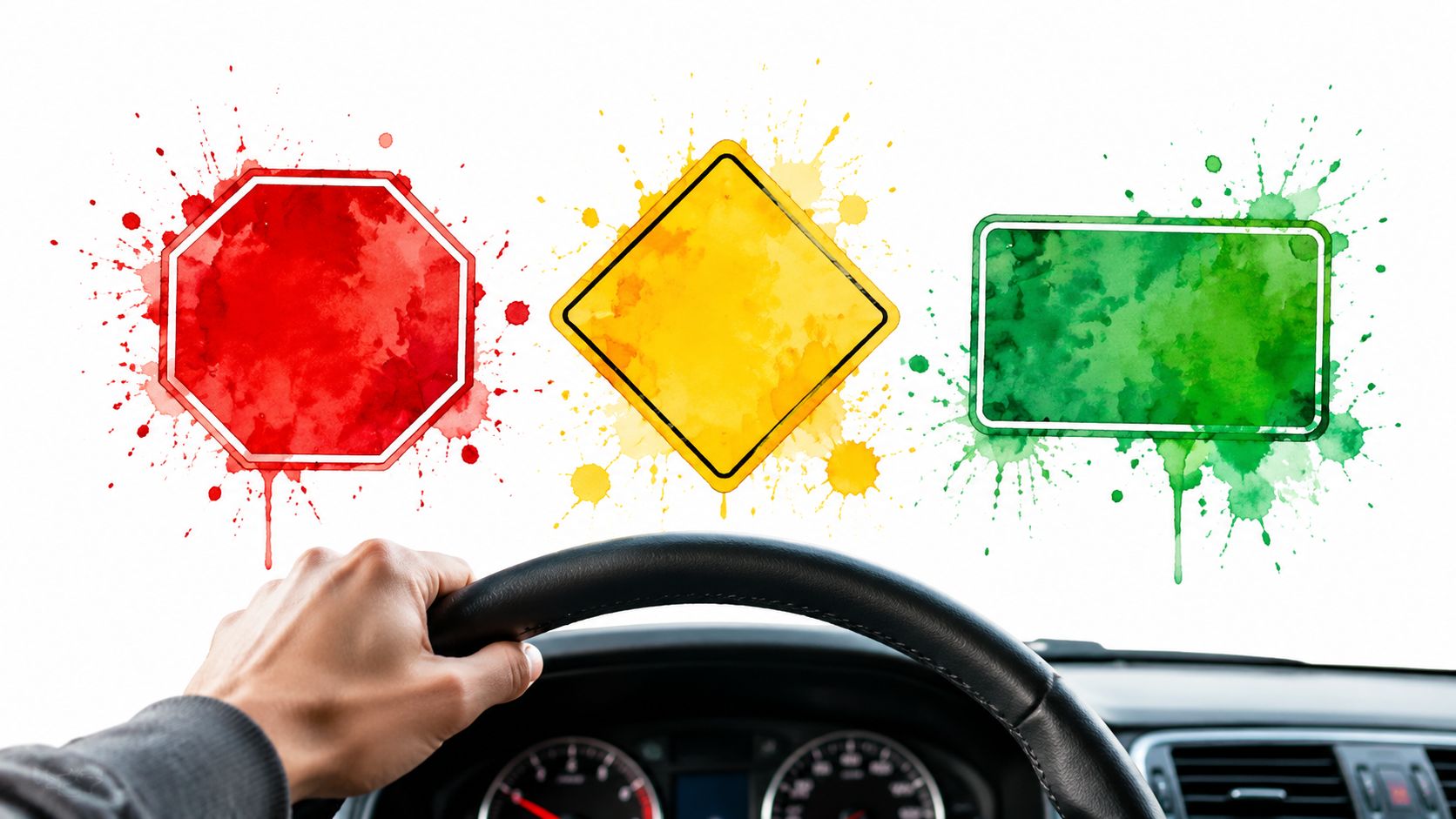
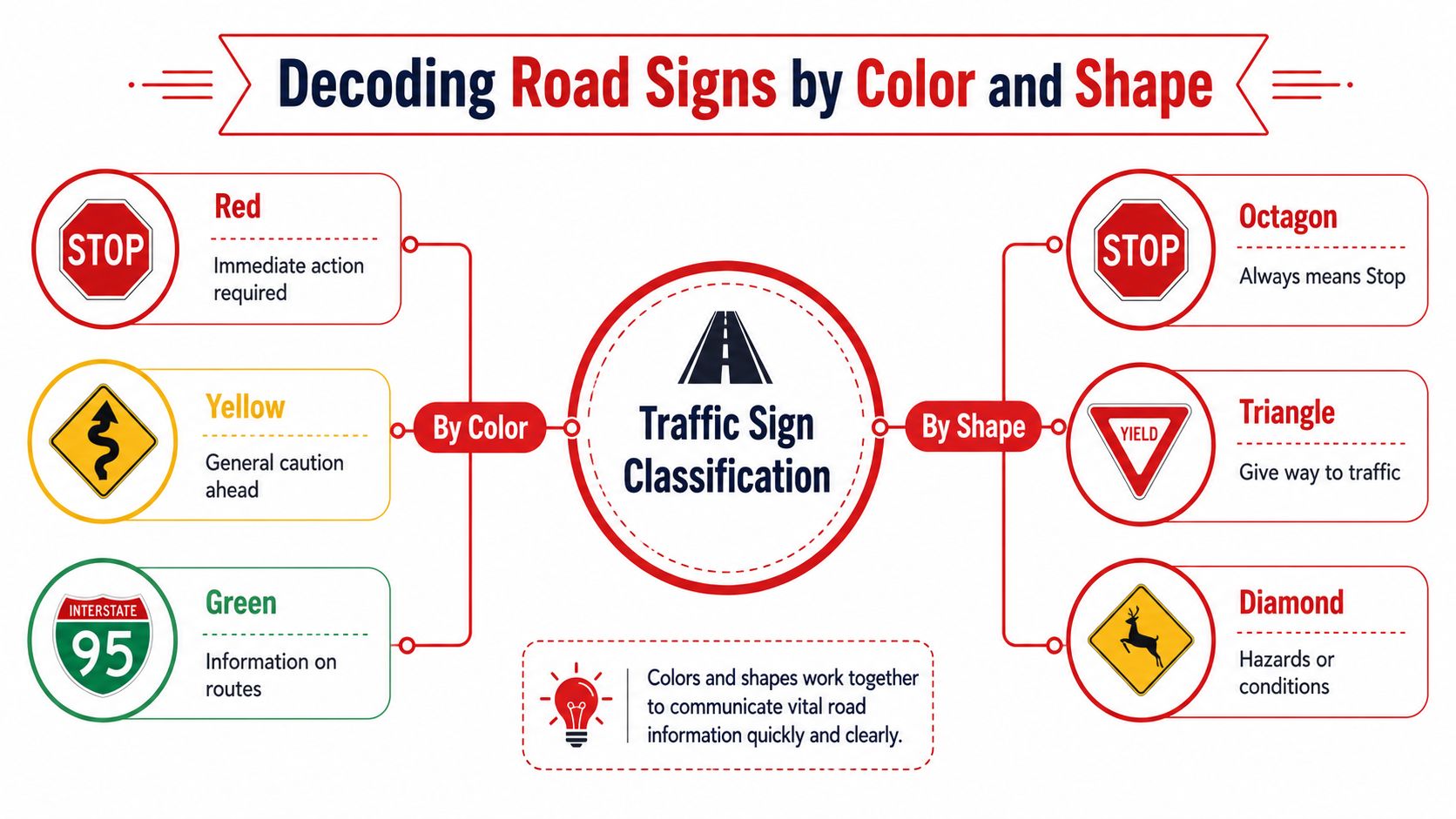
The fastest way to learn signs isn't to memorize a giant list. Learn the system first. Color tells you the category. Shape tells you the urgency or type of instruction.
If you want a broader sign overview while you study, this guide on what road signs mean in Georgia driving is a helpful companion.
Read the color before you read the words
A sign's color gives your brain a head start.
- Red means immediate control. Think stop, yield, wrong way, or other signs that demand caution right now.
- Yellow means warning. Curves, merging traffic, slippery conditions, and other hazards usually live here.
- Green points you somewhere. These signs give route and direction information.
- Blue usually gives services or driver information.
- Brown points to recreational or public-interest locations.
- White and black often mean rules. Speed limits, lane-use rules, and turn restrictions often use this combination.
A simple memory trick helps: red for rules that can't wait, yellow for “watch ahead,” green for “go this way.”
Let the shape do part of the work
Shapes are even more powerful because you can recognize them quickly, sometimes before you can read the text.
Here's a simple breakdown:
| Shape | What it usually tells you | What to do |
|---|---|---|
| Octagon | Stop | Come to a complete stop |
| Inverted triangle | Yield | Slow down and give right-of-way if needed |
| Diamond | Warning | Scan ahead and adjust speed |
| Rectangle | Regulation or guidance | Read for instructions |
| Pentagon | School-related warning | Increase alertness and slow appropriately |
| Round | Railroad crossing | Prepare for tracks and possible train traffic |
The two shapes every new driver should know instantly are the octagon and the inverted triangle. If you freeze in traffic, those two should still trigger the correct response without hesitation.
A stop sign tells you what to do with the car. A warning sign tells you what to do with your attention.
A quick example that makes this easier
Suppose you see a yellow diamond ahead. Before reading the words or symbol, you already know two things. It's a warning, and it's about a condition ahead rather than a direct command.
Now suppose you see a red octagon. You don't need to read anything. Your foot should already be moving toward the brake.
That's how experienced drivers process signs. They don't decode everything from scratch each time. They use color and shape as shortcuts. Once you train that habit, unfamiliar signs become less intimidating because you can still classify them quickly.
A Staged Practice Plan From Flashcards to Highways
Most nervous drivers try to learn signs all at once. That usually backfires. A better approach is to practice in stages, the same way a teacher builds a lesson from easy recognition to real-world use.
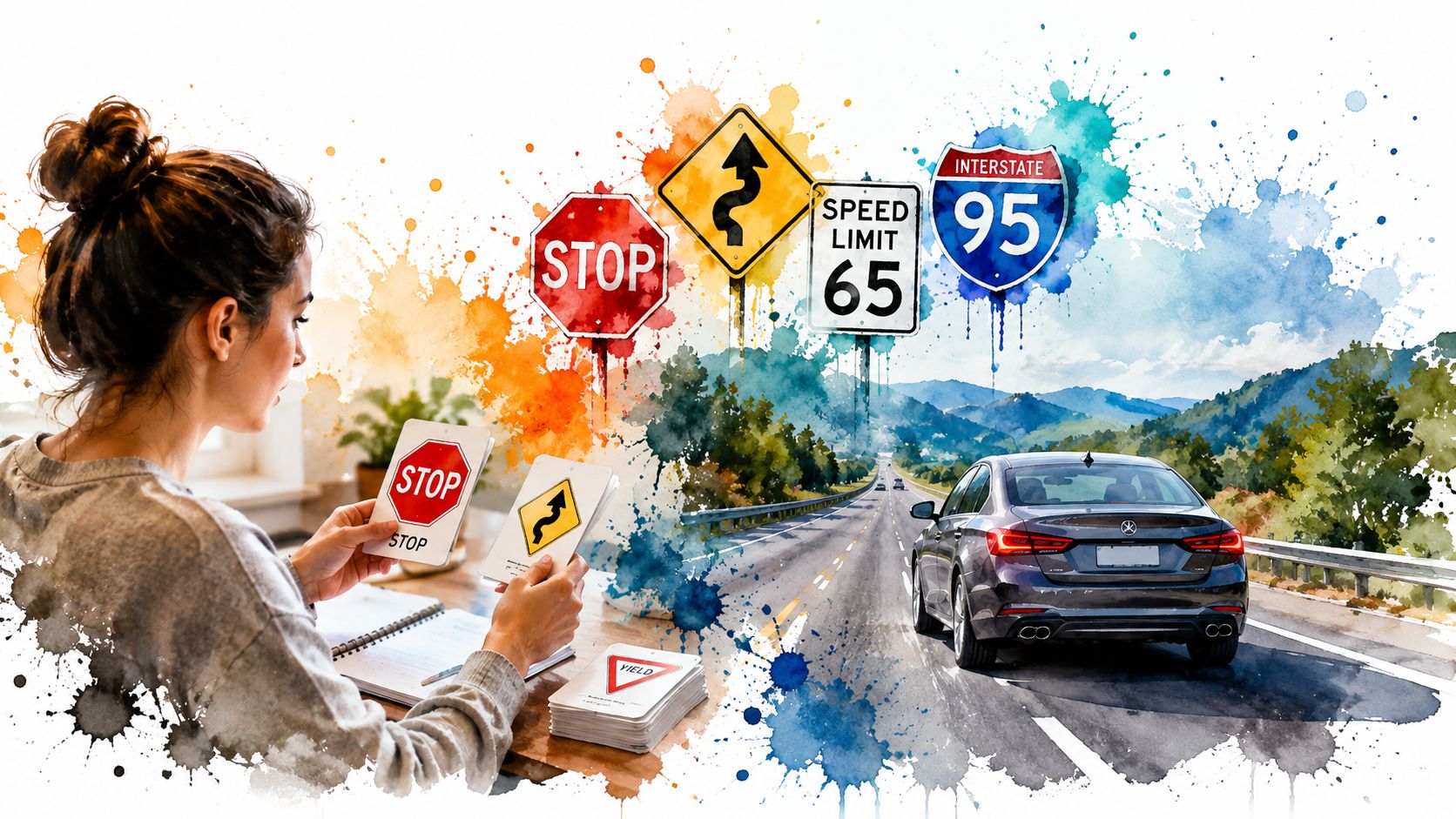
Stage one at home
Start where there's no pressure. Sit at a desk, use flashcards, and sort signs into groups by color and shape before you worry about every exact definition.
This works because your brain learns patterns better than isolated facts. If you've ever looked at a training curriculum for community managers, you'll notice a strong curriculum moves from basics to application. Driving study works the same way.
Try this routine:
- Sort first: Put signs into warning, regulatory, and guide groups.
- Name the action: Don't just say “yield sign.” Say “slow down and give right-of-way.”
- Study in short bursts: A focused review session is better than cramming until everything blurs together.
Stage two as a passenger
The next step is free practice in real traffic. Ride with a parent or another licensed driver and act like a quiet co-pilot.
Look ahead and call out signs before the driver reaches them. Then predict what should happen next.
- At intersections: Say whether the driver should stop, yield, or continue.
- Near schools: Notice when the environment changes and where extra caution is needed.
- On larger roads: Watch lane-use and speed-related signs early, not at the last second.
This stage matters because it trains timing. Many teens know what a sign means in a workbook but spot it too late in traffic.
Study habit: Don't ask only, “What sign is that?” Ask, “What should the driver do because of that sign?”
Stage three behind the wheel
When you start driving, say signs out loud. Not every sign. Just the ones that affect your next move. “Stop sign ahead.” “Yield on ramp.” “School zone.” “No turn on red.”
That simple habit slows your mind down in a good way. It turns passive seeing into active decision-making.
A useful short demonstration can help you practice visually before your next drive:
How to move from quiet streets to faster roads
Don't jump straight from neighborhood practice to complicated highways if signs still feel rushed.
Use this progression:
- Neighborhood streets first. Focus on stop, yield, speed, and school-related signs.
- Then main roads. Add lane control, turn restrictions, and more frequent warnings.
- Then highway entry and exit practice. Watch guide signs early so you're not making last-second moves.
The point isn't to impress anyone. The point is to build recognition until your response feels steady. That's how confidence grows. Not from guessing correctly once, but from repeating the same skill in slightly harder environments.
Navigating Common Sign Mistakes on the Georgia Road Test
A road test mistake usually isn't dramatic. More often, it's small and preventable. The driver saw the sign too late, reacted too softly, or assumed instead of confirming. That's why sign-related errors show up so often during testing.
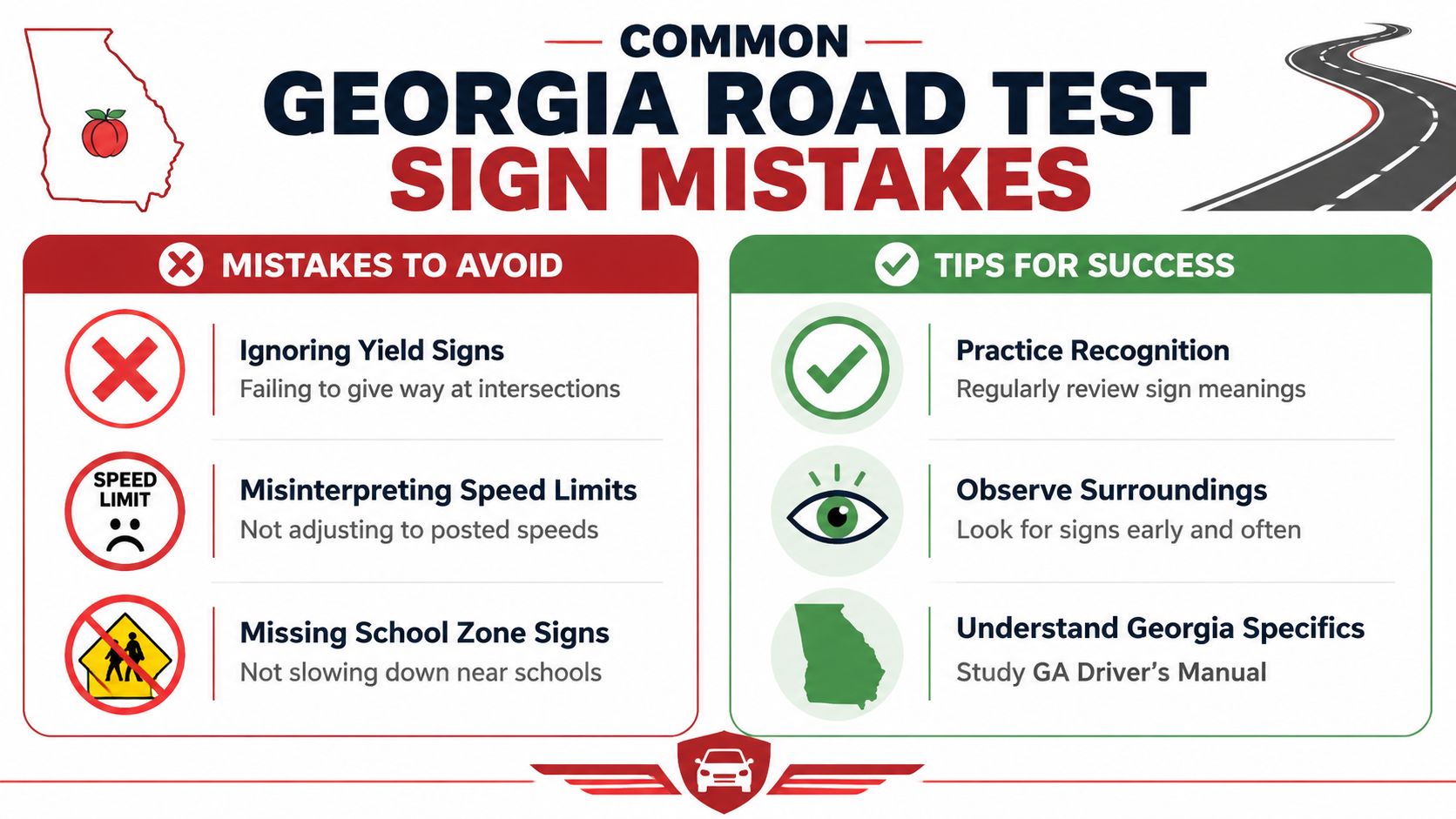
A focused review of Georgia driving test signs and meanings can help sharpen the areas that tend to cause trouble under pressure.
Four mistakes that cost drivers points
Here are some of the most common problems examiners notice:
Rolling through stop signs
Many teens slow down but don't fully stop. A complete stop means the car stops moving before proceeding.Missing a turn restriction
“No Turn on Red” and lane-direction signs can be easy to miss if you only look at the traffic light. Always scan the whole intersection.Treating a yield sign like a decoration
Yield doesn't always mean stop, but it does mean you must be ready to give way. The examiner wants to see you check and decide, not drift through.Ignoring warning signs until you're on top of them
A curve, school zone, or merging traffic sign should change your behavior early. Late braking tells the examiner you saw the sign too late.
Why human attention still matters
Modern systems can recognize signs impressively well, but they're not flawless. Research on traffic sign recognition found that top algorithms reached 98.23% overall on the German Traffic Sign Recognition Benchmark, with some models such as DenseNet reaching 98.82% and ShuffleNet reaching 99.11% on an Indian dataset, while performance can still drop in harsh conditions like rain, snow, or glare, according to the published review in PMC.
That matters for one reason. If even advanced systems can struggle when conditions get messy, you can't rely on casual scanning. You need deliberate observation.
On a road test, the examiner isn't grading your intentions. They're grading what you noticed and how you responded.
Some training businesses outside driver education use tools such as test prep center software to organize practice and progress tracking. The same idea can help here. If you keep missing the same sign type, don't just “study more.” Track that category specifically and fix the pattern.
How Sign Recognition Fits into Joshua's Law
For Georgia teens, sign recognition isn't just a smart skill. It's part of the legal path to getting licensed.
Joshua's Law in Georgia explicitly requires all 16- and 17-year-olds to complete a DDS-approved 30-hour Driver's Education course, which includes thorough training on Georgia traffic laws and sign recognition, before they can obtain a Class D license, as explained in this overview of Joshua's Law requirements in Georgia.
That requirement changes how you should think about studying signs. This isn't bonus material. It's built into what Georgia expects young drivers to learn before they earn driving privileges.
Why formal instruction helps
A good driver's education course does more than show pictures of signs. It teaches context.
For example, a student may know a yield sign in isolation but still hesitate at a real merge. Or a teen may know a school sign from the manual but miss how early they should begin adjusting attention and speed. Structured instruction helps connect the sign to the driving decision.
That's especially helpful for students who feel anxious. When you learn signs in a sequence that makes sense, the road feels less random and more readable.
Online courses and financial help matter for families
Many Georgia families need flexible scheduling. Online course options can make Joshua's Law training much easier to fit around school, sports, and work. Some students do better in a classroom. Others prefer to review material online at their own pace. Both can support stronger sign recognition if the course is organized well.
If cost is a concern, the Georgia Driver's Education Scholarship Grant Program is worth exploring. For eligible students, that support can make quality training more accessible.
You can also review the broader Georgia driver's license requirements for teens to understand how driver's education fits into the full licensing process.
Build Your Confidence with A-1 Driving School
Reading about signs helps. Real practice is what makes those signs feel familiar when you're driving.
That's where guided instruction matters most. A teen can memorize sign names at home and still freeze at a busy intersection. Confidence comes from repeating the skill in traffic, with an instructor who corrects the timing, scanning, and decision-making behind each sign.
Why driving lessons matter more than memorization alone
Driving lessons let you connect the sign to the action in real time. You're not just looking at a red octagon on paper. You're learning where to stop, when to scan, how long to wait, and how to move again smoothly.
That's especially useful for:
- New teen drivers who need Joshua's Law support plus road experience
- Adults learning later who want calm, structured instruction
- Road test candidates who need practice in the kinds of situations examiners watch closely
A practical next step
If you want the fastest path from uncertainty to confidence, look for a program that combines driver's education, online Joshua's Law options, driving lessons, lesson packages, and road test support in one place. That combination makes studying more consistent because the classroom material and behind-the-wheel practice reinforce each other.
Road testing also becomes less intimidating when you've practiced the same sign-related habits with an instructor beforehand. Familiar routines reduce panic. Better scanning reduces mistakes.
If you're ready to turn traffic sign recognition into real driving confidence, explore A-1 Driving School for Joshua's Law courses, online class options in Georgia, driving lessons, lesson packages, and road testing support that helps you practice what matters on test day.