
You've got the renewal notice in one hand, your teen's Joshua's Law packet in the other, and one simple question on your mind, can this clean driving effort lower the bill? For a lot of Georgia families, the answer starts with understanding what a good driver discount really is, then matching that idea to the right training step, the right documents, and the right insurer conversation.
What a Good Driver Discount Really Means
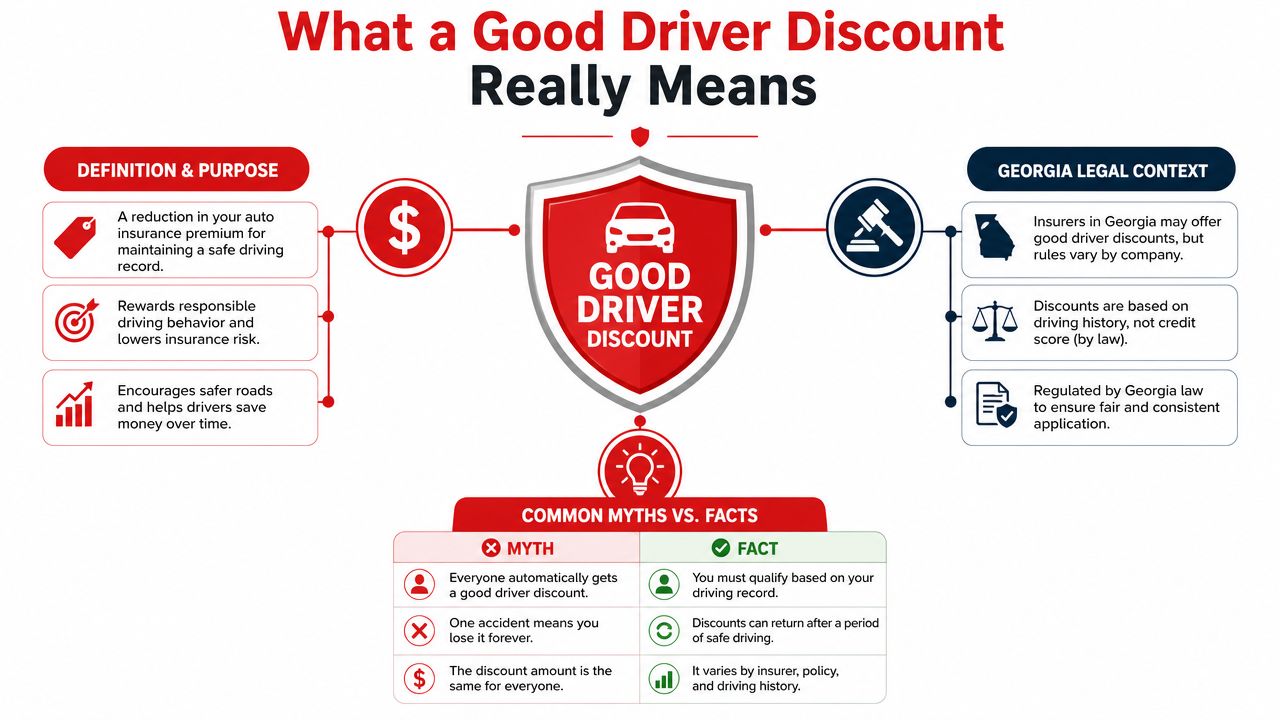
A good driver discount is a lower auto insurance price tied to a clean driving record, not just a salesperson's promise. In plain English, the insurer is saying, “You have fewer risky incidents, so you may cost less to insure.”
The basic idea in Georgia terms
That matters in Georgia because the discount can feel like a reward for safe habits, but it is not always the same thing from one carrier to the next. Some insurers treat it as a formal record-based reward, while others apply a narrower version of the idea. For a clear consumer example, CarInsurance.com explains that California requires insurers to offer a 20% good-driver discount to qualified motorists who meet a licensed-record standard of at least three consecutive years, with no more than one point in the past three years and no serious driving convictions. Georgia does not use that same rulebook, but the contrast helps families see why one insurer may be generous and another may be strict.
A clean record window is still the core idea. Many insurers outside California look for a three to five year period without major problems before they grant a discount, so the price break is built around past driving behavior, especially claims and violation history, not just the car in the driveway. For families who want a broader guide to lowering premiums, A-1's overview on how to lower car insurance premiums gives a useful starting point.
Practical rule: if you want a good driver discount, focus on a clean driving history that can be documented, not a vague label like “nice driver.”
The same idea also shows up in training choices. A family comparing lesson formats can use the Skillz2Drives offer on automatic lessons as a simple example of how structured instruction can support safer habits, even if the insurance company still bases the discount on the record it sees.
Why families confuse the label
People often use safe driver, good driver, and accident-free driver as if they mean the same thing. Insurers do not always use them the same way, and the eligibility rules can be stricter than a parent expects after just one quiet year behind the wheel.
That is why the discount is best understood as a record-based reward. The insurer looks at whether your history suggests fewer claims, fewer violations, and fewer reasons to expect a payout, then prices accordingly. When families see it that way, the discount stops looking like a marketing slogan and starts looking like a measurable target.
How Insurers Measure a Good Driver
Insurers don't guess. They look for a stretch of time where your record stays clean enough to suggest lower claim risk, and the most common benchmark is a three-year or longer loss-free window without moving violations or at-fault accidents, as summarized by Policygenius.
What goes into the scorecard
A good driver profile usually starts with the driving record itself, then expands into claims history. If a carrier sees repeated tickets, at-fault crashes, or major violations, that clean window gets reset or shortened, because the insurer can no longer treat the driver as low risk.
Telematics complicates the picture in a good way for careful drivers. Those programs use an app or device to measure real driving behavior, and Consumer Reports says the typical savings are about 10%, with leading carriers offering up to 30% to 40%, while its median annual savings finding among telematics users was $120. That means a driver with steady habits may do well under either system, but the newer one watches the road behavior itself, not just the paper record.
A clean record helps, but a monitored record can sometimes help more if the insurer rewards the behavior you actually show on the road.
Why the clean window matters so much
The clean-record window tells the insurer whether your habits have stayed stable long enough to matter. Short bursts of good behavior don't carry the same weight as several years of consistency, because insurance pricing is built on probability, not hope.
That's also why many companies keep the discount tied to documented claims and violations rather than personality or confidence at the wheel. If the loss history is clean, the carrier has a stronger reason to lower the rate. If it's not, the discount may shrink or disappear until the driver rebuilds trust over time.
Georgia Paths That Build a Qualifying Record
A Georgia family usually has three realistic ways to move toward a good driver discount. One is slow and steady, one is more immediate, and one depends on the insurer's program design. The right path depends on whether the driver is a teen building a record, an adult trying to improve one, or a parent looking for the cleanest paperwork trail.
Compare the common paths
Joshua's Law and driver education work best for new drivers because they shape habits before the first policy gets priced. That matters because a smoother lane change, better following distance, and fewer rookie mistakes help create the kind of driving history insurers like to see later.
Telematics enrollment is different. It can reward current behavior continuously, which helps careful drivers who want the insurer to measure what they do now instead of only reading the old record. Consumer-facing sources describe these programs as a separate savings path, not just a duplicate of the classic discount, so a family may want to compare privacy tradeoffs and the savings structure before opting in.
Road test prep and coaching sit in the middle. They don't directly change an insurer's formula on their own, but they can reduce nervous mistakes before the record is ever reviewed. That's especially useful for teens, because a better first year on the road can shape the clean-record window that follows.
Which option fits which driver
- Teen drivers: start with structured education, because the best time to build a clean insurance profile is before the first policy cycle.
- Adults with a spotless record: ask about a traditional good driver discount and then compare it with telematics.
- Drivers trying to rebuild confidence: focus on coaching and road-test readiness first, then document the safer habits.
PTL Insurance Associates, Inc. also discusses good student auto insurance discounts, which can matter for Georgia families with teen drivers who are trying to stack school performance and driving responsibility in the same household policy.
From Joshua's Law to First Policy Discount
A Georgia family usually sees the first insurance benefit long before the first bill arrives. It starts when a parent insists on proper training, an instructor catches small errors early, and a young driver learns that road habits eventually show up in the policy review.
A simple example from a Georgia household
Take a 16-year-old who completes Joshua's Law training, practices with supervision, and then gets road-test ready. That student now has a real training record, not just a family statement that “they drive fine.” Insurance companies and parents both trust documentation more than memory, and that is where the value begins.
The training steps matter because they create proof of readiness. Course work, behind-the-wheel practice, and road-test completion all show a driver who followed a structured path instead of jumping straight into solo driving. For families comparing school-related savings later, the good student auto insurance discounts resource can sit beside the driving-record conversation as a separate reference.
How the discount conversation usually happens
By the time the teen is added to a policy or moves onto their own, the insurer can review two things at once, the training history and the driving record. If the record is still clean, the conversation becomes easier, because the insurer sees preparation and discipline side by side.
That is why many families treat driver education like the first stage of insurance planning, not an extra chore. A clean, documented start gives the later discount discussion a clearer foundation, and it helps the parent explain why this driver looks different from someone with no training trail at all.
Good training does not just help a teen pass a test. It gives a parent a record the insurer can understand.
How A-1 Driving School Helps You Qualify
The easiest way to think about this is simple. If you need the classroom requirement, choose the Driver's Education course. If you need flexibility, use the online option. If you need road confidence, look at driving lessons and road test preparation. If tuition is the obstacle, check the Georgia Driver's Education Scholarship Grant Program.
Pick the program that matches the gap
A-1's Driver's Education course is the Joshua's Law path, so it fits families who need the foundational class before the next step. The school also offers an online classroom option for families who need scheduling flexibility, which is helpful when school, work, and practice driving are all competing for the same week.
For students who learn better in person, A-1 also teaches classes through Fulton County Schools and other Atlanta-area high schools. That matters because some families want training to happen where the student already spends time, instead of adding another commute.
Use lessons to build the habits insurers like
The practical difference between passing and being ready is usually made in driving lessons. Lessons help teens and adults sharpen lane discipline, judgment at intersections, parking control, and comfort in traffic before those habits become part of a long-term record.
A-1 also provides Georgia Road Test preparation and testing assistance, which is useful for families who want the paperwork and the driving skill to line up at the same time. If you're tracking the documents that matter after training, A-1's page on insurance claim documentation is a helpful reference for staying organized.
Keep scholarship and budget in the same conversation
The Driver's Education Scholarship Grant Program can help qualifying Georgia teens and adults cover tuition, which makes the path more realistic for families that are trying to improve the record without stretching the budget too far. A-1 also offers multiple driving lesson packages, so families can choose the amount of instruction that fits their timeline and their confidence level.
Steps to Claim and Document Your Discount
A lot of drivers finish the training, feel relieved, and never tell the insurer. That's where the money gets left on the table, because the carrier usually won't apply a discount it doesn't know about.
Start with the paperwork
Ask for your certificate of completion, road test confirmation, and any lesson records that show the driver finished the program. Then keep those documents in one place, because insurers often want proof before they adjust the rate.
If your carrier uses an app or portal, upload the paperwork there as soon as you can. If you're managing multiple family drivers, an insurance document automation tool can make that filing process less messy, and AI for Insurance is a useful example of how digital document handling works in this space.
Ask the insurer three direct questions
- What document do you need? Ask whether they want a certificate, a transcript, a road-test result, or all three.
- When will the discount apply? Some carriers re-check eligibility at renewal, so timing matters.
- Can you stack another safe-driving program? If telematics is available, ask whether it changes the discount amount.
Do not skip the confirmation step
After you submit everything, review the policy again. A discount should show up on the declaration page or premium breakdown, and if it doesn't, call back with the confirmation number or email trail.
The easiest mistake is assuming the insurer already connected the dots. It usually won't unless you do the follow-up yourself.
Keeping the Discount Year After Year
One ticket does not always erase a discount forever, but it can slow things down. The important question is whether the driver can get back to a clean record and keep the habits that support it.
What usually helps preserve the savings
Not-at-fault incidents are treated differently from at-fault losses, and that distinction matters when a carrier reviews a renewal. A careful driver who avoids repeated claims is much easier to re-price favorably than someone whose record keeps getting interrupted.
That's also why ongoing practice still matters after the first policy win. A family that keeps using coaching, refresher instruction, or a lesson package can reinforce the same habits that helped in the first place. If a driver wants to work on points and record management, A-1's guide on how to reduce points on a license is a practical companion.
Practical rule: keeping a discount is mostly about keeping the story of your driving simple, clean, and easy for the insurer to trust.
Combine the discount with other savings
A good driver discount can sit alongside other common savings paths, like bundling and pay-in-full arrangements, depending on the carrier. Telematics can also help careful drivers who want the insurer to see current behavior, not just history.
Consistency is key. Smooth speed control, better following distance, and stronger observation habits lower the chance of a claim, and that's what protects the pricing benefit over time. Safe driving isn't separate from insurance savings, it's the part that makes the savings possible.
Next Steps and Georgia FAQs
If you want the cleanest path, start with Driver's Education or Joshua's Law, add driving lessons if the driver needs more confidence, schedule road test preparation, and then contact the insurer with the certificates in hand. That sequence gives you both the skill-building and the paperwork trail that insurers understand.
Georgia training options and their discount impact
| Program | Who It's For | Discount Impact |
|---|---|---|
| Driver's Education / Joshua's Law | Teens and new drivers | Builds the documented training record that supports later pricing conversations |
| Driving lessons | Teens and adults who need confidence or correction | Improves habits that help protect a clean record |
| Road test preparation | Drivers who need help before testing | Helps finish the path to licensure with fewer mistakes |
| Telemetics program | Drivers who want behavior-based pricing | Can add savings on top of a clean record, depending on the carrier |
| Scholarship Grant Program | Eligible Georgia teens and adults | Helps make training more accessible financially |
Georgia FAQs
Does a defensive driving course automatically qualify you for the good driver discount in Georgia? Not automatically. Some insurers may offer a separate savings path for safety courses, but the classic good driver discount is usually tied to the driving record and the carrier's own rules.
Does a parent's clean record transfer to a teen? No, the teen is usually judged on their own training and their own record. A parent can help pay for lessons and organize the paperwork, but the insurer still looks at the individual driver.
How is telematics data used? Insurers use it to measure driving behavior, which can help careful drivers qualify for behavior-based savings. It also means the driver should be comfortable with monitoring before enrolling.
What if the carrier denies the discount? Ask for the reason in writing, then check the dates, the documents, and the driving record. Sometimes the issue is a missing certificate or a timing problem at renewal rather than a hard denial.
A-1 Driving School has supported more than 100,000 Georgia drivers, and that experience shows up in the way families move from classroom to road test to insurance paperwork with less guesswork.
If you're ready to turn safe driving into a real insurance conversation, start with A-1's Driver's Education, driving lessons, and road test support, then bring those documents to your insurer. Visit A-1 Driving School to find the course or lesson package that fits your family, and take the first step toward a stronger driving record and a better chance at the discount.