You're sitting in the driver's seat, the permit is in your wallet, and the thought of moving into traffic makes your stomach tighten. Maybe you're a teenager in Marietta preparing for a first lesson, a college student in Statesboro who needs dependable transportation, or an adult learner in Atlanta starting later than planned. An automatic driving lesson gives you a calm place to learn the fundamentals before traffic, testing, and licensing decisions begin to feel overwhelming.
For Georgia teens, behind-the-wheel practice isn't separate from the licensing journey. It connects with Joshua's Law, the Driver's Education Grant Scholarship Program, online coursework, supervised driving, and the eventual road test. This guide follows that path in practical terms, so you can understand what happens in the car, what an automatic license allows, and how to choose lesson packages that match your readiness.
Why an Automatic Lesson Might Be Your Smartest First Step
A first lesson should reduce the number of unfamiliar tasks competing for your attention. In an automatic vehicle, you won't need to coordinate a clutch pedal with a gear shifter or worry about stalling while moving away from a stop. That leaves more attention for steering, braking, mirror checks, lane position, and reading traffic.
For a nervous learner, that change can matter immediately. Your instructor can spend the early part of training on smooth stops, controlled turns, and observation instead of asking you to manage transmission mechanics at the same time. Automatic driving lessons can also allow road skills to become the main focus earlier in the learning process.
Confidence without losing structure
An easier drivetrain doesn't mean an easier road test. The BBC's report on automatic driving tests cites Driver and Vehicle Standards Agency figures showing a 50.4% manual pass rate compared with 43.9% for automatic tests in the financial year ending 2025. That's a useful warning for students who assume removing the clutch guarantees a pass.
A 2026 UK guide summarizing DVSA-aligned training data reports that automatic learners average 36 to 38 professional hours, compared with 47 for manual learners, with the difference linked to removing gear management from training. The same guide reports that automatic learners often reach test standard in 20 to 30 lessons, compared with 40 to 50 for manual learners. These figures are a guide, not a promise. Your lesson total still depends on observation, practice outside lessons, traffic exposure, and how consistently you correct mistakes.
Instructor's rule: Choose automatic lessons to simplify the car, not to skip the learning.
For Georgia teens under 18, an automatic lesson can contribute to the supervised driving experience required on the path to a Class D provisional license. The automatic-only license is valid, but you should understand its transmission restriction before booking a test.
What Happens During Your First Automatic Driving Lesson
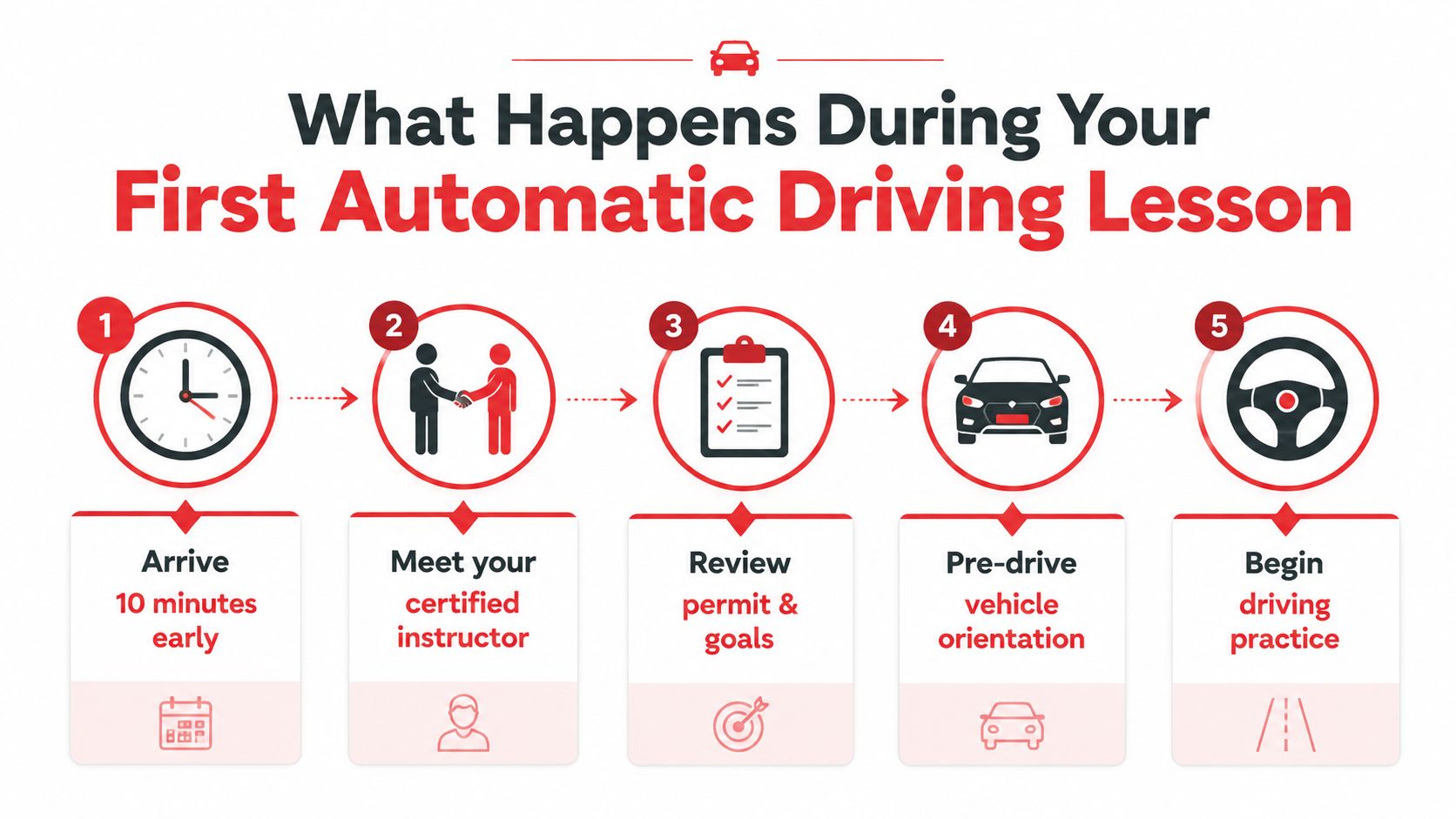
The first lesson becomes much less intimidating when you know the sequence. Arrive about 10 minutes early, bring your permit, and tell the instructor whether you're starting from zero or have practiced with family. That conversation helps the instructor choose a suitable starting point rather than assuming every learner needs the same route.
Getting comfortable before the car moves
The instructor will review your permit and goals, then complete a pre-drive orientation. You'll adjust the seat so you can press the brake fully without stretching, set the mirrors to reduce blind areas, confirm your hand position, and learn the controls you'll use during the session.
The walk-around has a purpose. You're beginning to treat the vehicle as part of a safety routine, not as a machine you just climb into. Your instructor may also confirm that you understand the gear selector, parking brake, indicators, lights, and windshield controls before starting.
Starting in a quiet area
Practice usually begins away from busy traffic. You'll work on gentle acceleration, progressive braking, and steering through lane lines or simple markers. The instructor watches whether you can keep the car controlled while looking where you intend to go.
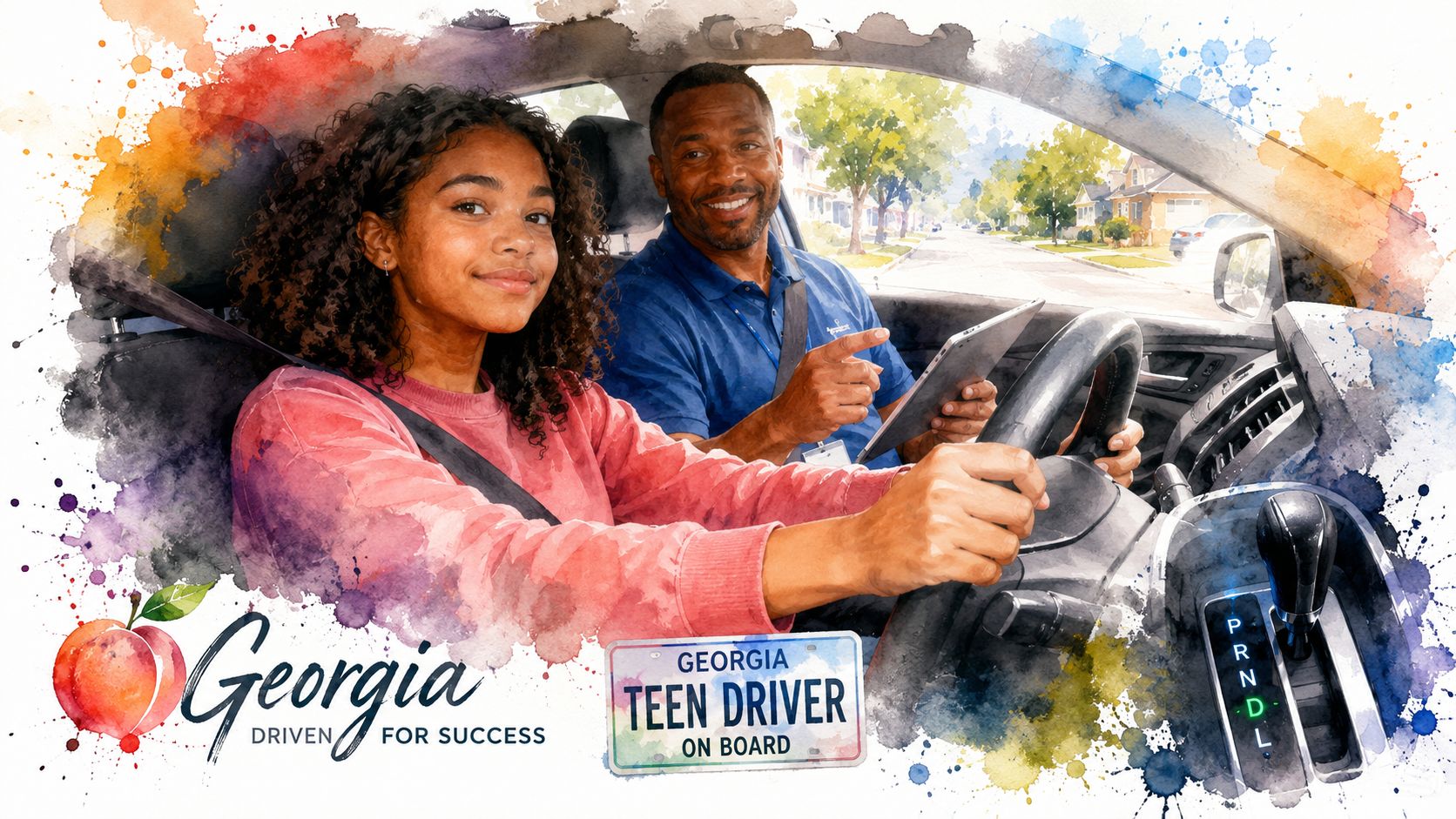
Once your control is steady, the route may move to residential streets. Expect basic left and right turns, stopping at signs, maintaining a safe position, and possibly a three-point turnaround. The instructor won't increase difficulty just to make you uncomfortable. A-1 instructors can adjust route complexity and pacing to the learner's current control.
The final minutes should include a debrief. You'll identify what felt natural, which action needs repetition, and what to practice with a qualified adult before the next session. If your supervised hours count toward your Georgia licensing requirements, record them carefully rather than relying on memory.
Key Maneuvers and Skills You'll Practice Behind the Wheel
An automatic vehicle removes clutch work, but it doesn't remove the habits that keep a driver safe. Your instructor will build those habits through repeated actions, then place them into ordinary Georgia traffic.
Control at different speeds
Smooth pedal pressure is the starting point. On a hill, you'll learn how to hold the vehicle with the brake and move forward without rolling backward. In a flat parking lot, you'll practice gentle acceleration and braking so the car responds without sudden movement.
Mirror checks should become routine rather than an occasional glance. The assigned practice target is a check every 5 to 7 seconds, paired with awareness of what's beside and behind you. Before changing lanes, you'll signal, check mirrors, look over your shoulder for the blind spot, and move only when the space is clear. This guide to checking blind spots while driving can help you review the sequence between lessons.
Position, timing, and space
On a single-lane road, your position should give you room from the curb without drifting toward oncoming traffic. On a multi-lane road, you'll learn to hold the center of your lane and plan changes early. Signal before turns, slow smoothly, and avoid braking so late that other drivers must react to you.
Your instructor may use the two-second following rule as a basic spacing exercise. In poor conditions or heavier traffic, you'll need more space. You'll also practice scanning roughly 15 seconds ahead, covering the brake near uncertain intersections, and yielding to pedestrians, especially around school zones.
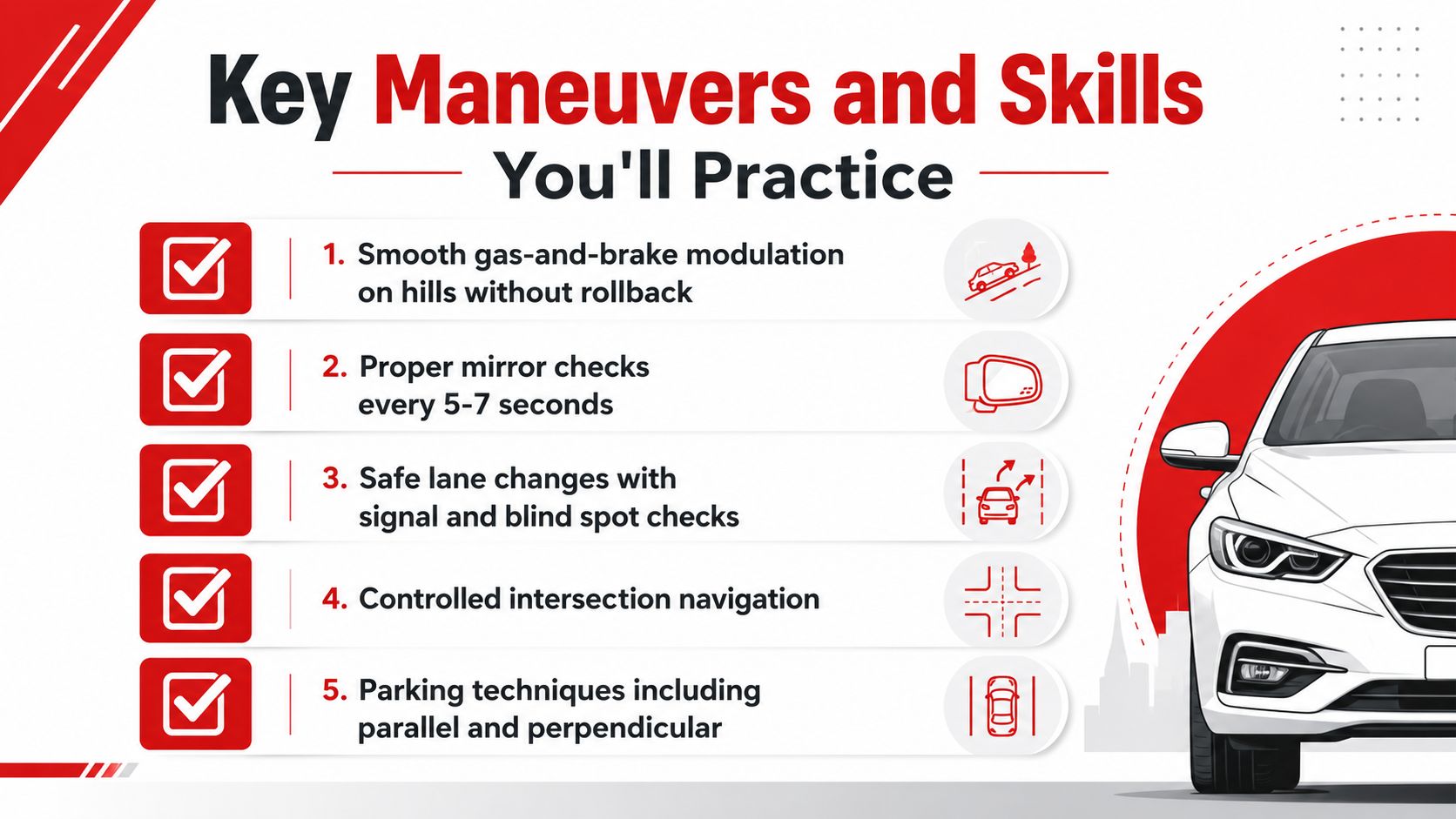
Parking practice should include more than one setting:
- Perpendicular parking: Enter a shopping-plaza space slowly, use reference points, and check both sides before straightening.
- Parallel parking: Practice on a residential street, where you can judge distance from the curb without pressure from dense traffic.
- Driveway backing: Reverse at walking speed, check around the vehicle, and use a spotter when practicing with a family member.
- Three-point turns: Choose a legal, low-risk location and focus on observation before each movement.
These repetitions support both everyday safety and the behaviors a DDS examiner evaluates, including observation, control, signaling, positioning, and appropriate responses at intersections.
Automatic vs Manual Lessons and the License Tradeoff
A Georgia teen choosing an automatic car is choosing more than an easier first lesson. Automatic lessons let you concentrate on steering, braking, observation, and traffic decisions while the car selects gears. Manual lessons add clutch control, gear selection, and stall recovery, dividing attention between vehicle operation and the road.
Manual training still makes sense for learners who may drive either transmission. If your household, future job, travel plans, or likely vehicle use points to automatic cars, the simpler starting point may suit you. The question is whether that convenience is worth a license restriction.
A quick comparison
| Factor | Automatic Lessons | Manual Lessons |
|---|---|---|
| Transmission control | No clutch pedal or manual gear changes | Requires clutch control and gear selection |
| Early lesson focus | Steering, braking, mirrors, positioning, and traffic scanning | Those same road skills plus clutch and gear coordination |
| Typical lesson counts | A 2026 UK guide reports 20 to 30 lessons for many automatic learners, with 36 to 38 professional hours on average. See the guide's training summary | The same UK guide reports 40 to 50 lessons for many manual learners, with 47 professional hours on average. |
| Georgia licensing impact | Testing in an automatic generally results in an automatic-only Class D license | Testing in a manual preserves access to manual and automatic vehicles |
The license result matters after the road test. Passing in an automatic generally limits you to automatic vehicles under that Class D license. A manual test preserves both options. Before choosing, consider whether you might need a manual vehicle for work, rent one while traveling, or buy an older vehicle with a manual transmission.
The broader shift toward automatic testing appears in the UK, where automatic tests rose from 6% in 2012/13 to 26% in 2024/25. The AA forecast 29% for 2025/26 as electric vehicle adoption accelerates, according to BBC coverage of the licensing tradeoff. That trend does not decide a Georgia learner's path. Your choice should match the vehicles you expect to drive and the license access you want to keep.
Tips That Make Every Automatic Lesson Count
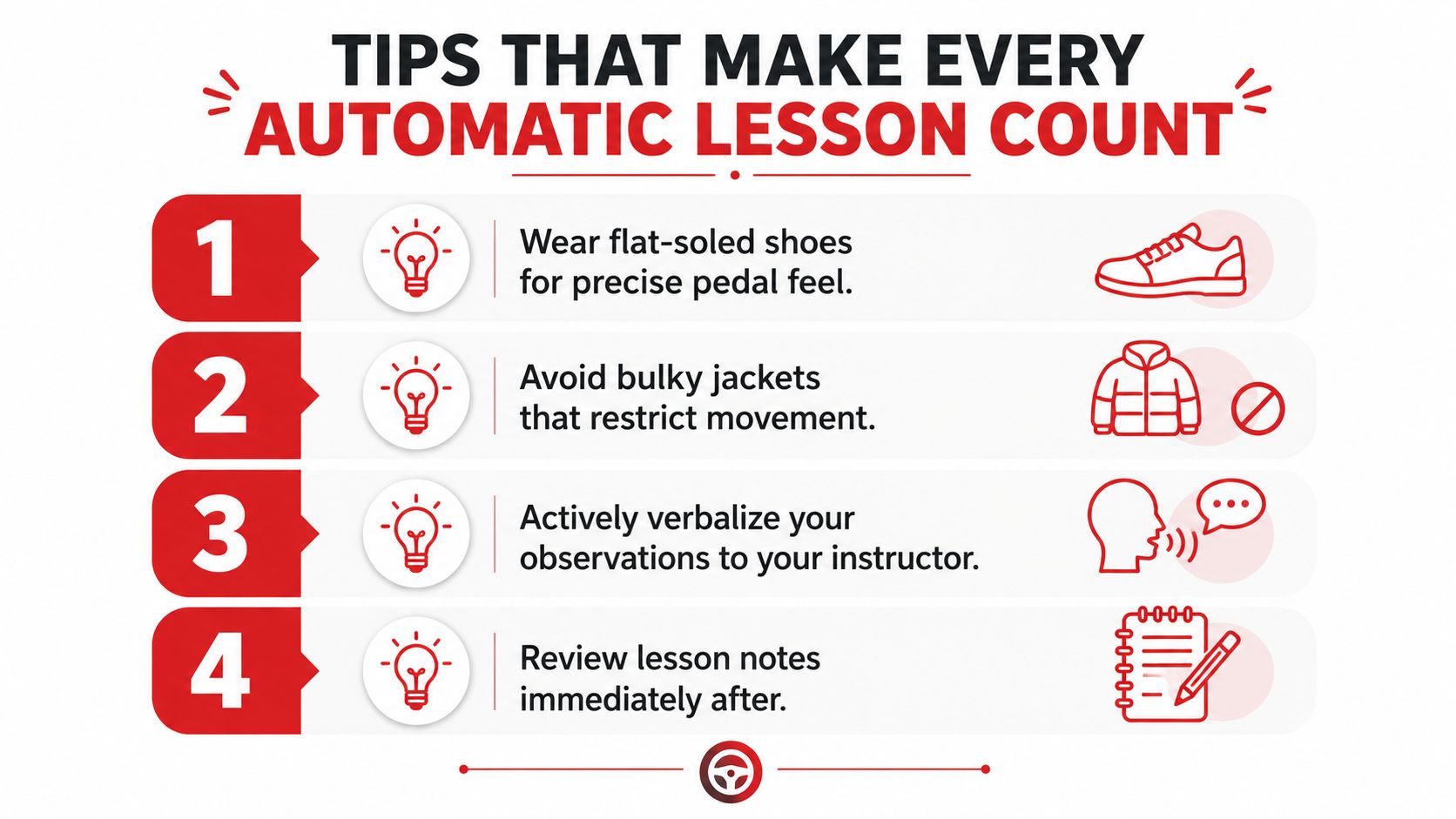
Small preparation choices can improve the quality of practice. Wear flat-soled shoes so your foot can feel pressure on the pedals, and avoid a bulky jacket that restricts arm movement or makes shoulder checks awkward. Bring your valid learner's permit and any glasses or contacts you're required to use while driving.
Arrive early enough to settle your breathing and silence your phone before the lesson begins. A distracted learner misses instructions and spends valuable time recovering from confusion. If an instruction feels unclear, ask the instructor to repeat it or explain it another way. That's responsible communication, not a sign that you're behind.
Use the time between lessons
Practice with a licensed adult when your instructor says the route and skill are appropriate. Don't spend every session driving aimlessly. Choose one focus, such as mirror routines, controlled stops, or parking, and discuss the result afterward.
Keep a short lesson log. Write down the mistake, the situation in which it happened, and the correction your instructor gave you. “Wide right turns” is more useful than “turning needs work,” because you can deliberately slow before the turn, set your position, and look through the corner during the next practice drive.
Progress often looks ordinary: a smoother stop, an earlier signal, or a better mirror check is still progress.
Stalling isn't part of an automatic lesson, but wide turns, hesitant decisions, missed observations, and slow parking are normal early errors. Treat them as information. Your job isn't to be perfect on the first attempt. Your job is to notice the correction and repeat the skill until it becomes reliable.
How Automatic Lessons Fit Into Your Georgia Licensing Path
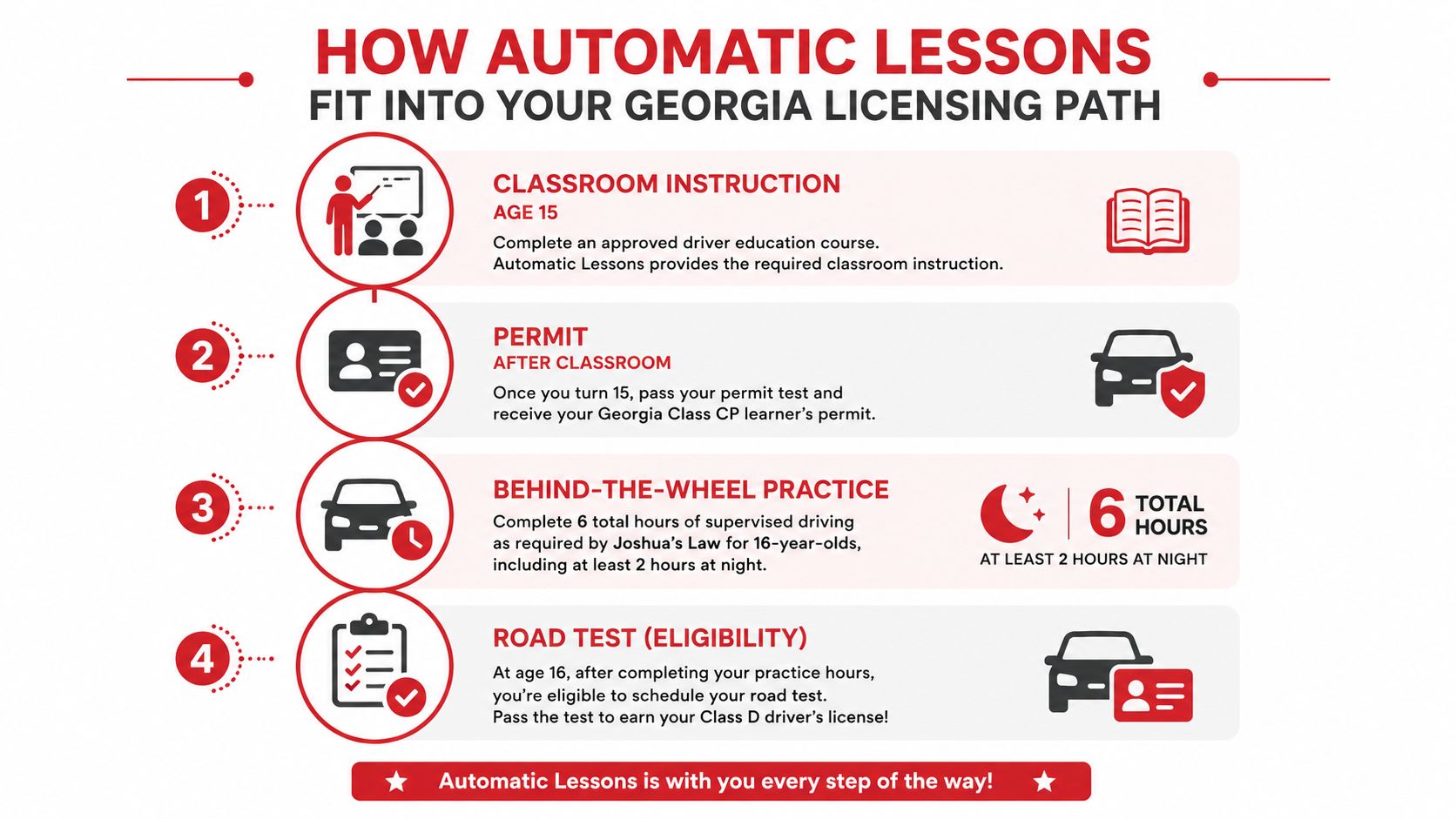
Georgia teens need to connect classroom education with supervised driving and testing. Joshua's Law applies to teens seeking a Class D provisional license and requires an approved driver education course plus 40 hours of supervised driving, including 6 hours at night, for applicants under age 17. The law has applied since January 1, 2007, according to Georgia Joshua's Law course information.
The classroom component matters because it gives you the rules and decision-making foundation before you face complex traffic. The behind-the-wheel automatic driving lesson then turns those ideas into actions, including observation, lane control, following distance, and intersection judgment.
Funding and online course options
Georgia's Driver's Education Grant Scholarship Program supports students completing a driver education course consisting of 30 hours of classroom instruction and 6 hours of behind-the-wheel training, as described in the official program rules. The program is intended to help students satisfy Joshua's Law requirements.
The scholarship is open to Georgia residents ages 15 to 17. Applicants need a valid Georgia instructional permit or driver's license, and selected students receive a redemption code on the first of the month before choosing from authorized providers, according to official scholarship guidance.
Online classroom options can make scheduling easier, while private automatic lessons supply focused practice in the vehicle. If you're unsure how the permit and provisional license stages fit together, review Georgia's provisional license process. A-1 Driving School offers online and instructor-led education, customized teen and adult lessons, lesson packages, and road-test preparation across its Georgia service areas.
Booking Your Lesson and Getting Road-Test Ready
Before booking, confirm four practical details: the instructor's qualifications, the vehicle's transmission, the pickup location, and what the package includes. Ask whether the behind-the-wheel time is structured to support Joshua's Law requirements and whether the package is designed for a beginner, skill-building, or road-test preparation.
Eligible teens can combine private lessons with the Driver's Education Grant Scholarship Program, provided the selected provider and course meet program rules. Adults and teens who aren't using the scholarship can compare lesson packages by the amount of practice, maneuver coaching, and road-test preparation they need.
Georgia DDS says non-commercial road tests are offered virtually through dual-facing-camera vehicles, while appointments are required for behind-the-wheel automobile, CDL, or motorcycle road tests. DDS also requires applicants to hold a valid Georgia non-commercial learner's permit for the road test, as explained on the DDS road-test requirements page. A road-test service using a familiar automatic vehicle can reduce one source of test-day uncertainty.
Your final preparation checklist
- Log supervised practice: Confirm that required driving and night-driving hours are recorded accurately.
- Prepare documents: Keep your permit, insurance documents, and any required paperwork together.
- Set up the vehicle: Adjust the seat and mirrors before moving, not after the test begins.
- Rehearse weak areas: Practice junction observation, lane changes, parking, and speed adaptation.
- Use a calm routine: Eat normally, silence your phone, arrive early, and listen fully before acting.
For more practical guidance, review how to prepare for the Georgia road test. A mock test or final lesson should focus on independent driving, because test readiness means completing core tasks without instructor intervention.
A-1 Driving School offers Georgia teens and adults online driver education, Joshua's Law course options, automatic driving lessons, structured lesson packages, and road-test preparation. Visit A-1 Driving School to compare courses and packages, check online enrollment, and schedule the next step toward your Georgia license.