

You can drive to school without much help, but parallel parking still takes coaching. Your parent thinks you're ready, yet you're not sure what happens when an examiner gives the directions. Passing a drivers test in Georgia starts with answering a more useful question than “Am I confident?” Ask, “Which driving tasks can I complete safely without anyone reminding me?”
What the Day of the Georgia Road Test Really Feels Like
You're sitting in the driver's seat, waiting for the examiner to approach. The parking lot suddenly feels busier than it did during practice. You notice your hands on the wheel and wonder whether the first instruction will involve the maneuver you've been avoiding.
That's a useful scene to rehearse before test day.
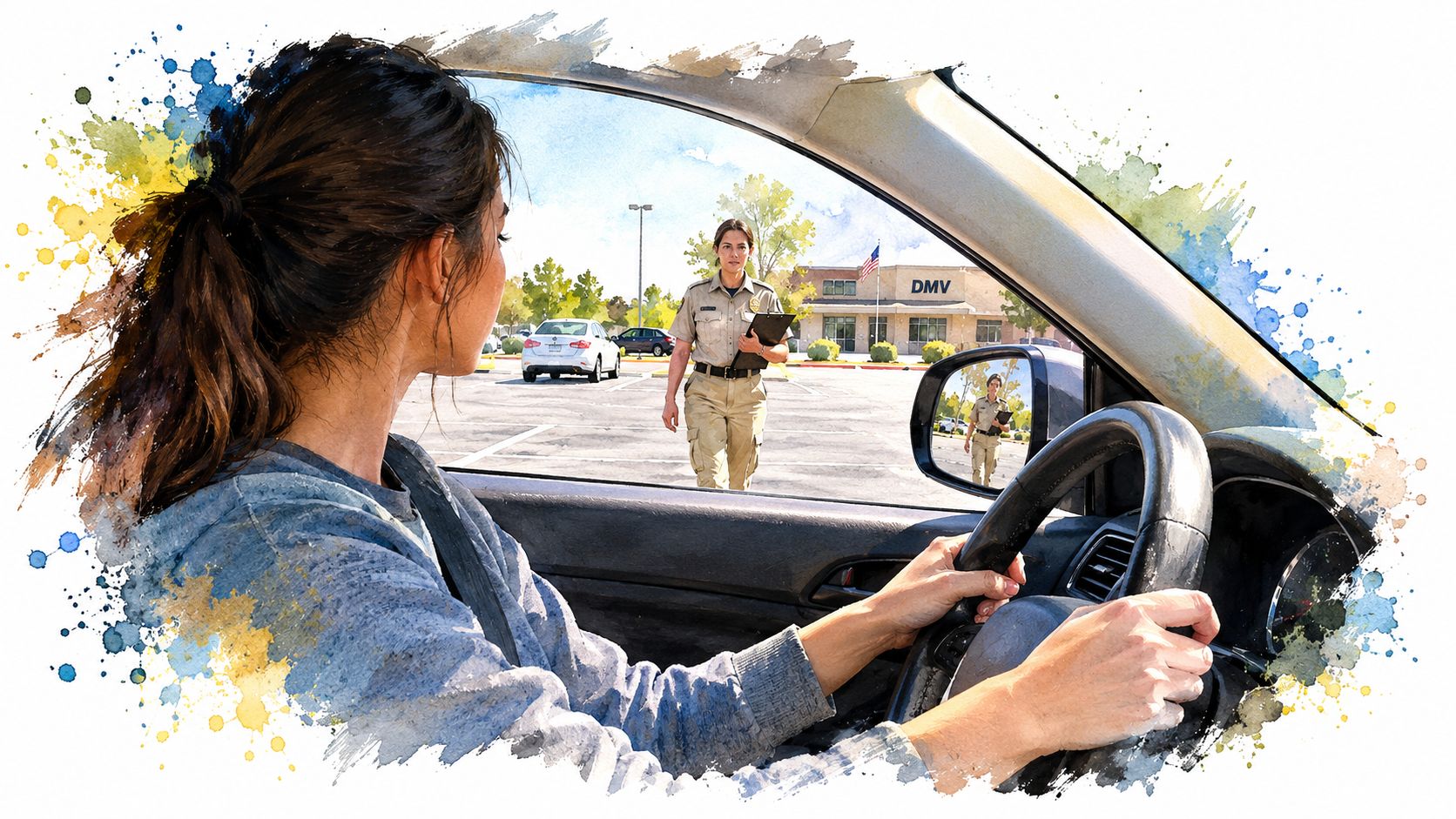
Rehearse the beginning, not just the driving
During a preparation lesson, start with the vehicle parked and the paperwork ready. Have the instructor approach, explain the exercise, and give an unfamiliar opening direction. Practice listening without immediately reaching for the gear selector.
The actual assessment arrangement depends on the testing format. Don't assume you'll walk to an examiner's car: Georgia Class C and D applicants must provide a four-wheel vehicle, and DDS requires road-test scheduling after the necessary license information is submitted, according to its Class D application guidance.
A clipboard or a quiet examiner can feel intimidating, but neither tells you how you're performing. Your job is to carry out the instruction while maintaining control and observing the surroundings.
Preparation principle: Rehearse the moments when you usually wait for reassurance. Independence matters more than looking relaxed.
Choose preparation that exposes missing habits
Ask for a road-test preparation lesson that includes the arrival routine, vehicle familiarization, and directions delivered without coaching. That gives the instructor something specific to evaluate.
- If you rush instructions: Practice waiting until the direction is complete before acting.
- If you need reassurance: Ask the instructor to remain silent during a mock assessment.
- If unfamiliar wording unsettles you: Practice different ways of giving the same safe driving instruction.
A-1's road-test preparation can be part of that rehearsal. The useful outcome isn't a promise that you'll feel no nerves. It's knowing what to do even while you're nervous.
Meeting Joshua's Law and DDS Requirements Before You Schedule
Course completion, driving practice, and licensing eligibility are separate requirements. Finishing an online course doesn't mean you're ready to book a test, and being comfortable behind the wheel doesn't replace the required education record.
For a teen seeking a provisional license, start with the permit's issue date rather than a hoped-for testing date.
Check the permit and education pathway
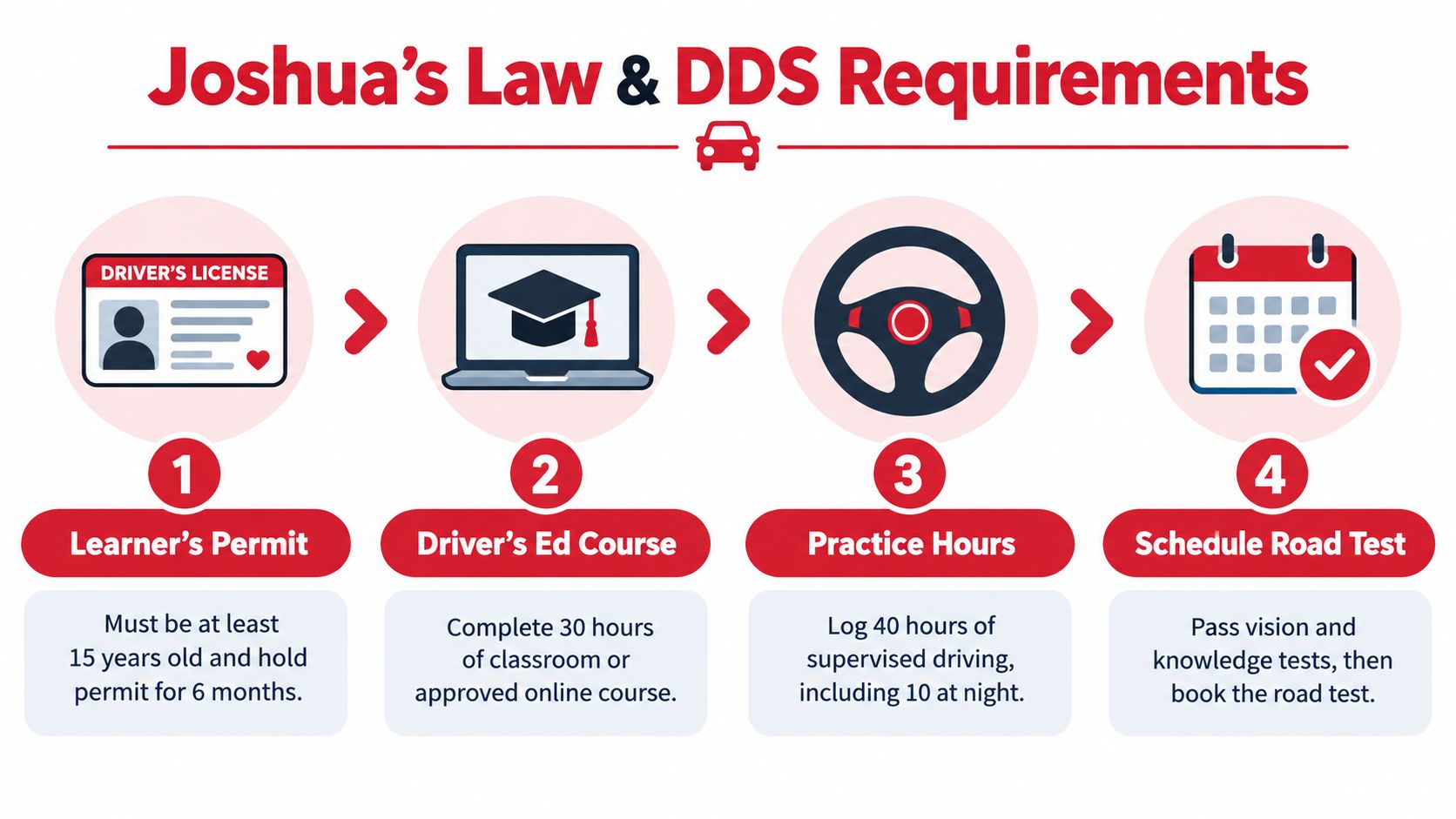
Georgia requires teens to hold an instructional permit for 1 year and 1 day before receiving a Class D license. Joshua's Law pathways include 30 hours of classroom instruction or an equivalent DDS-approved online course, practical training through 6 hours with a certified driving school or the approved Parent/Teen Driving Guide, and 40 supervised driving hours, including 6 at night, as explained in the DDS Joshua's Law requirements.
The permit is also required for behind-the-wheel training. Don't schedule practical instruction on the assumption that course enrollment substitutes for it.
The process graphic below is useful as an overview, but its permit-holding period and nighttime-hour captions are incorrect for Georgia. Use the DDS requirements above, not those captions, when planning eligibility.
Match each unfinished requirement to the right service
A-1 offers classroom Driver's Education through metro Atlanta high-school programs and an online option. Either format addresses the theory portion when taken through the appropriate approved course; driving lessons address practical training and skill development.
Use the school's Joshua's Law course and requirements information to choose a pathway before enrolling.
- Theory unfinished: Choose the classroom or approved online course that fits your schedule.
- Practical training unfinished: Arrange instructor-led lessons or confirm the permitted parent-taught pathway.
- Practice record incomplete: Keep documenting supervised driving rather than treating lesson attendance as the entire requirement.
- Licensing prerequisites unresolved: Confirm completion before committing to a test date.
For applicants ages 16 or 17, DDS also identifies completion of the Alcohol and Drug Awareness Program, avoidance of major violations triggering mandatory permit suspension, and passing the road-skills test as licensing requirements in its teen-driver guidance.
Build a folder containing your permit, course-completion records, applicable program documentation, and supervised-driving information. Compare it with the current application checklist and ask the testing provider what must be presented at the appointment. That's more reliable than assuming a course certificate is the only document you'll need.
The Maneuvers Georgia Actually Scores You On
A parking maneuver isn't successful merely because the car fits. The examiner also needs to see observation, controlled movement, and safe positioning. Practice the whole behavior, not just the final location.
Georgia's published benchmarks include a minimum passing score of 75%, parallel parking within 18 inches of the curb in a 22-by-10-foot space, and approximately 50 feet of straight-line backing at no more than 10 mph, with smooth control and no boundary-line crossing, according to DDS road-test requirements.
Practice to the standard without chasing the limit
The backing speed is a ceiling, not a target. Move slowly enough to observe continuously and make small steering corrections. For parking, use marked boundaries in a suitable practice area so your instructor can distinguish an alignment problem from poor steering timing.
| Assessed behavior | Useful practice drill | What the observer records |
|---|---|---|
| Parallel parking | Repeat the setup and controlled entry | Observation, steering control, final curb position |
| Straight-line backing | Reverse along a marked corridor | Continuous rearward observation, drift, abrupt corrections |
| Controlled stops | Approach a clearly marked stopping point | Early braking, complete stop, correct placement |
| Turnabout | Rehearse the separate movements before combining them | Scanning, signaling, control, traffic judgment |
| Lane positioning | Drive through varied turns and lane changes | Approach lane, blind-spot checks, final lane position |
Use A-1's driving-test rubric to organize a lesson around observable behaviors rather than a general request to “practice driving.”
Don't let the maneuver distract you from observation
When reversing, keep looking behind continuously rather than treating a quick mirror glance as sufficient. For turns, establish the correct approach position and signal adequately before committing. Maintain safe following space and respond to traffic controls without waiting for a reminder.
This video can support your review, but it shouldn't replace supervised practice.
A well-positioned car doesn't cancel out an unsafe observation routine.
Match the correction to the error. Missed rearward checks call for an observation-focused backing lesson, not more parking attempts. Late signals call for approach-planning practice. Stops beyond the crosswalk call for braking and placement drills.
An unsafe vehicle belongs on a pre-test inspection checklist, not on a list of driving skills to improve. Ask the instructor to identify which problem you have before choosing additional lessons.
A Layered Practice Plan That Builds Real Test-Ready Skill
A longer drive isn't automatically a better lesson. If a parent repeatedly reminds you to signal, you may finish the trip successfully without learning to initiate the signal yourself.
Use a progression that makes those reminders visible, then removes them. Research on standardized driving assessment supports recording observable errors by category and severity rather than relying only on an overall impression of the drive, as discussed in this driving-assessment research paper.
Start with control, then add decisions
Low-speed vehicle control comes first. Practice smooth acceleration, gradual braking, steering, backing, and parking in an appropriate supervised setting. Ask the observer to describe the actual error: an abrupt brake application is more useful feedback than “That felt rough.”
Next, add rule execution. The learner must choose when to signal, recognize right-of-way, position the car at stops, and account for pedestrians while still controlling the vehicle. If steering deteriorates whenever a decision appears, simplify the exercise before adding more traffic demands.
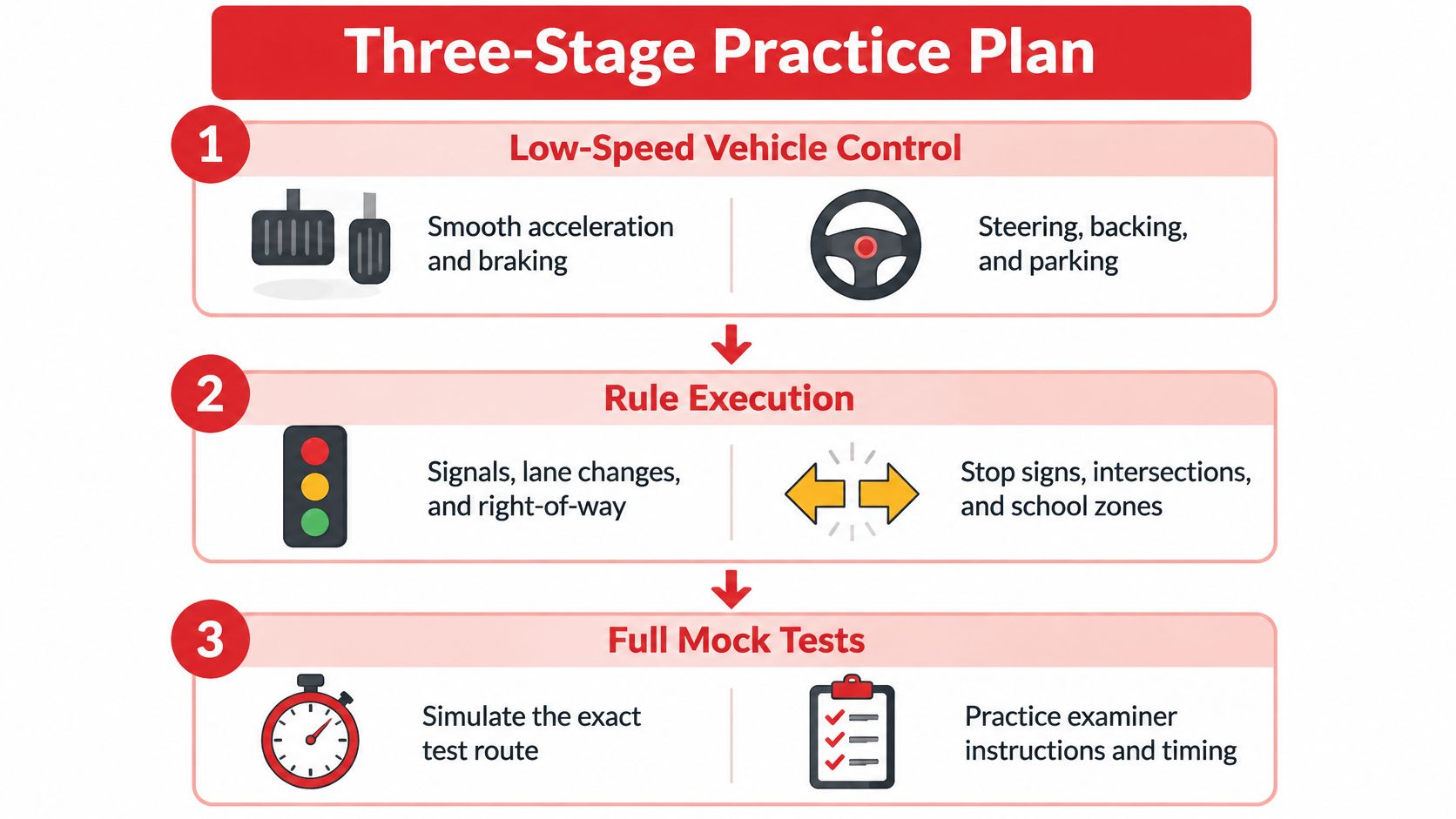
Treat the graphic's reference to an “exact test route” as a rehearsal concept, not a promise. Practice representative conditions and instructions instead of depending on a memorized route.
Use lesson packages to solve the right problem
Different learners need different amounts of structure. Parents can provide supervised repetition, while professional instruction can help identify errors the family hasn't recognized.
- An isolated weak spot: Ask about a single targeted lesson when the rest of the drive is independently safe.
- Several connected weaknesses: Discuss a multi-lesson package that allows control, observation, and decision-making to develop together.
- Skills that disappear under pressure: Request road-test preparation built around uninterrupted mock assessments.
These are useful ways to discuss A-1's customized driving lessons and packages. Ask what the selected package includes rather than assuming every option contains a mock test or testing appointment.
During a mock assessment, the observer should record omissions without offering mid-run corrections, unless safety requires intervention. Review the notes afterward and practice the specific behavior that failed.
Before a separate drill, explain your intended observation sequence aloud. During the final simulation, perform it independently without a running conversation. Readiness means repeatable safe performance across consecutive rehearsals, not a particularly good drive after extensive coaching.
Pre-Test Vehicle Prep and Examiner Interaction Without the Jitters
An equipment problem can prevent you from demonstrating skills you've worked hard to develop. Check the vehicle before test morning, while there's still time to address a fault or clarify a documentation question.
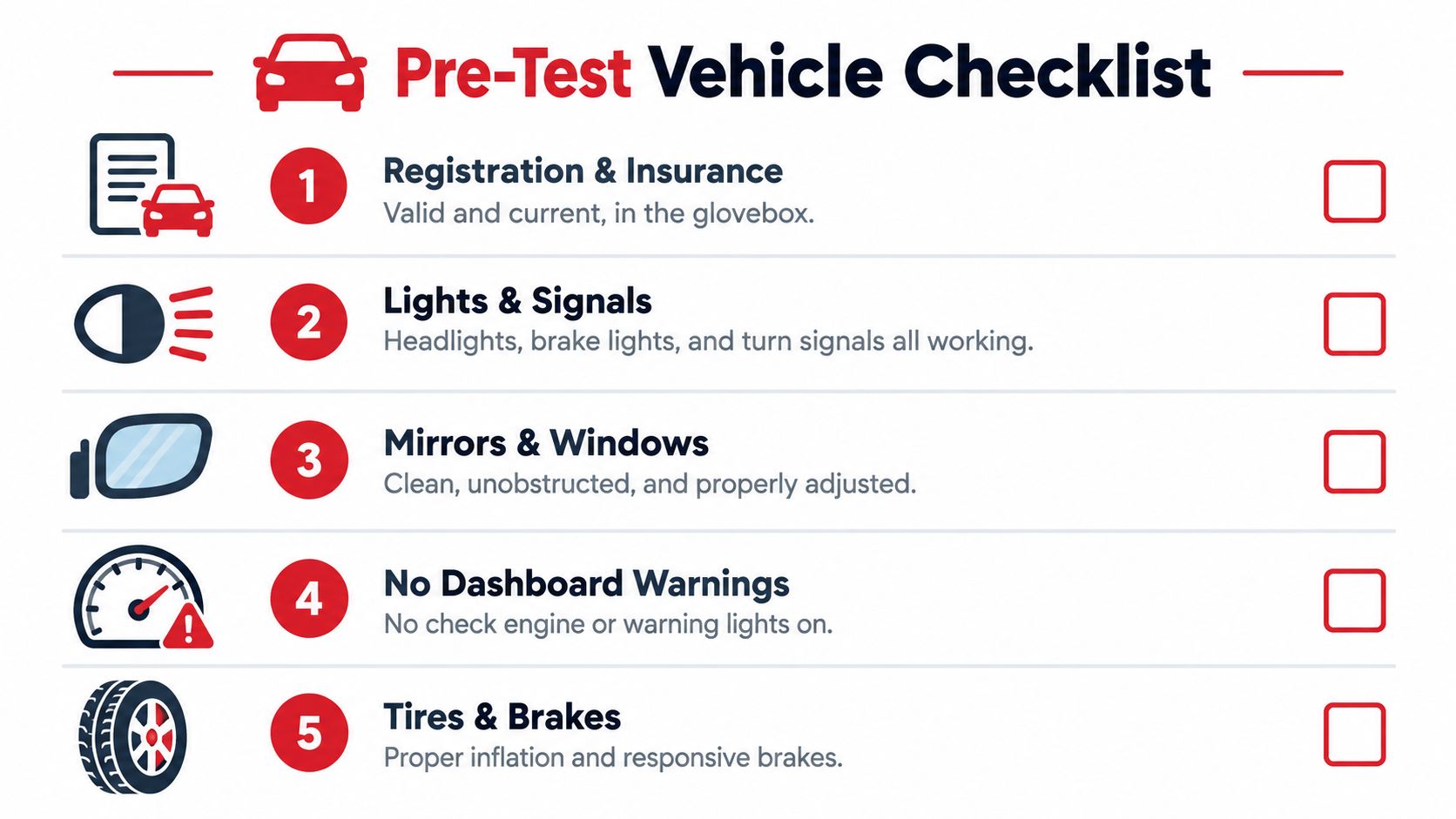
The vehicle checklist is a preparation tool, not a substitute for the testing provider's inspection. Georgia requires valid registration and liability insurance and a vehicle that passes the DDS safety inspection.
Run a physical check, not a mental one
Have a supervising adult help inspect the car you intend to use. Familiarity with another family vehicle won't help you find an unfamiliar defroster control.
- Registration and insurance: Locate current documents and confirm they match the test vehicle.
- Lights and signals: Check headlights, brake lights, and turn signals with someone observing outside.
- Mirrors and windows: Clean the glass, remove obstructions, and adjust mirrors from your driving position.
- Dashboard warnings: Investigate illuminated warnings with a qualified person rather than dismissing them.
- Tires and brakes: Check tire condition and inflation and address unusual braking behavior.
- Cabin and controls: Secure loose items, clear the footwell, and locate the controls you may need.
Communicate clearly without performing for the examiner
While parked, give the examiner your attention and ask about anything you haven't understood. Once moving, keep your visual attention on driving. You don't need to turn toward the passenger to prove you're listening.
A brief audible confirmation can help when an instruction is unclear. If you need clarification, ask before guessing or making an abrupt maneuver. Let the examiner direct the assessment rather than trying to impress them with constant commentary.
After a mistake: Return your attention to the next safe action. Don't attempt a sudden correction just to undo what already happened.
Before moving off, release unnecessary tension in your hands and take a comfortable breath. During the drive, avoid monitoring the examiner's expression or trying to calculate your score.
A pre-road-test lesson can rehearse this interaction alongside the driving. Ask for neutral instructions, realistic pauses, and feedback afterward, so the assessment isn't your first experience driving without encouragement from the passenger seat.
Using the Scholarship Grant and Lesson Packages Together
Training costs deserve a place in the plan before a family starts booking lessons. The Georgia Driver's Education Scholarship Grant Program is worth investigating for eligible teens, but don't assume an application guarantees an award or that every service you want is covered.
Start with A-1's scholarship eligibility requirements and confirm the current application process, covered training, participating options, and enrollment instructions. Get those answers before paying for a course you hope the program will fund.
Build the training plan around confirmed coverage
The practical question isn't whether financial assistance exists. It's which remaining training needs the award can address and which costs the family must plan for separately.
| Decision | What to confirm |
|---|---|
| Apply for assistance | Current eligibility and required documentation |
| Choose theory instruction | Whether the intended online or classroom option is covered |
| Arrange driving lessons | Included practical training and scheduling conditions |
| Add preparation | Whether additional lessons or mock testing require separate payment |
| Arrange road testing | Applicant eligibility, location, vehicle arrangements, and applicable charges |
A-1's classroom and online options, customized lesson packages, and road-testing services offer ways to coordinate these tasks through the school. Ask staff to distinguish course enrollment, driving lessons, test preparation, and the road test itself. They serve different purposes and shouldn't be assumed to come bundled together.
Once funding and enrollment are confirmed, schedule practical instruction around the learner's needs and continue the required family-supervised practice. Use instructor feedback to decide whether additional lessons are necessary, rather than buying preparation based only on the approaching test date.
Testing assistance can also help families clarify the appointment process. Ask whether school-based testing is available to your applicant and what remains to be completed with DDS afterward. Financial support can make training more accessible, but readiness still has to be demonstrated behind the wheel.
One Next Step Before Momentum Fades
Passing the Georgia road test is easier to plan for when you stop treating it as a single performance. Eligibility, vehicle preparation, maneuver control, and independent decisions each need attention. Confidence becomes more useful when you can point to the behaviors supporting it.
Choose your next action from the gap you can identify today.
- Missing education: Select the appropriate Joshua's Law course format.
- Inconsistent driving skills: Choose a lesson package based on instructor feedback.
- Ready but untested: Arrange a preparation session that checks independent performance.
- Uncertain about affordability: Confirm scholarship eligibility before committing to enrollment.
Put a realistic training date on the calendar, then work toward a test date supported by your performance. Don't reverse that order and hope the deadline will make you ready.
Your next booking should answer a specific need, whether that's learning the rules, correcting a maneuver, or demonstrating a complete drive without prompts. That's a practical step toward earning the license rather than merely attempting the test.
A-1 Driving School offers Joshua's Law classroom and online education, customized driving lessons and packages, and Georgia road-test preparation and testing services. Visit to choose a course or ask which lesson package addresses your current skill gaps, and confirm scholarship eligibility before enrolling if you're seeking financial assistance.