A Georgia teen must be 16, hold a valid Class CP learner's permit for at least 1 year and 1 day, complete Joshua's Law, log 40 hours of supervised driving, including 6 at night, complete ADAP, and pass the road-skills test before receiving a Class D provisional license. For Joshua's Law, the education requirement includes 30 hours of classroom or approved online instruction and either 6 hours of behind-the-wheel training with a certified instructor or the approved parent-teen driving alternative (Georgia DDS Joshua's Law requirements).
If you're a parent and teen looking over a licensing checklist, it can feel as if every requirement leads to another form, course, or appointment. The process becomes easier to manage when you see it as a series of separate milestones: qualify for the permit, learn and practice, then apply for the license that fits your age and experience.
Why Getting a Georgia Driver's License Is a Process, Not a Test
A family with a 15-year-old may be focused on the first DDS visit, but passing a permit test is only the start of the teen licensing path. The learner's permit lets a new driver begin supervised practice. It doesn't replace driver education, the required practice period, or the tests that come later.
Think of the path as a sequence. First, the teen gets a Class CP learner's permit. Next, the family plans Joshua's Law education and supervised driving. When the teen reaches the minimum age and has held the permit long enough, they can apply for a Class D provisional license after completing the remaining requirements.
That waiting period matters. It gives families time to fit lessons and practice into real life, including school, work, sports, and weather. A teen who starts driving practice only shortly before becoming eligible may have the required hours but still feel unprepared for unfamiliar roads or a busy intersection.
A useful planning habit: Keep course completion records and supervised-driving documentation together, and check that each requirement is complete before scheduling the road test.
What each milestone does
The different requirements serve different purposes. Driver education teaches road rules and foundational knowledge. Instructor-led or approved parent-teen practical training provides structured driving experience. Supervised practice builds familiarity across everyday situations, while the road-skills test checks whether the teen can demonstrate driving ability.
ADAP, the Alcohol and Drug Awareness Program, is another required milestone for teen applicants who must satisfy Joshua's Law. The DDS also requires a vision examination and successful road-skills test, and an applicant must avoid major traffic violations that would suspend the learner's permit (DDS Joshua's Law requirements).
The result is a staged system, not a race to book the earliest test appointment. Families can start by identifying which requirements apply, then work through them in order. A course can cover the education component, but it doesn't eliminate the supervised-driving requirement or the need to meet the permit-holding period.
The Three License Types Georgia Drivers Actually Earn
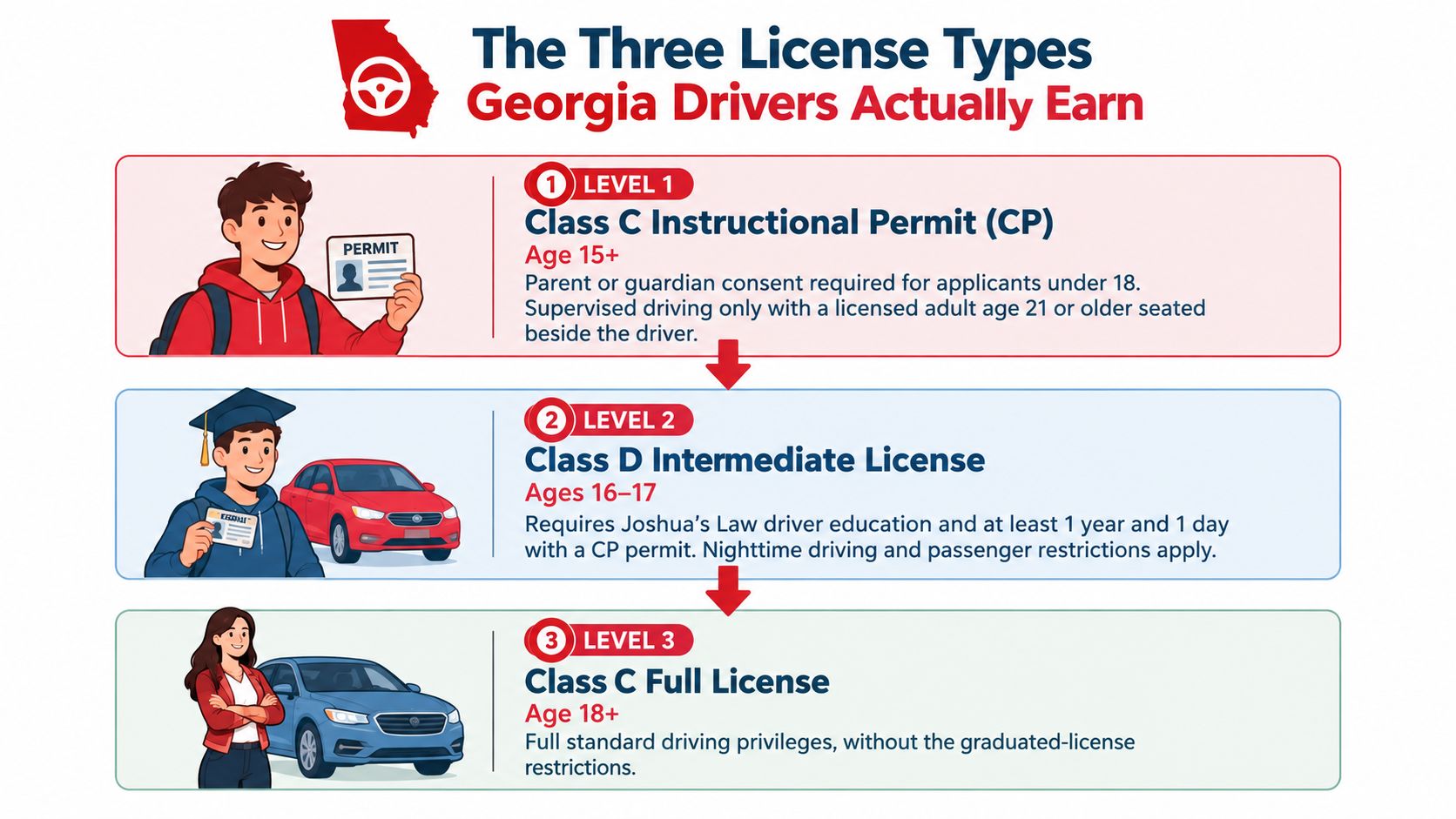
Georgia's licensing classes make more sense when you picture a ladder. The Class CP permit is the supervised-learning stage, the Class D license is the provisional stage for eligible teens, and the Class C license is the regular license that adults may apply for directly in certain circumstances.
Class CP, the learner's permit
The Class CP permit is where many teen drivers begin. It allows a teen to practice under supervision, rather than drive independently. For a family, this is the time to combine instruction with calm, regular practice so the teen learns to manage traffic, road positioning, intersections, and basic maneuvers.
Class D, the teen provisional license
The Class D license is the next step for qualifying teen drivers. Applicants must meet the age and permit-holding requirements, complete the applicable education and practice requirements, and pass the required tests. The license comes with restrictions, including limits on nighttime driving and passengers, so earning it doesn't mean every driving condition is immediately unrestricted (Georgia DDS Class D requirements and restrictions).
Class C, the adult license
Adults may follow a different route. Georgia residents 18 or older may apply directly for a Class C license rather than first completing the teen Class D progression. They still need to meet the applicable testing, documentation, and supervised-driving requirements (Georgia's Class C license application guidance).
The first question to answer is which class you're applying for. A 16-year-old pursuing a provisional license and an adult applying for a first license aren't following the same checklist.
How Joshua's Law Fits Into the Licensing Timeline
A 15-year-old holding a fresh CP permit will hear "Joshua's Law" used as shorthand for everything standing between them and a Class D license. The law has two distinct components, and families confuse them constantly at the DDS counter. The theory portion requires at least 30 hours of classroom or approved online instruction. The practical portion can be completed with 6 hours of on-road training from a DDS-certified instructor or through the approved parent-teen driving alternative (Georgia DDS driver-education FAQs).
Here is where the confusion usually starts. Six hours behind the wheel with a certified instructor satisfies the Joshua's Law practical component, yet those hours count toward a different requirement than the supervised practice log. Under the same DDS requirement, the teen must still complete 40 hours of supervised driving, including 6 hours at night, typically with a parent or guardian in the passenger seat. Three separate obligations, three separate boxes to check.
Match the course to the road practice
A-1 Driving School offers Joshua's Law driver education in Georgia with course formats that satisfy the 30-hour theory requirement and behind-the-wheel instruction for the 6-hour practical component. Before enrolling, confirm the selected course and training option meet the current DDS requirements for the teen's application.
For the supervised hours, plan varied practice rather than repeating one comfortable route. A new driver who only rehearses the same five streets to school will freeze the first time an intersection looks unfamiliar. Rotate through empty parking lots, quiet neighborhood roads, busier arterials, and a few nighttime drives early on, so the required night hours never pile into the final week.
A completion certificate is one milestone on a longer list. A 16- or 17-year-old applicant still needs ADAP and the required permit-holding period before the license itself is within reach.
Documents, Tests, and Fees the DDS Will Ask For
A DDS visit works like packing for a flight: the airline checks your ticket, your ID, and your bag separately, and a problem with any one of them holds up the whole trip. The service counter follows the same logic, reviewing documents, test results, and payment as three separate items. Sort all three before leaving home and the appointment usually moves quickly.
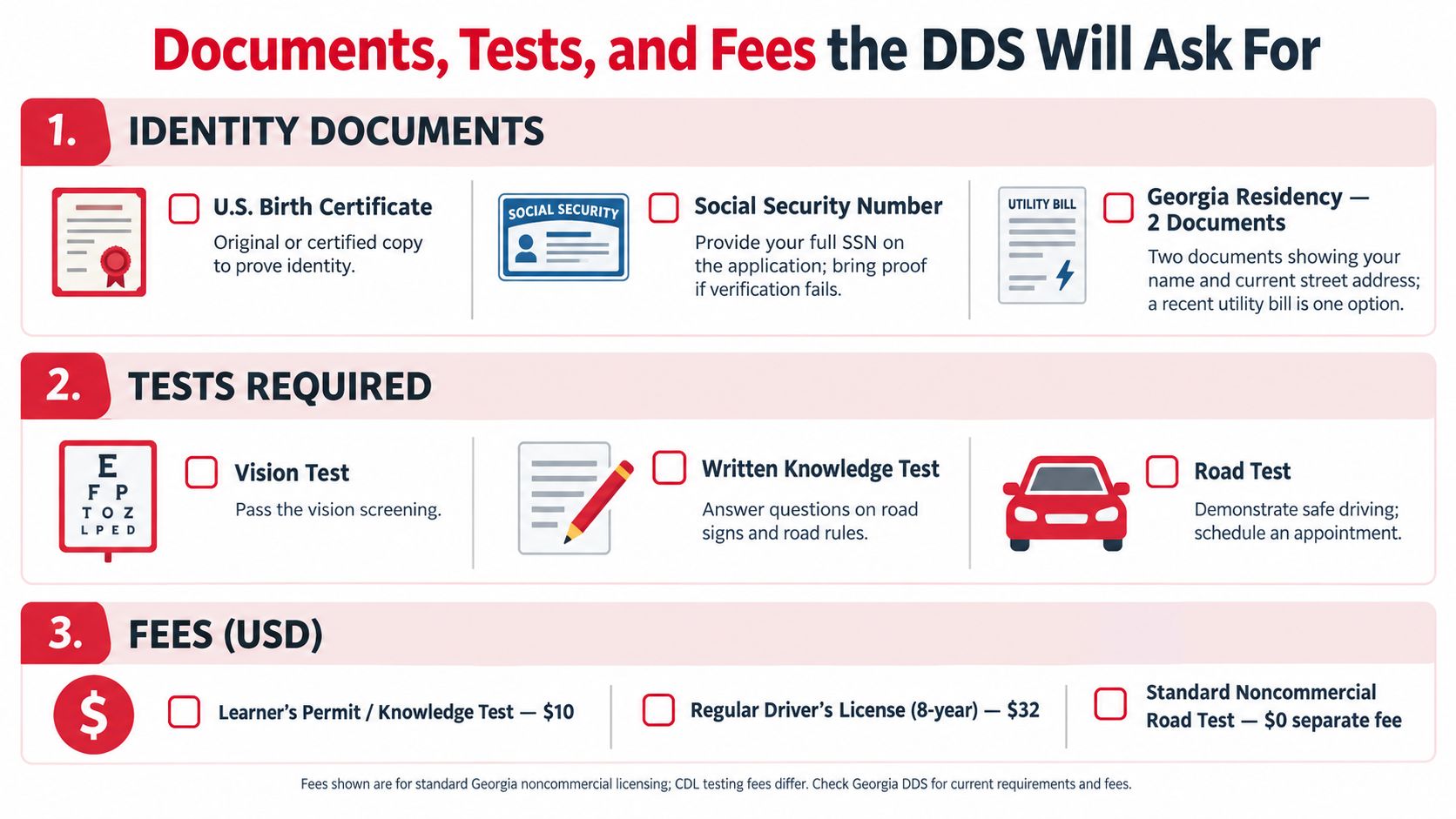
The document stack changes with the applicant. A teen applying for a Class D provisional license needs different paperwork than an adult seeking a Class C license or a first-time permit, so pull the checklist for that exact credential rather than a generic list. Expect to show proof of identity, Social Security information, and Georgia residency. For a minor, confirm the current parent or guardian consent rules and any school documentation the DDS requires for that age group. The Georgia driver's license and ID document guide walks through what to gather for each applicant type.
Tests belong in the same plan
Every applicant passes a vision exam. Beyond that, the knowledge and road-skills tests depend on the license stage. A teen's road-skills test comes only after driver education, supervised practice, and the permit-holding period are complete, while a first-time adult applicant takes vision, knowledge, and road-skills exams in sequence.
Fees vary by credential and service, so check the current DDS fee schedule and appointment availability before the visit.
A preparation list keeps this manageable: confirm the license class, gather the documents for that applicant, identify which tests come due at this visit, and verify the education and practice milestones are finished. If a teen is applying, keep course completion records and the driving log with the rest of the paperwork so nothing has to be hunted down at the counter.
From Permit to Road Test With Driving Lessons That Actually Help
Road-test preparation works best when lessons build the skills the driver will need to show, not just familiarity with one route. A teen who can turn smoothly on a quiet street may still need practice checking traffic at intersections, changing lanes with care, parking, and controlling speed in different conditions.
Some drivers take their road test through DDS; others may use a driving school's testing option when available. Before choosing, confirm how scheduling works, what vehicle is used, and what the test appointment includes. A familiar vehicle and a clear appointment plan can help reduce avoidable surprises, but preparation still comes from practice and skill.
A lesson package can add structure to practice. An instructor can notice habits a family member may miss, such as late mirror checks, wide turns, inconsistent lane position, or hesitation when entering an intersection. Families can then work on those skills between lessons, while keeping the required supervised hours in view.
The teen's overall supervised practice requirement remains at least 40 hours, including 6 at night (Georgia DDS Joshua's Law requirements). Professional lessons support that preparation, but families should confirm how each lesson counts toward the applicable practical-training requirement and the separate supervised-driving total.
A road test appointment is a check of the driver's ability, not a substitute for instruction. If a learner still struggles with observation, signaling, speed control, or parking, rescheduling after more focused practice may be a wiser choice than treating the first available slot as the only goal.
Adults, New Residents, and License Transfers in Georgia
Three people can reach the same DDS counter on the same morning and still need three different plans: a teen moving toward Class D, an adult seeking a first license, and a new resident holding a valid card from another state. Georgia licensing works like separate doors into the same building, so the first task is choosing the door that matches age, licensing history, residency, and documents.
| Applicant | Starting point | What to check |
|---|---|---|
| Teen pursuing Class D | Teen graduated-license pathway | Permit period, Joshua's Law, supervised driving, ADAP, tests, and Class D restrictions |
| Adult applying for a first license | Direct Class C application may be available | Vision, knowledge, and road-skills exams, required documents, and applicable supervised-driving evidence |
| New Georgia resident with a current out-of-state license | License transfer | Identity, residency, citizenship evidence, and surrender of the prior license |
For an adult first-timer, the teen graduated-license sequence is usually not the route once the applicant is on the adult Class C track. The adult still has to prove identity and residency, pass the required exams, and meet any supervised-driving evidence requirement that applies instead of assuming an adult application skips preparation. Use the same document checklist used for the application steps, then match it to the adult path.
Residency changes the next step
A move to Georgia starts a clock. Residency can be shown through ordinary life evidence such as a Georgia home, work in the state, school enrollment for children, or sustained presence, and a valid out-of-state license points toward a transfer instead of a first-time application. Someone with no current license enters the licensing path from the beginning.
Non-citizen applicants should expect to show legal status, identity, and Georgia residency, then complete the required vision, knowledge, and driving exams. When documents use different names, or when an immigration document is temporary, confirm the supporting papers before the visit instead of solving it at the counter. REAL ID is a separate planning question: a star marking indicates a credential intended to meet federal identification standards, so applicants who need that credential should verify the current DDS REAL ID checklist before they go. For background on a specific licensing issue affecting some applicants, see A-1 Driving School's guide to Georgia license rules for Puerto Ricans and others.
Scholarships, Locations, and How to Enroll With A-1
The Georgia Driver's Education Scholarship Grant Program may help qualifying applicants cover approved driver education. If the cost of a course is a concern, check the program's current eligibility and application process before enrolling, then confirm which course options qualify.
A-1 Driving School offers in-person classroom, online, and virtual learning options, along with driving lessons and road-test preparation. Families can choose a course format and consider pairing driver education with a lesson package that supports practical skill-building. A-1 also serves the metro Atlanta area through multiple locations, so check the current enrollment options and schedules for the location that works for you.
The practical next step is to identify the applicant's license path, choose the required course or lessons, and confirm the schedule and scholarship process before booking. That keeps education, practice, and testing aligned rather than leaving a requirement until the last minute.
Quick Answers to Georgia Licensing Questions
How long must a teen hold a permit? A teen must hold an instructional permit for at least 1 year and 1 day before qualifying for a Class D license, and meet the other requirements.
When do Class D restrictions end? The midnight-to-5 a.m. driving ban applies during the first six months of the Class D period. Passenger limits also restrict non-family passengers during that period. Check the DDS Class D requirements for current details.
What if the road test isn't passed? Check with DDS or the testing provider for current retest scheduling and requirements. Before trying again, practice the specific skills that need work.
When must a new resident get a Georgia license? Within 30 days of establishing Georgia residency. For vehicle-specific rules beyond a standard driver's license, including low-speed vehicle requirements, find Georgia LSV requirements.
A-1 Driving School offers driver education, Joshua's Law courses, driving lessons, and road-test preparation. Choose the option that fits your licensing path, then visit A-1 Driving School to review enrollment and available schedules.