

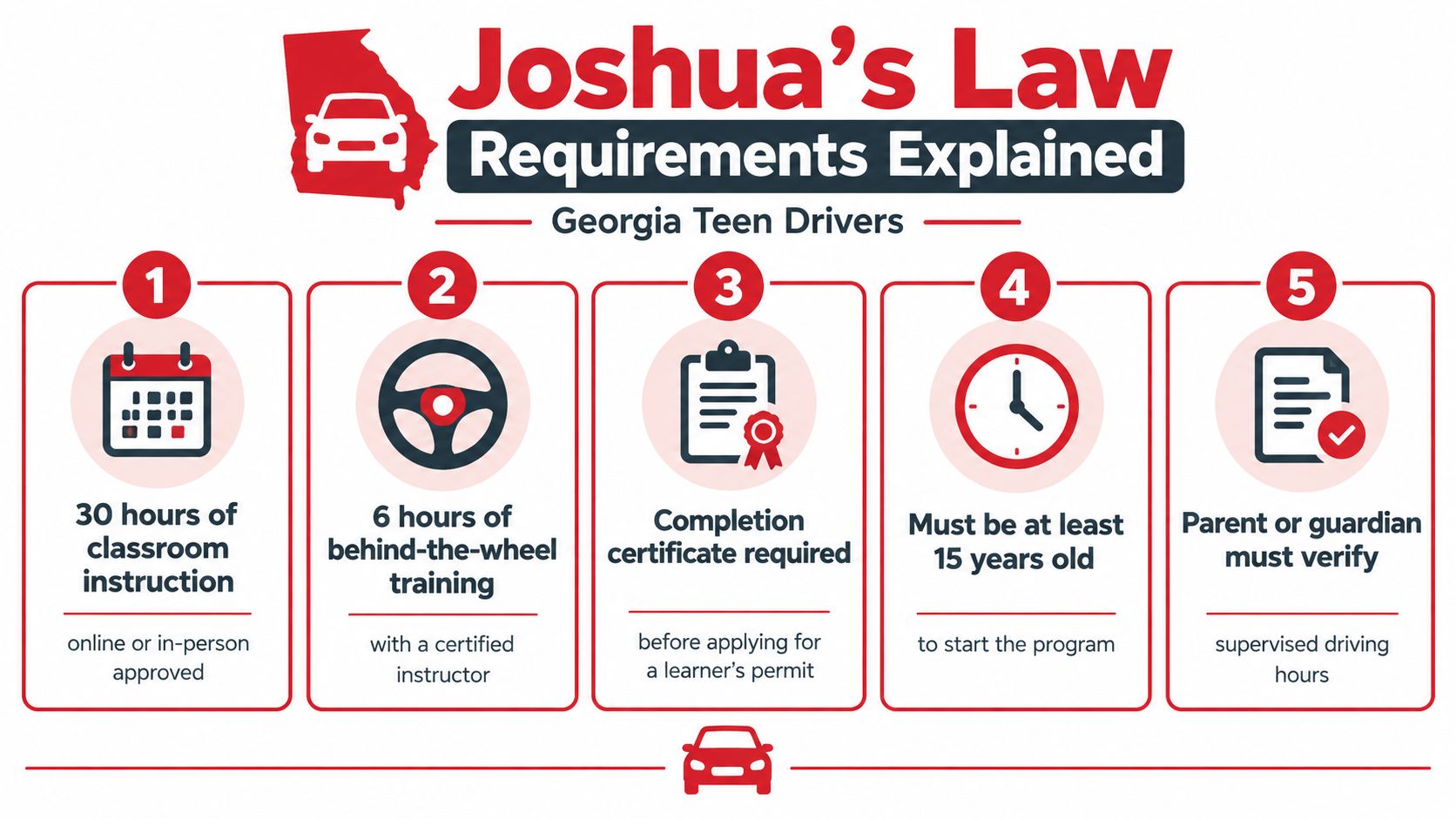
Georgia teens ages 16 and 17 must complete 30 hours of driver education, 6 hours of behind-the-wheel training or an approved parent-taught alternative, and 40 hours of supervised driving to earn a Class D license under Joshua's Law. That first permit photo often sits on the kitchen counter while a parent asks, "So what happens next?" It's a fair question, because the permit is only the starting line. Think of Drivers Education GA as a set of stepping stones, not a single class you finish and forget. You learn the rules, practise with guidance, build hours at home, and then prove you're ready on a road test. Each stone has a purpose, and skipping the paperwork on any one of them can delay the license even when the driving itself is going well.
Starting Your Georgia Driving Journey
A typical first week looks like this. Your teen passes the permit test, drives home from the DDS office beaming, and then sits in the passenger seat because that's what the permit requires for now. You take a slow loop around the neighborhood that evening. The turns are wide, the braking is late, and you're both gripping something a little too tightly. That's normal. Every confident driver you've ever met started exactly there.
Georgia structures this learning period on purpose. Under Georgia DDS Joshua's Law requirements, applicants ages 16 and 17 seeking a Class D provisional license must complete at least 30 hours of theoretical education, practical training through 6 hours with a certified provider or an approved parent-taught alternative, and 40 hours of supervised driving including 6 hours at night.
The Roadmap in Plain Terms
Picture the journey as three layers that build on each other.
- Learn the language: The theory course teaches signs, right of way, speed management, and hazard awareness before your teen has to apply them at speed.
- Practise with a coach: Behind-the-wheel lessons turn that vocabulary into smooth steering, braking, and scanning habits.
- Repeat at home: Supervised hours with you turn coached skills into everyday judgment on real errands, in real traffic.
This graduated approach exists because new drivers shouldn't jump from a permit to full independence overnight. Privileges expand as experience grows. Families who understand that logic tend to pace themselves better. They spread practice across months instead of cramming it into a few anxious weekends before a test date.
Treat the permit period as an apprenticeship. Your teen is learning a skilled trade, and you're the senior partner riding along.
One more point belongs here because I hear the confusion often. A learner's permit is not a license, and driving alone on one carries real legal consequences. If a family member ever faces a charge for driving without proper licensing, it's worth understanding GA no license defense options rather than guessing at the outcome. The safer path is simpler. Follow the staged process, keep records as you go, and your teen arrives at the road test with both skill and proof in hand.
Joshua's Law Requirements Explained
Joshua's Law is the rulebook that ties the whole process together for younger teens. According to Georgia DDS teen driver guidance, the pathway combines a DDS-approved course with at least 30 hours of theory, either 6 hours of behind-the-wheel instruction with a certified instructor or the DDS-approved Parent/Teen Driver Guide, plus 40 hours of supervised driving with at least 6 hours at night, and completion of the Alcohol and Drug Awareness Program (ADAP).
Why Each Piece Exists
The theory hours build the mental model. A teen who understands why following distance matters brakes earlier without being told. The instructor-led hours build technique in a car where a professional can intervene calmly and correct habits before they harden. The supervised hours build judgment, because judgment only comes from varied, repeated experience. Night hours matter because darkness changes depth perception, glare, and reaction time in ways daytime practice can't simulate.
Georgia didn't adopt this structure on a hunch. DDS cites a study comparing periods before and after the Teenage and Adult Driver Responsibility Act, known as TADRA, in Georgia DDS material on TADRA, which found the fatal crash rate for 16-year-old drivers was 36.8% lower in the 5½ years after enactment than in the 5½ years before it. TADRA stages the privileges. Joshua's Law makes sure education comes before those privileges expand.
Your Working Checklist
- Theory complete: Keep the completion certificate from your approved classroom or online course.
- Practical training complete: Finish certified behind-the-wheel instruction or the approved parent-taught pathway, and keep that documentation too.
- Supervised hours logged: Record dates, duration, and conditions, and track nighttime time separately so there's no guesswork later.
- ADAP confirmed: Don't assume a driver education course covers it. Verify it early so it doesn't become a last-minute surprise.
You can review the full breakdown on A-1's Joshua's Law requirements page and check items off as you finish them. Families sometimes ask what happens if a teen drives before finishing all this. It's worth reading about the penalties for no license in Georgia to understand why completing the sequence properly protects both your teen's record and their timeline.
Online vs In-Person Driver Education
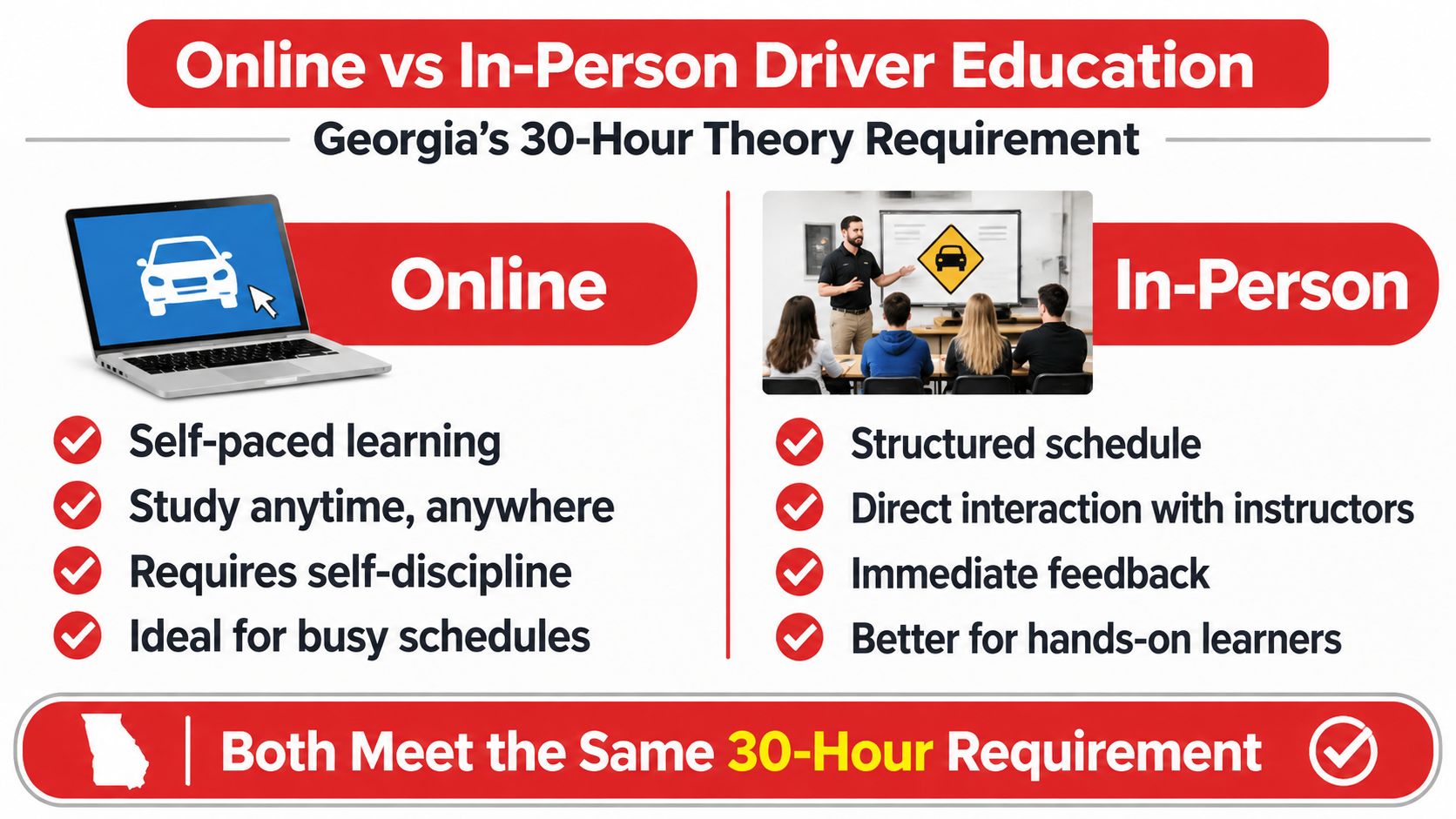
Both formats satisfy the same theory requirement, so this decision is about fit, not legitimacy. DDS recognises classroom and online delivery for the theory component, and Georgia DDS driver education FAQs confirm the modality doesn't reduce the practical exposure still required afterward. A teen who learns online still needs in-car training and supervised practice. The screen teaches concepts. The road teaches driving.
Choosing by Learning Style
Online courses suit teens with packed schedules, long commutes, or a genuine preference for self-paced study. Your teen can pause, replay a tricky segment on intersection rules, and study after practice or work. The trade-off is discipline. Without a set class time, some students drift, and parents end up playing attendance officer.
In-person classes suit teens who learn by asking questions out loud and hearing classmates' questions too. The fixed schedule creates momentum, and an instructor can spot a confused expression that a progress bar never will. The trade-off is logistics. Someone has to get that student to a location, on time, repeatedly.
| Question to Ask | Online Leans Yes | In-Person Leans Yes |
|---|---|---|
| Schedule | Irregular, busy, or changing weekly | Predictable free blocks for class |
| Self-direction | Finishes homework without reminders | Works better with external structure |
| Questions | Comfortable reviewing material alone | Learns through discussion and examples |
Whichever route you pick, verify DDS approval before paying anything. An unapproved course, however polished, won't count toward licensing. Also look for clear progress tracking and a completion record you can retrieve later, because you'll need that proof at licensing time.
One misconception deserves a direct answer. Online doesn't mean easier. The content standards are the same, and your teen still has to demonstrate the knowledge later on tests and behind the wheel. Students who want extra reps on rules and signs sometimes supplement their course with a theory test practice hub to build recall through repetition. What matters most is pairing theory with scheduled road practice, so concepts get used while they're still fresh.
Driving Lessons and Training Packages
Here's where classroom knowledge becomes a physical skill, and it's the part of Drivers Education GA that changes students the most visibly. A teen can define a blind spot perfectly on a quiz and still forget to check one at forty miles per hour. Lessons close that gap through coached repetition.

What a Good Lesson Sequence Looks Like
Structured lessons progress in layers, much like learning an instrument. Early sessions cover vehicle control in quiet areas: smooth starts, gentle stops, steering recovery, and mirror routines. Middle sessions add lane changes, turns at busier intersections, and scanning for hazards that haven't happened yet. Later sessions tackle parking maneuvers, heavier traffic, and the specific skills examiners evaluate. Each layer assumes the one beneath it is steady.
- Dual-control safety: An instructor brake means your teen can make a recoverable mistake and learn from it in the moment, safely.
- Neutral feedback: Teens often hear correction from an instructor differently than from a parent, and that emotional distance keeps lessons productive.
- Deliberate variety: Instructors choose routes for teaching value, not convenience, so students meet situations a familiar neighborhood loop never presents.
Watching a lesson helps many parents understand what they're reinforcing at home.
How Packages Help Families Plan
The required behind-the-wheel hours are a legal minimum, not a promise of mastery. Some teens are steady after the minimum. Many benefit from additional coached time, especially for parking, highway merging, or simple confidence in traffic. Driving lessons packages let you book that progression as a planned sequence instead of scrambling for single appointments before a test date. Spacing lessons out also lets your teen practise each new skill with you between sessions, which is where the true consolidation happens.
Providers such as A-1 Driving School offer Joshua's Law courses alongside teen and adult driving lessons and road test preparation, so families can coordinate theory, lessons, and testing through one schedule. Whatever provider you choose, ask how lessons are sequenced, how progress is communicated to parents, and what happens if your teen needs more time on a skill. A clear answer to those questions tells you more than any brochure.
Instructor's rule of thumb: if a skill only works when the road is empty and everyone is calm, it isn't learned yet. It's introduced. Practice is what moves it to learned.
Road Test Preparation and What to Expect
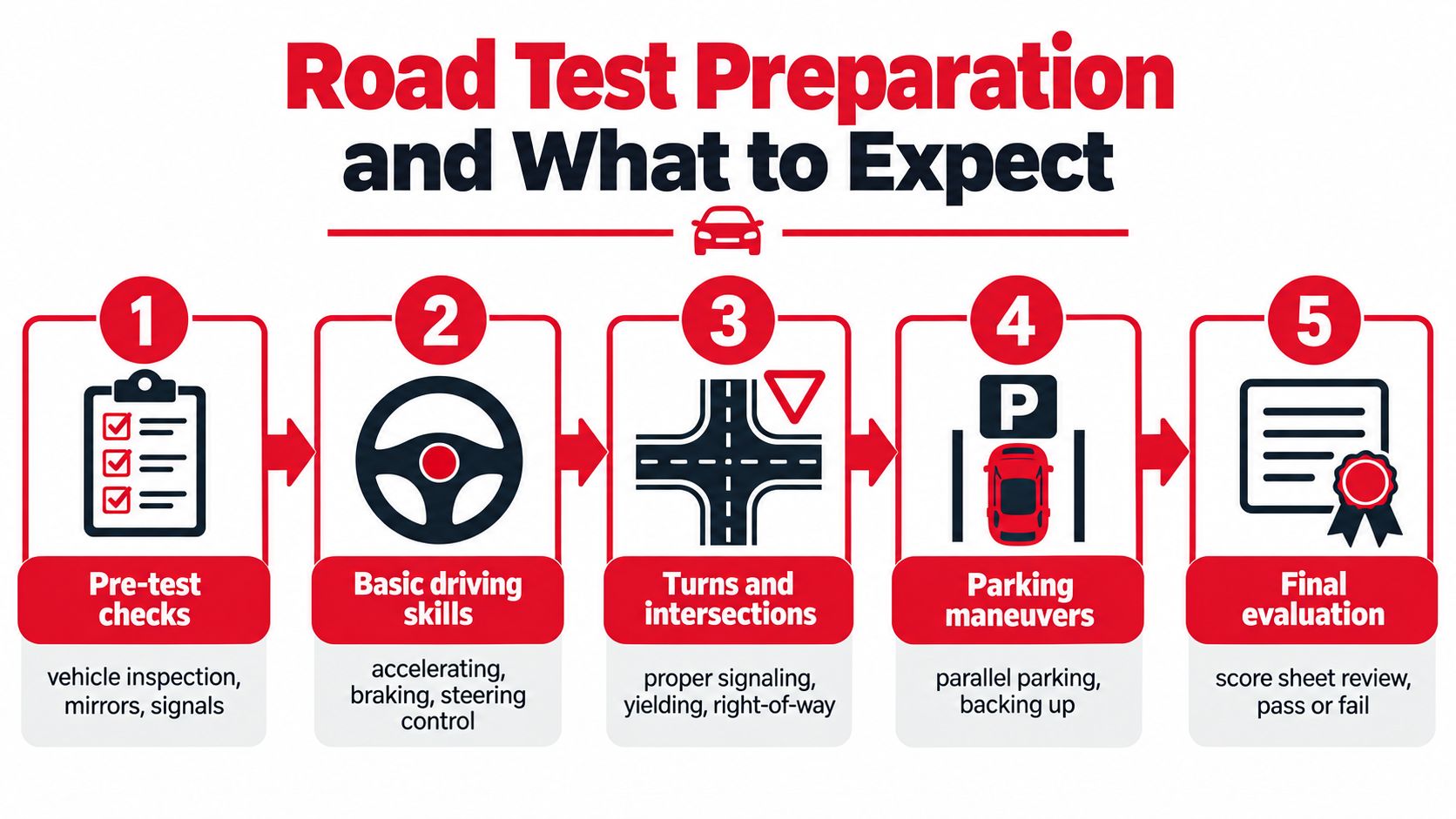
Most families picture the road test as purely a driving challenge. In my experience, just as many appointments unravel over logistics. Under Georgia DDS test and exam information, the traditional road test requires a minimum score of 75% to pass, an appointment rather than a walk-in, a valid permit, and an affidavit confirming the supervised hours, with the testing vehicle providing valid registration, liability insurance, and a safety inspection.
The Vehicle and Paperwork Audit
Run this check a week early, not in the parking lot.
- Documents in the car: Paper registration and current insurance, ready to hand over without digging through a glovebox.
- Vehicle condition: Lights, signals, brakes, and tires in working order, since the car must pass inspection before the test begins.
- The right adult present: Georgia DDS road test guidance explains that an under-18 applicant must arrive with a licensed driver at least 21 years old, and only the applicant and that adult may be in the vehicle.
- Forms done ahead: Complete the required online license form before your visit so the appointment starts on time.
Borrowed and rental cars deserve extra scrutiny. Rules for rental agreements and temporary tags can trip up families who assume any working car will do. Confirm eligibility before test day, and bring the relevant paperwork with you.
What Examiners Are Watching
Examiners evaluate safe vehicle operation: controlled starts and stops, signaling, lane position, observation at intersections, speed choices, and parking. They're not hunting for perfection. They're checking whether your teen notices the world around the car and responds early and smoothly. The most common point losses I see come from rolling stops, late mirror checks, and rushing turns. All three are fixable in focused practice sessions.
That's why many students schedule road test lessons and preparation in the final stretch. A mock test with an instructor exposes small habits while there's still time to correct them. It also lets your teen experience test-style instructions from someone other than a parent, which reduces nerves considerably on the day itself. Some certified schools also offer road testing, which can feel more familiar than an unfamiliar DDS site.
Georgia Driver's Education Scholarship Grant Program
Cost stops some families from starting, and that's exactly the problem the Georgia Driver's Education Scholarship Grant Program exists to solve. The program is designed to help qualifying Georgia students access approved driver training with state support, so a family's budget doesn't decide whether a teen gets proper instruction. It's one of the most overlooked parts of the whole licensing system, because many families never hear about it until after they've already paid out of pocket.
Why Applying Is Worth Your Time
Driver education isn't a luxury purchase. It's safety training with consequences that follow a teen for years. When cost pushes families to delay or skip quality instruction, teens still eventually drive, just with less preparation. A scholarship that removes that barrier serves the same goal as Joshua's Law itself: putting better-trained young drivers on Georgia roads. Even if you're unsure whether your family qualifies, checking costs you nothing and the answer might change your plans.
How the Process Generally Works
- Confirm eligibility first: Review the program criteria before enrolling anywhere, since approval typically needs to come before training begins.
- Apply through the proper channel: Complete the application accurately and keep copies of everything you submit.
- Enroll with a participating provider: Once approved, coordinate your course and lessons so the scholarship applies as intended.
You can start by reviewing the scholarship eligibility requirements to see how the criteria apply to your household. Do this early in your planning, right alongside choosing a course format. Families who treat the scholarship as step one, rather than an afterthought, avoid the frustrating situation of discovering help was available after the fact. If you qualify, you've turned a financial obstacle into a scheduled start date, and your teen gets the same structured training as everyone else.
Don't self-disqualify. Plenty of families assume they won't qualify and never check. Let the program make that decision, not your assumption.
How to Enroll and Get Started
Everything you've read so far fits into one timeline, and building that timeline now prevents most of the stress families describe later. Start with the permit holding period as your frame. Georgia's driver manual resources set out that a Class D applicant must be at least 16 years old and must have held a Class CP permit for at least 1 year and 1 day, alongside Joshua's Law completion, ADAP, and passing vision and road-skills testing at 75% or better. Work backward from the date your teen becomes eligible, and the rest of the plan reveals itself.
A Simple Order of Operations
- Check scholarship eligibility before enrolling, so funding is sorted first.
- Choose your theory format, online or in-person, based on your teen's learning style and your family's schedule.
- Book driving lessons early and space them across the permit period, practising each new skill at home between sessions.
- Log supervised hours from day one, tracking nighttime driving separately and keeping certificates in one folder.
- Schedule the road test once skills are consistent, then run the vehicle and paperwork audit a week ahead.
When you enroll, have your teen's permit details and basic information ready, and ask how completion records will reach you. Online enrollment and multiple time slots make this easier than it used to be, and providers with several metro Atlanta locations give you flexibility when schedules shift. What you should expect after signing up is a clear sequence: course access or class dates, lesson scheduling, and guidance on what to practise between sessions.
If you're feeling behind, you're almost certainly not. Families start this process at every point in the permit year and finish successfully. What matters is starting with a plan instead of a pile of disconnected tasks. Pick your course, book the first lesson, open a simple log on your phone tonight, and the journey stops feeling abstract. One completed step has a way of making the next one obvious.
Ready to turn this plan into a start date? A-1 Driving School offers DDS-approved Joshua's Law courses online and in person, driving lessons packages that build from first turns to test-day confidence, road testing, and guidance on the Georgia Driver's Education Scholarship Grant Program. Visit the site to explore course options, check scholarship eligibility, and enroll your teen in the program that fits your family's schedule.