
Your teen has finished an online Driver's Education course, but the road test is getting closer and the practice car still feels unfamiliar. Every stop sign brings a question, every lane change feels rushed, and parallel parking works once but not the next time. That situation is common because passing the knowledge requirement and driving consistently under examiner pressure are separate skills.
Effective road test practice closes that gap. The goal isn't to cram maneuvers the night before. It's to build repeatable habits for observation, signaling, speed control, lane positioning, turns, parking, and calm decision-making. Georgia's requirements provide the education and supervised-driving framework, while targeted lessons and realistic mock tests help turn that framework into dependable performance.
What to Expect on Your Georgia Road Test
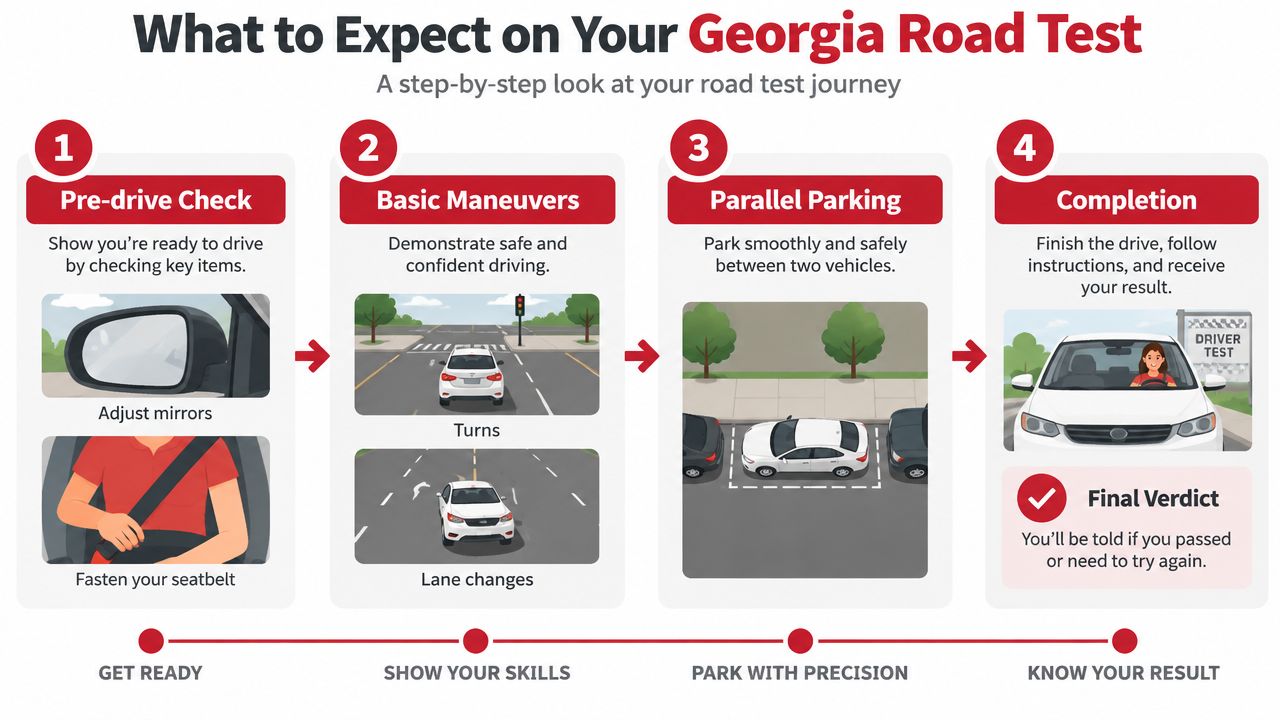
You'll usually begin with a few quiet moments that feel more stressful than they should. The examiner may ask you to adjust your seat and mirrors, fasten your seatbelt, and follow basic instructions before the vehicle moves. Use that time to settle your hands, confirm your surroundings, and listen carefully. A road test is straightforward, but it demands precision in ordinary driving tasks.
The examiner watches whether you create safe habits consistently. That includes smooth starts and stops, correct signaling, mirror use, shoulder checks, speed management, obedience to signs and signals, and controlled positioning through turns and lane changes. Parallel parking and other basic maneuvers matter, but the examiner is also assessing whether you observe before acting.
The habits that carry the drive
Treat every maneuver as a sequence rather than a single movement:
- Prepare: Check mirrors and the road ahead.
- Communicate: Signal early enough to give other road users clear information.
- Confirm: Check the relevant blind spot with a shoulder glance.
- Act: Make the turn, lane change, stop, or parking movement smoothly.
- Recover: Recheck your speed and position once the maneuver is complete.
That sequence explains why last-minute cramming rarely works. A student might remember to signal in a driveway but forget under pressure when approaching a busy intersection. Consistent repetition in different settings builds the automatic behavior the examiner needs to see.
Practical rule: The test measures safe, repeatable habits, not a flawless performance with no human hesitation.
A minor correction doesn't automatically mean failure. What matters is whether you remain controlled, follow instructions, and avoid serious or dangerous errors. Practice should therefore focus on consistency, not theatrical perfection. Review the Georgia road test process and expectations before scheduling, then rehearse the same habits in a familiar vehicle.
A-1 Driving School offers in-person road testing at many locations. Testing in a vehicle you already know, with a certified instructor familiar with examiner expectations, can remove unnecessary uncertainty from the appointment.
Understanding Joshua's Law and Practice Requirements
A teen can finish online Driver's Education, log practice drives, and still feel unprepared when the examiner gives the first instruction. Joshua's Law creates the required path toward a Georgia Class D license, while structured road-test practice turns that coursework into repeatable driving performance. The Georgia Joshua's Law requirements outline the formal framework.
For 16- and 17-year-olds seeking a Class D license, the pathway includes:
- 30 hours of instruction: Students may complete this in a classroom or through an approved online course.
- Behind-the-wheel training: The approved route includes 6 hours with a qualified driving school or a parent-taught alternative.
- Supervised driving: Students must complete 40 hours, including 6 hours at night, under the applicable pathway.
The course covers rules, signs, risk awareness, and decision-making. Supervised driving exposes the student to traffic. Professional lessons add something different: an instructor can spot a recurring habit, correct it immediately, and check whether the correction holds in another setting.
Completion is different from readiness
A student may understand right-of-way rules yet brake late, turn too widely, or check the blind spot inconsistently. A parent may provide extensive practice but repeat the same route, miss a small positioning error, or give feedback that changes from one drive to the next. Both forms of practice have value. Neither automatically prepares a student for the pressure and variety of an exam.
The practice gap sits between knowing a rule and applying it reliably. Evidence-based graduated driver licensing programs recommend roughly 70 or more supervised practice hours, while jurisdictions vary from 0 to 120 required hours. Those figures are documented in young-driver education guidance. The practical point is simple: the legal minimum may not match the practice needed for confident performance.
A useful lesson has a target, a drill, and a later check. A student who misses shoulder checks should not spend the entire session driving without a plan. A certified instructor can repeat lane changes, merges, and curb departures, then require the same mirror, signal, and shoulder-check routine each time. A-1's certified mock-test program and driving lessons provide that bridge between online instruction and the actual exam, with practice built around observed weaknesses rather than random mileage.
A-1 is the only provider holding the Fulton County Board of Education contract, delivering Driver's Education across Fulton County Schools and numerous Atlanta high schools. Qualifying students may also explore Georgia's Driver's Education Scholarship Grant Program. Under Georgia rule 163-1-2-.01, eligible recipients are Georgia residents actively enrolled in school, ages 15 through 17, who hold a valid Georgia instructional permit or driver's license.
Running Through a Realistic Mock Road Test
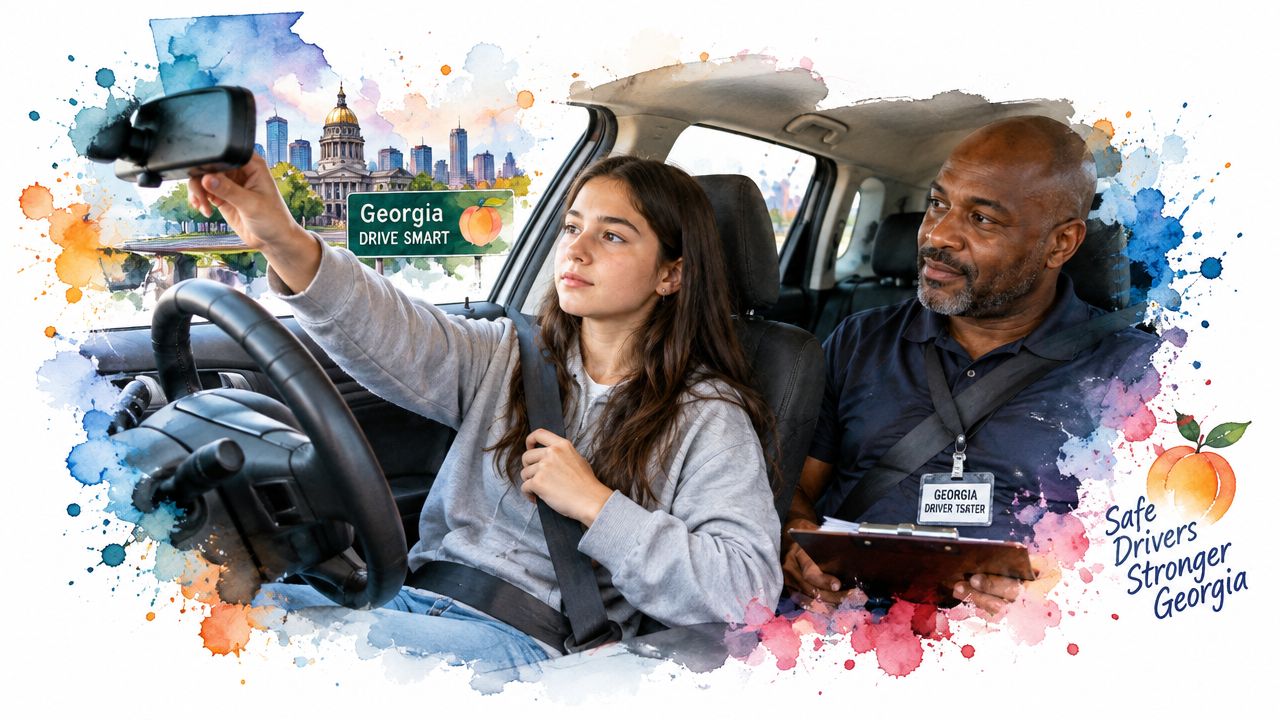
A useful mock test begins before the vehicle moves. Sit normally, adjust the seat and mirrors, fasten the seatbelt, and wait for the examiner's instruction. Don't reach for controls while the vehicle is moving, and don't begin a maneuver until you understand where you're going.
From the first stop to the first turn
Pull away smoothly and check your mirrors before entering the road. As you approach a stop sign, reduce speed early and stop fully at the required position. A rolling stop tells the examiner that the habit isn't dependable, even if the intersection appears empty.
For a left or right turn, scan the intersection, signal, select the appropriate lane position, and control your speed. Look for pedestrians, cyclists, and cross traffic rather than staring only at the signal. Complete the turn into the correct lane without cutting the corner or drifting wide.
Merging and changing lanes require visible preparation. Check the rearview mirror, check the side mirror, signal, look over your shoulder, and move only when the space is safe. Afterward, cancel the signal if necessary and reestablish a centered lane position. The sequence should be deliberate, not rushed.
The examiner can't grade a blind-spot check you only think about. Make the shoulder glance visible and timely.
Continue the rehearsal through a busier road, then return to a lower-speed area for parking. A strong mock test changes the environment enough to reveal whether the student can transfer the skill instead of repeating it only on one familiar street.
Use the following video as a visual supplement, but keep the priority on active practice with feedback:
Parking and pulling away
For parallel parking, slow the vehicle, observe the space, and use small steering inputs. Keep the vehicle controlled while reversing, monitor the curb and surrounding area, and avoid rushing because another driver is waiting. Once parked, secure the vehicle as instructed before preparing to leave.
Pulling away from a curb is another complete maneuver. Check mirrors, signal, look over the shoulder, and enter the lane only when safe. A mock test should record each fault by maneuver and route segment, not end with “good drive” or “bad drive.” That record shows whether the student has one isolated mistake or a repeat pattern that needs another lesson.
Common Mistakes That Cost Students the Road Test
A student can handle online driver-ed questions and still fail the road test by missing one visible habit under pressure. In a National Highway Traffic Safety Administration analysis of young novice drivers, in-vehicle road-test failure rates ranged from 10% to 19% in most states, reaching 34% in Minnesota and 33% in West Virginia. The lesson for practice is direct: train observable behavior, not confidence alone. See the NIH-hosted road-test study for the analysis.
Fix the error at its source
A-1's certified mock-test program turns these habits into specific practice targets. An instructor watches the full sequence, records the fault, and assigns the next driving lesson to the skill that caused it.
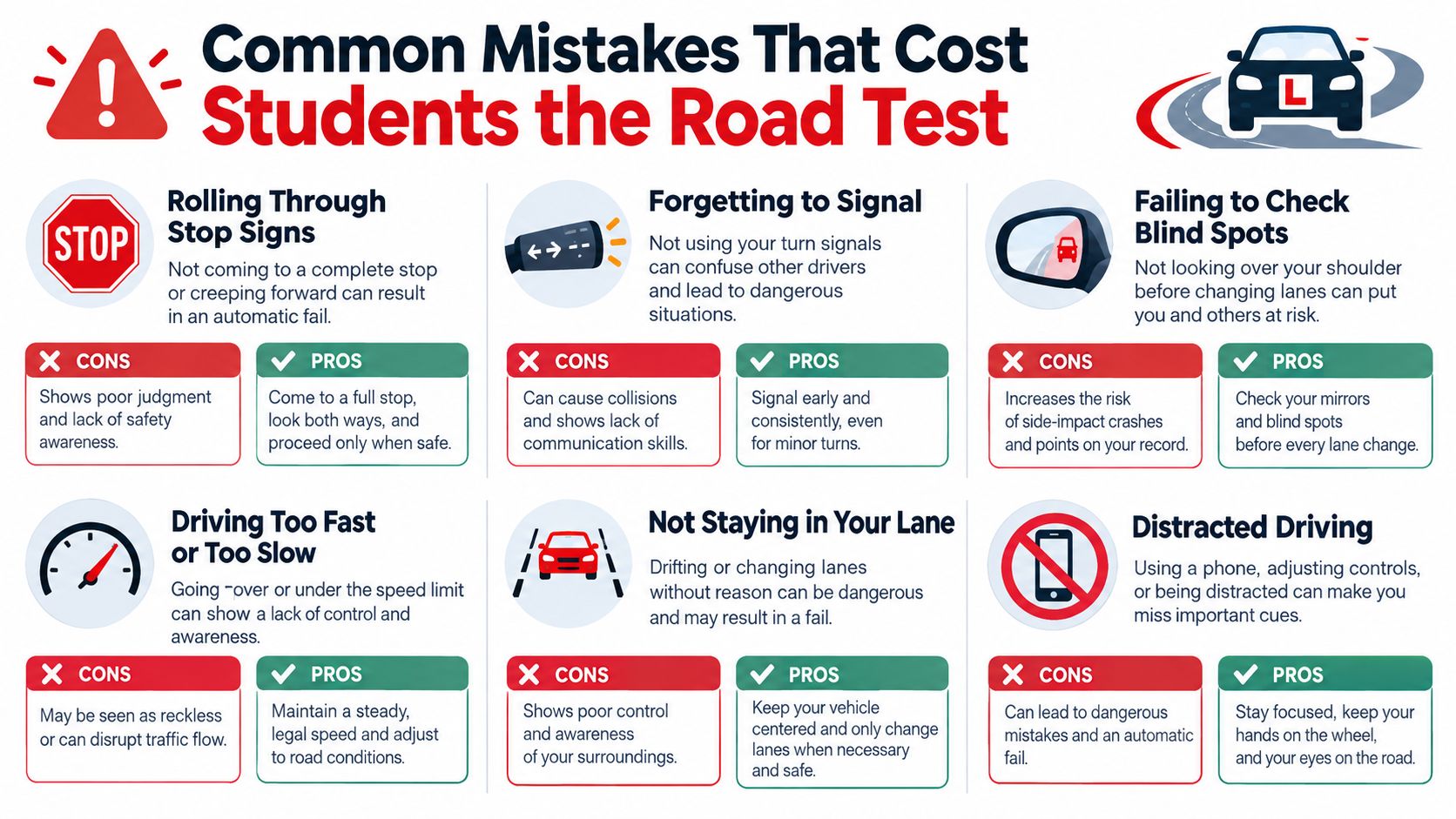
- Rolling through stop signs: Brake early, stop completely, and pause before proceeding. Saying “full stop” as the vehicle settles can reinforce the habit.
- Forgetting signals: Signal before turning, changing lanes, pulling away from a curb, or entering a parking space. Include the signal in preparation, rather than adding it at the last second.
- Skipping blind-spot checks: Check mirrors, signal, turn your head, then move when safe. Mirrors cannot show the entire area beside the vehicle.
- Speed errors: Confirm the posted limit after entering each new zone and adjust for conditions. Pay close attention near schools, playgrounds, and construction areas.
- Poor lane positioning: Look farther ahead, keep the vehicle centered, and finish turns in the correct lane. Wide turns and curb-hugging often start with looking too close to the hood.
- Stalling: In a manual vehicle, use slower clutch control and restart without panic. Secure the vehicle, restart calmly, and follow the examiner's instruction if it stalls.
- Panic after a minor error: Direct attention to the next task. One small fault can lead to speeding, missed signals, or weak observation if the student loses focus.
Driving-test guidance repeatedly identifies inadequate observation as a leading failure pattern, including missed shoulder checks, weak junction scanning, and insufficient mirror use. Practical road-test fault guidance also emphasizes rehearsing frequent behaviors until the sequence remains reliable under pressure.
Understand faults without chasing perfection
In Great Britain, the practical car driving test pass rate for April 2025 to March 2026 was 50.0%, representing 1,000,043 passes out of 1,998,621 tests, according to the officially reported figures summarized in road-test guidance. Roughly one in twenty passes recorded zero faults, so successful candidates can still finish with minor faults.
The practical point applies beyond one testing system. A minor mistake is not automatically a failure, while a serious or dangerous error can end the test. Repeated minor faults can also weaken the result. Certified feedback helps students remove automatic-fail behaviors first, then reduce recurring smaller faults through route-based mock testing.
Vehicle Requirements, Paperwork, and Scheduling Your Test
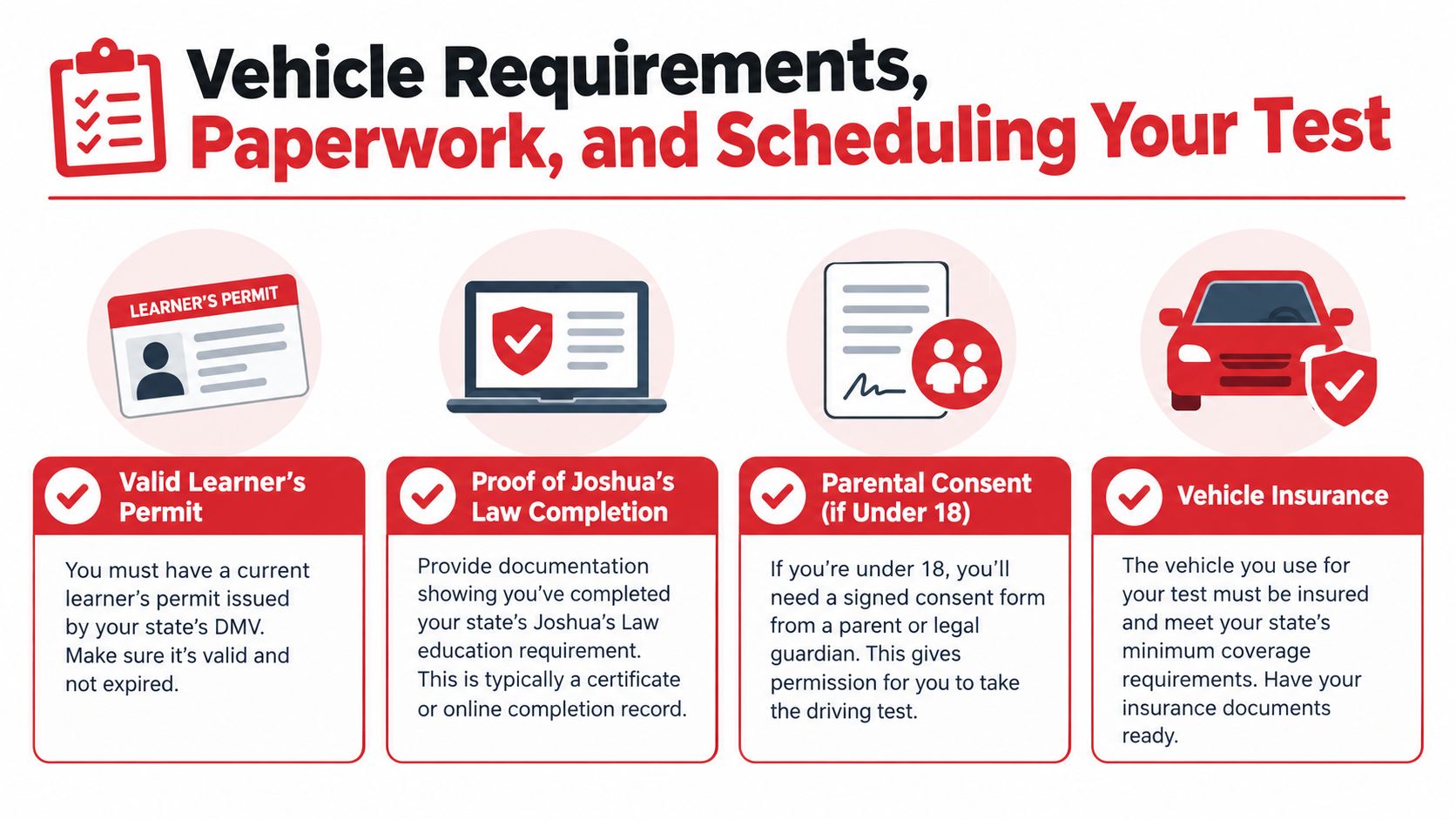
A student can perform well during a mock test and still lose the appointment over missing paperwork or an unsuitable vehicle. Check the student's permit, required course-completion documents, parental consent when applicable, and insurance before leaving home. The Georgia driver's test document and vehicle checklist helps organize those details for the selected testing arrangement.
Confirm that the vehicle is registered, insured, and accepted by the testing location. Walk around the car before the appointment, then check:
- Learner's permit: It must be valid and available at check-in.
- Required completion proof: Bring the documentation required for the student's pathway.
- Parental consent: Arrange it if the student is under 18.
- Safety controls: Test seatbelts, turn signals, headlights, horn, and brakes.
- Visibility: Clean the mirrors and remove items that block the driver's view.
A familiar training car still needs a test-day inspection. A loose seatbelt, failed signal, or warning light can create a problem before the driving portion begins. Arrive early so a missing document or vehicle issue can be addressed without rushing.
A-1 Driving School offers road testing at select locations, flexible scheduling, and multiple time slots. Its instructors can prepare students with structured mock tests and lessons on local test routes. Testing through a driving school may also let the student use a familiar training vehicle instead of bringing an unverified car to a DMV appointment.
Your Next Steps to Passing the Road Test
A student can finish online driver education, hold a valid permit, and still feel unprepared when the examiner gives the first instruction. The gap is practical experience. Build a written road-test plan that turns each drive into focused preparation.
Start by confirming the legal pathway and required supervised driving. Online instruction covers the academic portion, while lessons develop the judgment, control, and consistency the exam requires.
Give every practice drive a clear purpose. One session might focus on complete stops and intersection scanning. Another can target lane changes, parallel parking, or speed transitions. End each drive with a brief fault review, then repeat the weakest maneuver before adding a harder task. This structure prevents comfortable cruising around one familiar neighborhood from replacing test preparation.
Research on learner-driver practice reported averages of 40.3 hours for males and 38.9 hours for females before assessment. It also found that each additional 10 hours of practice was associated with a 2% decrease in the mean number of license attempts, while more pre-test practice was associated with fewer critical errors, according to the peer-reviewed research.
A-1 Driving School offers driving lessons, lesson packages, Georgia road-test preparation, and testing assistance at 18 or more locations in metro Atlanta. The family-owned school reports 38 or more years of experience and service to more than 100,000 satisfied drivers. Ask for practice in real traffic, test-style directions, and a certified mock test that exposes gaps before appointment day.
Book the mock test early enough to schedule another lesson if the feedback identifies inconsistent observations, control, or parking. Visit A-1 Driving School to review course, lesson, and scheduling options.