You've finished your driver's education, your permit has been in your wallet for months, and your family keeps asking the same question: when can you book the practical test for driving? The answer isn't just “whenever an appointment appears.” In Georgia, the timing of your road test depends on Joshua's Law completion, supervised practice, required certificates, your vehicle, and whether you choose a DDS appointment or an available road test through a driving school.
A successful booking starts with readiness. If you schedule before the paperwork, waiting period, and practice requirements are complete, the appointment won't solve the problem. It can create more stress instead. The practical approach is to build a complete licensing plan first, then reserve a test date that matches your actual preparation.
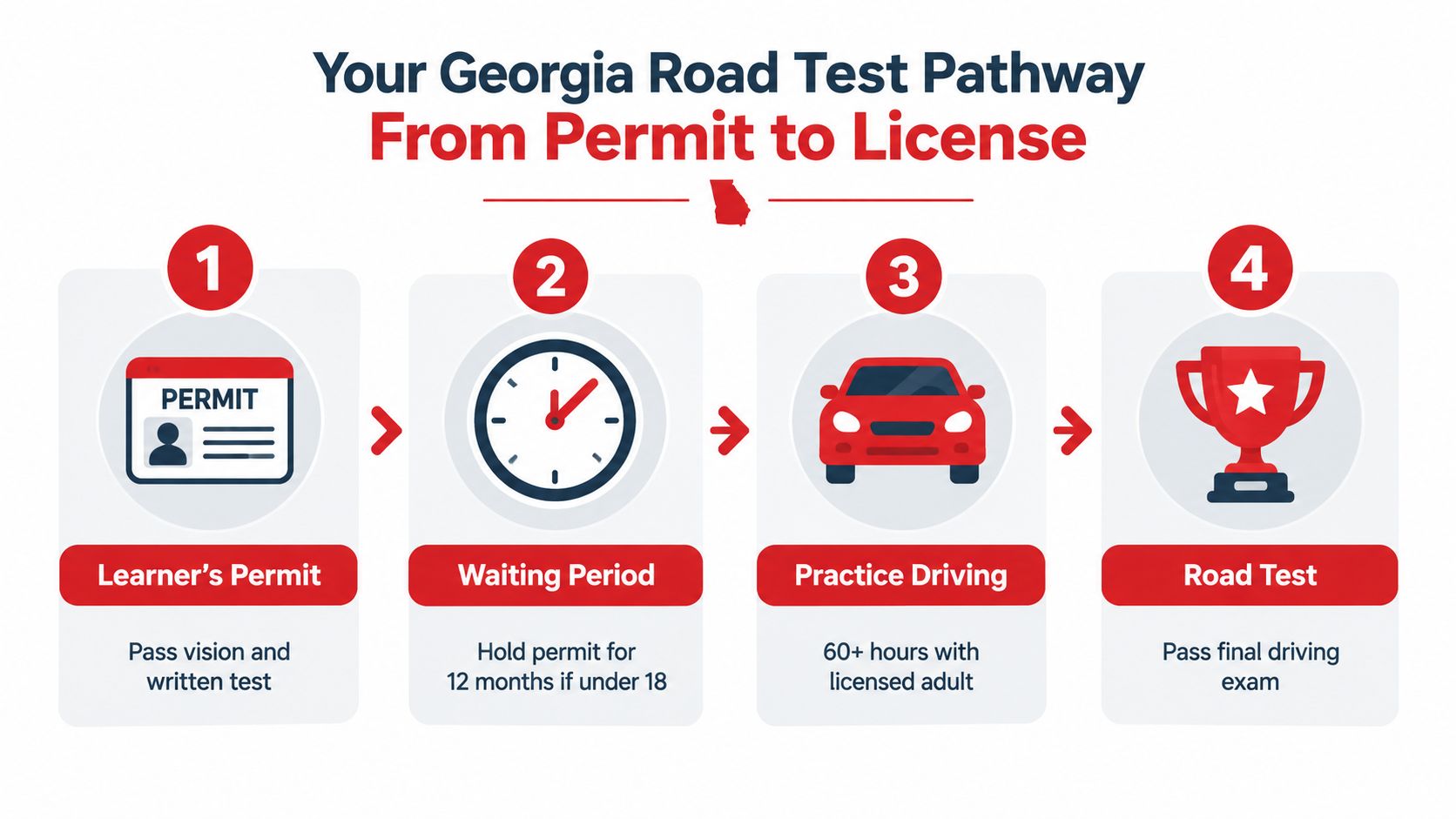
Your Georgia Road Test Pathway From Permit to License
Your Georgia Class D pathway follows a sequence, and each step supports the next. Start with the learner's permit by passing the required vision and written testing. The permit gives you legal practice time, but it isn't permission to rush toward the road test before you've developed dependable habits.
Build eligibility before looking for appointments
If you're under 18, Georgia requires you to hold your instructional permit for 12 months and 1 day before moving to the next licensing stage. During that time, complete the education and practice requirements rather than treating the waiting period as time spent doing nothing.
Joshua's Law combines formal instruction with supervised driving. You'll need an approved driver education course, behind-the-wheel instruction, and practice with a parent or guardian. You'll also need the required ADAP completion for a Class D license at age 16 or 17, as well as the additional driving experience required by the Georgia Department of Driver Services. The Georgia driver's license pathway can help you check where each milestone fits.
Schedule only when the date makes sense
Your final step is the road test. Before you try to book practical test for driving, confirm that your permit period is complete, your certificates have been issued, your supervised hours are documented, and your vehicle will meet DDS standards.
The road test is a readiness checkpoint, not a formality. Georgia DDS requires a minimum score of 75% to pass the Class C or D road test, so your preparation should focus on consistent observation, speed control, signaling, lane position, turns, stops, and safe decision-making.
Understanding Joshua's Law Requirements
Joshua's Law eligibility has two sides. Classroom education gives you the rules and risk awareness needed to understand traffic situations, while practical instruction and supervised driving help you apply those ideas behind the wheel. Passing one part doesn't replace the others.
The required education and instruction
Georgia requires 30 hours of classroom instruction, 6 hours of behind-the-wheel training at a certified school, and 40 hours of supervised driving with a parent or guardian, including 6 hours at night. The Georgia Department of Driver Services Joshua's Law requirements confirms that the approved course may be completed through classroom instruction or an equivalent online virtual course, followed by the required on-road experience.
The 30-hour course covers knowledge that appears in everyday driving decisions, including signs, right-of-way, defensive habits, and legal responsibilities. The instructor-led hours are different. They give a trained professional the opportunity to correct steering, braking, scanning, lane control, and maneuvering before weak habits become automatic.
Your supervised practice should be deliberate, not just a record of trips to school or the store. Use different roads, traffic conditions, intersections, parking environments, and nighttime situations. A parent or guardian can provide repetition, while a certified instructor can identify errors that family members may overlook.
Practical rule: Don't book the road test just because the calendar says you've had enough time. Book when your documentation is complete and your driving remains steady without constant reminders.
Why eligibility and readiness must match
Georgia DDS also requires a teen seeking a Class D license at age 16 or 17 to complete both a DDS-approved driver education course and the Alcohol and Drug Awareness Program. The applicant must complete the additional supervised driving experience, including nighttime practice, before licensing.
That means a road-test appointment isn't the final requirement by itself. If a certificate hasn't been received, hours haven't been completed, or the permit period hasn't ended, passing the drive may not be enough to finish the licensing process. Confirm every requirement before choosing a date, then use road-test preparation to evaluate whether your skills match the standard.
Choosing Between Online and In-Person Driver's Education
Online and classroom education can both satisfy the educational component when completed through a DDS-approved provider. The better choice depends on how you learn, how much structure you need, and whether your schedule makes regular classroom attendance realistic.
| Feature | Online Course | In-Person Classroom |
|---|---|---|
| Schedule | Complete lessons from home according to your availability | Attend scheduled classes with a fixed structure |
| Learning style | Works well for independent learners who review material at their own pace | Suits students who learn through discussion and direct interaction |
| Instructor access | Questions are handled through the course format and available support | Ask questions and receive clarification during class |
| Accountability | Requires personal organization and consistent progress | The class schedule creates built-in accountability |
| Road-test connection | Must be paired with behind-the-wheel instruction and supervised practice | Must also be paired with behind-the-wheel instruction and supervised practice |
When online works well
An approved online course can be practical for a student balancing school, sports, employment, or family responsibilities. You can study at home and organize the academic work around your existing commitments. That flexibility is useful, but it also requires discipline. If you rush through lessons or postpone them repeatedly, the format becomes a delay rather than a convenience.
Online education also doesn't replace driving lessons. Reading about a safe turn is different from completing that turn in traffic while managing speed, mirrors, lane position, and pedestrians. Schedule professional behind-the-wheel training early enough to apply the knowledge before you book.
When classroom learning is the better fit
In-person instruction gives students a regular routine and immediate access to an instructor. Some learners retain more when they can ask questions aloud, hear real examples, and work through confusing situations with classmates.
Neither option guarantees road-test readiness. The course satisfies the knowledge requirement, while instructor training and supervised practice develop control. Choose the format you're most likely to complete carefully, then connect it to a realistic driving lesson package and a deliberate practice plan.
Booking Your Georgia Road Test Online or In Person
Georgia DDS is the standard route for booking a road test. Begin by checking your eligibility and gathering your permit information, completed education records, ADAP documentation, and any other information the appointment system or DDS office requires. Select the location you intend to use, not the first appointment that appears.
DDS booking and school-based testing
For a DDS appointment, use the official Georgia road-test scheduling option or confirm the current process directly through Georgia DDS. Online scheduling is convenient, while calling or visiting an office may help when you need clarification about eligibility or documentation.
The common mistakes are predictable:
- Booking too early: Your permit period or required education may not be complete on test day.
- Choosing the wrong center: A distant location can make the appointment harder to attend and may involve an unfamiliar testing area.
- Arriving without a compliant vehicle: DDS requires the applicant to provide the vehicle, so transportation arrangements matter.
- Using unofficial booking services: Third-party promises can create confusion, extra costs, or unreliable appointments.
A school-based road test can be a useful alternative where offered. Taking the test through a driving school may provide a familiar vehicle, a known location, and preparation from instructors who already understand your strengths and weaknesses. It doesn't remove the need to meet Georgia's eligibility rules, but it can reduce the logistical friction around the appointment.
If you're considering that option, ask whether the location provides road testing, what vehicle arrangements apply, which documents are required, and how scheduling works. Don't assume every school location offers identical services.
The video below provides additional context for planning driving lessons and test preparation.
What to Bring and Prepare for Test Day
Many road-test failures happen before the vehicle moves. A missing certificate, an expired document, or an unsuitable vehicle can prevent the test from starting, so prepare the paperwork and car well before the appointment.
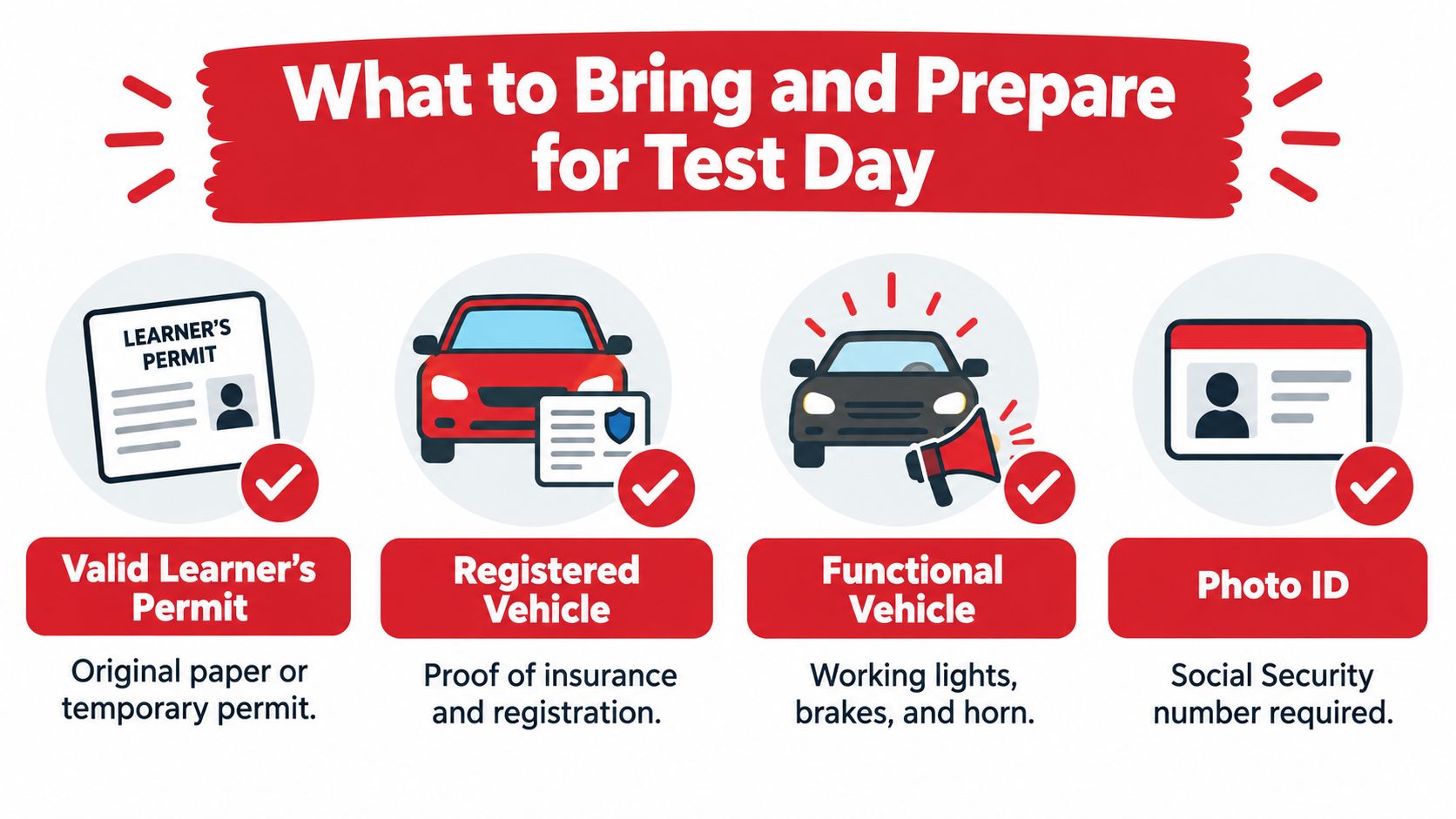
Bring your valid learner's permit and the required proof of completed driver education and ADAP. If you're under 18, confirm whether parental consent documentation is required for your appointment. Use the Georgia road-test document checklist to review the items before leaving home.
Check the vehicle, not just the appointment
Georgia DDS requires a four-wheel vehicle with valid registration, or a temporary dealership tag with proof of purchase, valid liability insurance, and a safety inspection. The car should also have functional lights, brakes, turn signals, tires, horn, mirrors, seat belts, and other equipment needed for safe operation. Review the vehicle with an adult or instructor before test day rather than discovering a problem at the center.
The Georgia DDS road-test requirements set the passing threshold at 75%. That score doesn't mean you should aim to scrape through. Practice until normal driving feels controlled and repeatable.
Prepare for the drive itself
Use a complete pre-test lesson to rehearse the skills that cause preventable errors. Stop fully at signs, scan before moving, signal early, check mirrors, maintain safe space, and keep both attention and speed appropriate for the road. A small mistake doesn't always determine the result, but panic after a mistake can create a second one.
Arrive with enough time to inspect the car and settle your attention. Put your phone away, adjust the seat and mirrors, and take a controlled breath before beginning. Calm preparation helps you demonstrate the skills you've already practiced.
How A-1 Driving School Simplifies the Entire Process
A-1 Driving School offers a connected route through driver education, behind-the-wheel instruction, road-test preparation, and road testing at select locations. The school is the only provider holding the Fulton County Board of Education contract, allowing it to deliver Driver's Education across all Fulton County Schools and numerous Atlanta high schools.
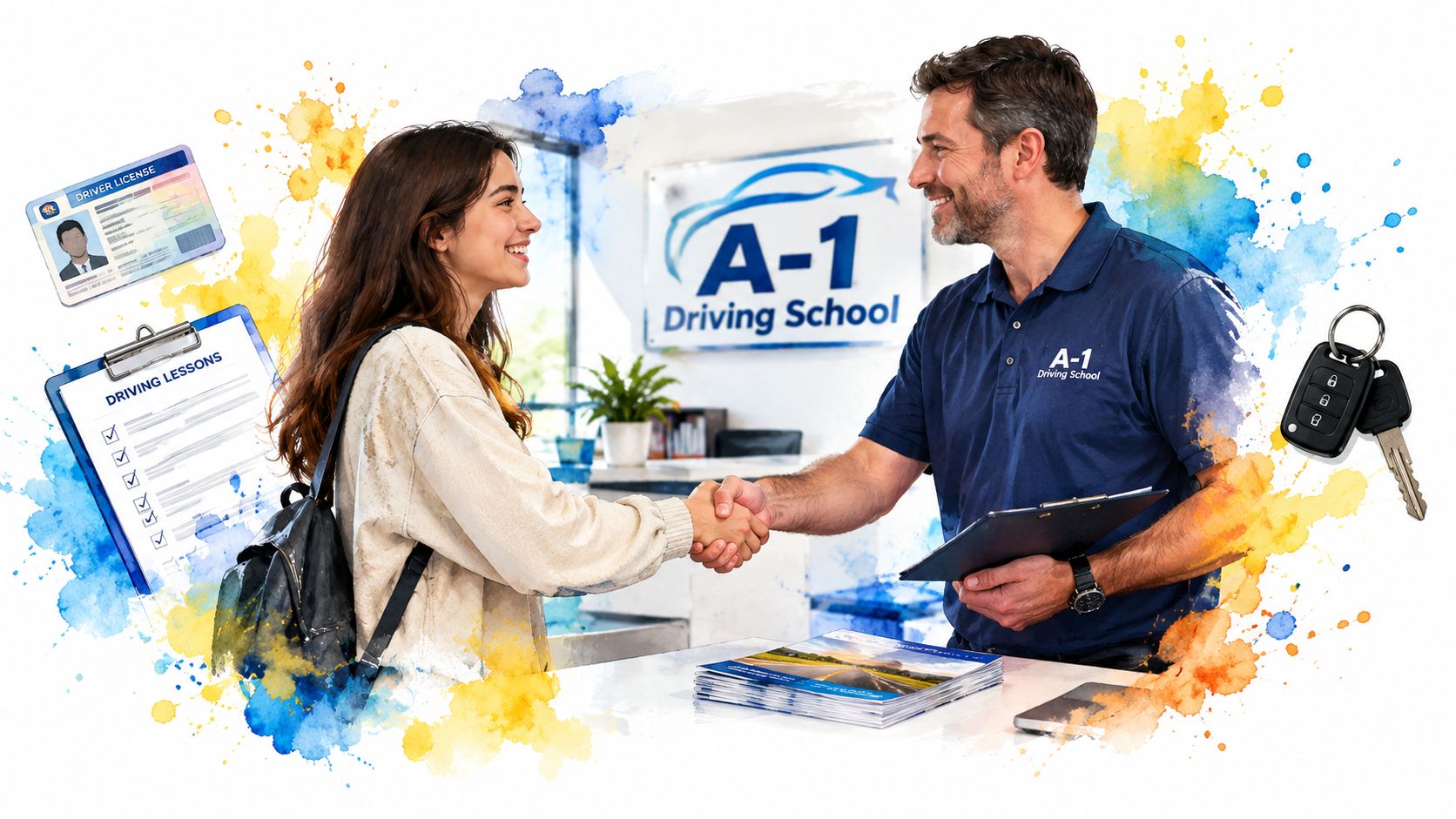
That connection matters because students can coordinate the academic requirement with professional driving lessons instead of treating each requirement as a separate task. A-1 provides Joshua's Law-approved education in classroom, online, and virtual formats, along with customized lessons for teens and adults.
A supported route to the appointment
The school has 18+ metro Atlanta locations, which can give families more scheduling options when choosing lessons or exploring available test locations. Instructors can use lessons to identify whether a student needs more practice with intersections, parking, lane changes, speed control, or test-day routines.
The Georgia Driver's Education Grant Scholarship Program is another part of the pathway. The statewide program supports eligible Georgia residents ages 15 to 17 who are actively enrolled in school and hold a valid Georgia instructional permit or driver's license. The grant covers driver education consisting of 30 hours of classroom instruction and 6 hours of behind-the-wheel training, subject to program eligibility and rules.
The practical value is coordination. Students can complete the required education, build skill through driving lessons and packages, and choose a testing route based on readiness rather than chasing the earliest appointment.
Explore Driving Lessons and Scholarship Opportunities
A road test exposes gaps that classroom learning can't reveal. Driving lessons give you a controlled way to work on those gaps before an examiner is evaluating every decision. For a teen, that may mean building confidence in traffic circles, lane changes, parking, and nighttime driving. For an adult, it may mean refreshing skills after a long break or preparing for a Georgia test in an unfamiliar vehicle.
Choose a lesson package based on the driver's actual needs rather than buying practice without a plan. A useful package should include an initial skills assessment, targeted instruction, opportunities to repeat difficult maneuvers, and a final review of the vehicle and test-day routine. The right number of lessons varies by experience and consistency, so an instructor's assessment is more useful than a generic promise.
Check whether the scholarship fits
The Georgia Driver's Education Grant Scholarship Program is designed for Georgia residents ages 15 to 17 who are enrolled in school and hold a valid instructional permit or driver's license. It supports the required 30 hours of classroom instruction and 6 hours of behind-the-wheel training. Families should review the current eligibility rules and application process before assuming funding is available.
A student who qualifies can pair scholarship-supported education with supervised family practice and additional lessons when needed. That combination addresses both compliance and competence, which is what makes booking a practical test for driving worthwhile.
If you're ready to move forward, review available Joshua's Law courses, ask about online or classroom enrollment, compare driving lessons packages, and confirm whether road testing is offered at a convenient A-1 location. Schedule only after your documents and skills are ready.
A-1 Driving School offers Joshua's Law education, online and in-person course options, customized teen and adult driving lessons, lesson packages, road-test preparation, and testing assistance at select locations. Visit A-1 Driving School to explore courses, schedule driving lessons, and learn whether the Georgia Driver's Education Scholarship Grant Program may fit your eligibility.